(If you missed Part Two, click HERE…)
Reading time: 35 minutes
…this is a matter for the county committee to sift!
~ the rugby pundit ‘Impartial’ notes the suspicion surrounding Jackett’s appearance for Penzance RFC in 1898
…the admirable performance of Jackett – reared in our own “nursery”, remember – against the conquering Colonials comes as a crowning point…
~ Jackett’s impressive England debut against the formidable 1905 All Blacks proves that rugby in Cornwall, and especially Falmouth, is a force to be reckoned with1
The story of Teddy Bartram
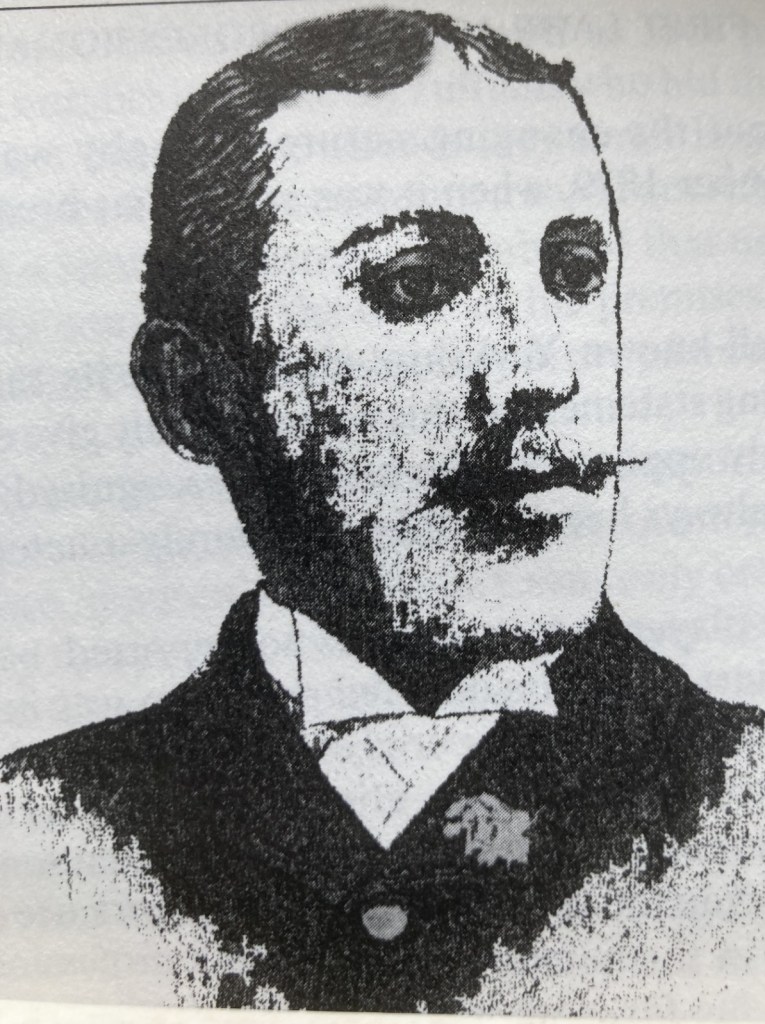
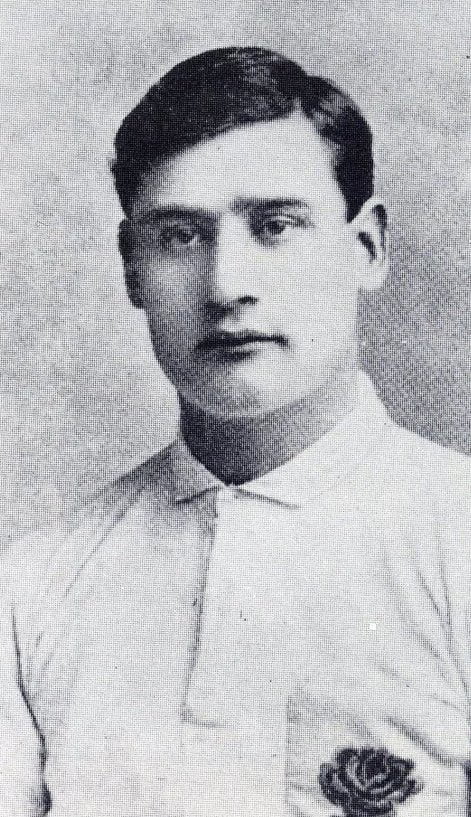
In the late 1870s and 1880s, Teddy Bartram was a centre threequarter of breathtaking ability. He also knew what his talent was worth to any club he cared to join. He left York because they wouldn’t pay his rail fare from Harrogate, and was soon recruited by Wakefield Trinity. They would pay his train fare, and quietly slip him a few bob on the side too. That was fine with Teddy. He helped Wakefield to win consecutive Yorkshire Cups in 1879 and 1880.
Responding to mutterings about Wakefield having a ‘paid man’ in their ranks, in 1879 the Yorkshire County Football Club introduced the very first rules against professionalism in the game. A player could be reasonably reimbursed for travel expenses, but anything beyond that was verboten.
Wakefield’s response was to dream up a job for Teddy: that of the club’s assistant secretary, with a salary of £52/annum (giving him a labour earning of around £29K/annum in 20223). This thinly disguised sinecure lasted Teddy until 1889, when he received a life ban from football for receiving loans from his club. Despite his skill, Teddy was never picked for England. Down south, they didn’t like the cut of his professional jib.
Thus began the long and bitter saga that, in 1895, resulted in twenty-one northern clubs breaking away from the amateur RFU to form the Northern Union. The NU would pay players’ expenses, as well as payments for ‘broken time’, ie. for loss of earnings on account of missing work to play for their club.
That’s the story of Teddy Bartram4.
Quidnunc
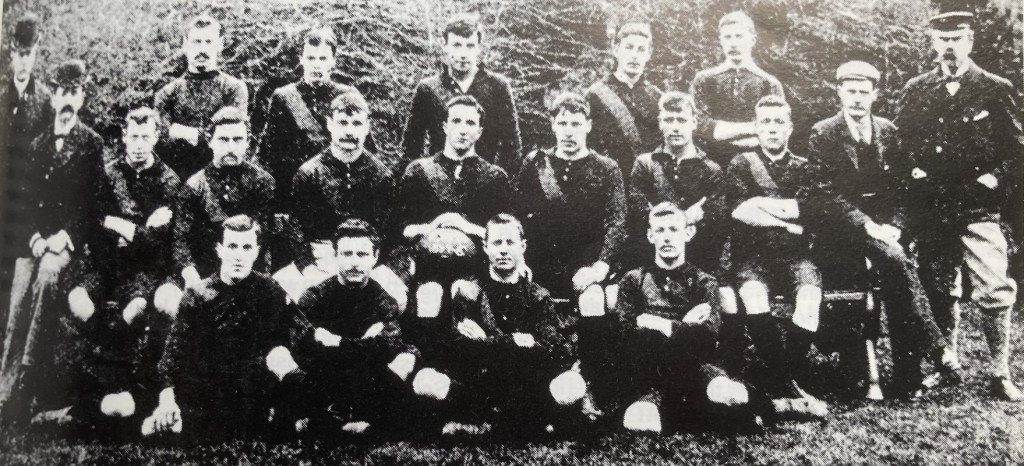
The 2022-23 season marked the 150th anniversary of Falmouth RFC. As the exact date of its founding in 1873 has been lost to history, the club decided to launch their celebrations on the birthday, in July 1878, of John Jackett. He was noted for being
One of the club’s greatest successes from the early 20th century…
Falmouth RFC website6
The birth of rugby in Falmouth and the birth of John Jackett, you might argue, are inextricably linked. He, and indeed the Jackett family, are rightly revered by the club. All his brothers played, and his father Thomas Jackett was prominent on the committee.

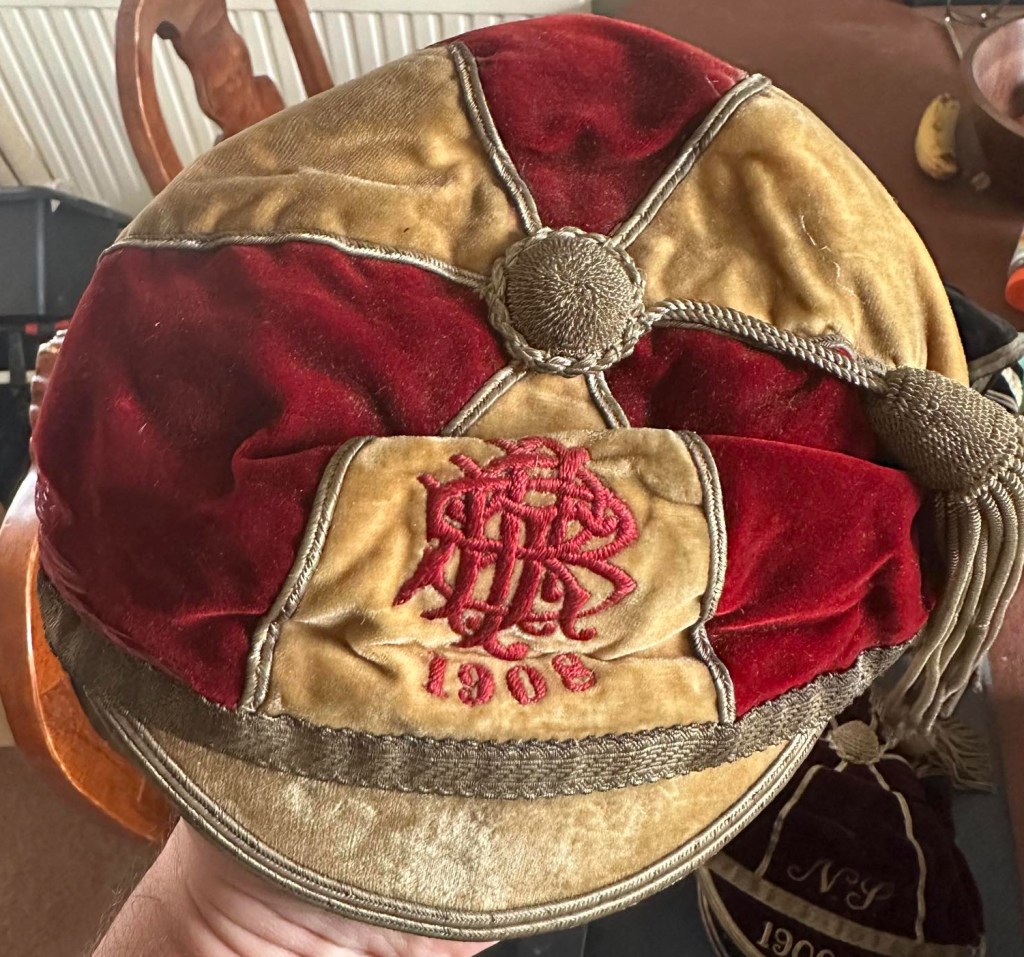
Every now and then, a precious piece of John Jackett memorabilia is unearthed at the Falmouth clubhouse, such as his 1908 British Lions cap:
However, apart from occasional guest appearances for the Falmouth XV7, his playing years for Falmouth Chiefs (as opposed to Falmouth One and All, a junior ‘feeder’ team for the senior club), only spanned from 1897 to 1905.
Furthermore, during this period Jackett also signed with, and represented Penzance, Devonport Albion and Plymouth, before finally committing to Leicester. He may have even guested for Penryn, such practices being common at the time8.
He was first selected for Cornwall whilst a Penzance player, and was picked for England and the 1908 Lions as a Leicester man.
For the Falmouth faithful though, by and large he could do no wrong. From one of his earliest appearances in 1896 for the One and All XV, the local rugby pundit ‘Quidnunc’ (an archaic term for an inquisitive, gossipy person) was already tipping him for bright things9.
A year later, and now full-back for Falmouth Chiefs (he wasn’t yet twenty), Quidnunc observed that the youngster’s play was
…superior…his huge punts to touch being, as usual, quite a feature of the game.
Lake’s Falmouth Packet, December 4 1897. p5
It’s tempting to don the rose-tinted spectacles and assume that, as he is recalled so fondly now by the club, that Jackett was always a popular figure. Maybe he was. But one suspects that, while his play won many games and earned him much plaudits, there may have been many clubmen whose life he made difficult.
Who’s he playing for this season? What are his plans? Who knows? Who do we pick now he’s gone? Who are we going to drop now he’s back? How long is he going to be back? How do we keep him here?
One could draw a parallel here with Jackett’s contemporary and Cornwall team-mate from Redruth, Bert Solomon. Solomon is feted now as one of Cornwall’s greatest players, a centre of elusive, ghost-like running ability. Yet how many Redruth committee men must have cursed him blind when, on match-day, he was once more nowhere to be found, and they had to shrug on their overcoats yet again to beg him to leave his bleddy pigeons alone and come and play rugby?10
The question we have to ask is, why did John Jackett switch clubs so often?
The Magpies
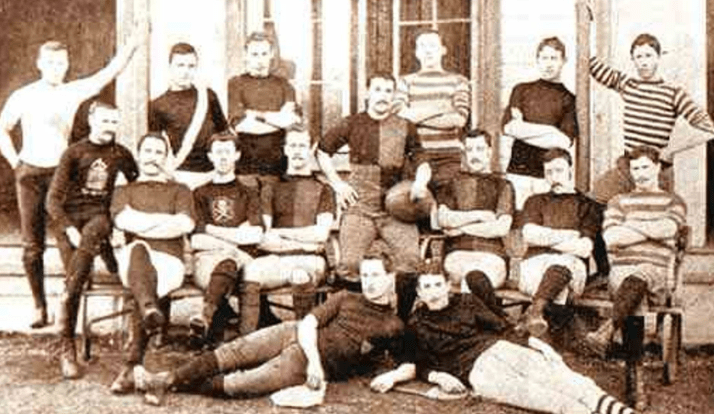
Jackett seemed to arrive at Falmouth RFC as the complete package, and his impact on their Chiefs cannot be underestimated.
In March 1897 Falmouth recorded a notable 13-0 victory over Redruth. ‘The Bounder’, Cornish Echo‘s rugby columnist (Cornish sportswriters loved a pseudonym) noted that, even though Falmouth’s young full-back had an off-day,
…his tackling was sure and his huge punts were always of considerable advantage.
March 19 1897, p8
Jackett’s B-game is already up to the level of many a 15’s best efforts.
So he could tackle. He had a massive kick – and it must have genuinely been a whopper, so often is this facet of his game remarked upon. One wonders how many yards he would have made given a lighter, more aerodynamic modern ball to hoof.
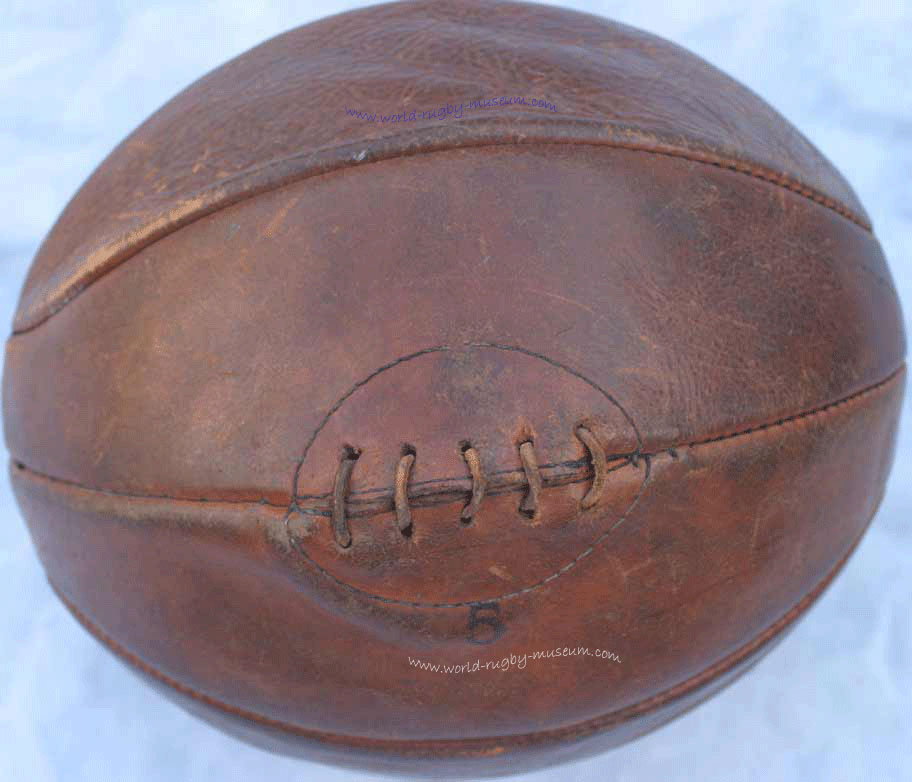
He was secure under the high ball too, Quidnunc noting that he was a
…very safe custodian…
Lake’s Falmouth Packet, March 3 1897, p5
…when dealing with any proto-Garryowens.
Jackett was fast, and he was very fit. A preview of the 1898 season observed that he
should be in good form as a result of his cycle training…
Lake’s Falmout Packet, September 3 1898, p5
As we saw previously14, Jackett trained hard for his cycling, and he was equally noted for being
…always in strict training…
Lake’s Falmouth Packet, November 11 1899, p5
…where rugby was concerned. One of his kicking drills was to place buckets along the touchline of the Falmouth pitch and, from the other half, aim his punts at them15. In an amateur sport, Jackett’s dedication was worthy of a professional.
The long hours of practice bore fruit too in his goal-kicking. When he started, a try only counted to your score if it was converted, or ‘majorised’ as the term was then. Additionally, field-goals (kicking the ball over the posts during open play) were permitted until 1905. Jackett’s prowess in this area was noted in the Press as often as his kicking, catching and tackling16.
Jackett had another aspect to his game. Attacking flair.
The “proper Cornish game”, wrote the journalist Jerry Clarke in 1970s, is one
…in which threequarters are mere spectators.
The Packet, March 23 1978
If Cornish rugby is forward-focused, then Rugby Union in general in the 1890s was undeniably dominated by the big men with their scrimmaging and dribbling.
But not all of it:
Jackett was responsible for the opening, running from half-way and passing to a threequarter, who ran over with a try, Jackett goaling amidst a scene of great excitement.
Lake’s Falmouth Packett, March 12 1898, p8
Last in defence, first in attack. Jackett had the 15’s complete game.
He was one hell of a player. He knew it, and Falmouth knew it. So did other XVs.
*
Long before they joined forces with Newlyn RFC, and even longer before they became the Cornish Pirates, Penzance RFC were known as The Magpies. They lived up to their name in the autumn of 1898.
There were “howls of disapproval” from the Penryn faithful as the Penzance XV took to the pitch, with a known Falmouth player on their team. The howls must have turned to screams of outrage at full time, when The Borough went down by one goal and one try to two tries.
They’d crossed Penzance’s line twice, but failed to majorise their efforts. Penzance, by contrast, had a decent kicker on the field, and his goal won them the game17.
The kicker was John Jackett. Here we might add another couple of strings to his rugby bow: an ability to stay out of trouble, and to remain calm under pressure. The Penryn crowd repeatedly exhorted their players to stick one on him or worse, but to no avail. He was too cute for that18.
He’d quit Falmouth at the end of September, offering no reason. However, it’s suggested that criticism for a poor early-season showing against Plymouth’s Keyham College was the explanation for his sudden departure19.
If true, Jackett can’t have had a very thick skin, and he didn’t use the brickbats’ words constructively. As we shall see, later in his career he again demonstrated that his knee-jerk reaction to any denunciations of his play was to pack his bag and try his luck elsewhere.
Rumours circulated as to who he’d join. Redruth counted themselves among the hopefuls20, but it was The Magpies that poached the rising star. How?
Jackett seems to have found, or been offered a job in Penzance21. What exactly this was is unknown, but some had their suspicions:
…he has to work hard enough when he plays on one or two occasions per week for the Penzance team, and if had to work the rest of the week it would kill him in a very short time; but I think you can depend on it he isn’t going to do that…
Cornubian and Redruth Times, October 28 1898, p5
In other words, Jackett’s ‘job’ probably didn’t involve much actual work. We can add to this assertion some bitter demands from Penryn that his appearance for Penzance was
…a matter for the county committee to sift!
Cornishman, October 6 1898, p2
Then there’s the courtroom testimony of Caroline Over’s mother22. She claimed that Jackett told her he made money “footballing”, but at Penzance
…she did not know how much he earned.
Royal Cornwall Gazette, February 14 1901, p3

Of course, it was against the RFU’s strict amateur codes for any player to be paid to play the game, but the inference is that Jackett did indeed quietly receive some boot money to go to Penzance.
His father played sport – yachting – for cash. Jackett himself cycled competitively for trophies or prizes24.
Why should playing rugby be any different? Although Jackett didn’t exactly have a working-class background, it had long been common practice for the working classes to play sport, or team games, for rewards25. And rugby, in Cornwall at least, had evolved into a working-class game.
Whatever the truth behind his brief dalliance with Penzance, by November 1898 Jackett had returned to Falmouth. He helped them beat Camborne26.
Maybe he’d made a point.
On the Waterfront

Of far greater controversy was Jackett’s signing for the powerful Devonport Albion club in late 1900. Albion had a reputation for luring talent away from their native clubs, it apparently being common knowledge in Wales that
Any good footballer can secure a berth in the Devonport Dockyard…One of the Swansea forwards was offered…£100 a year…and would consent to play for the Albion club…he need not be too clever at his work so long as he played good football.
Qtd in Lake’s Falmouth Packet, December 8 1900, p8
Albion weren’t the only ones. Poaching was known to be
…rife in Devon…
Lake’s Falmouth Packet, October 13 1900, p5
By October 1900 John Jackett was white-hot. His poor showing against Keyham College in 1898 was avenged, with
…his running, fielding and kicking being faultless. He played with excellent judgement…
Lake’s Falmouth Packet, October 13 1900, p5
Falmouth began to play him at 10, with predictable results against Camborne. A cross-kick (or was it a kick-pass?) put his wing in for a try, and then Jackett broke through on a mazy run to set his outsides up for another28.
What a player. What an asset. Devonport had already acquired Falmouth’s skipper, Syd Skinner, and now they made a bid for the star player. An attempt to “induce” Jackett was made, but his
…decision to stand by his old team has given great satisfaction.
Lake’s Falmouth Packet, October 20 1900, p8
Not for long. Albion reached out to Jackett with another ‘inducement’, and there was uproar in Falmouth when he left. There were calls for the RFU to launch an enquiry, and for a change to the codes:
Better to have recognised professionalism than unfair work of this kind.
Lake’s Falmouth Packet, October 20 1900, p4
An incensed Falmouth RFC took their grievance to the Cornwall RFU. Messrs. Prior, Miller and Lake strode into the committee room of their sport’s governing body.
For all their high talk about the depletion of smaller clubs hastening the death of Cornish rugby, the CRFU were hamstrung. Falmouth had no hard evidence of Jackett (or Skinner) receiving money to play.
They might have claimed that Skinner was losing days at his actual job by travelling to play in Devon, and that the Albion were surely recompensing him. Or they could assert Jackett had uttered something like
…he was going to the Devonport Albions to see what they could do for him…
Cornish Echo, December 7 1900, p8
…but to no avail. Not even one strongly-worded letter left Cornwall bound for Devonport. Falmouth were left to seethe.
Jackett would later state that he was only legitimately paid travel expenses, and nothing else29. The RFU belatedly caught up with Devonport Albion in 1912. During the aftermath of the abortive Westcountry Northern Union movement, they suspended practically all of Devonport’s 1st XV for breaches of anti-professionalism laws.
One of the players was Jackett’s old team-mate from Falmouth – Raphael Jago30.

By May 1901 however, Jackett had left Devonport, and England, for South Africa. He was back by June 190231.
Before the start of the 1902-3 season, Falmouth acted quickly to secure his services. In August they appointed him club secretary,
…to which he will be able to devote the necessary time to ensure the smooth workings of the club’s affairs.
Lake’s Falmouth Packet, August 23 1902, p4
This meant he would be playing for them too. Making a key player a secretary was a “common way”, one historian states, for the said player
…to be paid for playing while retaining their amateur status.
Tony Collins, A Social History of English Rugby Union, Routledge, 2009, p26
If this was Falmouth’s ploy to keep Jackett to themselves, it didn’t last. By September 1903, “rumour” was “rife” as to his intentions32.
And the rumours proved correct. Jackett signed for Plymouth RFC, who then went on to beat Falmouth that season at South-Devon Place. A Jackett cross-kick (which must have been a feature of his game) set up one of the home XV’s three tries33.

He returned to Falmouth for the start of the 1904-5 season. The club elected him skipper; clearly they weren’t going to make him secretary again. But by January 1905, Jackett had joined Leicester35.
However, it was while playing for Falmouth in 1904 that John Jackett was named as Cornwall’s Captain…36
1908 and all that
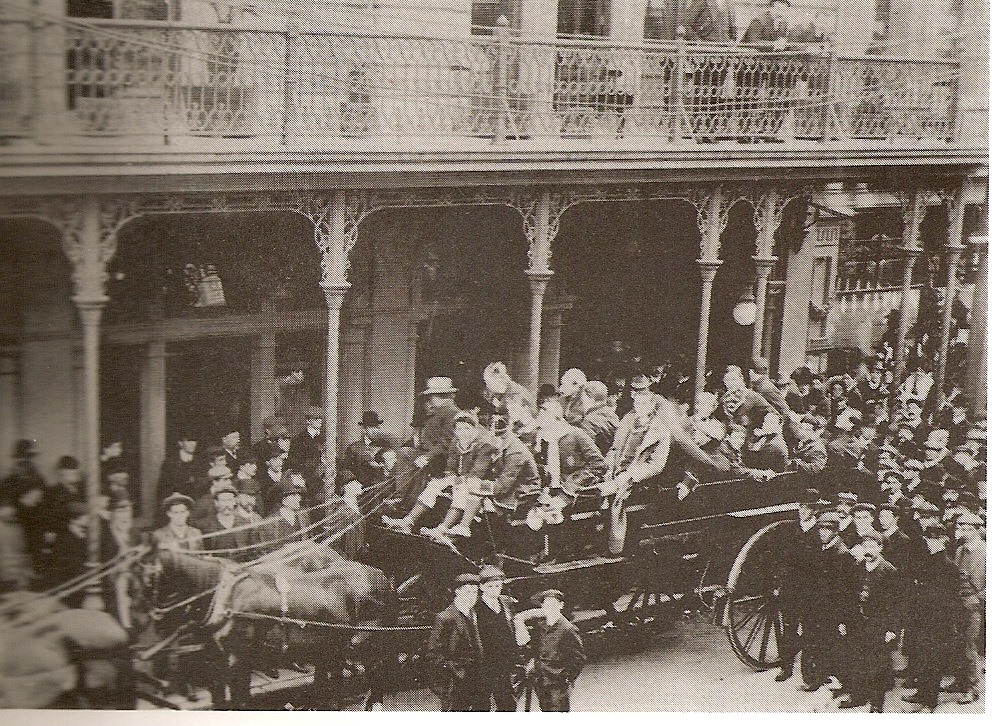
There’s no other way to put it. Cornwall’s rugby team were crap. They’d first entered the South Western Division (joining Devon, Somerset and Gloucestershire) of the County Championship in the 1892-3 season, and for some years following had been the region’s whipping boys.
From that inaugural year up to the start of the 1900-01 season, they’d played 23 matches…and lost each one37.

In the press, resignation was prevalent. Before the 1893-4 fixture against Devon, ‘Spectator’ had already thrown in the towel:
Victory will undoubtedly rest with the Devonians…
Cornish Post and Mining News, November 24 1893, p3
Spectator was correct. At Exeter, Devon stuffed Cornwall 38-3, majorising four of an eyewatering six tries38.
That said, Cornwall were in a tough draw. After the formation of the Northern Union in 1895 had broken the dominance of the Lancashire and Yorkshire XVs, Rugby Union’s power-base switched to the West Country. In the years John Jackett played for Cornwall (52 times from 1898-1911), Devon won the Championship in 1899, 1901, 1906 and 1911. Gloucestershire won in 191039.
Cornish insularity, hostility to the CRFU and inter-club rivalry were contributory factors to Cornwall’s poor showings too.
On the eve of the Devon match mentioned above, two Penzance players were named in the line-up40. In the event, the club withdrew their players’ services in protest at the CRFU’s decision to move the venue of the forthcoming fixture against Gloucestershire from Penzance to Redruth, their committee arguing that
…the removal has been done improperly and illegally.
Cornish Telegraph, November 30 1893, p5
Although 1897’s campaign was another whitewash, the journalist ‘Impartial’ (who was anything but) saw a glimmer of hope – and an opportunity to have a sly dig at Devonport Albion. Cornwall had
…shewn a bolder front to their opponents. With a few big industries (a dockyard for instance) we shall be able to cope with the adjacent shires…
Cornishman, April 21 1898, p6
Was it time to be bolder? Blood some youth? What did Cornwall have to lose?
By October 1898, John Jackett was a Cornwall player41. The upturn in the side’s fortunes was far from immediate. Cornwall only registered their maiden Championship victory, against Somerset in the 1900-01 season. 3,000 in Redruth witnessed the two tries to nil win. Jackett played a prominent role:
…the Falmouthian did all that was required of him in a style unequalled by any custodian turned out by Cornwall…Jackett…came out of the ordeal with flying colours.
‘Touch’, Cornish Telegraph, November 14 1900, p8
(Also playing well that day was a young fly-half from Redruth, James ‘Maffer’ Davey.)
This victory however was a false dawn. Cornwall didn’t win another Championship fixture until the 1904-5 round, when they beat Gloucestershire 18-9 in Bristol42.
It was Jackett’s first game as captain. It was also the beginning of a new era for Cornish rugby. Belief. Flair. Success.
And it was John Jackett who threw down the gauntlet. Here’s his opening statement – at 10 – in that match. There was
…a sensational incident, for from the first scrimmage J. Jackett slipped past Butcher and found a clear field in front of him, save for the full back. On reaching the latter, he punted, and then ensued a foot race for the line…
‘The Bounder’, Cornish Echo, November 4 1904, p2
It didn’t, alas, result in a try, but Gloucestershire were stunned. Cornish XVs didn’t normally play with such gay abandon. Jackett gave his men confidence, coupled with a fast, open game plan based on what he’d seen at Devonport Albion and would shortly experience with Leicester. This is how it’s going to be.
With handling “worthy of a first-class Welsh team”43, Cornwall were easy winners, Jackett kicking the crucial three goals which bested the home XV’s three tries.
He’d been given the tools for the job too. The CRFU had picked a team based
…on form, instead of reputation…
‘The Bounder’, Cornish Echo, November 4 1904, p2
And four of those form-horses that day would be with Jackett in 1908: his brother Dick, the wing Barrie Bennetts (Penzance and Richmond), and two more forwards, Nick Tregurtha of St Ives and John G. Milton of Camborne School of Mines. (Bennetts and Milton would also win international honours44.)
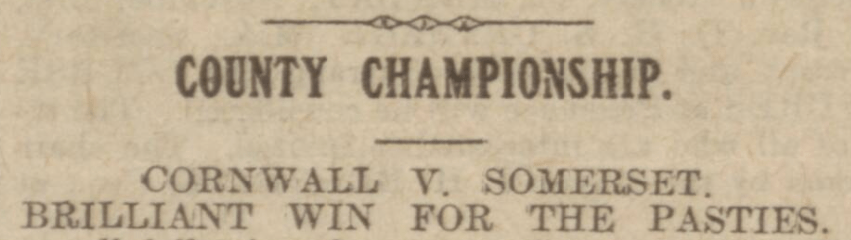
They went on to beat Somerset, but came unstuck against Devon. Jackett, maybe not a natural 10, was criticised in both games for demonstrating the fly-half’s cardinal sin: greed45.
Cornwall reached the playoffs, did the double over Somerset, but once more Devon proved the stumbling block. Jackett’s men had failed to win the South West Division, but Cornwall had notched up their most successful Championship to date46.
They were no longer the South West’s makeweights. They were competitors. But it was Devon, always Devon, that thwarted them. In 1905-6 they lost 19-0 in Devonport; in 1906-7 they were on the wrong side of an agonisingly tight 8-6 scoreline at Camborne47.
Cornwall had never beaten Devon in the Championship. If they wanted to progress, they would have to overcome one of the strongest XVs in the whole Championship.
*
The 1907-8 campaign started well. Somerset were hammered 25-6 in the opener at Taunton. Jackett by now had reverted to 15, with cross-kicks that held The Cidermen back. A youngster from Redruth, Bert Solomon, was a constant threat in the centre. Also, a Leicester team-mate of Jackett, as big and physical as brother Dick, who claimed he was Cornish and said his name was Fred Jackson, kicked five goals (more on him to come)48.
But then it unravelled in Plymouth against their old nemesis, Devon, who won 17-8 in atrocious conditions. Their pack dominated, which gave the Devonians’ scrum-half, Raphael Jago, an open invitation to make a real menace of himself. Starved of decent possession, Maffer Davey, recently returned from the Transvaal49, had a game to forget at 10. Bert Solomon’s partner at centre failed to create space for the wunderkind to work his magic.
Jackett was one of the few to finish the game with any credit. Cornwall were gutted. Not another season as bridesmaids.
There was a glimmer of hope: if Somerset lost to Devon, and The Pasties beat Gloucestershire, the latter three XVs would have to meet again to determine the South West’s champion50.
In a roundabout way, it was at this point that Cornwall’s luck began to change. A frozen Redruth pitch postponed the Gloucestershire fixture. Gloucestershire appealed to the RFU, arguing that, as Cornwall had failed to protect their pitch, they (Gloucestershire) ought to be given home advantage for the rearrangement.
They weren’t, and the postponement meant that Jackett, at first doubtful, could make the rearranged date. On Saturday January 25 1908, a crowd of 5,000 in Redruth watched Cornwall hand the reluctant visitors a 34-10 beating51.
To the playoffs. Devon were coming to Redruth.
It’s one of those fixtures where you wish you had been there with the other 6,000 fans to watch, or at least be lucky enough to stumble across some archive footage of the match at Kresen Kernow. For Cornwall finally realised
…the ambition of years – to thrash Devon…
West Briton, February 17 1908, p3
Jackett, as was his wont on winning the toss, elected to play uphill in the first half: let them come at us, then we’ll have a crack later on. His display overall was described as “faultless”. Fred Jackson’s kicking saw him carried off the field by a delirious mob. Maffer Davey was a general at 10. And yes, Bert Solomon scored that try:
He feinted to send Bennetts in, and the latter was so perfectly deceived that he actually proceeded to dive for the line…Solomon then with a clear course coolly romped over…
West Briton, February 17 1908, p3
Cornwall 21, Devon 3. No longer world-weary harbingers of doom, the Press were talking up the Cornishmen as likely winners of the whole Championship. What of Gloucestershire, next victims in the playoffs?
…[they] will have to show a vast improvement on their form of a fortnight ago to make even a draw of it.
West Briton, February 17 1908, p3
And what of Middlesex, potential opponents in the semi-final? They were dismissed as mere
…Varsity men and public school boys, who will probably crack up when opposed to the hurricane tactics of the Cornishmen…
West Briton, February 17 1908, p3
Not only were Cornwall going to win, they were going to rough up some toffs. The Cornish rugby identity was already resolutely working class – and proud of it.
Gloucestershire lost at home 15-3, giving Cornwall the South West Division52. The CRFU won the toss to decide the venue of the semi against Middlesex. Cornwall would have home advantage. The burning issue was, which club would have the honour of hosting? The CRFU’s Hon. Secretary, W. Dennis Lawry (a Penzance man), proposed Redruth.
A Falmouth representative proposed his own club, stating
…Redruth had had its share.
Cornishman, February 27 1908, p4
Falmouth threatened to boycott the CRFU when their proposal was dismissed. Redruth’s representative, William Hichens53, played the martyr. Getting the ground ready for such a big fixture was a “great amount of work”, but
…they should do everything for the team…He would sink his own feelings and take on the work again.
Cornishman, February 27 1908, p4
Furthermore, John Jackett
…had said that he knew every inch of the [Redruth] ground, and that was a very important thing…
Cornishman, February 27 1908, p4
Redruth’s slope fitted his gameplan.
Camborne grumbled too, and expected to host the Final – nobody seemed to doubt Cornwall would make it. But for now, Middlesex would come to Redruth. Hichens made a show of rolling his sleeves up…and doubtless afforded himself a smug grin in private54.
Jackett won the toss, and made his team play uphill first. After a tight initial forty, it was a try apiece. However,
Gradually the homesters wore down the visitors…
Cornish Echo, March 13 1908, p8
John Milton, a South African-born, six-foot, 15-stone beast of a forward, took two Middlesex men with him over the line. Shortly after, swift passing ignited by Maffer Davey put Bennetts in on the wing. Another try in the closing minutes was the coup de grace.
Cornwall 19, Middlesex 3. It might have been closer, were it not for John Jackett. He was judged
…a tower of strength…he saved his side as no other full back in England could possibly do…
Cornish Echo, March 3 1908, p8
This set up the Final, against Durham.
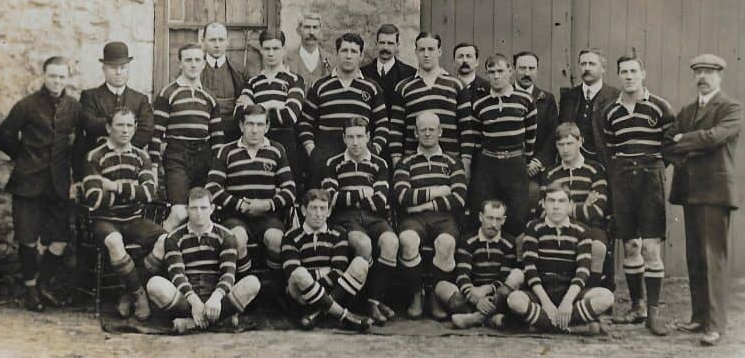
Cornwall’s XV for the Final contained seven men who had been, or would shortly be awarded, international honours. It also contained four from Devonport Albion, which amply demonstrates how ‘attractive’ a club it must have been. Wing Barrie Bennetts, scrum half Tommy Wedge and Bert Solomon all represented England. John Jackett, Maffer Davey and John Milton all played for England and toured with the British Lions. Fred Jackson, though not capped by England, went on the same 1908 Lions Tour as Jackett and Davey55.
Additionally, Dick Jackett had been an international trialist, and is reckoned to be the best player never to win recognition by England56.
This is surely the greatest Cornwall XV. It needed to be. Durham boasted six internationals themselves, and ‘The Monkey Hangers’, as they were known, had been County Champions in 1900, 1902, 1903 and 1905 (they shared the title with Devon in 1907)57.
This was the game of the season. The two best sides in the land. Today’s equivalent would be the Gallagher Premiership Final.
As with the Middlesex match, Cornwall had drawn home advantage. Predictably, within the CRFU debate raged as to which club would host the great occasion.
Charles Bryant, of Camborne RFC, proposed his ground. Improvements had been made to the facilities, and besides,
To have four matches at Redruth and none at Camborne is not a fair nor a proper thing.
Cornubian and Redruth Times, March 19 1908, p3
Clearly Bryant couldn’t give a tinker’s damn about the hopes or merits any other rugby club in Cornwall had of being hosts. William Hichens stamped all over his proposal. Gone was his feigned reluctance to preside over yet another county match:
They [Camborne] did nothing until they saw everything was going successfully at Redruth…such a puerile argument…
Cornubian and Redruth Times, March 19 1908, p3
Hichens claimed to have the players’ interests at heart, but Bryant was far from pacified:
You take it we shall not continue members of this Union if you have all the matches at Redruth…
Cornubian and Redruth Times, March 19 1908, p3
This was not the last time Bryant and Hichens locked horns, nor the last time Camborne threatened to quit the CRFU58.
Ultimately, Hichens and the team’s sentiments held sway. Jackett had been approached on whether the venue ought to be changed for the Final. His response was succinct:
Certainly not…
Cornubian and Redruth Times, March 19 1908, p3
Redruth it was. The West Briton‘s big game preview ran profiles of the Cornwall XV. Here’s what ‘The Celt’ said of John Jackett:
He is perhaps the soundest full-back that has represented England in recent years for he possesses great kicking power, fine judgment, and is a deadly tackler…
March 26 1908, p3
This match would be the pinnacle of his four years as leader of Cornwall. He’d taken them from tournament also-rans to being one victory away from the accolade of The Best in the Land. Yes, he’d played for England. Yes, he’d led his Cornish XV against the All Blacks and the Springboks (which will be discussed in due course). He was doing great things at Leicester.
But in a few months, John Jackett would be thirty. Not the young gun anymore. There surely wouldn’t be many more chances, if any, to lead Cornwall in a Cup Final, to win some silverware. To be the first.
He must have wanted it badly.
So did his team. So did the 17,000 spectators shoehorned into hastily-erected stands in Redruth, easily the club’s biggest gate until the 1969 Final. Then, an estimated 23-25,000 were packed in to watch Lancashire win 12-9. As we have seen, county matches regularly drew crowds of between 3-6,000, but this was off the scale59.
Not that they were all there to cheer on Cornwall. A member of the Durham contingent displayed their mascot – a lynched toy monkey – on a very visible gallows: the crossbar of one of the goalposts.
For balance, a pasty in a paper bag was strung up on the ‘posts at the opposite end of the pitch. The ground was firm, which suited Cornwall’s fast play.
The reporters present (and here we can imagine ‘Impartial’, ‘The Bounder’, ‘Quidnunc’ et al) suffered the indignity of having some railings crash on them, suspending play for a time. Finally, all was ready.
Durham had won the toss, and elected to start downhill. Jackett gave his best poker face. Fine with us, boy.
From the get-go, he was on it. Cornwall’s tactics – indeed, Jackett’s own – were to absorb pressure in the first half and catch their opponents on the break. It required balls of steel, and a full back up to the task.
That was Jackett. His trademark (said trademark being a great distance) kicks relieved the pressure. His tackles kept Durham honest, and their scoreboard quiet. Rushes were stopped. Dribbles cleared up. And, when the opportunity came, the flair men were waiting. Durham cleared messily, and Bennetts pounced, putting Solomon in for a try. Jackson failed to majorise.
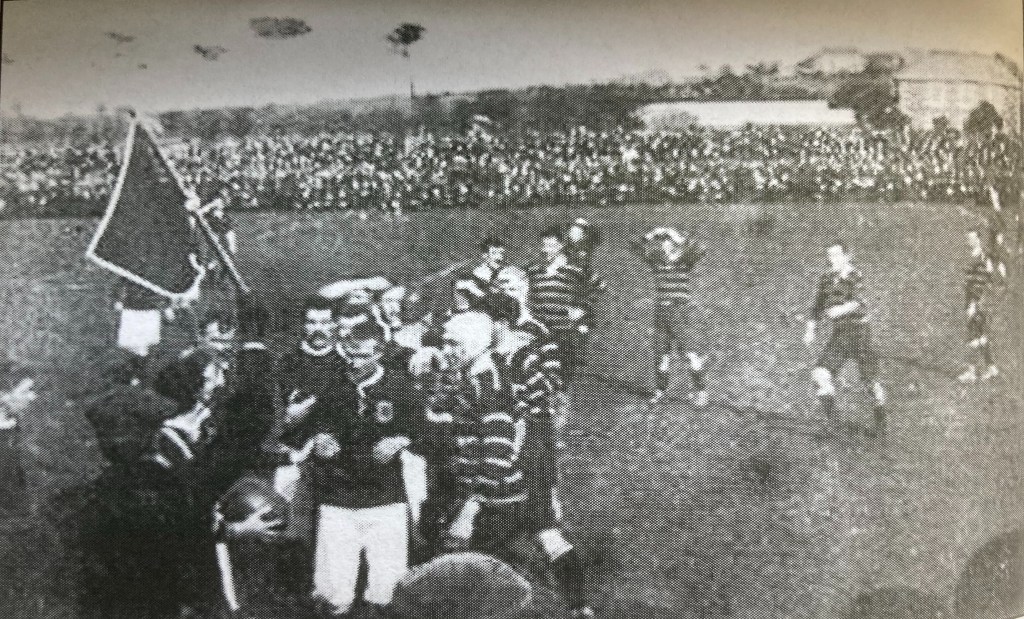
More pressure from Durham. More last-ditch efforts from Jackett. Another Durham attack – and Solomon intercepted, drew the 15, and put in Bennetts for a second try. Jackson walloped over the conversion.
Excitement was mounting. Is it our day?
Jackett was punishing Durham, his kicks covering half the pitch. Time and again the visitors’ heavy forwards had to turn and trudge back up the slope after another Jackett bomb had sailed over their heads.
Half time. Cornwall led by a goal and a try to one penalty.
The second half followed the first, except Durham were now playing against the gradient, and had to chase the game. Jackett by now was torturing the Monkey Hangers, his punts keeping them exclusively in their own 25.
And then it happened.
Solomon broke from a Davey pass, with Bennetts outside him. In a similar situation, previously Solomon had passed to his wing, but not this time. The dummy. The swerve. The acceleration. The uproar in Redruth as Solomon ghosted over the line, a brace of Durham defenders trying in vain to halt a phantom. A photographer was on hand to immortalise the event.

Although Nick Tregurtha bagged another try late on, Solomon’s score put the result beyond doubt. Durham had barely got to the half-way line in the second half – thanks to John Jackett.
Cornwall 17, Durham 3. History had been made. Jackett was more than aware of his XV’s monumental achievement. In Cornwall, he later said, rugby is
…not of the first class…[teams] are composed mostly of miners and fishermen, and the way they make up their fixture lists is to play each other three or four times a season…So you can well see why Cornwall should always be more or less a weak rugby county…
Yorkshire Evening Post, February 3 1912, p3
As we shall see, in an era when the RFU was consciously trying to eradicate working-class influences from the game, Cornwall’s victory with ‘miners and fishermen’ was a sweet kick in the face of The Establishment. Jackett, in flagging up his players’ backgrounds and the circumstances of Cornish rugby, realised this.
How great this achievement was is borne out by the fact that it would be over eighty years before Cornwall took another Championship.
Fred Jackson might have kicked 38 points in the competition prior to the Final62. The Final itself might be remembered as Bert Solomon’s match, and he was indeed the “outstanding star” on the day63.
But John Jackett gave
…an International display…No one knows better than the forwards what an advantage such a sound touch-finder is…Time after time he gained three parts of the field with his kicking…
West Briton, March 30 1908, p4
Add to this his tackling, his nous, his leadership, and you begin to realise that Cornwall could not have done it without him.
If you think this presumptuous of me, in 1909 Cornwall were the Championship Finalists again. Again, their opponents were Durham. This time, however, the venue was Hartlepool.
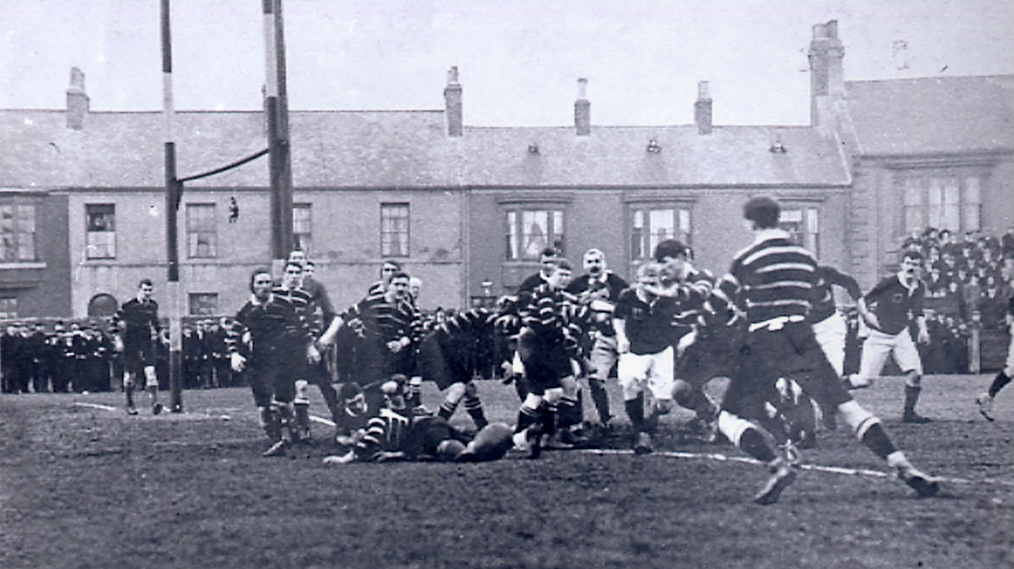
This time, Cornwall lost, 12-0. This time, Jackett played through injury. This time, as a result, his kicking wasn’t up to scratch.
But no matter. At the post-match dinner it was anticipated that the two XVs would line up in next season’s Final, and that Cornwall would win…65
A below-par Jackett was also evident when Cornwall played Australia at the White City Stadium in the 1908 London Olympics.

The whole tournament was something of a farce. Only two XVs – Cornwall and Australia – entered, with France failing to raise a side. Thus only one match was played. Cornwall lost 32-3, but were guaranteed silver medals.
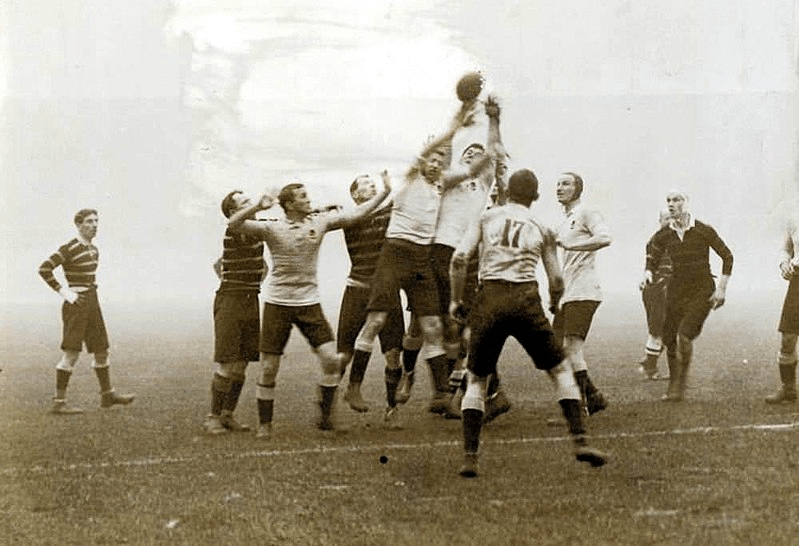
Jackett, along with Maffer Davey, had only recently returned from New Zealand with the British Lions. His play, for once,
…was a disappointment and seemed stale…
Cornish Telegraph, October 29 1908, p8
No doubt he was exhausted, and out of condition after weeks spent at sea. Lest we forget, he was Leicester’s star full back too.
You are cordially invited

Thanks to the industry – and wallet – of Secretary Tom Crumbie, by the early 1900s Leicester were the biggest club in the Midlands. By 1905, Crumbie had made Leicester a ‘play by invitation only’ club, and managed to procure the cream of rugby talent from all over the country. Think Devonport Albion, minus the dockyard69.
Just what these invitations amounted to was an immediate cause of suspicion, the 1908 RFU investigation into Leicester’s activities being the culmination of this ill-feeling. Many Midlands’ clubs were jealous of Leicester’s prestige and ability to attract players. What, they all asked, exactly was the attraction? Many jumped to the cynical conclusion: Leicester’s boys were on the take70.
The RFU, however, were always reluctant to take Leicester on:
…should Leicester switch allegiance to the rival code [the Northern Union] as was likely if the Rugby Union moved against them, then it could instigate another split within the game as catastrophic as the 1895 one.
Tom Mather, Rugby’s Greatest Mystery: Who Really Was F. S. Jackson? London League Publications, 2012, p20
Leicester’s suspected recruitment/inducement policies put the RFU in a lose-lose situation. Fail to investigate, and the sport’s governing body lost face and made their laws against professionalism a joke. If they did act, Leicester might very well throw in their lot with the Northern Union, thus further reducing the Union’s homelands in England to the West Country and the Home Counties.
The RFU had recently lost the North. Did it want to risk losing the Midlands too?
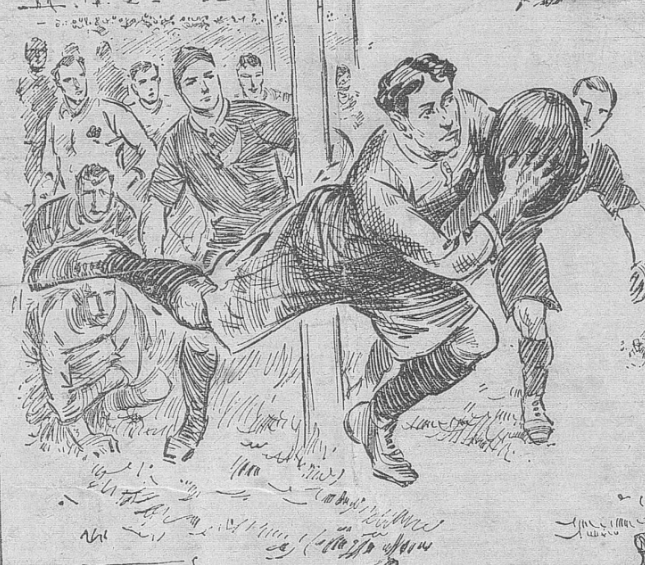
One of the big names Leicester acquired the services of was, of course, John Jackett. The man himself put down some serious roots in Leicester, meeting – and marrying – Sallie Chapman there. We know he played a bit of cricket for Waterhouse Reynolds & Co., a local corset manufacturing business71.
He also worked, the 1911 census noting he had a job as a cycle agent, possibly with the up-and-coming firm in Leicester, Halford. How demanding an occupation (or indeed, any other form of employment he might have had) was this?
Probably not very. A handsome, charming, well-known member of the big local rugby club could not help but be an asset to a business looking to sell bikes – and Jackett would have had knowledge of the machines too. We could draw a parallel here with the cycling star of the 1940s and 50s, Reg Harris, whose role on the board of any firm was
…to simply serve as a celebrity face of the company whose sheer presence alone would impress potential customers.
Robert Dineen, Reg Harris: The Rise and Fall of Britain’s Greatest Cyclist, Ebury Press, 2013, p264
Similar to Harris, we can be sure that, if Jackett needed time off to play rugby for Leicester, or Cornwall, or England, or nip off to tour New Zealand for several months with the British Lions, there was never an issue.
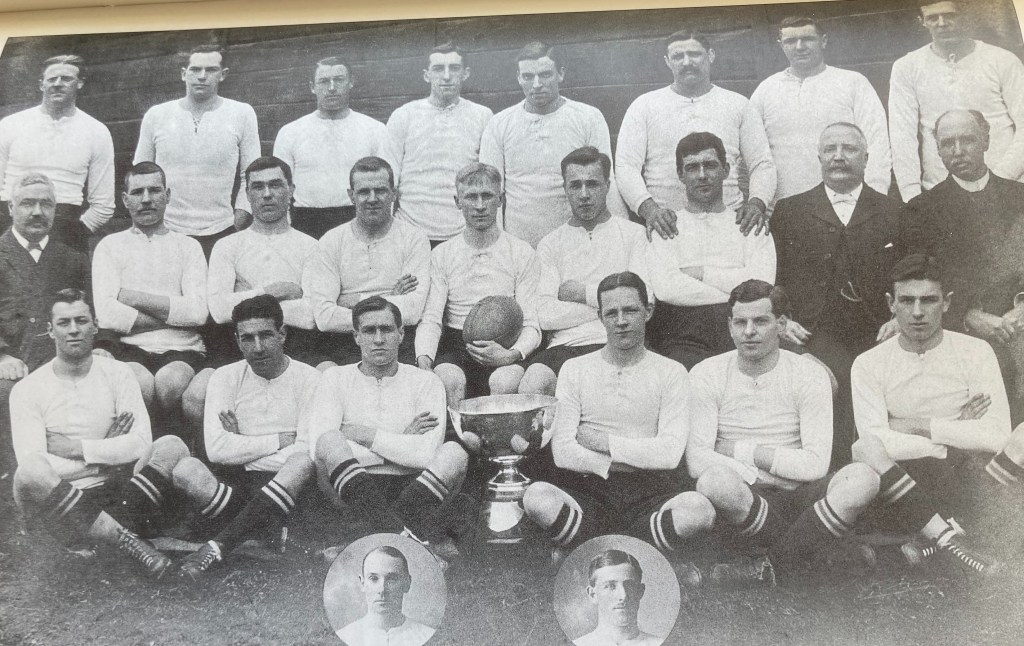
Besides his Cornish and International commitments, Jackett made over 180 appearances for Leicester, from 1904 to 191173.
He started as a centre and was prominent in Leicester’s victory over Nottingham to win the Midland Counties Cup in 190574. Quickly, however, Jackett took over at 15, with customary elan:
Never have I seen a more perfect display…
Leicester Journal, November 10 1905, p6
In 1909 Leicester took the Cup again, with Jackett’s touch-finding starving Coventry as much as it did Durham in 190875.
In the 1910 final (a repeat of 1909’s edition), he was being outplayed by his opposite number – “out-Jacketted”, in fact. Leicester were struggling.
But it’s all about having a good scriptwriter. A Jackett field goal drew the scores level. Coventry drew ahead with a penalty. Leicester scored with minutes left to even matters up again. A successful conversion would mean victory, and another trophy. Who do you throw the ball to? Who else?
Jackett kicked it76.
His performances for Leicester became as celebrated as his exploits for Falmouth, or Cornwall. Even in the late 1950s he was being compared to the current poor crop of Leicester players as a
…legendary full back…By comparison, the present outfit look like pussy-cats…
Daily Mirror, October 24 1957, p21
Jackett belonged to Leicester as much as he did to Falmouth, or Cornwall. But controversy continued to follow him.
In 1908 the RFU opened investigations into Leicester RFC. Accusations had been made that the club had knowingly signed Northern Union men (thus in turn professionalising themselves and anybody who played a game of rugby union with them), of paying players, and of offering cushy jobs to those they wished to recruit.
One of the Leicester players interviewed by the investigative committee was John Jackett, who was alleged to have
…been obtained by the Leicester club in violation of the professional laws.
RFU statement, Lake’s Falmouth Packet, February 5 1909, p7
There was ample evidence of unaudited accounts, sparse balance sheets, off-the-book expenses and payments for ‘refreshments’, a usefully vague term if ever there was one.
But, somehow, Jackett talked his way out of trouble (there are suggestions that players were told to refund any payments made to them), and so did Leicester. The RFU found no evidence that he, and the other players implicated had been acquired by the club in breach of their laws.
Leicester pretended they hadn’t been aware that the Northern Union players were NU men on signing for them, and the RFU pretended to believe them. Four former NU players, including Jackett’s Cornwall team-mate, Fred Jackson (whose story we shall return to), were suspended. Leicester, for pleading their surely-feigned ignorance, were exonerated.
Rowland Hill, Secretary of the RFU77, went on the record as believing that to expel Leicester
…would be to practically break up the union.
Qtd in: A Social History of English Rugby Union, by Tony Collins, Routledge, 2009, p40
Disgusted, the then-President of the RFU, C. A. Crane, resigned in protest78.
Another old comrade of Jackett’s, James ‘Maffer’ Davey, was also embroiled in the investigation. His new club, Coventry, were found to have been footing his lavish hotel bills when he was up in the town. Davey was suspended, and never played another game of rugby (Union or otherwise) again79.
Even when a Northern Union player, Jackett would still stress that
Any suggestions which are made reflecting upon the amateur bona fides of the club are, you can take it from me, most unjustifiable.
Yorkshire Evening Post, February 3 1912, p3
C. A. Crane might have disagreed.
*
John Jackett was a brilliant rugby player. So brilliant was he, in fact, that many clubs looked to secure his services by fair means or foul. Jackett himself was probably always amenable to a little extra pocket money, or the offer of an undemanding job.
If you believe this to be speculation on my part, at the time the activities of the big clubs, and Jackett himself, were practically an open secret.
On the eve of his England debut against the 1905 All Blacks, a journalist noted his recent switch to Leicester, recalled the furore with Devonport Albion, and knowingly described him as
Jackett, a modern Bartram…
Evening Mail, December 1 1905, p6
In the final post of In Search of John Jackett, we shall examine the man’s unfulfilled international career, and his time as a Northern Union star. Read all about it here…
Many thanks for reading; follow this link for more top blogs on all things Cornwall: https://blog.feedspot.com/cornwall_blogs/
Do you enjoy my work?
All content on my website is absolutely FREE. However managing and researching my blog is costly! Please donate a small sum to help me produce more fascinating tales from Cornwall’s past!
Your contribution is greatly appreciated.
DonateReferences
- Excerpts from: Cornishman, October 6 1898, p2, and Lake’s Falmouth Packet, December 8 1905, p5.
- Image from: Rugby’s Great Split: Class, Culture and the Origins of Rugby League Football, by Tony Collins, Frank Cass, 1998, p50.
- Calculations from: https://www.measuringworth.com/calculators/ukcompare/relativevalue.php
- From: Tony Collins, Rugby’s Great Split, p49-51.
- From: The First Hundred Years: The Story of Rugby Football in Cornwall, by Tom Salmon, CRFU, 1983, p45.
- https://www.falmouthrugbyclub.co.uk/150th-Anniversary. 2022 also saw the inaugural year of the John Jackett Cup, a friendly cricket match played between a Falmouth RFC XI and a Seaview Old Boys XI. See: https://www.falmouthpacket.co.uk/news/20595147.falmouth-rugby-john-jackett-cup-seaview-old-boys/
- Though a Leicester player, he turned out for his old club in late 1905. Lake’s Falmouth Packet, October 6 1905, p6.
- Cornish Echo, April 21 1899, p7. A ‘Jackett’ is listed as playing for Penryn, but as no initial is given, it could have equally been John’s brother Dick.
- Lake’s Falmouth Packet, November 21 1896, p8.
- See: Bert Solomon: A Rugby Phenomenon, by Allen Buckley, Truran, 2007.
- Image from: https://cornwallyesteryear.com/cornish-rugby-once-a-way-of-life-by-michael-tangye/
- Image from: https://www.pitchero.com/clubs/penzancenewlynrfc/photos/626409/20050760.html
- Image from: http://www.rugbyrelics.com/Museum/exhibitions/NR125/03.htm
- See: https://the-cornish-historian.com/2024/06/29/in-search-of-john-jackett-king-of-cornish-sport-part-one/
- Tom Salmon, The First Hundred Years, p6.
- For example, Lake’s Falmouth Packet, March 12 1898, p8. For a fuller explanation of the convoluted history of Rugby Union scoring, see: https://www.rugbyfootballhistory.com/scoring.htm
- Cornishman, October 6 1898, p2.
- Lake’s Falmouth Packet, October 8 1898, p5.
- Lake’s Falmouth Packet, October 1 1898, p5.
- Cornubian and Redruth Times, October 7 1898, p5.
- Cornubian and Redruth Times, October 21 1898, p5.
- See In Search of John Jackett, Part Two: https://the-cornish-historian.com/2024/07/06/in-search-of-john-jackett-part-two-the-artists-model-the-coastguards-daughter/
- Image from: Tony Collins, Rugby’s Great Split, p119.
- See In Search of John Jackett, Part One LINK HERE
- From: Tony Collins, Rugby’s Great Split, p32, also p29-66.
- Cornishman, December 1 1898, p6.
- That Jackett and Jago both took the pitch for Falmouth is noted here: Royal Cornwall Gazette, February 23 1899, p3. In 1902 he was in the Cornwall squad; by late 1903 he was playing for Devon: Cornubian and Redruth Times, October 31 1902, p7; Brixham Western Guardian, November 12 1903, p5. He had joined Devonport Albion for the 1902-3 season: Royal Cornwall Gazette, September 11 1902, p3. So keen was Jago to assert his Devon roots to the Cornish public he wrote to Lake’s Falmouth Packet on the subject: December 9, 1904, p8. He was born in Bridport, Dorset, in 1882 (England and Wales, Civil Registration Birth Index 1837-1915, vol. 5a, p378), and stated as such in the 1911 census. He was a blacksmith by trade.
- Lake’s Falmouth Packet, October 20 1900, p8.
- Royal Cornwall Gazette, February 14 1901, p3; See also In Search of John Jackett, Part Two here: https://the-cornish-historian.com/2024/07/06/in-search-of-john-jackett-part-two-the-artists-model-the-coastguards-daughter/
- See my post on the 1912 breakaway movement here: https://the-cornish-historian.com/2024/02/03/the-great-cornish-rugby-split/
- See In Search of John Jackett, Part Two here: https://the-cornish-historian.com/2024/07/06/in-search-of-john-jackett-part-two-the-artists-model-the-coastguards-daughter/
- Lake’s Falmouth Packet, September 5 1903, p4. See also the Cornubian and Redruth Times, September 4 1903, p4.
- Western Morning News, September 14 1903, p3.
- See my post on the 1912 breakaway movement here: https://the-cornish-historian.com/2024/02/03/the-great-cornish-rugby-split/
- Cornubian and Redruth Times, October 8 1904, p4; Lake’s Falmouth Packet, January 6 1905 p6, January 20 1905, p6. Jackett’s appointment as Falmouth’s captain was announced in the Cornish Echo, September 23 1904, p2.
- Cornish Echo, November 4 1904, p2.
- Tom Salmon, The First Hundred Years, p115.
- Tom Salmon, The First Hundred Years, p115.
- For the full list of winners, see: https://en.wikipedia.org/wiki/County_Championship_(rugby_union)
- Cornish Post and Mining News, November 24 1893, p3.
- He took part in a trial in October; by November, he was making his debut against Devon – as a Penzance player. Cornish Post and Mining News, October 21, p5, and November 3, p5.
- For the results, see Tom Salmon, The First Hundred Years, p115.
- ‘The Bounder’, Cornish Echo, November 4 1904, p2
- For more on Barrie Bennetts, see: https://en.wikipedia.org/wiki/Barrie_Bennetts. For more on Milton, see: https://www.bedfordschool.org.uk/head-masters-assembly-values/. For more on Tregurtha, see: https://en.wikipedia.org/wiki/Nicholas_Tregurtha
- Cornish Echo, November 18 1904, p6; West Briton, November 28 1904, p3.
- Cornishman, March 30 1905, p6.
- Tom Salmon, The First Hundred Years, p116.
- Cornubian and Redruth Times, November 7 1907, p3.
- For more on Davey, see: https://en.wikipedia.org/wiki/James_Davey_(rugby_union)
- Cornish Telegraph, December 12 1907, p3.
- The CRFU had to front Gloucestershire’s expenses as a slap on the wrist for neglecting the Redruth pitch – but must have been mighty glad to retain home advantage. Lake’s Falmouth Packet, January 24 1908, p6; Royal Cornwall Gazette, January 30 1908, p7.
- West Briton, February 24 1908, p4.
- Hichens was formerly President of the CRFU from 1896-1905, and also President of Redruth RFC from 1893-1903. Not renowned for his diplomacy in CRFU meetings, another taste of his style can be seen in an article of mine here: https://the-cornish-historian.com/2024/02/03/the-great-cornish-rugby-split/
- Cornishman, February 27 1908, p4.
- For more on Barrie Bennetts, see: https://en.wikipedia.org/wiki/Barrie_Bennetts. For more on Milton, see: https://www.bedfordschool.org.uk/head-masters-assembly-values/. For more on ‘Chicky’ Wedge, see: https://en.wikipedia.org/wiki/Thomas_Wedge_(rugby_union). For more on Davey, see: https://en.wikipedia.org/wiki/James_Davey_(rugby_union). For more on Solomon, see: Bert Solomon: A Rugby Phenomenon, by Allen Buckley, Truran, 2007. For Fred Jackson’s amazing story, see: Rugby’s Greatest Mystery: Who Really Was F. S. Jackson? by Tom Mather, London League Publications, 2012.
- See his obituary in the West Briton, July 28 1960, p4.
- For a grisly explanation of the ‘Monkey Hanger’ moniker, see: https://www.historic-uk.com/HistoryUK/HistoryofEngland/The-Hanging-of-the-Hartlepool-Monkey/. For a full list of County Champions, see: https://en.wikipedia.org/wiki/County_Championship_(rugby_union)
- See my post on the subject here: https://the-cornish-historian.com/2024/02/03/the-great-cornish-rugby-split/
- Unless otherwise stated, the narrative of the Cornwall-Durham Final is taken from the West Briton, March 30 1908, p4. The information on the 1969 Final is from: https://en.wikipedia.org/wiki/County_Championship_(rugby_union)
- Image from: Tom Mather, Rugby’s Greatest Mystery, p26.
- Image from: Tom Salmon, The First Hundred Years, p6.
- West Briton, March 26 1908, p3.
- West Briton, March 30 1908, p4.
- Image from: https://worldrugbymuseum.com/from-the-vaults/club-rugby/durham-countys-golden-era
- West Briton, March 29 1909, p3. As of 2024, Cornwall have won the Championship in: 1908, 1991, 1999, 2015, 2016, 2019 and 2022. They have been runners-up on eleven occasions. Information from: https://en.wikipedia.org/wiki/County_Championship_(rugby_union)
- Image from: https://en.wikipedia.org/wiki/White_City_Stadium
- Image from: https://en.wikipedia.org/wiki/Rugby_union_at_the_1908_Summer_Olympics
- Image from: The Tigers Tale: The Official History of Leicester Football Club 1880-1993, by Stuart Farmer and David Hands, ACL & Polar, 1993, p258.
- Stuart Farmer, The Tigers Tale, p19.
- Tom Mather, Rugby’s Greatest Mystery, p15-41.
- Leicester Daily Post, July 12 1909, p6. Jackett married Sallie in 1909. England & Wales, Civil Registration Marriage Index, 1837-1915, Vol. 7a, p579.
- Image from: Stuart Farmer, The Tigers Tale, p263.
- Stuart Farmer, The Tigers Tale, p153-4.
- Leicester Daily Press, April 3 1905, p6.
- Leicester Daily Mercury, April 3 1909, p4.
- Leicester Evening Mail, April 4 1910, p4.
- For more on Hill, see: https://en.wikipedia.org/wiki/George_Rowland_Hill
- From: Tony Collins A Social History, p39-42, and Tom Mather, Rugby’s Greatest Mystery, p35-45.
- Coventry Herald, October 1 1909, p5.
 Francis Edwards ~ The Cornish Historian
3 thoughts on “In Search of John Jackett, Part Three: A Modern Bartram”