
Reading time: 20 minutes
A rugby league knighthood
On June 9 2025 the Wigan and Great Britain rugby league legend Billy Boston was honoured with a knighthood. It is the first knighthood for a rugby league player ever and was only bestowed after extensive lobbying. The Rugby Football League had told the BBC in May that its players had been ‘poorly treated’ by the honours system.1 That only one rugby league player has so far received such official recognition for his achievements ought to come as no surprise.
‘There is no parallel in the history of sport’, observes Tony Collins, ‘for rugby union’s hostility to league’2. Outside of its northern heartlands, the game of rugby league, its clubs, players, administrators and fans were all seen as pariahs by the Establishment. The ‘Establishment’ is taken in this sense to imply the public school and university educated men who, by and large, ran rugby union from its base in southern England and the home counties. But this could obviously be extended to those in more influential corridors of power, particularly when we consider that it’s taken 130 years for a league player to receive a knighthood.
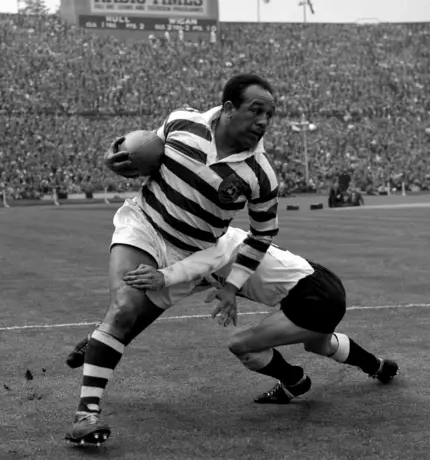
Those who forsook rugby union for league were, before the former went professional in the 1990s, completely ostracised by the RFU. Signing for a league (or, before 1922) northern union club meant a life ban from the RFU. Even playing for an amateur league club carried this penalty. And life meant just that. Retired players who had switched codes were still not permitted to enter union clubs or, indeed, fraternise with union players. Like those poor unfortunates in 1930s Russia who were alleged to have betrayed Comrade Stalin, they were written out of history, or worse.
This happened in Cornwall too. Throughout the history of Cornish rugby, its players who left the Cornwall RFU (CRFU) to join the northern union or rugby league were judged to be beyond the pale and forgotten.
But when you think about it, these men were merely part of that much celebrated phenomenon, the great Cornish migration3. Like the Cousin Jacks and Cousin Jennies who migrated into England or emigrated abroad to find work, so did Cornwall’s rugby codebreakers. They backed their talent and their muscles – just like the others. They left because of lack of opportunity or employment at home – just like the others. They went to countries or regions holding better opportunities – just like the others. They went because they were invited – just like the others.
If Cornwall’s rugby codebreakers cannot be separated culturally from the great migration, they often cannot be separated individually either. Many had emigrated, returned, and then joined the northern union/rugby league, or vice versa.
Some achieved great things as professional rugby players. Some enjoyed solid careers. Some, for various reasons, weren’t quite up to the mark. For a few, misfortune and/or tragedy awaited. But all deserve to be remembered with pride in Cornwall.
This is their story.
These posts are a work in progress. We’ll never definitively know all the names of the players who went north – how many left Cornwall to work in the coalfields, and found themselves playing amateur northern union rugby – but I hope this story will grow with the telling.
William Trembath (1877-1932), Penzance RFC, Newlyn RFC
Three caps for Cornwall, 18964

William Trembath was a vegetable gardener from Newlyn5. As an adult he stood 5ft 3, weighed 12 stone 8 and forswore alcohol. At the age of 13 he emigrated to America and returned when he was 19. Only then did he take up rugby, and must have had some talent. Starting out as a forward with Penzance, he was selected for Cornwall in that position before moving to the threequarters.
With a change of position came a change of club. Trembath made the short trip to Newlyn, helping them to the junior championship of Cornwall in their second season. He was rapidly made their captain.
This move meant his days as a Cornwall player were over. The CRFU were never going to pick a man from the ranks of junior rugby, even one of Trembath’s calibre. Perhaps this made the northern union all the more appealing.
In 18996 he signed to Rochdale Hornets and continued the occupation he had in Cornwall, only now his income was supplemented as a professional footballer. He also moved back to the pack. A dislocated shoulder on debut put him out for several weeks, but he soon made his mark and was appointed the Hornets’ captain too.
Either Trembath was prone to injury, or both versions of the game were remarkably tough in those days. He had another injury to his arm which kept it in a sling, a dislocated ankle, fractured ribs and an indentation on his skull courtesy of a well-aimed boot. Overall, though, his preference was for the northern union:
…it was so fast. It took more out of a man than Rugby football, and it was absolutely essential for any man who would do his duty by his club to train assiduously.
Cornish Telegraph, December 19 1900, p5
In his day William Trembath was the ‘best forward’ Rochdale possessed7, but he returned to Cornwall in 1902. The 1911 census finds him living in Falmouth, and still working as a vegetable gardener. William died in 1932, and was well remembered in Rochdale:
He was a typical Cornishman with the fair complexion and rounded features common to the county and he possessed a winning personality and was a great favourite in whatever company he happened to be.
Rochdale Observer, September 7 1932, p4
(With thanks to Nick Serpell.)
Oliver Triggs (1874-1939), Penzance RFC
19 caps for Cornwall, 1894-1900

Oliver Triggs was born in Cumberland in 1874, the son of a Cornish miner. The family took him back to Marazion to be baptised on the Wesleyan Circuit, and then returned to Cumberland. Aged 26 in 1900, Oliver stood 5ft 10, weighed 13 stone and had served time at Bodmin for assaulting a policeman. He was a forward of some note and a Cornwall regular. He may have also played association football for Cornwall, as a goalkeeper in 18968.
The northern union may have only been in existence for five years, but its talent scouts and agents had already reached west Cornwall. One (very possibly the same man who approached William Trembath) apparently made Triggs an offer he couldn’t refuse in the autumn of 1900, and by November he had left Penzance to join Rochdale Hornets. This was an obvious blow to Cornish rugby, but his friends were unanimous in wishing him
Good luck…
Cornubian and Redruth Times, November 30 1900, p7
Oliver’s time in Rochdale was over before it had begun. By December 1900 he had left, a ‘paper at the time stating he
…had a difference with the committee…
Northern Daily Telegraph, December 29 1900, p3
His obituary, on the other hand, claims an injury put him on the train back to Cornwall. He later served in the Duke of Cornwall’s Light Infantry, but was invalided out in 1916. He became a hotelier, and then a farmer at Crowlas, being remembered on his death as
…probably the best forward Penzance has ever produced…was liked and esteemed by all who knew him.
Cornish Post and Mining News, November 25 1939, p6
(With thanks to Nick Serpell.)
Jack Bray (c1880-1935), Penzance RFC, Devonport Albion RFC
Eight caps for Cornwall, 1898-99
Jack Bray was a threequarter who began his career at Penzance, but would shortly switch allegiance to Devonport Albion9. The Devon club was powerful and prosperous in the early 1900s, being long – and jealously – suspected of luring rugby talent into their fold with assurances of easy money to be had working in the dockyards:
Any good footballer can secure a berth in the Devonport Dockyard…One of the Swansea forwards was offered…£100 a year…and would consent to play for the Albion club…he need not be too clever at his work so long as he played good football.
Lake’s Falmouth Packet, December 8 1900
Bray’s flirtation with the northern union was nebulous, but he certainly joined Rochdale Hornets in 190010. Injury put paid to his professional career, and he emigrated to Johannesburg. The stigma of professionalism followed him to South Africa, and he was barred from joining any union teams. He died there in 1935. Even then, he was remembered as
…one of the finest rugby men produced by Penzance.
West Briton, September 26 1935, p3
Tommy Brice (c1885-1963), Falmouth RFC
Four caps for Cornwall, 1907-08
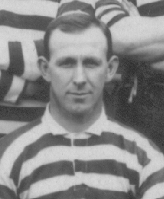
Tommy Brice was an engineer from Falmouth and a talented scrum-half, the ‘nippiest’ in Cornwall, by the estimation of one pundit11. The early 1900s, though, was not the time to have serious designs on that position for Cornwall. The diminutive St Ives player Thomas ‘Chicky’ Wedge was in the ascendant throughout the decade, and went on to win two England caps12.
For example, when Cornwall hosted the South Africans in December 1906, Tommy was a reserve, while Wedge got the honours. His chance came in early 1907. Wedge’s England debut against France clashed with Cornwall’s fixture at Gloucester, and Brice contributed to a fine 13-6 victory. Even then he was damned by faint praise. Tommy
…made a capital understudy for Wedge…
Cornishman, January 10 1907, p3
Tommy filled in for the next fixture against Devon when Wedge was injured, but was always going to be a stopgap. Similar happened against Somerset at Taunton in November 1907; then against Devon at Camborne in December 1908, Tommy was the second-choice replacement for James ‘Maffer’ Davey13. A season later, and with no further honours, Tommy had probably had enough. By autumn 1909, he had signed for Oldham. He was handed a tough baptism against Salford:
Brice did not prove convincing at half-back. He was up against a hot scrummage worker, and the Cornishman did not shine.
Royal Cornwall Gazette, September 16 1909, p7
As in Cornwall, so it was to be in Oldham. Tommy made less than 30 appearances for the senior team between 1909 and 1914, but did become skipper of their ‘A’ side14.

Always a fringe player, the 1921 census finds him married and working as a tool fitter in Oldham. He died there in 1963.
Harry Launce (c1886-1963), Camborne RFC
One cap for Cornwall, 1911

The surname Launce is rather well known in Salford. William Henry Launce was a engineer from Devonport who came to Camborne in 190616. Standing at 5ft 6, he found his way barred to becoming Cornwall’s premier full-back by none other than John Jackett, and would find himself chosen as a reserve, hoping against hope that his chance would materialise17.
Opportunity only came knocking in early 1911, when wing Barrie Bennetts was unavailable for the fixture against Devon. Jackett slotted into the centre, paving the way for Launce to make his debut, but he had little to do as Cornwall went down 6-0 in a Devonport mud bath. By August that year, he had signed terms for Salford18.
Salford had conducted a nationwide search in their quest for a new full-back; in other words, Launce was probably second only to John Jackett in the entire country, not just Cornwall. As such, he probably wasn’t cheap, but Salford were right to back their hunch. Between 1911 and 1920 Harry made over 250 appearances for the club, including 87 during the war. His finest hour came against Huddersfield in the northern union league final in 1914. Harry had to leave the field with a nasty rib injury, but bravely returned and made a last-minute, try-saving tackle to give Salford their first-ever league victory, 5-319.
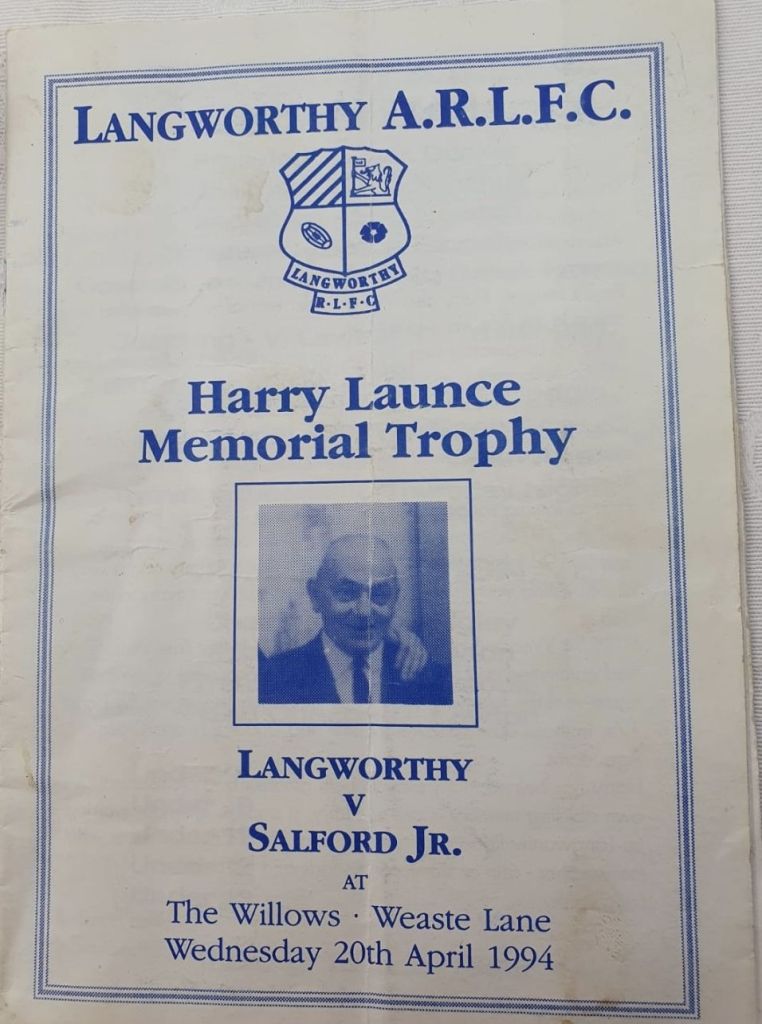
In the early 1930s, Harry founded the amateur rugby league club Langworthy Reds. Over the years this has acted as a feeder team for the parent club in the area, Salford, and Harry himself maintained strong links with his old team. Even in the 1950s, you could find him selling tickets on match days. He died in 1963, but that was not the end of the Launce family’s connections to rugby league in Salford20.
Harry’s son, Harry Jnr became a Langworthy stalwart. On his death in 1992, a memorial trophy was commissioned and matches were played in his memory21. To this day he is remembered with great fondness. Here’s what a local man, Alan Gordon, had to say:
…he was a massive part of its history, encouraging hundreds of youngsters to get off the streets and play rugby…
Many in Salford expressed similar sentiments. That’s quite a legacy.
John Jackett (1878-1935), Falmouth RFC, Leicester RFC
52 caps for Cornwall, 1898-1911
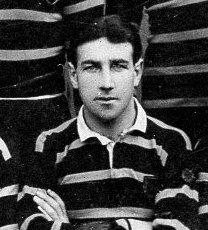
John Jackett is not only a Cornwall rugby great, but one of Cornwall’s greatest sportspeople. Correspondingly his life is well documented23.
Blessed with matinee-idol looks, in his youth he was a model for the artist Henry Scott Tuke. Before finding fame as a rugby player, he was a champion racing cyclist during the sport’s pioneering years. When a Leicester RFC full-back, he led Cornwall to their 1908 County Championship triumph, and was also at the helm when Cornwall represented Great Britain at that year’s Olympic Games24. He won 13 caps for England, and was a playing member of the gloriously shambolic 1908 British Lions tour to New Zealand and Australia.
Yet Jackett was a controversial figure. A scandal with an unmarried Falmouth girl resulted in him spending a year as a Cape Mounted Policeman in the Boer War. He was also long suspected of playing rugby union for financial gain. Falmouth and Leicester may have been his principal clubs, but he also represented Penzance, Devonport Albion and Plymouth, with many accusations of him being ‘induced’ to do so. Indeed, the RFU investigated Leicester’s accounts when Jackett was with them, but decided to find nothing untoward. The RFU President resigned in disgust. He criticised in print the England and British Lions’ woeful lack of preparation and found himself frozen out as a consequence.
In late 1911 he signed for the northern union club Dewsbury, and many saw this as an attempt by Jackett to cash in (legitimately) on his name with an unfashionable side while he still had gas in the tank. In fact, he was instrumental in Dewsbury’s first Challenge Cup success in 1912. His opposite number in the second round against Salford was none other than Harry Launce; Jackett was still judged the latter’s superior.
Contentious to the last, he may have attempted to recruit Cornishmen for the northern union himself, and Cornish ‘papers reported on how he believed the northern game ‘superior’ to its southern variant25.
Only two men have ever captained a XV to the County Championship, played for the British Lions, and won the northern union/rugby league Challenge Cup26.
John Jackett is one of them. But you can search in vain for his involvement with professional rugby in the CRFU’s official history27.
Tom Morrissey (c1888-1953), Camborne RFC
Five caps for Cornwall, 1911-12
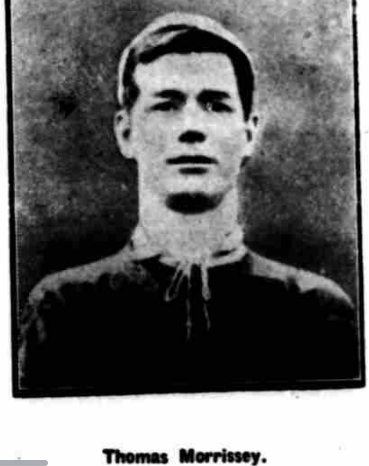
Tom Morrissey, whose parents hailed from Tipperary28, was a miner who stood 6ft and weighed 14 stone. This made him one of the biggest men around, and he needed to be. Many a Saturday night in Camborne was spent brawling with those who sought, unwisely, to mock his Irish roots.
As it was on the streets, so it was on the pitch. His disciplinary record wasn’t the best before that fateful match at Redruth in spring 1912, when constant, racist barracking from the home faithful caused Tom to drop his shorts and bare his arse to Hellfire Corner. What was a bad-tempered fixture degenerated into a mass brawl on the pitch at full-time involving players and fans both.
Nobody was condoning Tom’s actions, but at a Redruth-dominated CRFU meeting, Camborne’s representatives condemned the home crowd’s provocation of their big forward, but to no avail. Tom was suspended for a draconian two years. Nobody seems to have been surprised when he signed for Rochdale Hornets over the summer.
Being feted on his arrival in the town for his size and obviously uncompromising character, Tom struggled to make his mark. His outings were largely confined to the ‘A’ team, until 1914 when a knee injury turned septic and required an emergency operation.
The joint was left permanently stiff, and his playing days were over. He lived on in Rochdale, working as an iron driller. Relatives in Cornwall remember him as a quiet, softly-spoken man.
Sam Carter (c1888-1967), Camborne RFC
Six caps for Cornwall, 1909-11

Sam Carter was not as big a man (5ft 9, 12st 7) as his Camborne team mate, Tom Morrissey, yet he was probably just as unflinching a character29. A miner who was one of an astounding 32 siblings, he had worked in America and British Columbia before returning to Cornwall. On the rugby pitch Sam had begun life as a threequarter before moving to the pack, and was regarded as one of Camborne’s up and coming stars, being tipped for a bright future.
All that changed in April 1912.
In that very same match against Redruth where the crowd provoked Tom Morrissey beyond all reason, Sam had issues of his own. He laid a Redruth player out cold on the field (in fact, this player was in the act of assaulting Morrissey when Sam intervened), and then threatened the referee with similar treatment if he ordered him off the pitch.
Suspended for three months in the aftermath, he took the same option as his team mate and joined Rochdale Hornets. Where Tom struggled, Sam had a successful career, and was reckoned within an ace of international recognition in the 1913-14 season. He built up a fearful reputation as a loose forward with formidable all-round skills, but was unfortunate that the Hornets’ Challenge Cup triumph in 1922 came too late in his career for him to play a full part.
Sam’s story is one of self-improvement.

No longer a scrappy, tough-as-hide miner, Sam became a publican and in 1932 stood, unsuccessfully, as the Conservative candidate for Rochdale’s Castleton East district. As he himself said,
…Rochdale had been good to him, and it was his desire to do something for the town of his adoption.
Rochdale Observer, October 26 1932, p4
Sam and his wife moved back to Camborne, where he died in 1967. His house at Treswithian was named Buersil, after an area of Rochdale. He never went to watch his old union club play.
Jack Thomas (c1885-1972), Devonport Albion RFC
21 caps for Cornwall, 1896-1910

Arthur John Thomas was the last surviving member of the 1908 County Championship winning XV. Though born in Penryn, he never actually played for the town, representing Devonport Albion for his entire senior career. His obituary noted he was a
…a robust forward with great speed and a tremendous tackler…
West Briton, April 13 1972, p20
His life was an eventful one. He had emigrated to America, was a strong swimmer and runner, and had served in the Royal Navy. During World War One he was in command of a machine gun corps on the Somme, where he was wounded.
Injury sustained during an international trial spoilt his England chances, and he signed for Dewsbury in 1913, eventually making 50 appearances for the club. One may suspect the hand of John Jackett here; the men played for Cornwall together, and Jackett of course represented Dewsbury himself. Jack later returned to Cornwall, managing a theatre in Falmouth31.
Harold Thomas (1894-1954), Penryn RFC
Uncapped
Harold Thomas’ treatment by the CRFU and RFU was a disgrace, but it must be observed that rugby football was not his primary sport.
A baker by trade, Harold’s main game was boxing. He was Cornwall’s one-time middleweight champion, and when with the Army of Occupation in France during World War One, fought his way to the top there too32.
He was clearly not a man to be troubling with; in 1922 he was fined for assaulting a man at a dance in Truro. The police had to drag him off his victim. On hanging up his gloves he became well known in the fight game as a promoter, organising bouts throughout the 1930s, 40s and 50s33.
Finding himself out of work on discharge from the Navy in 1914, he travelled north to Dewsbury, taking up amateur northern union rugby. A centre of some note, he came to the attention of Dewsbury club itself, and signed for them professionally in 1914, yet only played a handful of matches before joining the Royal Flying Corps34.
He transferred to the military and saw action in France, Belgium and Germany. Demobbed in 1920, he returned to Penryn, taking up rugby union football, yet keeping his professional rugby past a secret35.
Somehow the CRFU’s suspicions were aroused, and they contacted Dewsbury, who denied that Harold had ever played for them. It was John Jackett, however, who blew his cover, stating that he and Harold had played games for Dewsbury together36. Quite what Jackett’s motivations were is unclear, but the CRFU had no choice but to suspend Harold.
(The CRFU, curiously, never had any objections to Harold Thomas’s career as a professional boxer37.)
Penryn RFC sent a petition to the RFU, and Harold appealed too. He had been under the impression that amateur and professional rugby distinctions had been relaxed during the war (which was certainly true), hence he felt he had no real obligation to mention his playing for Dewsbury.
The CRFU passed the whole affair on to the RFU for adjudication, which it duly did. In March 1923 it was announced that Harold’s amateur status would not be reinstated38.
You can examine the careers of the later Cornish codebreakers in part two, by clicking HERE.
Many thanks for reading; follow this link for more top blogs on all things Cornwall: https://blog.feedspot.com/cornwall_blogs/
Do you enjoy my work?
All content on my website is absolutely FREE. However managing and researching my blog is costly! Please donate a small sum to help me produce more fascinating tales from Cornwall’s past!
Your contribution is greatly appreciated.
DonateReferences
- See: https://www.bbc.co.uk/news/articles/cz0d5zr2g20o
- A Social History of English Rugby Union, Routledge, 2009, p120.
- The ‘pull’ factors of emigration in the earlier 1800s (Cornish mining expertise being sought after in new ventures overseas) contributed to the ‘push’ factors which became more evident later in the century. As the foreign mining industry, assisted by Cornish know-how expanded and prospered, so this led to an economic depression in Cornwall itself and accelerated the cult of migration. Furthermore, a global market factor – the copper crash of the 1870s – spelt the beginning of the end for Cornwall’s primary industry. Leaving Cornwall to find work became a way of life that would only begin to abate with the outbreak of World War One. The figures are staggering. Between 1840 and 1900, 240,000 Cornish went overseas. An additional 230,000 left to find work in England and Wales. Between 1861 and 1900, over 44 per cent of Cornwall’s male population aged between 15 and 24 left its shores. A further 29 per cent of this age bracket went north of the Tamar. From: Philip Payton, The Cornish Overseas: The Epic Story of the ‘Great Migration’, Cornwall Editions, 2005, p28.
- All players’ appearances for Cornwall are, by and large, from: The First Hundred Years: The Story of Rugby Football in Cornwall, by Tom Salmon, CRFU, 1983. Salmon’s records state that Tommy Brice debuted in 1906 (it was 1907, and he played thrice not once), and Harry Launce in 1910 (it was 1911).
- An interview Trembath gave for a northern ‘paper was reprinted in the Cornish Telegraph on December 19, 1900, p5. England and Wales, Civil Registration Birth Index 1837-1915, vol. 5c, p281.
- Rochdale Observer, November 4 1899, p5.
- Cornish Telegraph, November 28 1900, p8.
- England and Wales, Civil Registration Birth Index 1837-1915, vol. 10b, p267, 1881 census and https://www.cornwall-opc-database.org/search-database/more-info/?t=baptisms&id=7276540. His assault is noted in the Cornishman, March 18 1897. Triggs’ vital stats are recorded in the Manchester Courier, November 26 1900, p9. A Cornish association side met Penzance in March 1896: Cornishman, March 26 1896, p6.
- As noted in the Cornishman, December 22 1898, p6.
- Yorkshire Post and Leeds Intelligencer, September 3 1900, p6.
- 1911 census; Lake’s Falmouth Packet, September 14 1906, p8.
- For more on Wedge, see: https://en.wikipedia.org/wiki/Thomas_Wedge_(rugby_union)
- Cornish Telegraph, December 20 1906, p5; West Briton, January 21 1907, p3, November 4 1907, p3 and December 7 1908, p3.
- From: https://orl-heritagetrust.org.uk/player/tommy-brice/
- Image from: Graham Morris, Salford Rugby League Club: 100 Greats, NPI Media, 2001, p78.
- 1911 census; West Briton, January 10 1907.
- Graham Morris, Salford Rugby League Club: 100 Greats, NPI Media, 2001, p78; the Commercial, Shipping and General Advertiser of November 18 1910 lists him as a reserve to Jackett.
- Cornishman, January 19 1911; West Briton, August 17 1911.
- Graham Morris, Salford Rugby League Club: 100 Greats, NPI Media, 2001, p78.
- Green Final (Oldham Evening Chronicle Sports Edition), March 8 1958, p7 (https://orl-heritagetrust.org.uk/app/uploads/2019/12/greenfinal_1958-03-08.pdf); Manchester Evening News, 20 Dec 1980, p4; England & Wales, Civil Registration Death Index, 1916-2007, Vol. 10f, p500.
- Manchester Evening News, August 8 1992, p9; Salford City Reporter, 28 April 1994, p87.
- Image from: https://www.crfu.co.uk/home/gallery/
- I’ve produced an extensive study of Jackett’s sporting career, which can be found here: https://the-cornish-historian.com/2024/06/29/in-search-of-john-jackett-king-of-cornish-sport-part-one/
- For more on Jackett’s crucial role, see: https://the-cornish-historian.com/2025/03/28/1908-and-all-that/
- West Briton, January 15 1914, p3.
- The other is Tosh Holliday: https://en.wikipedia.org/wiki/Tom_Holliday_(rugby)
- That being: The First Hundred Years: The Story of Rugby Football in Cornwall, by Tom Salmon, CRFU, 1983.
- Morrissey’s story is studied in more detail here: https://the-cornish-historian.com/2024/02/03/the-great-cornish-rugby-split/
- Carter’s story is studied in more detail here: https://the-cornish-historian.com/2024/02/03/the-great-cornish-rugby-split/
- Image from: https://www.crfu.co.uk/home/gallery/
- West Briton, April 13 1972, p20; https://dewsbury-heroes.co.uk/player/220/
- West Briton, February 11 1954, p11.
- West Briton, May 15 1922, p3; February 11 1954, p11.
- Cornishman, April 5 1922, p3; https://dewsbury-heroes.co.uk/player/240/. That Thomas was a centre in noted in the West Briton, January 13 1921, p3.
- Cornishman, April 5 1922, p3; West Briton, February 11 1954, p11.
- West Briton, February 23 1922, p5.
- That Thomas boxed as a pro is noted in the West Briton, May 15 1922, p3.
- Cornishman, April 5 1922, p3; March 14 1923, p6.
 Francis Edwards ~ The Cornish Historian
2 thoughts on “Cornwall’s Rugby Codebreakers: Part One”