
Reading time: 20 minutes
… the town even had a club called ‘The Unemployed RFC’ …1
The Black and the Gold: The Story of Cornish Rugby, by Nick Serpell and myself, will be published in autumn 2027. This post complements our chapter on Cornish rugby between the wars.
An unemployed rugby team?
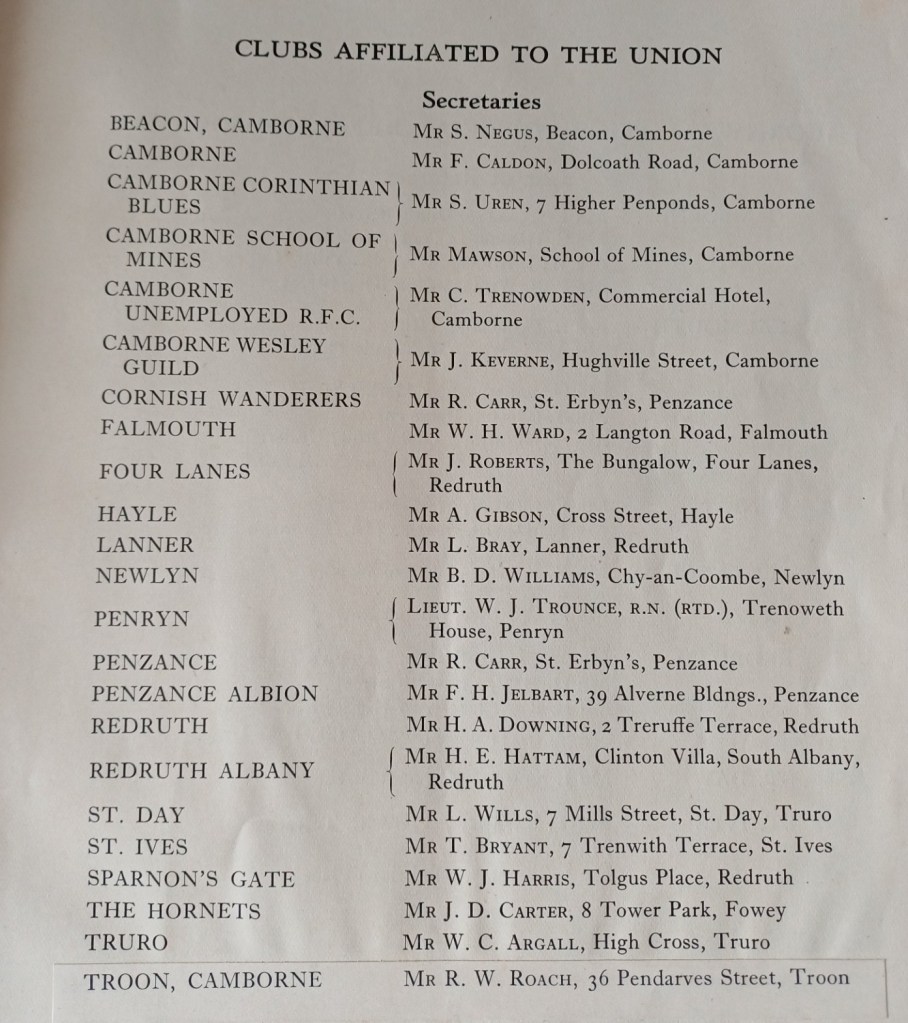
The above image is taken from the Cornwall RFU’s (hereafter: the CRFU) 1934/35 season handbook. Although we may sadly reflect on the fact that many clubs listed are no longer in existence, Cornish rugby nowadays stretches from Land’s End to the Tamar and is no longer confined to a few localised pockets.
For me, the name of one long-defunct club raises more eyebrows than the others: Camborne Unemployed RFC. The rest were all formed around a town or village, or around a certain belief, such as the Camborne Wesleyans. The Cornish Wanderers were an invitation-only club who also purported to serve a higher purpose:
to improve the spirit as well as the play of Cornish Rugger … and so eliminate any undesirable form of play from the game.
Cornishman, 3 Sep 1931. Page five
Rugby clubs had also commonly formed around a certain profession. Before 1900 you had the Camborne Butchers’ XV, and the Camborne Shop Assistants RFC.2 But here, in the Unemployed RFC, was something unheralded: a club formed for men who had no collective identity other than that of being out of work.
This had never happened in Cornwall before, and has only happened once since, when the employment training agency Direct Mission had a team in the mid-1990s. Additionally, Cornwall had not one but two unemployed rugby clubs. I can find only one other unemployed rugby club operating in the 1930s, and that was in Neath.3
Cornwall’s unemployed sports’ clubs were not confined to rugby. I can’t find an unemployed cricket XI, but in 1933 there was talk of a whole unemployed football league being formed in the St Austell area. This venture appears to have been stillborn, but nevertheless an unemployed soccer team was active in the Bodmin region during the 1930s.4
Let’s return to unemployed rugby, and our first clue: the CRFU’s list of affiliated clubs in 1934/35. The other thing that strikes us about the Camborne Unemployed RFC is their level of organisation. They were members of the game’s governing body. They had a base – Commercial Hotel. They had a secretary: the 1939 England and Wales Register lists Charles Trenowden as an iron foundry labourer. Clearly this wasn’t an entity as casual as a group of men, out of work and bored, kicking a ball around a field and half-jokingly describing themselves as the ‘Unemployed RFC’.
If Camborne Unemployed RFC was set up on similar lines to other, more conventional Cornish rugby clubs, then we may infer they also operated similarly. They must have had a squad, a ground, a committee, training sessions and a fixture list. They must have had – and this is not something you’d generally associate with the unemployed – some kind of financial backing.
The biggest question to ask however is this: why did unemployed rugby clubs come to exist in Cornwall at this moment? One reason is economic, the other social.
Evil, but inevitable
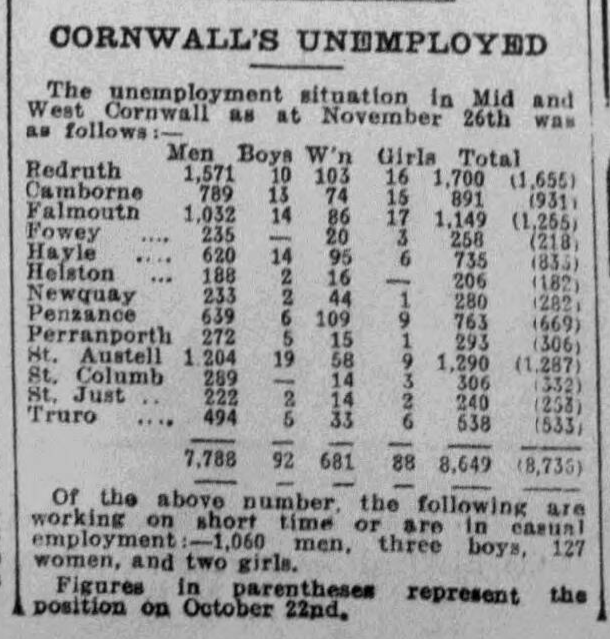
The above table shows the total number of unemployed people in mid and west Cornwall (St Ives excepted) in November 1934. Of that total, 8,649, it states that 1,192 are either employed casually or on short time. So, 7,457 people were definitively unemployed.
No corresponding figures for east Cornwall have been found, but in 1933 2,085 people were out of work in Bodmin, Bude, Callington, Camelford, Gunnislake, Lanuceston, Liskeard, Saltash, Torpoint and Wadebridge.5 Let’s say 2,000 for east Cornwall, and 7,400 for mid and west Cornwall.
For Cornwall as a whole, this gives us a rough unemployment figure of 9,400 (out of a population of approximately 317,9006) at around the time unemployed sports’ clubs were coming into existence.
To put this into perspective, Cornwall’s population at the end of 2022 has been put at 568,210. In December 2023, the Cornish unemployment figure was at 7,400.7 There are lies and damn lies, but one doesn’t need the exact figures to realise that 1930s Cornwall must have been a desperately tough place to live.
It was tough pretty much everywhere else, as the effects of the Wall Street Crash began to get a grip. In 1931 the UK’s total unemployed hit 2.5 million – in December 2025 this figure was 1.88 million.8
In 1934 the Government identified four ‘special areas’ (Scotland, South Wales, West Cumberland and Tyneside) where industry had collapsed and required emergency grants. The Cornish press campaigned for Camborne and Redruth to receive similar treatment. One imagines many communities felt the same.9
What all this means is that, for practically the first time, ‘the unemployed’ almost became a distinct social class of their own. In Cornwall it wasn’t just the miners and the clayworkers who were on the dole, or just Camborne, Redruth and St Austell where economic depression was rife, as it had been in the early 1920s. Now the unemployed were everywhere, even, as the above table shows, in Newquay, whose popularity as a resort increased throughout the 1930s.10 No government scheme or socialist utopianism would make unemployment miraculously disappear. As A. J. P. Taylor stated:
unemployment was an evil, but inevitable …
English History 1914-1945. Clarendon Press, 1986. Page 270
Cornwall’s unemployed could read in the Cornishman of how their brethren had gained another 84,000 members throughout the land in a single month.11 They could also hear of ‘increasingly ugly’ criticism of the Government by their opposite numbers in South Wales.12
The unemployed had their own movement: the National Unemployed Workers’ Movement (NUWM). They even had their own literature, such as Walter Greenwood’s 1933 classic Love on the Dole, or George Orwell’s The Road to Wigan Pier (1937). They were the subject of campaigns by the Labour Party, trade unionists, the Communists and the Independent Labour Party (ILP). Besides being out of work, the unemployed had a focus for their discontent: the Government’s incredibly unpopular Means Test policy, introduced in 1934, relieved men of their benefits if other household members were in work. Newquay’s branch of the Labour Party described the test as an ‘inhumanity and injustice’ in 1935.13
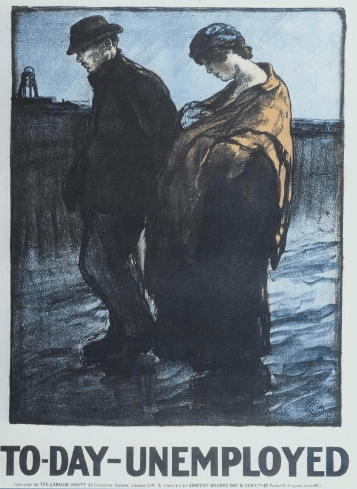
The situation in Redruth could have been lifted straight from the pages of Greenwood or Orwell. Men littered the streets, with nothing to do except hug the walls ‘for shelter’. All they had ever known was the dole:
scores of young men who have never done a day’s work in their lives, while there are also hundreds of middle-aged or older men who will never work again.
St Austell Gazette and Cornwall County News, 4 Jan 1933. Page eight
This was the problem: being unemployed was no longer an unpleasant but hopefully brief prospect. In 1930s Cornwall, there was a serious danger that you would spend your entire life on the dole.
In 1932 the Hayle branch of the NUWM protested at the treatment of that town’s unemployed, citing ‘undernourished’ and ‘scantily clad’ women and children.15 A year later Helston’s NUWM organised a march in protest at the Means Test. An ILP candidate stood for election to Truro council, appealing to the unemployed to vote him in.16
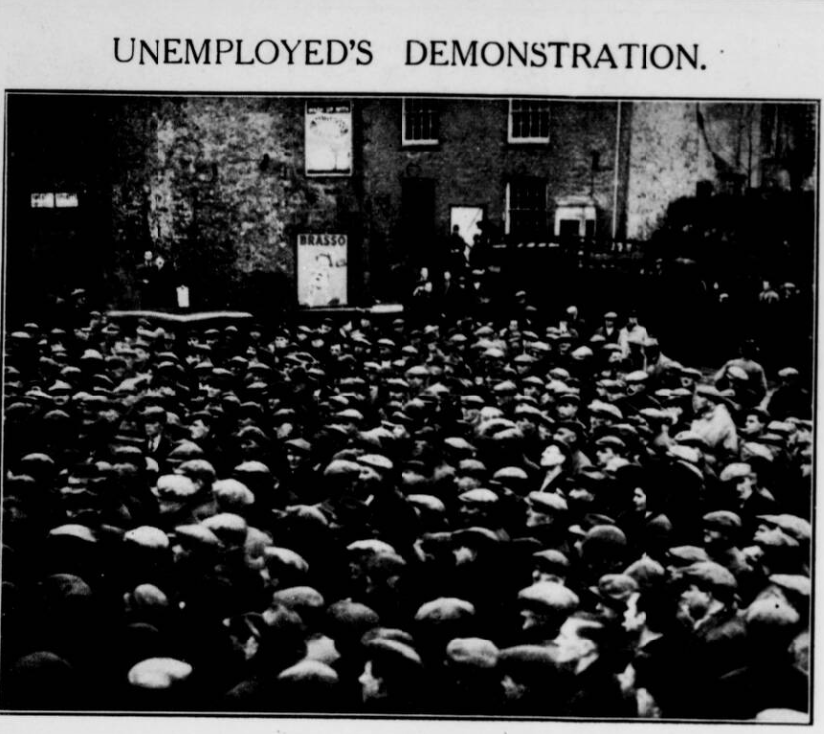
In 1933 the NUWM and ILP of Camborne and Redruth combined to hold a demonstration against the Means Test, war and fascism.17 Another march took place there in 1935:
The authorities were appreciably wary of all this unrest. In 1938 Bodmin’s Conservative MP attacked all ‘left-wing’ movements (which for him meant anything and anyone to the left of the Tories) as tools of the Communistic world design:
All the woes of scarcity, poverty and perhaps even of hunger were then exploited to the full … Arising out of that discontent was encouraged … action in the form of riots.
Newquay Express and Cornwall County Chronicle, 17 Feb 1938. Page six
The unemployed here were less people than stooges of the revolution. Love on the Dole may have been a bestseller and a hit play, but its subject matter, including a police baton-charge on a group of unemployed protestors, was controversial. The novel had in fact been banned in several countries, and plans to make it into a film were constantly thwarted by the censor until 1941. The author, Walter Greenwood, then resident in Polperro, was dumbfounded:
Why the ban? The theme of unemployment?
Daily Herald, 27 Feb 1940. Page five
Cornwall’s cinemagoers could finally watch Love on the Dole at the St Austell Odeon in late 1941, but by then life had already imitated art. In 1939 striking miners at South Crofty, Camborne had been the target of their own police baton-charge.18
Luckily, not all took such a dim view of the ‘inevitable evil’ of unemployment. Many tried to help.
The social service movement
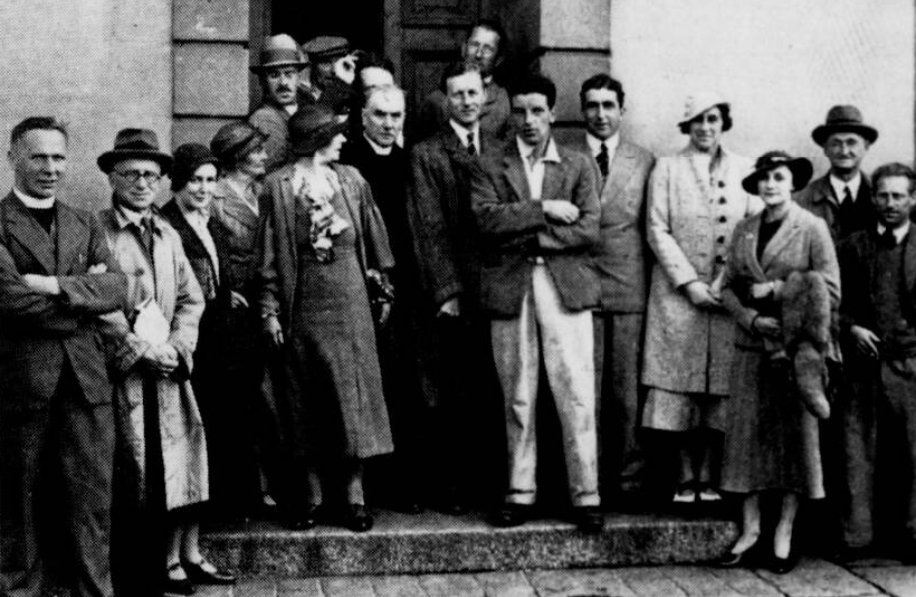
In early 1934 Edward, Prince of Wales spoke to the nation over the wireless. His concern was ‘the intolerable nightmare of unemployment’, and what could be done about this ‘national emergency’:
if everyone were to take some small piece of voluntary service … a determined and sustained effort in the years to come … creating a new spirit of good fellowship amongst all sorts of conditions of men and women …
BBC Archive, 202419
Edward wasn’t talking into the ether, and he had made a similar appeal a few years earlier. His words, coupled with the UK’s dire economic situation, reinforced the efforts of the National Council of Social Service, which had been formed in 1919.20 This meant that, when the Depression hit, there was already a national infrastructure of people willing to undertake voluntary social work and aid the unemployed.
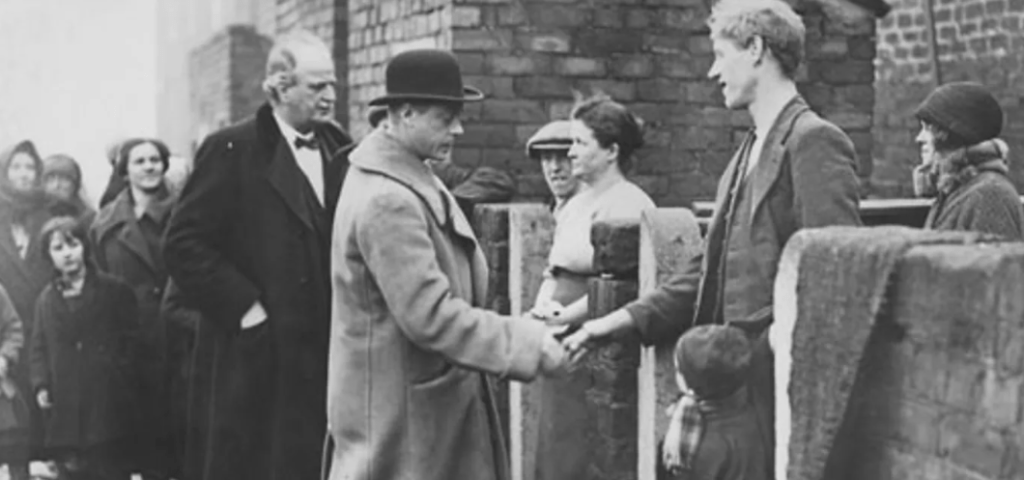
Cynics may argue that having the unemployed occupied with things other than protest marches and left-wing politics was the best way of keeping the peace. Yet everywhere, even in Cornwall, various councils and committees looked to the unemployed to complete various schemes.
Helston Cricket Club’s new pavilion was built, at the behest of the town council, by their unemployed men. Victoria Park, Nanpean, the home of Nanpean Rovers RFC, was once a china clay pit reclaimed by the efforts of the out of work. Labour had commenced there under the auspices of the local social service committee. This new movement – the social service movement – was gathering momentum.21
Falmouth’s centre was at the local YMCA, and many destitute families went there over Christmas 1934 for bags of kindling. St Austell’s centre had a market garden maintained by their unemployed men, and by 1937 they were being taught upholstery. A children’s playground at Lanner was completed thanks to a grant from the National Social Service Committee – and the labour of the village’s unemployed.22
The Whitemoor Institute, which opened in 1934, was built by the graft of men on the dole:
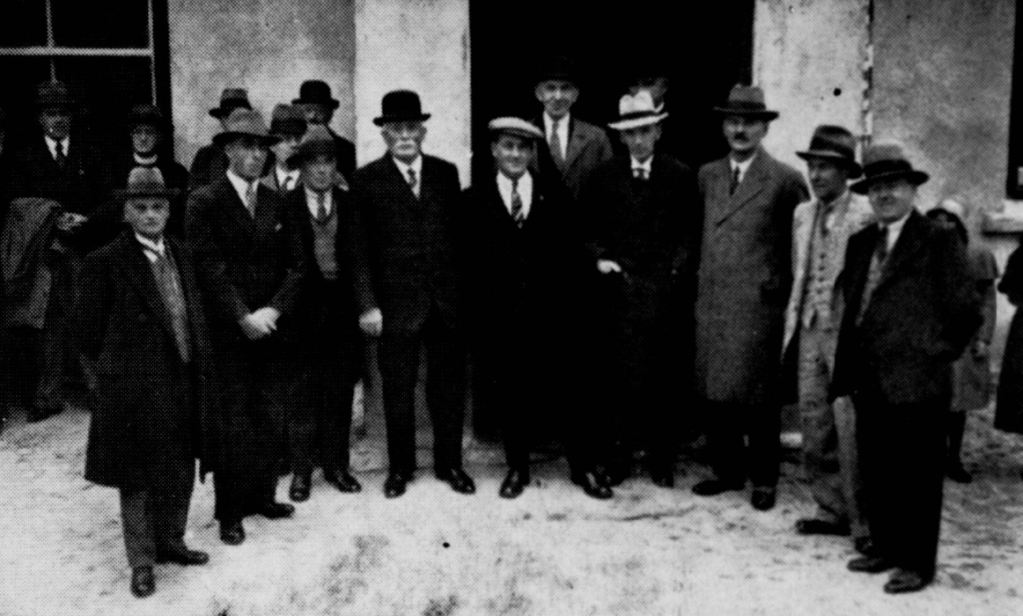
The people who ran and assisted these centres did so voluntarily. Those who attended, though they could expect to be fed and watered, also gave their time and efforts of their own volition. But the growing of vegetables, the mending of shoes , hewing of logs and building work made direct and worthwhile contributions to their local communities. When Truro’s Social Service Centre reopened in 1936, the obvious was stated:
Every time I have been there I have found the men working, which is infinitely better than that they should be standing on street corners.
West Briton, 3 Sep 1934. Page four
As a counterpoint to what Edward, Prince of Wales would have termed this ‘good fellowship’, not all areas were as fortunate as the ones described. In November 1935 there were around 600 people out of work in the Penzance district, but nobody there was prepared to help.23 The unemployed were allowed cut-price admission to many sporting events, but this was a privilege frequently abused. When Cornwall took on the Police RFU’s XV in 1933, the CRFU resolved to:
admit the unemployed at half-price but not to advertise the fact.
CRFU Committee Minutes, 14 Oct 1933
Additionally, many out of work men, with a sense of misplaced pride, avoided the social service centres as they believed to do so would affect them with the canker of ‘charity’.24
In short, you needed dedicated volunteers, from all walks of life, to make a social service centre work. For a time, one of the better-organised ones was in Camborne.
Rugby on the dole
The new centre, based at the Commercial Hotel, had considerable backing.25 The hotel itself needed it: extensive cleaning and renovating was required to make it fit for purpose, which gives us some notion of how destitute Camborne was in the 1930s. I mean, imagine an empty and rundown hotel in Newquay.
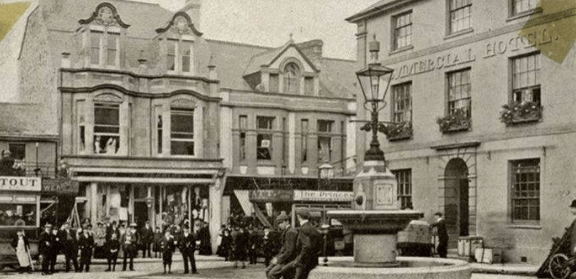
The chairman of Camborne’s major engineering firm, J. Leonard Holman, and his wife, Gladys, were behind the venture from the start. Gladys in particular was tireless as the centre’s secretary, with her influential husband ensuring the Commercial had a plethora of departments and activities on its opening in September 1934.
There was boot repairing, woodwork and handicraft classes. An allotment garden scheme was planned in conjunction with the Society of Friends. Ambulance training was touted. The education class had 30 willing members. In the first instance, there was a physical training class. Open five days a week, the centre must have been a hive of activity.
Almost immediately, and perhaps inevitably, there was talk of a rugby club for the unemployed. Every community needs its representative team. In fact, there was already an unemployed XV in existence – and it had been instigated by the out of work themselves.
Back in November 1933 the Camborne Unemployment Committee noted ‘the unemployed’ wished to form their own rugby club, and appealed on their behalf for jerseys and a ball. From this point, things moved quickly. On Thursday, 4 January 1934, St Austell-based Hornets RFC took on the Unemployed RFC at Camborne’s Recreation Ground. The home XV won, 6-3.27
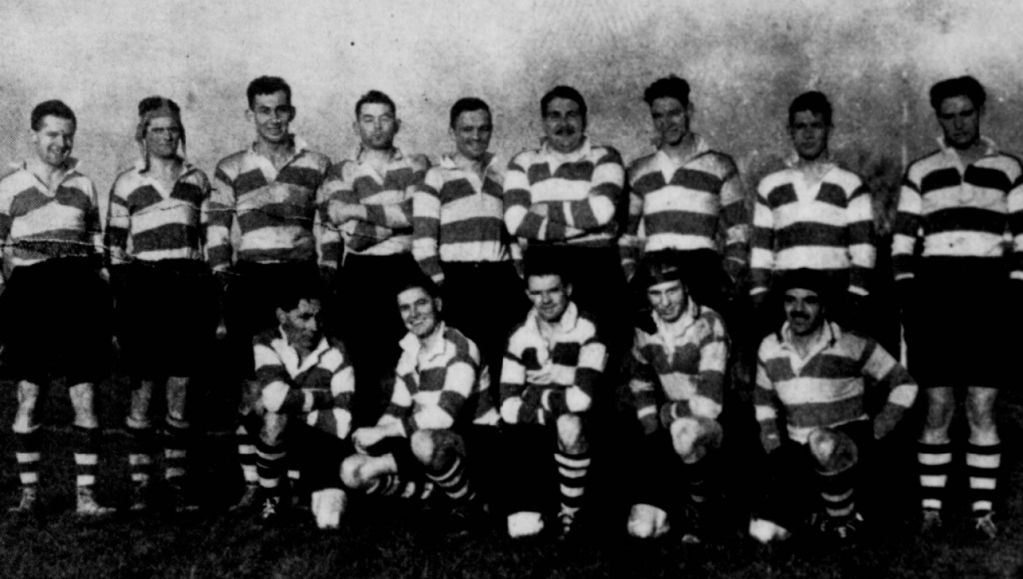
News of this new team in Camborne pricked jealous ears in nearby Redruth. Not to be outdone, by February 1934 the Redruth Unemployed RFC had been founded. Before you ask, it’s unclear if the two teams actually played each other.28
As noted earlier, an individual’s sense of unemployment was often one of permanency in 1930s Cornwall. ‘Unemployment’ on a grand scale was perhaps here to stay, a ‘chronic condition’, noted one journalist, and maybe explains why sports’ teams formed by those and for those on the dole occurred during these years. They certainly had as much, if not more, staying power than teams formed around fading industries. For example, Porkellis United RFC, a mining team, only lasted four seasons, from 1929/30 to 1932/33. Redruth Unemployed were still playing in 1938.29
Gradually Cornwall’s two unemployed rugby clubs came to be associated with their respective towns’ social service centres until, in time, reports referred to them as the ‘Social Service’ RFCs. Camborne Unemployed RFC could boast J. Leonard and Gladys Holman as president and vice-president. Probably as a direct result, Camborne RFC allowed the Unemployed use of their pitch, changing rooms and baths on Thursdays (match days) free of charge.30
What was the relative standard of these teams, on Cornwall’s junior rugby circuit? Though reports are scarce, there are clues. Camborne Unemployed travelled to Liskeard on Boxing Day 1935 and lost 20-8. It was noted to be their first defeat of the season, though it’s unclear how many matches they had played by that point. Their 29-strong squad numbered erstwhile Camborne RFC players, such as the Boase brothers, Hannibal John and William James.31
Perhaps the most talented of the Camborne Unemployed’s ranks was their Welsh full-back, Cliff Ford. In 1927 he had skippered Pontypool to victories over the New Zealand Māori XV and the New South Wales Waratahs, feats remembered and celebrated in the town to this day. Before leaving Pontypool due to lack of work and a smallpox epidemic, Cliff had been Wales’ reserve 15.32
Cliff found work at Camborne’s New Dolcoath/North Roskear mine, but of course this venture had been abandoned by 1930. Small wonder he was active with Camborne Unemployed RFC, as well as with the town’s senior club. He died in Bristol in 1953, and if you ask anyone in Pontypool, Cliff Ford was one of the great uncapped Welsh players.33
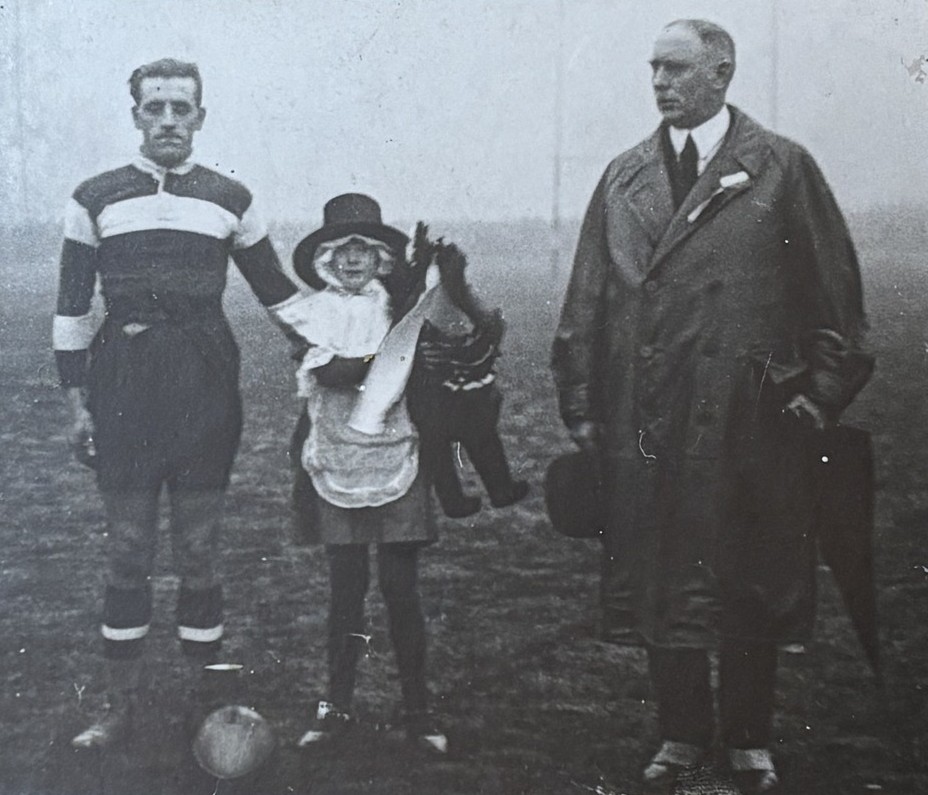
Despite all the good intentions and inclusiveness of the social service movement and their rugby teams, it was hard, nay impossible, to negate the competitive nature of Cornish rugby. After Camborne Unemployed lost at Liskeard in December 1935, for the return fixture those at the town’s Social Service Centre pulled out all the stops. In the process, maybe they forgot what they had set out to achieve – the spirit of good fellowship, as the Prince of Wales had it. Nine regular Camborne RFC players were called up, and who cared if they were on the dole or not. Even Redruth’s British Lion full-back, Roy Jennings, guested.
Liskeard won, 6-3. Maybe it served Camborne Social Services right.34
Disbanded
What caused the end of the unemployed rugby clubs? Fixture limitations must have been a factor. Although Camborne Social Services played (and beat) Redruth Highway on a Saturday in 1936, for the most part unemployed rugby took place on a Thursday. The clubs’ pitches and facilities which the unemployed teams borrowed would have had their own matches on a Saturday, with their own followings, and no club, however benevolently-minded, could be expected to take their generosity that far.35
Redruth Social Service were practically forced by this state of affairs to play Redruth Wanderers in 1938. The latter club were made up of shop assistants, who, by dint of their professions, could only play on Thursdays, which was early closing day. Even the Wanderers’ annual dinners took place on a Thursday.36
If it was unemployment that brought these clubs together, then it was employment, perhaps thankfully, that could break them up. As men found work (or left the area in search of work), they would leave the social service centres too. The 1939 England and Wales Register lists the Boase brothers, for example, being employed as labourers.
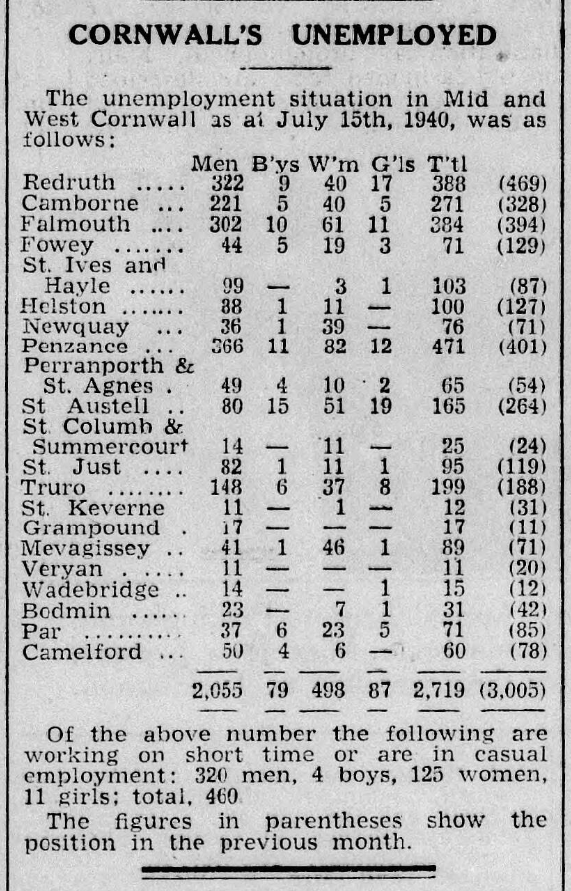
What ultimately put paid to sport on the dole – and the sufferings of mass unemployment in general – was the outbreak of war. As the above table shows, by August 1940 there were 2,700 unemployed people in mid and west Cornwall, compared to 8,640 in 1934. The Means Test in its most despised form was also abolished during the early 1940s, and the post-war Labour Government’s socialist reforms (the National Health, Insurance and Assistance Acts) ushered in the welfare state.37 But surely, nobody really wanted the Unemployed RFCs to become established and powerful centres of the game in Cornwall, and we must be grateful that such entities haven’t existed, with the brief exception of Direct Mission RFC, since the 1930s.
With special thanks to Pontypool RFC Supporters Group
Many thanks for reading; follow this link for more top blogs on all things Cornwall: https://blog.feedspot.com/cornwall_blogs/
Do you enjoy my work?
All content on my website is absolutely FREE. However managing and researching my blog is costly! Please donate a small sum to help me produce more fascinating tales from Cornwall’s past!
Your contribution is greatly appreciated.
DonateReferences
- Salmon, T. The First Hundred Years: The Story of Rugby Football in Cornwall, CRFU, 1983. Page 43.
- From: https://the-cornish-historian.com/2024/12/26/rugby-and-mining-in-camborne/
- Porthcawl Guardian, 3 Nov 1933. Page six. Direct Mission RFC were losing 71-11 to Helston Reserves in late 1993, and to St Agnes in 1994. West Briton, 9 Dec 1993, page 30, 3 Mar 1994, page 22.
- St Austell Gazette and Cornwall County News, 22 Mar 1933, page one. Newquay Express and Cornwall County Chronicle, 29 Mar 1934, page 15.
- Cornish Guardian, 15 Jun 1933. Page 14.
- This is the estimated Cornish population for 1931: https://www.cornwalleng.com/statistics.html
- Figures from: https://populationdata.org.uk/cornwall-population/, https://www.ons.gov.uk/visualisations/labourmarketlocal/E06000052/
- Figures from: Taylor, A. J. P. English History 1914-1945. Clarendon Press, 1986, page 284, and https://www.ons.gov.uk/employmentandlabourmarket/peoplenotinwork/unemployment/timeseries/mgsc/unem
- Taylor, English History, page 352. Cornish Post and Mining News, 20 Mar 1937. Page four.
- West Briton, 17 Dec 1936. Page four.
- 12 May 1932. Page two.
- Newquay Express and Cornwall County Chronicle, 4 Jul 1935. Page four.
- Taylor, English History, pages 352-3. Cornish Guardian, 11 Apr 1935. Page four.
- Image from: https://collection.sciencemuseumgroup.org.uk/objects/co531792/labour-party-centenary-1900-2000-historical-party-posters-poster
- Cornishman, 3 Nov 1932. Page ten.
- Cornishman, 28 Sep 1933. Page four. West Briton, 3 Oct 1933. Page three.
- St Austell Gazette and Cornwall County News, 26 Apr 1933. Page five.
- Cornishman, 9 Feb 1939. Page seven. St Austell Gazette and Cornwall County News, 8 Oct 1941. Page four. For more on Greenwood, see: https://waltergreenwoodnotjustloveonthedole.com/walter-greenwood-among-the-artists-polperro-1936-to-1965/
- Listen here: https://www.bbc.co.uk/videos/c9rzr2vy5p2o
- Morning Post, 28 Mar 1919. Page seven. See also: https://www.ncvo.org.uk/#/
- St Austell Gazette and Cornwall County News, 2 Mar 1932, page two, 16 Aug 1933, page four.
- West Briton, 27 Dec 1934, page 6, 4 Feb 1935, page three, 28 Feb 1935, page nine. Newquay Express and Cornwall County Chronicle, 1 Apr 1937. Page seven.
- Cornishman, 21 Nov 1935. Page eight.
- West Briton, 17 Dec 1936. Page four.
- Most of the following is summarised from: Cornish Post and Mining News, 14 Apr 1934. Page three. Cornishman, 4 Jul 1935. Page two.
- Image from: https://br.pinterest.com/pin/commercial-square-camborne–317292736223482348/
- Cornishman, 9 Nov 1933. Page ten. Cornish Guardian, 11 Jan 1934. Page 14.
- Cornish Post and Mining News, 3 Feb 1934. Page five.
- CRFU Committee Minutes, 29 May 1929, 1 Jun 1932. Quote from: Cornishman, 10 Nov 1932. Page six. West Briton, 24 Feb 1938. Page ten.
- Cornishman, 25 Oct 1934. Page six.
- Western Morning News, 8 Sep 1932, page 12, 26 Oct 1935, page five. Cornishman, 25 Oct 1934. Page six. West Briton, 2 Jan 1936. Page nine.
- St Austell Gazette and Cornwall County News, 19 Sep 1928. Page seven. Western Mail, 11 Jul 1927. Page five.
- Western Morning News, 14 Sep 1928. Page 12. Western Mail, 11 Feb 1953. Page five. For more on New Dolcoath Mine, see: https://www.cornishmineimages.co.uk/roskear-shaft-1/
- Newquay Express and Cornwall County Chronicle, 16 Jan 1936. Page 14. For more on Roy Jennings, see: https://the-cornish-historian.com/2025/12/13/cornish-rugbys-england-trialists-1919-to-1939/
- Cornishman, 20 Feb 1926. Page six.
- St Austell Gazette and Cornwall County News, 18 Dec 1935. Page four. West Briton, 24 Feb 1938. Page ten.
- Kynaston, D. Austerity Britain 1945-51. Bloomsbury, 2007. Page 143-170.
 Francis Edwards ~ The Cornish Historian