Reading time: 30 minutes
A working-class hero is something to be ~ John Lennon
You done okay, but you’ve come out of Daniel Place, and they’re never going to let you forget it. ~ Graham Paul
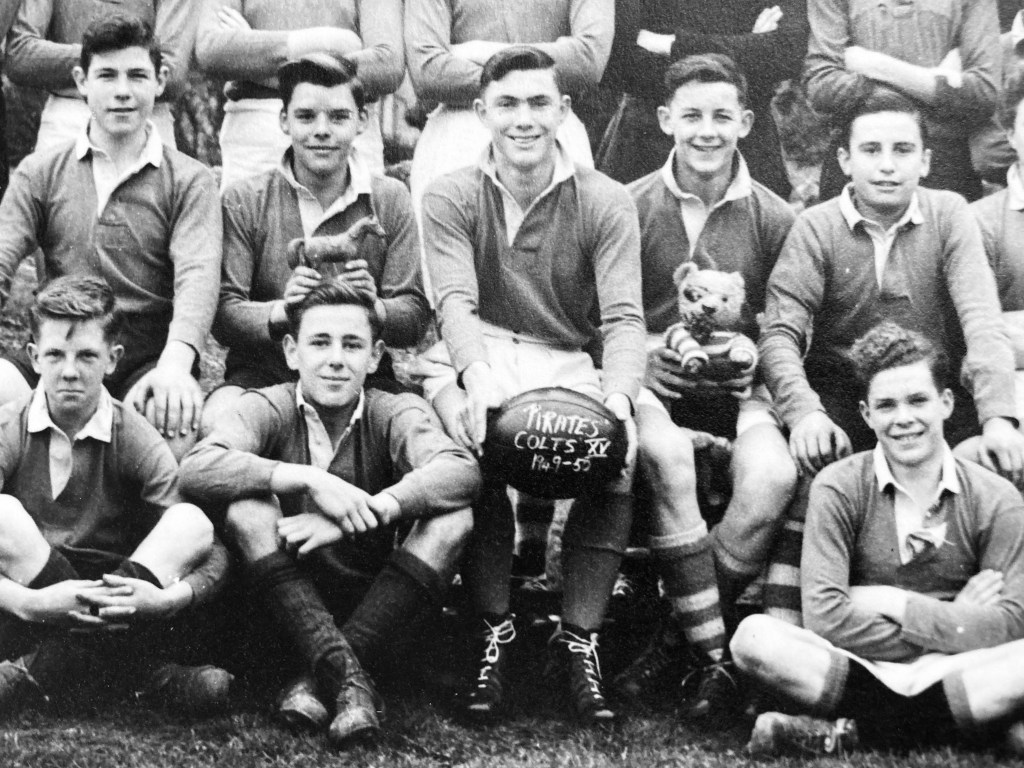
Graham was born on June 6, 1934 and brought up at Daniel Place, just off Morrab Road in Penzance. His earliest rugby memory is the amalgamation of deadly rivals Penzance RFC and Newlyn RFC in 1945:
Was there any friction? There wasn’t. My explanation for it is, it was 1945, all these guys had been away in the services, and that brought them together…also, fortunately the Mennaye Field was available, and it’s mostly in Penzance but some of it’s on the Newlyn side, so that was ideal…
His father, Arnold, worked for the local laundry. Apart from a spell in the Army, this was a job he held his entire life. His mother, May, ran the household, raising Graham and his two siblings:
It was a whole row of terraced houses, little houses. Each house had a kitchen, a middle room, and a front room. Upstairs there were three bedrooms. No bathroom, there was no water of any description in there, the water was a tap in the back yard, also the toilet was in the back yard outside…there was mother, father, me, my sister, my brother Trevor, and my granny, all living there. It was chaos! I look back on it and I just can’t believe it.

The outcome, really, was that I left home at 17. I’d had enough! I was in the grammar school, got to 17 and father said to me, you’ve gotta get out and work. All my friends were going off to college, but father wouldn’t entertain that. So what I did was, I went to Redruth, I went into the RAF recruitment centre, and I joined the RAF…this was in October, November time [1951], they said we can’t take you until you’re 17 and a half! So I left home on the 25th of January [1952], went into the RAF, never lived at home again. Never!
By now, Helena and I were courting, she was still at school, and the way we met was, I had to do this period from September through to January, and father said you can go back to school. So I went in, went to see the headmaster, explained the situation, so he said what’re you going to be the in the RAF?, so I said a PTI [Physical Training Instructor], so he said how about you go and work in the gym?, so I said, great! The Boys’ School and the Girls’ School decided for the first time ever to get together and produce a show, it was by Benjamin Britten, and the gymnasium was to be the theatre, so I was down there painting scenery for the opera, Helena came down, she was domestic science, she was helping make the costumes, and that’s how we met, pure fluke!
By now, there was no room for Graham at Daniel Place. On leave or at weekends he would stay at Helena’s parents’ spacious B&B in St Ives.
When I left home, my father gave me two and ten, that’s what I left home with, that was the only money I ever got! Alright, it doesn’t sound very much now, but two pounds and ten shillings then was probably half of his week’s wages!
Still in his teens, Graham had to adjust to life away from home. His sporting ability helped him settle:
I went to the RAF School, PT School, which was just outside of Wolverhampton, and one of the sergeants there played scrum-half for Wolverhampton, and he said d’you want a game of rugby, so I played three games, and that was my first introduction to senior rugby. Up to that stage I’d only played in the U16s at Penzance, and then for a bit in the U18s.
I played three games at fly-half and I thought, I like it out here, and that’s really what changed the way I played, up till then I’d always been a scrum-half.
Hard to comprehend is how rugby union was played then, but Graham found an attacking method to suit:
It was a totally different game to what we watch now. In those days you had a big pack of forwards that won the ball, and gave it to the backs. And the forwards didn’t do anything else, basically! Win the ball, get it to the backs, and the backs scored the points! So, what I found was, particularly later in my career, I could take the ball, give it, drop around behind, and support anybody that was breaking…I was never, ever a great defender! I just wasn’t big enough! The forwards stuck to their job, and the rest of the pitch was left to the backs, so there was space everywhere.
Helena went to college, she did three years at Stafford. So while I was at various places in the RAF, I could always make my way over to Stafford for half term and whatnot.
Graham was first stationed at RAF Upwood in Cambridgeshire and was invited to play for Bedford RFC. However, an incident involving a horse wrecking a biplane he was supposed to be guarding and the subsequent fallout (Graham was cleared of any neglect of duty, but his superior officer wasn’t), meant he was swiftly transferred to RAF Waddington, near Lincoln. There, he had two seasons with Nottingham RFC:
I had the time of my life! As my game developed in Nottingham, it came to the light of the RAF, and I ended up playing for Bomber Command, and then I played for the RAF. Then the RAF themselves decided my rugby career would be better served if I was down in Cornwall, so the RAF sent me down to St Mawgan, so I could play for The Pirates, and hopefully play for Cornwall!
Being in the RAF, Graham came into contact with a form of rugby not normally witnessed in Cornwall:
Playing for the RAF, I met a lot of Rugby League players, good players, who were doing their National Service. Alex Murphy was one of them, probably one of the most famous Rugby League players of all time1, he did everything in the game. He was in the RAF, and he had a deal with them, if they allowed him to play for St Helens, he would play in the inter-service games [Union] for the RAF, and that’s why I never got an inter-service game. Alex always got the inter-service games! Years later, in my very early days at Hull KR, we played St Helens away, and Alex was playing opposite me, he came out of a maul, screaming, and the packs just piled into one another! I’m standing looking at this, thinking, should I get involved?, and I started to move in, and Alex ran, put his arm round my shoulder, he said ‘This is f___ all to do with us!’
Once back with Penzance-Newlyn, Graham formed a formidable partnership on the pitch with scrum-half Peter Michell, who sadly died aged 90 in 2023:
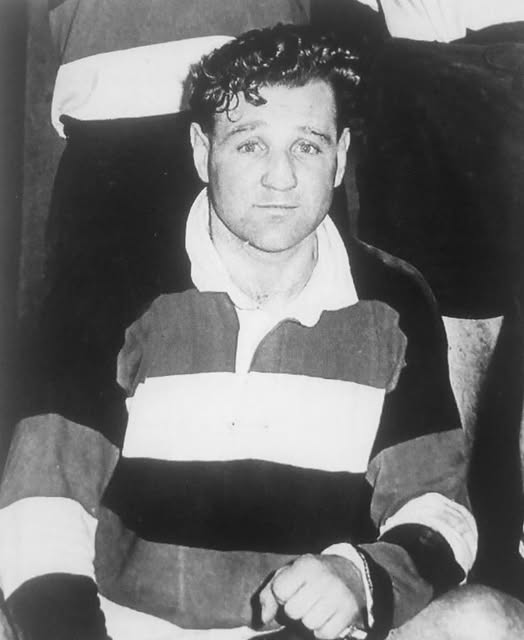
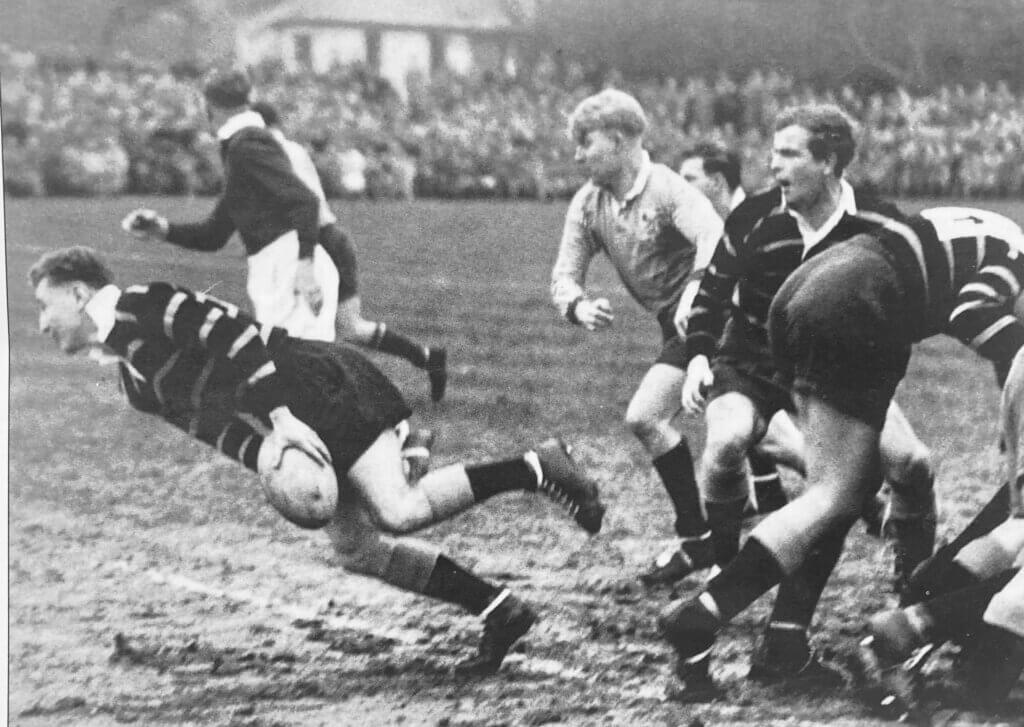
We came from totally different backgrounds, his background was a big house in Heamoor, which had a tennis court…very very wealthy family, Michell’s the jewellers, but Peter had no side to him, Peter was great, he got me on a sevens team once, The Public School Wanderers, in the Twickenham Sevens!
After sharing the bridal suite of a hotel in Bagshot, Peter, Graham and the other Wanderers were knocked out in the first round. Chalk and cheese, the two Pirates men were close friends:
Peter could do three things on a rugby pitch: one is catching the ball, two is kicking, and third was the way he passed the ball…but he never ran five yards! So I was out there waiting, and basically he was either going to kick it, or pass it. And the passing was good, it was always right there…
Here Graham indicates where Peter, without fail, would deliver him the ball: right in front of his stomach, at elbows-length – where every player wants to receive a pass.
Playing for the RAF, I’d never played with a scrum-half who could run, until I played with Onllwyn Brace, Welsh scrum-half who was in the RAF at the time…I played with Onllwyn several games, and found once you had a running scrum-half, it gave you a lot more room, it would suck people in…
For all his flair, Brace2 was probably the exception rather than the rule. In Cornwall, 1950s rugby is remembered chiefly for its powerful, intimidating forwards, such as Redruth’s Bonzo Johns or Camborne’s Gary Harris. But who was the toughest?
Vic Roberts. He was as hard as any of them. He wasn’t the biggest by a long way, a lot of them were just throwing their weight around, but Vic was amazing. He would pick people twice his size, and flatten them! He was ferocious!
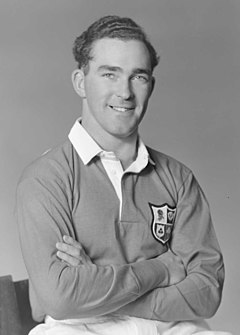
As my late uncle John had been a massive fan, I felt honour-bound to ask Graham about Camborne’s Gary Harris. His response gave an evocative window on how the game was played back then:
It was a funny set-up in those days, d’you know, forwards and backs, you’re on the same team, but you never really mixed. You tended to mix just with the people that are with you on the field. Hey, those guys just get the ball and give it to you, that’s their job, forget them…there was no real interaction.
Forwards always trained together, scrummaging, lineout, that was their game, and the backs trained together. You very rarely trained as a team. You trained as two units with a job to do.
Cornwall [for the 1958 Championship] would train on a Sunday. That was it. Everybody was working, everybody had jobs…the situation when I was there, the full-back, came from St Ives, Harold Stevens, lovely guy, he actually became a pastor, and if we met on a Sunday, to train, we had to go to the chapel first! We had to go through the morning service in the chapel, and then we could train in the afternoon. But he insisted the whole team went to the chapel first.

The image of the entire Cornwall XV kneeling in prayer before training because their skipper for the 1957-8 season happened to be a man of the cloth is irresistible.
Graham debuted against Gloucestershire in October 1957, Cornwall winning 15-6. His play was praised in the Press as a
…revelation. He took his chance in fine style.
Daily News (London), October 14 1957, p10
Not only that, two England selectors were watching. But Graham plays down any international ambitions he may have had:
The only reason I was in the team, was Richard Sharp broke his arm…in my mind, I could see the selectors thinking, Who’s Peter Michell’s partner for Penzance? That guy Paul, we’ll have him…I consider I got in that team on the back of being Peter Michell’s partner. But having got in there, I thought this isn’t going to last, I’m having a bit of fun! I played as if I didn’t care a toss!
That season [1957-8], I played every fixture, I absolutely we thought we could do it, particularly going into the semi-final against Lancashire. Harold Stevens came to me before the game, ‘Quick word, I think we can beat them in the pack. The problem is the threequarters, they’re really good. I want you cut [the Lancashire fly-half] Bev Risman off. I want you to get up flat to him, get between him and the backs’…There was actually a comment in the ‘paper about my inability to tackle Risman…what invariably happened was, just occasionally he got a kick in, but he would usually turn back inside me, and our openside flanker, played for Harlequins, David Mills, he would come up and flatten him!
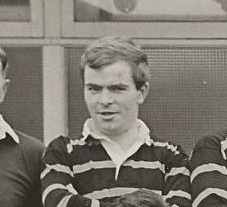

It worked. An estimated crowd of 13-20,000 at Redruth RFC saw Cornwall beat Lancashire 14-8. The Liverpool Daily Post reckoned the heavily partisan crowd was worth at least three points for Cornwall6, and Graham’s memories give some impression of what the atmosphere must have been like:
They actually built a huge stand on the other side of Redruth ground, it was built over in the field, behind…
In other words, you had two stands in Redruth that day, the Hellfire stand and the temporary one on the opposite side of the pitch. For Lancashire, there was to be no escape. This victory set up the Final on March 8 against Warwickshire, at Coventry.
Two things I distinctly remember, the first one is, we stayed at the Leofric Hotel, which was built after the War, it was the first hotel I’d ever stayed in where every room had a bathroom suite!
Second, the morning of the game, Peter and I woke up (we were in the same room together) and went down for breakfast, and Peter said, ‘I can hear singing, what the hell’s that?’ We went and looked outside, all the Cornwall supporters were there singing Trelawny.
Helena was expecting, and when I left to join up with the Cornwall team, she said to me, ‘Go, play your rugby, don’t bother getting in touch until after.’ And when the game was all over, Peter Michell went and rang Helena, and she was in labour! John was born the morning after!

At half-time, Cornwall were 5-0 up:
The first quarter of an hour, we were up on their 25, and Peter got the ball and flashed it to me, it was a bleddy awful pass, bleddy awful, it almost went behind me, I got the ball, and I’m going back almost to get it, very rare for Peter, and as I straightened up, the openside wing forward went where I should have been, he went past me, and I just ran inside him, looked left, Vic Roberts was the blindside, he was coming down the touchline, I gave him the ball, he went over and scored…

Lest we forget, this was long before VAR…
Years and years later, Cornwall won the Championship, first time for a number of years [1991]. The team that I played in was invited to the Final. We were given expenses, seats, everything, even had a hospitality suite…it was amazing! Virtually all the Cornwall players were there, but no Vic Roberts. I wondered, where the hell is he, he’d gone down to the President’s suite. I went into the room and, in the left-hand corner of the bar, was Vic, having a drink with a couple of others. He saw me come in, and he shouted ‘Hey, Graham, come here!’ You’ve gotta remember that he’d captained England, Lions, he’d done everything, played thousands of games of rugby, and as I walked towards him, he said,
‘That was a bleddy forward pass, you know’. And it was! Nobody saw it, well actually everybody saw it, ‘cept the referee…
(Graham’s other favourite memory of the 1991 Final at Twickenham is overhearing the Duke of Edinburgh ask one of his aides what the mass of security guards were attempting to do with the thousands of Cornish fans invading the pitch. ‘They’re sweeping the pitch, Sir’, the aide said to His Highness. ‘Is that for mines?’, queried the Duke…)

Back in 1958, there was a feeling that five points wasn’t enough…
It was worrying, because we’d got so many injuries, Roger limping on the wing, and our prop, Alan Mitchell, he’d had a back knock, he ended up going to hospital. So we were concerned, but I don’t think we ever thought we were going to win.
General consensus is that this was one of the hardest Finals in Championship history. A Camborne man, Terry Symons, was in the crowd that day and recalls seeing Vic Roberts and David Mills collide early on, effectively neutralising both of them. Back in Camborne after the match, he bumped into Gary Harris, with his face ‘scrawled’ up. Harris had carried the Cornish front five single-handedly, and it showed. Several Camborne fans reckon he was never the same player again.
Roger Hosen, a centre for Penryn, Nottingham and England, spent most of the game hidden on the wing with his thigh heavily strapped. In the days before substitutions, Alan Mitchell played on with a broken jaw. Make no mistake, Cornwall were tough, but Warwickshire’s pack were a step up. Cornwall needed to score early in the second half. Graham attempted two snap drop goals8:
The first, I was totally off-balance, they were the only times when I’d pre-thought the drop-goal, which I’d never done before…and I got the ball, had a knock at the same time, and that happened twice…
Graham claps his hands in disgust. Warwickshire gradually took control, their ‘mighty steam-roller pack’ overwhelming Cornwall’s to win 16-89. But they didn’t have it all their own way:
You know what the Cornish supporters are like when they’re wound up…but really you were too involved in the game, your job is on the field…I can’t remember looking at them [the crowd], or thinking about them, you can’t!
We accepted the fact they were probably a better team than us anyway…this was the first time Cornwall had got to the Final in God knows how many years [1928], we were pretty pleased with ourselves having got there!
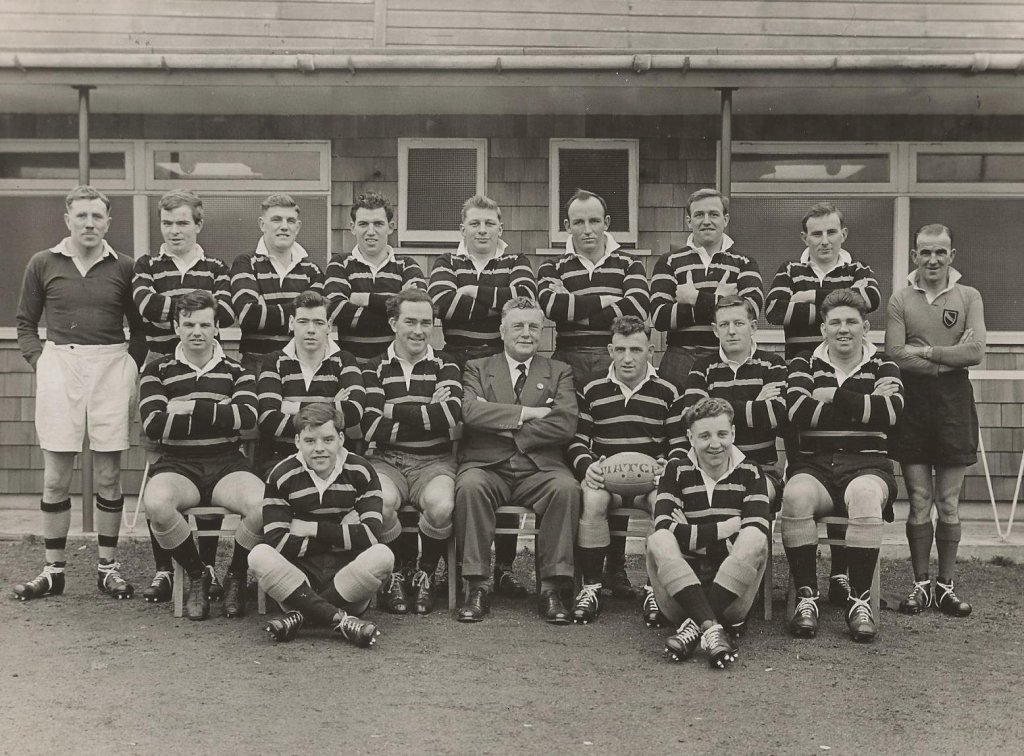
Much was made in the national Press of Cornwall’s unruly, partisan support, but we might do well to remember that in Cornwall itself, its XV’s exploits were met with indifference east of Truro. The Cornish Guardian, produced in soccer-dominated North Cornwall, devoted one meagre paragraph to the Final10. One only has to consider the handful of clubs the XV was picked from (above) to conclude this was essentially a team from West Cornwall.
Graham obviously had the temperament for a big game. He was 23, at his peak, and three England selectors had watched the Final11. One reporter noted his quick feet when on the attack12, but when I asked if he considered himself close to international honours, the answer is firm:
No. I didn’t have the background. You done okay, but you’ve come out of Daniel Place, and they’re never going to let you forget it.
His main competitor at the time for the 10 jersey was Richard Sharp, himself no slouch. But Sharp himself knew who the better man was:
Graham Paul was the fly-half and was considered the key member of the side so there was no question of an alternative.
Winning Rugby, Pelham Books, 1968, p30
(Graham himself says Sharp’s statement was ‘very generous’.)
Graham has gone on record elsewhere regarding his thoughts on the RFU’s perceived selection policy at the time. In 2008, he spoke of Mike Blackmore, a Barnstaple wing who also signed for Hull KR, and played with Graham in the 1964 Challenge Cup Final:
Like me, Mike was from what you might call a modest background and it always seemed to be someone from the establishment who was selected…Background counted for a lot in those days and I think that was one of the main reasons he switched.
Independent, February 20 200813
In his living room, Graham continues:
Mike was a good player, his background was certainly better than mine, but wasn’t right up in the top bracket, and the other thing was, they [Hull KR] offered him a lot of money!
Graham may have a point. Mike Blackmore captained Devon in three County Championship Finals, and had had five England trials by the time he was 22. It’s hard not to reach the conclusion that Mike’s secondary modern education would forever count against him where the RFU were concerned. Small wonder he signed for Hull KR14.
It was at this time, around March 1958, that Graham found himself at a crossroads. He would shortly be leaving the RAF, having served his time.
Graham hands me a letter. It’s an old, important letter. In fact, it’s a very important letter. Ultimately, it changed Graham and Helena’s lives.
When I was leaving the RAF, it became pretty common knowledge in the rugby world, and that I was looking for something or other. Bedford wrote to me, and this is the letter…

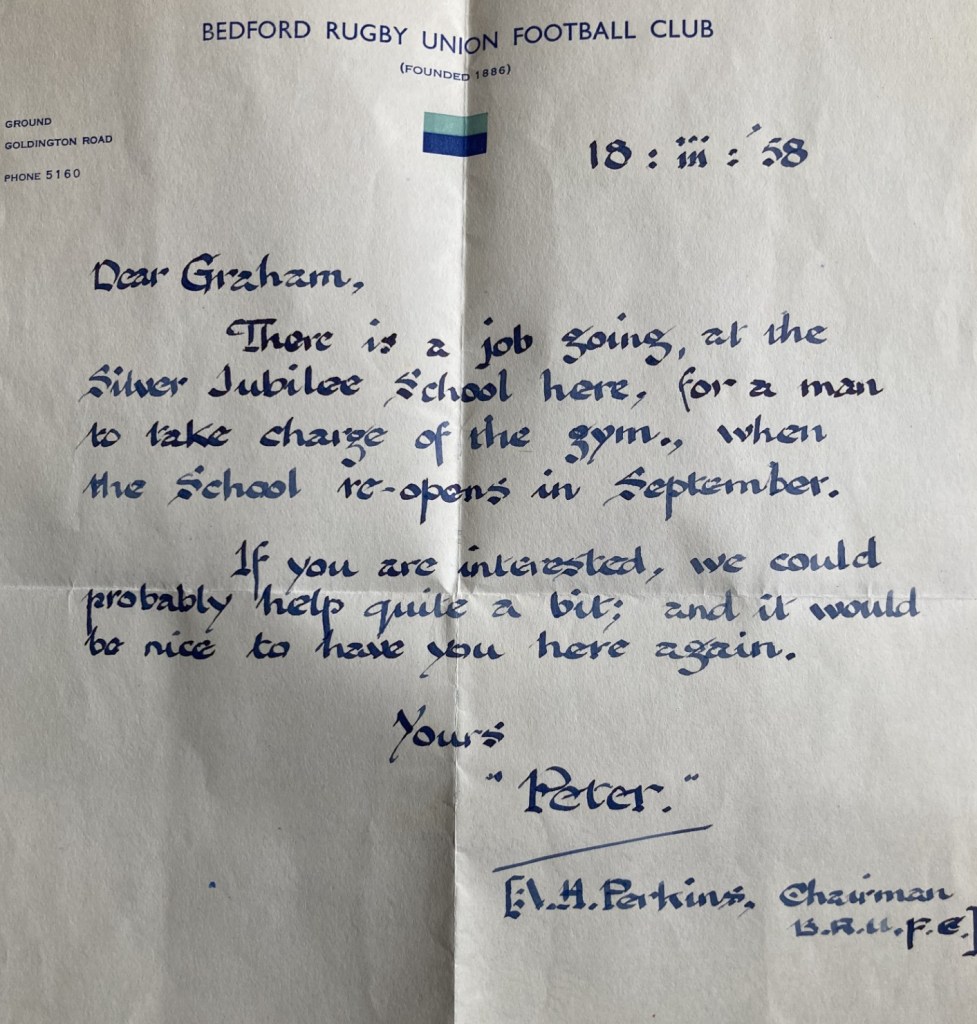
The implication is clear: come back to play for Bedford RFC, and we’ll see you right. Technically, under the RFU’s amateur regulations this was an offence, albeit one of the more flouted ones. But that didn’t perturb Graham:
I rang him [Perkins] up, and spoke to him on the ‘phone, and said to him, ‘This is all very well, but I’ve got a young wife and a son. Where are we going to live?’ And he said, ‘That’s no problem, you’ll get a house.’ But that was off the top of his head!
So I went to the Pirates, and I took that letter, and I showed it to the Treasurer of the Pirates, and I said to him that I’d been offered a house too, and asked him, ‘What’s on the cards for me, here?’ And he said, ‘Nothing, we can’t get involved.’
And that’s what sent me to Rugby League.
Graham didn’t need to make enquiries about switching. Even if he had, and those enquiries reached the wrong ears, he would have faced suspension from the RFU. The rugby grapevine was strong enough to be heard further north than Bedford, and did all the work for him…
There was a guy called Fairfax, he was Welsh, and he was an agent for several Rugby League clubs. I don’t know if that’s his real name even! He came to me and said, ‘Would you be interested in Rugby League?’ He came to me out of the blue…he phoned me, then came to see me. He said there were three clubs he worked for: Halifax, Wigan and Hull KR. He said, ‘Which one interests you most?’ So I said, ‘Not, Wigan, if I go Wigan, I’ll have to be a star overnight, and I’m going to have to learn this game.’ Of the other two, I said either one, and he went to Halifax, and apparently Halifax said no, we don’t need another stand-off half, we’ve got two! So, he went to Rovers, and the rest is history…
The historian Tony Collins told me that Arthur Fairfax was a top League scout in Wales and the South West. He signed Roy Francis for Wigan in the 1930s, and tried to procure Carwyn James for Halifax in the 1950s.
Fairfax had come to see me in Newquay, and then we arranged to meet in Hull, and he took me to Rovers. Would you believe, he had a fee, he was expecting a fee, and I said to him, ‘I am going to negotiate my terms, not you, you’ll get your money, but I’m negotiating the terms.’ What I didn’t want was him going in there blabbing big this and big that, I just went in there and said, ‘Look, you’ve seen me, what’s on the table?’
Hull KR had certainly seen Graham in action. On November 8, 1958, the Club’s directors had travelled to Bristol to watch Gloucestershire beat Cornwall 8-6. Scoreline notwithstanding, they obviously thought Graham a useful prospect15.
They came up with £1000, I came up with £2000, and we met in the middle!
As Graham told the Hull Daily Mail in 1991, this was
…an offer I couldn’t refuse.
January 1 1991, p12
Indeed, he and Helena were set for life:
How many people can say, they’ve never had a mortgage, or never had anything on hire-purchase? Never! And the basis for that was signing for Hull KR. They gave me a cheque for £1500 [£29,900 in 2024]…it was quite demanding at the time, selling up here, and moving up there…they [Hull KR] fixed me up with a flat, which strangely enough was over a fish shop! It was a bit smelly but okay for a while. It was also thankyou to Rovers that I got in the licence trade, because when I first got there they said, ‘We’ll find you a job…you’re going to be a car salesman.’ I said, ‘I beg your pardon?’ I couldn’t even drive a bleddy car!
And the level of secrecy?
Huge! Absolutely huge! One person knew what was going on, Helena, nobody else. Not my mum, my dad, nobody. I signed for Rovers, and I had a deal with them, that they wouldn’t release the news to the Press, they would let me go one last game for the Pirates [Graham’s 100th match], and that last game was Penryn away.
I played the game, I enjoyed it, and I’m walking off, and Peter was just ahead of me, and I caught up with him, put an arm around him and said, ‘Quick word, Peter…that’s our last game together.’ And he just stopped, and said ‘What? What are you talking about?’ So I said, ‘I’m telling you this, what you want to do with it, it’s up to you, but I’m going to play Rugby League for Hull Kingston Rovers, it’s signed and dealed, this is our last game.’
Peter said, ‘Can I tell everybody?’ And we went in the changing room, and he stopped everything that was going on, and he said ‘Stop! Graham’s just played his last game for us, he’s now a professional Rugby League player, he’s going to Hull Kingston Rovers.’
And there was a second of silence, and then ‘WOW!’
Nobody held it against me. Only thing was, word got to one or two supporters, and they’d told my father back at the Club, he knew! When I got back to the Club, he saw me and said, ‘What the hell have you done now?’

Of course, the Pirates’ fans, Graham’s family and fellow players had nothing but admiration for his switching codes. One team-mate (and fellow 1958 Finalist) who certainly didn’t object was Jimmy Jenkin, who signed for Hull KR too in early 195916. But understandably you get a sense of the regret within the Pirates’ upper echelons. Committee man Cyril Ladner was quoted as saying
The club did what they could, but they could not compete with the offers that Rugby League clubs were able to make.
West Briton, June 18 1959, p2
Graham also knew that, under the RFU’s regulations, he could never play Rugby Union, or be admitted into a Union club ever again. As Gareth Edwards once said, ‘You’d be damned to bloody hell!’17
Graham’s new club appreciated this:
Rovers really looked after me. They were very, very considerate, they appreciated the fact that it was a different game for me, it was a new game. They had a very good stand-off half called Rowley Moat, he could play wing as well, and we used to switch…in the end I ended up on the wing permanently.

They signed Alan Burwell19, and he was a superb player, and he was a stand-off half. And they actually came to me and said, ‘Look, we’ve signed Burwell, can you play on the wing permanently?’ And I thought Phew, I’ll live longer!
Modern professional sportspeople talk of having a ‘safety net’, a backup plan, in case things go awry. Not Graham:
There was no backup plan. I was going to make a success of it.
The game was harder in those days, harder than Union, because the ball was handled so much, and there was no ‘six goes, now you have the ball’20…sometimes you could go 10, 15 minutes and never touch the ball…it was physically very, very tough, but hey, you’ve got to live with these things!
I mean, I was always pretty fit, I was a PTI, but never fitter than when I played Rugby League…my big asset was speed, and speed off the mark. From standing still to flat out was about three paces!
Graham must have been like a young Jason Robinson. In September 1959 he scored a hat-trick against Halifax who, lest we forget, could have signed him themselves and must have spent the afternoon washing egg off their faces. An enterprising stringer for the Hull Daily Mail conjured up the nickname by which Graham is famous:

Other journalists deployed the moniker as a cheap pun, like at York in 1961:
It was Easter weekend, and my mother sent us up some cream [Rodda’s] to have with the kids…on the day before the match we had rhubarb and cream…the only problem was that night I had the runs something terrible, and I got down to the ground for the match, and I said to Colin Hutton, the coach, ‘I can’t play, there’s no way’ and he just said, ‘Get in there and get changed!’ There was no substitutes in those days, anyway I set a club record, I scored five tries, and there was a headline in the ‘paper:

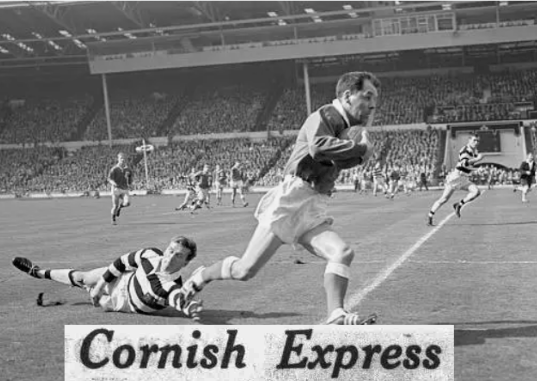
Ill or not, Graham Paul, The Cornish Express, was a lethal finisher. He scored 116 tries in 197 appearances for Hull KR.
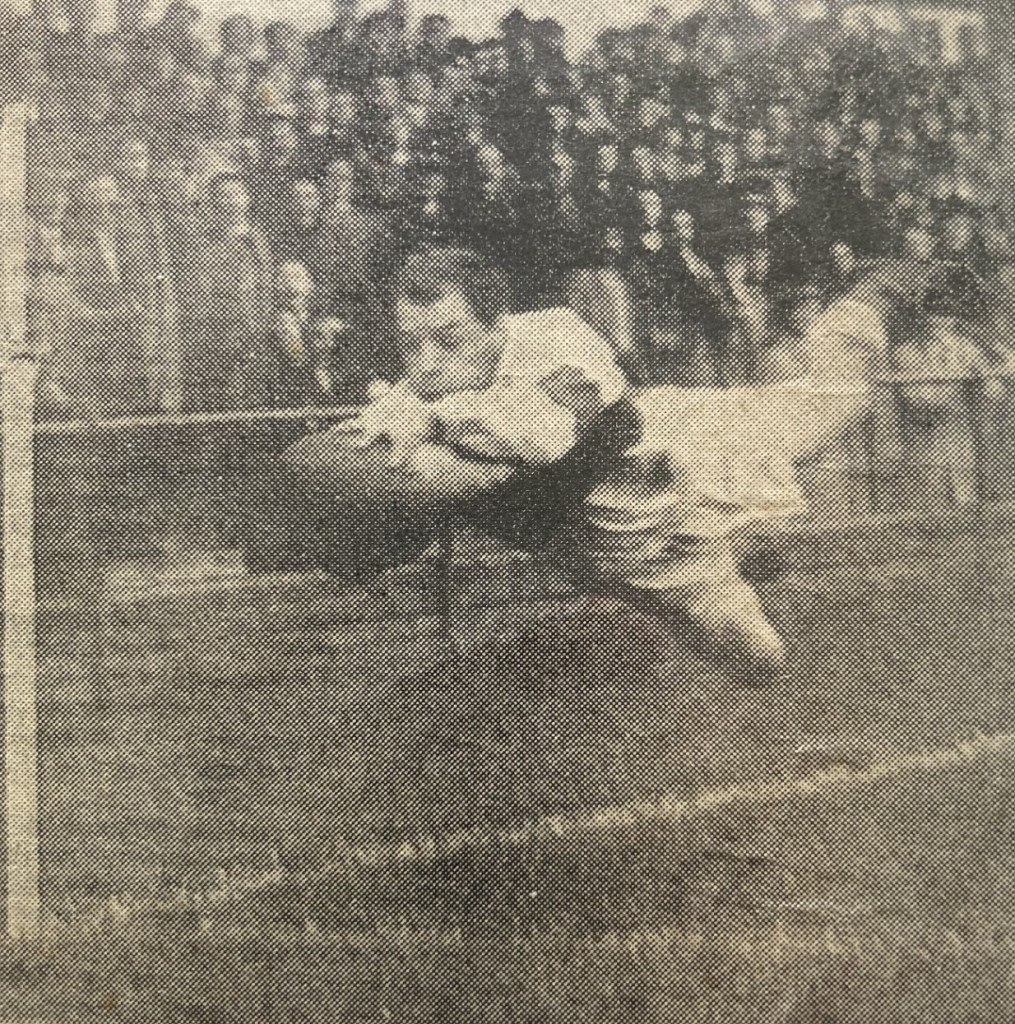
It shouldn’t be forgotten though that he also had a day job. Graham’s work in Hull, that of a publican and hotelier, was no sinecure. Helena told me that she never watched Graham play. One of them had to be on hand to run the business, as well as raise three children.
In 1962, Graham suddenly found himself back in Cornwall, as part of a League recruitment drive. Hull and Hull KR had decided to stage a series of exhibition matches at Penzance, Camborne and Falmouth.
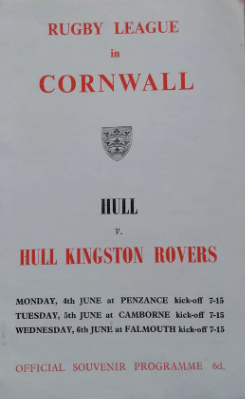
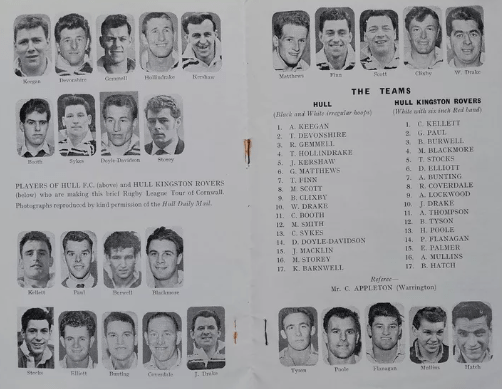
They [the Hull Clubs] thought there was a source of Rugby Union players worth looking at, and starting to get them interested…the rugby standard in Cornwall was high enough that Rovers felt an exhibition Rugby League game was a worthwhile investment.
It had its problems…they gave me a week to go down and organise everything. Where were we going to play? Well, that was solved by the fact that it was close-season, and the grounds were the property of the local councils, so that was that problem solved.
Problem two, all the Clubs said to me, ‘You’re not having our goalposts.’ So…the council organised this, at all three grounds, they removed the goalposts, they put another set of goalposts up, and then immediately after the first game, those goalposts were taken down [at Penzance], taken to Camborne, same thing up there…
Next problem we had was, the Pirates wouldn’t let us use the clubhouse. Fortunately in Penzance, the soccer ground is only 300 yards up from where the Pirates were, we were able to change there, then walk down to the Mennaye Field.
When the game was over, we weren’t allowed in the clubhouse.
The Press coverage wasn’t especially inviting either21. Clearly for some, professionalism was a contagious disease, and those infected had to be corralled away from the healthy, amateur populus.
In 1962-3, Graham broke the club record for tries in a season, 34. He started the final game level on 32 with Mike Blackmore. It was a feat that was only bettered in 198522. Clearly, Graham’s decision to switch codes was the right one:
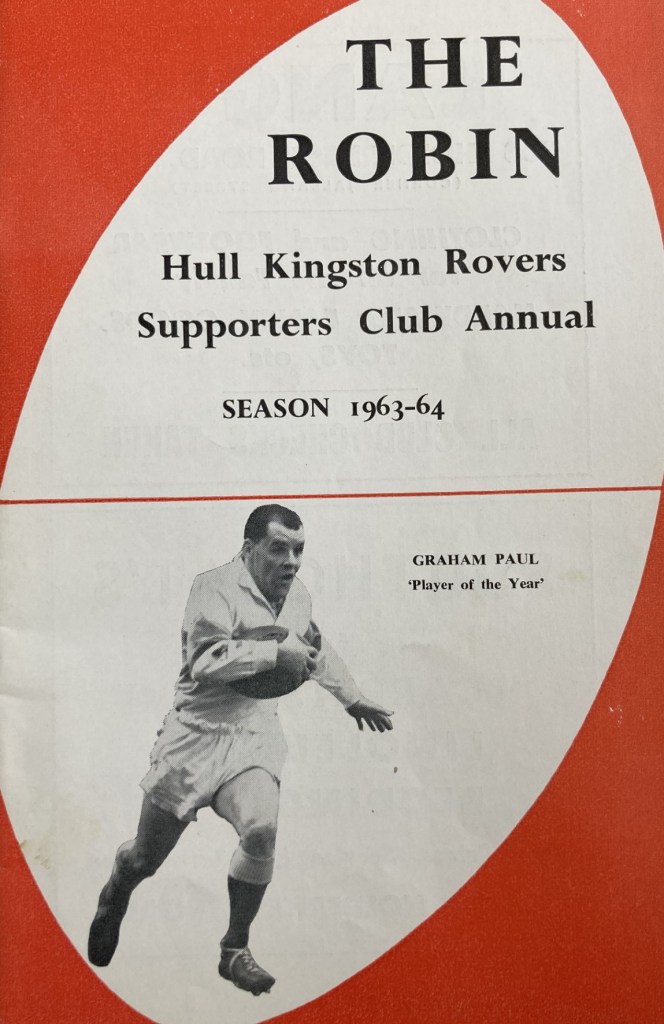
Graham is also one of very few rugby players to have played in a County Championship Final and a Challenge Cup Final. In 1964, Hull KR played Widnes in front of 85,000 people at Wembley. Alas, they lost, 13-5. Online you can find a few brief minutes of match footage23. Graham catches the ball, skins his opposite number on the outside (as you would expect), and gets clean away down the touchline:

But as in 1958, it was not to be. For once, The Cornish Express was brought down short. I was curious to know which Final meant more:
No different. Equal. I lost both of them so they were equally disappointing! They were both great Finals, the Cornish support [in 1958] was amazing…
To be honest, when we played at Wembley, I was already thinking, What’s next? Helena, three young boys, we were at a crossroads, and I was offered a job as backs coach for Hull KR, because they appreciated my career was coming to an end. Helena had been offered a job as well, and I’m thinking to myself, What do you really want? I wanted the boys to grow up in the environment that we grew up in, which was Cornwall. So we dumped everything and came back to Cornwall!
Of course, even for an ex-Rugby League player, going to watch a game of Rugby Union was out of the question:
I accepted the fact that I couldn’t go back to the Mennaye Field, I couldn’t watch the Pirates, I wouldn’t be allowed in the ground. Now I think, in the bottom of my mind, if I went down there, they wouldn’t stop me. But the other side of the coin is, I didn’t want to put anybody in a position of having to say, Look, you can’t come in.
So I stayed away, which meant I could concentrate on running the pub!
On retiring from League in late 196524, Graham, Helena and their family returned to Heamoor, and ran the Sportsman’s Arms. Fame and a steady stream of visitors from Hull meant the business prospered handsomely. Acquiring property along the way, Graham also became a handy golfer, boasting a handicap of 11. He wore a Hull KR jumper for a bet during a match where he was paired with Bill Bishop, then on the committee of the RFU. Bishop saw the funny side, and asked Graham if he would like his amateur status back:
He fixed it. I never applied…
Graham hands me another significant letter. It’s from the RFU, dated November 1991. Twenty-six years after his retirement, Graham’s amateur status was reinstated. He could enter the Pirates’ clubhouse once more.

At least Hull KR know how to treat their former players:

In 1991, Graham was interviewed by the Hull Daily Mail:
…there have been a lot of things in my life that I’ve enjoyed, but I enjoyed my time in Hull more than most of them…My only regret is that I wish I’d gone to Rovers [Hull KR] earlier.
January 5 1991, p12
Hearing this quote, Graham reflects:
Looking back on it, I would have liked to have had a longer career in Rugby League, but…Rugby Union taught me how to play. That’s where I learned the game. So I’ve got to except that.
I’ve had a life…
Graham stops, checks himself, glances at Helena:
We’ve had a life, that I never believed would be possible. It’s been fantastic.
With special thanks to Helena Paul and Phil Westren
(If you missed my previous Cornish Sporting Hero, international distance runner Emma Stepto, click here.)
Many thanks for reading; follow this link for more top blogs on all things Cornwall: https://blog.feedspot.com/cornwall_blogs/
Do you enjoy my work?
All content on my website is absolutely FREE. However managing and researching my blog is costly! Please donate a small sum to help me produce more fascinating tales from Cornwall’s past!
Your contribution is greatly appreciated.
DonateReferences
- For more on Alex Murphy, see: https://en.wikipedia.org/wiki/Alex_Murphy_(rugby_league)
- For more on Brace, see: https://en.wikipedia.org/wiki/Onllwyn_Brace
- For more on Roberts, see: https://en.wikipedia.org/wiki/Vic_Roberts
- Image from: https://www.redruthrugbyclub.co.uk/news/harold-stevens-rip-1249096.html, information from: https://www.trelawnysarmy.org/harold-stevens/
- The information on Mills is from: http://www.cliftonrfchistory.co.uk/blues/cambridge/mills/mills.htm. For more on Risman, see: https://en.wikipedia.org/wiki/Bev_Risman, and https://www.skysports.com/rugby-league/news/12196/12908491/bev-risman-former-rugby-dual-code-international-dies-aged-85
- February 17 1958, p9.
- For more on Stack, see: https://en.wikipedia.org/wiki/Stack_Stevens
- Daily Mirror, March 10 1958, p23; Sports Argus (Warwickshire), March 8 1958, p7.
- Sunday Express, March 9 1958, p7.
- March 13 1958, p11.
- Daily News (London), March 9 1958, p8.
- Birmingham Weekly Mercury, March 9 1958, p27.
- From: https://www.independent.co.uk/news/obituaries/mike-blackmore-dualcode-rugby-player-784370.html
- From: https://www.northdevongazette.co.uk/news/sport/1199844/loss-of-a-rugby-legend.html
- Hull Daily Mail, November 24 1958, p8.
- West Briton, January 15 1959, p2.
- Edwards is quoted in The Rugby Codebreakers, BBC documentary, 2018. It can be viewed here, and I highly recommend it: https://www.youtube.com/watch?v=Lo8nAtxhUl0
- Image from: https://hullkr-heritage.co.uk/record/rowley-moat-graham-paul/
- For more on Burwell, see: https://en.wikipedia.org/wiki/Alan_Burwell
- When Graham played, there was no limit to how many times a team in possession of the ball could be tackled before handing it over to the opposition. The four-tackle rule was introduced in 1966, and was extended to the familiar six tackles in 1972.
- West Briton, June 7 1962, p11.
- Hull Daily Mail, June 3 1963, p6, and https://hullkr-heritage.co.uk/record/triesinaseason/
- Go here: https://www.facebook.com/watch/?v=845623330024811
- Huddersfield Daily Examiner, October 19 1965, p8.
 Francis Edwards ~ The Cornish Historian
Just read it. Very enjoyable. Wh
LikeLike
Thanks for that excellent article. It brought back many memories. Alan Alan Mitchell
Sent from my iPad
>
LikeLike
Thank you…are you the Alan Mitchell that played in 1958?
LikeLike