
Reading time: five minutes
Congratulations to Camborne RFC’s hooker Ben Priddey! The two tries he scored at Macclesfield brought his haul for the 2024-25 campaign to 45, thus setting a new club record. Alex Ducker was the previous champion, with a mammoth 44 tries racked up in the 2018-19 season.

But who, I hear you cry, were Town’s previous top try scorers?
Though Camborne RFC played its first game in November 1877, it wasn’t until January 4, 1879 that a player actually crossed the line. Only a handful of fixtures had actually been played during this time, but the first try was scored, fittingly, against Redruth. Frustratingly, the report doesn’t tell us who the scorer was, and worse still, Camborne lost1.
More pleasingly, less than a month later, the two sides met again, and this time Camborne won, by five tries to two. First in the list of scorers for Town was Charles Vivian Thomas2.

The son of Josiah Thomas, a staunch Methodist and manager of Dolcoath Mine, Charles was educated at Taunton Wesleyan College and Cambridge. In Camborne he set up practice as a lawyer, gaining a reputation as a firebreathing Wesleyan preacher along the way.
Thomas had a sharp mind, a sharper tongue and a strong body. He also enjoyed rugby football, which he played while at College. There it was noted of him that he was
…a quick runner, a good scrag, and backs up well.
Wesleyan College Quarterly Magazine, 1877, p114. With thanks to Geoffrey Bisson, Queen’s College, Taunton
He was also a founder-member of Camborne RFC, and its first captain. It’s therefore rather apt that he is Town’s first (named) try scorer3.
The first player of note as a touchdown specialist is Sam Carter (1888-1967). Carter was a miner who had worked in the USA and British Columbia. Though starting his rugby career as a three-quarter, he became a back-row forward of some note, being capped for Cornwall in this position. In the 1911-12 season, he was reported to have scored 16 tries.
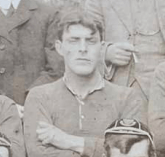
Facing a three month ban at the end of that season for spectacularly knocking a Redruth player cold on the pitch, Carter left Cornwall behind him, signing a professional contract for Northern Union side Rochdale Hornets. He was a member of their victorious 1922 Challenge Cup squad, yet lived the last years of his life on Treswithian Road, Camborne. His house, ‘Buersil’, was named after a district of Rochdale4.
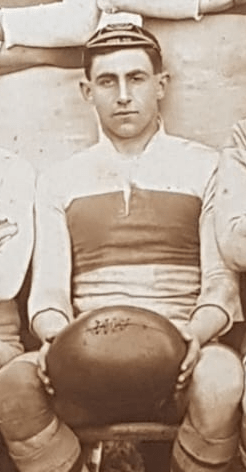
The first player to have his try scoring exploits defined as a record was Leonard Hammer (1895-1979). A veteran of the Western Front, Hammer was a centre who won 13 caps for Cornwall, was given an England trial and attracted the interest of Northern Union outfit Halifax. In fact, Halifax were so impressed they asked him to state his own terms. The terms Hammer gave them was presumably ‘no thanks.’
In the 1922-23 season, Hammer touched down 24 times, and formed a deadly partnership in the centre with Phil Collins. Yet later that year, the Holmans employee was offered a clerical job in Birmingham, and took the opportunity. He also joined the city’s rugby club.
But he never forgot his roots. On a visit to Camborne in 1949, he was invited to kick off the Feast Monday match against Redruth, being described as a ‘star’ of yesteryear5.
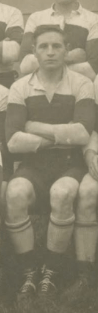
Wing Reg Parnell (1899-1970) is the try scorer every Camborne fan remembers – and with good reason. The record he set, that of 36 tries in the 1926-27 season, stood for the best part of 60 years.
With players like him, Hammer, Collins, Bill Biddick, Rafie Hamblin, George Thomas and Herbert Wakeham, it’s small wonder Town’s exploits of the 1920s are legendary. Parnell, a Climax rock-drill engineer from Carn Brea, was an integral part of the team’s success and must have been a lethal finisher.
Parnell might have set the record with 36 tries, but it was in the 1924-25 season that he actually topped Hammer’s tally, with 29. For all that, he only played five times for Cornwall.
Less well-known is Parnell’s charity work during World War Two. Though all official play had been suspended, Parnell organised morale-boosting invitation matches, and the local communities, starved of entertainment, could watch their heroes of days gone by once more6.


Nobody could hold a candle to Parnell’s tally for decades. The best efforts came from Ivor Moyle, a back-row forward who won two caps for Cornwall and was a champion javelin thrower. He scored 25 tries in 1961-627. Wing Mike ‘Jed’ Eddy, a Royal Navy man, went two better in 1975-76.

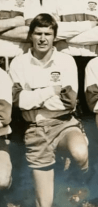
Honourable mentions must be made for Forrester Matthews, who chalked up 18 in 1945-46. John Rockett, Camborne’s ‘most dangerous attacking player’8 of the 1960s, managed 15 in 1962-63. Dave Edwards crossed the line 17 times in the 1977-78 Centenary Season – a strike rate, legend has it, of two tries for every three passes. Nigel Pellowe, who needs no introduction, scored 14 the year after9. (Apologies for any omissions.)


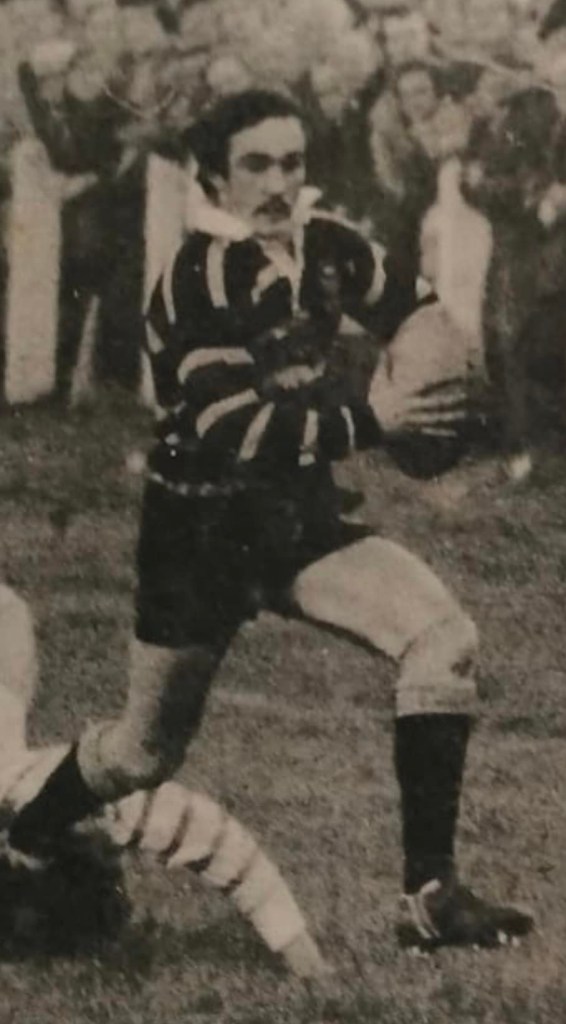
It wasn’t until 1985-86 that Parnell’s pre-war feat was surpassed. David Weeks, another wing, raised the bar to 39. It was believed he’d beaten Parnell with 30 in 1984-85, but fortunately for Weeks Camborne’s 1980s successes rivalled those of the 1920s, and he was given ample opportunity to definitively claim the mantle the following season. His fellow wing, Jon Bowden, was nearly as prolific.
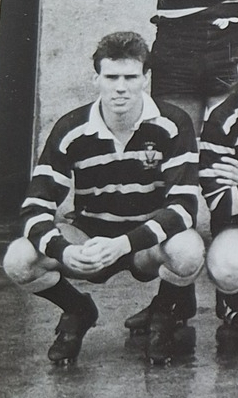
Like Parnell before him, Weeks was a try machine, scoring over 250 for Camborne in 500 games. He also won 69 caps for Cornwall, including two County Championship Final appearances at Twickenham (but not, sadly, in 1991), and is a true club legend11. David’s club record stood for over 20 years, until Alex Ducker bested it in 2018-1912.
So now you know…
Many thanks for reading; follow this link for more top blogs on all things Cornwall: https://blog.feedspot.com/cornwall_blogs/
Do you enjoy my work?
All content on my website is absolutely FREE. However managing and researching my blog is costly! Please donate a small sum to help me produce more fascinating tales from Cornwall’s past!
Your contribution is appreciated.
DonateReferences
- West Briton, January 9 1879, p5.
- Cornishman, February 6 1879, p5. Actually, the report just records his surname, but as he was such an influential figure in the club’s early history, it’s fitting that Thomas was first.
- For more on Thomas, see: https://the-cornish-historian.com/2023/08/26/cambornes-feast-day-rugby/
- Carter’s story is recounted in more detail here: https://the-cornish-historian.com/2024/02/03/the-great-cornish-rugby-split/. Individual appearances for Cornwall are taken from: The First Hundred Years: The Story of Rugby Football in Cornwall, by Tom Salmon, CRFU, 1983.
- Cornishman, April 23 1919, p7; Cornubian and Redruth Times, July 26 1923, p5; Western Morning News, November 30 1923, p2; December 1 1923, p2; November 15 1949, p8.
- Cornubian and Redruth Times, May 7 1925, p5; Cornish Post and Mining News, April 30 1927, p8.
- From: Camborne RFC Centenary Programme 1878-1978, by Philip Rule and Alan Thomas. Moyle was Cornwall’s champion javelin thrower for several years. In 1958 he threw 169ft, or 51m in a meet at Par. From: Cornish Guardian, July 10 1958, p12.
- West Briton, October 22 1964, p2.
- Rockett’s tally is noted in the Camborne RFC Centenary Programme 1878-1978, by Philip Rule and Alan Thomas. Matthews’, Edwards’ and Pellowe’s totals are mentioned in Tom Salmon’s The First Hundred Years: The Story of Rugby Football in Cornwall, by Tom Salmon, CRFU, 1983, p44.
- Forrester’s afternoon in the sun is reported in the Cornishman, February 7 1946, p7. A Troon boy, Matthews had served in the DCLI.
- West Briton, September 5 1985, p5; September 8 1986, p5. County appearances are listed on the Cornwall RFU website. The relevant County Championship Final entries are here: https://en.wikipedia.org/wiki/1991%E2%80%9392_Rugby_Union_County_Championship, https://en.wikipedia.org/wiki/1990%E2%80%9391_Rugby_Union_County_Championship, https://en.wikipedia.org/wiki/1988%E2%80%9389_Rugby_Union_County_Championship#
- Curiously, Ducker’s Wikipedia entry lists only 39 tries scored for that season, yet elsewhere the total is 44.
 Francis Edwards ~ The Cornish Historian
I think commiserations are
LikeLike