Reading time: 30 minutes
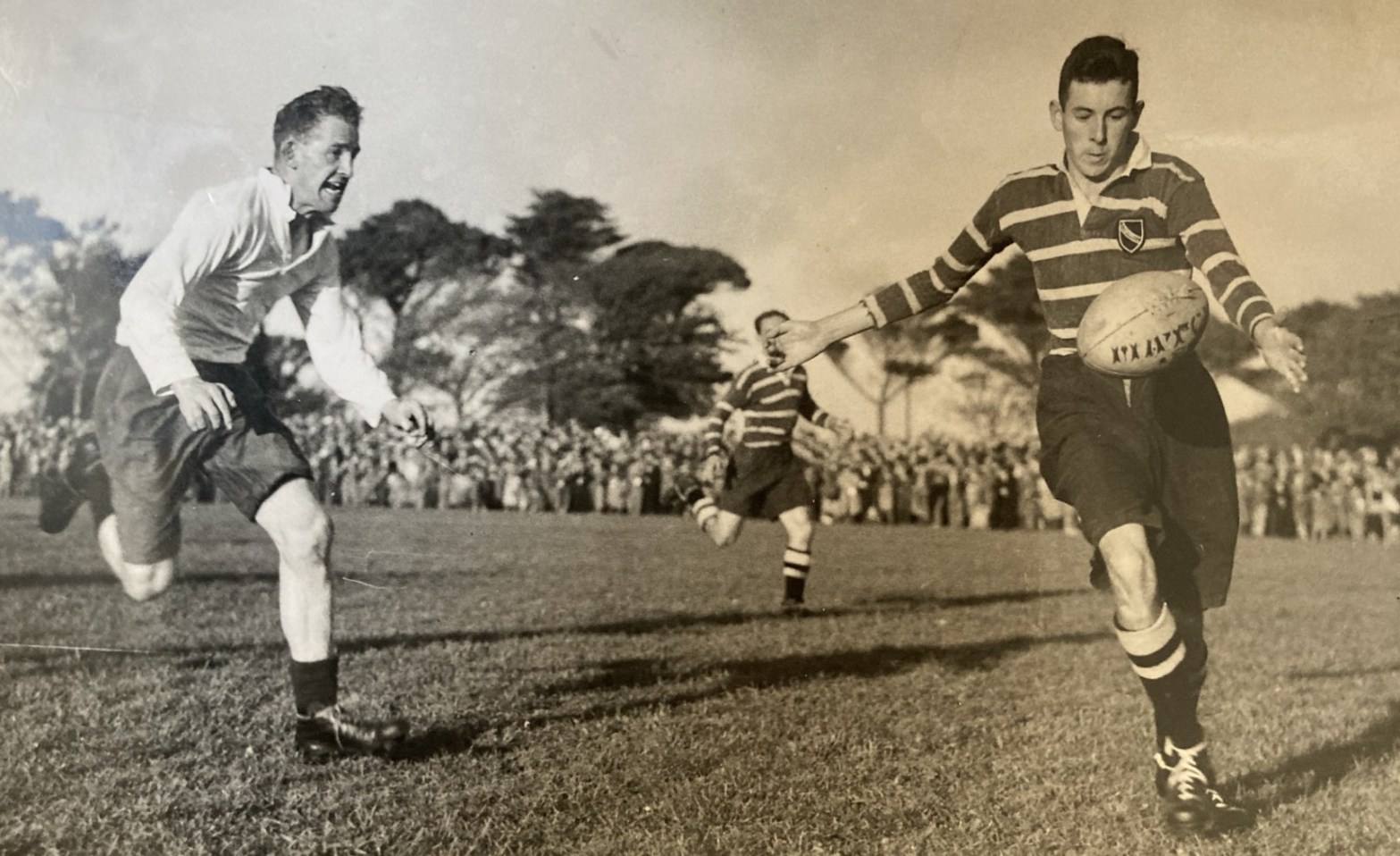
John Collins too sticks out in my mind…the kicks, phew! ~ A rugby fan of the early 1950s looks back
I always had ambitions to go as far as I could. ~ John Collins
…down in the John Collins country they know a good full-back when they see one. ~ West Briton, November 11 1953, p2
Austerity rugby
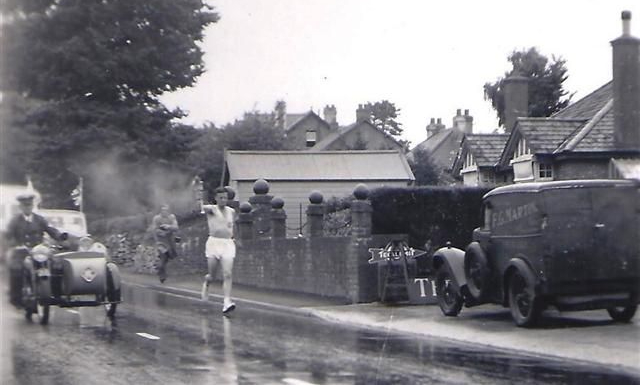
Post-war Britain saw a boom in sport. People, starved of entertainment since 1939, needed something to take their minds off rationing and austerity. The 1948 London Olympics, with its extensive media coverage and torch processions reinforced a sense of unity and recovery through games, no matter the reality2.
This was a boom in spectator sport: the austerity generation was the last generation without televisions in their homes. People still had to, by and large, leave their homes to go and witness a good contest. In West Cornwall, that meant going to watch rugby. Austerity rugby in Cornwall might have only boasted eight senior clubs (Camborne, Redruth, St Ives, Falmouth, Hayle, Camborne School of Mines, Penryn and Truro3), but they were willing to travel, and they were willing to entertain. There was
…an increased tendency to abandon the typically forward game in favour of throwing about the ball in plenty of open movements. This is the only type of rugby that will draw the crowds, and it is commendable that such a universal endeavour has been made.
Western Morning News, May 3 1949, p8
Even with limited Cornish opposition and no dual-carriageway in Cornwall, Camborne’s 1st XV could still play 37 fixtures in 1950-51. By 1954-55 they would host clubs like Exeter University, Public School Wanderers, Cambridge Wanderers, Newcastle Medicals, Royal Military College of Science, Imperial Club XV, Bridgwater, and Captain Crawshay’s XV. Allied to this, a local derby could pull a crowd of 4,0004.
Luckily, there’s a man who can tell us what post-war rugby was like. And that’s John Collins. He was born in November 1928.
England’s oldest living rugby international is excited. You get the impression he relishes the opportunity to turf out his extensive memorabilia and spend an afternoon reminiscing. He’s read my questions and he’s done his homework. The living room of his terraced house has, this afternoon, been made over to a photographic archive. John has a formidable memory, and he seems to use each of his photos as a cue or prop to trigger off a recollection or an anecdote. Without John, the images remain what they are: pictorial records of post-war Cornish and international rugby. With John, they are suddenly brought to life. He provides a provenance no simple caption could ever hope to attain. Because he was there.
Holmans apprentice, rugby apprentice
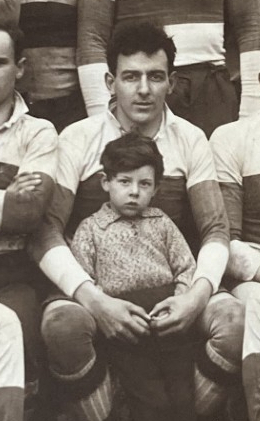
The first photograph I’m handed, along with a cup of strong tea, was taken in 1930, when John was about two years old. 1930.

My grandfather had a pork butcher’s shop there, just down from Martin’s garage it was. I was born on Centenary Street. Brother, Malcolm Peter, was born before me but died after ‘bout three months. That shop-front is still there now.
John’s father, Phil Collins, is remembered today as one of Camborne RFC’s greatest players. He was good enough to play for Cornwall against the 1924 All Blacks5.
Given John’s sporting background, it’s little surprise what one of his earliest memories is:
My father was a very heavy tackler, not a dirty tackler, proper tackle, put’n down on the floor. And he’d always turn the man, so he’d be underneath and father would always be on top.
I was ‘bout five or six…I can just remember my father playing for Camborne at Plymouth Albion. And in those days you had an excursion train going from Camborne to Plymouth. Everybody went on that! And when we were in the stand, there was an Albion man sitting next to my mother…
Father had a few heavy tackles, and that man was calling all over my father! And near the end, Camborne had a free kick and father hesitated ‘bout what to do, and I shouted out ‘Kick high, and follow up!’ Well that let the cat out of the bag then, the Albion chap knew who we were!
[After the game] you would walk down through the town, go to a restaurant, have a cup of tea and all the team would be there as well. Weren’t no cars in those days, might catch a bus if you were lucky. Lot different.
It certainly was. John was 14 when he left school.
I failed my eleven-plus and went to Basset Road school. But I couldn’t start my apprenticeship [at Holmans] until I was 16. So I had to go Tech [Technical College, Pool] for two years. I started my apprenticeship New Year’s Day, 1945.
Hitler was still alive. The Atomic Age was yet to dawn.
Here is the earliest photo we have of John as a rugby player, that of Camborne Reserves, in probably 1945 or 1946. Obviously a lot has changed in rugby since then, but lesser XVs having to scrape around for manpower has always been a constant.
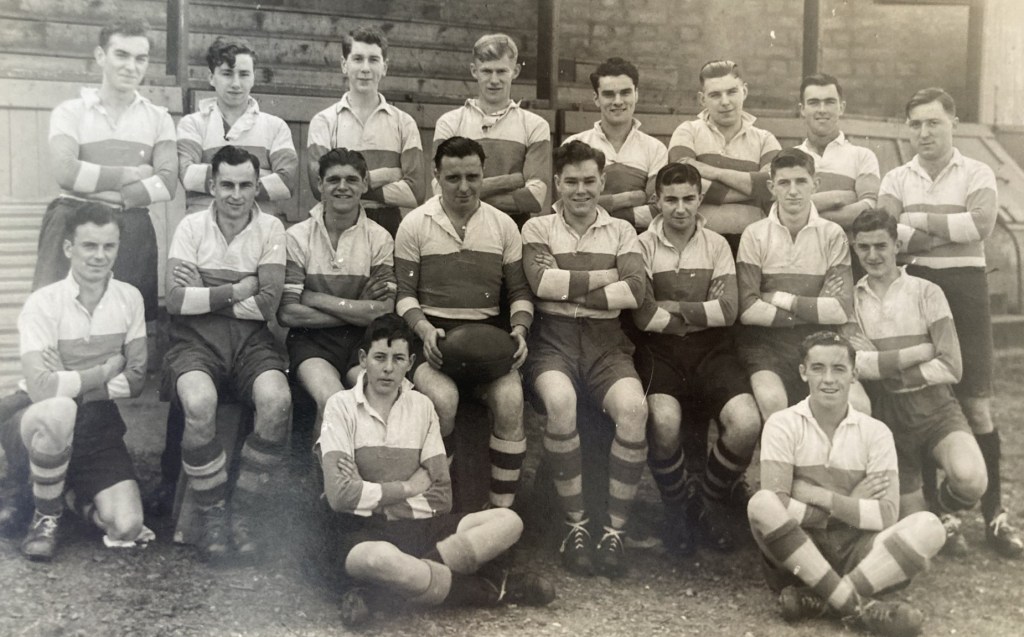
With the Reserves, you’d just turn up with your kit. If anybody was short, you’d fill in.
John was so young that, in his very first away matches for Camborne Chiefs, the baggage man was told to keep an eye on him.
No ‘Old Boys’ in those days. No Colts, no youth, no nothing. Not in the time when I was playing, when I started. Used be Camborne Chiefs, Reserves, then Corinthian Blues and Camborne Wesley RFC.
Tell you a tale about them…Had to pick up sides, they were always one or two short. One game they kicked off, at the first scrum, they had four props in the scrum, and when they counted there was 18 players out there, so they lined ‘em up on the halfway line, and the last three had to go off. And the three that went off were the ones originally picked!
There was no coaching. I never had a training session in my life! I would do a bit of line kicking, but that was that! My father told me, ‘Never buy a dummy, always take the man with the ball.’
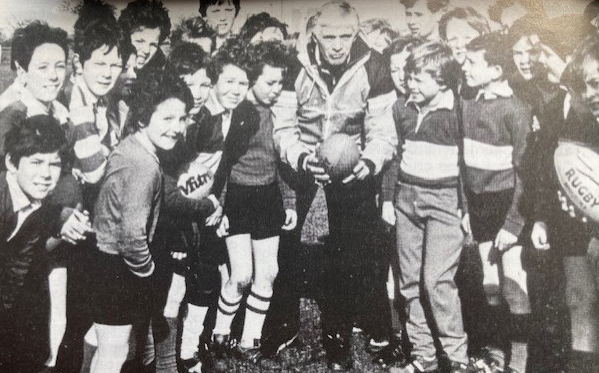
First time we had a coach [in the mid 1950s] was Chalkie White. He was schoolmaster up Truro school, and he was playing for Penzance-Newlyn, and then [Pirates scrum-half] Peter Michell come back from the Forces, and he became first-choice then. So Chalkie came to Camborne, and someone said to him, what about doing a bit of coaching?
The next image is of the first post-war Camborne XV. Standing left is a man called Harry Glanville:
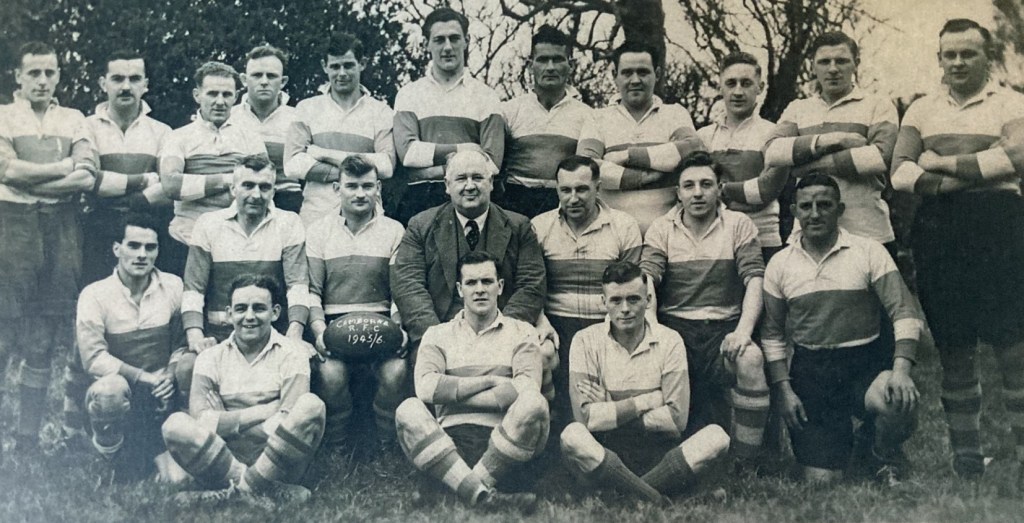
In my time, the only chap that went North was a man called Harry Glanville, Oldham, or something like that. He worked for the Council here, he didn’t play much for Camborne, it was after the war like…I knew him quite well, but he didn’t make it [in Rugby League].
Glanville appears to have signed for Oldham, aged 25, in May or June 1947, yet only made 20 appearances. Still, he would have had a lucrative signing-on fee and been provided with a job, and thus perhaps considered it a gamble worth taking7.
Around the back of the grandstand, cleaning off his boots after a match, John himself was approached by an anonymous gentleman, recommending he turn pro with the Rugby League:
I said no, not really! I don’t think physically I weren’t big enough to play Rugby League. It wasn’t much of a kicking game either, not really. So what I was strongest at weren’t good enough for Rugby League.
Post-war rugby rivalry
John is one of the few players around today to have played in Camborne’s Feast Monday fixture (generally the second Monday in November), which, after the War, meant hosting Redruth. The fixture itself was disbanded in 1963, when Holmans stayed open, offering its employees an extra day off at Christmas instead. As the firm employed every sportsman in the Camborne-Redruth area, the move effectively killed the tradition8.
Boxing Day was the top match, because only Camborne people were on holiday for the Feast. Christmas, Boxing Day, everyone was on holiday. It would still be quite a good gate, like, but not as good as it would be on Boxing Day. [Camborne was] on complete shut-down, Holmans, most businesses, but not Climax, they were Redruth area.
‘Course, when I worked over Climax, [Redruth and Cornwall star] Tony Bidgood was over there, and there was always hassle! Monday mornings and Tuesday mornings you’d talk ‘bout the game on the Saturday before, and Wednesday, Thursday you’d be talking ‘bout the games coming on in the future.
These were the days when the Holman-Climax concern would employ around 3,500 workers. On a Monday morning, those whose team had been successful at the weekend walked to work like they’d just been given a raise; those less fortunate looked like redundancy would be a blessed release.
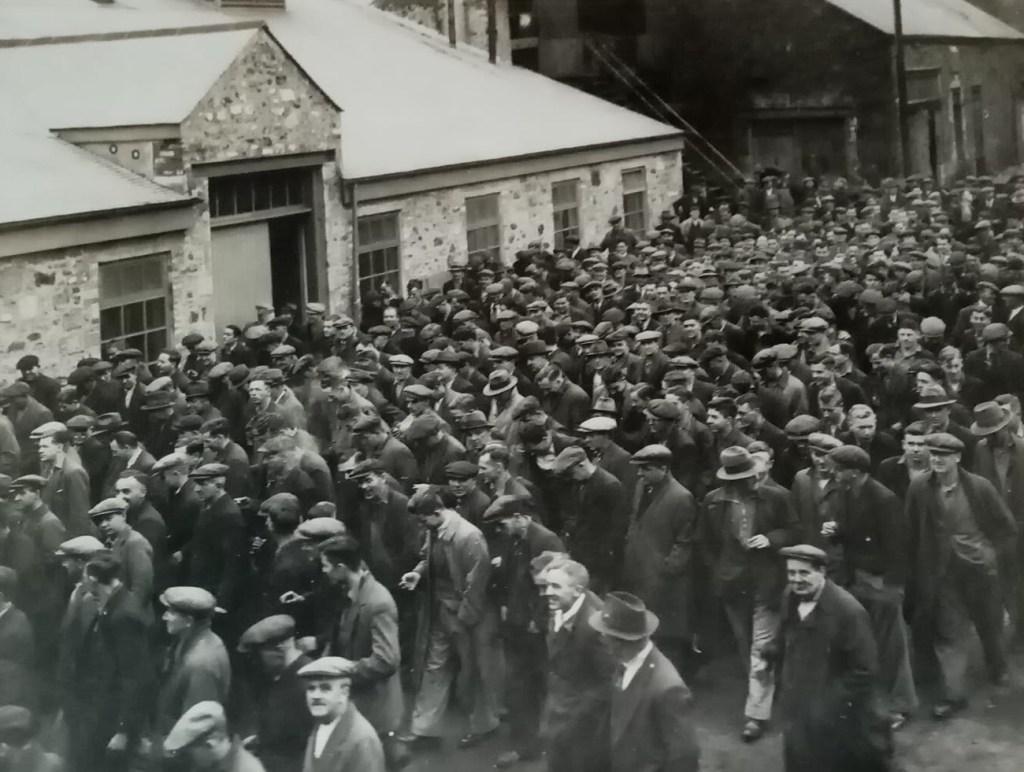
Due to the Camborne Feast tradition, from 1935 to 1963 the Boxing Day fixture against Redruth was, for Camborne supporters, always an away match:
They’d all be queued up in Camborne Square for buses. There’d be several buses on Boxing Day. They’d be queued up all around down the corner, down past where Boots used be, two or three deep! Supporter buses would be sorted out in the week. Earlier on it would’ve been by tram.
Those unlucky enough to miss the charabanc would pace around Commercial Square, awaiting a telegram informing them of the result.
Another photo, this of the Camborne 1st XV for 1947-48.
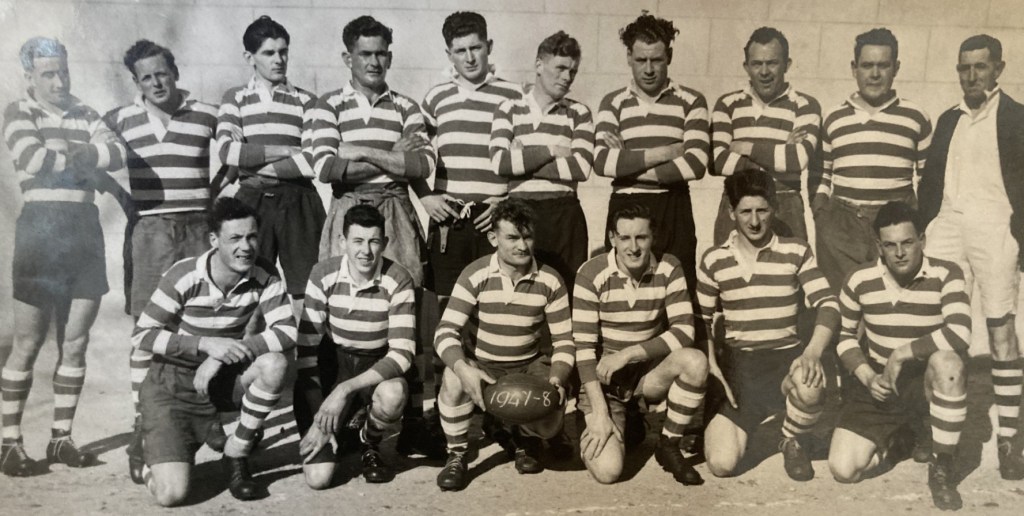
Standing left is Bob Kennedy, whose main club was in fact The Camborne School of Mines (CSM). The chance appearance of Rhodesian-born Kennedy in this image, who won three England caps whilst with CSM9 , gave rise to an interesting discussion. Kennedy only really played for Camborne on Feast Mondays, helping Camborne to victories in 1946 and 1947…
…until Redruth put paid to it. They went to the County [Cornwall RFU], and it was returned that if you played for School of Mines, you couldn’t play for Camborne on Feast Monday.
Which is true. In a CRFU minute-book from March 1950 is a reference to bylaw #33. Regarding CSM players,
…it has been ruled that when the school is out of normal session, its members shall be free to play for another club if invited…On occasional holidays the school is not considered as being out of session.
Cornwall RFU Minutes, 1950. With thanks to Bill Hooper, CRFU
Another schoolboy guest, albeit from Truro, was a youngster called Robert Shaw:
He scored the try in Redruth when we lost 6-3 [Boxing Day, 1947]. That was my first game. He scored the try up in the corner where the scoreboard is now, which was the changing rooms before.

Camborne RFC on tour
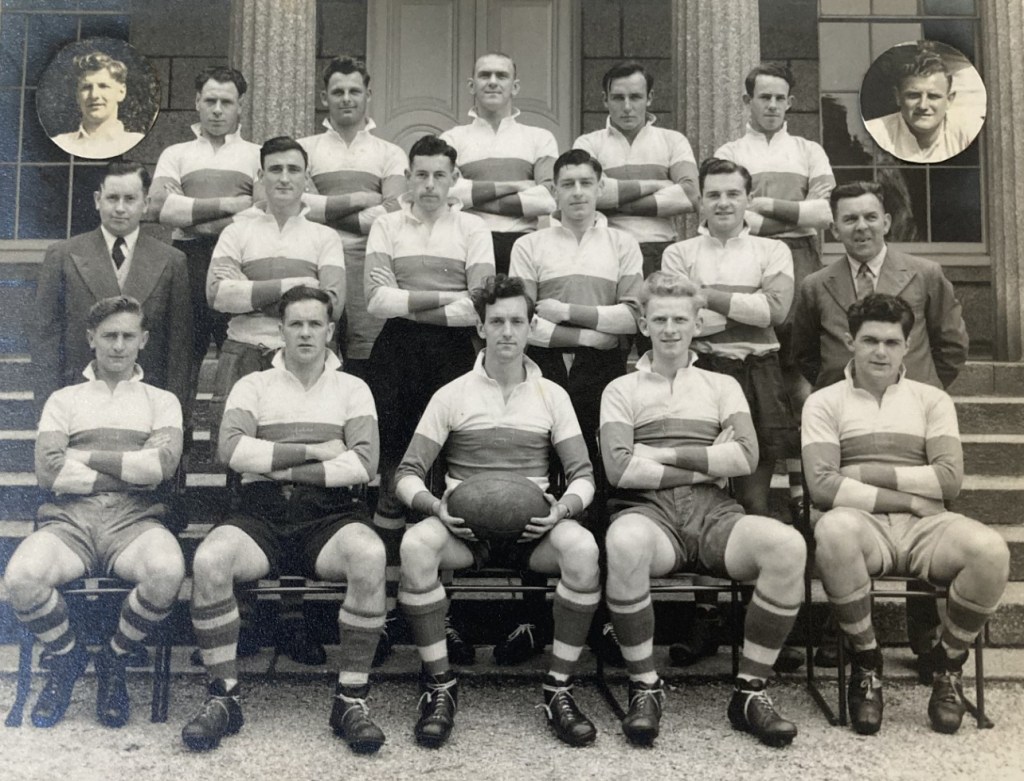
John hands me another team photo, from the 1951-2 season, which was taken on the steps of Rosewarne House which in those days was the Holman Bros. administration block.
We had no clubhouse, or nothing like that, only thing you had after a match was a big tea urn, for cups of tea. And at half-time, you had either oranges cut up, or lemons. You never went off the field, you stayed on. If you was winning, you had the oranges!
The game of rugby might have altered beyond all recognition, but one thing remains true. Any XV on an away trip accepts that high jinks is part of its remit:
The team always went by bus. Troon buses. I was only a youngster then, we went and played up Barnstaple. We lost 3-0. On the bus back, nobody was allowed go sleep. From Barnstaple to home, we always kept them awake! One chap got so fed up in the end he got up, with his kit, and he tried to open up the door at the back of the bus and jump out, with the bus goin’ on! When we dropped the chap off, he said he’d never play for Camborne again, and he went Redruth!
Bear in mind this was in the days before the Tamar Bridge, which opened in 1961…
In those days you only had the [Torpoint] ferry, no bridge up there then, see, and if you didn’t catch the midnight ferry home you ‘ad wait another hour! Anyway, we got on, and there was an announcement,
‘Will the two gentlemen in the engine room please remove themselves, the ferry isn’t going anywhere until they do…’ It was two of our blokes in there!
In those days you had a 10 shilling note gived to you, buy your dinner, tea, pint of beer or go to the pictures. For Camborne this was, all above board! I earned 18 and 11 a week as an apprentice, and a decent meal out then would cost three and six.
Telling these stories, John is a young man again. Living for the weekend:
Another time we was up Barnstaple, we had leave a certain time. Everybody was there except Gerald Wakeham. Waiting, waiting, waiting, we waited ‘bout three-quarters of an hour, we weren’t going to wait no more, so we came home.
Turned out Gerald had caught the train to Salisbury to see his girlfriend, wife afterwards, and never told nobody!
Cornwall RFU selection
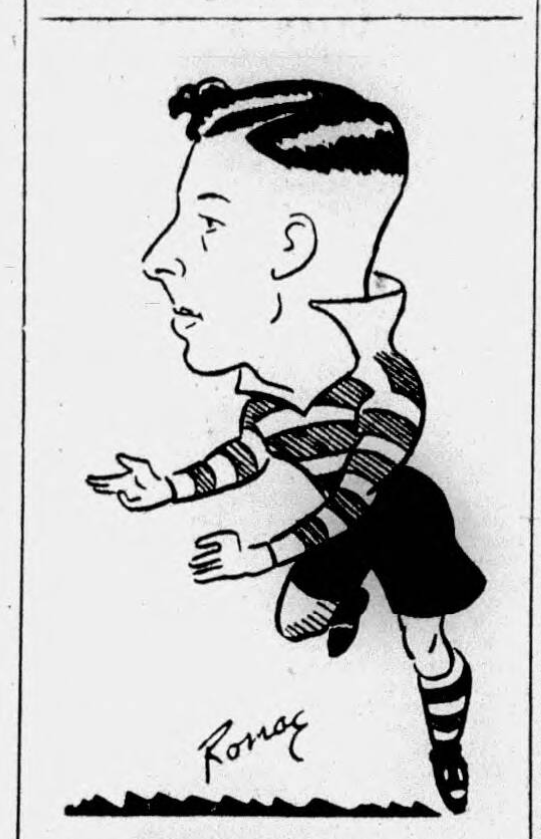
John was 19 when he debuted for Cornwall, against Monmouth at Penzance in April 1948. In those years, John said, Monmouth would tour at the end of the season for friendly matches. Cornwall lost in atrocious conditions, but the young full-back showed promise10. His calm assurance contributed to a 14-6 win over Somerset in November 1948:
Young Collins (Camborne) played a sterling game at full-back, finding long touches with the nonchalance of a veteran.
West Briton, November 29 1948, p3
John had a massive left-footed kick, and probably rivalled the great John Jackett in this regard.
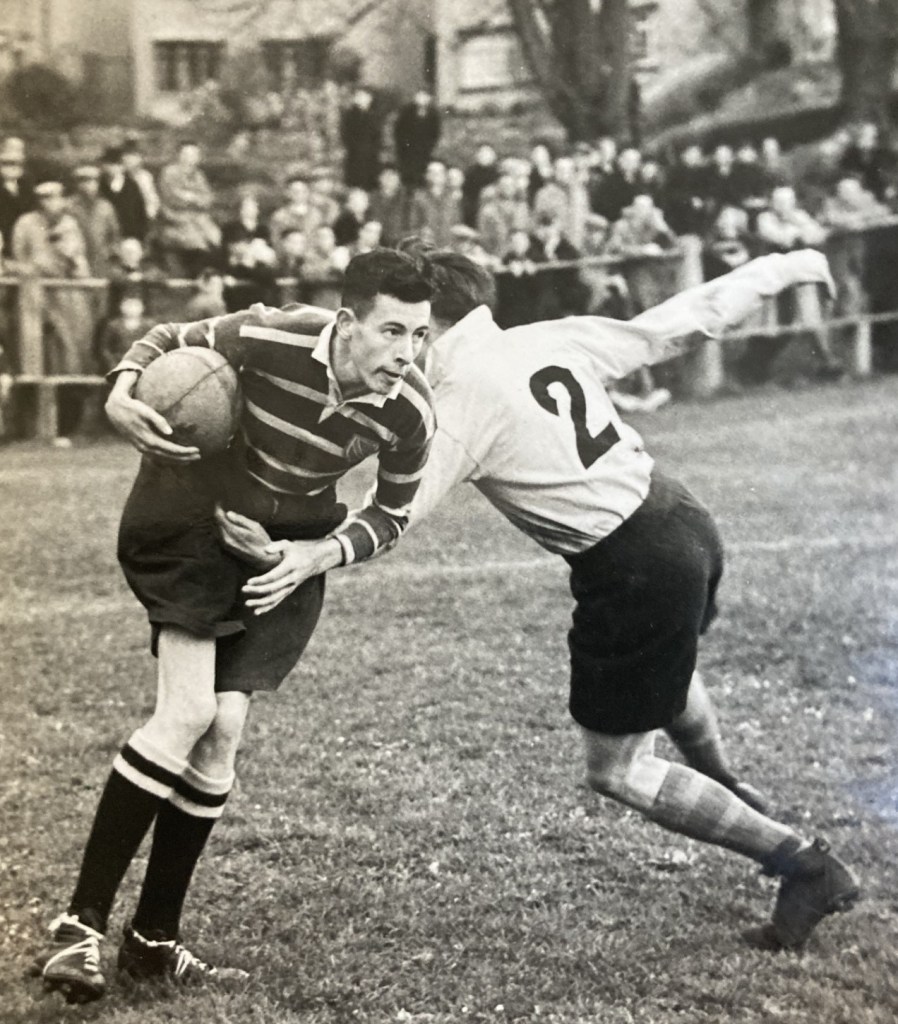

The longest drop-goal I ever kicked was from my own ten-metre line, up Camborne, in a county trial, with a gale blowing behind me! All I had do was lift the ball up!
Not boasting, but I was in the top three in the country for kicking the ball. No stats, just the opinion of reporters who watched the games. If I was on the right-hand side of the field, and the wind was behind me, I would kick for the far side of the field.
At Camborne, John was undoubtedly the tops. He was top scorer for the 1950-51 season, with 69 points12. But all this rugby came at a cost. In Camborne, the wheels of industry only stopped on Feast Monday. John told me he had to work extra hours at Holmans on a Monday night to enable him to have his entire Saturday free to play rugby.
RFU County Championship
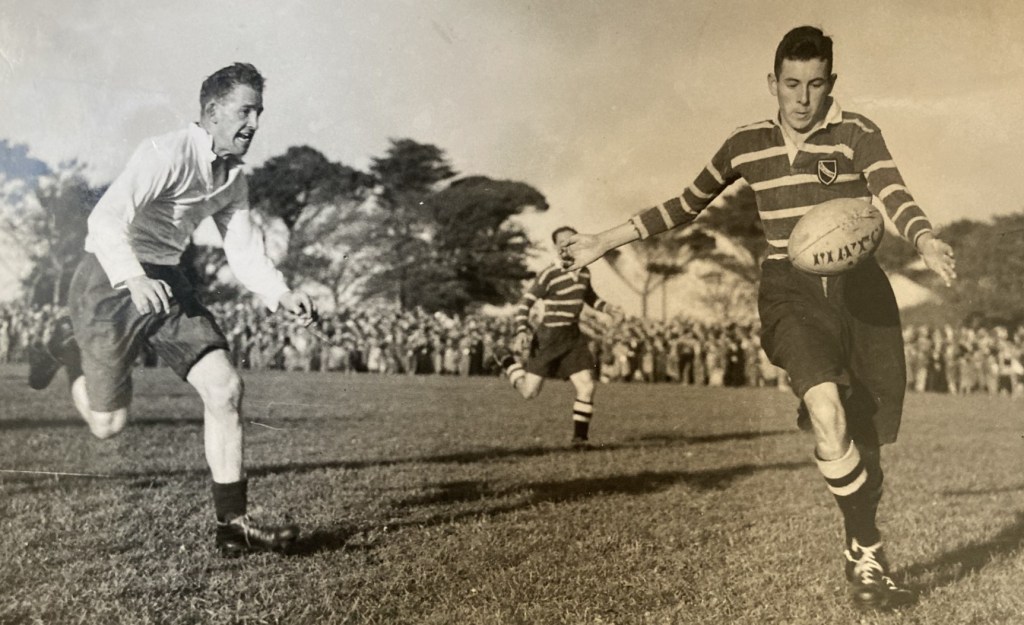
Monmouth, Berskhire and the Police Union were essentially warm-ups for the serious stuff: the County Championship.
…my first Championship game was against Gloucester. I made headlines that day: ‘Collins fails to save.’ I touched it [the ball] down, but [Sid] Dangerfield13 came and dived on it and they gived the try. Referee said you didn’t have enough downward pressure on it. We lost 9-8, in the last minute Ivor Richards broke through the middle of the field, and I said to myself, ‘This’ll be the saviour for me,’ but he didn’t score.
We came off the field and I thought I’m in for a bollocking now, and Keith Scott14 said, ‘Collins, I want to speak to you, never leave that ball on the floor again, when you save it, keep it in possession – I hope you learn by your mistakes.’
A change in the rules for that season was John’s undoing. As the ball rolled loose in Cornwall’s dead-ball area, he dived to touch it dead, but ‘failed to show the necessary pressure’, and Dangerfield capitalised15.

So the next home game, they kicked it and I touched it down, put it under my arm and walked off with it. Someone in the crowd said, ‘You silly bugger, you should’ve done that last Saturday!’
John hands me an image of Cornwall’s 1948 team:

Yeah, we had some side. Les Williams on one wing, Mike Terry on the other, Keith Scott and Kennedy in the centres, Harry Richards and the scrum-half down Penzance [Taylor]…
The team was tipped to
…bring further honours to the county this season.
West Briton, October 7 1948, p2
There were no honours, but their only Championship loss came in the Gloucestershire match16. This Cornish XV was selected from just six teams, and given the intense club rivalries during this era, I was curious to know if this ever impinged on Cornwall’s performances:
Not in my time, might’ve been in my father’s time, I can remember when two players were sent off in Redruth, they come off in front the stand and bowed to the crowd! I think post-war was different to pre-war. More live and let live.
Such things are relative. The Cornishman of November 24, 1949 noted that Cornish teams could play open attractive rugby against non-Cornish opposition. But any local derby would see regular rule infringements, heavy forward play and a desire to win at all costs. There was still room for the hard men:
Vic Roberts was quite physical, but that was his job, to nail the fly-half. He was never a dirty player, hard, but you’d never see him play dirty. Then again John Kendall-Carpenter, he wasn’t a great scrumming forward, put it that way! He played prop for England, as well as No. 8, he was a good footballer, but people used to say he ought be doing something else rather than play second full-back!
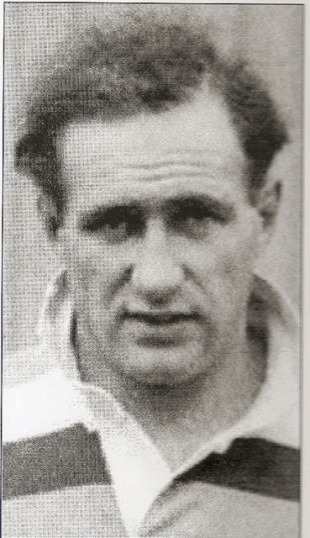
One Camborne player whose name is always mentioned in this context is Gary Harris. A Charles Atlas devotee and local doorman, he was nevertheless a quietly-spoken individual…
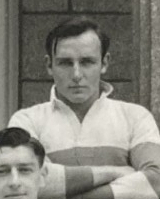
He [Gary] was quiet, he didn’t drink or nothing. What would take four men to do a job, Gary would do by himself. He was quiet on the pitch until someone worked him up a bit. I was playing St Ives, chap kept jumping on his back, and Gary said, ‘If you keep doing this, you’re goin’ have one.’ Course, he kept doing it, and Gary clunked to’n right in front of the referee. So he had be sent off. Actually he was suspended by the Cornwall Rugby Union, but our chairman, he had a bit of brains, he appealed against it, and Gary got off.
Gary played one more game, then he finished. He never played no more.
I met the St Ives man a few years ago. ‘Do you know who I am?’ I said no, he said ‘I’m the man that left my teeth behind on Camborne Recreation Ground.’
England international trialist
John didn’t play a single Championship game for Cornwall in 1949:
I weren’t playing as well as I should’ve done. I ain’t got no complaints ‘bout it, not really.
In newspaper columns – and, I’ll wager, several workplaces – debate raged as to who was Cornwall’s best full-back. Camborne asserted it was John; Redruth naturally put forward their own candidate, Frank Partridge18. In 1949, it was Partridge who was the form horse; he was described as ‘virtually perfect’ for Cornwall in the position19.
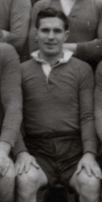
John was still learning his craft, but he was learning quickly. In October 1950 Cornwall lost 9-20 to Somerset, and his positional play was criticised in the Press20. By December of that year however, John had improved rapidly. Against Gloucestershire he
…far outshone Hooke, the international trialist.
Cornishman, December 14 1950, p13
Back in his living room in 2025, John says that
I always had ambitions to go as far as I could. What my father had done, I wanted to try and equal him…I didn’t dream of playing for England, but as things went on, it emerged I was knocking on the door a bit. But for my size and that, I didn’t think I was big enough to do it.
My first [England] trial was at Leicester. Five Cornishmen played in that trial. Kendall-Carpenter and Vic Roberts was on the white side, blues side was me, Harry Oliver from St Ives and Freddie Sampson from Hayle. We kicked off, and Kendall-Carpenter caught the ball, and he kicked it straight down to me! I thought, well done, good start this, and I knocked it on!
By early 1951, he was selected for an England trial at Twickenham.
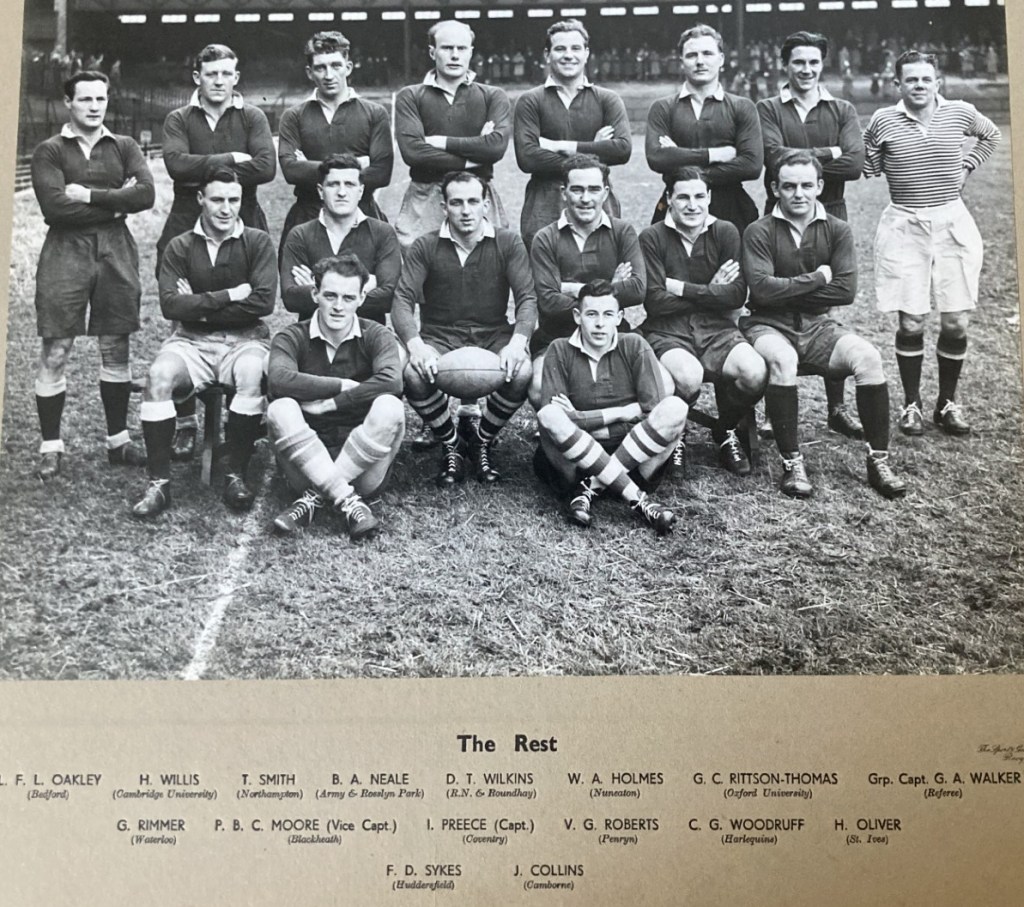
It was noted that his opposite number outplayed him, and maybe his chance had gone. John wasn’t selected for the trial to take place in December of that year21.
However John was still playing well; the 1951 Boxing Day fixture, ‘one of the hardest games seen between these clubs’ ended in a 3-3 draw, with him ‘right at the top of his form’22. He’d also represented the South West against the touring Springboks in October, it being written that
…no one did better than John Collins. He kicked a colossal length, and his fielding was impeccable.
West Briton, October 15 1951, p3

Sometimes, you don’t need to be in a trial. Sometimes, you need a bit of luck. Sometimes, you need to be in the right place, at the right time.
England cap, England debut
The sense of British rebirth and reemergence from austerity after 1945 was further reinforced in 1951 by the Festival of Britain, described by its director as a ‘tonic to the nation’23. The events even reached Cornwall, with Holman Bros. organising a week of entertainment in Camborne that August24. Sport was part of the Festival’s agenda, and John took part in an exhibition match organised by the journalist and ripping yarns-style author Hylton Cleaver, who was that year’s President of the RFU:
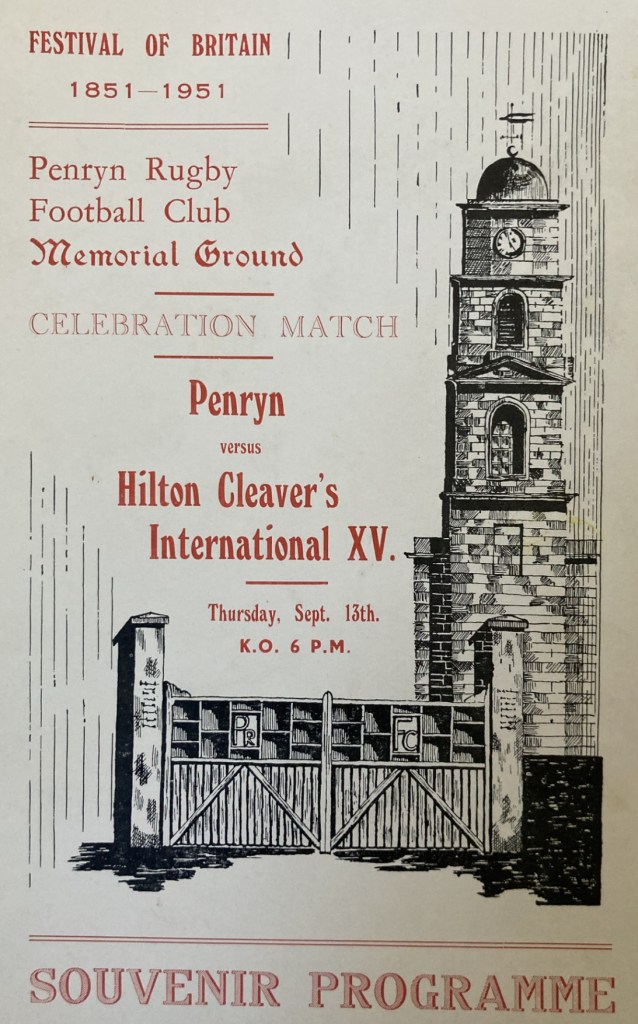
Lest we forget, the motivations of the Festival were in part to make the nation forget its woes. Rationing was still in force, with the meat allowance in Cornwall being described as ‘miserable’25.
Cleaver must have liked the look of young Collins. Maybe he put a word in the ear of the incoming RFU President for 1952, Percy Holman, whose family’s firm just happened to be John’s employer.

John hands me a flimsy scrap of paper:

I ‘ad that from Captain Crawshay. I met him first when I was about six or seven. Father introduced me to him, behind the ‘stand. Played Crawshay’s nearly every year. Back in those days, we’d play Devonport Services first, then play Crawshay’s Easter Monday. Sent me that when I was picked for England.
I was over working in the drawing office [Holmans], chap come over to me and said ‘John, manager want to see you, right away up in his office’. I never thought nothing ‘bout rugby! I thought in my mind, what ‘ave I done wrong now!
Went up there, opened the door, there was Reggie Parnell, father, Uncle Tom…they said the President [of the RFU, Percy Holman], phoned them up and said I’d been picked for England, ‘gainst Ireland. I got all the facts and figures, all the information, but it wasn’t a surprise!
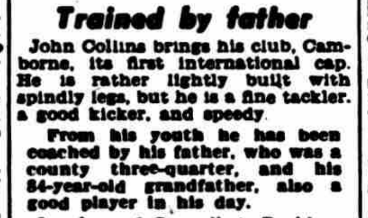
‘Course, then the King [George VI] died, so it [the game] was all put off then. I’m thinking now, maybe someone was out because they were injured, and they might be fit next time around, but it wasn’t so, and everything turned out alright.
The Ireland fixture was cancelled. England kept the same XV for the next fixture, against Scotland at Murrayfield28.
I felt there was a lot of good people in front of me who, in their time, didn’t have a sniff-in. At that time, you had to be a bit higher-class people to play for England. [The exception was] Bert Solomon, I always regretted not meeting him, I met his son, Alfred John, always had bit chat with him. Very quiet chap, he got picked to play ‘gainst the Wallabies, at full-back, never played full-back in his life! Alfred was a good man with the dummy, and a very good goalkicker, but he wasn’t all that interested whether he played or no, just like his father really29.
Like his near-contemporary and fellow Cornish rugby star Graham Paul, John knew all too well the social barriers that kept working men from playing rugby union at the highest level. Paul would ultimately sign a professional contract with Hull KR; much like Bert Solomon, John’s talent was simply too great to be ignored30.
He shortly received the following itinerary from the RFU:
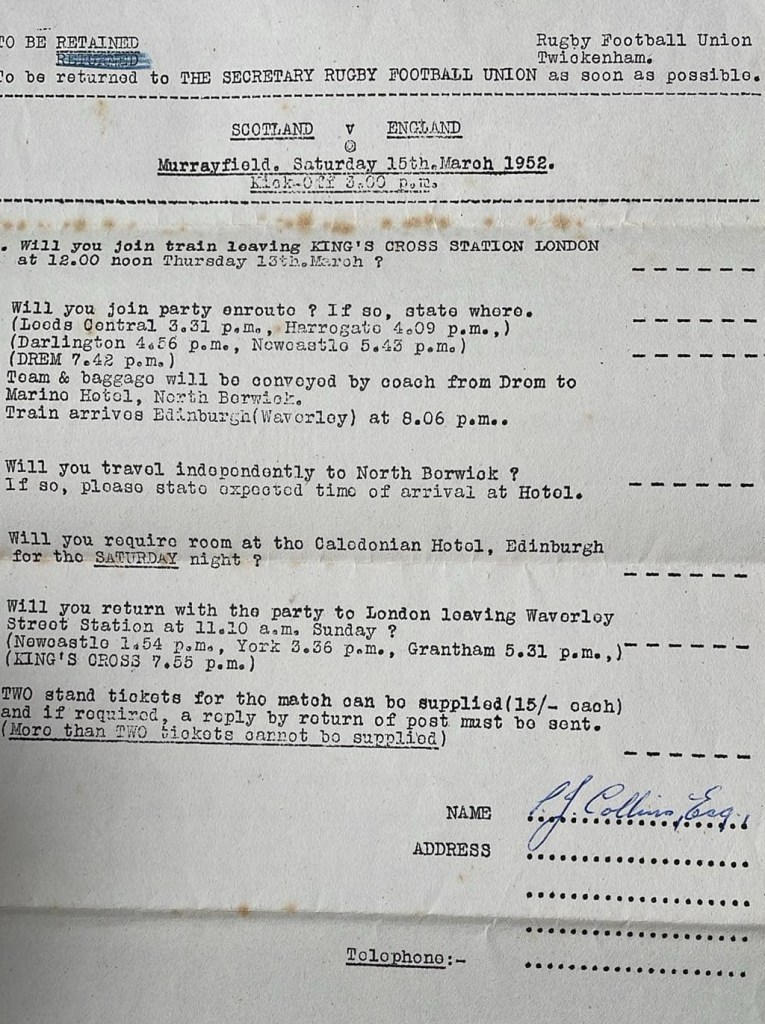
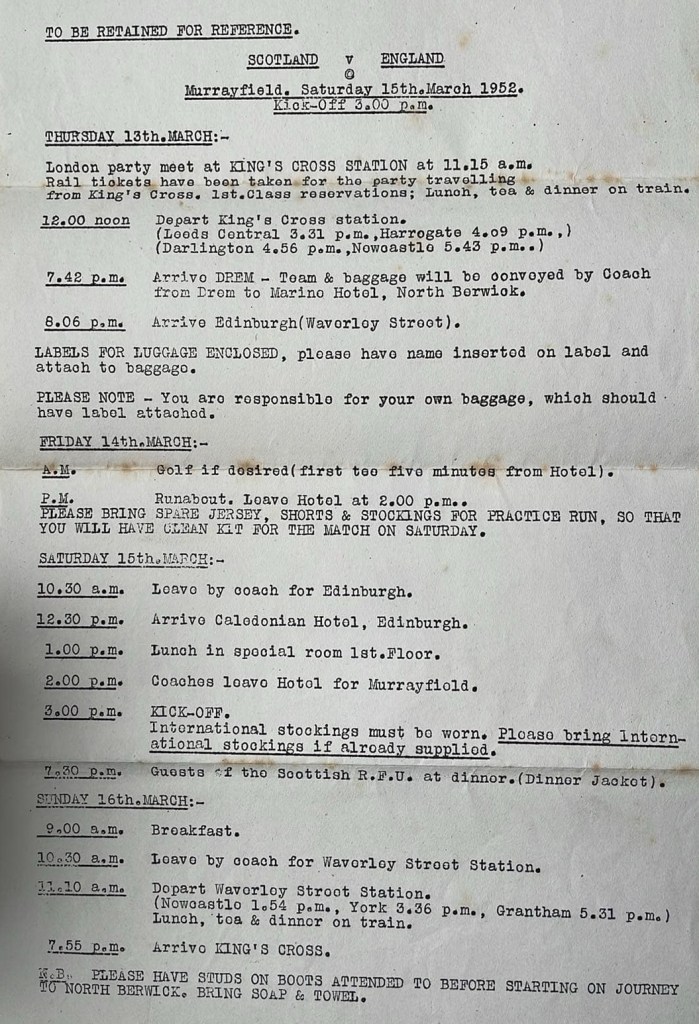
Went play for England, never had a training session, no talk, no nothing. Only get-together we had was playing snooker, darts or cards. Never had no tactics or nothing like that. Anyhow, [Chris Winn] scored in the right-hand corner, which was the right corner for me being a left-footer. ‘John! Take the kick…’
In the days before kicking coaches, kicking tees or even jugs full of wet sand, a team-mate would balance the ball just off the ground for the placekicker. John indicates to me that his assistant at Murrayfield that day held the ball sideways, that is, with his hands over the middle of it…
Normally, I said, I have top and bottom! He said, ‘You’re the kicker, you can have it which way you like!’ So he held it top and bottom, then he dropped it and it rolled over as I kicked it, and it went near the corner flag!
Same game, I had a chance for a drop-goal, ‘bout 45 metres out, right in the middle of the field. I kicked it, and it went just outside the upright.
England won 19-3, claiming the Calcutta Cup at Murrayfield for the first time since before the War. John perhaps made a nervy debut:
His kicking was short and often sliced.
Daily Herald, March 17 1952, p5
There is a Pathé newsreel available of the match, but John’s attempted conversion has been edited out. Maybe that’s no bad thing31.
A Camborne player at Twickenham
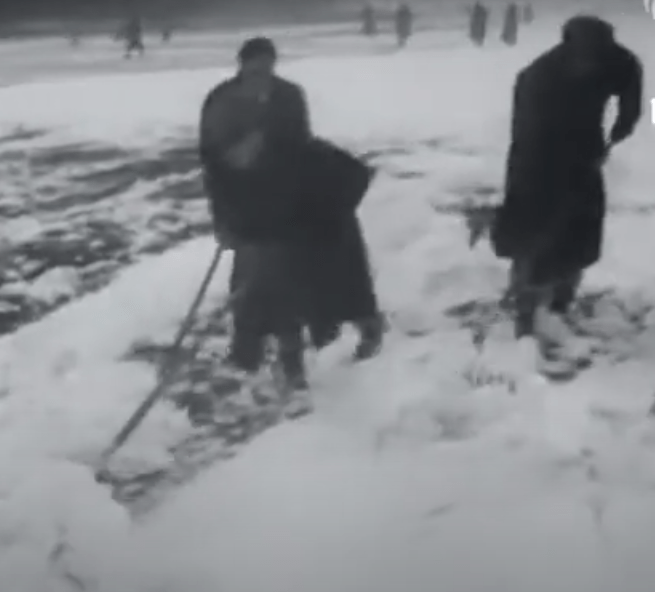
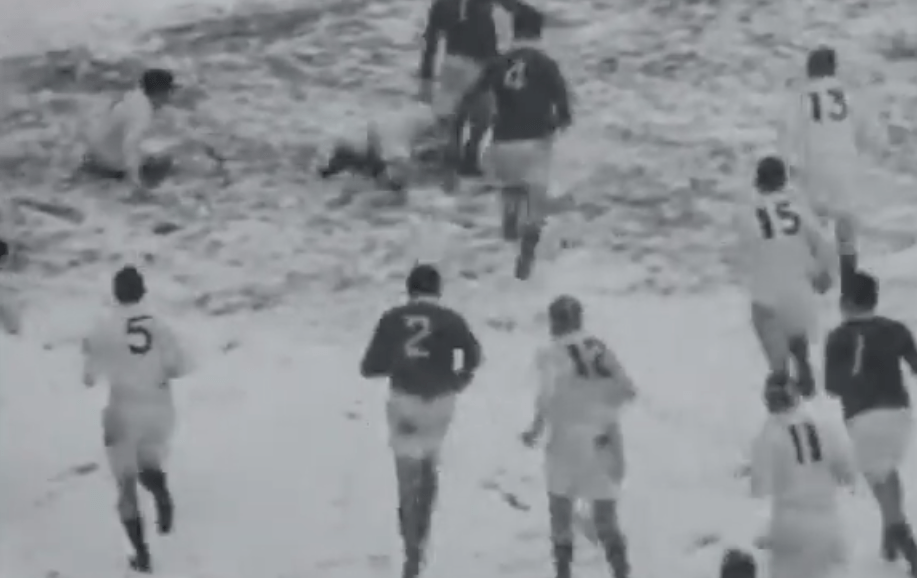
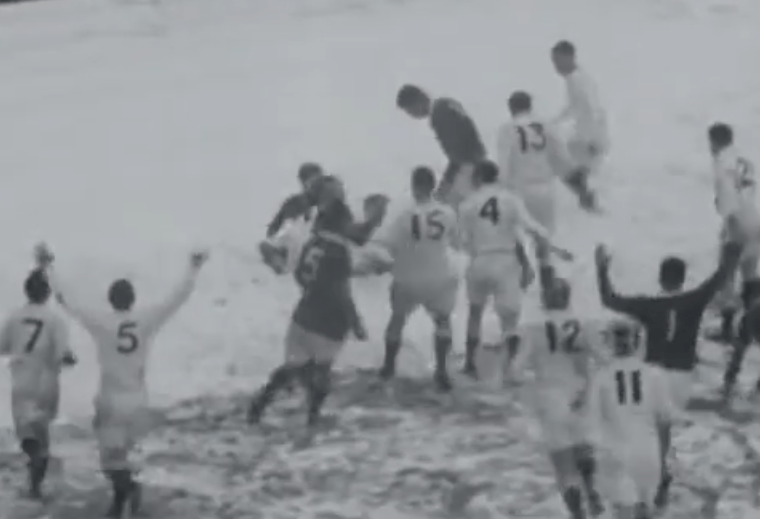
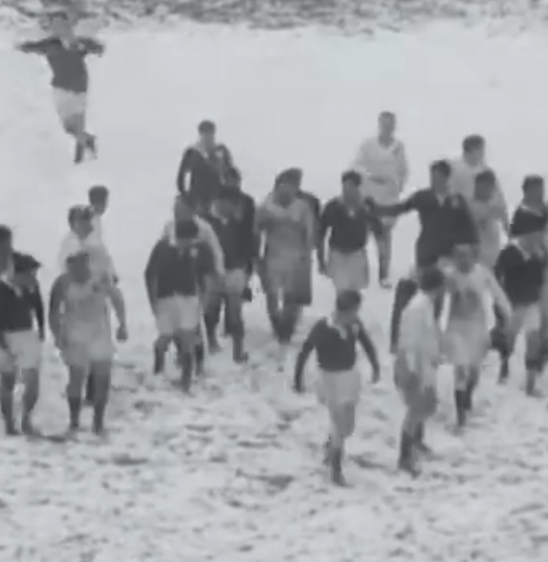
The same month, March 1952, England played the rearranged match against Ireland at Twickenham. Played mostly in a blizzard with half the pitch covered in a blanket of snow, one newspaper described the match as ‘grotesque’32.
England won 3-0. ‘Long’ John was the star player:
…always the frail figure of Long John Collins barred the way. He flung himself fearlessly at the feet of the Irish forwards; he was never flummoxed by a ball as slippery as a bar of soap; he kicked a long length with that deadly left foot.
Daily Mirror, March 31 1952, p11
There was no talk of the game being abandoned, but certain precautions were taken:
Only thing that happened was the photograph was taken underneath the ‘stand, we didn’t go out on the pitch. We came off at half time, you normally didn’t in those days. We changed jerseys and carried on. The other one didn’t have no rose on’n, only was a plain white shirt.
The snow was overnight. They got people in, they cleared half the field, lengthways, of snow. Other half was left! Lowest crowd ever seen at an international at Twickenham! 20,000!
Several of the crowd, including John’s parents, had made the long trip up from Cornwall. A Holmans employee in charge of transport had hustled up a train. No doubt management turned a blind eye.
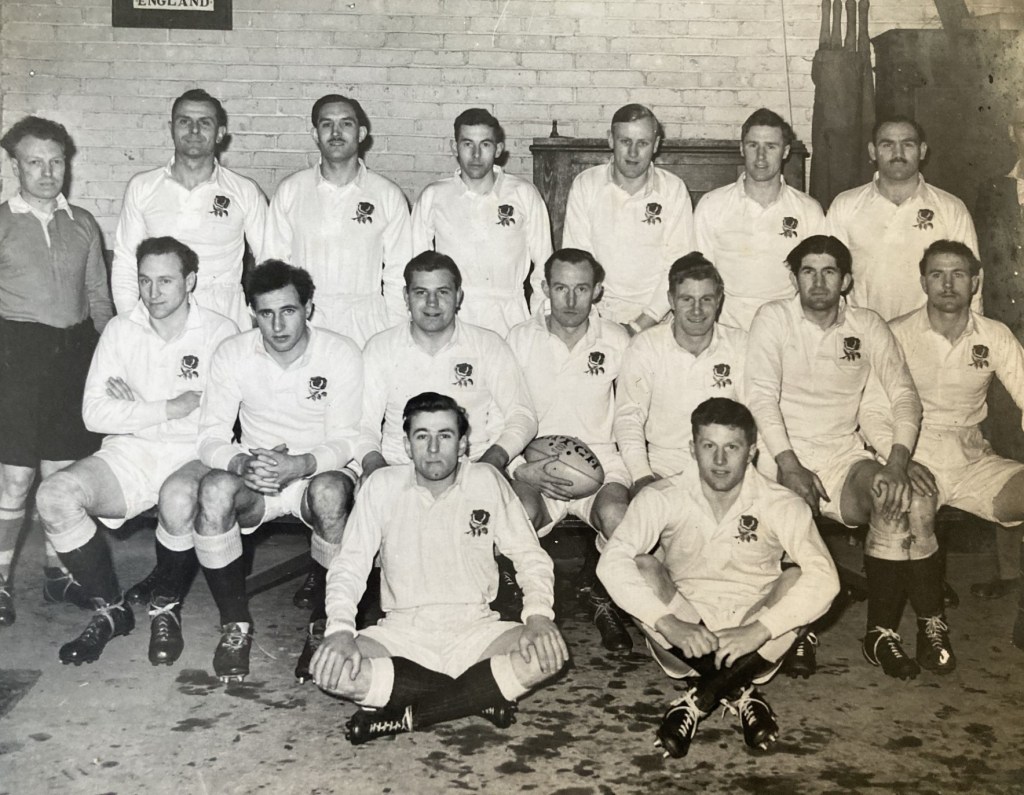
1952 Five Nations
England’s final match of the Championship was against France, at the Stade Colombes. French rugby in 1952 was in turmoil, with several clubs being accused of professionalism. There was even a rumour that the England fixture would be Les Bleus last ever Championship match34.
I left here on the Wednesday. Got up London, stayed the night. Thursday, went across to Paris. Trained on the Friday or, what training there was, won’t no training as such, not really! Played on the Saturday, come back on the Sunday night, ferry from Paris, come back on the night train…Leslie May was waiting for me at Camborne station, I had to play Captain Crawshay’s XV that day! But I couldn’t play, I was injured, hurt my rib.
[In the game] I made a mark, in they days you could make a mark anywhere on the pitch. Anyway I made a mark in the middle of the pitch, and two French players struck me the exact same time! Knocked the wind out of me!
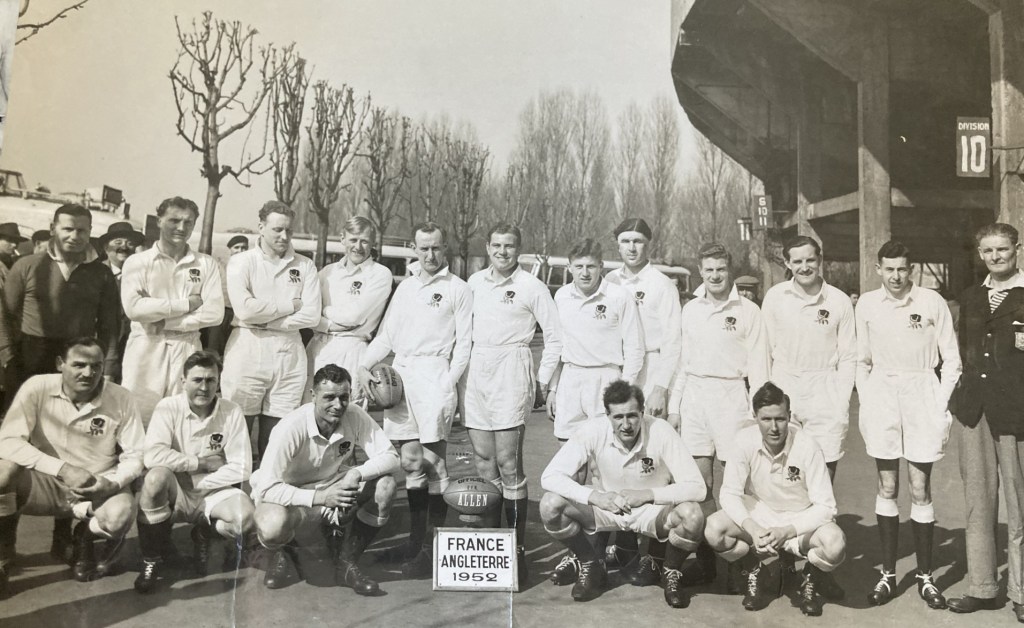
England’s 6-3 win over France was described as the ‘dullest’ game of the Championship. Although France were down to 14 men for most of the second half due to an injury, England barely capitalised35. Nevertheless, England’s three victories with John at 15, noted for his ‘resolute’ tackling in France, meant they finished second overall, behind a Welsh Grand Slam36.
John finished his first international season undefeated.
It would also be his last international season.
Feast Monday, 1952
Some of John’s memories don’t require photographic aid. I asked him about his injury; John of course had several injuries over the course of his career, but there’s only one injury that matters. And that was sustained against Redruth on Feast Monday, November 195237.
Gale wind, straight up through the field. We was playing’ straight against the wind. I caught the ball, and first thing I did was move closer to the touchline. But I ran two paces too far, an’ as I kicked the ball, he tackled me. And I felt something go…
That put paid to me for the rest of the season.
His recovery and progress received much attention in the Press, so quickly had John’s star risen in Cornish rugby circles. Indeed,
…down in the John Collins country they know a good full-back when they see one.
West Briton, November 5 1953, p2
Camborne RFC was asked to give statements. The West Briton wished him a speedy return to Cornish and international rugby38. By February 1953 John himself told a reporter that
It might be as well for me not to play this season, but, despite rumours, I’ve no intention of giving up the game. I hope to start playing next season.
West Briton, February 26 1953, p2
I didn’t have any treatment, at that time. He [the doctor] thought I’d strained ligaments. I saw a man up Truro Infirmary, and he said I shouldn’t play no more, for so long.
John’s leg was put in splints, and he was sent to a specialist in London. This man sent him to Leicester, where he was discovered to have torn ligaments and cartilage in his knee. Told to go back to London for the operation, John made sure he got married first, which was the sensible thing to do, for he was laid up in a hospital bed for eight weeks. Camborne fans travelling to Twickenham for the internationals would visit, bribing the matron with Rodda’s cream to gatecrash John’s ward en masse.
The operation seemed to have done the trick. John was back playing for Camborne at the start of the 1953-54 season, but had his eyes on one particular fixture:
I wanted to do something what my father had done. He’d played against the South Africans, and the All Blacks…
John had played the Springboks, back in 1951. A Cornwall-Devon XV were due to play the 1953 All Blacks in early December. That was the target.
Before the All Blacks game, Cornwall was playing Devon away. I had the ball, and John Stark was coming towards me. I beat him, and went and kicked to touch, he turned quickly, came behind me and tapped my ankle, and my knee was gone again!
John did nothing wrong, but he might have been disappointed that he’d done that. I was quite friendly with him.
John Stark, a wing for Exeter, skippered Devon to their 1957 County Championship victory. He died aged 88 in 2013.
I went to see the doctor again, and he said, ‘I advise you to give up. If you was a professional, I could operate on you and shorten your ligaments, but as an amateur I wouldn’t advise it.’
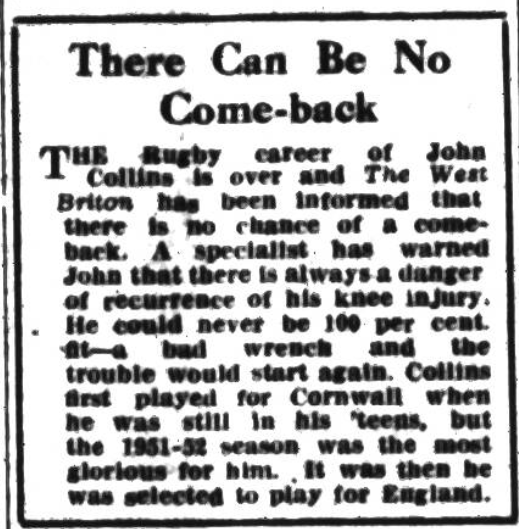
John’s retirement was described as ‘tragic.’ He was 2440.
I look at it both ways, really. I’ve still got my leg!
One of John’s sons, David, played a Boxing Day fixture a few years ago in Redruth. In the bar, a man approached him and said:
I never meant it. I never meant it…
The man who had inadvertently caused John’s injury on Feast Monday, 1952 still carried the blame.
Camborne’s first England international
It’s important to remember that John’s rugby career lasted less than ten years, and that there’s more, much more, to him than just ‘John Collins, Camborne’s first England international’. It’s only over time, and with no additional Town players donning the Red Rose, that John’s feat has gained legendary status, yet simultaneously threatens to overshadow his many other achievements41. The sense of what-might-have-been is evident in histories of Cornish rugby:
Those privileged ever to have seen John Collins kick for touch need never seek another kicker.
Tom Salmon, The First Hundred Years: The Story of Rugby in Cornwall, CRFU, 1983, p44
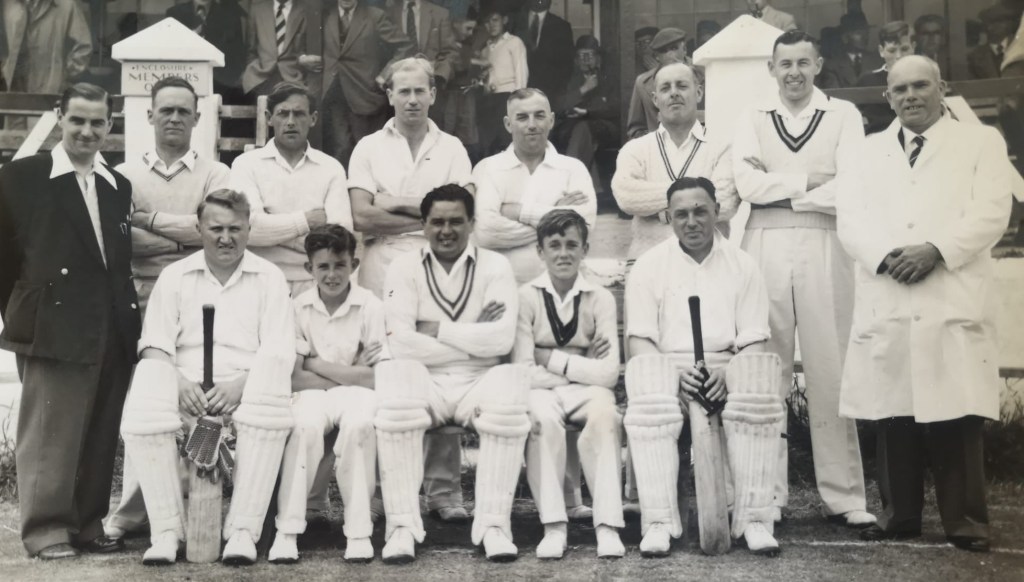
For example, John played cricket for many years with Camborne and Holmans. He was also a fine snooker player, who once took on the great Joe Davis. His sons, Malcolm and David, both played rugby for Camborne, Malcolm going on to represent Cornwall. Above all, he’s a true gentleman, and I was honoured to chat to him.
With special thanks to Honor Collins, Malcolm Collins, and David Collins.
My previous Cornish sporting hero was Richard Pascoe, of Saint Piran Cycling. Find out all about him here.
Many thanks for reading; follow this link for more top blogs on all things Cornwall: https://blog.feedspot.com/cornwall_blogs/
Do you enjoy my work?
All content on my website is absolutely FREE. However managing and researching my blog is costly! Please donate a small sum to help me produce more fascinating tales from Cornwall’s past!
Your contribution is greatly appreciated.
DonateReferences
- Image from: http://chudleighhistorygroup.uk/articles/1948_olympic_torch.html
- Peter J. Beck, “Britain and the Olympic Games: London 1908, 1948, 2012”, Journal of Sport History 39.1 (2012), p21-43.
- As listed in the West Briton, November 27 1947, p2.
- West Briton, July 12 1951, p2; July 1 1954, p10. 4,000 watched an early season victory for Redruth over Camborne: West Briton, October 7 1948, p2.
- For more on Phil Collins’ exploits, see: https://the-cornish-historian.com/2024/09/21/the-magnificent-seven-meet-the-invincibles/
- For more on Chalkie White, see: https://en.wikipedia.org/wiki/Chalkie_White_(rugby_union). Image from: Tom Salmon, The First Hundred Years: The Story of Rugby in Cornwall, CRFU, 1983, p103.
- From: https://orl-heritagetrust.org.uk/player/harry-glanville/, and Halifax Evening Courier, June 3 1947, p2.
- For more on the Feast Monday sporting tradition, see: https://the-cornish-historian.com/2023/08/26/cambornes-feast-day-rugby/
- For more on Kennedy, see: https://en.wikipedia.org/wiki/Robert_Kennedy_(rugby_union). He was always known, and selected for England as, a CSM player: Western Morning News, January 25 1949, p6.
- Cornishman, April 29 1948, p7.
- Cornishman, November 11 1950, p7.
- West Briton, July 12 1951, p2.
- Sid Dangerfield was a prolific scorer for post-war Gloucestershire: https://www.gloucesterrugbyheritage.org.uk/content/people/player_profiles/sid-dangerfield#
- Truro-born Keith Scott represented England in 1947 and 1948: https://en.wikipedia.org/wiki/Edward_Scott_(sportsman)
- Cornishman, October 28 1948, p7.
- Cornwall hammered Dorset-Wiltshire 52-3, beat Somerset 14-6 at Falmouth, and drew 8-8 with Devon. From: Tom Salmon, The First Hundred Years: The Story of Rugby in Cornwall, CRFU, 1983, p118.
- For more on Kendall-Carpenter, see: https://en.wikipedia.org/wiki/John_Kendall-Carpenter. Image from: https://www.bathrugbyheritage.org/content/heritage-topics/people/player-profiles/kendall-carpenter-john-3
- Western Morning News, May 13 1949, p6.
- West Briton, October 6 1949, p2.
- Cornishman, October 19 1950, p9.
- West Briton, January 11 1951, p2; December 13 1951, p2.
- West Briton, December 27 1951, p2.
- Quote from: https://en.wikipedia.org/wiki/Festival_of_Britain
- West Briton, August 2 1951, p7.
- West Briton, March 22 1951, p4.
- West Briton, February 6 1969, p18. Image from: https://artuk.org/discover/artworks/percy-miners-holman-18951969-14315
- For more on Crawshay, see: https://www.crfu.co.uk/crawshays-the-camborne-connection/
- West Briton, March 6 1952, p2.
- Alfred Solomon represented Cornwall and Devon against the Wallabies in September 1947. The Wallabies won, 17-7. From: From: Tom Salmon, The First Hundred Years: The Story of Rugby in Cornwall, CRFU, 1983, p132.
- See my interview with Graham Paul here: https://the-cornish-historian.com/2025/04/12/cornish-sporting-heroes-2-graham-paul-the-cornish-express/. Solomon only played once for England; an employee at a local factory, his lack of social polish embarrassed him so much in front of the rest of the XV he refused to put himself through it ever again. See: Bert Solomon: A Rugby Phenomenon, by Allen Buckley, Truran, 2007. For more on the class barrier in rugby union, see: Tony Collins, A Social History of English Rugby Union, Routledge, 2009, p96-129.
- View the footage here: https://www.youtube.com/watch?v=JYi93OR89NA
- Daily Herald, March 31 1952, p6.
- See the full newsreel here: https://www.youtube.com/watch?v=roNFv701_w8
- Evening News (London), March 31 1952, p8; Daily News (London), April 5 1952, p5.
- Sunday Express, April 6 1952, p9.
- The People, April 6 1952, p10.
- Another brutal war of attrition ended in a 6-6 draw. West Briton, November 13 1952, p2.
- November 20 1952, p2.
- West Briton, October 15 1953, p2.
- West Briton, December 3 1953, p2.
- John was interviewed by EPCR in 2012: https://www.epcrugby.com/european-professional-club-rugby/content/rugby-legend-john-collins-reminisces, and was the subject of an RFU article in 2023: https://www.englandrugby.com/follow/news-and-media/camborne-honour-englands-oldest-former-player
 Francis Edwards ~ The Cornish Historian
Wh
LikeLike
nice to see a picture ofour family butchers it was in Centenary street not Trevenson though 😉
LikeLike