
Reading time: 30 minutes
The trouble about being a Rugby selector is that you can never be right. ~ Howard Marshall (Oxford University and Harlequins), 19391
Cornwall’s rugby history
Regular readers of my blog will be aware that Nick Serpell (Hellfire Awaits: 150 Years of Redruth RFC) and myself are writing a history of Cornish rugby. Hitting the stands in late 2027, it will be the first book-length study of Cornwall’s national sport, from the 1870s to the present.2
My recent rugby posts, on the Cornishmen who switched codes from amateur rugby union to professional league, and the Camborne School of Mines players who perished in World War One, are related to the forthcoming publication and complement it.3 So, when I eventually say in the book that 24 players joined the rugby league, or that the School of Mines RFC lost more members in the war than any other Cornish club, I’ll have the groundwork – the posts – to back these assertions up.
The piece you are about to read has been developed with a similar purpose in mind. In the book, I will probably say something like the following:
Between 1919 and 1939, although eight Cornish-born players were awarded England trials, and a ninth trialist had made Cornwall their home, not one became a full international. We have to ask why.
I can then refer back to this post, and you will know that the total of nine trialists is a fact, and that I’m not just making it all up.
This number is important for two reasons. Firstly, between Redruth’s Bert Solomon in 1910 and Falmouth’s Jim George in 1947, not one single Cornishman represented England. In terms of international recognition, that’s an incredibly long period, even if we take into account two world wars.
Secondly, three players who represented Cornwall on the pitch did in fact play for England between the wars. These men are however only ‘Cornish’ in the broadest possible sense. They might have played rugby for Cornwall, yet none ever represented a Cornish club, nor were born on the right side of the Tamar.4
Naval men Ernie Gardner, Fred Gilbert and Charles Webb all played for Devonport Services RFC. Gardner hailed from Cardiff, and Gilbert and Webb were both born in Plymouth. The trio quite possibly qualified for Cornwall through residency, yet Webb and Gardner also played for Devon.5
Why, then, did Gardner, Gilbert and Webb represent England, yet eight Cornishmen (and one club-playing resident) did not? Why were so many fine Cornish players overlooked by the RFU’s selection committee in those years?
Mine and Nick’s book seeks to answer these questions; this post doesn’t. Here we will examine the lives and careers of nine men who, even now, many people recall as being good enough to merit international recognition.
Honourable mentions
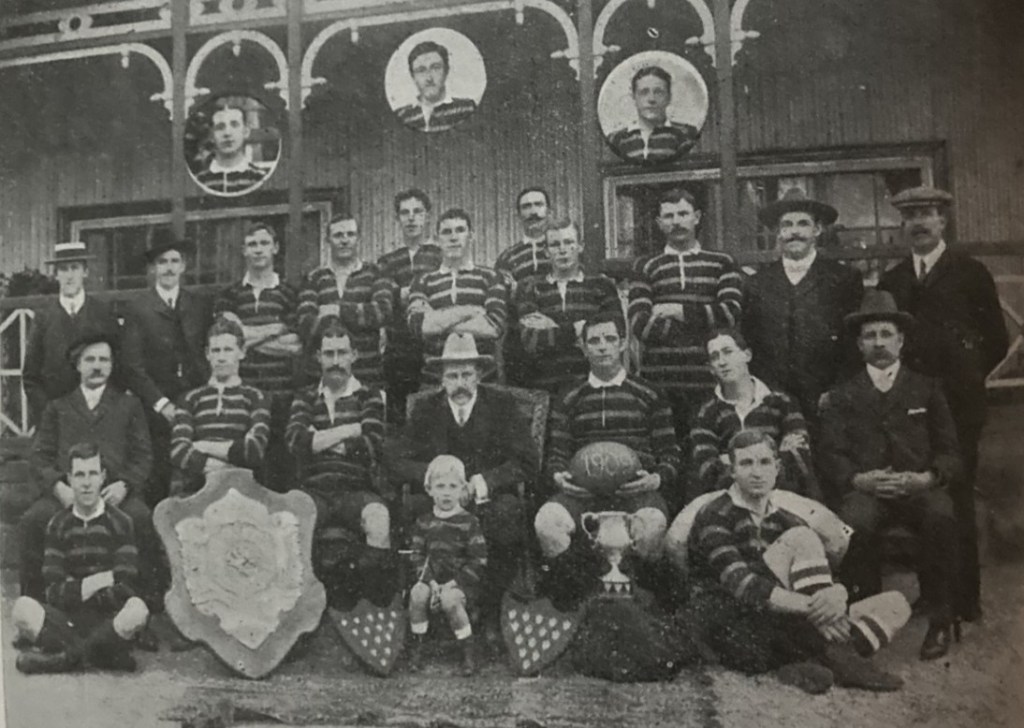
Although they appeared in trial matches before the war, two men are worthy of inclusion here. Camborne RFC’s Alfred Rodda (1881-1926), a miner, was the first Cornishman to be awarded a trial cap. He appeared in two such matches before emigrating to South Africa with 15 others in 1902. He married in Johannesburg in 1905 and appeared for several rugby teams, including Randfontein.
Fred’s life was marred by tragedy. His wife and three young children drowned when their ship, the Galway Castle, was sunk by U-boats in 1918. Fred was only 45 when he died of phthisis.7

Dick Jackett (1881-1960) is a Falmouth and Cornwall rugby legend. Such was the wealth of sporting talent in his family, however, that he wasn’t even the best player in the Jackett household. That title must go to his older brother, John, but Dick was no slouch.8
Dick represented Cornwall well into his 40s, his tally of 70 caps being a record on his retirement. Even now, only Stack Stevens, Peter Hendy, Bonzo Johns and Tony Cook have played more matches.9
He was a key member of the monster pack that helped Cornwall win the County Championship in 1908, and an Olympic silver medal that same year. Though recalled most vividly by Falmouth RFC, Dick was also a high-profile signing for Redruth, and latterly followed his brother to Leicester, in the days when such a move was by invitation only.
Yet Dick never played for England. From 1904 to 1911, he played in five trial matches and had to pull out of a sixth. Had he been successful in 1905, he would have debuted alongside brother John against New Zealand. A nod in 1906 would have seen Dick take the field against the Springboks. Even in 1910 the London ‘papers still rated him ‘one of the best forwards in the West’, whose claims for inclusion were ‘hotly supported’ by many pundits.10
But it was not to be.11 On his death in 1960, one of Cornwall’s strongest, toughest forwards of all time was described as:
the county’s unluckiest player.
West Briton, 28 Jul 1960. Page 14
As we shall see, several more can lay claim to that unfortunate accolade.
Ernest Rodda (1894-1936), Camborne RFC
Two trials and four caps for Cornwall12
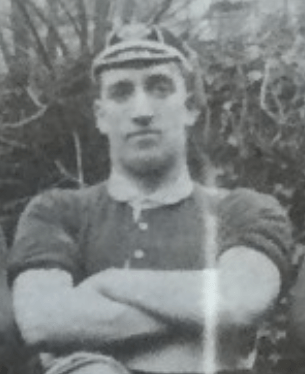
Between England’s first international match in 1871 and the RFU’s long-delayed decision to turn the game professional in 1995, only four miners were ever capped.13
Ernest Rodda, the son of a grocer from Crowan, wasn’t one of them.
For the 1920 Five Nations championship, England’s dream XV was to materialise after three trial matches. A nominal international team would be pitted against ‘North’ and ‘South’ XVs, leading to a final game against ‘The Rest’. Commentators and armchair selectors prepared themselves:
Theoretically it is a good idea, for in the exhaustive process of selection and alteration the very best side of all should be come upon. But unfortunately things do not work out so smoothly or sequentially.
‘Astral’, Daily News, 17 Dec 1919. Page nine
Ernest, with a burgeoning reputation in the West Country (and South Africa, where he had worked) as a powerful forward, was picked for the South XV which ran in four first-half tries against England at Twickenham on 20 December 1919, eventually winning 19-14. This was not the ‘smooth, sequential’ process the selectors had been hoping for, but it generated plenty of column inches.14
Ernest was the only Cornishman selected for the South, though he had men from Gloucester, Plymouth and Newton Abbot for company. The other players were all from London clubs or the principal universities. Nonetheless, he must have shone, for the selectors had another look at him for the Rest in the final trial on 3 January 1920. This time though the England XV won convincingly 30-16, solving much selectorial consternation and denying many journalists the opportunity to further sharpen their pencils.15
Ernest didn’t hang around for the next season’s trials. By late January or early February 1920, he had signed professional terms for the northern union’s Rochdale Hornets. Indeed, northern scouts were probably present at the trial matches, on the alert for burly working class lads willing to back their own talent.16
Ernest took the gamble, but it didn’t pay off. A leg injury kept him out of the Rochdale team that won the 1922 Challenge Cup, though another Cornishman, Redruth’s Tommy Harris, played in the final. In fact the injury was so bad that Ernest’s leg had to be amputated. He entered the licensing trade, managing Rochdale’s Eagle Hotel. Ernest died in 1936, with the Cornwall RFU sending condolences to his widow.17
Herbert Wakeham (1897-1963), Camborne RFC
Three trials and 23 caps for Cornwall

The Five Nations championship was, in these years, generally the only opportunity to play, or watch, international rugby. Additionally, from 1932 to 1939, the Five Nations in fact reverted to the Home Nations: France, with accusations of professionalism in their game, had been expelled, meaning even less fixtures. The now-annual Autumn Nations Series did not exist. New Zealand only visited in 1924/25 and 1935/36, with their Māori side coming over in 1926/27. The New South Wales Waratahs toured in 1927/28. South Africa visited in 1931/32. There was no televised rugby, with the BBC in its infancy.
Without a recognised league system, outside of the Five/Home Nations the trial matches by definition and intention had to feature the best rugby in the land. Teams were selected from key domestic and County Championship matches. For example, in 1925 a selector watched Devon trample all over Cornwall to win 6-0 in Redruth, and promptly awarded four Devon forwards a trial. When Harlequins hosted the Army in 1927, the selectors requested a Yorkshire wing play for the latter, in order that they might have a better look at him.18
Although the final trial was always held at Twickenham, the first two varied in location. If you couldn’t make an international, a trial in your locale was often the next best thing. When the South played England at Bristol in 1921, a crowd of 15,000 saw the latter win 29-14. Another 15,000 turned up for a trial at Birkenhead in 1923. Reports of trial matches even began to be broadcast over the wireless. If you owned a radio in London in late 1928, you could be treated to a 15-minute report of the trial in Newcastle.19
Trial matches were prestigious events, with those selected to represent the various XVs either already full internationals or potentially on their way to becoming one. Such occasions were marked with the presentation of a trial cap. Here’s a couple of Herbert Wakeham’s:
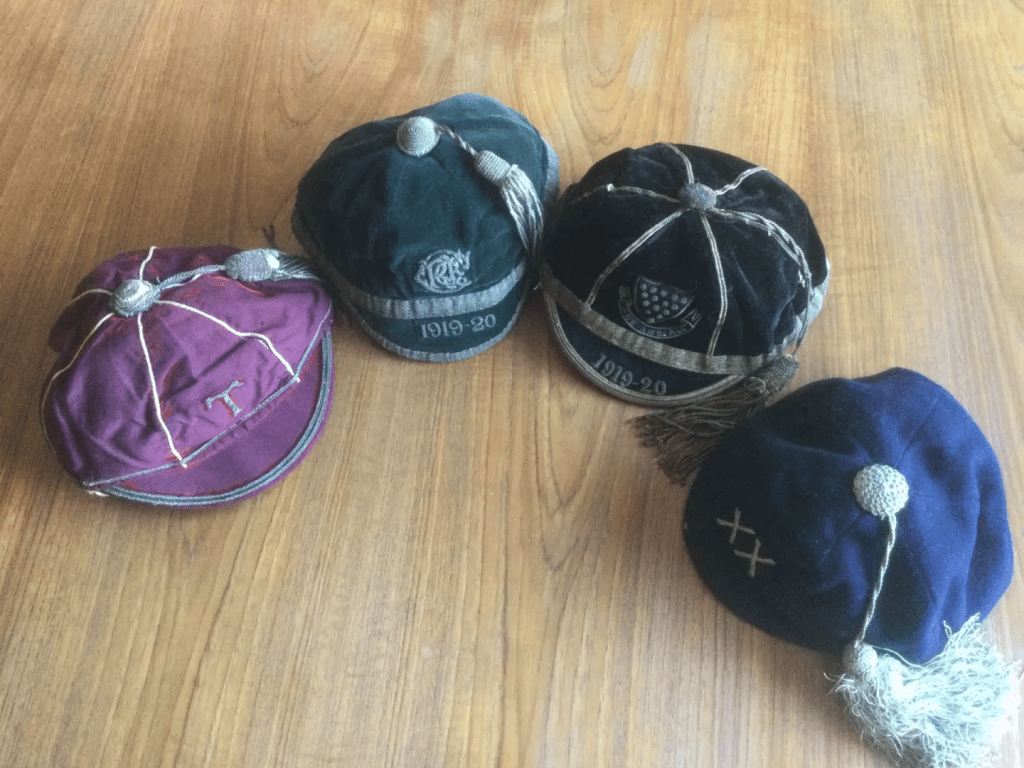
Herbert was a rock-drill salesman for the Camborne firm Climax, and had rapidly gained a reputation as a ‘fast and clever’ forward in the immediate post-war era.20
That said, his selection for the South at Leicester in December 1920 was far from seamless. Trial XVs, often announced weeks in advance of the actual fixture, were regularly altered on account of injuries or work commitments. Herbert, not named in the original side, was such a last-minute call-up the West Briton thought he was in the England XV. One national ‘paper omitted his inclusion altogether on the day of the match, but the Daily Express got it right.21
Being thrust into an unfamiliar team chock-full of university dons, medical students and big club players would have fazed many, but not Herbert. His experience as a travelling salesman may have helped, but Herbert definitely did the talking on the pitch. Though an 18,000 crowd watched England hammer the South 31-8, Herbert did enough to merit selection for the Rest at Twickenham in the final trial.
Playing opposite him were two future England greats, Ronald Cove-Smith and Wavell Wakefield, and Herbert can’t have impressed as much on this occasion. England went on to win the 1921 Grand Slam.22
At this time he was also offered a northern union contract, but Herbert had a steady enough job to allow him to say no. In late 1921 Climax sent him to South Africa; he only returned in 1924. Luckily for Herbert, he was able to keep his rugby hand in by playing for Transvaal’s Pirates RFC.
Such form meant Herbert could be selected for Cornwall against the 1924/25 ‘Invincible’ All Blacks at Camborne RFC. Though he had to leave the pitch towards the end of the game with an injury and New Zealand won emphatically 29-0, once more Herbert was in the mix for higher honours.
Picked to play alongside Wavell Wakefield for the South against the North, this was Herbert’s big chance. Wakefield had already led England to two Grand Slams and was revolutionising the game, but Herbert got no further.23
In 1927 Herbert sailed once more, this time for Malaya. A bout of malaria contracted while he was overseas put an end to his rugby career. Remembered on his death as a ‘tower of strength’ for any XV he represented, even now Camborne RFC recall Herbert Wakeham as one of their greatest players.24
William H Taylor (1891-1963), Hayle RFC and Guy’s Hospital
One trial and ten caps for Cornwall

A forward from Hayle Towans, William Taylor first played for Cornwall before the war. By 1921 he was studying dentistry at, and playing rugby for, Guy’s Hospital, London.
Though nowadays Guy’s have joined forces with two other old hospital teams and lurk in the Kent Metropolitan leagues, by 1922 they could already boast 15 England internationals. They would win the annual Inter-Hospital Cup for fun and trial matches regularly featured their players. When Ernest Rodda trialled for the South in December 1919, two Guy’s players were in his XV – and one in the England side. Perhaps unsurprisingly, William was picked for the South XV to meet England at Devonport on 16 December 1922.26
Starting opposite William in England’s pack was Ernie Gardner, and he had Fred Gilbert with him in the South XV. As both trial XVs had been named nearly two weeks before the actual fixture, the South still had two spots in the pack to fill. A selector was duly dispatched to Camborne, having been briefed to find the required men from the Cornwall-Gloucestershire game on 9 December.
The Press reckoned that Cornwall, with ‘several good players in the front rank’, had three likely lads vying for the two vacancies. These were Redruth’s James Richards, who would later lead Cornwall against the All Blacks, and Camborne’s Bill Biddick and Richard Selwood.27
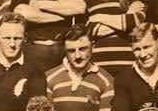
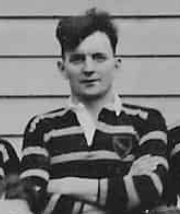
Cornwall went down 9-7. Nobody on the losing team got the nod, but fate conspired at the last minute. An injury to a South forward days before the match gave someone a chance. Question was, who?29
Richard H Selwood (1897-1964), Camborne RFC
One trial and eight caps for Cornwall30
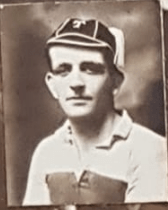
The 1911 census tells us that Camborne lad Richard was already a miner at the tender age of 14. His kid brother, Foster Selwood, would go on to win 11 Cornwall caps and play in the 1928 County Championship final defeat to Yorkshire at Bradford.
Back in 1922, Richard may not have been under any illusions as to his chances of further trial opportunities. As a second- or even third-choice pick, he would have had to put in a barnstorming performance to get the selectors’ juices flowing.
In a dour match at Devonport, England overcame the South pretty easily. Richard got no mention in the reports, and neither did William Taylor. This match, however, is the only occasion between 1919 and 1939 that four Cornwall players appeared together in a trial. The Devonport duo of Ernie Gardner and Fred Gilbert (aged 39) would go on to represent England in their 1923 Grand Slam season.31
Leonard Hammer (1895-1979), Camborne RFC and Birmingham
One trial and 13 caps for Cornwall; also represented the North Midlands

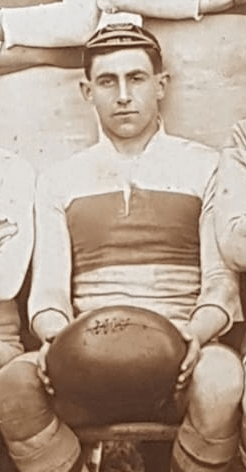
It’s hard to believe the cherubic youth pictured below in 1920 was not only a Cornwall player but a Western Front veteran:

But Leonard Hammer was. An office clerk at one of Camborne’s major engineering concerns (whether Holmans or Climax, the 1921 census is unclear), he formed a deadly partnership in the centre for Camborne with Phil Collins. Leonard was more the speed and the flair, Phil the brutal defensive force.
The 1922/23 season was Leonard’s peak, at least in Cornwall. Given the Camborne captaincy, he ran in 24 tries, at the time a club record. He also attracted the eye of the northern union outfit Halifax, who were so bowled over by his talent they practically handed him a blank cheque. Like Herbert Wakeham, his white-collar job and decent wage meant Leonard could politely decline.
Although as stated there was no league structure, the national ‘papers strived to give their readers a sense of the major clubs’ form, and Camborne’s numbers under Hammer began to stack up. In March 1923 it was noted that the club had won 24 of 32 fixtures and racked up 470 points against such XVs as Llanelli, St Bart’s Hospital, Plymouth Albion, Devonport Services and Bath. Only one other team in the land, Nuneaton, could boast better stats. Surely this guy Hammer was worth a look?32
In preparation for the 1924 Five Nations, England altered their trial format, reviving a system not seen since before the war. First, the North would play the South, then the Probables would play the Possibles, and finally the Rest would play England. Hammer got the nod for the South.33
At Birkenhead on 1 December, the North defeated the South 24-13. The South’s back division, featuring Hammer, was panned by the critics as being:
appallingly experimental …
Gloucester Citizen, 8 Dec 1923. Page seven
It was Leonard’s first and last chance. While England took the 1924 Grand Slam, he accepted a job with a Birmingham firm and joined the city’s rugby club. Leonard took his Cornish form with him and rapidly became a popular player, representing the North Midlands against the touring New Zealanders in October 1924. Needless to say, the latter won easily by 40 points to three.34
But Leonard never forgot his roots. On a visit to Camborne in 1949, he was invited to kick off the Feast Monday match against Redruth, being described as a ‘star’ of yesteryear.35
Roy Jennings (1905-1968), Redruth RFC
Five trials and 61 caps for Cornwall

As Howard Marshall wrote in 1939, a rugby selector could never be right. In the case of Roy Jennings, they got it very wrong.
Of the 57 inter-war trials, only two were held in Cornwall. The first – indeed the first in Cornwall ever – was a Probables-Possibles match that took place at Camborne on Saturday, 15 December 1928. This trial, coming after the Cornish XV had reached the County Championship final in March of that year, put Cornish rugby back on the map.36
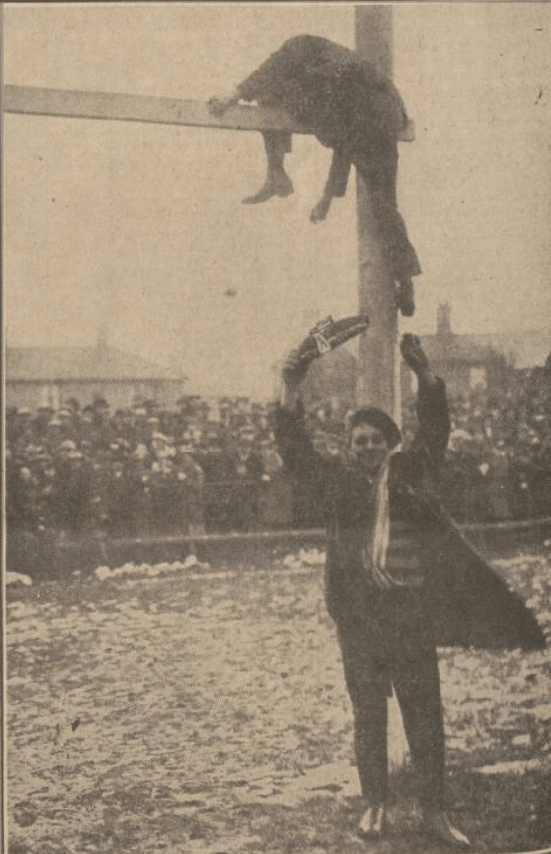
As you can probably imagine, Camborne RFC pulled out all the stops, with the town also rolling out several metaphorical red carpets. As the game was likely to finish around 4 p.m., Camborne’s hostelries were granted permission to open at that hour and not the customary, later time of 5.30 p.m. (Beacon’s, Troon’s and Barripper’s pubs had no such luck.) All Cornish rugby that Saturday was suspended. Many players joined the 8,000 spectators at the Recreation Ground for what was billed as the ‘cream’ of English rugby.37
The Possibles bested the Probables 19-16, and such was the level of upcountry rugby on display that:
if the numerous Cornish players who witnessed the play took full note of what was served up, and attempt to play it in their future matches, then Rugby in Cornwall should have a great uplift.
St. Austell Gazette and Cornwall County News, 19 Dec 1928. Page seven
All the forwards had allotted scrummaging positions; Cornish packs still adhered to the outmoded ‘first up, first down’ approach. Shortened lineouts were non-existent, making play more open and faster. Always the objective was to move the ball wide, quickly, and in this respect the threequarters on show gained much admiration.
There was only one sour note. No Cornishman had been given the opportunity to show his mettle. Prior to the announcement of the XVs, two locals had received hints to make themselves ready.
One was Camborne’s Bill Biddick. Wavell Wakefield, an England skipper so hard he believed breaking an opponent’s ribs was part of the game, and whose (unsuccessful) tactics against the 1924/25 All Blacks was to systematically beat the shit out of them, rated Biddick the toughest man he ever faced. Yet he was never selected for a trial.38
The other was Redruth’s centre Roy Jennings, who instead spent the match running touch. He was better than that, and perhaps the opportunity to see modern play close up made him so.
The son of a nonconformist saddler who himself became a hotelier, Roy Jennings is an undisputed Redruth and Cornwall rugby legend. Nick Serpell is of the opinion that:
The legend of Bert Solomon can sometimes overshadow the achievements of later players in the history of the club, but there is a case for suggesting that the contribution of Roy Jennings was as great, if not greater, than that of Solomon.
Hellfire Awaits: 150 Years of Redruth RFC. Pitch Publishing, 2025. Page 190
Roy regularly racked up a hundred points a season, and played at the top of his game well into his (and the decade’s) late thirties. Renowned for his speed, vision, versatility, finishing and toughness (he once finished a match minus two teeth and a broken nose), Roy was a vital part of the immensely successful Redruth side of the 1930s.

The Daily Express‘s regular ‘Rugby Club Records’ table was a handy barometer of leading teams’ form in these years. Indeed, to be included in its alphabetical list was often an indication that your side mattered nationally. In December 1934 Cornwall’s two biggest clubs were in the mix. Camborne were between Burton and Cambridge University, while Pontypridd and Richmond flanked Redruth.39
As road and transport conditions improved, the Cornish kingpin XVs could more frequently visit, and host, notable clubs from up the line. In the 1932/33 season Redruth played Bath, Coventry, Cardiff and London’s St Bart’s Hospital, losing only to the Somerset club.
Therefore, Cornish county and club rugby’s increased visibility in the late 1920s and early 1930s meant Roy didn’t drop off the selectors’ radar. He was picked for the 1929/30 season’s opening trial at Northampton. In Cornwall, they believed it was his just desserts:
A deserving honour … unquestionably one of the finest three-quarters in the West of England …
West Briton, 5 Dec 1929. Page three
The old Redruth international and British Lion, James ‘Maffer’ Davey, rated him second only to Bert Solomon, and second to nobody currently playing. Roy’s XV lost, but he scored a try and kicked two conversions. It was more than enough.40
Roy proceeded to represent the Possibles at Gloucester on 21 December 1929. Again, his XV narrowly lost. Roy’s attacking play was criticised in the Western Daily Press as being inferior to his Bristolian partner in the centre, but as the Bristol-produced Press would have probably said their man was better if he hadn’t played at all, we can safely discredit this.41
It was the opinion of the selectors that mattered, and they put Roy in for the Rest at Twickenham’s final trial.
England won 29-7, but Roy buried a massive penalty and was rated ‘the best’ of the Rest’s back line. But was his best in a team that shipped six tries going to get him through the door?42
It wasn’t. The RFU handed out nine new caps, their decision to blood youth justified in the Five Nations opener at Cardiff with an 11-3 win over Wales. These appearances in three consecutive trials allied to a selectorial policy of rebuilding would be Roy’s biggest chance.43
His reputation as the great nearly-man of English rugby grew, and not just with sympathetic Cornish commentators. It was a status reinforced by his inclusion in the 1930 British Lions squad that toured Australia and New Zealand. Operating mainly as a wing, Roy ran in 12 tries, including a hat-trick, but a chipped shoulder-blade meant he missed out on the Tests.44
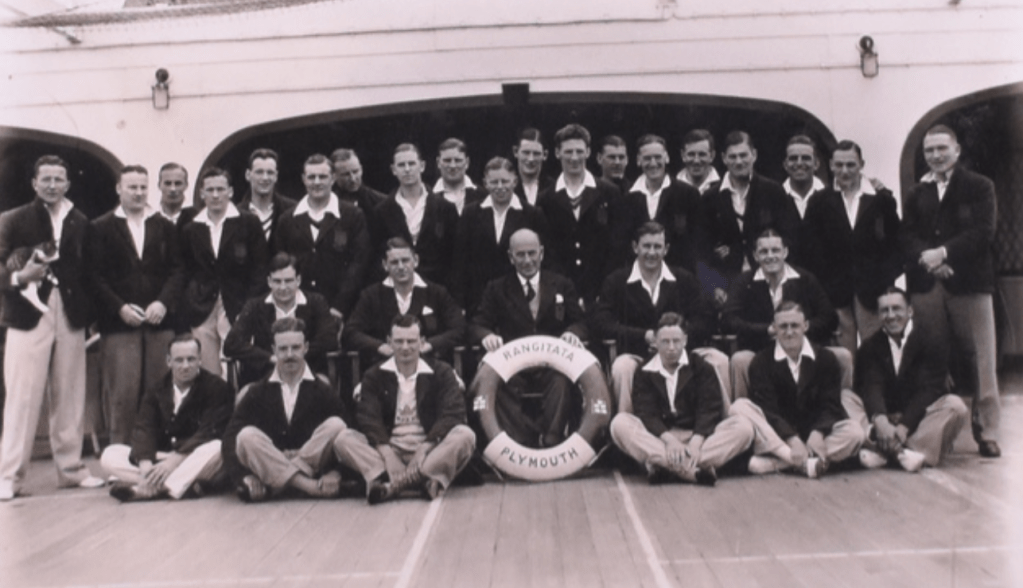
Roy got another shot. In November 1931 he skippered the Cornwall XV that took a significant win over Devon, then starred at full-back for the Cornwall and Devon side that held, with only 14 men, the touring Springboks to a 3-3 draw later that month. It put him back in the hunt. (With him in both teams were Charles Webb and Cecil Greenwood-Penny, both of whom feature again.)46
The 1931/32 trials had an odd sequence. With France exiled, the 1932 competition would be a Home Nations tournament, yet England were scheduled to meet South Africa on 2 January. The RFU decided to schedule two trials beforehand, and a third after the international matches had begun. The experiment was much-maligned and not repeated.
For Roy, it meant having the less arduous path of only two trials to shine in. He represented the South against the North, and was then invited to represent England – at 15 – against the Rest at Twickenham. Roy was in the box seat.
England lost. Roy missed a kick, and received an injury early in the game. It was his last trial.47
Disbelief bordering on incredulity at his exclusion grew as the seasons went on. In 1933 the RFU cut its nose off to spite its face by handing their number one full-back, Bristol’s Tom Brown, a life ban for speaking to a rugby league club. England could do worse, reckoned both the Daily Mirror and the Daily News, than to give Roy Jennings – lest we forget, a centre by trade – his chance.48
It never happened. In 1938, with Roy notching up his 60th cap for Cornwall, the question was still asked:
the only wonder is that he has not been capped for England … there are undoubtedly several full backs who have been more fortunate and less accomplished.
The Tatler, 19 Jan 1938. Page 124
Redruth’s glamourous brylcreem boy continued to delight his home fans, giving them something to cheer about during the tough years of the 1930s. On his death in 1968, he was judged to be the best player never to get an England cap. Not just the best Cornish player, but the best period. Why this was so has never been satisfactorily answered.49
Cecil Greenwood-Penny (1911-1970), Penzance RFC and Camborne School of Mines
One trial and nine caps for Cornwall

Cornwall and Devon’s performance against the 1931 Springboks raised a lot of eyebrows in the right places. The South team that met the North shortly after that fixture featured seven members of that side. The three Cornwall players were Roy Jennings, Navy marine Charles Webb (who went on to make 12 England appearances), and forward Cecil Greenwood-Penny. He was described as a:
finely-built young Camborne School of Mines player … [who] was one of the most prominent of the combined counties’ pack against the South Africans …
Western Morning News, 24 Nov 1931. Page 12
Then as now, any man who could front up to a Springbok pack attracted attention. However it was Cecil’s only trial.
The son of a Devon medical practitioner, Cecil was born in Marazion and played his first rugby for Penzance. He attended Camborne School of Mines from 1929 to 1932, winning his trial cap whilst a mining student. After completing his studies, he returned to Penzance.
Cecil’s engineering career meant his time on a rugby pitch was to be truncated. He appears to have had various postings in Kenya and Dutch Guiana, and rose to the rank of lieutenant in World War Two. He died in Malawi in 1970.51
(With thanks to Carol Richards, Camborne School of Mines Association.)
Harry Faviell (1916-1977), Harlequins and Redruth RFC
Two trials and five caps for Cornwall; also represented the Eastern Counties
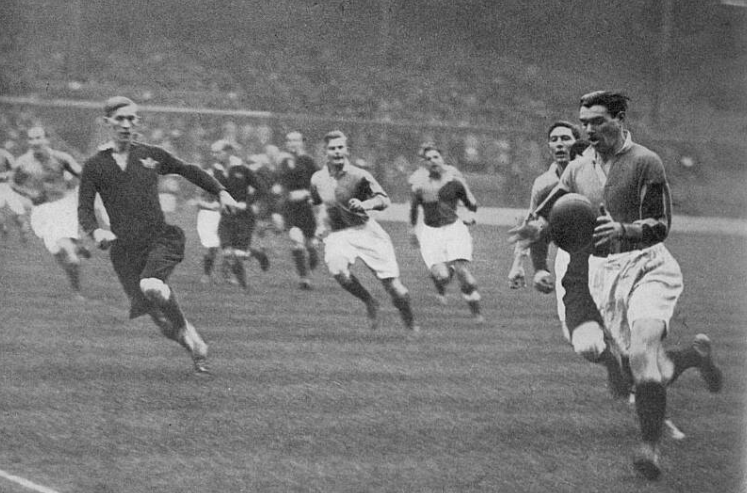
The second trial game to be held in Cornwall was to be hosted by Falmouth RFC in December 1933. Roy Jennings and Camborne’s Phil Collins (whose son John would go all the way) were called up as reserves, but neither got on the pitch.52 In fact, nobody got on the pitch: a hard frost meant the fixture was cancelled. It was rescheduled for later that month, but at Twickenham. The future RFU President Percy Holman took pains to point out that:
the difficulties of Christmas travel probably had a good deal to do with the decision not to hold the match so far away from the centres as Falmouth.
Cornishman, 21 Dec 1933. Page eight
I’m sure all the Cornish rugby fans left seeking refunds for their rail tickets to the original match were delighted.
Falmouth did get their trial a year later. Yet again, no Cornishmen were selected. Three were on standby, to be left unused: the hosting club’s Cliff Roberts, Len Roberts (Redruth) and F J Dale (St Ives). Nevertheless, 5,000 spectators were finally treated to a real spectacle of running rugby, as the Possibles and Probables tied at 12-all.53
The next year, 1935, Henry Louis Vere Faviell joined Redruth from Harlequins, but don’t let his name, or the name of his original club fool you into making assumptions about his background. In fact Harry had been born in Barnstaple, and came to Cornwall in order to begin an apprenticeship at Holmans.54
What is not in any doubt is Harry’s rugby pedigree. A wing of uncanny speed and finishing ability, before crossing the Tamar he had played for the Eastern Counties and already had an international trial match. One of his final acts before leaving London was to turn out for the Barbarians.55
He was probably Roy Jennings’ dream wing – and Roy was Harry’s dream centre. Together for Redruth they were truly lethal. In Harry’s first season for the club, 1935/36, he chalked up an amazing 53 tries. His new team ran up 447 points against all Cornish opposition, and conceded a paltry 27.56

What havoc they might have wrought together for England is sadly unknowable. Harry had one more trial, at Bristol in 1936, but was on the receiving end of the one thing every winger hates. The lack of opportunity to show off:
The pity was that Faviell got no chances to show his pace.
Daily Mirror, 21 Dec 1936. Page 27
Harry made Cornwall his home. A Redruth teammate, Harold Curnow (himself a trial reservist in 1937) taught him Cornish wrestling, though several Redruth players of the time, including Roy Jennings, could have showed him how to make a clean back: Harry and a number of the Redruth XV took part in a tournament at Pool in 1937. But speed in all its myriad forms was always his thing. He was fined for being caught flooring his roadster over the limit in 1938.57
A lieutenant in the war, Harry was made MD of Holmans’ West African operation in 1963, covering Ghana, Nairobi and Sierra Leone. Yet he died back in Devon.58
Frank Maurice Noel Heath (1915-1993), Penzance RFC and Cambridge University
Two trials

Harry Faviell’s final trial in 1936 featured seven Varsity players, which at the time came as no surprise:
the high standard of Varsity Rugby this season receives a just reward.
Daily Mirror, 10 Dec 1936. Page 30
One university man in the pack was Frank Heath. Born at Lamorna, his father Frank Snr was a painter of the Newlyn School, popularly known as the ‘sunshine artist’. Frank Jnr was probably one of those demon schoolboy sportsmen who are good at everything. Like another trialist, Cecil Greenwood-Penny, Frank learnt his rugby at St Erbyn’s School, Penzance. Later he captained Clifton College at both cricket and rugby, turning out for Penzance in the latter discipline when home on holiday. Moving up to Caius College, Cambridge he became Cornwall’s first rugby blue since before the war.60
Frank made it through to the final trial for the Rest at Twickenham in January 1937. West Cornwall held its breath.61
England won, 16-0. The game was so poor the selectors had to postpone picking the full England XV. Both sets of forwards were described as ‘slovenly’.62
Frank Heath was Cornwall’s last unsuccessful trialist before the war. Redruth’s Les Semmens was to continue this unfortunate pattern in 1948.63
Many thanks for reading; follow this link for more top blogs on all things Cornwall: https://blog.feedspot.com/cornwall_blogs/
Do you enjoy my work?
All content on my website is absolutely FREE. However managing and researching my blog is costly! Please donate a small sum to help me produce more fascinating tales from Cornwall’s past!
Your contribution is greatly appreciated.
DonateReferences
- The Bystander, 4 Jan 1939. Page 34. For more on Marshall’s fascinating career, see: https://en.wikipedia.org/wiki/Howard_Marshall_(broadcaster)
- The two previous histories are: Pelmear, K. Rugby in the Duchy: An Official History of the Great Game in Cornwall. CRFU, 1960. Salmon, T. The First Hundred Years: The Story of Rugby Football in Cornwall. CRFU, 1983.
- See: https://the-cornish-historian.com/2025/06/21/cornwalls-rugby-codebreakers-part-one/, and https://the-cornish-historian.com/2025/11/09/roll-of-honour-camborne-school-of-mines-rfc/
- See the Cornwall RFU’s list of internationals here: https://www.crfu.co.uk/home/international-players/
- Webb’s Wikipedia entry states he also turned out for Devon: https://en.wikipedia.org/wiki/Charles_Webb_%28rugby_union%29. For more information on Gilbert, see: https://en.wikipedia.org/wiki/Frederick_Gilbert. Gardner represented Devon in 1922: London Daily Chronicle, 10 Nov 1922. Page 14. See also: https://en.wikipedia.org/wiki/Ernie_Gardner
- Image from: Pelmear, K. Rugby in the Duchy: An Official History of the Great Game in Cornwall. CRFU, 1960. Page 12.
- Globe, 23 Feb 1901. Page three. Sporting Life, 28 Nov 1901. Page four. Cornish Telegraph, 10 Sep 1902. Page four. Cornubian and Redruth Times, 22 Apr 1905. Page eight. The Cornishman, 25 Sep 1918. Page two. Cornish Post and Mining News, 23 Jan 1926. Page eight.
- For more on John Jackett, see: https://the-cornish-historian.com/2024/06/29/in-search-of-john-jackett-king-of-cornish-sport-part-one/
- See: https://www.crfu.co.uk/home/county-players/individual-players-appearances-20/
- London Daily Chronicle, 20 Dec 1910. Page nine. Lloyd’s Weekly Newspaper, 8 Jan 1911. Page 27.
- London Daily Chronicle, 14 Nov 1904. Page nine. 16 Nov 1906. Page 11. 26 Nov 1906. Page seven. Cornish Telegraph, 30 Nov 1905. Page six. Daily Mirror, 28 Nov 1911. Page 14. The Morning Post, 29 Nov 1911. Page four. Daily Express, 30 Nov 1911. Page eight.
- Appearances for Cornwall are taken from Tom Salmon’s The First Hundred Years: The Story of Rugby Football in Cornwall, CRFU, 1983.
- Collins, T. A Social History of English Rugby Union. Routledge, 2009. Page 217.
- Daily News, 22 Dec 1919. Page nine.
- Daily News, 11 Dec 1919. Page two. 3 Jan 1920. Page seven. Pall Mall Gazette, 3 Jan 1920. Page 12.
- West Briton, 5 Feb 1920. Page three.
- See: https://the-cornish-historian.com/2025/06/28/cornwalls-rugby-codebreakers-part-two/. Cornwall RFU Committee Minutes, 4 Nov 1936.
- Exeter and Plymouth Gazette, 7 Dec 1925. Page six. Athletic News, 31 Jan 1927. Page four.
- The Weekly Dispatch, 18 Dec 1921. Page 11. Gloucester Citizen, 1 Dec 1923. Page ten. Western Daily Press, 1 Dec 1928. Page ten.
- West Briton, 16 Dec 1920. Page three.
- London Daily Chronicle, 9 Dec 1920. Page 12. West Briton, 16 Dec 1920. Page three. Daily Herald, 18 Dec 1920. Page eight. Daily Express, 18 Dec 1920. Page eight.
- Weekly Dispatch, 19 Dec 1920. Page ten. 2 Jan 1921. Page ten.
- For more on Wakefield, see: https://en.wikipedia.org/wiki/Wavell_Wakefield,_1st_Baron_Wakefield_of_Kendal
- West Briton, 18 Apr 1963. Page 14. See also: https://the-cornish-historian.com/2024/09/21/the-magnificent-seven-meet-the-invincibles/
- Image from: https://www.kcl.ac.uk/gkt-rugby-history
- The Daily News, 11 Dec 1919. Page two. Western Daily Press, 4 Dec 1922. Page eight. See also: https://en.wikipedia.org/wiki/Guy%27s,_Kings_and_St_Thomas%27_RFC, and https://www.englandrugby.com/fixtures-and-results/search-results?competition=228&division=72531&season=2025-2026
- Western Morning News, 8 Dec 1922. Page two.
- The image of Richards comes courtesy of Pamela Best; Biddick is from: https://www.crfu.co.uk/home/gallery/
- Western Evening Herald, 12 Dec 1922. Page three. Western Morning News, 15 Dec 1922. Page two.
- Tom Salmon’s The First Hundred Years provides a list of Cornwall players who were awarded trials but never went further. Selwood isn’t on this list.
- Exeter and Plymouth Gazette, 18 Dec 1922. Page three.
- Daily News, 3 Mar 1923. Page nine.
- Gloucester Citizen, 1 Dec 1923. Page ten. 8 Dec 1923. Page seven. Gloucestershire Echo, 5 Jan 1924. Page six.
- Birmingham Daily Gazette, 14 Oct 1924. Page seven.
- Western Morning News, 15 Nov 1949. Page eight. See also: https://the-cornish-historian.com/2025/04/26/camborne-rfcs-top-try-scorers/
- St. Austell Gazette and Cornwall County News, 21 Dec 1927. Page eight.
- St. Austell Gazette and Cornwall County News, 19 Dec 1928. Page seven. Also the Western Morning News, 12 Dec 1928. Page four.
- Collins, T. A Social History of English Rugby Union. Routledge, 2009. Pages 72-4. West Briton, 5 Jan 1984. Page six.
- Daily Express, 28 Dec 1934. Page 12.
- Western Morning News, 3 Dec 1929. Page six. Daily News, 4 Dec 1929. Page 15. West Briton, 5 Dec 1929. Page three. Western Daily Press, 9 Dec 1929. Page four.
- Western Daily Press, 23 Dec 1929. Page eight.
- Western Morning News, 6 Jan 1930. Page 11.
- Daily News, 6 Jan 1930. Page 12.
- Daily News, 1 Jul 1930. Page 15. See also: https://www.lionsrugby.com/en/teams/mens-team/roy-jennings-RJ182766
- Image from: https://www.the-saleroom.com/en-gb/auction-catalogues/mullocks-specialist-auctioneers-and-valuers/catalogue-id-srmu10175/lot-b3346dec-555e-403c-935e-b10f00c6710c. See also: https://en.wikipedia.org/wiki/List_of_uncapped_British_%26_Irish_Lions_rugby_union_players
- St. Austell Gazette and Cornwall County News, 11 Nov 1931. Page seven. Salmon, T. The First Hundred Years: The Story of Rugby Football in Cornwall. CRFU, 1983. Page 131.
- Western Morning News, 24 Nov 1931. Page 12. 10 Dec 1931. Page 11. 1 Jan 1932. Page three. Western Daily Press, 21 Dec 1931. Page two. Daily Express, 16 Feb 1932. Page 12. Sunday Mirror, 28 Feb 1932. Page 26.
- Daily Mirror, 11 Nov 1933. Page 24. Daily News, 14 Nov 1933. Page 14. Collins, T. A Social History of English Rugby Union. Routledge, 2009. Page 118.
- Bristol Evening Post, Oct 12 1968. Page eight. See also: Serpell, N. Hellfire Awaits: 150 Years of Redruth RFC. Pitch Publishing, 2025. Pages 172-207 and 261.
- Image from: https://www.ebay.co.uk/itm/333146348963
- The Cornishman, 28 Mar 1929. Page ten. 2 Apr 1931. Page six. Cecil’s biographical details are from the 1921 census and: https://sites.rootsmagic.com/gwehydd/individual.php?p=2092
- Western Morning News, 8 Dec 1933. Page ten. For more on the career of John Collins, see: https://the-cornish-historian.com/2025/05/03/cornish-sporting-heroes-4-john-collins-camborne-cornwall-and-england-rugby/
- West Briton, 20 Dec 1934. Page nine.
- West Briton, 5 Sep 1935. Page nine. England and Wales, Civil Registration Birth Index, 1916-2007, volume 5b, page 662.
- Evening News, 8 Jan 1935. Page 13. The Cornishman, 19 Nov 1936. Page ten. https://www.barbarianfc.co.uk/results-fixtures/east-midlands-vs-barbarians-3-7-1935/
- Serpell, N., Hellfire Awaits, page 200.
- St. Austell Gazette and Cornwall County News, 14 Jul 1937. Page three. 25 Aug 1937. Page seven. Western Morning News, 29 Sep 1938. Page 11.
- Harry had his portrait painted during the war: https://www.iwm.org.uk/collections/item/object/11622. West Briton, 20 Jun 1963. Page six. See also: https://www.findagrave.com/memorial/130441187/henry-louis_vere-faviell
- Image from: https://www.frankheath.com/gallery/6/1920-1936
- The Cornishman, 12 Nov 1936. Page three. See also: https://www.frankheath.com/gallery/6/1920-1936. Pelmear, K. Rugby in the Duchy: An Official History of the Great Game in Cornwall. CRFU, 1960. Page 21.
- The Cornishman, 24 Dec 1936. Page five.
- Weekly Dispatch, 3 Jan 1937. Page 21.
- St. Austell Gazette and Cornwall County News, 17 Nov 1948. Page two.
 Francis Edwards ~ The Cornish Historian
Dear Francis,Thanks so much for that – and your previous notes. I really enjoy them.- I love the idea of a book about the Cornish Triallists – takes a real enthusiast to even think of those who “didn’t make it”. I would love to have been one of those people – often thought of as “failures”I hope that you have a great Christmas.AlanAlan Mitchell
LikeLike
Best Christmas wishes to you and yours pal; the book will be a full history of Cornish rugby, coming late 2027, so spread the word 👍
LikeLike