Reading time: 35 minutes
The Black and the Gold: The Story of Cornish Rugby, by Nick Serpell and myself, will be published in autumn 2027. This post complements our chapter on Cornish rugby in the 1960s.
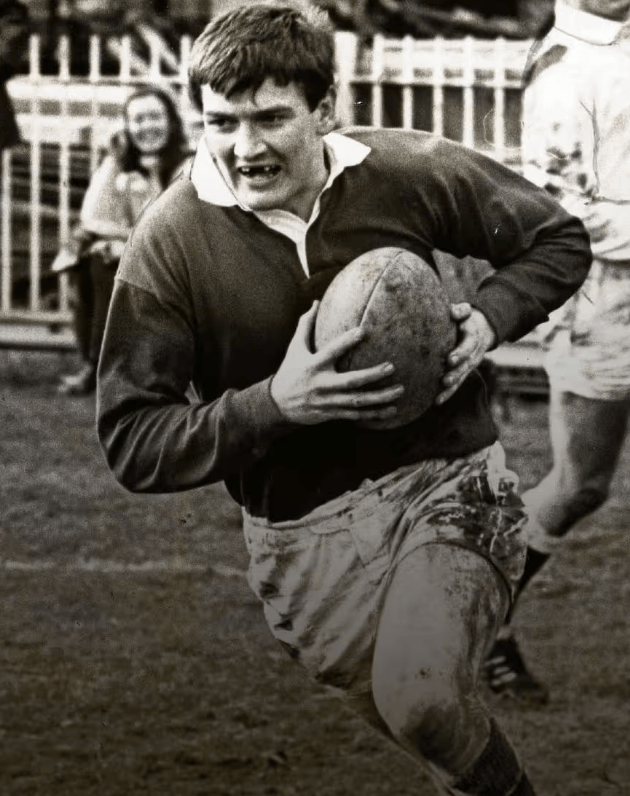
As a young teenager I remember revelling in the highlights of Wales’s 30-9 demolition of England at Cardiff Arms Park in 1969. It genuinely looked like attack versus defence, with one of the scariest collections of Welsh rugby talent ever assembled on a pitch: Gareth Edwards, Barry John, John Dawes, Keith Jarrett, JPR Williams, Denzel Williams, Delme Thomas, John Taylor and Merv Davies. The star of the show though was wing Maurice Richards, who ran in four tries. England had no answer.
Little did I know at the time, but Richards’ opposite number that day was a Cornishman…
A ‘rynner through and through
Ken Plummer was born in January 1947. One of his earliest memories – he reckons he was about five – was going to the woods with his father to chop down trees for rugby goalposts.2 ‘I suppose you could say’, said Ken, ‘that rugby was in the genes’:
My father [Jack Plummer] actually played for Falmouth, but he married a Penryn girl, that was it then! He had to transfer over to Penryn. My brother, Ray, he went to grammar school and he represented Cornwall three times. Scrum half – he actually played with Richard Sharp.
Ray Plummer was good enough to be capped for England’s Army Cadet Force XV along with another Penryn lad called Roger Hosen. Later, the only man keeping him out of the Cornwall XV was Penzance & Newlyn’s Peter Michell, with whom Ray had some ding-dong battles.3
In 1950s Penryn, though, rugby was far from being a solely male pastime:
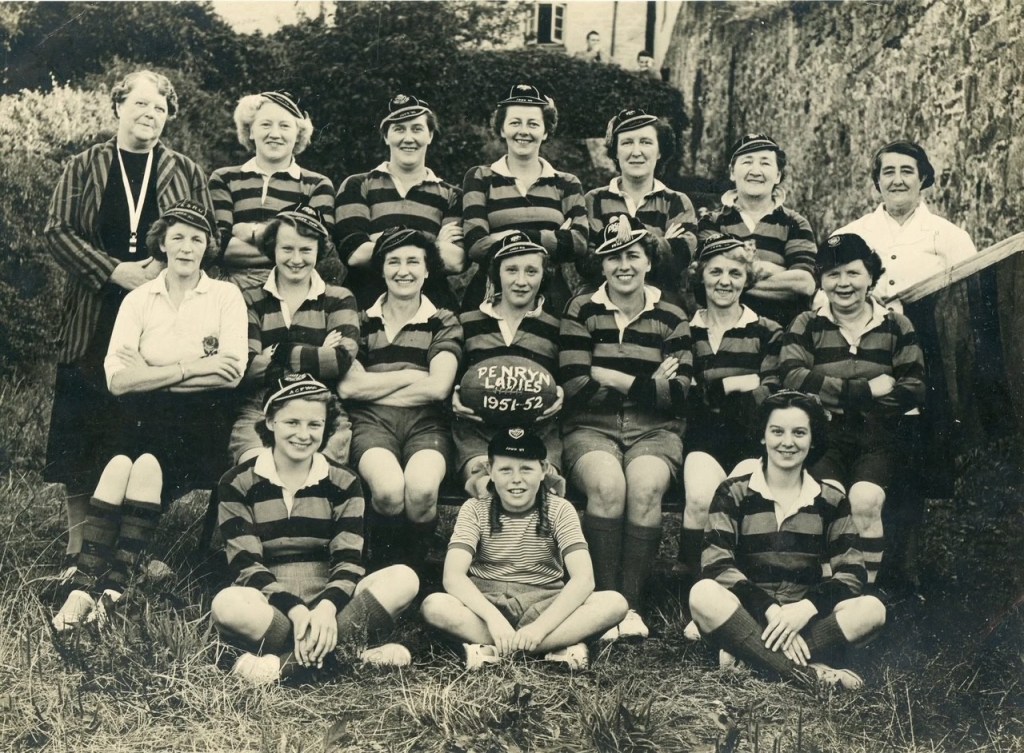
That photograph is actually taken out the back of the Fifteen Balls, where the team used to change before they had a clubhouse. It was to actually raise funds for the rugby club, so they formed this ladies’ team, and they actually played against the men! I think the ladies won!
Ken’s mother, Ida, sits to the captain’s left. His gran, Emily Martin, is in the back row, second from right. Sitting front right is his sister-in-law, Frances. Ken’s aunt, Pauline, is in the back row, second-left. Not only is it the earliest instance of a ladies’ XV in Cornwall, but is quite possibly the earliest anywhere.
When Ken was growing up, sport in post-war Cornwall was booming, and Penryn RFC were in the vanguard. In fact, any form of social activity centred around the club, which was:
the only form of organised sport in the town, and the only source to which youth could look for recreation.
West Briton, 12 Feb 1953. Page five
In 1947 the Cornwall RFU (hereafter: CRFU) granted Penryn 20 guineas with which to lay out their Memorial Ground, at around the same time as Vic Roberts became the club’s first England international.4
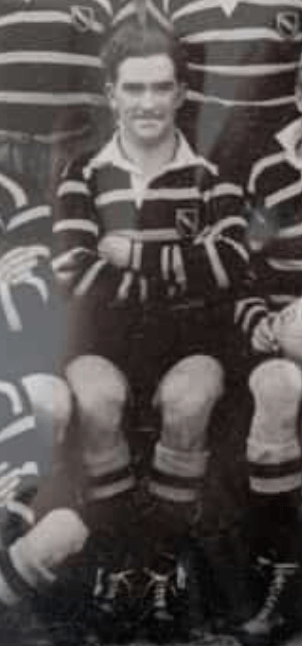
Who was running the club at this time?
We had quite a good committee, there was a guy called Barry Quintrell who was a ‘rynner through and through, and he drove the Penryn club quite hard, he was the one got the new clubhouse built and things like that.
Barry was a sales rep in the docks, selling paint I think, did well for himself, company car and all that, made a few quid in the States then came back and took up the reins at Penryn again.
With players like Vic Roberts, Ken’s brother Ray and other talents such as John Cobner and Roger Hosen (who joined Northampton in 1955), Penryn were becoming a force to be reckoned with in Cornish rugby during the 1950s. In the 1951/52 season, Penryn topped Cornwall’s unofficial rugby merit table with a barnstorming five wins in ten days to clinch it on the final weekend.5 It was the perfect stable for youngsters wanting to take up the game, and very soon Ken wasn’t just joining their ranks but pushing the club forward too.
Like shit off a shovel
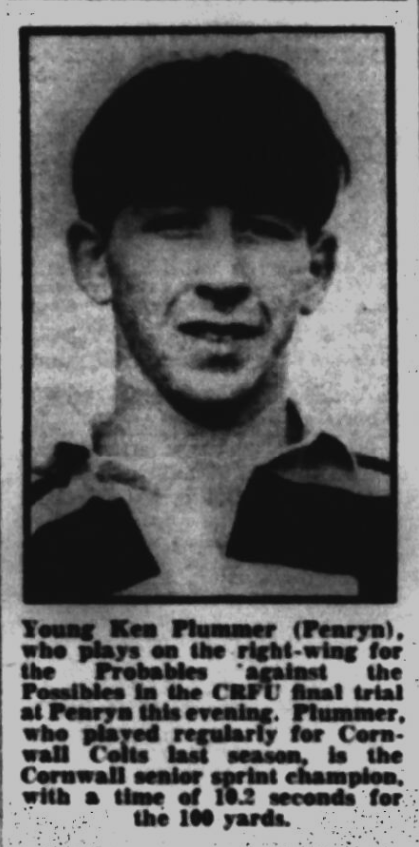
School, Ken told me, was ‘never for’ him. Ray had gone on to Falmouth Grammar School but Ken, who failed his 11-plus, went to Penryn Secondary Modern:
We didn’t have a side or play rugby at secondary modern. I was lucky enough my sports teacher, guy called Trevarthen, put me in for the Cornwall Schools trial. I played a couple of trials, and I managed to play for Cornwall Schools, against Devon at St Ives. That was my first real taster of rugby, though I was playing a little bit for Penryn Colts at the time, as a 14-year-old.
Even though he was only 14, Ken was tall for his age and committeeman Jack Chinn (another influential ‘rynner6) immediately stuck him into the second row. Ken protested that it was far too dark for him:
So he said “we’ll play you scrum-half, like your brother!” So I sort of graduated my way out to the wing eventually. [Wing was] where I was more comfortable, although I did enjoy playing fly-half and centre to be honest. But as I moved into senior rugby it had to be wing or nothing. Obviously I played for Penryn 1st XV as a 16-year-old, there was no way my father would let me play fly-half or scrum-half in that! Of course, that kind of thing would never happen now.
It soon became apparent that wing was the only place to play the young Plummer. He took up sprinting at around the same time he found rugby, and here he was fortunate that Penryn RFC didn’t just limit their activities to rugby union football:
In those days in Cornwall there was a lot of events, Grampound Road, Par, Cornwall Tech., Falmouth Docks, a lot of athletics around … Penryn and Falmouth rugby clubs formed an athletic club … Les Williams, he lived in Penryn, formed the club with a guy called Paul Spencer, who was a middle-distance runner, and another guy, Dave Collins. So we used to enter teams into championships around Cornwall.
When I went on to Bristol, I joined Westbury Harriers up there and ran for them for a couple of seasons. But then, it came, I had to make up my mind whether it was going to be athletics or rugby. But then there was no choice really, it was always going to be rugby!
I wasn’t quite quick enough for athletics, not for top class.
Maybe not, but Ken had some serious wheels. In 1964 he was the Cornwall AA senior sprint champion, being timed at 10.2s for the 100-yard dash. He was just 17. He won it again in 1967 (10.6s) and 1968 (10.3s). (The world record at the time, incidentally, was held by the USA’s Frank Budd at 9.2s.)7
In fact, Ken’s pace out wide made him something of a teen prodigy, and his ascent of the rugby ranks was equally rapid. Tim Nicholls, a former Penryn player and president, described him as being like ‘shit off a shovel’.8
Ken’s first season of senior rugby was 1963/64. He scored five tries, he told me, on debut. He was being hailed as a ‘star of the future’ alongside brother Ray in Penryn’s 17-0 hammering of Launceston. The club’s first loss to Cornish opposition (and first try conceded by Cornish opposition) wasn’t until January 1964 when Penzance & Newlyn defeated them.9
By the end of that season Penryn topped Cornwall’s unofficial merit table, playing 48 games, winning 34 and losing six. Their 552 points were answered by a mere 135, scoring 124 tries. Ken, in his first season, had scored 49 points, but Penryn’s main man was full-back Graham Bate with 120. Barry Quintrell was talking about a £12,000 extension of pitches and facilities.10
But what was the secret behind Penryn’s success? Their training and preparation.
Les Williams
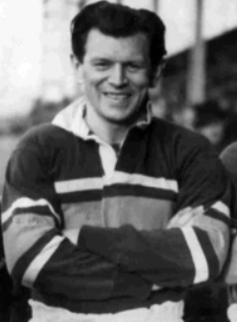
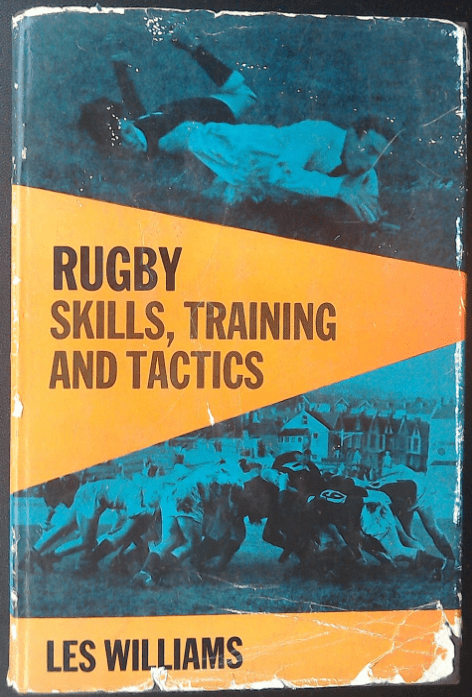
Les Williams did more for Penryn and Cornish sport than just form an athletics club. A Navy PTI from Carmarthenshire, Les had been stationed on HMS Raleigh and playing for Devonport Services when he won four caps for Cornwall in the late 1940s. He also played for Llanelli, Cardiff and Wales as a wing. Switching codes in 1949 for rugby league outfit Hunslet (and using the extra cash to pay for a specialist PE training course), he represented the Welsh league team and was selected for Great Britain to tour Australia but declined the invitation to finish his studies.12
By 1956 he was living in Penryn and had been appointed Cornwall Council’s assistant organiser for physical education. Not only did he contribute an informative and lively column on Cornish rugby to the West Briton, but Les’s work preaching the rugby and physical culture gospels in Cornwall’s schools was second to none. In the late 1980s he was still competing himself, winning medals in the World Veteran Athletic Championships in San Diego.13
Almost inevitably, he started training the Penryn squad – unofficially. In 1962 the RFU decreed that all present and former rugby league players could not be members of a union club.14 But where there’s a will … here’s what Ken had to say:
Les wasn’t allowed to train us, but we trained at the school which was next door!
He was fabulous. He was ahead of his time as a coach anyway, and of course he had the experience of being a rugby union international and then going into rugby league … he was superb. Absolutely superb.
One, he got us fit, and then he brought in all these rugby league moves, and we had a very talented back division, with John Cobner, Ted Rose, Brian Stevens at fly-half, Mike Morris, my brother at scrum-half, so that’s how we got to be major force in the 1960s.
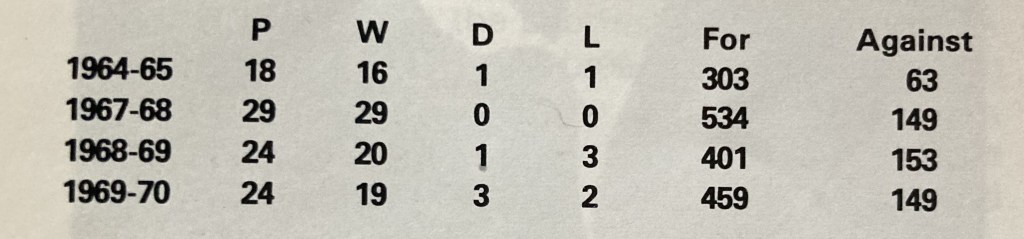
He even had the squad pumping iron in his own living room.15 Les Williams’ methods, for 1960s rugby union, were revolutionary. Penryn’s Cornish opposition could rarely find a solution. Here’s their inter-county performances during the period Ken was a player:
Penryn RFC looked like a rugby league team. Here they are, unbeaten in 1967/68, with the merit table trophy and inaugural CRFU Knockout Cup:
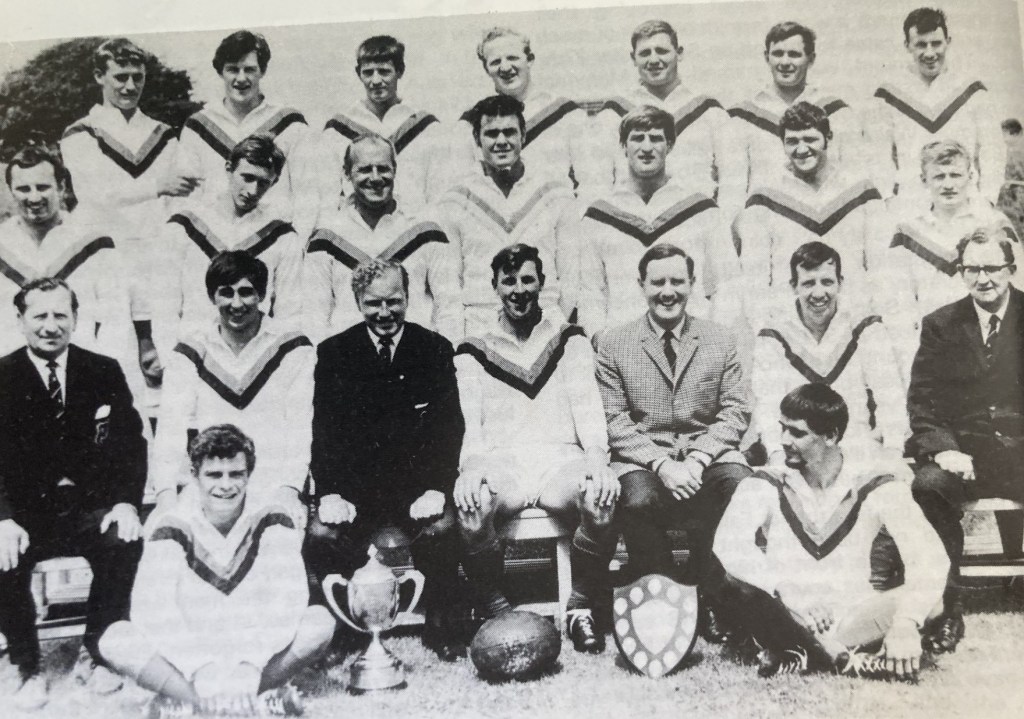
Middle row – Dave Benji Thomas, Robert Edwards, John Cobner, John Blackburn, Colin Kneebone, Dwayne Taylor, Brian Stephens. Front row – Bob Harrison (team secretary) Ken Plummer, Cyril Vanstone (chairman) Graham Bate (captain) Cap. Alan Muirhead (president) Mike Morris, B D Williams (treasurer).
Sitting – Robert Marshall and Franklin Johns. Names courtesy Jonathan Plummer16
For me, there’s one person missing from this photo, and that’s Les Williams himself, but as a league player he was blackballed. Tom Salmon’s official history of Cornish rugby makes no mention of his name when describing Penryn’s 1960s successes. One of Les Williams’ proteges, Benji Thomas, was Cornwall’s coach in 1991, and we all know what happened then.17
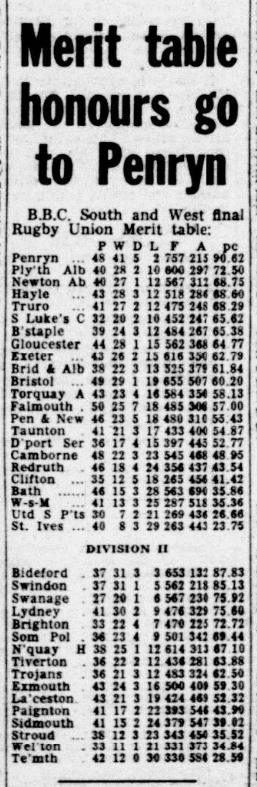
Penryn’s rugby also mattered regionally and nationally. For two consecutive seasons, 1963/64 and 1964/65, they topped the BBC’s South and West Merit Table. Admittedly not all clubs in this arbitrarily drawn up and publicity driven table actually played each other18 (Ken readily admits the likes of Bath and Bristol ‘would’ve stuffed us’), but still, it makes pretty good reading:
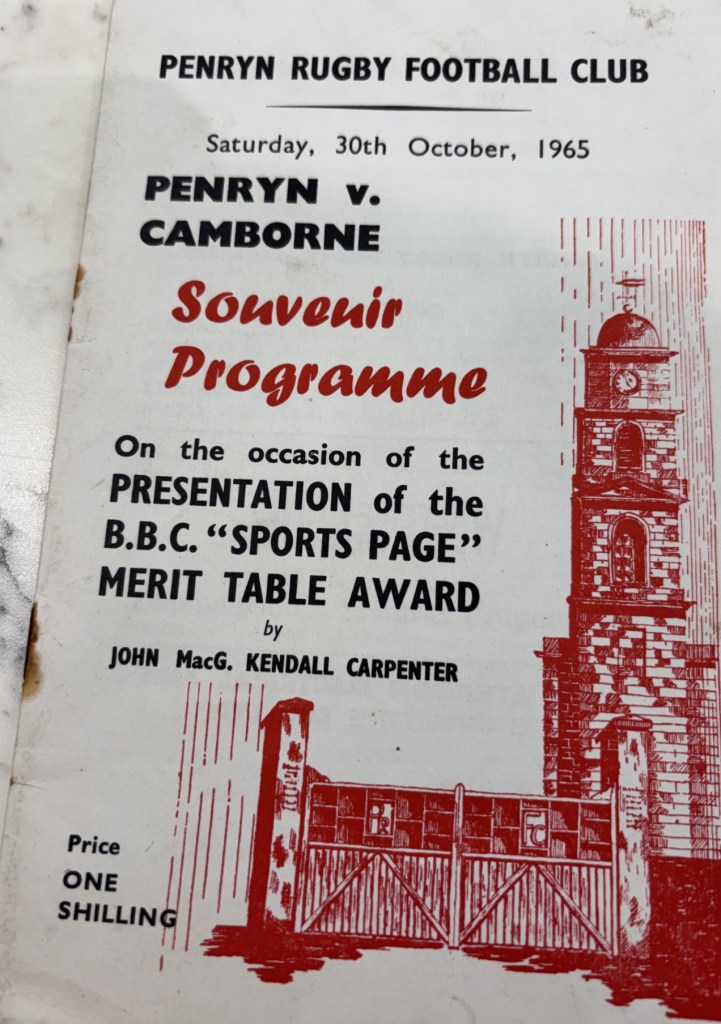
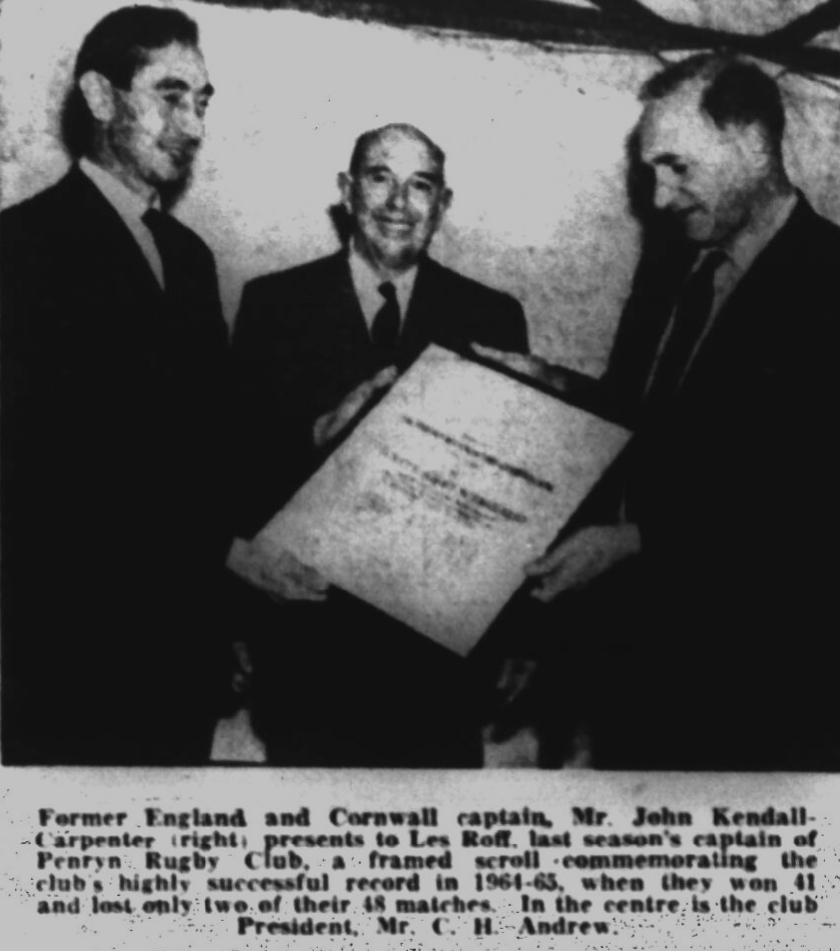
Penryn RFC made as much of the achievement as the BBC did. A celebratory match was organised (they beat Camborne 8-5), followed by a do at Falmouth Hotel. There, former England skipper and Pirate John Kendall-Carpenter, in the company of BBC West’s presenter Alan Gibson and future After Dark chair Anthony Smith presented a commemorative scroll:
I said Penryn RFC mattered nationally. When their Cornwall flanker Gerard McKeown was suspended for two months in 1970 for refusing to travel to Exeter, it made the Daily Mirror.19 Contributing weekly to Penryn’s success and burgeoning fame, was Ken Plummer.
Absolutely massive
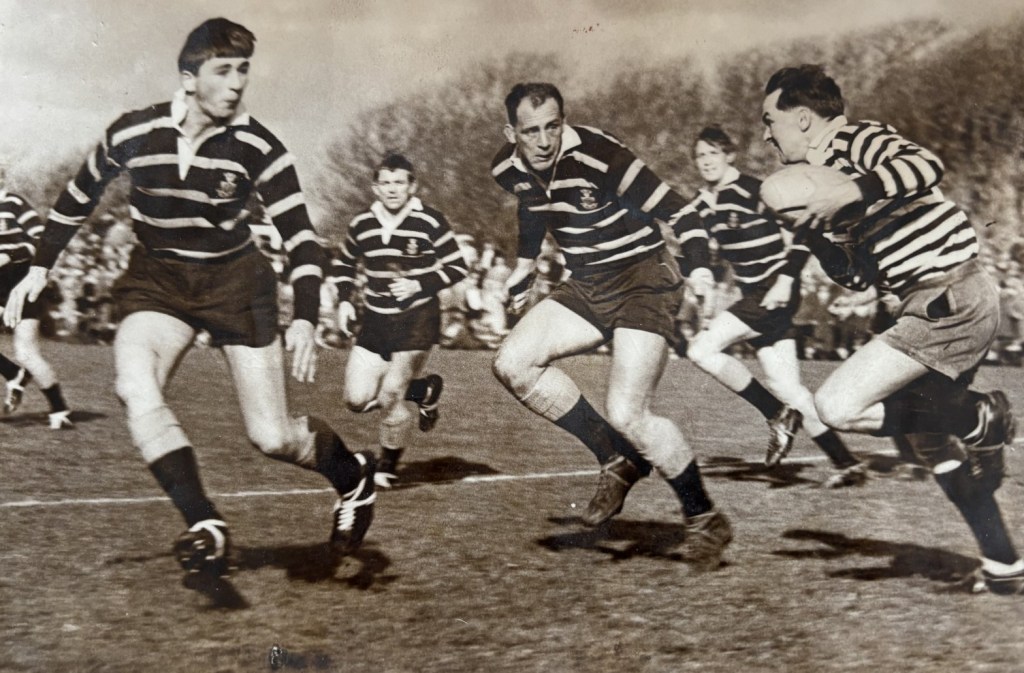

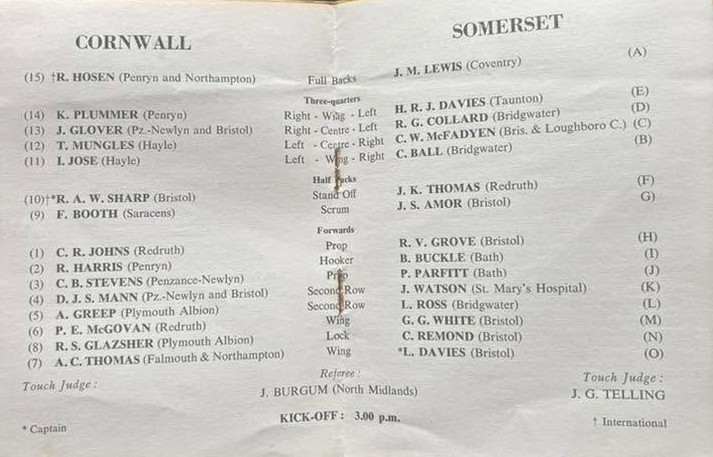
Ken’s rise was meteoric. In the 1963/64 season he was playing for Cornwall Colts and travelled to Wales (with Gerard McKeown) with the England youth XV. By October 1964, still 17, he was playing for Cornwall. He scored a 45-yard try against St Ives, two tries against Penzance & Newlyn and a hat-trick against Truro to outshine visiting international Roger Hosen. In the 1965/66 season, he ran in 30 tries.20 But it was the fixtures with Penryn’s nearest rivals that always got the juices flowing:
Boxing Day with Falmouth was always … I remember talking to Ray George, Georger was playing for Falmouth, he said to me, “We’re going to put a high ball up … but we’re not going to worry about the ball, we’re just gonna take you out!” That’s how competitive it was!
Everybody had a few beers after the game, though I must admit in my early years I didn’t touch it … if you think back in the 50s and 60s, it was just after the war, Falmouth Docks were employing 3,000 people, so the Boxing Day game with Falmouth was something to behold, very lively with 2,500 spectators.
Ken has confessed elsewhere that, with the level of expectation thrust on him from such a young age, that he ‘used to get more nervous playing against Falmouth than any game I played for Bristol or anybody’. However he usually managed to channel the adrenaline. In April 1965 Penryn beat Falmouth 14-0. Ken outpaced his opposite wing to haul him over before he could touch down, then later sprinted clear to score himself.21
What was it like coming into the Cornwall XV as a wide-eyed youth? What about meeting Richard Sharp?
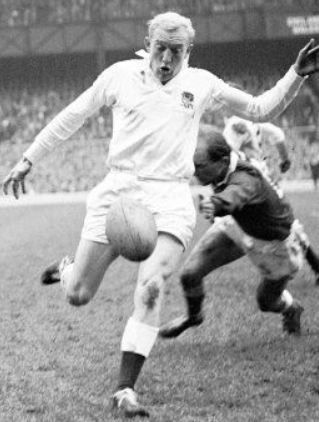
He was fantastic. A real gentleman. Sharpey – he scored that try against Scotland and in the following couple of weeks he was in for Cornwall against Somerset at Camborne. It was my first County Championship game, I was only 17. We met in Tyack’s, in Camborne, I remember walking through the door, and Richard Sharp and Roger Hosen, both come to see me, Sharpey’s just been this big hero on the TV, and they both put their arms around me and looked after me like I was their son. It was really fantastic.
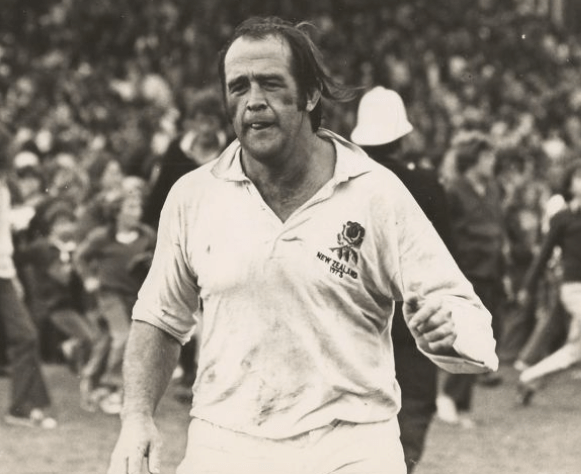
Also there to reassure the youngster was a Penzance & Newlyn prop with a bright future, Brian ‘Stack’ Stevens: ‘Don’t worry, we’ll look after you, boy’, words which, coming from a brick outhouse of a Godolphin farmer who trained by running on sand, drinking milk and eating pasties, must have been manna to Ken: ‘I will never forget that’, he said.22
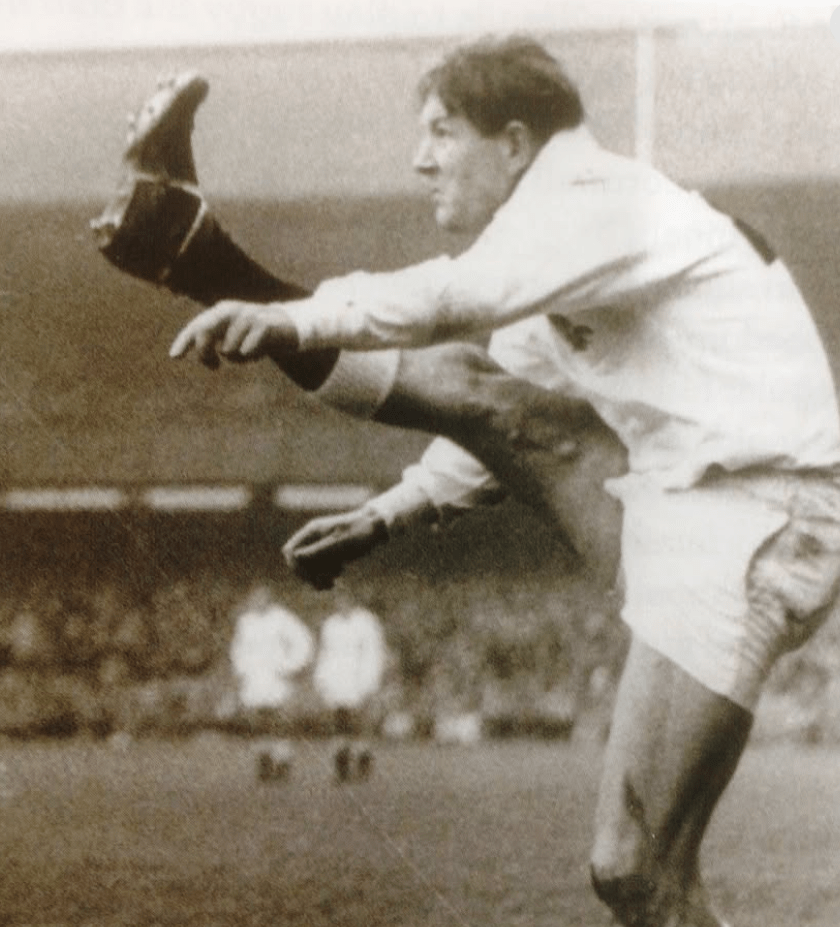
Ken was now a Cornwall regular, who in the 1966/67 County Championship campaign won the South-West Division for the first time since 1961/62, being undefeated against Gloucestershire, Somerset and Devon. Before the quarter-final against Oxfordshire at Redruth, the touring Australians were to play a South-West Counties XV at Camborne on 3 January 1967. Of the seven Cornishmen selected, four were from Penryn: Graham Bate, Roger Harris, Gerard McKeown, and Ken. Such games were
Absolutely massive. I was only 19 when I played against the Aussies. If you’re thinking about playing top-class rugby, and you’re playing against the Aussies at Camborne, in front of 16,000 people, there’s nothing else like it. It was my first step into the big time … We’re never going to see that in Cornish rugby again. Which is a total shame.
The Counties lost 6-11, their two drop-goals having given them the lead for most of the first half.24 Indeed, Ken stresses that to be selected for such regional XVs against international opposition was a great honour, a step up from county championship rugby that, in the seasons before leagues and the John Player Knockout Cup, was rugby union’s biggest domestic competition.
A competition Cornwall could win. Oxfordshire were rolled over 16-6 at Redruth in the quarters. Surrey were coming to Hellfire Corner for the semi. A crowd of 14,000 saw Ken score in the corner late on to give Cornwall a 6-3 lead and surely victory. But minutes later, England full-back Bob Hiller sunk a penalty from 35 yards to draw the game at six-all. Cornwall would have to go to Richmond for the replay.25
They took 3,000 Cornish fans with them, and recalled Roger Hosen, whose nous and howitzer boot could rival Hiller’s. In the final minute, Cornwall were 14-9 down. Then Sharp broke from a Cornwall scrum, and fed to Ken … Ken turned on the afterburners and roared past his opposite number, John Coker, the first person of colour to play for Harlequins, and scored in the corner.26 Cornwall 12, Surrey 14. Hosen lined up the kick from the touchline, the last kick of the game:
Thank God Roger was recalled! The reception was fantastic, the Cornish support there was … the referee never blew the final whistle! As he kicked the conversion to draw the game 14-all, all the crowd came on! We were all hoisted up, shoulder high, and carried off the pitch. Fantastic! Unbelievable.
This set up another replay, back at Redruth. Surely this time … but no, Bob Hiller’s boot trumped Roger Hosen’s and Surrey won 14-3 in front of a largely disbelieving crowd of 14,000. Hosen kicked only one penalty and missed four to increasingly demoralise a hardworking pack.27 It was his last game for Cornwall and Penryn’s Graham Bate became the full-time 15.
(The 1966/67 County Championship was memorable for its tied matches. Surrey met Durham in the final and they drew 14-all. When a miserable replay ended nil-nil, the RFU called time on the whole affair and the Championship was shared.)
We got this
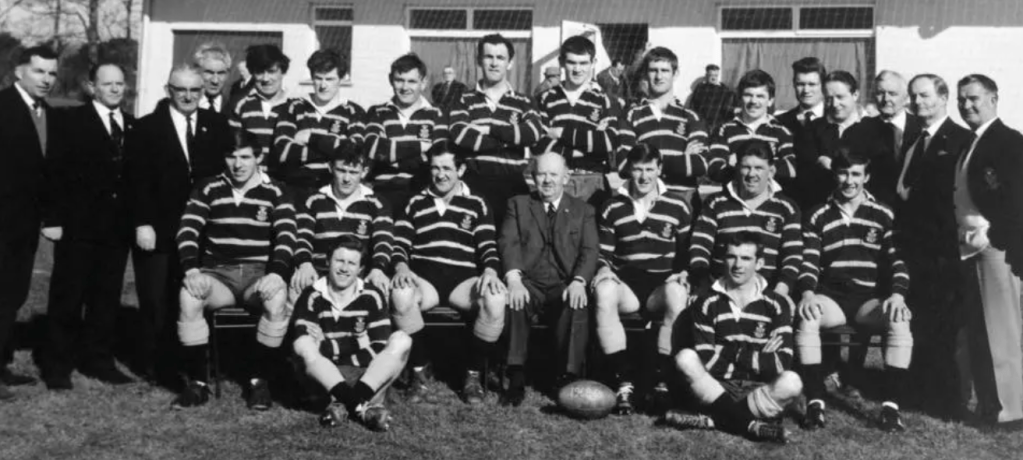
1909, 1928, 1958 … more than any other championship, the 1968/69 edition is the one Cornwall should have won. They were the most prepared: who else but Les Williams had been quietly coaching the 27-strong squad over the summer of 1968, and that squad trained, Ken told me, every Sunday in Exeter throughout the campaign. They were winners: seven of the XV selected for the final were from Penryn, one of the strongest clubs in the south west. They were talented: Ken, Derek Prout, Stack Stevens and Barry Ninnes would all play for England; Bonzo Johns, Graham Bate and Roger Harris would have international trials.29
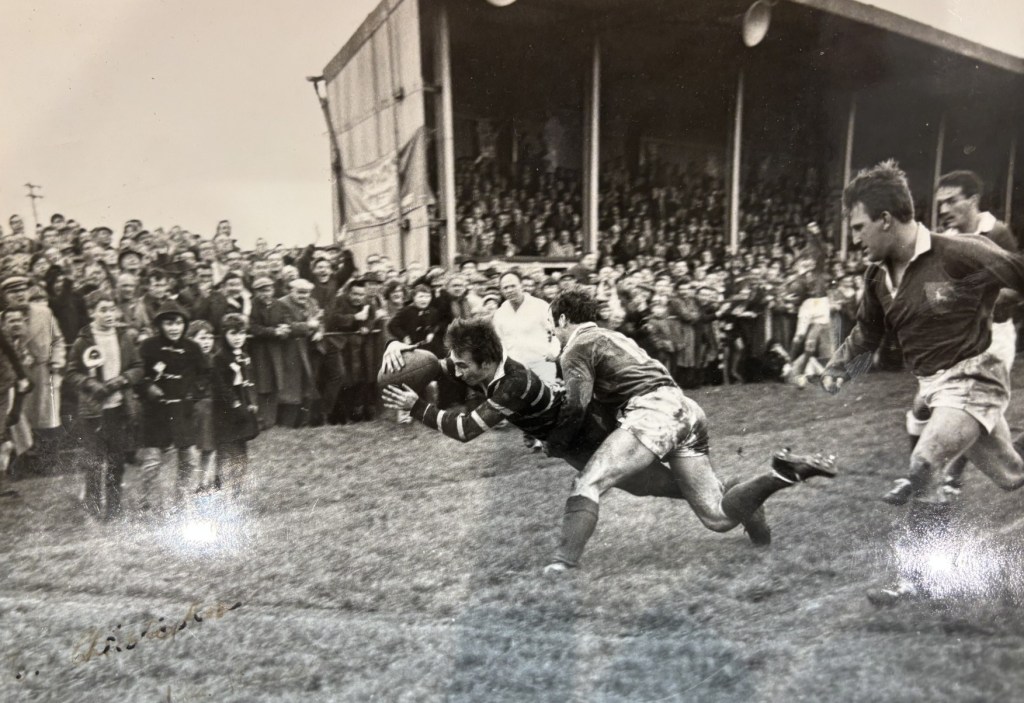
They had an overwhelming home advantage: five of their six games were played on Cornish turf, including the final in Redruth – the first to be played in Cornwall since that semi-mythical day in 1908. There were no replays; their path to the final had been seamless. Here’s Ken scoring against Herefordshire in Redruth:
Excitement as the big day against Lancashire approached reached fever pitch, and that’s probably an understatement. Cornwall were favourites. Bill Bishop had spoken:
We’re going to win this one.
West Briton, 6 Mar 1969. Page one
So, Ken, what happened?
We blew it. We played the occasion and not the game. That was the problem. It was built up for us, first final we’d been in since 1958 … it was the biggest disappointment of my rugby career, without a shadow of a doubt.
We were winning nine-nil playing up the slope, and we had an injury, Derek Prout did his ankle, and of course it was the days before substitutes. In the second half they just played the ball wide to Prouty’s wing, I don’t know who we had out there, their winger scored in the corner, and that killed us.
But on top of that, we had a penalty to win it, poor old Ray George, the bleddy ball toppled off the tee! He started his runup, and the ball toppled off, he fluffed it, completely.
There was 23,000 there they reckon on the day, it’s just indescribable. We met in Tyack’s, in Camborne. We came out to get on the coach to drive into Redruth, and we couldn’t understand, the players looked round, there was nobody – Camborne town centre was empty. We couldn’t believe it.
Again, it was one of those cases I think there was so much pressure on us, we just didn’t concentrate on the game.
We had a lot to do [even being nine-nil up] … I think the injury affected us, but we stopped, we stepped back, we thought, nine-nil, we got this, playing down the slope, put it into Hellfire Corner and we’ll get a try from there. Of course, it just didn’t happen.
Nobody told Lancashire they were there to lose. Trailing nine-nil at half-time, their skipper, England’s Dick Greenwood (and father of Will), uttered to his men the greatest piece of balls-to-the-wall fighting talk in championship history:
You are 40 minutes away from disgrace.
Evening News (London), 26 Mar 1969. Page 19
The England number eight had the tools for the job: centres David Roughley and Chris Jennins, the two flankers Tony Neary and Barry Jackson, plus lock Mike Leadbetter were either internationals or would shortly become so. They had been granted use of Manchester United’s practice ground throughout their campaign. Their fearsome coach, future England trainer John Burgess, had even compiled a dossier of the Cornwall side. He probably even knew which roads to avoid in summer.
The season’s big domestic showpiece event demanded a herculean effort of its participants. Playing up the slope, Lancashire clawed their way back. Cornwall played the occasion, the history, the expectation, and not what was in front of them. The 4,500 Lancastrians in the crowd grew ever noisier. Jennins, who shouldn’t have played because of bronchial trouble but was probably terrified of what Burgess would do to him if he cried off, kicked the winner. Lancashire 11, Cornwall 9.30
How times have changed. Ken, while congratulating the Cornwall senior men (who beat Lancashire) and women’s XVs who in June 2026 won their respective championships at Twickenham, had this to say:
They [the RFU] have destroyed it, to be honest with you, the County Championship. Cornwall are there, there’s no disrespect to Cornwall, but I mean playing one team, home and away, and they’re at Twickenham. Takes the kudos away from it, I think.
When I was President of the CRFU, I said at the time, “why can’t we just go back to the old way of playing South-West Counties. Playing Devon, Somerset, Gloucester, and from there onto a quarter-final, semi, and on to the final?”It would mean something. My fear is that we’ll lose the County Championship. I can see it.
Back in 1969, and from a personal point of view, Ken had had a good Championship. In the semi against East Midlands, his opponent had been Glenn Robertson, that season’s top try-scorer and who would boast the phenomenal record of 99 tries in 101 appearances for Northampton.31 Neither man scored, neither man escaped, neither could best the other. It was, said Ken, ‘a rare old tussle’, and his performance befitted his status at the time as the coming man. For, back in August 1968, Ken had signed for Bristol.
Trap Six
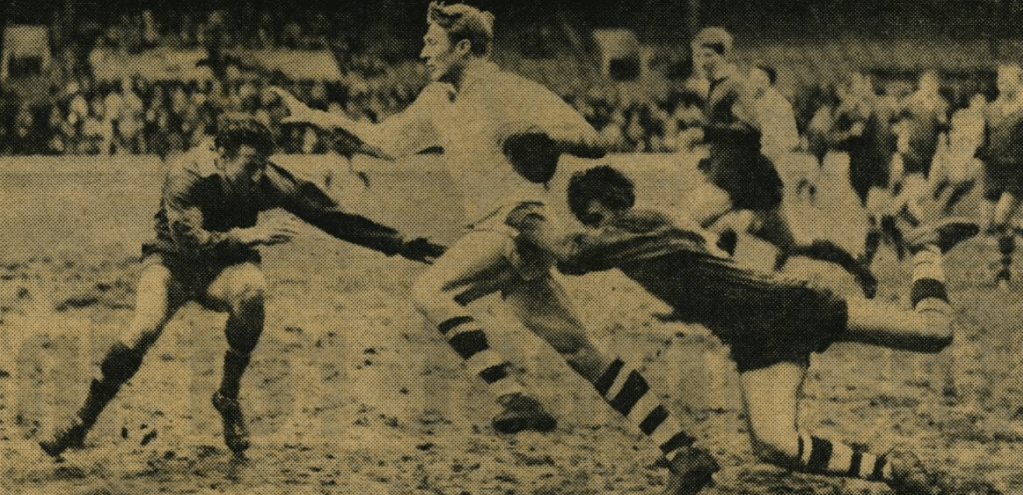
Ken was getting noticed. Prolific wingers usually do. Scoring for one of the region’s gun clubs, scoring for Cornwall at the sharp end of the championship and acquitting himself well against the Australians earned him in Easter 1968 a place on the Barbarians’ annual tour to Wales.
The Barbarians required all their players wear a blazer when on tour, but Ken, an apprentice mechanic, couldn’t afford one:
So the [Falmouth] dock workers heard about this, and they did a whip-round for me to buy a blazer, and presented it to me at the club … that was so special.32
Do us proud, boy. Two tries against Penarth, and beating Swansea in front of 10,000 alongside a chirpy scrum-half called Edwards told Ken he belonged at that level33:
That convinced me, that if I wanted to get an England cap, I had to move out of Cornwall … I wanted to play top-class rugby.
Of Ken’s contemporaries, Roger Hosen had been capped when playing for Northampton, as had Derek Prout. Richard Sharp played for Oxford University and Wasps. In 1968, the last man to win an England cap with a Cornish club solely as their base had been Camborne’s John Collins, back in 1952.34
To be sure, Ken wanted to play top-class rugby union. Rugby league club Widnes had already written to him, inviting him up for a trial, expenses paid. His father shunned the notion, as did Ken himself: the distance and the risks involved were too great. If he had played the trial, and the CRFU got wind of it, he would have faced suspension, regardless of the outcome.
Ken was mates with the Penzance & Newlyn, Bristol and Cornwall wing Jimmy Glover, whose daughter Helen became an Olympic rower:
He said to me, “Bristol have been talking about you, would you like to go to Bristol?” I said I don’t know, I’m quite happy down here, I’m comfortable with what I’m doing! He said “Jim Bryan runs a string of garages in Bristol, he would give you a job.” I said, well I’ve still got my apprenticeship to finish, and Jimmy said “Well, I’m sure we can sort that out!”
Jim Bryan, of Bryan Brothers Motors, was Bristol’s equivalent of Barry Quintrell. He owned five garages and a car dealership in the city, with a fleet of 6,000 vehicles.35 He was also chair of Bristol RFC. He invited Ken up to meet him, the club, the garage, and offered him a job at his Brislington workshop. (Years later, when Bryan Brothers expanded into Cornwall, Ken was made MD of this branch.) But Ken took a bit of convincing:
Father was keen, and he got hold of Gary Newbon, who at the time was working for Westward Television, and he wrote an article in the Sunday Independent, ‘Plummer signs for Bristol’, so I didn’t have much choice then! I couldn’t back out, so away I went!
Bristol had also signed his Penryn teammate, centre Vernon Parkyn, and on his first afternoon in the city Ken got cold feet – literally. At a loose end and fancying a swim, he went down to Severn Beach, envisaging Perranporth in July. What he got was ankle-deep in mud. ‘I was heartbroken’, he said.
It was the first, and last, doubt. In Bristol’s pre-season trials, Ken scored hat-tricks in both matches. Straight in the first XV, he didn’t look back. By October 1968, sportswriters reckoned he was ‘on the verge’ of an England cap. His new teammates christened him, in an echo of another flying wing who left Cornwall to seek his fortune, Graham Paul, ‘The Cornish Express’, or ‘Trap Six’. Everything came together at the right moment. A starring role for one of the strongest county teams in the land, three England trials and 19 tries for Bristol by late March 1969 meant it was merely a question of when.36
Called up to a pay-your-own-way training session at Coventry that same month, it became apparent there that the current England incumbent on the right wing, Keith Fielding, wasn’t fit. Ken’s debut came against Wales at Cardiff Arms Park on 12 April 1969.37
The deep end
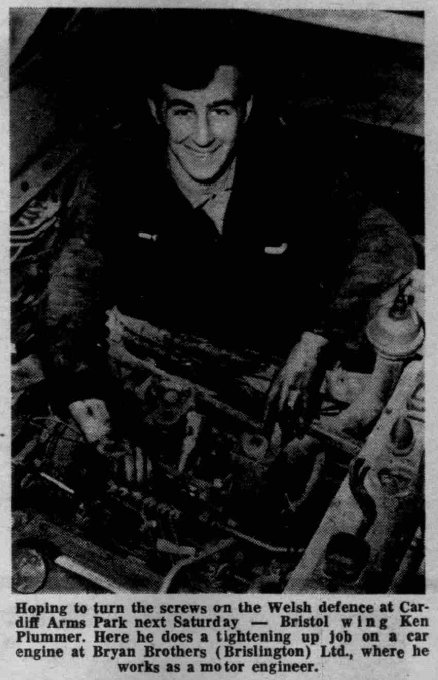
If England won, they would share the Five Nations championship with Ireland. If Wales won, the championship would be theirs. England had a pretty strong XV, with a backline of Bob Hiller, Ken, Ron Webb, John Spencer and David Duckham. In the pack were John Pullin, Bob Taylor, Budge Rogers and Dave Rollitt. Yet with the greatest respect, Trevor Wintle and John Finlan at half-back were not in the same league as Gareth Edwards and Barry John – few are.
The old, ramshackle Arms Park, replete with a dog track and a pitch covered with straw, looked an unlikely field of dreams. However:
It was a lifetime’s ambition. Your first ambition is to play for your club, then you wanted to play for Cornwall, that was the next thing, you think you’ve made it, so then you look at the next horizon, you wanna play fer England, and I was lucky enough to do it. I was very honoured.
But there’s little doubt Ken was thrown in, one judge reckoned, ‘at the deep end’. Although he identified his own strengths as a good swerve and sidestep to complement his devastating speed, Ken admits that defensively he wasn’t yet the finished article. Bristol’s coach, Peter Colston, would have the young Cornishman practicing his high-ball skills for an extra half-hour after every squad training session.38
England’s own preparation, or lack of, would count against them. The team had one get-together at Porthawl, Ken said, and that was it. He even had to provide his own pair of white shorts:
Then you’re in the changing room now, and they hand you a pair of white socks, “now look after those socks, ‘cause if you’re lucky enough to get in the next game, you’ll have to wear the same ones”! Can you imagine the boys doing that today!
Wales by contrast had just appointed Carwyn James as coach, and the squad had been together all summer, regardless of what the other home Unions and several players such as Dave Rollitt said.39 Their approach was years ahead of England. I asked Ken about this, and his response was blunt and telling:
They were just beginning to get into … professionalism, basically.
At half-time, it was three-all. But perhaps Gareth Edwards had told Barry John something about Ken Plummer, something he may have noticed on that Barbarians tour back in 1968:
I always remember I was in trouble in the first ten minutes. Barry John put up a high ball, and I caught it under the posts, their prop, Denzil Williams came from miles offside and crunched me! I thought, this could be a long afternoon!
Another kick ahead had Ken isolated and scrambling. Wales gained possession and Maurice Richards scored his first try, the only points the Welsh chalked up in the first half.
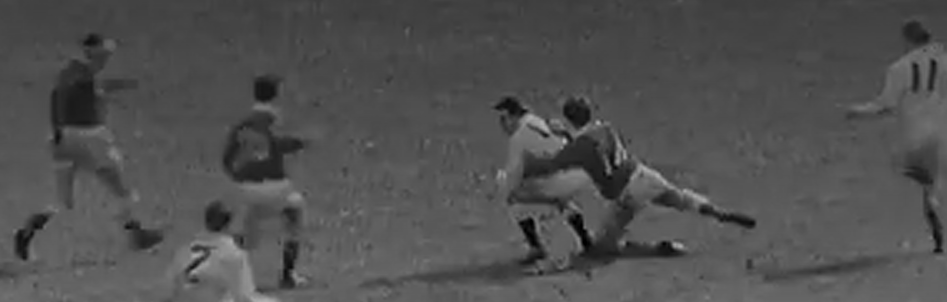
In the second 40, the floodgates opened:
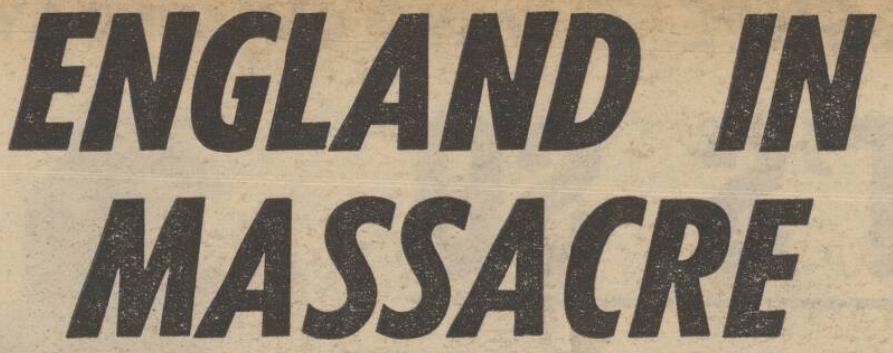
Maurice Richards was a bit of a handful on the day! It wasn’t all my fault! I saw Maurice a few years ago, I said to him, “I made you, ya bugger, you owe me half of your fee! That £20K you got, half of that’s mine!”
It’s certainly true that Maurice Richards’ signing to Salford shortly after his triumph in Cardiff was lucrative. Ken also acknowledges that, by the time Richards got the ball, much of the hard work had been done for him:
Wales at that time were perfecting bringing JPR Williams into the line … we just didn’t have anything defensively lined up for it.
However Barry John (‘the bugger’) jinked inside Ken to score a try as gracefully, gushed one pundit, ‘as a cheetah’. To be fair, Ken wasn’t the last player to be beaten by the man they would shortly anoint ‘The King’.41
Before his debut, Ken had been tipped to tour South Africa with the Barbarians that summer. All he needed to get the nod was a decent showing in Cardiff.42
Ken didn’t make the trip, and he didn’t play for England again until 1976.
I played on
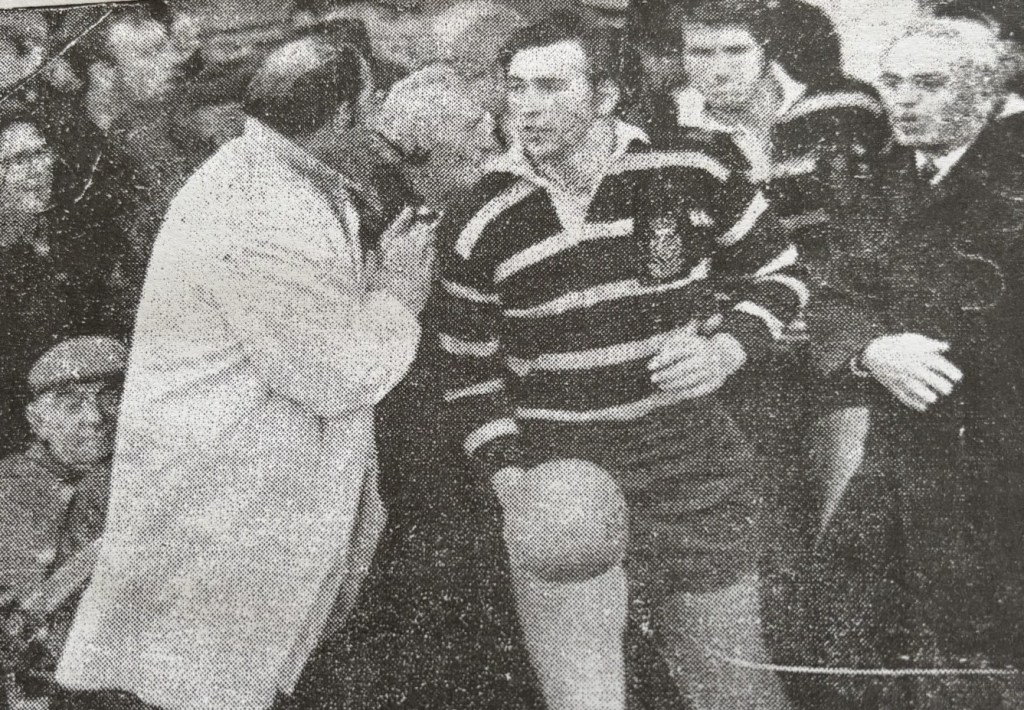
From 1963/64 to 1967/68, Ken played over 150 games for Penryn. From 1968/69 to his retirement in March 1978, Ken ran out for Bristol on 269 occasions and scored 139 tries (‘I didn’t know all this, I had to be told!’). A hundred of those Bristol matches, however, had been notched up by Christmas 1970: Ken was never as prolific a player as the 1970s wore on.43
Throw in over 50 caps for Cornwall, various other representative matches and the fact he was still sprinting in the early 1970s, it’s tempting to think the injuries Ken racked up in the second half of his career was his body telling him he’d done too much too soon. Additionally, Ken, since his teens, had only ever played hard, serious, front-rank rugby. There were no gentle runouts for reserve XVs, no finding his way in junior matches. Did Ken agree with my theory?
Possibly … though there was a lot of luck attached to it. I did a cartilage in 1970 that kept me out for three or four months. I got back from that and I think the next injury I had was playing against Australia in 1973, and I dislocated me shoulder. But I didn’t come off! They put it back in, and I played on, and then the last tackle of the game it came out again!
They had to cart me off to hospital after that … from then on, it came out eight times, before I had to have an operation … which got me back playing for two seasons I suppose. Years ’72 and ’73 were bad for me from an injury point of view.
The cartilage injury meant Ken played only six games in the 1971/72 season. That knee and Ken’s shoulder kept him out of rugby for two twelve-month spells between 1971 and 1974. Ken, married in 1969, now had a young family; he considered packing the game in to focus on the day-job and life at home.44 But then again…
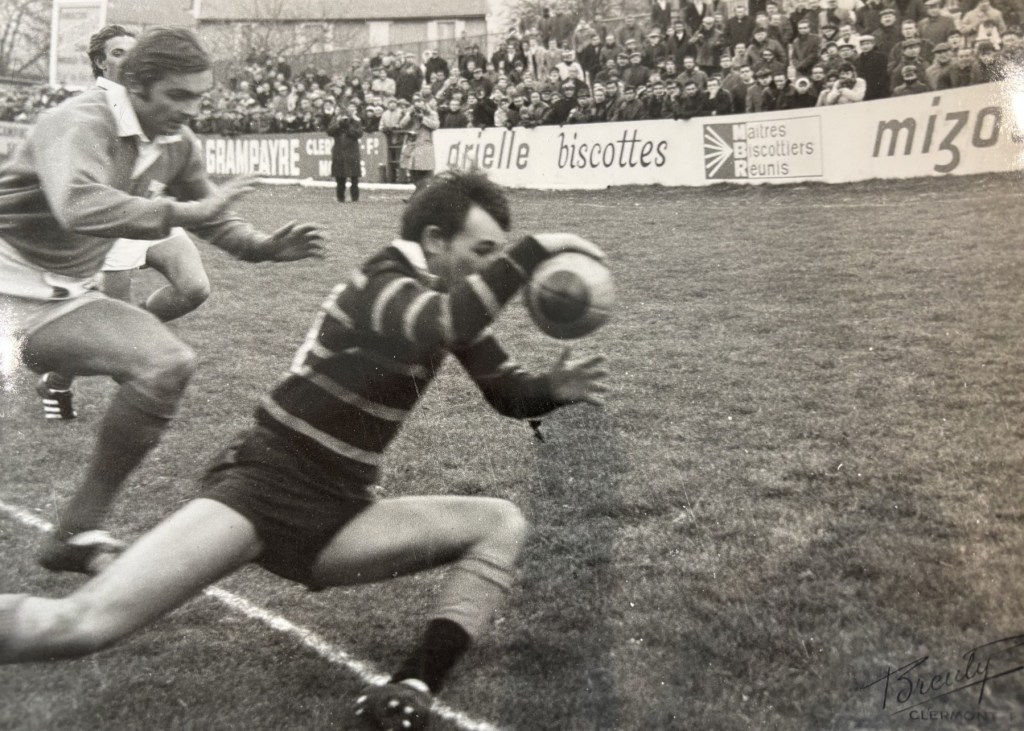
I had a few tours actually! I toured Romania with Cornwall and Devon … there were some good people on that tour, Terry Pryor, an outstanding man.
That was an interesting experience … we were ushered everywhere, we weren’t allowed to go out on the town or anything like that. We were sort of escorted everywhere we went. We played in the capital then went down to Constanta, which is down on the Black Sea … we were watched, that’s for sure.
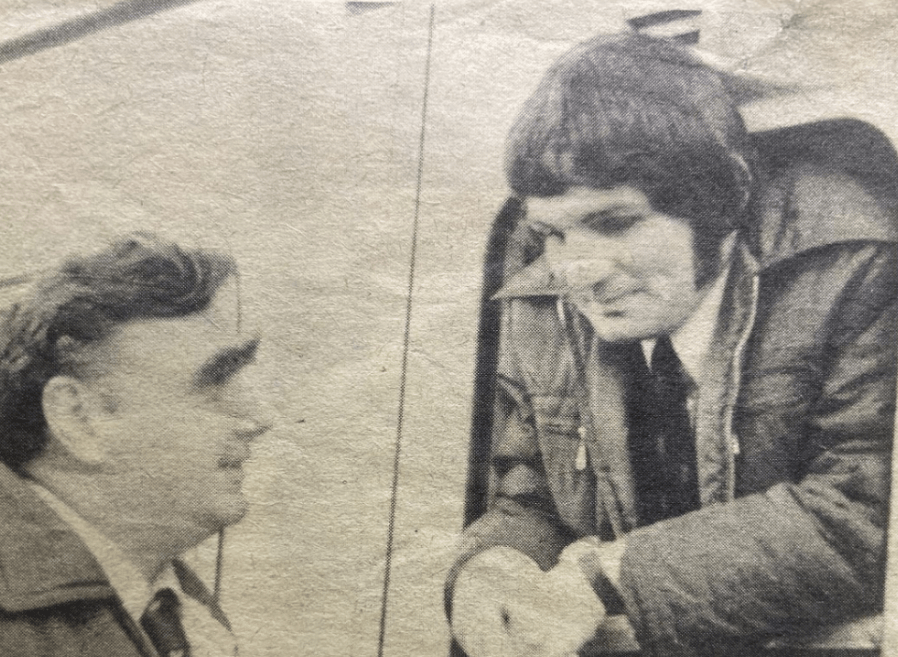
The Romanian match officials Ken reckoned were as corrupt as Nicolae Ceaușescu’s regime: ‘diabolical’ was his verdict at the time. The Cornwall and Devon side lost two games and won one in front of crowds of around 3,000.46
Of far greater controversy, Ken made two tours of South Africa, with Newport in 1973 and the Public School Wanderers (not that Ken ever went to a public school) in 1975. That country’s apartheid regime had seen it banned from competing in the Olympics since 1964 and, over the Basil D’Oliveria affair, exiled from international cricket since 1970. Rugby players such as Wales’ John Taylor refused to join the 1974 British Lions tour there on political grounds and, indeed, Newport RFC’s own fans (and the Welsh anti-apartheid pressure group) called for the club’s tour to be cancelled.47
Two Newport schoolteachers were refused leave of absence to tour, a motion on the part of the Monmouthshire education authority that bitterly divided opinion:
We shall be forcing politics into sport. If they go, they will further the case against apartheid … If we stop them going, are we any better than the apartheid people?
Western Daily Press, 19 Apr 1973. Page six
Yet Ken, one of a 25-strong squad, toured:
The only Englishman, if you like, in the party! So the only way I got away with it was to say “Hang on a minute, I’m Cornish, I’m a Celt!” That’s the only reason I got accepted [by the squad] I think!
We played the top teams over there: Natal, North Transvaal, Rhodesia, then we went down on the coast to Western Province … it was a real Lions tour, with a club team. We got absolutely slaughtered!
The rugby was fantastic, to be honest. The pitches were bone hard for a start, so it was top of the surface running. The ball was pinging around everywhere!
But:
The coloureds were on one side of the street and the whites were on the other. That wasn’t nice, to be honest, not at all.
When England toured there in 1972, Stack Stevens went into a post office to buy stamps and was told he had come in through the wrong door, and should go out and re-enter through the ‘whites only’ door. Stack told them were to shove their stamps.48
The 1975 Wanderers tour, led by Fergus Slattery and including players of the calibre of Peter Wheeler, was more successful.49 It only did good things for Ken:
That set me up, ‘cause obviously I’d trained through the summer when these tours were on, so I came back for Bristol in September hitting the ground running … I was scoring tries, I was playing at the top of my game again. I had my confidence back, I thought I was as good as anybody!
In early 1976, the injured England wing Peter Squires was ruled out of the rest of the Five Nations. It was a straight toss-up between Ken and his fellow Bristol flyer, Alan Morley. A national selector watched Ken score against London Irish in a John Player Cup match. It was enough.50
Seven years after his debut, Ken was back.
Never in touch
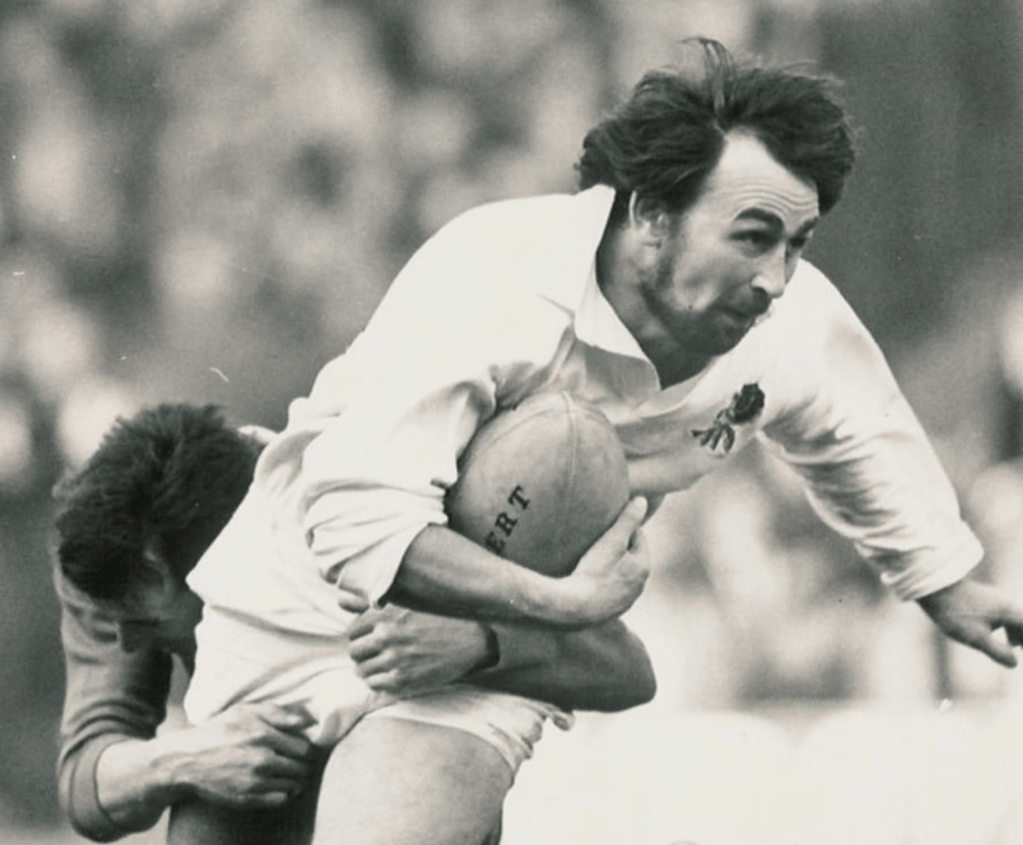
Carmichael out to Tomes … Tomes out to Lawson … Lawson must score for Scotland … what a try!51
Yes, Ken played in that Calcutta Cup match, the one that gets repeated every year to remind us that Bill McLaren got to commentate on his son-in-law, Scott Lawson, scoring for Scotland – and that Scotland won 22-12. It also means that Ken’s last-ditch tackle on Lawson gets shown every year too:
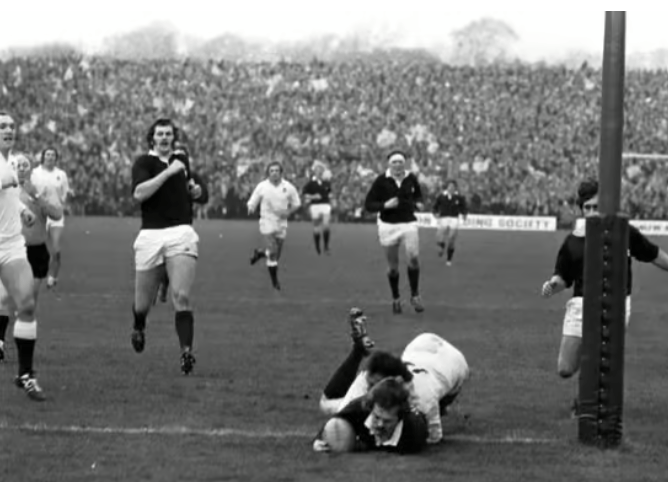
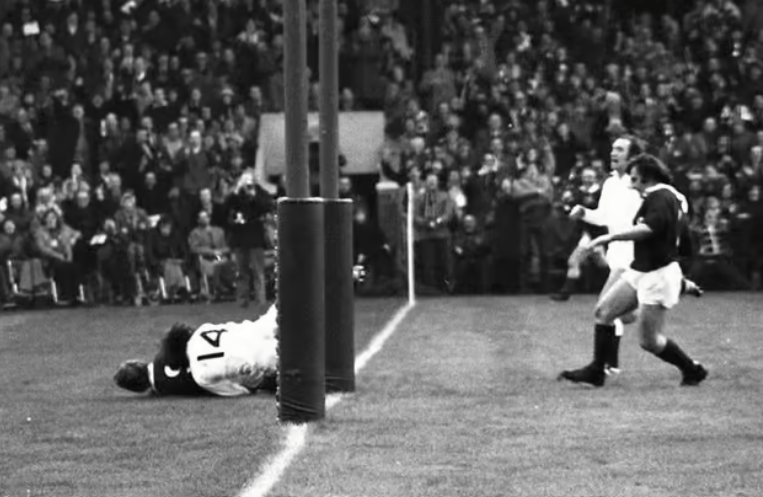
It could have been a very different narrative. In the opening minute of the match, shortly after shaking hands with The Queen, Ken gassed his opposite number Dave Shedden and scorched down the touchline to score. He had barely begun celebrating, and barely begun to hear the cheering of 70,000 fans, before the referee’s whistle blew:
Never in touch! I don’t think so! These days they would go through everything, have it on the telly, all angles, but in those days there was nothing.
Worse was to come:
Then about 20 minutes in, I had my shorts ripped off, in front of the Queen! So I had to change with me jockstrap showing!
Andy Irvine snared him late on to snuff out another 40-yard break. It was not a great championship to be an England player. Nine-nil up at half-time (and at Twickenham), Ireland came back to win 13-12. A 30-9 mauling at Parc des Princes (‘they stuffed us’) gave the English that year’s wooden spoon. Wales enjoyed another Grand Slam.
Those three internationals were Ken’s last. The try-that-never-was at Murrayfield was the closest he ever got to scoring.
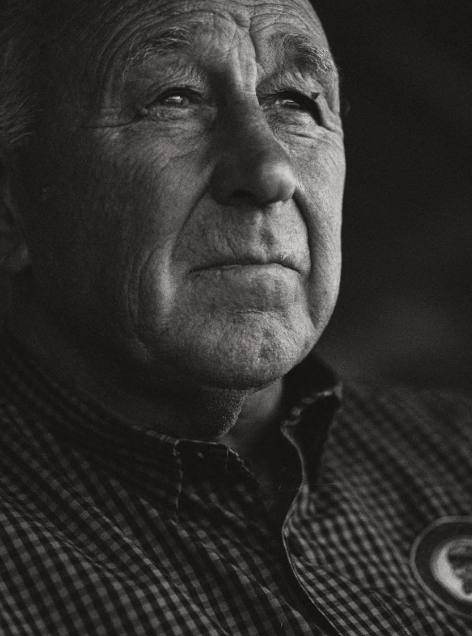
My life since I was six

For the 1976/77 season the RFU had introduced regional merit tables, then decided it would be a good idea to further overload a choked domestic programme by organising an inter-regional championship (i.e. South West v. North East) for the 1977/78 season.53
For top club players, this meant a massive increase in workload: club and county rugby (with all the training, travelling, time off work and away from families that that entailed) would now be augmented by regional rugby and, for the best, international trials and matches. Lest we forget, no one was paying the players for their services. Ken hit out in the press:
That’s the best way of killing club rugby. And, if I had the responsibilities of Bristol captaincy again, I could not possibly take on county commitments as well.
Bristol Evening Post, 22 Jan 1977. Page six
Although a recurrence of that old cartilage injury in February put Ken out for the rest of the season, he was indeed reappointed skipper for 1977/78.54 Time to decide: club or county? Or was it possible to do both?
I was in a terrible situation. It was my second season as skipper, and Bristol always put a reasonable side out on county days. There was a lot of pressure as captain to set an example. So I said to the Cornish selectors, “Look, we’ve gotta bit of a predicament here, don’t pick me for any of the friendlies, but I want to play in the County Championship if I can”.
But unfortunately Bristol then came back, and Peter Colston, he was both the Bristol and England coach, he put the pressure on me to skipper Bristol on county days.
I opted out of Cornish rugby. I’ve regretted it ever since to be honest. We all make mistakes.
With the John Player Cup and now official RFU merit tables making club rugby ever more the English game’s cutting edge, the late 1970s saw the prestige of the County Championship begin to wax and wane. But for Ken, that’s beside the point:
I loved playing for Cornwall. It was massive. It made my season, being able to come home, seeing my parents … I don’t think my father ever forgave me, but there we are!
If you’re Cornish, you want to play for Cornwall, to pull on the black and gold, and who the hell cares about the status of the competition.
But there’s more than one way to serve Cornwall, to serve rugby football. After his enforced retirement (shoulder) in March 1978, Ken had a period as an England selector during the Jack Rowell era. Returning home in 1997, Ken became more and more involved with Penryn RFC and the CRFU. He had two spells as the CRFU’s president (from 2012 to 2014 and 2015 to 2016), and was at the helm when the men’s XV won at Twickenham in 2016. Presenting the Bill Beaumont Cup that day was Beaumont himself, an England teammate of Ken’s in 1976.
Ken has even combined the duties of president and chairman for Penryn. His son, Jonathan, is also heavily involved at The Borough, as is his partner Judi. Two of his grandchildren work for Bath RFC. Rugby, Ken said, is ‘in our DNA’:
You’re just putting something back in, aren’t you? I want to see us as a club do well … This rugby club means everything; it’s been my life since I was six. When you went to school, all you wanted to do was play for Penryn. Penryn first, then Cornwall, that’s just the way it was.55
Ken Plummer’s achievements, on (and off) the pitch are truly remarkable. His social, educational and geographical background all counted against reaching the pinnacle of English rugby. He was one of only four Cornishmen to play for England in the 1960s – all had to leave Cornwall to gain recognition. He was one of only six state-school educated men to play for England between 1966 and 1970, against 22 who were privately educated and 18 from grammar schools. Ken is one of the two car mechanics ever, between 1871 and 1995, to play for England, against 68 doctors, 81 company directors or 79 solicitors.56
If you want to know something about ambition, dedication, willpower and making the most of your talent, go visit Penryn RFC and speak to Ken Plummer.
Many thanks for reading; my previous sporting hero was the wrestler Gerry Cawley. Read all about his career here.
Do you enjoy my work?
All content on my website is absolutely FREE. However managing and researching my blog is costly! Please donate a small sum to help me produce more fascinating tales from Cornwall’s past!
Your contribution is greatly appreciated.
References
- Image from: The 15 greatest wingers in Welsh rugby history – Wales Online
- Ken has also been interviewed for Radio Cornwall and The Rugby Journal. See: BBC Radio Cornwall Sport – …’Mr Ken Plummer, you’ve been selected to play for England. Please bring your own white shorts…’ – BBC Sounds, and Rugby Towns #2 Penryn – Rugby Journal
- Ray and Roger were first capped in 1951: West Briton, 22 Feb 1951. Page two. For an example of the Plummer-Michell rivalry, see: West Briton, 15 Jan 1953. Page two. For more on Ray Plummer’s contribution to Penryn RFC, see: Penryn RFC – Ray Plummer 1934 – 2020
- Cornwall RFU Committee Minutes. 22 Apr 1947.
- Hosen’s signing was announced here: Birmingham Daily Post, 6 Aug 1955. Page 15. West Briton, 17 Apr 1952. Page two.
- Councillor Jack Chinn dedicated his adult life to Penryn. On his death in 1996 a memorial seat was dedicated to him at St Gluvias church. West Briton, 4 Apr 1996. Page four.
- West Briton, 8 Oct 1964, page two, Cornish Guardian, 22 Jun 1967, page seven, and 13 Jun 1968, page seven.
- Rugby Towns #2 Penryn – Rugby Journal
- West Briton, 9 Jan 1964, page two, and 23 Jan 1964, page two.
- West Briton, 16 Jul 1964. Page two.
- Image from: Raiding the Valleys – Part Five – Hunslet RLFC
- From: Sport mourns loss of legendary figure | Somerset County Gazette and Leslie Williams (rugby) – Wikipedia
- West Briton, 6 Sep 1956, page two, and 17 Aug 1989, page 31.
- Kynaston, D. Modernity Britain 1957–62. Bloomsbury, 2015. Page 536.
- Sport mourns loss of legendary figure | Somerset County Gazette
- Image from: Salmon, T. The First Hundred Years: The Story of Rugby Football in Cornwall. CRFU, 1983. Page 64.
- Salmon, T. The First Hundred Years: The Story of Rugby Football in Cornwall. CRFU, 1983. Page 63-4. For more on Benji Thomas, see: Cornwall mourns the loss of “Benji” Thomas – Funeral arrangements announced.
- Criticisms levelled at the BBC’s table from the start: Bristol Evening Post, 22 Sep 1962. Page 39.
- 13 Nov 1970. Page 22.
- West Briton, 16 July 1964, page two, 1 Oct 1964, page two, 5 Nov 1964, page two, 24 Dec 1964, page two, 12 Apr 1965, page three, 5 May 1966, page 14.
- Rugby Towns #2 Penryn – Rugby Journal. West Briton, 15 Apr 1965. Page two.
- Tomlin, S. Stack Stevens: Cornwall’s Rugby Legend. Amberley Publishing, 2016. Page 44 and 135.
- Images from: Richard Sharp – Alchetron, The Free Social Encyclopedia, ‘Stack’ Stevens :Cornish Pirates, and courtesy of Phil Westren, Cornish Pirates RFC.
- Western Daily Press, 4 Jan 1967. Page 12.
- Daily Express, 5 Feb 1967. Page 26.
- For more on Coker, see: Trailblazing John Coker | Harlequins FC. Report from: West Briton, 23 Feb 1967. Page 14.
- West Briton, 9 Mar 1967. Page 14.
- Image from: Nostalgic return to Redruth for the Cornwall side of 69 | Trelawny’s Army
- Williams’ involvement is mentioned here: West Briton, 5 Sep 1968, page 14. For more on the 1908, 1909 and 1928 campaigns, see: 1908 and All That – Francis Edwards ~ The Cornish Historian and John Jackett’s Ghost: Cornish Rugby and the 1928 County Championship – Francis Edwards ~ The Cornish Historian. All results and international details are from: Salmon, T. The First Hundred Years: The Story of Rugby Football in Cornwall. CRFU, 1983.
- Manchester Evening News, 4 Mar 1969, page eight, 8 Mar 1969, page one. West Briton, 13 Mar 1969. Page 16.
- From: PressReader.com | Try hero Robertson remembered
- From: Rugby Towns #2 Penryn – Rugby Journal
- West Briton, 4 Apr 1968. Page one. Western Daily Press, 13 Apr 1968, page ten, and 16 Apr 1968, page eight.
- For more on John, see: Cornish Sporting Heroes, #4: John Collins: Camborne, Cornwall and England Rugby – Francis Edwards ~ The Cornish Historian
- Bryan’s obituary is here: Western Daily Press, 26 Apr 1994. Page nine.
- The Cornish Guardian reckoned Ken was ‘on the verge’: 31 Oct 1968, page seven. Bristol Evening Post, 31 Mar 1969, page 32, and 5 Apr 1969, p32. See my interview with Graham Paul here: Cornish Sporting Heroes, #2: Graham Paul, Rugby League Star – Francis Edwards ~ The Cornish Historian
- Bristol Evening Post, 31 Mar 1969. Page 32.
- Bristol Evening Post, 31 Mar 1969. Page 32. For more on Peter Colston, see: Obituary: Peter James Colston – Bristol Bears Rugby
- Daily Mirror, 14 Apr 1969. Page 27.
- Still from: Rugby – Wales V England (1969)
- The gusher was Peter Wilson: Daily Mirror, 14 Apr 1969. Page 27.
- Bristol Evening Post, 5 Apr 1969. Page 32.
- Ken’s century for Bristol was noted in the Western Daily Press, 6 Jan 1971. Page 11.
- Bristol Evening Post, 27 May 1972, page 47, 20 Feb 1976, page 14, 17 Apr 1976, page six.
- Image from: Rugby Special ~ Part Three – Francis Edwards ~ The Cornish Historian
- Bristol Evening Post, 24 May 1972. Page 42.
- Western Daily Press, 12 Jan 1973. Page nine. Daily Mirror, 31 Oct 1973. Page 27.
- Tomlin, S. Stack Stevens: Cornwall’s Rugby Legend. Amberley Publishing, 2016. Page 85.
- Leicester Daily Mercury, 3 May 1975. Page 36.
- Bristol Evening Post, 7 Feb 1976, page six, and 14 Feb, page three.
- From: The story of Scotland’s famous 1976 Calcutta Cup win – part I
- Images from: The story of Scotland’s famous 1976 Calcutta Cup win – part I, and The story of Scotland’s 1976 Calcutta Cup win – final part
- Field, 20 Jan 1977. Page 26.
- Bristol Evening Post, 19 Feb 1977. Page 32.
- From: Rugby Towns #2 Penryn – Rugby Journal
- Figures from: Collins, T. A Social History of English Rugby Union. Routledge, 2009. Pages 215-218.

