
Reading time: 25 minutes
The Black and the Gold: The Story of Cornish Rugby, by Nick Serpell (Hellfire Awaits: 150 Years of Redruth RFC) and myself will be published in autumn 2027. As the layout currently stands, chapter six ends in 1939 and chapter seven picks up the thread in 1945.
This doesn’t mean to say that, because rugby was officially suspended between those years, nothing of interest happened. Quite the contrary. Nick and myself didn’t want to leave a gap in our narrative, or a gap in Cornwall’s rugby history. This post fills that gap.
Cornish rugby in 1939
At the opening of the abortive 1939/40 season, Cornish rugby appeared to be rather healthy. There were 11 senior clubs: Camborne, Camborne School of Mines, Falmouth, Hayle, The Hornets, Newlyn, Penryn, Penzance, Redruth, St Ives and Truro. Complementing them were around 15 junior and/or independent old boys’ outfits: Camborne Corinthians, Camborne Wesleyans, Cornwall Electric Power Co. (based at Brea), Falmouth Old Boys, Lanner, Redruth Albany, Redruth County School, Redruth Highway, Redruth Wanderers, St Day, St Erbyn’s School (Penzance), Stithians, Troon and Truro Cathedral School.
The top 1930s club was Redruth. This XV from 1938 would accumulate over 200 caps for Cornwall:

Their exploits mattered nationally, being regularly featured in the Daily Express‘ ‘Rugby Club Records’ table. They had played in London in 1931, and in 1935/36 ran up 447 points against all Cornish opposition, conceding only 27, with wing Harry Faviell running in 53 tries.
At the next level, the Cornwall men’s senior XV had recently reached the semi-finals of the County Championship, losing 9-0 to Surrey at Richmond in February 1938. To get there they’d played Devon twice (and won both times), Gloucestershire (lost 9-3) and Somerset (won 11-5) in the Championship’s South-West Division. Every side Cornwall encountered would have contained that county’s crack players and featured international talent.
Speaking of internationals, Falmouth had hosted a trial in 1934, and the Cornwall RFU (hereafter, the CRFU) were looking forward to another one in 1941, with all the prestige and gate money that the occasion would bring.
Yet on the other hand, things were not so wholesome. No Cornishman had been capped for England since Bert Solomon in 1910. Cornwall hadn’t won the County Championship since 1908, only reaching the final once – 1928 – since 1909.
Cornwall’s severe economic depression had meant some of its finest 1930s talent (Fred Rule, Fred Bone (who became a POW in Germany), Francis Gregory, Spencer Vibart and Jack Knowles) would be lured away to professional rugby league contracts. Those out of work and left behind formed rugby clubs for their unemployed brethren.
There were no clubs east of St Austell, where The Hornets were then based. What teams there were spent as much time at each other’s throats as they ever did playing rugby. In early 1939 a game between Troon and Redruth Reserves was abandoned 17 minutes from time on account of the constant brawling. In April of that year, a St Day player was suspended for attacking the referee in the changing rooms after a fixture with Redruth Highway. Such matters were almost weekly occurrences in the 1930s.
Then Germany invaded Poland.
The Phoney War

It seems the CRFU were rather hasty in officially suspending play. They reneged on their above decision when it became apparent that the latest mob of barbarians from across the channel weren’t due any time soon, and that the people of Cornwall were pining for some robust entertainment:
In these days of stress and strain, as an aid to helping the Home Front, would it not be possible to give certain areas in Cornwall a little Rugby.
‘A Cornishman’, West Briton, 28 Sep 1939. Page four
By January 1940 it was reported that the CRFU had
decided to do everything possible to keep the game going in the county.
Cornishman, 11 Jan 1940. Page six
That may very well have been the CRFU’s wishes at the time. Indeed, society tried to carry on as normal for as long as possible. For example, in spring 1940 the respective Old Cornwall Societies of Redruth and Helston gave lantern lectures on a visit to South America and ancient Cornish crosses.
But the County Championship had been suspended and fixtures with Devon had been abandoned. The CRFU, for all the good intentions, didn’t meet again until 20 December 1944. Cornish rugby was left to fend for itself.
A Penzance ‘Borough’ XV was beating St Ives in October 1939; Redruth were giving a combined schools side a stern lesson that same month. Newlyn RFC shrugged its shoulders at the cancellation of all their fixtures and promptly arranged their own with Penzance on the 21st.
Truro, a senior club boasting a Cardiff player at centre, lost 19-3 … to Truro School. The School of Mines beat a scratch XV calling itself Camborne Wanderers. Despite the keeping calm and carrying on, change was definitely in the air.
Newlyn lacked two key players for that game with Penzance: they had already been called up. Redruth’s schoolboy victims included pupils from Marylebone Grammar, who had been evacuated to the area. Redruth had allowed the London school use of their ground – for a fee, naturally – and the pupils were taking their lessons at Redruth County School. Letters now held at Kresen Kernow document the headmaster’s frustrations at the cramped arrangements.1
Meanwhile, at Camborne, the ARP were using the Recreation Ground to simulate air raids. St Ives arrived at Redruth in February 1940 with only nine men; as no ringers were available in the town, the game had to be abandoned. So many of Redruth Albany’s squad got the call-up that the club cancelled all fixtures in March 1940. Albany only reappeared in the 1945/46 season.
Suddenly, Cornish rugby was in a fight for its life. So was everybody else.
Bang

It has been estimated that the Luftwaffe visited Cornwall on around 50 occasions.2 In July 1940, a lone bomber machine-gunned Polruan’s harbour, then dropped its cargo, scoring a direct hit on the school. I’m sure some youthful villagers were grateful.
There were no casualties in Polruan that day. In August 1942 the inhabitants of Truro were not so lucky. The railway station was machine-gunned and an entire hospital wing was bombed flat. In all 14 people were killed and 65 injured.
Connie Beer, a Truro resident, recalled that day vividly:
I was coming home from night school in Lemon Street and as I got opposite the railway station a German plane came over the roof of the station machine gunning. A man pushed me and some young boys up against the wall to protect us.
Let’s be clear: living through these events was a terrifying experience. One lady was killed when Penzance was bombed in October 1942, and areas of the town were left as smouldering ruins. One local, Mr Hichens, spoke to the Cornishman the day after. He had been at home with his wife and two young children:
We were going down the stairs, when – bang – down came the bomb, and we were blown down them by the blast …
We picked ourselves up and found we were trapped … I started to shout for help, but nobody heard me. And then I saw fire. I thought it was in our building, and at this I became frantic … we were all choking from the dust and fumes, and in an effort to escape I barged against the ground floor door, and at last got it down …
Three times we made a run for safety, and each time a ‘plane came over machine-gunning. My little girl was terrified.
29 Oct 1942. Page five
A Dornier crashed into a St Just house that same night. Fortunately the family whose dwelling it was survived the hit. The severed limbs of the Luftwaffe airmen were ‘scattered in various directions’.3 A leg was discovered in a bedroom.
Unsurprisingly, organised recreation rapidly dried up. Yet Cornish rugby soldiered on. It wasn’t regular and sides were often cobbled together at the last minute. It probably wasn’t of the highest quality. Several clubs closed their doors and never reopened them. Yet the games boosted morale, provided a spectacle, and were invariably for a good cause: local charities, the war effort, or even to simply keep the sport alive. All this was of a piece with rugby elsewhere. In February 1941 Richmond’s ‘Keevils’ XV of past and present stars took on a strong Army side at Deer Park. All proceeds were for the War Effort Fund.
So, how did Cornwall’s senior clubs fare? (The junior clubs, incidentally, with smaller squads and less geographical reach, largely followed the example of Redruth Albany.) Let’s start down west.
Newlyn RFC

World War Two spelt the death-knell for Newlyn. The game against Penzance in October 1939, which they won 8-6, was their last ever on the Goulder Hill pitch. They travelled to St Ives and won there in January 1940, then went down to Penzance at St Clare a month later. This was the last rugby match Newlyn RFC ever competed in, but a game between Penzance and St Ives in November 1940 seemed to point to the future: several Newlyn players turned out for Penzance.
In autumn 1944, the club had something cooking:

Penzance RFC
Penzance found the going almost as tough as Newlyn. The second half of the 1939/40 season saw them play only four matches: the one previously mentioned against Newlyn, a home victory and away defeat to St Ives, and another loss at Redruth. In August 1940 the club announced it was postponing play for the foreseeable future, then changed its mind two months later, advertising fixtures against Camborne School of Mines, the Army and St Ives.
Penzance’s 1940/41 season can be summarised thus: seven games and undefeated by Christmas, followed by three 1941 defeats by Services’ XVs, all at St Clare.
At the end of that season, playing member and CRFU committeeman Rex Carr organised a match between a West Cornwall XV and a Services team at St Clare for War Weapons Week. Although the Services, thanks to the wartime relaxation of rugby union’s utter denial of its rival code, featured seven league players, they still lost 8-5, and £24 was raised.
Penzance’s 1941 Boxing Day match against the RAF was the last game the club ever played. Elsewhere, though, their players were making their mark with Peter Gartrell scoring a hat-trick for the London District Army against United Hospitals.
St Clare hosted two final fixtures. A Public School XV played Devonport High School there in January 1942, and King’s School, Canterbury met the Devon team there in October 1943, winning a tight match 9-8. King’s had previously been evacuated to Carlyon Bay Hotel and their rugby team were photographed in its grounds.4
Penzance RFC’s first general meeting since 1939 took place in December 1944. It was also its last. The president, W. J. Hichens, called the club’s big announcement a
genuine bit of post-war reconstruction.
Cornishman, 14 Dec 1944. Page six
Penzance & Newlyn RFC had come into being. In one of Cornish rugby’s great ironies, it took a world war to unite two of Cornwall’s most notoriously hostile sporting rivals.
St Ives RFC
The Cornishman of 18 January 1940 reported only one match played the previous weekend. Redruth had visited St Ives, the fixture resulting in a pointless draw. For February’s Feast Monday celebrations, no interest (or manpower) could be drummed up for a game of rugby. As an alternative, a bunch of schoolkids tried their hands at hurling (which customarily took place in the town’s streets during the annual revelling) on the Recreation Ground instead.
This perhaps illustrates how much Cornish rugby had regressed in such a brief period. In September 1939 the game had a fully realised structure from the schools up and was in robust good health. Months later, and the pre-industrial, pre-historic folk game that union supplanted in the 1870s took over a rugby pitch for an afternoon.
St Ives and Redruth were the only morsel on the rugby fans’ menu for another weekend in March 1940: this time Redruth hosted and it was a 3-3 draw. A month later St Ives lent a player to Penzance to even up the numbers and won the 14-a-side game 8-5.
The feast of 1941 did see some rugby. St Ives played a XV rustled up by their own chairman, Col J. Daniel and lost 7-4. Daniel must have had a few connections: the player who kicked the winning drop-goal for his side was William Murdoch, the Scottish international. This was St Ives RFC’s last game before the 1946/47 season.
Only two more organised matches graced the town during the war. For War Weapons Week in May 1941, a XV of players from Penzance, Newlyn and St Ives took on a military side. Then, in February 1944, Redruth Home Guard came to play a pickup team called the ‘Cornish Blues’. The latter featured some pretty decent names, including Harold Curnow, Leslie May, Spencer Vibart (who had joined Salford from Camborne), and a young St Ives fly-half, Harry Oliver. Running touch was the 1908 County Championship winner, Tommy ‘Chicky’ Wedge.

Many St Ives’ players were on active service. Joe Peters RN, received a DSM from the King, as did seaman S. F. Phillips. Frank Woolcock and Gerry Banfield had similar honours. Cpl Harold Rowe got through the Normandy landings, saved several comrades’ lives, and was awarded the BEM.
Hayle RFC
Hayle RFC played no form of rugby during World War Two. The town’s Home Guard managed one match in October 1942, winning 17-3 against a Services’ XV and raising over £1 for the Red Cross. Playing for the Home Guard was Leonard Rowe, who was a Hayle RFC regular in the late 1940s:

Hayle, who had struggled financially throughout the 1930s, came back on the scene in the 1946/47 season. Although their own Verdun Thomas was playing for an artillery team in the Middle East, the final wartime game witnessed in Hayle was between a West Cornwall XV and a Redruth District side in December 1942.
Falmouth RFC
Falmouth hosted and beat Stithians – their only wartime rugby appearance – in February 1940 then won before a ‘large Easter crowd’ against St Ives a month later.5 In April they travelled to Redruth and lost 11-0. That was it for four years. Sgts O’Shea and Mainwaring, squad members, had been confirmed as POWs and two other players, Fred Smith and Norman Williams, were missing in action. Jim George RN, a forward who had worked on the docks, was in 1941 selected for the international Navy XV in Scotland but his duties kept him from playing. In 1947, George was picked for England.
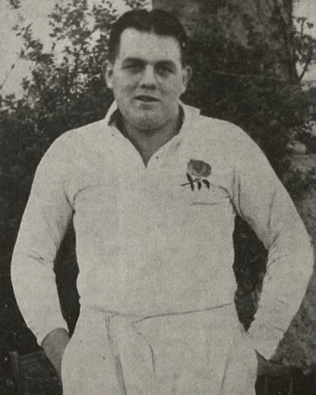
In December 1944, when the CRFU reconvened and agreed to resume fixtures on the basis of the 1939/40 season, Falmouth RFC was ready to go. Very few matches (between even fewer clubs) of that truncated 1944/45 season were actually reported, but the club managed to get two sides out, the first XV playing 22 and winning 11, the reserves playing 12 and winning five.
Penryn RFC
Nothing of Penryn RFC was mentioned until April 1943. Playing member Sgt Ivor Andrews was awarded the DCM in Tunisia and was complemented by General Montgomery.
Like their near-neighbours Falmouth, the 1944/45 season saw Penryn reappear. They had no kit, but the coffers were £48 to the good. That first season back, Penryn played 20 games but lost 16. What match reports there are champion brevity. When Redruth travelled to the Borough for their first wartime match there in April 1945, their 8-5 victory and the occasion merited one paragraph in a West Briton rationed to only eight pages.6
Truro RFC

Truro had only claimed senior club status in the 1939/40 season and their reserves were still playing in April 1940. We only know this because it was reported that one of their players had broken a shoulder blade.
Their chiefs had lost to a Services XV in January, but what rugby there was in the early years of the war was mainly played by an outfit calling themselves Truro Corinthians.
They travelled to Redruth School twice in 1940 and won both times. That October saw them in Redruth again, this time going down 9-8 to Marylebone Grammar. The Corinthians’ Truro base was Boscawen Park. They lost 12-8 there to a Services XV in November 1940 and an Army team featuring several league pros beat them 8-4 in January 1941.
Later that same month the Corinthians joined forces with County Hall staff to beat the Services 7-6 at Boscawen. Then they seemingly vanished.

A ‘Truro XV’ comprised of Redruth players and at least one professional from Hull KR drew 8-8 with a Services side for War Weapons Week in March 1941. The County Hall played Truro School and Kent College combined in September that year, then for the latter half of the war charity matches were held at Truro City FC.
In March 1943 a Cornwall XV featuring Redruth’s Harold Curnow and Billy Phillips, along with Penryn’s 1920s star George Jago, played an RAF XV during Wings for Victory Week. A crowd of 2,000 saw Cornwall win 24-8. The last wartime game of rugby played in Truro was between a Cornwall team and an Army teams to raise funds for POWs. That was on Easter Monday, 1943.
Although Truro RFC donated £7 to the expansion of Royal Cornwall Infirmary in April 1942, the club had effectively ceased to function and wouldn’t reform until the 1948/49 season.
Hornets RFC
Hornets closed down their rugby operations completely and only stepped onto a pitch again, as a junior outfit, in the 1949/50 season. Two players would be decorated: Flt Lt James Warne won the DFC in the Battle of Britain and Lt Col Coxon the MC in 1944.
However, the Carlyon Bay evacuees of King’s School had been loaned their pitch, so rugby in St Austell didn’t altogether cease, even if King’s don’t seem to have played any local sides. Besides the game against Devonport’s schoolboys at St Clare, they took on Clifton College, Gresham’s of Holt, Kelly College and RENC Keyham. In July 1941 King’s celebrated its 400th anniversary at Carlyon Bay itself and not Canterbury Cathedral. In 2005 the school opened a new house, naming it ‘Carlyon’.
Camborne School of Mines RFC
In March 1940 the CSM had arranged fixtures with Falmouth, St Ives and RENC Keyham. In December they lost 3-0 at Penzance, and didn’t play again until February 1942 when they went to Redruth as part of Warship Week.
CSM became active again in late 1943, when they beat Redruth Home Guard away, then hosted Devonport in February 1944. Two more losses, against the respective Home Guards of Camborne (January 1945) and Redruth (February 1944), completed their wartime rugby. In September 1945 one of their pre-war players, Jack Polglase, was released. He had been a POW in Singapore since 1942.
Camborne RFC

Camborne had one or two final reminders of Redruth’s superiority before the playing programme evaporated. Boxing Day 1939 saw The Reds run in five tries to drub Town 15-0, then a holidaying Roy Jennings helped his old club win 6-0 on Good Friday 1940. It was the last time a Camborne RFC XV would play until the 1945/46 season.
St Ives’ Col Daniel and the CRFU’s secretary W. J. Robbins rescued Camborne’s traditional Feast Monday fixture in November 1940, putting two sides out under their names. All proceeds went to a Christmas fund for servicemen. Yet there was no Boxing Day rugby in 1940. Holmans, working at full capacity to meet the wartime contracts, didn’t close for Christmas. It was a time of little frivolity:
… no Christmas music was heard …
West Briton, 2 Jan 1941. Page five
Daniel raised another team to play a Services XV at Camborne for War Weapons Week in March 1941. Among the half-time entertainments was an auction for a quantity of onions.
In fact, local men were far more likely to get a game on service than they ever were at home. Reports came back in early 1943 of a team of Cornish players being undefeated in India. One of their fans wrote home that:
We are hoping they will be visiting us soon, and once again to see a game of rugger.
St Austell Gazette, 6 Jan 1943. Page four
(A team of Cornish POWs was also playing in Italy, sporting jerseys provided by the Red Cross.)
That Christmas the Mining Division finally had something sporting to look forward to. A charity match that raised £100 and drew a crowd of 2,000 took place at Camborne on Boxing Day 1942. Reg Parnell, Camborne’s star wing of the 1920s, and Harold Curnow, a threequarter of Redruth’s 1930s vintage, managed to bring together the talent of seasons gone by for what must have been a fine exhibition:

(Obviously not all local men were in reserved occupations. Camborne’s pre-war half-back, David Bailey, was a POW in Japan.)
Parnell and Curnow arranged similar for Boxing Day 1943; a public appeal was made for the supply of 32 oranges or lemons for the players and officials at half-time. This last should remind us that, after all, there was a war on. There were no clubs, players, committees, secretaries, finances, resources or facilities. Parnell, Curnow, Daniel and all the other forgotten people who made wartime sport happen at all had to do everything themselves, calling in favours, twisting arms and doing whatever was necessary to create a spectacle that could entertain and raise cash.
Yet in the summer of 1944 Camborne Home Guard met at Tyack’s and decided to form their own rugby club. Their avowed aim was to build a ‘team for after the war.’7 By the opening of the 1944/45 season they were beating a Holmans XV (and if anywhere had manpower in wartime Cornwall, it was there) 37-5 at the Recreation Ground. They played the RAF in October and again on Feast Monday. But there was another local team around …
Redruth Home Guard had had their own XV since late 1942, and the inevitable happened in October 1944. The ‘real rugby rivals’ played at Redruth for the first Mining Division derby since Good Friday 1940, Camborne losing 5-3.8
On 9 December 1944 Redruth went to Camborne for the first time in five years and lost 11-6. Camborne Home Guard played further games against Falmouth, CSM, an RAAF XV and, in March 1945 travelled to Plymouth to beat RNE College. (Clearly the Home Guard’s duties were not too onerous by 1945.) In what was billed as a ‘new chapter’ in Cornish rugby history, a team from north Cornwall called Launceston Tigers visited Camborne in Easter 1945.9 The Tigers were so obscure that, when the CRFU reconvened in December 1944, the Union were unsure if they actually existed.


The Tigers (originally the Trebursye Tigers, a hamlet near Launceston) were no myth, playing from late 1943 to the end of the 1944/45 season. Besides Camborne they had a handful of fixtures against Launceston College, a New Zealand Naval XV, Devonport Barracks, the Royal Engineers and a few RAF teams before disbanding. Launceston was a major military hub throughout the war, and as the above programme makes clear, practically all the Tigers’ players were upcountry servicemen. Launceston RFC proper didn’t form until the 1949/50 season, but thanks to the Home Guard, Camborne RFC were up and running for the 1945/46 season.
Redruth RFC

In terms of rugby, Redruth was the most consistently active Cornish town throughout World War Two. Every year, a team bearing the Redruth moniker stepped foot on a pitch, which, considering the enforced inactivity of practically all the other clubs, is quite an achievement.
There were two main reasons behind this. Firstly, Redruth RFC’s success and subsequent high profile in the 1930s meant there was perhaps a greater desire and demand for the sport in the town than elsewhere in Cornwall. Service and invitation XVs would want to play a team from Redruth, for the very reason of the rugby club’s fame.
Secondly, when Redruth Albany shut up shop, one of their committeemen, Roy Martin, decided to arrange matches for Redruth town XVs instead. Martin’s talents as a rugby administrator should not be underestimated, and nor should his tenacity. As secretary of the Cornwall Junior Rugby Group from its inception in 1932, Martin campaigned tirelessly for Cornwall’s junior clubs to have equality of representation on the CRFU.
Besides the early 1940 fixtures against Camborne, Falmouth, Penzance and St Ives already mentioned, Redruth beat RNE College 11-8 in February. As the club games shrivelled up during the 1940/41 season, Redruth XVs had matches against the Australasian Services, the Army and several against the RAF. The profits from at least one gate went to the evacuated children billeted at Tabb’s Hotel.
For the 1941/42 season, Roy Martin had been busy. Service XVs took on a Redruth side in November, December and on Boxing Day. Warship Week in February 1942 saw games versus CSM and yet another Services team that raised £9. Martin even got together two matches for 1942’s Easter weekend.
By the beginning of the 1942/43 season, Redruth’s Home Guard had formed their own side and, with the Recreation Ground as their base, took on allcomers for the rest of the war. Needless to say, all their games, against the Services, the RAF and RAAF, Devonport High School, Camborne Home Guard, a Holmans XV or HMS Raleigh, were for charity. In the 1944/45 season they managed around 20 fixtures (four against Camborne), beating the RAF 51-0 and putting 28 points past Penryn.
As the photo that opened this section suggests, this was no doddery ‘Dad’s Army’ rugby team. Surviving committee minutes held at Kresen Kernow tell of how upcoming fixtures were announced in local cinemas.10 Even the boys overseas could keep abreast of the latest results and gossip:

One of the Home Guard’s wingers was Ernie Loze, who had first played for Cornwall Electric Power. Loze gained local fame as a talented caricaturist, his prints becoming collectors’ items. Here is a rare example of his early work:

Redruth Home Guard RFC were officially disbanded in July 1945, when Redruth RFC elected to resume play for the 1945/46 season:
Tribute was paid by several speakers to the Home Guard Club for displaying such splendid form and maintaining so worthily, the reputation of Redruth Rugby.
West Briton, 19 July 1945. Page six
Cornish rugby in 1945
World War Two had decimated Cornish rugby. When the CRFU met in December 1944 to respond to the RFU’s November decree that rugby had to be revived, there were only four Cornish clubs operating: Falmouth RFC, Penryn RFC, and the Home Guards of Camborne and Redruth.
Some clubs active in 1939, such as Camborne Wesleyans, Cornwall Electric Power, Falmouth Old Boys and Redruth Wanderers, would never play again. As we have seen, others took several years to reform. Two senior clubs – Penzance and Newlyn – had shrunk to one, and who knew how long that venture would last.
At a meeting on 14 July 1945, the members of the CRFU stood in silence to remember the ‘loss sustained by this Union’ as a result of the conflict.11 Twenty-five Vice Presidents and various officers had been killed, along with 14 public school and schoolboy players. It must have been a sombre moment.
Maybe those present remembered Lt John Haye, Lt Townson or Col Treffry of Hornets RFC. Or Hayle RFC’s John Hollow and Verdun Thomas, who played in the Middle East. Or the sailors of the St Ives club, William Stevens, John Adams and Richard Curtis; on land, St Ives lost Cpl George Scoble and Daniel Perkin.
The School of Mines RFC had lost Lt Leopold Nino, Charles House and Lt Ronnie Sturgess, who was killed in action in North Africa. John Griffiths and Caleb Greenwood-Penny (whose brother Cecil was an England trialist) would never play for Penzance again – or Penzance & Newlyn. Or Capt Edgar Moss of Truro RFC, hit by a shell in Mareth, Tunisia. Falmouth RFC’s Ernest Palmer, Redruth Albany’s James Ellis and Newlyn’s Bertie Hoskin and Thomas Waters wouldn’t be coming home.
Yes, the CRFU stood to their memory, and to the memory of all the others. But not for long. Time was a-wasting. Cornwall needed to start over. Cornish rugby needed to be rebuilt. It needed to be rebuilt better. To borrow a phrase of the time, Cornish rugby needed to build a new Jerusalem.
Many thanks for reading; follow this link for more top blogs on all things Cornwall: https://blog.feedspot.com/cornwall_blogs/
Do you enjoy my work?
All content on my website is absolutely FREE. However managing and researching my blog is costly! Please donate a small sum to help me produce more fascinating tales from Cornwall’s past!
Your contribution is greatly appreciated.
References
- Reference: X955/102.
- Cornwall Family History Society, 2017. Bombings – Cornwall Family History Society
- Cornishman, 29 Oct 1942. Page five.
- Kresen Kernow, reference GE/2/E/6197A.
- The West Briton and Royal Cornwall Gazette, 28 Mar 1940. Page ten.
- 19 Apr 1945. Page six.
- The West Briton and Royal Cornwall Gazette, 3 Jul 1944. Page three.
- Cornish Post and Mining News, 26 Oct 1944. Page four.
- The West Briton and Royal Cornwall Gazette, 5 Apr 1945. Page five.
- Redruth RFC Committee Minutes, 1937–1947. Kresen Kernow, reference AD334/7.
- Cornwall RFU Committee Minutes, 14 Jul 1945.
Primary sources – unpublished/archival:
Cornwall RFU Committee Minutes, 1930 to 1945 and 1945 to 1951
Kresen Kernow: Kresen Kernow – A home for Cornwall’s archives
Primary sources – newspapers:
Cornish Post and Mining News
Cornishman
Daily Express
Newquay Express and Cornwall County Chronicle
Richmond Herald
St Austell Gazette and Cornwall County News
The Cornish Guardian and County Chronicle
The West Briton and Royal Cornwall Gazette
Western Morning News
Secondary sources – books:
Carter, C., and Joseph, P. From Holman Brothers to CompAir: The Story of Camborne’s Engineering History. Second edition, Trevithick Society, 2012.
Pelmear, K. Rugby in the Duchy: An Official History of the Game in Cornwall. CRFU, 1960.
Salmon, T. The First Hundred Years: The Story of Rugby Football in Cornwall. CRFU, 1983.
Serpell, N. Hellfire Awaits: 150 Years of Redruth RFC. Pitch, 2025.
Secondary sources – online:
Cornwall Family History Society, 2017. Bombings – Cornwall Family History Society
Edwards, F, 2026. Cornish Rugby’s England Trialists, 1919 to 1939 – Francis Edwards ~ The Cornish Historian
Edwards, F, 2025. Cornwall’s Rugby Codebreakers: Part Two – Francis Edwards ~ The Cornish Historian
Edwards, F, 2026. John Jackett’s Ghost: Cornish Rugby and the 1928 County Championship – Francis Edwards ~ The Cornish Historian
Edwards, F, 2026. Sport on the Dole: Cornwall’s Unemployed Rugby Clubs – Francis Edwards ~ The Cornish Historian
Edwards, F, 2025. The Polruan School Strike of 1922 – Francis Edwards ~ The Cornish Historian
Launceston Then!, 2024. Launceston and World War Two | Launceston Then!
Penzance-Newlyn RFC, 2005. Penzance & Newlyn RFC – Newlyn Rugby Club 1894 – 1944
Trewhela, L, 2023. When Luftwaffe attacks on Cornwall destroyed a hospital and left over 20 people dead – Cornwall Live


Lovely piece of research. Nick SerpellSent from my iPadOn 31 Jul 2026,
LikeLike