1908 and All That

(A version of this post was originally published as part of the story of John Jackett, 2024)

Reading time: 20 minutes

Cornwall’s largely unexpected victory in the Final of the 1908 RFU County Championship against Durham is a story many people think they know. Bert Solomon. A pasty on the goalposts. Redruth RFC. Thousands of fans. Endless renditions of ‘Trelawny’, and so on.

What is largely overlooked these days is the heavily influential role in this victory of Cornwall’s captain, John Jackett, and other key players. Triumph is normally ascribed to Solomon’s mercurial genius, masking Jackett’s development of the side over several seasons, a development that would ultimately bear fruit in 19081.

Also forgotten is the fact that the internal squabbles of the Cornwall RFU (CRFU) in the build-up very nearly scuppered its team’s chances of victory. It was only after the final whistle at Redruth on Saturday March 28, 1908 that some semblance of unity in Cornish rugby was achieved.
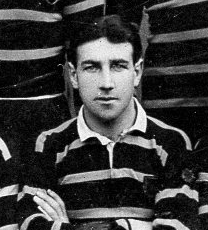
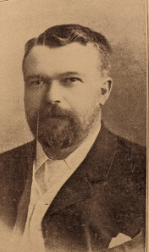
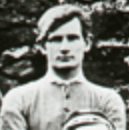
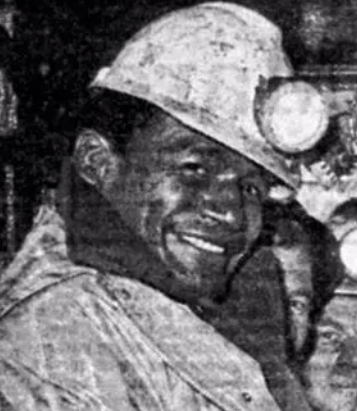
John Jackett (1878-1935)
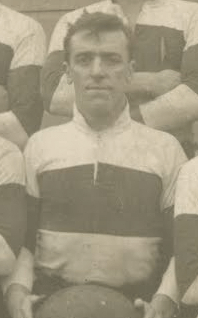
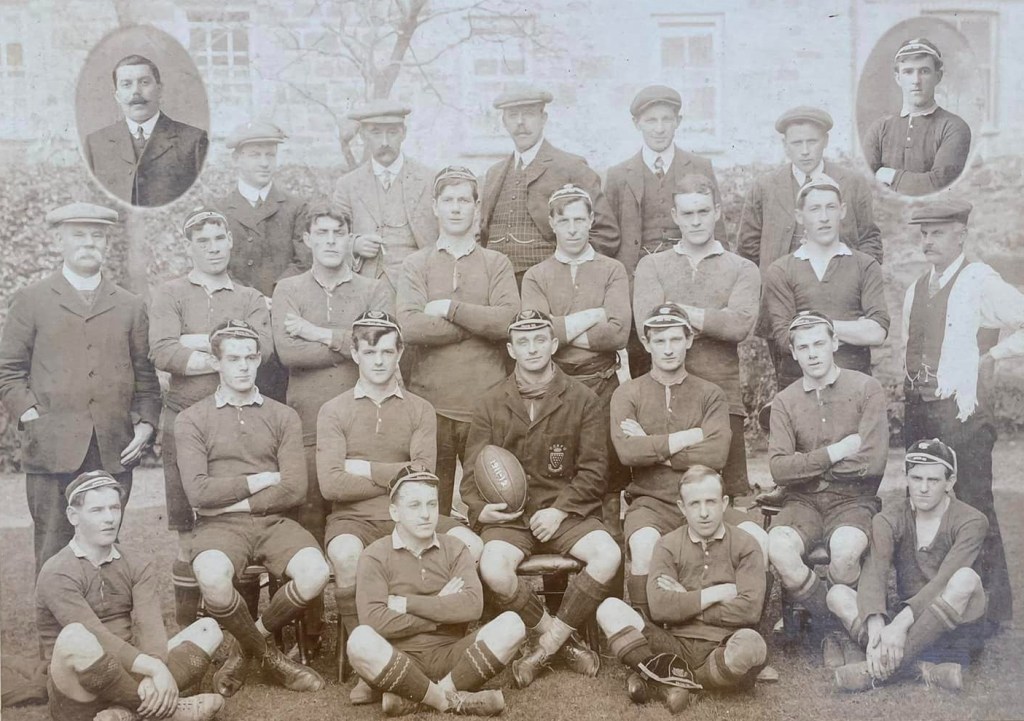
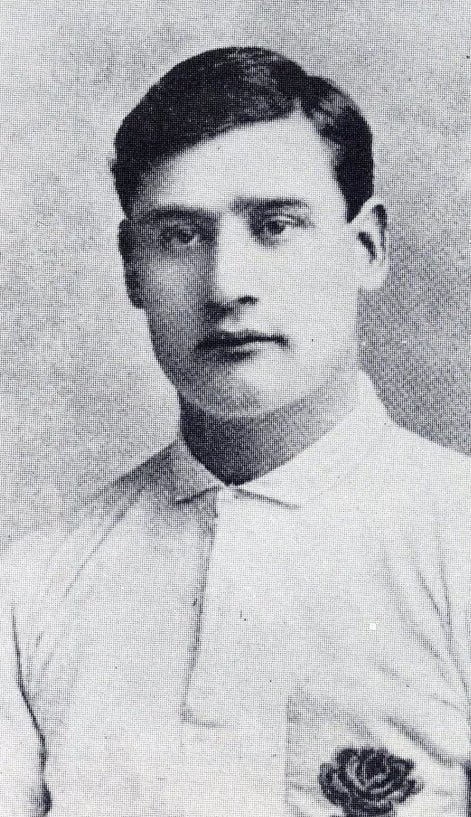
Bert Solomon (1885-1961). He only wore that England jersey once…2

To begin to see why all this might be so, we need to begin with a discussion of Cornwall’s very first Championship campaigns, which were less than inspirational, to say the least.

They’d first entered the South Western Division (joining Devon, Somerset and Gloucestershire) of the County Championship in the 1892-3 season, and for some years following had been the region’s whipping boys.

From that inaugural year up to the start of the 1900-01 season, they’d played 23 matches…and lost each one3.

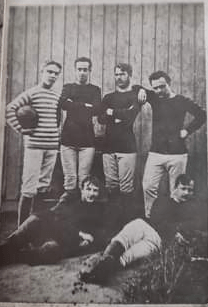
Cornwall’s first Championship XV, 1892. From the CRFU website

In the press, resignation was prevalent. Before the 1893-4 fixture against Devon, the pundit ‘Spectator’ had already thrown in the towel:

Victory will undoubtedly rest with the Devonians…

Cornish Post and Mining News, November 24 1893, p3

Spectator was correct. At Exeter, Devon stuffed Cornwall 38-3, majorising four of an eyewatering six tries.

That said, Cornwall were in a tough draw. After the formation of the Northern Union in 1895 had broken the dominance of the Lancashire and Yorkshire XVs, Rugby Union’s power-base switched to the West Country. In the years John Jackett played for Cornwall (52 times from 1898-1911), Devon won the Championship in 1899, 1901, 1906 and 1911. Gloucestershire won in 19104.

Cornish insularity, hostility to the CRFU and inter-club rivalry were contributory factors to Cornwall’s poor showings too.

On the eve of the Devon match mentioned above, two Penzance players were named in the line-up5. In the event, the club withdrew their players’ services in protest at the CRFU’s decision to move the venue of the forthcoming fixture against Gloucestershire from Penzance to Redruth, their committee arguing that

…the removal has been done improperly and illegally.

Cornish Telegraph, November 30 1893, p5

Although 1897’s campaign was another whitewash, the journalist ‘Impartial’ (who was anything but) saw a glimmer of hope – and an opportunity to have a sly dig at Devonport Albion, a club long suspected of acquiring players by offering them cushy local jobs6. Cornwall had

…shewn a bolder front to their opponents. With a few big industries (a dockyard for instance) we shall be able to cope with the adjacent shires…

Cornishman, April 21 1898, p6

Was it time to be even bolder? Blood some youth? What did Cornwall have to lose?

By October 1898, Falmouth’s twenty year-old full-back John Jackett was a Cornwall player, and was being tipped for a bright future7. The upturn in the team’s fortunes though was far from immediate. Cornwall only registered their maiden Championship victory, against Somerset in the 1900-01 season. 3,000 in Redruth witnessed the two tries to nil win. Jackett played a prominent role:

…the Falmouthian did all that was required of him in a style unequalled by any custodian turned out by Cornwall…Jackett…came out of the ordeal with flying colours.

‘Touch’, Cornish Telegraph, November 14 1900, p8

(Also playing well that day was a young fly-half from Redruth, James ‘Maffer’ Davey.)

This victory however was a false dawn. Cornwall didn’t win another Championship fixture until the 1904-5 round, when they beat Gloucestershire 18-9 in Bristol8.

It was Jackett’s first game as captain. By now, he had had playing experience with Plymouth and Devonport Albion. He would shortly sign for the formidable Leicester Tigers and be selected for England. In other words, he was hitting his peak. It was therefore no coincidence that this was also the beginning of a new era for Cornish rugby. Belief. Flair. Success.

And it was John Jackett who threw down the gauntlet. Here’s his opening statement – at 10 – in that match. There was

…a sensational incident, for from the first scrimmage J. Jackett slipped past Butcher and found a clear field in front of him, save for the full back. On reaching the latter, he punted, and then ensued a foot race for the line…

‘The Bounder’, Cornish Echo, November 4 1904, p2

It didn’t, alas, result in a try, but Gloucestershire were stunned. Cornish XVs didn’t normally play with such gay abandon. Jackett gave his men confidence, coupled with a fast, open game plan based on what he’d seen at Devonport Albion and would shortly experience with Leicester. This is how it’s going to be.

With handling “worthy of a first-class Welsh team”9, Cornwall were easy winners, Jackett kicking the crucial three goals which bested the home XV’s three tries.

He’d been given the tools for the job too. The CRFU had for once picked a team based

…on form, instead of reputation…

‘The Bounder’, Cornish Echo, November 4 1904, p2

And four of those form-horses that day would be with Jackett in 1908: his brother Dick, the wing Barrie Bennetts (Penzance and Richmond), and two more forwards, Nick Tregurtha of St Ives and John G. Milton of Camborne School of Mines. (Bennetts and Milton would also win international honours10.)
Cornishman, November 17 1904, p2

They went on to beat Somerset, but came unstuck against Devon. Jackett, maybe not a natural 10, was criticised in both games for demonstrating the fly-half’s cardinal sin: greed11.

Cornwall reached the playoffs, did the double over Somerset, but once more Devon proved the stumbling block. Jackett’s men had failed to win the South West Division, but Cornwall had notched up their most successful Championship to date12.

They were no longer the South West’s makeweights. They were competitors. But it was Devon, always Devon, that thwarted them. In 1905-6 they lost 19-0 in Devonport; in 1906-7 they were on the wrong side of an agonisingly tight 8-6 scoreline at Camborne13.

Cornwall had never beaten Devon in the Championship. If they wanted to progress, they would have to overcome one of the strongest XVs in the whole Championship.

*

The 1907-8 campaign started well. Somerset were hammered 25-6 in the opener at Taunton. Jackett by now had reverted to 15, with cross-kicks that held The Cidermen back. A youngster from Redruth, Bert Solomon, was a constant threat in the centre. Also, a Leicester team-mate of Jackett, as big and physical as brother Dick, who claimed he was Cornish and said his name was Fred Jackson (which it wasn’t), kicked five goals14.

But then it unravelled in Plymouth against their old nemesis, Devon, who won 17-8 in atrocious conditions. Their pack dominated, which gave the Devonians’ scrum-half, Raphael Jago, an open invitation to make a real menace of himself. Starved of decent possession, Maffer Davey, recently returned from the Transvaal15, had a game to forget at 10. Bert Solomon’s partner at centre failed to create space for the wunderkind to work his magic.

Jackett was one of the few to finish the game with any credit. Cornwall were gutted. Not another season as bridesmaids.

There was a glimmer of hope: if Somerset lost to Devon, and The Pasties beat Gloucestershire, the latter three XVs would have to meet again to determine the South West’s champion16.

In a roundabout way, it was at this point that Cornwall’s luck began to change. A frozen Redruth pitch postponed the Gloucestershire fixture. Gloucestershire appealed to the RFU, arguing that, as Cornwall had failed to protect their pitch, they (Gloucestershire) ought to be given home advantage for the rearrangement.

They weren’t, and the postponement meant that Jackett, at first doubtful, could make the rearranged date. On Saturday January 25 1908, a crowd of 5,000 in Redruth watched Cornwall hand the reluctant visitors a 34-10 beating17.

To the playoffs. Devon were coming to Redruth.

It’s one of those fixtures where you wish you had been there with the other 6,000 fans to watch, or at least be lucky enough to stumble across some archive footage of the match at Kresen Kernow. For Cornwall finally realised

…the ambition of years – to thrash Devon…

West Briton, February 17 1908, p3

Jackett, as was his wont on winning the toss, elected to play uphill in the first half: let them come at us, then we’ll have a crack later on. His display overall was described as “faultless”. Fred Jackson’s kicking saw him carried off the field by a delirious mob. Maffer Davey was a general at 10. And yes, Bert Solomon scored that try:

He feinted to send Bennetts in, and the latter was so perfectly deceived that he actually proceeded to dive for the line…Solomon then with a clear course coolly romped over…

West Briton, February 17 1908, p3

Cornwall 21, Devon 3. No longer world-weary harbingers of doom, the Press were talking up the Cornishmen as likely winners of the whole Championship. What of Gloucestershire, next victims in the playoffs?

…[they] will have to show a vast improvement on their form of a fortnight ago to make even a draw of it.

West Briton, February 17 1908, p3

And what of Middlesex, potential opponents in the semi-final? They were dismissed as mere

…Varsity men and public school boys, who will probably crack up when opposed to the hurricane tactics of the Cornishmen…

West Briton, February 17 1908, p3

Not only were Cornwall going to win, they were going to rough up some toffs. The Cornish rugby identity was already resolutely working class – and proud of it.

Gloucestershire lost at home 15-3, giving Cornwall the South West Division18. The CRFU won the toss to decide the venue of the semi against Middlesex. Cornwall would have home advantage. The burning issue was, which club would have the honour of hosting? The CRFU’s Hon. Secretary, W. Dennis Lawry (a Penzance man), proposed Redruth.

A Falmouth representative proposed his own club, stating

…Redruth had had its share.

Cornishman, February 27 1908, p4

Falmouth threatened to boycott the CRFU when their proposal was dismissed. Redruth’s representative, William Hichens19, played the martyr. Getting the ground ready for such a big fixture was a “great amount of work”, but

…they should do everything for the team…He would sink his own feelings and take on the work again.

Cornishman, February 27 1908, p4

Furthermore, John Jackett

…had said that he knew every inch of the [Redruth] ground, and that was a very important thing…

Cornishman, February 27 1908, p4

Redruth’s slope fitted his gameplan.

Camborne grumbled too, and expected to host the Final – nobody seemed to doubt Cornwall would make it. But for now, Middlesex would come to Redruth. Hichens made a show of rolling his sleeves up…and doubtless afforded himself a smug grin in private20.

Jackett won the toss, and made his team play uphill first. After a tight initial forty, it was a try apiece. However,

Gradually the homesters wore down the visitors…

Cornish Echo, March 13 1908, p8

John Milton, a South African-born, six-foot, 15-stone beast of a forward, took two Middlesex men with him over the line. Shortly after, swift passing ignited by Maffer Davey put Bennetts in on the wing. Another try in the closing minutes was the coup de grace.

Cornwall 19, Middlesex 3. It might have been closer, were it not for John Jackett. He was judged

…a tower of strength…he saved his side as no other full back in England could possibly do…

Cornish Echo, March 3 1908, p8

This set up the Final, against Durham.
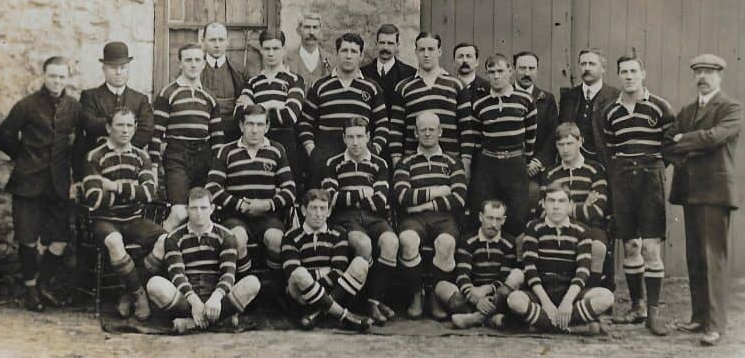
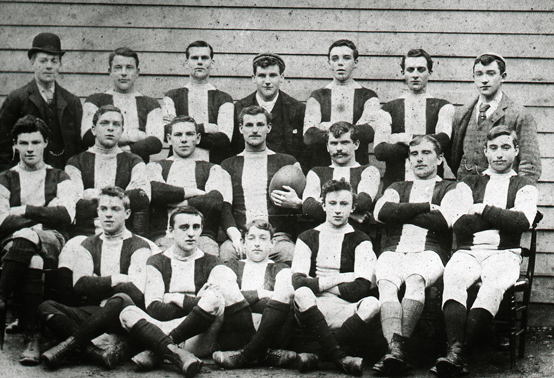
The Cornwall XV that faced Durham. The players first. Back row, l to r: Barrie Bennetts (Devonport Albion), A J Wilson (Camborne School of Mines), Fred Jackson (Leicester), John G Milton (Camborne School of Mines), Nick Tregurtha (St Ives), A J Thomas (Devonport Albion). Seated, l to r: A Lawry (Redruth), Dick Jackett (Falmouth), John Jackett (Leicester), F Dean (Devonport Albion), Bert Solomon (Redruth). Ground, l to r: R Davey (Redruth), J Jose (Devonport Albion), T G ‘Chicky’ Wedge (St Ives), James ‘Maffer’ Davey (Redruth). CRFU Committee, l to r: Gil Evans, W Dennis Lawry, R C Lawry, J H Williams, C F Hopley, J Quick, F W Thomas, W Hichens, H Skewes. From the CRFU website

Cornwall’s XV for the Final contained seven men who had been, or would shortly be awarded, international honours. It also contained four from Devonport Albion, which amply demonstrates how ‘attractive’ a club it must have been. Wing Barrie Bennetts, scrum half Tommy Wedge, Bert Solomon and mining students Arthur ‘Ajax’ Wilson and John ‘Jumbo’ Milton all represented England. John Jackett and Maffer Davey played for England and toured with the British Lions. Fred Jackson, though not capped by England, went on the same 1908 Lions Tour as Jackett and Davey21.

Additionally, Dick Jackett had been an international trialist, and is reckoned to be the best player never to win recognition by England22.

This is surely the greatest Cornwall XV. It needed to be. Durham boasted six internationals themselves, and ‘The Monkey Hangers’, as they were known, had been County Champions in 1900, 1902, 1903 and 1905 (they shared the title with Devon in 1907)23.

This was the game of the season. The two best sides in the land. Today’s equivalent would be the Gallagher Premiership Final.

As with the Middlesex match, Cornwall had drawn home advantage. Predictably, within the CRFU debate raged as to which club would host the great occasion.

Charles Bryant, of Camborne RFC, proposed his ground. Improvements had been made to the facilities, and besides,

To have four matches at Redruth and none at Camborne is not a fair nor a proper thing.

Cornubian and Redruth Times, March 19 1908, p3

Clearly Bryant couldn’t give a tinker’s damn about the hopes or merits any other rugby club in Cornwall had of being hosts. William Hichens stamped all over his proposal. Gone was his feigned reluctance to preside over yet another county match:

They [Camborne] did nothing until they saw everything was going successfully at Redruth…such a puerile argument…

Cornubian and Redruth Times, March 19 1908, p3

Hichens claimed to have the players’ interests at heart, but Bryant was far from pacified:

You take it we shall not continue members of this Union if you have all the matches at Redruth…

Cornubian and Redruth Times, March 19 1908, p3

This was not the last time Bryant and Hichens locked horns, nor the last time Camborne threatened to quit the CRFU24.

Ultimately, Hichens and the team’s sentiments held sway. Jackett had been approached on whether the venue ought to be changed for the Final. His response was succinct:

Certainly not…

Cornubian and Redruth Times, March 19 1908, p3

Redruth it was. The West Briton‘s big game preview ran profiles of the Cornwall XV. Here’s what ‘The Celt’ said of John Jackett:

He is perhaps the soundest full-back that has represented England in recent years for he possesses great kicking power, fine judgment, and is a deadly tackler…

March 26 1908, p3

This match would be the pinnacle of his four years as leader of Cornwall. He’d taken them from tournament also-rans to being one victory away from the accolade of The Best in the Land. Yes, he’d played for England. Yes, he’d led his Cornish XV against the All Blacks and the Springboks. He was doing great things at Leicester.

But in a few months, John Jackett would be thirty. Not the young gun anymore. There surely wouldn’t be many more chances, if any, to lead Cornwall in a Cup Final, to win some silverware. To be the first. To make history.

He must have wanted it badly.

The Cornwall XV leave Tabbs Hotel in Redruth to play Durham in the County Championship Final, March 28, 1908. Image courtesy Mr John Jackett, Falmouth

So did his team. So did the 17,000 spectators shoehorned into hastily-erected stands in Redruth. This was easily the club’s biggest gate until the 1969 Final, when an estimated 23-25,000 were packed in to watch Lancashire win 12-9. As we have seen, county matches regularly drew crowds of between 3-6,000, but 1908’s gate was off the scale. Crammed in amongst the fans that day was a young lad from Four Lanes, Bill Osborne, who would, where watching Cornish rugby was concerned, have the happy knack of being in the right place at the right time25.

Not that they were all there to cheer on Cornwall. A member of the Durham contingent displayed their mascot – a lynched toy monkey – on a very visible gallows: the crossbar of one of the goalposts.

For balance, a pasty in a paper bag was strung up on the ‘posts at the opposite end of the pitch.
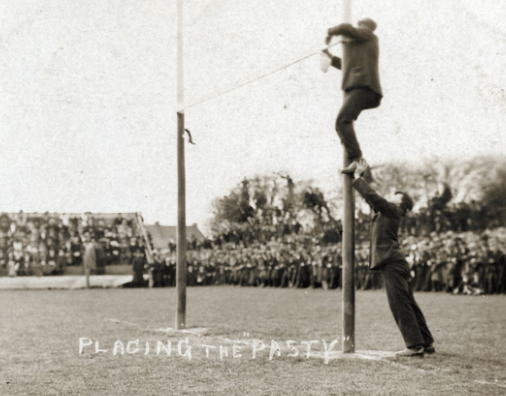
Image from Cornwall Forever

The reporters present (and here we can imagine ‘Impartial’, ‘The Bounder’ et al) suffered the indignity of having some railings crash on them, suspending play for a time. Finally, all was ready.

The ground was firm, which suited Cornwall’s fast play. Durham had won the toss, and elected to start downhill. Jackett gave his best poker face. Fine with us, boy.

From the get-go, he was on it. Cornwall’s tactics – indeed, Jackett’s own – were to absorb pressure in the first half and catch their opponents on the break. It required steely resolve, and a full-back up to the task.

That was Jackett. His trademark (said trademark being a great distance) kicks relieved the pressure. His tackles kept Durham honest, and their scoreboard quiet. Rushes were stopped. Dribbles cleared up. And, when the opportunity came, the flair men were waiting. Durham cleared messily, and Bennetts pounced, putting Solomon in for a try. Jackson failed to majorise.
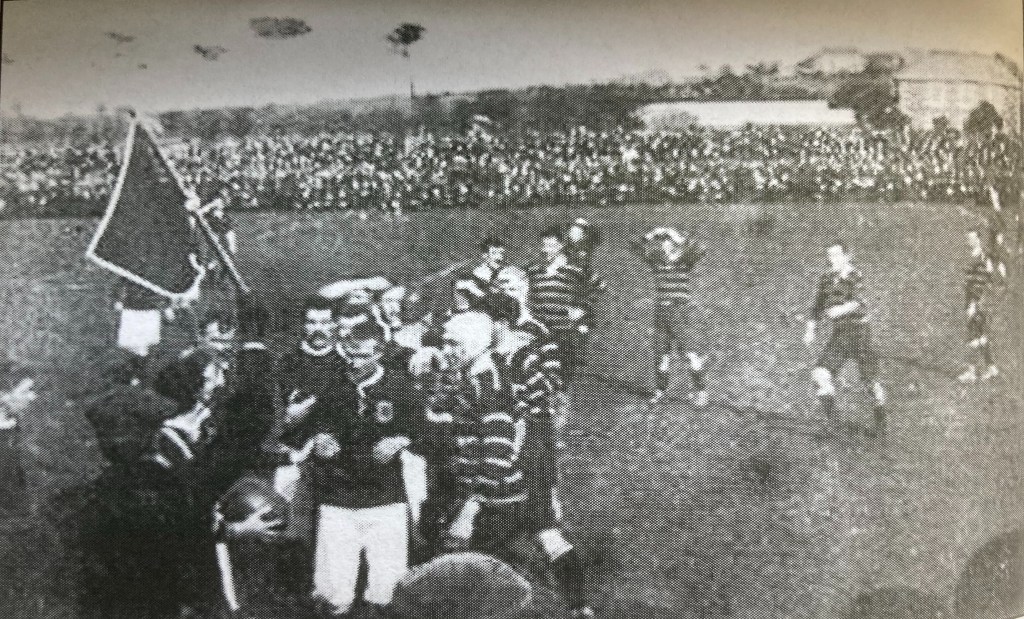
Action from the game. Note the crowd26

More pressure from Durham. More last-ditch efforts from Jackett. Another Durham attack – and Solomon intercepted, drew the 15, and put in Bennetts for a second try. Jackson walloped over the conversion.

Excitement was mounting. Is it our day?

Jackett was punishing Durham, his kicks covering half the pitch. Time and again the visitors’ heavy forwards had to turn and trudge back up the slope after another Jackett bomb had sailed over their heads.

Half time. Cornwall led by a goal and a try to one penalty.

The second half followed the first, except Durham were now playing against the gradient, and had to chase the game. Jackett by now was torturing the Monkey Hangers, his punts keeping them exclusively in their own 25.

And then it happened.

Solomon broke from a Davey pass, with Bennetts outside him. In a similar situation, previously Solomon had passed to his wing, but not this time. The dummy. The swerve. The acceleration. The uproar in Redruth as Solomon ghosted over the line, a brace of Durham defenders trying in vain to halt a phantom. Photographers were on hand to immortalise what has become the Final’s seminal moment.

Nobody was stopping Solomon…
…and in that instant, Durham knew the game was gone27

Although Nick Tregurtha bagged another try late on, Solomon’s score put the result beyond doubt. Durham had barely got to the half-way line in the second half – thanks to John Jackett.

Cornwall 17, Durham 3. History had been made. Jackett was more than aware of his XV’s monumental achievement. In Cornwall, he later said, rugby is

…not of the first class…[teams] are composed mostly of miners and fishermen, and the way they make up their fixture lists is to play each other three or four times a season…So you can well see why Cornwall should always be more or less a weak rugby county…

Yorkshire Evening Post, February 3 1912, p3

In an era when the RFU was consciously trying to eradicate working-class influences from the game, Cornwall’s victory with ‘miners and fishermen’ was a sweet kick in the face of The Establishment. Jackett, in flagging up his players’ backgrounds and the circumstances of Cornish rugby, realised this.

John Jackett did many great – and several controversial – things in his life. But ‘Cornwall, County Champions, 1908’, has to be his greatest achievement.

Fred Jackson might have kicked 38 points in the competition prior to the Final28. The Final itself might be remembered as Bert Solomon’s match, and he was indeed the “outstanding star” on the day29.

But John Jackett gave

…an International display…No one knows better than the forwards what an advantage such a sound touch-finder is…Time after time he gained three parts of the field with his kicking…

West Briton, March 30 1908, p4

Add to this his tackling, his nous, his leadership, and you begin to realise that Cornwall could not have done it without him.

If you think this presumptuous of me, in 1909 Cornwall were the Championship Finalists again. Again, their opponents were Durham. This time, however, the venue was Hartlepool.
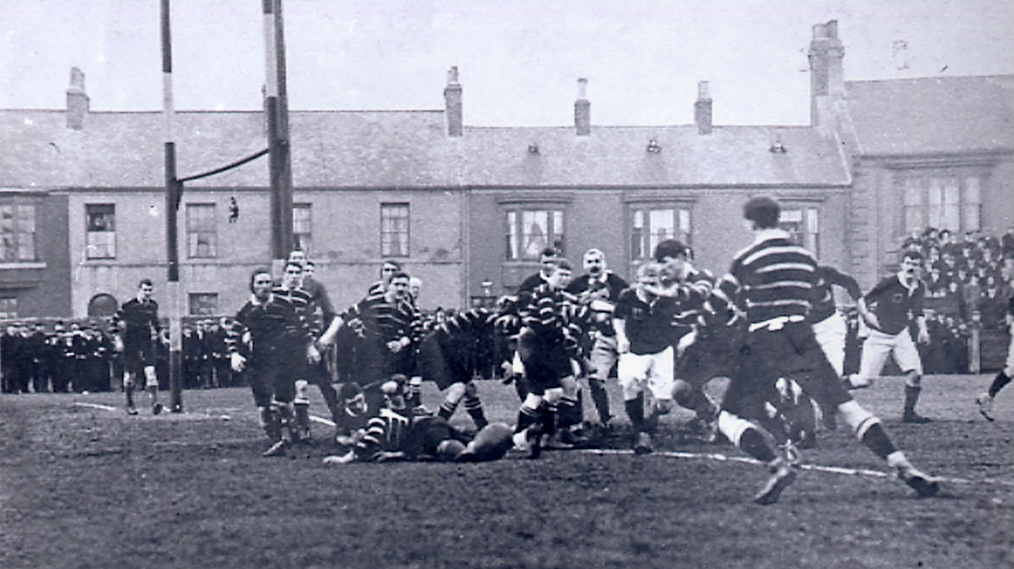
The 1909 Final in Hartlepool. Note Durham’s mascot30

This time, Cornwall lost, 12-0. This time, Jackett played through injury. This time, as a result, his kicking wasn’t up to scratch.

But no matter. At the post-match dinner it was anticipated that the two XVs would line up in next season’s Final, and that Cornwall would win…31

A below-par Jackett was also evident when Cornwall played Australia at the White City Stadium in the 1908 London Olympics.

The White City Stadium, 1908. Demolished 198532

The whole tournament was something of a farce. Only two XVs – Cornwall and Australia – entered, with France failing to raise a side. Thus only one match was played. Cornwall lost 32-3, but were guaranteed silver medals.
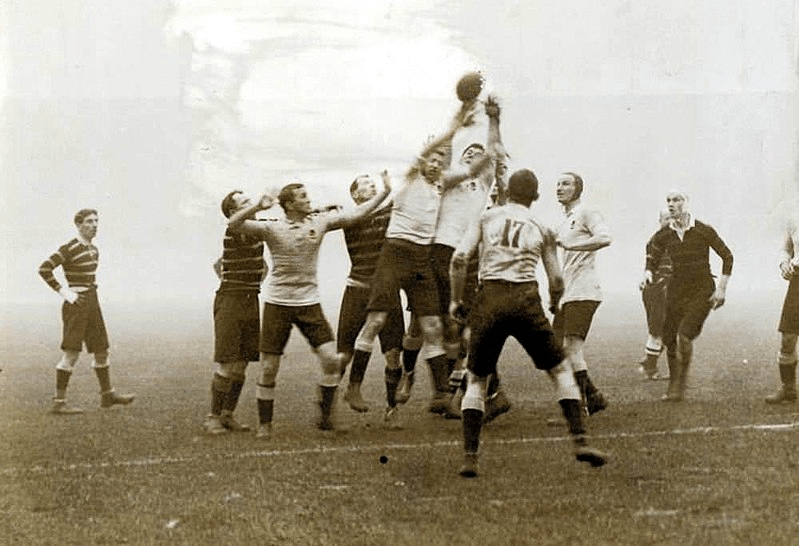
The Wallabies dominate in London, 190833

Jackett, along with Maffer Davey, had only recently returned from New Zealand with the British Lions. His play, for once,

…was a disappointment and seemed stale…

Cornish Telegraph, October 29 1908, p8

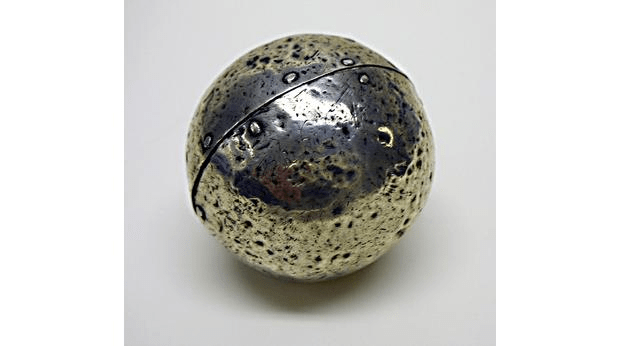
No doubt he was exhausted, and out of condition after weeks spent at sea. He didn’t even get a consolation medal. Only one was ever awarded, and the players drew lots for it. The lucky winner was St Ives’ Thomas ‘Chicky’ Wedge, and to this day the medal remains at his old clubhouse34. Here’s a replica:

Courtesy Danny Trick, Falmouth RFC

After 1909, Cornwall would reach the Championship Final in 1928, 1958, 1969 and 1989. But it wouldn’t be until 1991, against Yorkshire at Twickenham, that they would again be victorious. Bill Osborne, the lad who saw the 1908 triumph in Redruth, was 103 in 1991 and witnessed that Final too. He watched Chris Alcock’s Cornwall do something that, at the time, only John Jackett and his ‘miners and fishermen’ had also managed, 83 years previously35.

They must have both been sweet moments.

Many thanks for reading; follow this link for more top blogs on all things Cornwallhttps://blog.feedspot.com/cornwall_blogs/

References

  1. For more on Jackett, see: https://the-cornish-historian.com/2024/06/29/in-search-of-john-jackett-king-of-cornish-sport-part-one/. For more on Solomon, see: Bert Solomon: A Rugby Phenomenon, by Allen Buckley, Truran, 2007.
  2. Images from: https://www.trelawnysarmy.org/ta/Pictures/cornwall-team-1908.html, and https://cornwallyesteryear.com/cornish-rugby-once-a-way-of-life-by-michael-tangye/
  3. Tom Salmon, The First Hundred Years: The Story of Rugby Football in Cornwall, CRFU, 1983, p115.
  4. For the full list of winners, see: https://en.wikipedia.org/wiki/County_Championship_(rugby_union)
  5. Cornish Post and Mining News, November 24 1893, p3.
  6. For more on Albion’s activities, see: https://the-cornish-historian.com/2024/02/03/the-great-cornish-rugby-split/
  7. He took part in a trial in October; by November, he was making his debut against Devon – as a Penzance player. Cornish Post and Mining News, October 21, p5, and November 3, p5.
  8. For the results, see Tom Salmon, The First Hundred Years, p115.
  9. ‘The Bounder’, Cornish Echo, November 4 1904, p2.
  10. For more on Barrie Bennetts, see: https://en.wikipedia.org/wiki/Barrie_Bennetts. For more on Milton, see: https://www.bedfordschool.org.uk/head-masters-assembly-values/. For more on Tregurtha, see: https://en.wikipedia.org/wiki/Nicholas_Tregurtha
  11. Cornish Echo, November 18 1904, p6; West Briton, November 28 1904, p3.
  12. Cornishman, March 30 1905, p6.
  13. Tom Salmon, The First Hundred Years, p116.
  14. Cornubian and Redruth Times, November 7 1907, p3. The story of Fred Jackson, who played with Jackett at Leicester and the 1908 British Lions, is one of the most fascinating in all sport. See: Tom Mather, Rugby’s Greatest Mystery: Who Really Was F. S. Jackson?, London League Publications, 2012, and https://the-cornish-historian.com/2024/07/20/in-search-of-john-jackett-part-four-the-king-of-cornish-sport/
  15. For more on Davey, see: https://en.wikipedia.org/wiki/James_Davey_(rugby_union)
  16. Cornish Telegraph, December 12 1907, p3.
  17. The CRFU had to front Gloucestershire’s expenses as a slap on the wrist for neglecting the Redruth pitch – but must have been mighty glad to retain home advantage. Lake’s Falmouth Packet, January 24 1908, p6; Royal Cornwall Gazette, January 30 1908, p7.
  18. West Briton, February 24 1908, p4.
  19. Hichens was formerly President of the CRFU from 1896-1905, and also President of Redruth RFC from 1893-1903. Not renowned for his diplomacy in CRFU meetings, another taste of his style can be seen in an article of mine here: https://the-cornish-historian.com/2024/02/03/the-great-cornish-rugby-split/
  20. Cornishman, February 27 1908, p4.
  21. For more on Barrie Bennetts, see: https://en.wikipedia.org/wiki/Barrie_Bennetts. For more on Milton, see: https://www.bedfordschool.org.uk/head-masters-assembly-values/. For more on ‘Chicky’ Wedge, see: https://en.wikipedia.org/wiki/Thomas_Wedge_(rugby_union). For more on Davey, see: https://en.wikipedia.org/wiki/James_Davey_(rugby_union). For more on Solomon, see: Bert Solomon: A Rugby Phenomenon, by Allen Buckley, Truran, 2007. For more on Wilson, see: https://worldrugbymuseum.com/from-the-vaults/players/lest-we-forget-arthur-james-wilson-england-31-07-1917. For Fred Jackson’s amazing story, see: Rugby’s Greatest Mystery: Who Really Was F. S. Jackson? by Tom Mather, London League Publications, 2012.
  22. See his obituary in the West Briton, July 28 1960, p4.
  23. For a grisly explanation of the ‘Monkey Hanger’ moniker, see: https://www.historic-uk.com/HistoryUK/HistoryofEngland/The-Hanging-of-the-Hartlepool-Monkey/. For a full list of County Champions, see: https://en.wikipedia.org/wiki/County_Championship_(rugby_union)
  24. See my post on the subject here: https://the-cornish-historian.com/2024/02/03/the-great-cornish-rugby-split/
  25. Unless otherwise stated, the narrative of the Cornwall-Durham Final is taken from the West Briton, March 30 1908, p4. The information on the 1969 Final is from: https://en.wikipedia.org/wiki/County_Championship_(rugby_union)
  26. Image from: Tom Mather, Rugby’s Greatest Mystery, p26.
  27. The first image is from Hellfire Awaits: 150 Years of Redruth RFC, by Nick Serpell, Pitch Publishing, 2025, the second from Tom Salmon, The First Hundred Years, p6.
  28. West Briton, March 26 1908, p3.
  29. West Briton, March 30 1908, p4.
  30. Image from: Image from: https://worldrugbymuseum.com/from-the-vaults/club-rugby/durham-countys-golden-era
  31. West Briton, March 29 1909, p3. As of 2024, Cornwall have won the Championship in: 1908, 1991, 1999, 2015, 2016, 2019 and 2022. They have been runners-up on eleven occasions. Information from: https://en.wikipedia.org/wiki/County_Championship_(rugby_union)
  32. Image from: https://en.wikipedia.org/wiki/White_City_Stadium
  33. Image from: https://en.wikipedia.org/wiki/Rugby_union_at_the_1908_Summer_Olympics
  34. See: https://en.wikipedia.org/wiki/Rugby_union_at_the_1908_Summer_Olympics#
  35. As mentioned in Nick Serpell’s Hellfire Awaits: 150 Years of Redruth RFC, Pitch Publishing, 2025, p120-1.

The Great Cornish Bake Off

Reading time: 25 minutes

…there were always people who were responsible. The bad guys. ~ Stieg Larsson1

The Napoleonic Wars created shortages of practically everything in Britain. As victory on the Peninsula looked increasingly certain, the financial consequences of a wartime economy looked equally dire. Luxury goods were at never-before-seen premiums (which resulted in a late flourish for smuggling), as were the everyday essentials. Arguably the pinch was felt most here regarding wheat, flour and bread2. When bread was available, it was of dubious quality and origin:

There is at present scarcely a white loaf to be bought in London, half of which does not consist of the very worst foreign and heated flour mixed up with…other ingredients, to make it please the eye.

British Mercury, September 18 1811, p2 (emphasis mine)

Part of the problem was that the British people, on the main, preferred white bread. Healthier brown, wholemeal and coarser-grained loaves were the traditional foodstuff of labourers, peasants, the dirt-poor, and even horses3.

This stubborn – and erroneous – insistence that white bread is the best bread reached its apogee in the early 1900s with the advent of the mass-produced sliced white. A sliced brown loaf was a non-starter, and from this we may deduce that the general public took a lot of convincing that brown bread is better for you. In 1847, another time of dearth, the British people were exhorted to see the error of their ways and buy wholemeal4:

…it is known by men of science that the bread of unrefined flour will sustain life, while that made with the refined will not.

The Leamington Spa Courier quotes from the Monthly Journal of Medical Science, February 13 1847, p4

The whiter and finer the flour, the less healthy it is. Men of science might have known this, but they were largely ignored. Thus, when the wholemeal National Loaf replaced the ubiquitous white in 1942, it was met with popular opposition:

…the public has consistently turned a deaf ear to all arguments and allurements.

West Briton, April 16 1942, p45

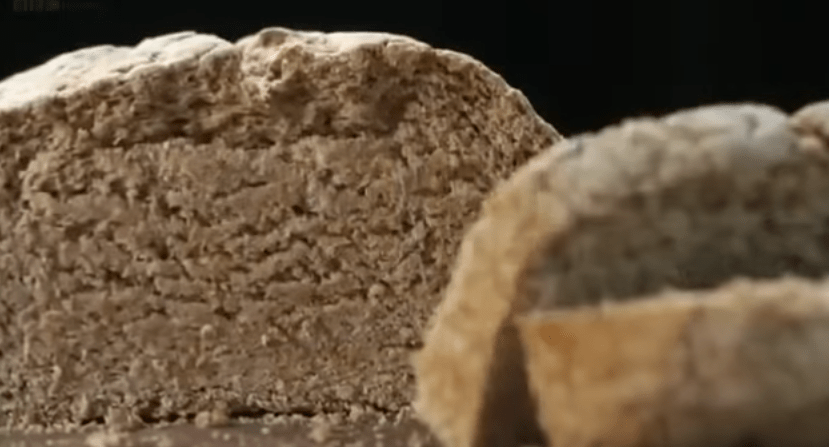
The despised National Loaf was nicknamed ‘Hitler’s Secret’6

In the final years of the Napoleonic Wars, however, no voices of officialdom or science appear to have preached the benefits of wholemeal flour to a predominantly disdainful – and snobbish – public. White was best, and the whiter, more refined, the flour, the better. The purer.

White flour, though, was relatively scarce, and therefore expensive; but even money-saving tips downplayed the wholemeal option. One newspaper recommended adding boiled rice to your dough. This produced a loaf that was

…very palatable, and lighter and whiter than wheaten bread.

Pilot (London), November 8 1811, p3 (emphasis mine)

In purely economic terms, the demand was for white bread, but supply couldn’t keep up with this demand. This created a gap in the market. Some merchants, millers and bakers realised this, and took steps to fill the gap.

Unscrupulous steps. Refined white flour was expensive. The solution was to mix the flour with another white substance. Said substance would be cheaper to buy and more readily available than flour, and also denser. (If it made your flour whiter too, that was an added bonus.) Any loaves baked could then be sold on to unwitting shoppers for the stipulated price, at the stipulated weight. This practice was as dishonest as it was illegal.

The production of bread was heavily regulated (after all, the health of the nation was at stake), but the strain of the War perhaps led to a lowering of watchfulness. For example, the medieval Bread and Ale Assizes had fallen into desuetude by the early 1800s. Furthermore, the Making of Bread Act (1757), introduced to punish those who sought to further ‘purify’ flour by adding whiteners such as alum (a compound of aluminium and potassium), failed to perturb any rogue baker during the period of our concern7.

Bakers were regularly satirised for their apparent lack of hygiene. By Thomas Rowlandson (1756-1827)8

In May 1811 the Liverpool Militia bridled at a batch of bad bread that had been consigned to them. Their superiors’ solution was to flog a private for insubordination9.

In 1813 an Oxford baker was caught making loaves from flour mixed with alum and potatoes. He used this method, he claimed, for

…the purpose of improving the flavour of the bread.

Oxford University and City Herald, October 2 1813, p4

In October of that year another baker in Greenwich was fined for combining his flour with a “Derbyshire stone” which he had burnt and then ground10. That same month, inspectors raided a baker’s shop in Clerkenwell and discovered a bathtub full of mashed potato, ready to be mixed with a batch of dough. Another was caught employing the same technique over Christmas11.

The situation was bad enough for flour merchants to publicly reassure buyers as to the purity of their flour, and the honesty of their trade. A Birmingham businessman took just this course of action in April 181312.

It was realised that the cost of flour wasn’t rising as fast as other foodstuffs because, due to adulteration practices, less was being sold. The use of potatoes had

…become so prevalent as to over balance the extra consumption…Three years back…Potatoes were frequently hardly saleable; whereas the quantities bought up these last two winters, for the avowed use of adulterating bread, have been immense.

Evans and Ruffy’s Farmer’s Journal, April 18 1814, p1

Leaving the obvious dishonesty aside, a loaf of bread part of which contained potato wasn’t all bad. The buyer may have been duped, but at least they were getting some nutrition. Cutting the flour with alum, say, or ‘Derbyshire’ stone however was downright dangerous, and concerned newspapers sought to inform their readers how to identify an adulterated loaf13.

A loaf baked from flour mixed with alum or plaster of Paris will be denser and heavier than an uncontaminated white loaf14

There was one fail-safe way to conclude that you’d been sold a spiked loaf: it made you ill. As one food historian has observed, if a miller sold a baker adulterated flour, which was in turn adulterated further by the baker himself, there could be serious consequences:

If you were a worker eating 2lbs of bread a day and not much else, when you consider that a third of what you’re eating won’t benefit you at all, you can see why chronic malnutrition is such an issue. And when your adulterants are things like plaster of Paris and alum, you can also see why chronic gastritis [an inflamed stomach caused by excessive intake of acid] is a problem…you’re going to start off with constipation, then…irregular bowel movements, and that will lead to chronic diarrhoea…in workhouse children, that will lead to death15.

The whitest flour and the whitest loaf could ironically have been the purest poison. To be sure, the bakers mentioned above were, in criminal terms, small fry. Their cottage industries of adulteration, though despicable, would only affect people in their immediate vicinity.

One group of men, though, had the raw materials, financial wherewithal, network, greed and total lack of morality to, where adulterating flour was concerned, think big. They turned a grubby backstreet act of swindling into a full-scale operation.

And they were Cornish.

The consequences of consuming adulterated foodstuffs were genuinely feared. From 185816

James Osler and William Trahar were prosperous Truro businessmen, Osler being described as a grocer. Trahar was a flour merchant at one of Truro’s more desirable locations: the newly-developed and quintessentially Georgian Lemon Street. For reasons already discussed, Trahar may have been struggling financially: in early 1813 he was auctioning off land for rent. He also turned to more dubious business practices. Back in 1811, a Scorrier man had issued copper trade tokens or ‘Cornish pennies’ for exchange; Trahar had produced his own cheap counterfeits with a view to ripping off his competitor17.

An 1811 Cornish penny, issued by John Williams of Scorrier…or is it one of Trahar’s imitations?18

Much of Osler and Trahar’s collateral, though, was tied up in their mills: Osler owned one at Penweathers, Traher’s had his at nearby Treyew (both are long-vanished). Judging by the plan both men seem to have concocted around 1812, the mills weren’t generating much income: maybe local grain crops were of a quality too inferior to compete with finer produce elsewhere19.

Whatever the reason, Osler and Traher were conscious of the necessity to produce the finest, whitest flour they possibly could – it’s what the public wanted. They were obviously prepared to do this by any means possible. And that meant adulterating their flour, which in turn meant breaking the law and endangering public health.

So be it. Question was, what to adulterate their flour with? They needed something cheap, denser than the product they were claiming to sell, readily available nearby, and with a seemingly inexhaustible supply. Oh – and it had to make their flour whiter too. Such additives as alum and plaster of Paris were, for Cornwall, out of the question. The transport overheads and attendant hassle would not be easily overcome. That old standby, the humble potato, doesn’t appear to have been considered either20. Then either Osler or Trahar had a brainwave:

What about china clay? It ticked all their immoral boxes.

For all their crookedness, Osler and Trahar were men of their times: venture capitalists of the Industrial Revolution. They sought to buy, and produce, an item in the cheapest market, and sell it in the dearest. China clay (cheap) would become refined white flour (dear).

They also appreciated the need to incorporate others into their scheme, create a convincing cover-story, and (as much as possible), stay in the background.

A Redruth haulage firm, Trenerry & Co., were sent to the china clay works at St Stephen-in-Brannel. There, they bought a quantity of clay, ostensibly for transport to a pottery on the Isles of Scilly. Of course, no such business existed, but a credible reason for buying up large amounts was required, as was a fictional location that was difficult to check. Osler and Trahar were not spending pennies on a hundredweight of clay here and there21.

No. Trenerry & Co. must have presented a vast order at St Stephen. From 1812 to 1814, it was estimated that two hundred tons of china clay had been

…vended to the public…

Taunton Courier, May 19 1814, p7

…under the guise of flour from the mills of Osler and Trahar.

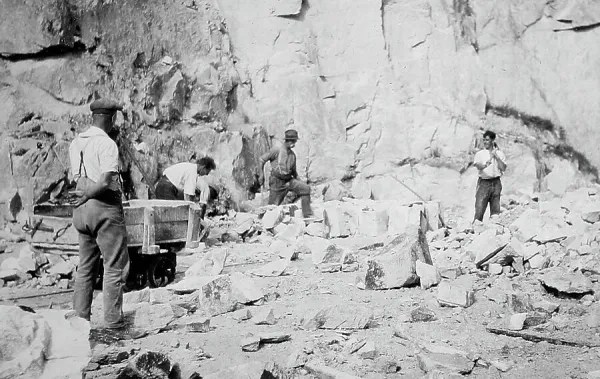
The clayworkers at St Stephen must have thought Christmas had come early. This is the Tregargus Works in the early 1900s. Image copyright The Keasbury-Gordon Photograph Archive / Mary Evans22

Though cheap, buying two hundred tons of clay was a considerable outlay. It retailed at £6/ton, so Osler and Trahar invested £1,200 in the raw materials. That’s £80,900 today23.

They must have been confident in the success of their scheme.

Trenerry & Co. never took the clay to the Scillies. It was transported straight to the mills at Penweathers and Treyew. In other words, Trenerry was in the know, and they were probably paid off. After what must have been a big first shipment, Osler and Trahar decided to keep this part of the operation in-house. One of Trahar’s employees, James Rowe, and a servant of Osler’s were charged with the cross-country clay run24.

The businessmen also desired to (literally and figuratively) keep their hands clean of the adulteration process at their mills. From Christmas 1813 (or so he would later claim), Trahar let his mill, Treyew, to John Rowe, the brother of James. Osler went a degree further in cunning. His front-man at Penweathers was Henry Rundle; he claimed to be renting the mill from a shadowy Mr Dunstone – maybe Osler had sub-let Penweathers to this man. Either way, both Osler and Trahar now had ‘cut-outs’ in place, and the whole operation could proceed25.

A ‘travelling bridge’, with dried clay in preparation26

The refined clay brought from St Stephen was described as having

…in appearance the finest hair powder, [and] is quite soft to the touch…It improves the appearance of the flour with which it is mixed in a considerable degree, so that persons, not aware of the cheat, would prefer it to that which is pure.

Taunton Courier, May 19 1814, p7

Just how much clay was being mixed into the flour varied. The “villains concerned”, one report ran,

…finding the imposition pass so readily, gradually increased the quantity…until at length one fifth, and sometimes one fourth, of the whole was clay.

Taunton Courier, May 19 1814, p7

It was also noted that two quarts of adulterated flour weighed as much as three quarts of normal, uncontaminated flour. A Falmouth physician later analysed samples of flour that had been sold to the people of the town. One contained one-ninth of clay, the other was wholly clay27.

(As we shall see, Osler and Trahar would ultimately make the outrageous decision to completely abandon the notion of cutting flour with clay, and just sell the clay…as flour.)

The ever-increasing confidence and recklessness of the perpetrators goes some way to explaining the varying amounts of clay found in their flour, but the haphazard preparation methods must also have been a contributory factor. John Holman, an employee at Treyew, would later describe mixing heaps of “whiter” flour and a duller variety with a spade. He also saw John Rowe empty “four or five” peck tubs (a peck was around 9 litres) of “white stuff” into the six gallon tub of flour that he was mixing28.

Clearly, precision was not the order of the day, and ingesting clay in any great amount is far from advisable:

When taken by mouth: Clay is POSSIBLY SAFE when taken by mouth for a short period of time. It has been safely used in doses up to 3 grams daily for 3 months or 4 grams daily for 6 weeks. Side effects are usually mild but may include constipation, vomiting, or diarrhea. Clay is POSSIBLY UNSAFE when taken by mouth for a long period of time. Eating clay long-term can cause low levels of potassium and iron. It might also cause lead poisoning, muscle weakness, intestinal blockage, skin sores, or breathing problems.

Webmd.com

The ill-effects of imbibing clay were also realised at the time:

Upon the clay no acid will operate, consequently it resists all the powers of the juices of the stomach, and must have had the most serious effects upon the health of those who were in the general habit of using this pernicious mixture.

Taunton Courier, May 19 1814, p7

In short, eating clay makes you constipated.

Mary Arthur of Falmouth baked a loaf from Trahar’s flour, which failed to rise. Her entire family objected to it, and she herself

…found that it lay hard on her stomach and made her ill.

West Briton, August 23 1816, p3

This came from a bag purported to be “the best” at Treyew mill – one dreads to think what ‘the worst’ was like. The Falmouth shopkeeper who purchased it, and sold some to Arthur, correspondingly paid “the best price” for it29.

What we must understand is that Mary Arthur was perhaps merely one of dozens, hundreds, even thousands who fell foul of Osler and Trahar’s activities. As I remarked earlier, both men thought big. The extent of their operation, and their arrogance, is breathtaking.

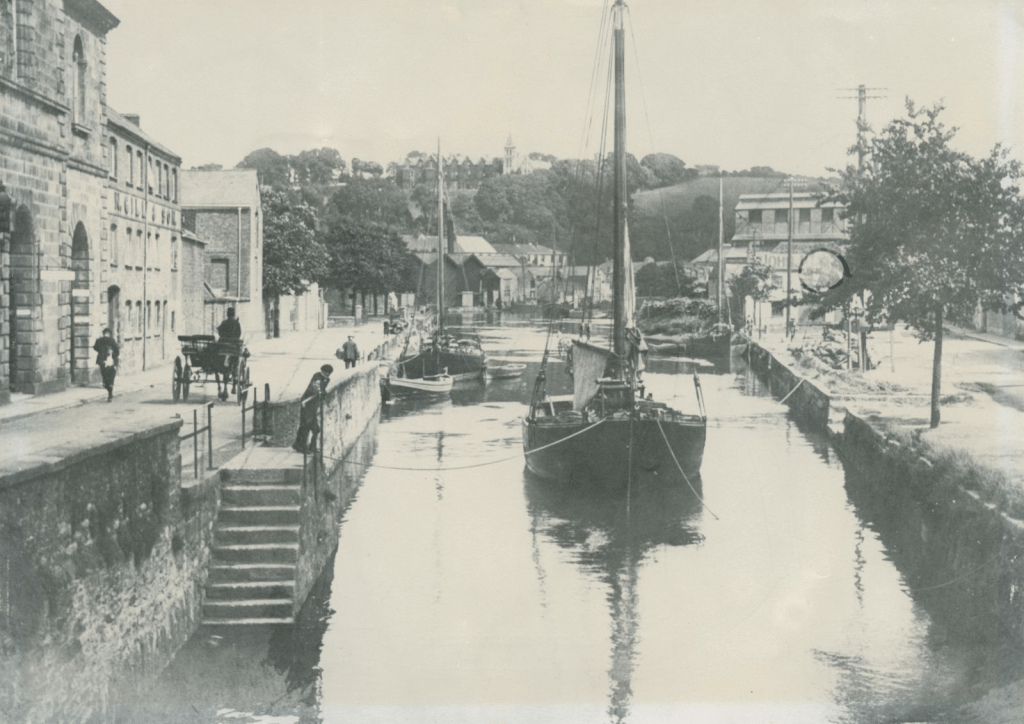
Lemon Quay, Truro, 1905. Truro was a bustling port in the early 1800s30

On May 2 1814 the sloop Diligence, skippered by a Thomas Chapman, was impounded at Plymouth and searched. It had sailed from Truro. The sixty-four sacks of “fine” flour in her hold turned out to be anything but. Twenty-four sacks (some of which had already left the port), contained a mixture of flour and clay, and were for Mr W. Smith of Plymouth. They had been sent from Osler. The other forty, though shipped by John Rowe of Treyew, had been sold by Trahar and were for Mr John Bartlett of the nearby Widey Mills. These sacks

…consisted entirely of pulverized china clay, resembling flour of the best quality.

Taunton Courier, May 26 1814, p5

The Diligence had a deadly cargo.

The authorities must have been distressed to discover several other sacks of ‘flour’, via Osler at Penweathers, had arrived in the city some 6 to 8 weeks previously. Then, on May 14, the local magistrates busted a baker on Market Street by the name of Potter. He was in possession of thirty-six sacks of Osler and Trahar’s adulterated flour, and was viewed to be

…knowingly concerned in this shameful imposition.

Taunton Courier, May 26 1814, p5

Therefore, the question we have to ask is, how much adulterated flour (or pure, unadulterated clay) did Osler and Traher manage to ship out of Truro? There may have been more vessels, and other ports, but we only know for certain that the Diligence, with Chapman (who of course would claim ignorance at the contents of the sacks), sailed the flour from Truro to Plymouth.

If the two-year lifespan of the operation is accurate, the Diligence made the journey from Truro to Plymouth on ten other occasions31.

Let’s assume the Diligence carried the adulterated flour on each voyage, and also assume that sixty-four sacks was the normal amount shipped. Each sack would have been the regulation weight, 280lbs, so sixty-four sacks would have been 17,920lbs.

That’s around 8 tons of clay/flour. So, for the ten shipments Diligence made prior to discovery, we can posit that 80 tons of Osler and Trahar’s poisonous substance was sent to Plymouth alone.

If that isn’t frightening enough, remember that Osler and Trahar purchased at least two hundred tons of clay from St Stephen-in-Brannel. They must have had other outlets. We’ve already observed how their flour appeared in Falmouth; three more sacks were located in Flushing and unceremoniously dumped in the sea32.

The compound was also delivered to

…all neighbouring mines.

West Briton, May 13 1814, p2

Indeed, the Adventurers of Wheal Unity near St Day clubbed together a £50 (£3,300 today) reward for anyone who could put the finger on the men who made their workforce ill33.

Stories abounded that the contaminated flour had been sold to the Army on the Peninsula, to the Royal Navy, and to the PoW prison at Dartmoor34.

(Over time, these tales have grown with the telling. I can find no further contemporary evidence to confirm much later reports of the Wheal Kitty Adventurers at St Agnes offering a similar reward as their counterparts at St Day, or that the flour turned up at the RN depot at Deptford, or the Army stores in Spain. Of course, it could have happened; at least one baker, a Portsmouth man, was convicted of selling adulterated flour to Dartmoor Prison. Alas, we aren’t told what the flour had been cut with35.)

If true, Osler and Trahar were war profiteers, as well as criminals. Clearly people championed white flour in peacetime as well as periods of conflict, but the Napoleonic Wars probably presented them with another market to exploit.

And the money rolled in. It was estimated that Osler and Trahar made between £4-5K from their adulterated flour. In 2024, that would be a return of between £269,900 and £337,000. Even when you account for the overheads (labour, transport, shipping, raw materials, bribes etc), you’re still looking at a massive profit36.

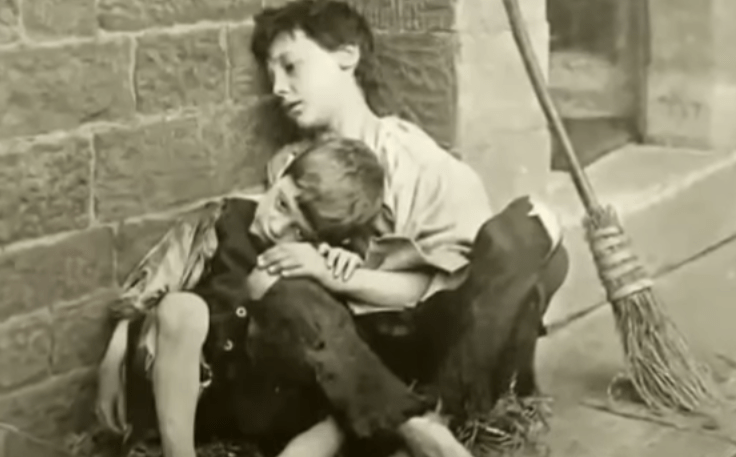
All this is easily calculable. What is impossible to measure, is how many people and families in Cornwall, Devon, possibly the entire South West region, were affected. How many were made ill? How many suffered malnutrition? How many lost their jobs as a result, their income, their homes? How many wasted away and died?

Undernourished street sweepers, London, 1800s37

All the while, Osler and Trahar gave the appearance of gentlemen. Both donated to a public subscription to provide aid for a German population much distressed by the War. Which, when you think about it, is rather ironic38.

It must have been beautiful. But it couldn’t last. It didn’t last. Osler and Trahar, in the end, were undone by their own stupendous greed. Trahar appears to have had to step in on several occasions to reduce the cost of flour sold by his man Rowe after complaints were made about its quality. Also, the public by now had been well educated on how to detect a suspect loaf – and Trahar’s must have been suspect. Indeed, people later remarked that they had never seen

…flour like it…

West Briton, August 23 1816, p3

…much less want to eat it. Eyebrows would have been raised, questions would have been asked. Suddenly, the heat was on. Although in two years the Diligence made ten trips to Plymouth before the fateful final voyage, five of those took place between September 1813 and March 1814. Osler and Trahar must have been rapidly selling off the evidence39.

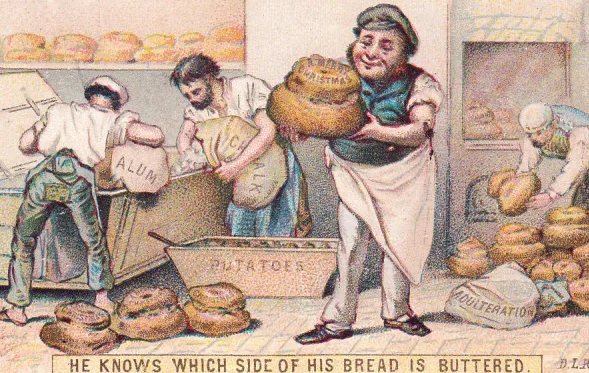
As the 1800s wore on, flour adulteration almost became the norm. This is a Christmas card from 189340

Every good crime story needs a grass, and this one has it. We are never told who tipped the wink to the Truro magistrates, but a strong candidate has to be John Osborne, a local carter. He had already intimated to Rundle at Penweathers that he would blow the whole gaffe, and had been strongly discouraged from this course of action by the Rowe boys. Osborne had once been part of the transport leg of the operation, but wasn’t to be trusted. As a precaution, Penweathers received no further deliveries of clay for six months41.

Nevertheless, on April 28, 1814, two constables, Edward Clemence, Richard Brown, plus a surly bunch of locals raided Penweathers and Treyew. The former, with Henry Rundle present, contained a small amount of adulterated flour. Rundle, like all good (and well paid) front men, stated that he rented the mill off a Mr Dunstone, and that Osler had only ever asked him to grind clay, never flour.

John Osborne, though, gave the authorities the link between Osler, Trahar and the adulterated flour trafficking ring. It was he who said that Osler’s servant had been on the clay run with James Rowe, who was of course linked to Treyew through his brother42.

At Treyew, John Rowe was caught bang to rights. Over a dozen sacks of adulterated flour were discovered, ready for sale. In another room was around two tons of fine clay, all of which was later slung over the side of Lemon Quay. Cross-examined, Rowe played his part. The clay and flour were his property. He was renting the mill for his business from Trahar. He had never mixed clay with flour. The clay was only there for sale. He couldn’t remember who he’d sold the clay to, or for what purpose. In fact, he couldn’t remember who he’d bought the clay off in the first place, Your Honour43

Rowe and Rundle were each fined £10 (£670 today). The magistrates expressed

…their regret that the law did not allow them to inflict a punishment more proportionate to the enormity of the offence…

Royal Cornwall Gazette, May 7 1814, p2

The Press also harboured suspicions that the two men were

…by no means the principals in this nefarious transaction.

Royal Cornwall Gazette, May 7 1814, p2

Who were the real bad guys? Equally pressingly, how much adulterated flour had already left Truro? With as much urgency as they could muster, revenue officers followed the trail all the way to the Diligence, which had recently sailed for Plymouth.

Before Osler and Trahar could be (hopefully) brought to book, there was an outcry, and the public believed they knew who the culprits were. On Wednesday May 11 two effigies were paraded and burnt on the streets of Truro. Though unidentified, the figures represented

…two persons supposed to be no strangers…

West Briton, May 13 1814, p2

…to the events. One imagines Osler and Trahar kept their curtains drawn that day. Besides the bounty posted by Wheal Unity, a dozen Cornish flour merchants offered their own cash reward, as well as professing their non-involvement in such practices44.

(Only the Truro constable, Richard Brown, ever received a reward. He blew his £5 on the public rejoicings at the end of the War45.)

One broadsheet described the trafficking as “beyond belief”46, while another waxed lyrical on the

…abominable composition by which the health, if not the lives, of so many people have been put in jeopardy…

Royal Cornwall Gazette, May 14 1814, p2

In London, one journalist blithely wondered if it would

…not be a great improvement of this system to send the clay to market in balls ready for eating, which would save the expense of baking?

Sun (London), May 23 1814, p3

On the whole, though, there was outrage, and small wonder. Bread, the staff of life itself, the very foodstuff starving rioters used as their banner, had been corrupted and poisoned. People in the areas worst hit must have viewed their loaves with a caution bordering on paranoia47.

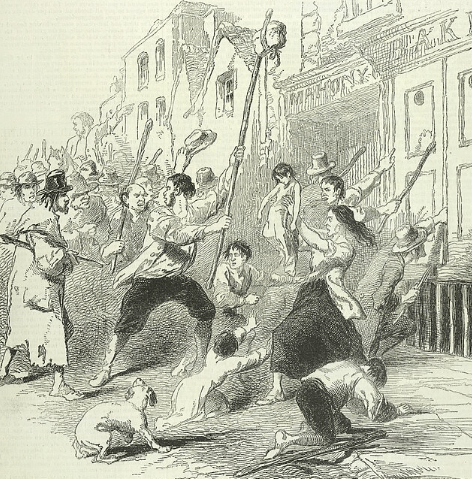
An 1846 food riot, replete with a loaf held aloft on a staff48

Trahar himself hit back in print, making a public and strident denial of ever having adulterated flour. John Rowe, doubtless assured of a good drink later, backed his boss up, stating that he would “at any time make oath” that he ran Treyew on his own account. Another employee took up the cudgels, making clear his belief that clay had never been used at the mill. Trahar even published another worker’s statement, that of Peter Hancock, making similar denials, but Hancock was not easily bought. In the same newspaper, Hancock issued a rebuttal of what Trahar had put his good name to, and wrote that in July 1813

…I was discharged from Mr Trahar’s service, in consequence of my refusal to adulterate wheaten flour with barley meal.

Royal Cornwall Gazette, June 18 1814, p3

Hardly a smoking gun, but it must have served to further blacken Trahar’s reputation. Bills had apparently been prepared against him, Osler, Trenerry and John Rowe49. The public waited for justice to be done. In fact, they waited two years, until August 1816.

Only Trahar and Rowe stood trial, for

…defrauding the public and endangering the health of His Majesty’s Subjects.

West Briton, August 23 1816, p3

Evidently the screen Osler had built around himself was more bulletproof than Trahar’s. Trenerry & Co.’s complicity was relatively peripheral and thus easy to play down.

The key witness was of course John Holman, who we met earlier. He could put Trahar in Treyew Mill whilst the adulteration process was taking place, as well as describe how the practice was undertaken. Sadly, Holman was a dud. A drunken one. Trahar’s counsel neatly demonstrated how the man stood in court “evidently intoxicated”, and could rubbish his whole testimony. William Trahar was a free man50.

John Rowe had no guardian angel. He must have known he was going down, especially after the testimonies of constables Brown and Clemence. He was fined a further £10, and sentenced to two years in prison51.

He was the only member of the gang convicted.

Yet, Osler and Trahar’s trust credit was utterly, and unsurprisingly, destroyed by the events. Osler was already bankrupt by late 181452.

Trahar sold up and left Truro in 1817. By 1826, we find him bankrupt too, in Southwark53.

It’s difficult, if not impossible, to have any sympathy.

Many thanks for reading; follow this link for more top blogs on all things Cornwallhttps://blog.feedspot.com/cornwall_blogs/

References

  1. The Girl Who Played With Fire, Quercus, 2009, p78.
  2. See: David Cannadine, Victorious Century: The United Kingdom, 1800-1906, Allen Lane, 2017, p59-104; Gavin Daly, “English Smugglers, the Channel, and the Napoleonic Wars, 1800-1814”, Journal of British Studies, 46.1 (2007), p30-46; Walter M. Stern, “The Bread Crisis in Britain, 1795-6”, Economica, 31.122 (1964), p168-187.
  3. See: William Rubel, “English Horse-bread, 1590-1800”, Gastronomica, 6.3 (2006), p40-51.
  4. See: Aaron Bobrow-Strain, “White Bread Bio-Politics: Purity, Health, and the Triumph of Industrial Baking”, Cultural Geographics 15.1 (2008), p19-40. Late 1840s Cornwall was not a place for the hungry; see my series of posts on the 1847 food riots here: https://the-cornish-historian.com/2022/01/09/the-cornish-food-riots-of-1847-background-and-context/ . Nowadays, the benefits of the brown loaf have finally been taken on board. Sales of white bread have fallen 75% since 1974. From: https://www.theguardian.com/lifeandstyle/2017/jan/04/i-love-sliced-white-bread-its-the-best-thing-since-er-sliced-white-bread
  5. For more on the National Loaf, see: http://www.teatoastandtravel.com/the-national-loaf/. The West Briton article quoted goes on to summarise the events of 1814 which are the main content of this post.
  6. Image from: http://www.teatoastandtravel.com/the-national-loaf/
  7. See: https://en.wikipedia.org/wiki/Assize_of_Bread_and_Ale , https://en.wikipedia.org/wiki/Making_of_Bread_Act_1757 , and J. Kirkland, “Bread Laws and the Price of Bread”, Economic Journal 5.19 (1895), p413-423.
  8. Image from: https://www.meisterdrucke.uk/fine-art-prints/Thomas-Rowlandson/163700/Dinners-Drest-in-the-Neatest-Manner-%28Satirical-Cartoon-on-Culinary-Hygiene%29.html
  9. The News (London), June 2 1811, p6.
  10. Johnson’s Sunday Monitor, October 17 1813, p2.
  11. Star (London), October 23 1813, p4; Sun (London), January 7 1814, p1.
  12. Aris’s Birmingham Gazette, April 12 1813, p1.
  13. Pilot (London), November 2 1813, p4.
  14. Still from: New Killers of the Victorian Home, Sterling Documentaries, 2018: https://www.youtube.com/watch?v=j9gv5528JZQ
  15. Dr Annie Gray, New Killers of the Victorian Home, Sterling Documentaries, 2018: https://www.youtube.com/watch?v=j9gv5528JZQ
  16. Image from: https://www.mediastorehouse.com/heritage-images/great-lozenge-maker-hint-paterfamilias-14829229.html
  17. Osler was probably born in 1764 (https://www.cornwall-opc-database.org/search-database/more-info/?t=baptisms&id=4750114), Trahar in either 1769 (https://www.cornwall-opc-database.org/search-database/more-info/?t=baptisms&id=4746031), or 1782 (https://www.cornwall-opc-database.org/search-database/more-info/?t=baptisms&id=6545087). For a brief outline on the development of Lemon Street, see: https://bernarddeacon.com/2021/04/24/the-rise-of-the-lemons/. See also: Royal Cornwall Gazette, October 31 1812, p1, and February 13 1813, p2. John Williams, the Scorrier businessman in question, publicly uncovered Trahar’s forgery in the West Briton, February 19 1813, p1. For more on Cornish pennies, see: https://en.wikipedia.org/wiki/Cornish_currency#
  18. Image from: https://www.ebay.co.uk/itm/225658937071
  19. When the crime was uncovered in April-May 1814, it was estimated to have been in operation for around two years. West Briton, April 13 1814, p2.
  20. Which is surprising: the 1812 harvest had been so successful that potato prices were expected to rapidly fall. Royal Cornwall Gazette, August 15 1812, p3.
  21. West Briton, May 13 1814, p2; Royal Cornwall Gazette, June 18 1814, p3. It was never proved that Trenerry ever did transport the clay, but they were involved in some respect and a Redruth firm was suspected of doing the work. Plus, Trahar mentions them by name when publicly refuting the allegations made against him.
  22. Image from: https://www.prints-online.com/new-images-july-2023/tregargus-china-clay-quarry-st-stephen-cornwall-32364032.html
  23. The price of clay is noted in the Taunton Courier, May 19 1814, p7.
  24. West Briton, May 6 1814, p2; Royal Cornwall Gazette, May 7 1814, p2.
  25. West Briton, May 6 1814, p2; Royal Cornwall Gazette, May 7 1814, p2, and June 18 1814, p3. John Rowe would claim in the latter newspaper that he had been in residence at Treyew since February 1814. Generally speaking, he never contradicted Trahar.
  26. For the image, and more on the china clay industry, see: https://cornishstory.com/2021/01/02/the-china-clay-industry/
  27. West Briton, May 6 1814, p2, August 23 1816, p3.
  28. West Briton, August 23 1816, p3. Holman, when giving his testimony, was found to be intoxicated, and thus discredited.
  29. West Briton, August 23 1816, p3.
  30. Image from: https://www.hallforcornwall.co.uk/heritage/the-collection/lemon-quay-1905/. For more on Lemon Street and Quay, see Petroc Trelawny, Trelawny’s Cornwall: A Journey Through Western Lands, Weidenfeld & Nicolson, 2024, p257-9.
  31. For the record, as recorded in: West Briton, April 24 1812, p4, February 19 1813, p3, September 24 1813, p3, December 24 1813, p3, March 25 1814, p3; Royal Cornwall Gazette, April 17 1813, p3, June 12 1813, p3, July 3 1813, p3, September 10 1813, p3, November 6 1813, p3.
  32. Royal Cornwall Gazette, August 20 1814, p4.
  33. Royal Cornwall Gazette, May 14 1814, p2.
  34. West Briton, May 13 1814, p2.
  35. These probable embellishments are from: West Briton, April 16 1942, p4; Cornish Guardian, October 8 1959, p9. The Portsmouth conviction is noted in Johnson’s Sunday Monitor, November 27 1814, p4.
  36. Figures from: Taunton Courier, May 19 1814, p7.
  37. Still from: New Killers of the Victorian Home, Sterling Documentaries, 2018: https://www.youtube.com/watch?v=j9gv5528JZQ
  38. The list of subscribers is in the West Briton, February 25 1814, p2.
  39. See note 31.
  40. Image from: https://www.mediastorehouse.com/mary-evans-prints-online/new-images-august-2021/bakers-bread-christmas-card-23076524.html
  41. Royal Cornwall Gazette, May 7 1814, p2.
  42. Royal Cornwall Gazette, May 7 1814, p2.
  43. Royal Cornwall Gazette, May 7 1814, p2; West Briton, August 23 1816, p3.
  44. West Briton, May 20 1814, p1. See my study of the Cornish cult of effigy burning here: https://the-cornish-historian.com/2024/11/05/effigy-burning-in-1800s-cornwall/
  45. West Briton, June 17 1814, p2.
  46. West Briton, May 13 1814, p2.
  47. For more on food riots in this era, see: E. P. Thompson, Customs in Common, Penguin, 1991, p185-259. See my series here on the Cornish food riots of 1847: https://the-cornish-historian.com/2022/01/09/the-cornish-food-riots-of-1847-background-and-context/
  48. Image from: https://en.wikipedia.org/wiki/List_of_food_riots
  49. As noted in the Royal Cornwall Gazette, August 20 1814, p2.
  50. West Briton, August 23 1816, p3.
  51. West Briton, August 23 1816, p3.
  52. West Briton, October 7 1814, p3.
  53. Royal Cornwall Gazette, May 24 1817, p3; Public Ledger and Daily Advertiser, October 25 1826, p1.

Death or Victory: The Bodmin Jail Riot of 1827

Reading time: 20 minutes

The real and only test of a good prison system is the diminution of offences by the terror of punishment…as monotonous, irksome, and dull as possible…no work but what was tedious, unusual, and unfeminine…to keep the multitude in order, and to be a terror to evil-doers…

~ The Reverend Sydney Smith, 1822

“Step in young man, I know your face, It’s nothing in your favour, A little time I’ll give to you: Six months unto hard labour.”

~ The Treadmill Song1

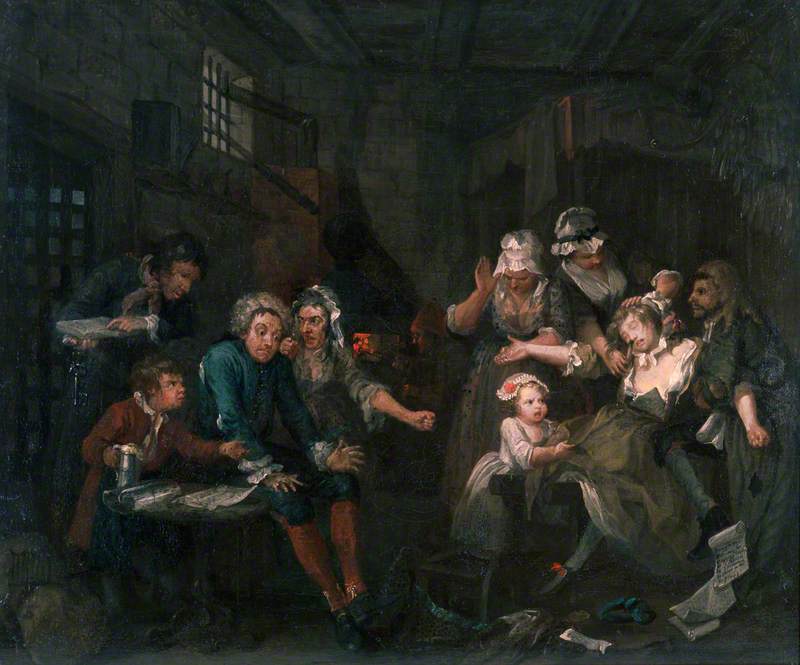
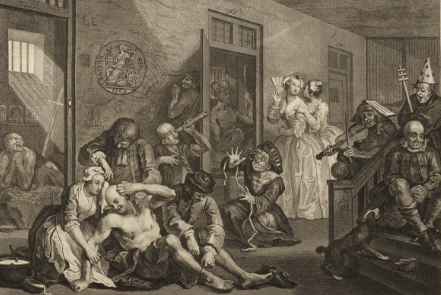
The Rake in Prison, by William Hogarth (1697-1764), gives us the classic view of a Georgian jail: men, women and children mix freely, alcohol is readily available, and the filthy dishevelled prisoners are left to their own dissolute devices2

The Penitentiary Act of 1779 was the Government’s response to reformer John Howard’s 1777 report The State of the Prisons. Independently-run jails were found to be unsanitary sinks of vice and corruption. If you couldn’t afford to buy decent food from the easily-bribed turnkey, you would probably starve to death. That’s if typhus didn’t claim you first.

Either clapped in irons all day or lying in cramped, unlit communal cells swarming with vermin, small wonder the prisoners sought refuge in sex, alcohol and violence (so did their jailers). Although in practical, state prison-building terms, the Act was largely a failure, combined with Howard’s work it generated public debate and opened the way toward prison reform3.

The debate centred around the following question: what are we going to do with them all? You couldn’t transport convicts to North America anymore, though New South Wales was looking promising. Also, public opinion was beginning, on the whole, to turn against executions too except for the most serious crimes. Though what has retrospectively become known as ‘The Bloody Code’ demanded death for over two hundred offences by the late 1700s, judges regularly declined to don the black cap, a practice that led to the more lenient 1823 Judgment of Death Act4.

Two social groups were prominent in the debate on this new era of penal punishment. The Evangelicals, centred around the Quaker Elizabeth Fry, argued that the convicted criminal ought to be reformed through the application of solitude and clean-living piety. The Utilitarians (simply, a group of theorists that encouraged actions leading to the greatest good for the greatest number), led by Jeremy Bentham, wanted prisoners to be productive and simultaneously provide a deterrent to others5.

Both groups agreed that they

…did not want less punishment…but more refined and effective punishment.

U. R. Q. Henriques, “The Rise and Decline of the Separate System of Prison Discipline”, Past and Present, Vol. 54 (1972), p63

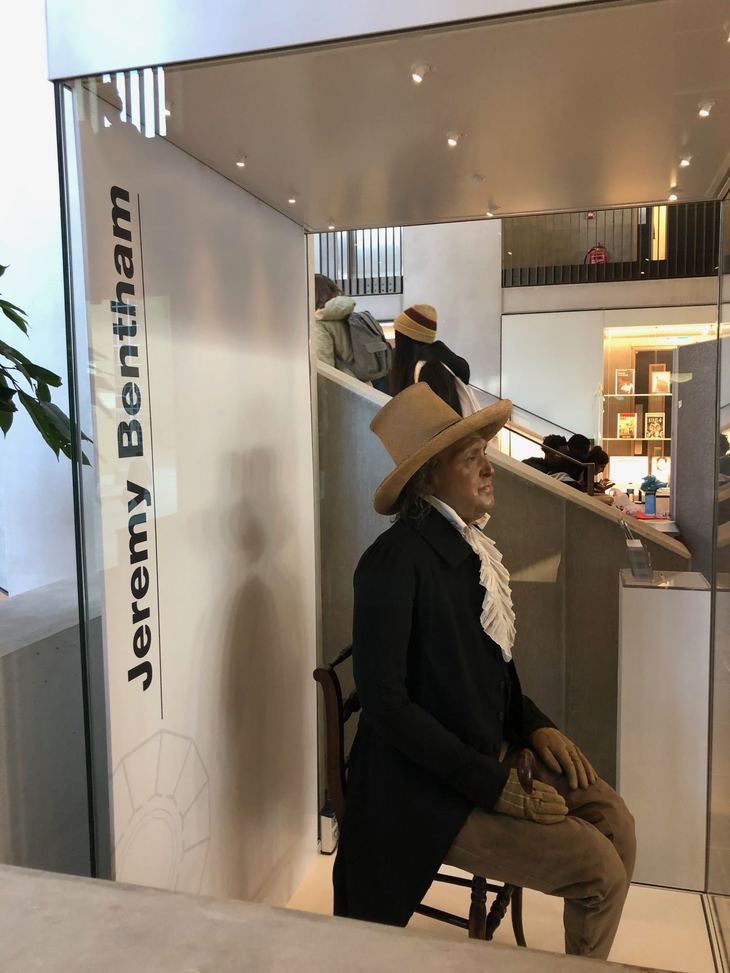
Bentham (1748-1832) was so committed to his own philosophy that he ensured his corpse was to be dissected in order to further medical knowledge. His dressed skeleton and wax effigy of his head now reside in the Student Centre of University College, London. In 2013, in response to many legends surrounding Bentham’s remains, he attended a meeting of the UCL Council, were he was listed as “present but not voting”6

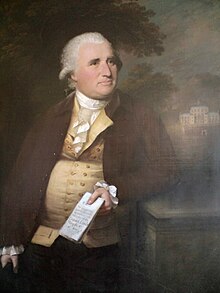
One man heavily influenced by the findings and recommendations of Howard, the Evangelicals and the Utilitarians was Sir John Call (1731-1801), an engineer and politician from Devon. The jail he designed and had built on Berrycombe Road, Bodmin, by 1779 was seemingly conceived with the reformers’ specifications in mind7.

Sir John Call in 1779, with possibly the newly-opened Bodmin Jail in the background. Of course, the original building bears little resemblance to the imposing, Gothic creation it later became8

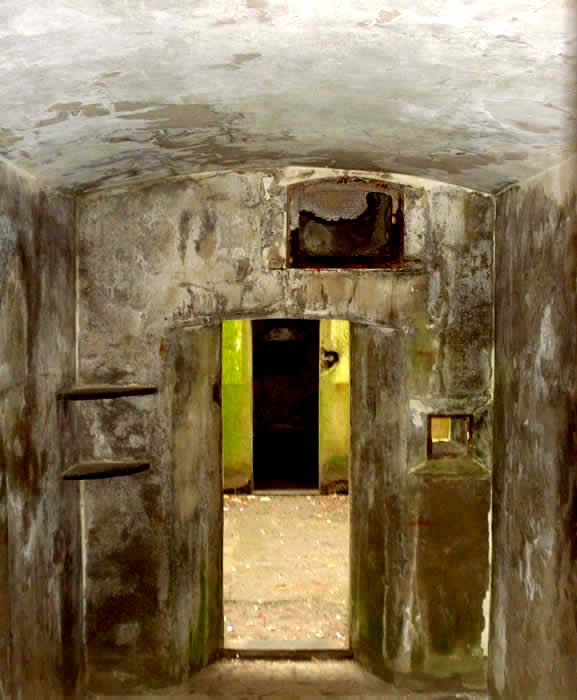
When John Howard visited in 1784, he certainly approved. Each prisoner had a separate cell for personal reflection, there were baths, an infirmary, the inmates (segregated by gender) earned a percentage of their labours sawing or polishing, and liquor was strictly verboten. Howard wrote that

By a spirited exertion, the gentlemen of this county have erected a monument of their humanity, and attention to the health and morals of their prisoners.9

A monument to humanity: each cell at Bodmin measures 8’2″x5’8″, and is 7’2″ high. Image copyright Jackie Freeman Photography10

By 1812, the jail was a pious, bustling site of industry. Another reformer, James Neild (1744-1814) paid a visit. He described the “orderly and devout” nature of the inmates during Divine service, and during daylight hours

The Women card and spin wool, or make, mend and wash the other prisoners’ clothes and bedding. The Men are chiefly employed in sawing timber…or in sawing and polishing head-stones for church-yards; or else in weaving at the looms…11

Neild further mentioned that those in prison for debt kept what money they earned; the rest, half. He was informed that one convict had learnt the trade of sawyer during his enforced stay, and was now earning good money on the outside.

In the early 1820s, the Committee of the Society for the Improvement of Prison Discipline observed similar:

At Bodmin, the employments of the prisoners are thrashing, and grinding corn, sawing and polishing stones for chimney-pieces, flooring, tombstones, &c; also making clothing, shoes, and blankets. The females are employed in spinning and knitting, making and mending, and washing clothes for themselves and the male prisoners.

Public Ledger, October 5 1821, p1

And this was the problem: the Industrial Revolution witnessed inside the many prisons of the land, and not just Bodmin’s, was having an adverse affect on the Revolution outside. Convicted felons could produce goods cheaper than their more honest counterparts, plus

…if prisoners became more industrious and were seen to prosper, gaols would cease to be dreaded.

U. R. Q. Henriques, “The Rise and Decline of the Separate System of Prison Discipline”, Past and Present, Vol. 54 (1972), p67

And, if jails became more like apprentices’ workshops, crime would surely rise, and prisons overcrowd, as more people would seek to gain a bed, food and learn a trade inside a prison’s welcoming walls. Suddenly, public opinion swung back to the notion of actually punishing those who had broken the law. Which is precisely why the Quaker-dominated Committee of the Society for the Improvement of Prison Discipline was visiting jails in 1821: to increase discipline:

The efficacy of such a system of hard labour on the minds and habits of an offender has not, even yet, been generally tried, or fully appreciated, in this country; but where the experiment has been fairly made, the benefits have been most striking. Few who have been subjected to this species of punishment, regard imprisonment without terror…

Public Ledger, October 4 1821, p1

The same question was being asked in 1821 as in 1779: what are we going to do with them all? The answer now was, to make them bitterly regret transgressing the laws of the land. But how?

Enter engineer William Cubitt (1784-1861), and his latest invention: the treadwheel.

The treadwheel at the Middlesex House of Correction, 1874, by Michael Fitzgerald12

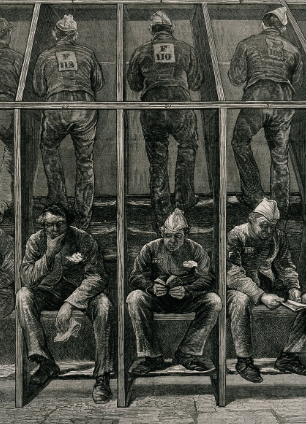
Cubitt’s device was simple. An iron frame held a large hollow cylinder of wood, around which was a series of steps about 7-8″ apart. Depending on the size of the ‘wheel (and the capacity of the jail in which it operated), between five and thirty prisoners could endure it at any given time, separated by boards and compelled to tread uphill in silence. As the felons walked forward, the ‘wheel would revolve, weights and machinery ensuring each would take their steps in turn.

If judged medically fit at the start of each day, a prisoner sentenced to hard labour would tread the wheel in 15-minute stints, with a 5-minute break…for six hours13.

An early treadwheel (minus dividing screens) at Brixton Prison, 1827. No image of the treadwheel at Bodmin survives. Image copyright Photos.com/Getty Images14
The treadwheel at Beaumaris, Anglesey.
Note the screens, and simple handle for the prisoners to steady themselves.
Though treading in silence, its heavy gearing ensured deafening noise15.

Each day, inmates would be climbing between 7,500ft and 8,640ft, or 1.4 to 1.6 miles. Some treadwheels were deployed constructively. One such in Gloucestershire was used to grind corn, another in Lancashire was attached to a loom and produced cloth. These were the exceptions16.

Bodmin’s treadwheel was ordered in 1822, to be erected in the Bridewell Yard. This, going by what we know of the prison layout of the time, situated it close to the day-rooms of the male prisoners17. It was still under construction when a law student visited that year, who noted it was to have a capacity of ten, but was not yet

…applied to any useful purpose.

Thoughts on Prison Labour, by a Student of the Inner Temple, London, 1824, p117. Retrieved from Google Books

When up and running, it wouldn’t grind corn, or produce cloth. No, at Bodmin, its

…purpose was much more sinister.

David Freeman, Bodmin Jail: Bridewell Revisited18

Its job was to mentally and physically crush those unfortunate enough to be subjected to it. Your monotonous, silent, solitary toil was, in practical terms, utterly pointless. In fact, it bordered on torture, and thus carried with it a vestige of earlier, bloodier methods of punishment, as one historian has realised:

…a punishment like forced labour…has never functioned without a certain additional element that certainly concerns the body itself…imprisonment has always involved a certain degree of physical pain…there remains, therefore, a trace of ‘torture’ in the modern mechanisms of criminal justice…

Michel Foucault, Discipline and Punish: The Birth of the Prison, Penguin, 1991, p13-14

Foucault may have been far removed from the nature of the treadwheel when he wrote in the 1970s, and was indeed considering hard labour per se, but at the time, controversy raged as to the effects of the ‘wheel on the prison population.

Horror stories began to emerge. The treadwheel wasn’t merely disciplining and punishing prisoners.

It was killing them.

It is a hideous irony that, a device introduced as part of the extended (and largely ad-hoc) programme of penal reform was in turn attacked by the reformers themselves. An anonymous London law student visited many jails, and in 1824 produced, much as John Howard had back in 1777, an excoriating account of the country’s prison system, in particular the employment of the treadwheel. Thoughts on Prison Labour is now available on Google Books, but its more sensational passages were serialised in the reformist, democratic newspapers of the day, notably the then-weekly Liverpool Mercury.

The editorial introducing the extracts made it plain:

…at the very time when the British are interesting themselves…on behalf of their suffering fellow subjects in the West Indies, they should permit an instrument of torture to be erected under their own eyes, which exceeds the severities there exercised in an incalculable degree…

Liverpool Mercury, May 21 1824, p7

The Mercury is referring to the Slave Trade Act of that year, which would be granted royal assent in June, and further reinforced the abolitionist movement. The editorial, therefore, is accusing the British people of hypocrisy: they can abolish slavery on the one hand, yet condone torture with the other19.

Furthermore, use of the treadwheel was “illegal” and “inconsistent with the law”20. Perfectly acceptable (and suitably exhausting) forms of hard labour had existed previously, wrote the law student, but this new

…penal machine…[has] been introduced WITHOUT THE EXPRESS SANCTION OF THE LEGISLATURE…a mode of punishment to which every individual…is liable…ought not to be established, without the consent of the people through their representatives…

Qtd in Liverpool Mercury, May 21 1824, p7

To arbitrarily introduce such an unprecedented instrument of punishment was undemocratic and unconstitutional. The magistrates who ordered the ‘wheels, and their manufacturers, however, could only see the profit.

By 1823, there were twenty-three treadwheels in operation; models had also been sent to Dublin, to Russia, to New South Wales and Philadelphia. Where the ‘wheels were harnessed to produce flour, the returns on the sale of this commodity were rapidly discerned. It covered the cost of the treadwheel’s installation, and ran at a dividend. Cheap prison labour also made economic sense, it kept the inmates busy, and there was a neverending supply, no matter how much agriculturalists might complain that it threatened their business21.

The treadwheel was, in all honesty, a product of the Industrial Revolution. And like many an innovation of that age, the human cost was conveniently ignored22.

Pentonville Prison, 189523

In 1821, a male convict in Leicester died whilst on the treadwheel. Two years later, similar happened at the same institution. At another prison in 1824, a man knelt down on the ‘wheel, was caught in the mechanism, and crushed to death. Pregnant women forced to endure the ‘wheel miscarried. These were all findings noted in Thoughts on Prison Labour, and run in the Liverpool Mercury24.

The female inmates of Coldbath-Fields would regularly faint and fall off the treadwheel, or simply cry in agony. After being revived, they would be forced back on. It broke some of the guards too, not normally a class you’d associate with sympathy. One remarked that

…how often the finest of them, after having been a few weeks at work, are worn down and emaciated…

Qtd in Liverpool Mercury, June 4 1824, p3

Clearly the judgment ‘medically fit’ to work on the treadwheel covered a broad church of conditions, and it was the same for the men as for the women. The male convicts were put on the wheel even when they had ruptured hernias. As one Governor at Brixton observed,

They had several prisoners at their wheel who had ruptured, and when they had fitted them with trusses, they were usually worked with the rest.

Qtd in Liverpool Mercury, May 28 1824, p1

Others, held together with improvised bandages,

…complained most bitterly…

Qtd in Liverpool Mercury, May 28 1824, p1

…when the student asked them about the mental and physical distress caused by the labour.

Conflicting voices made themselves heard too. One noted how prisoners

…retire from it [the treadwheel] in the evening, in that fatigue of body and exhaustion of animal spirits, which renders them less inclined to mischief…that it is held in considerable dread by offenders is certain, and the fear of returning to it may operate favourably…

Bath Chronicle, July 31 1823, p2

The aforementioned Committee on Prison Discipline certainly approved:

…the primary feature in the character of ‘hard labour’ should be severity…a severity that shall make those who have violated justice, feel the penalties of law…the Tread-wheel is…a punishment of this description, and that no house of correction should be without it.

Bath Chronicle, February 10 1824, p2

In May 1824, a petition was presented to Parliament. It highlighted the unlawful introduction and barbaric nature of the treadwheel, but to no avail25.

With all this considered, then, the events at Bodmin Jail in May 1827 ought to come as no surprise. Complaining to sympathetic ears was one thing, but Bodmin witnessed a far more direct form of protest.

An 1890 mugshot of a twenty year-old member of a Manchester street-gang called ‘The Scuttlers’26

In the years before the invention of photography, portraiture captured the likenesses of the upper-class and nobility; a sketched ‘Wanted’ poster or a prison sentence offered a chance for the lower orders to have their appearance (briefly) recorded for posterity. To ensure a positive ID and track possible repeat offenders, jail registers often gave a brief description of new inmates, noting distinguishing marks (I’ve read of scars and missing thumbs), and behaviour.

It’s not an exact science; the researcher is relying heavily on the diligence of the prison registrar. But sometimes, you strike gold.

With James Sowden, we are unlucky. Either his prison record has yet to be transcribed by the amazing volunteers at Cornwall Online Parish Clerks, or it no longer exists, and we will never have any idea what Sowden looked like, or his age when he was sent down.

All we know for certain about James Sowden is this: he lived in Camborne, he was a miner, he got six months hard labour at Bodmin for assault, and…well, all in good time27.

But we can make educated guesses as to his biography. He may well have been the same James Sowden who married Catharine Richards in Camborne in 1832; neither could write. In the 1841 census, Sowden is listed as a copper miner. The couple resided at New Downs, near what was once Treswithian Downs, and had six children. He gave his age as 30, though ages in early census returns are rarely accurate, and 1841’s means of recording age was particularly eccentric. If this James Sowden is our James Sowden, he would have only been around 17 at the time of his visit to Bodmin Jail28.

In 1851, the family are living on College Street, Camborne. Here James Sowden told the census officer he was 34. He died in 1863, aged around 4829.

If this is the same James Sowden who was behind bars in 1827, then we might also say this of him: he was one hell of a fighter, he had courage beyond his years, he had a certain sense of the dramatic, and he was no champion of penal discipline.

Sowden was arrested on the streets of Camborne with two other miners, John and Richard Cock. John was 23, stood 5’8″, had grey eyes, a pale complexion and sandy hair. Richard was two years younger, an inch shorter, and had dark hair30.

The three men were doing time for assaulting both of Camborne’s (voluntary, unpaid) parish officers, Henry Eva and William Terrell, “in the execution of their duty”31. Sowden and the Cocks were probably drunk and violent when the officers intervened, and said officers were made to bitterly regret taking this course of action. Eva and Terrell may very well have been the first law enforcement officers to come second to Camborne’s miners, but they weren’t the last32.

At the Truro Easter Sessions, all three were given six months at Bodmin. On the treadwheel.

A handcuffed prisoner awaits transportation to Bodmin from St Columb in the 1880s33

Several other likely lads were handed similar sentences at the same hearing. Three miners from Kea (between Carnon Downs and Truro) got nine months on the ‘wheel for beating up their parish constable. They were Robert Northey (21), James Francis, also 21 and who stood an impressive 6’1″, and John Bastian (22)34.

Joining them from Illogan were another trio of miners, on a 15-month stretch for riot and assault: Stephen Rickard (21), William Martyn (20) and Richard Branch (21). Like their fellow convicts from Camborne and Kea, they were to have the pleasures of the treadwheel too35.

I dwell on these eight men who were sentenced with Sowden because, although it’s only his name that’s connected with the events at Bodmin Jail on May 14, it’s likely these men acted with him. In the case of Rickard, Martyn and Branch, highly likely. The records describe their behaviour as being

…not very orderly…very disorderly…very disorderly…36

Who knows what Sowden’s entry read.

So, they were sentenced on April 24, and entered Bodmin Jail on Thursday April 26. Less than three weeks later, on Monday May 14, enough was enough.

Prisoners exercising at Wormwood Scrubs, 190737

Miners are conditioned to hard work, but they also expect a material return for their labours. Bodmin’s treadwheel would offer them no such recompense, plus this early incarnation of the device at the prison was especially fiendish. Though as noted earlier it only sat ten, it was

…regulated by friction only, a very uncertain method. The wheel is made of wood, and from its rough manufacture revolves very unsteadily!

Thoughts on Prison Labour, by a Student of the Inner Temple, London, 1824, p94. Retrieved from Google Books

(By 1883, Bodmin’s wheel had a capacity of thirty-two inmates, and would grind corn38.)

If one convict pushed too hard, he would throw his fellow sufferers off their rhythm, causing them to overbalance and, like as not, injure themselves. Treading on rough, unfinished timber all day must have made the experience all the more hellish.

We are not told how many prisoners were to be on the ‘wheel that day, but obviously there cannot have been more than ten. They lined up in the yard after another night in solitary and a thin breakfast chewed in silence, and faced up to another day of agony39. If they had a plan, it may have been no more than a hasty whisper: I’m not going on; who’s with me?

Suddenly, they refused to step on the treadwheel, or rather

…manifested signs of insubordination…

Royal Cornwall Gazette, May 19 1827, p2

We can imagine Sowden, identified for all time as the ringleader, standing forward of the rest, arms folded, staring down the guards.

The guards patently lacked the numerical superiority to take on a bunch of defiant miners. They also lacked the stomach; after all, these were men who made a pastime out of battering officers of the law. They panicked, and when subordinates panic, they look to their superiors, which is exactly what happened.

Two magistrates were on hand that day: Joseph Pomeroy, and Nicholas Kendall (1800-1878). Kendall wasn’t the kind of man to panic; in fact he made it his business to quell riots quickly and bloodlessly. He was to do it again at St Austell in 184740.

Kendall was at various times the High Sheriff of Cornwall, Conservative MP for East Cornwall, a County Magistrate, and also a Captain of the Royal Rangers Militia41

At the magistrates’ appearance, the miners armed themselves, tearing up the treadwheel’s railings. They then assumed battle formation.

Kendall showed the quick decision-making that was to be crucial in 1847. The unrest needed to be stamped out rapidly, before other inmates got similar ideas and the situation got out of hand. Kendall needed a show of strength. Fast.

The 32nd Regiment of Foot (later, the Duke of Cornwall’s Light Infantry) was in Limerick, but the militia of the Royal Cornwall Rangers were conveniently nearby in the town. It’s unknown how many of this irregular fighting force Kendall was able to rustle up, but he did it in short order – in all, the events of that day took several hours at most42. They lined up in the prison’s outer courtyard. Kendall informed the rebellious inmates of their presence. Last chance.

At this point, the hastily-assembled militiamen would have known they were in for a fight. Loud cheering came at them over the prison wall, and the cry went out,

…death or victory…

Royal Cornwall Gazette, May 19 1827, p2

Kendall, thus being challenged to do his worst, obliged, and ordered the soldiers in.

Once they got past the gate, the prisoners, with no regard for personal safety, fell on the riflemen, thrashed at them with their improvised weapons, and struggled to gain possession of the muskets themselves.

It’s at this point that the riot could have turned into a massacre. If one or more of Sowden and his desperate cohorts had got hold of a rifle, or an excitable Ranger had opened fire, who knows what carnage would have ensued.

We may detect the hand of Kendall here. If a shot was fired inside that prison, he was in serious trouble. Discretion and forbearance was required, and would have been stressed on the soldiers. It was a lesson he took with him to St Austell.

Rifle-butts and elbow-grease did the job. When it was over, several convicts lay prone on the ground, and the rest had retreated. Five of the worst were dragged off to the detention cells.

Except James Sowden:

…being the ringleader, [he] was again ordered by the Magistrates to ascend the wheel.

Royal Cornwall Gazette, May 19 1827, p2

All eyes were on Sowden. He probably drew himself up, stuck his chin out at Kendall, and

…positively refused…

Royal Cornwall Gazette, May 19 1827, p2

This was the last straw for Kendall. An example had to be made. Sowden had just volunteered himself.

He was strapped down and whipped, right there in the yard.

How intransigent prisoners were punished in the 1800s. Image copyright Photos.com/Getty Images43

Whatever fight the prisoners had left was crushed by this horrifying sight. Sowden was probably whipped unconscious, and left bleeding in his ropes for a while. The men he had led to rebel, possibly including his mates from Camborne, the Cock boys, knew it was over. Back to the ‘wheel they went.

For James Sowden and his fellow prisoners, there was no death or victory, only brief defiance followed by pain and humiliation.

The use of treadwheels in Britain’s prisons was only abolished in 1902. That same year, we discover that Bodmin’s modern, 32-man monster ‘wheel had been sold on44.

Sowden’s uprising changed, or achieved, nothing. Nor, you could argue, did the object of his riotous wrath. One historian has commented that

There was no evidence that the treadmill had any impact on crime rates, or the size of the prison population.

Professor Rosalind Crone, Open University45

Many thanks for reading; follow this link for more top blogs on all things Cornwallhttps://blog.feedspot.com/cornwall_blogs/

References

  1. Quotation from: U. R. Q. Henriques, “The Rise and Decline of the Separate System of Prison Discipline”, Past and Present, Vol. 54 (1972), p61-93. Henriques notes that Smith was actually pushing for prison reform. The ‘Treadmill Song’, also known as the ‘Gaol Song’, was sung to a folklorist by Dorset workhouse inmates in 1906; its origin is probably much earlier. See: https://mainlynorfolk.info/lloyd/songs/gaolsong.html
  2. Image from: http://www.artuk.org/artworks/a-rakes-progress-7-the-rake-in-prison-123979
  3. See: U. R. Q. Henriques, “The Rise and Decline of the Separate System of Prison Discipline”, Past and Present, Vol. 54 (1972), p61-93. For more on Howard, see: https://en.wikipedia.org/wiki/John_Howard_(prison_reformer). For a brief overview of the Act, see: https://en.wikipedia.org/wiki/Penitentiary_Act_1779
  4. See: Douglas Hay, “Property, Authority, and the Criminal Law”, in Albion’s Fatal Tree: Crime and Society in Eighteenth-Century England, 2nd ed., Verso, 2011, p17-64. For a brief overview of ‘The Bloody Code’, see: https://en.wikipedia.org/wiki/Bloody_Code. For more on the history of transportation, see: https://en.wikipedia.org/wiki/Penal_transportation
  5. From: U. R. Q. Henriques, “The Rise and Decline of the Separate System of Prison Discipline”, Past and Present, Vol. 54 (1972), p61-93. For more on Elizabeth Fry, see: https://en.wikipedia.org/wiki/Elizabeth_Fry
  6. Image from: https://londonist.com/london/jeremy-bentham-ucl-body-auto-icon-where. Bentham’s eccentric afterlife is as well-known as his work. See: https://en.wikipedia.org/wiki/Jeremy_Bentham, https://blogs.ucl.ac.uk/transcribe-bentham/jeremy-bentham/, https://blogs.ucl.ac.uk/museums/2013/07/12/bentham-present-but-not-voting/
  7. For more on Call, see: https://en.wikipedia.org/wiki/John_Call. How Bodmin Jail was built can be read here: https://www.theprison.org.uk/BodminCGB/
  8. Image from: https://en.wikipedia.org/wiki/John_Call. The photographer Jackie Freeman asserts that the building behind in Call is Bodmin Jail: https://www.jackiefreemanphotography.com/bodmin_jail.htm
  9. Quotation from: https://www.theprison.org.uk/BodminCGB/
  10. John Howard measured the cell dimensions during his visit of 1784: https://www.theprison.org.uk/BodminCGB/
  11. From: https://www.theprison.org.uk/BodminCGB/. For more on Neild, see: https://en.wikipedia.org/wiki/James_Neild
  12. Image from: https://wellcomecollection.org/works/vem7sjza/images?id=ejbzn8sq
  13. Information from: https://www.britannica.com/topic/Britannica-on-the-treadmill-1998450#ref1205851. Of course, being judged medically unfit to tread the wheel didn’t mean you were excused hard labour. Instead you were made to sit and turn ‘The Crank’, a steel box filled with sand with a handle on side. See: https://www.bbc.co.uk/ahistoryoftheworld/objects/04G2X6rXSsiAvbotujleew
  14. Image taken from: https://www.britannica.com/topic/Britannica-on-the-treadmill-1998450#ref1205851
  15. Stills from: https://www.open.edu/openlearn/history-the-arts/history/the-legacy-the-victorian-prison-treadmill
  16. Figures from: https://www.britannica.com/topic/Britannica-on-the-treadmill-1998450#ref1205851 and https://www.open.edu/openlearn/history-the-arts/history/the-legacy-the-victorian-prison-treadmill. The treadwheel uses are noted in: Bristol Mercury, February 24 1823, p4, and Salisbury and Winchester Journal, December 29 1823, p2.
  17. Exeter Flying Post, October 24 1822, p4, and https://www.theprison.org.uk/BodminCGB/
  18. See: https://www.jackiefreemanphotography.com/bodmin_jail.htm#treadwheel
  19. For more on the Act, see: https://en.wikipedia.org/wiki/Slave_Trade_Act_1824
  20. Liverpool Mercury, May 21 1824, p7.
  21. Bath Chronicle, July 3 1823, p4.
  22. For examples, see: E. P. Thompson, The Making of the English Working Class, Penguin, 1991, p207-232.
  23. Image from: https://cdn.nationalarchives.gov.uk/documents/education/victorian_prison.pdf
  24. May 21 1824, p7.
  25. See: https://hansard.parliament.uk/Commons/1824-05-05/debates/6f72505c-a667-42fa-8688-cf14cb80f052/Tread-Mill%E2%80%94PetitionOfSirJCHippisleyAndCAgainstTheUseOf
  26. Image from: https://www.manchestereveningnews.co.uk/news/greater-manchester-news/fascinating-1800s-mugshots-reveal-greater-24842983
  27. Easter Sessions, Truro, April 24 1827. Kresen Kernow, ref. QS/1/11/254. Another James Sowden was given six months hard labour at the Bodmin sessions of 1829; but as this Sowden resided at Lostwithiel, it’s unlikely to be the same man. Kresen Kernow, ref. QS1/11/500.
  28. For the 1841 census, see: https://en.wikipedia.org/wiki/1841_United_Kingdom_census. The marriage record is available here: https://www.cornwall-opc-database.org/search-database/more-info/?t=marriages&id=1858413
  29. The burial record is available here: https://www.cornwall-opc-database.org/search-database/more-info/?t=burials&id=5261897
  30. See the Cocks’ prison records here: https://www.cornwall-opc-database.org/search-database/more-info/?t=institution_inmates&id=149011, https://www.cornwall-opc-database.org/search-database/more-info/?t=institution_inmates&id=149010
  31. Easter Sessions, Truro, April 24 1827. Kresen Kernow, ref. QS/1/11/254. Of course, there was no police force; Cornwall Constabulary was only formed in 1857.
  32. In 1873, Camborne bore witness to the largest anti-police riot in Cornish history: https://the-cornish-historian.com/2023/09/30/the-camborne-riots-of-1873-part-one/
  33. Image from: One & All: A History of Policing in Cornwall: The Cornwall Constabulary 1857-1967, by Ken Searle, Halsgrove, 2005, p18.
  34. Easter Sessions, Truro, April 24 1827. Kresen Kernow, ref. QS/1/11/254. See the descriptions of the three Kea convicts here: https://www.cornwall-opc-database.org/search-database/more-info/?t=institution_inmates&id=149015, https://www.cornwall-opc-database.org/search-database/more-info/?t=institution_inmates&id=149017, https://www.cornwall-opc-database.org/search-database/more-info/?t=institution_inmates&id=149016

35. They had been inside since March, but were only sentenced on April 24. See: Easter Sessions, Truro, April 24 1827. Kresen Kernow, ref. QS/1/11/254, and https://www.cornwall-opc-database.org/search-database/more-info/?t=institution_inmates&id=148969, https://www.cornwall-opc-database.org/search-database/more-info/?t=institution_inmates&id=148971, https://www.cornwall-opc-database.org/search-database/more-info/?t=institution_inmates&id=148970

36. See the links in note 35.

37. Image from: https://blog.britishnewspaperarchive.co.uk/2021/04/15/exploring-life-behind-prison-bars/

38. Cornish Telegraph, December 6 1883, p8.

39. Only one Cornish newspaper covered the riot, and that was the royalist, conservative Royal Cornwall Gazette of May 19 1827, p5.

40. See: https://the-cornish-historian.com/2022/02/06/trouble-in-clay-country-the-food-riots-of-1847-part-five/

41. Image from: https://artuk.org/discover/artworks/nicholas-kendall-b-1800-14110. For more on Kendall, see: https://en.wikipedia.org/wiki/Nicholas_Kendall_(Conservative_politician)

42. The Rangers had formed in 1760. See: https://www.lightinfantry.org.uk/regiments/dcli/duke_timeline.htm

43. Image from: https://www.britannica.com/topic/flogging

44. See: https://en.wikipedia.org/wiki/Penal_treadmill, and Cornish Guardian, August 1 1902, p3.

45. From the OU film available here: https://www.open.edu/openlearn/history-the-arts/history/the-legacy-the-victorian-prison-treadmill

The Piskie Trap Podcast: Mary Hartley of Rosewarne

Listening time: 1 hour

To read my own post on Mary Hartley, click this link

The Piskie Trap is a popular podcast produced by the great Keith Wallis, a folklorist from Tywardreath. He’s been taking his show on the road; in April you’ll find him giving a talk at St Austell Arts Centre, and in May he collaborates with Liz Dale, ‘The Cornish Bird’, at the Port Eliot Mystery and History Conference. Full details can be found on Keith’s podcasts.

Keith has a nose for a good ghost story, and invited me to talk on his show about Mary Hartley, the ‘Madwoman’ of Rosewarne House, Camborne. It’s a tragic tale of vast wealth, betrayal, insanity, secret tunnels and a dash of the supernatural.

Hit play, sit back, and enjoy…

Many thanks for reading; follow this link for more top blogs on all things Cornwallhttps://blog.feedspot.com/cornwall_blogs/

Cornish Minstrel Bands

Reading time: 25 minutes

NOTE: This post contains historically racist language and images that readers may find offensive. Neither the language quoted, or the images shown, represent the views of the author.

I recently watched a powerful documentary on the history of minstrel bands in England. There is perhaps no better place to start this post than by quoting the programme’s narrator, the black actor and activist David Harewood, OBE1:

…in telling this story, we have no choice but to use toxic racial language. In fact, minstrelsy was a major delivery system of it, into British culture.

David Harewood on Blackface: The Hidden History of Minstrelsy, BBC, July 27 2023

It is a great irony, Harewood states, that “an art form that was once mainstream British popular culture”, was also one of its most poisonous.

It’s another great irony that what was once such a common feature of everyday life is now so difficult to study. An example. The BBC’s main Saturday night entertainment from 1958 to 1978 was The Black and White Minstrel Show. It’s stated on Harewood’s documentary that, at its peak, the programme reached 20 million viewers, yet throughout its existence received (justifiable) accusations of racism, from both within the Corporation and without2.

Still from: David Harewood on Blackface: The Hidden History of Minstrelsy, BBC, July 27 2023

I couldn’t quite believe this tacky, racist trash was still on TV the year I was born. I also couldn’t believe I’d never heard of it – a symptom, it is asserted, of the society I live in:

The destruction of the past, or rather of the social mechanisms that link one’s contemporary experiences to that of earlier generations, is one of the most characteristic and eerie phenomena of the late twentieth century.

Eric Hobsbawm, Age of Extremes: The Short Twentieth Century, 1914-1991, Abacus, 1995, p3

Maybe people don’t want to remember that they watched, and enjoyed The Black and White Minstrel Show (or indeed admit such a thing was ever broadcast to the nation), because nowadays such a thing would be completely beyond the pale of tasteful mainstream television. To be found appreciating a racist TV programme makes its viewer racist in turn.

Now, take the BBC’s current Saturday night flagship show, Strictly Come Dancing, which hit a high of nearly 11 million viewers in 2020, and has also been running for twenty years3. Imagine if, tomorrow, the show was cancelled due to accusations of racism, sexism or whatever, and in over forty years time, had been all-but forgotten in the history of broadcasting? Doesn’t that sound downright weird?

But this process of historical airbrushing occurred with the Minstrel Show, and a good thing too, I hear people cry. But this is precisely the point Harewood makes in his documentary:

The history of blackface minstrelsy is hidden, it has been shelved, and put out of sight, because the subject is too difficult, or too uncomfortable, for people to face.

David Harewood on Blackface: The Hidden History of Minstrelsy, BBC, July 27 2023

Why, you may ask, is someone whose research interests are primarily Cornish history, investigating the murky area of British blackface minstrelsy? I hadn’t intended to. A contact suggested I might like to address the controversy surrounding what is now known as Padstow’s ‘Mummers’ Day’.

Mummers’ Day, Padstow, 20184

This is a Boxing Day tradition until recently known as ‘Darkie Day’. It involves the townspeople parading the streets in fancy dress and/or blackface, singing Cornish folk songs, and collecting money for charity.

(I ought to mention here that the word ‘darkie’ in this context is a contraction of the Cornish dialect word ‘darkening’ which, in Cornish guize or masked dancing, means to darken one’s face, and not as a racist slur.)

As it was called then, Darkie Day fell foul of some unwelcome publicity in 1998. Accusations of racism by an MP led to a police investigation. Besides the obvious target of white people blackening their faces, it’s long been realised that elements of some of the songs sung of Darkie/Mummers’ Day contain lyrics of old minstrel tunes. Apparently such a band was active in Padstow before World War Two, and by some process of social osmosis left their own legacy on the Boxing Day parade. (More on this band later.)

My own work on Mummers’ Day was stillborn. The Cornish academic Merv Davey has produced his own study, and I felt I could add nothing further to it5.

But for me, questions remained. Who was this obscure Padstow minstrel band? Was it the only one of its kind to operate in Cornwall? (The Cornish National Music Archive could provide no answers, and Padstow Museum only hinted at how big a phenomenon minstrel music was.) Could there have been more bands? (As it turned out, there was.) What motivated them to perform? Cultural influences and/or change, cold hard cash, philanthropy, or just the desire to get onstage with your mates and, well, show off? Who were the players – moonlighting pros, or rank amateurs? How popular were they? How did they go down with the punters? Did they use the ‘disguise’ element of minstrelsy to their advantage? When did they fall out of fashion, and why?

The big question: how aware were these bands that their act was communicating a racist stereotype of black people?

To begin to answer this last, we can set up the following conflicting viewpoints. Minstrel bands conveyed

…an idea that black people are either savages in Africa, or they’re happy-go-lucky simpletons in America.

Professor David Olusoga, from David Harewood on Blackface: The Hidden History of Minstrelsy, BBC, July 27 2023

In contrast, one study attempts to

…undercut the tired old story that black-faced minstrelsy is about unrelenting hatred of blacks…for I believe that interpretation to be ahistorical. It ascribes meaning without understanding context…For some…the basic impulse was toward entertainment.

Dale Cockrell, Demons of Disorder: Early Blackfaced Minstrels and Their World, Cambridge University Press, 1997, p162

As we shall see, unwittingly or not, Cornish minstrel bands performed an act that perpetuated grotesque racial stereotypes. In America, at least one contemporary certainly thought as much. W. E. B. Du Bois spoke of the “debasements and imitations”, the theft of black culture, such as

…the Negro ‘minstrel’ songs, many of the ‘gospel’ hymns, and some of the contemporary ‘coon’ songs,—a mass of music in which the novice may easily lose himself and never find the real Negro melodies.

The Souls of Black Folk, 1903, p2096

Yet at the same time, they performed a valuable community function in late 1800s and early 1900s Cornwall.

With that in mind, I realise that I’m writing about an area of Cornish history that, if David Harewood’s previous assertion is correct, people may not want to read. And yes, this post may make you feel uncomfortable. How could it not, when you consider that, in 1931, a journalist for the Cornishman could lament that

One does not see much of the nigger minstrel troupe these days…

December 12, p3

Aren’t such uncomfortable things best left alone? I confess, I came close to not writing this post at all, but surely the historian’s job, however modest they may be, is to inform people of the events of the past, pleasant or not, and attempt to make some sense of them. As one far greater than me bluntly states,

…it really happened…

Richard J. Evans, In Defence of History, new edition, Granta,2000, p253

…so we’d better best get on with it.

Thomas D. Rice’s most (in)famous stage creation7

It was the American performer Thomas D. Rice who brought blackface minstrelsy to these shores. He toured his wildly successful act ‘Jump Jim Crow’ in 1836, and by the late 1850s there was at least fifty minstrel troupes in Britain. Even Queen Victoria was a fan8.

This process was not a like-for-like cultural transfer. It couldn’t be, when slavery had been abolished throughout the British Empire in 1834. The USA would not follow suit until 1865, and Britain’s black population was “very few in number”:

The conviction that John Bull was the chosen protector of the slaves was clearly growing in the public mind all through the period from 1830 to 1860…

J. S. Bratton, “English Ethiopians: British Audiences and Black-Face Acts, 1835-1865”, The Yearbook of English Studies 11.2 (1981), p127-42

Britain/England was the land of the free, not America, and minstrel lyrics were altered on British stages to reflect this:

Den I jump aboard de big ship,

And cum across de sea,

And landed in ole England,

Where de nigger be free.

Qtd. from: J. S. Bratton, “English Ethiopians: British Audiences and Black-Face Acts, 1835-1865”, The Yearbook of English Studies 11.2 (1981), p127-42

Free maybe, but still a n_____: slavery might have been abolished, but the language and imagery of racism lingered on. Lest we forget, these were the halcyon days of the British Empire9. Practically anyone not white and bourgeois was an inferior being to be subjugated and controlled. The black man, or a crude parody of him, still danced and sang for the diversion of white people:

…the ideological degradation of the black as socially, culturally and psychologically inferior…worked in concert with the accompanying elevation of…white English civilisation, to confirm, at the other end of the scale, a position of racial superiority and predestined imperiality.

Michael Pickering, “John Bull in Blackface”, Popular Music 16.2 (1997), p181-201

Another reason for the success of British minstrel bands was the public’s desire for alternative forms of entertainment in a newly-urbanised, industrial country:

There is very much the sense of a break occurring at this time with the older, rural cultural forms…

Michael Pickering, “John Bull in Blackface”, Popular Music 16.2 (1997), p181-201

Minstrel bands caught the zeitgeist. Similar happened in Cornwall.

West Briton, September 30 1859, p1

Naval man Henry Rogers noted seeing a minstrel show at Clowance in late 1850 – this is the earliest reference to such an occurrence in Cornwall10. However, it wasn’t until the acclaimed Ethiopian Serenaders (an offshoot of the famous Christy’s Minstrels11) tour in 1859 that the Cornish minstrel craze genuinely took off.

As was later to happen with Padstow’s Mummers’ Day, elements of the latest fad’s songbook rapidly found their way into more established repertoires, as acts looked to cash in. In 1860 the Royal Cornwall Rangers performed in aid of the Bodmin Volunteers, and featured tunes plundered from Christy’s Minstrels12. By 1861, the Wadebridge Volunteers had formed their own minstrel troupe, in an aggressively modern move away from traditional brass band fare.

Others (towns, villages or just groups of musicians) followed suit.

Matthews’ Minstrels were at Hayle in 1872. The Diamond Troupe of Christy Minstrels were at Praze in 1873. The Star Amateur Minstrels played at St Day Town Hall in 1874 and “brought down the house”. Seworgan Prize Band’s performance at Helston in 1877 featured “nigger minstrels”13.

As in England, minstrel bands in Cornwall were prolific throughout the later Victorian era and into the early 1900s. In 1886 alone, there are 14 recorded Cornish shows, from the St Agnes Ebony Minstrels to “Sambo with his banjo” in Ludgvan14.

Note that these are ‘recorded’ instances. It’s a safe assertion that fourteen was the lowest number of minstrel shows taking place in Cornwall for that year. The larger towns would have had a local correspondent, but the newspapers had no designated ‘showbiz’ or ‘entertainment’ columnists yet. For example, the Cornish and Devon Post‘s stringer ‘Mounted Postboy’ was based in Launceston (where the ‘paper was produced), but they were no Nick Ferrari15. We only know that two

…nigger minstrels…

May 8 1886, p2

…performed in the street outside the White Hart Hotel because ‘Postboy’ objected to their obstructing the traffic. As to the contents of the minstrels’ act or how Launceston’s public received them, we can only guess.

Any traces that shows took place further from Cornwall’s urban centres in this era would be lost too, unless a willing local took the time to send a note to the offices of the nearest broadsheet – and said broadsheet deemed it newsworthy enough to run. This is what happened in March 1886, and is why we know the village of St Teath once boasted its own minstrel troupe16.

We cannot conclude however that street-shows on the fly, or obscure acts in remoter areas meant that minstrel shows were purely milk for the masses, and that the upper classes still preferred the operas and sonatas on offer in Truro17. Falmouth’s Sunbeam Minstrels were polished and confident enough to hire out the Poly:

Lake’s Falmouth Packet, November 27 1886, p4

A classier minstrel troupe could expect expert guidance. The director of music for the 30-strong Merry Magpie Minstrels of Penzance was George Sellers, a London-born professor of music18.

Cornish minstrel bands, therefore, appealed to a broad swathe of society, were fairly ubiquitous – and successful. The only poorly-attended show I can find owes more to parochialism than a lack of quality on the performers’ part:

Royal Cornwall Gazette, March 25 1869, p8

(The seemingly inexhaustible examples of Camborne and Redruth’s age-old animosity is becoming something of a running joke in my posts.)

Audiences knew when they were being ripped-off too. A troupe claiming to be the famous Christy’s Minstrels attempted to play at Druid’s Hall, Redruth, in 1871. They drew a bigger crowd than Camborne’s minstrels had back in 1869, but the punters rapidly realised this troupe were a bunch of impostors, with inevitable results:

Somehow or other the troupe cleared their heels without sustaining personal injury, and it is hoped such a lot of nondescripts of the sable order will not again venture to trifle with the temper and forbearance of a Redruth audience.

West Briton, January 26 1871, p5

On the whole, though, minstrel bands met with great success. The Merry Magpie Minstrels’ show at Falmouth Poly

…superadded the charm of burnt cork and lamp black…

Cornish Echo, December 11 1886, p5

The Star Amateur Minstrels of St Day “brought down the house” in Christmas 187419. Ludgvan’s concert in 1886 furnished

…a rich fund of hilarity, without the least scintillation of vulgarity…

Cornish Telegraph, April 29 1886, p5

The Diamond Troupe of Christy Minstrels passed through Praze in 1873, performing “negro melody” to

…a crowded and highly respectable audience.

West Briton, April 10 1873, p3

An all-female troupe toured Cornwall that same year, and a review of their show in Truro noted

…several capital singers…a first class violinist…and the performances throughout are so spirited and superior…

Royal Cornwall Gazette, June 28 1873, p4

From the St Day mining district to genteel Truro, minstrel bands were a hit. A night spent at such a show practically guaranteed a good time. Were it not for the content of these displays, such success would not be so uncomfortable to recall now.

This song-book was widely available in the late 1800s20

For example, The Merry Magpie Minstrels, though run by a professional director, rejoiced in such stage names as

…’The Golden Cornstalk’…’The Porthminster Coon’…’Our Darkey Dreamer’…

St Ives Weekly Summary, April 17 1914, p2

Doubtless these were localised variants of common minstrel characters. There was the dancing simpleton ‘Jim Crow’, and ‘Zip Coon’, a pretentious persona with dandified, chi-chi mannerisms21. They certainly dressed to look the part:

This was taken in Padstow in the late 1930s. The figure beside the trumpet player is probably a variant of ‘Jim Crow’. With thanks to Malcolm McCarthy

Though the evidence is scanty (reports tend to say how well the minstrels performed, rather than what they performed), the content was undoubtedly racist. When a troupe of twenty in “nigger costume” played at St Ives in 1914, one of the songs in their repertoire was ‘Old Folks at Home’ (more commonly known as ‘Swanee River’), a tune in its then form known to romanticise slavery22.

In 1880 at Truro, the Excelsior Minstrels sung, amongst other staple minstrel hits, ‘Oh! Susanna’, which would have contained something like the following lines:

I’ve come from Alabama, wid my banjo on my knee

I jumped aboard the telegraph, and trabbled down the ribber,

De ‘lectric fluid magnified, and killed five hundred nigger.

Oh! Susanna22

The Excelsiors’ rendering of this song “created roars of laughter”23.

Padstow’s Missouri Minstrels had the following as part of their act in 1930:

The song was published in 192325

We really don’t need to go any further with this to reach the following conclusion: minstrelsy, Cornish minstrelsy, made manifest onstage blacks and black culture as representations that were created and

…pinned down by the sovereign subject. The construction of the subaltern subject in minstrelsy was such that the black as low-Other acquired breath only in the atmosphere of imperial mastery.

Michael Pickering, “John Bull in Blackface”, Popular Music 16.2 (1997), p181-201

The ‘Porthminster Coon’ singing, say, ‘Oh! Susanna’ reinforces white-British superiority at the same time as denying – and denigrating – the very people the entire act lampoons.

Of course, this process probably played itself out unconsciously (which doesn’t make it any less pernicious). It’s possible no Cornish minstrel band set out with the avowed intention of doing any harm, racist or otherwise. As noted earlier, there was little or no coloured population in the country to actively persecute, should they have wished to. In this sense, they (the bands) were as caught up in the cult of imperial mastery as those they impersonated onstage.

And the rise of the British Empire, forged with the Industrial Revolution, made the new entertainment of minstrelsy the success it was in Cornwall. For the Revolution, as we all know, spelt the end for many traditional forms of recreation and community celebrations26.

A tradition that has survived unbroken: Obby Oss celebrations, Padstow, early 1900s. Kresen Kernow, ref. AD707/2/30

Progress stops for nobody, and those in control of the wheels of industry frowned upon the activities (which had been largely tolerated in days gone by) of their employees which they perceived as detrimental to production, or profit. For example, it was written of the Helston Feast in September 1886 that the

…excitement, carousing, wrestling and holiday keeping of former days have become obsolete, and a good thing too. Folks in general were attending their business…nothing in particular showed it to be holiday time.

Cornish Telegraph, September 30 1886, p5 (italics mine)

The Mevagissey Feast of 1909 was marred by assaults on policemen and served as further grist to the mill of authority. If there was no feast, there would be no disturbance:

That sort of thing must be stopped.

Cornish Echo, July 9 1909, p7

Of course, you may argue the other way and say that, if there were no policemen present at the Feast, they would not have been assaulted. Mercifully, the Mevagissey Feast has endured27.

Margaret Courtney’s fascinating work Cornish Feasts and Folklore (1890) was perhaps written for precisely this reason: the old ways were dying out. Without her efforts, many aspects of Cornish traditions would be lost for ever.

The pages of her book are littered with such phrases as “was formerly held…” (p4), “has quite died out…” (p7), “formerly practised…” (p9), or “it was customary…” (p16). Nearly everything she records is spoken of in the past tense.

Cornwall’s population needed something new. Minstrel shows, for a time, filled the void.

A version of this photo is held by Padstow Museum, which describes the figures as ‘Mummers’, and likely to be in costume to celebrate the occasion, from around 1920. However evidence suggests the photo was taken around 1900, and is a minstrel troupe at Treator Cottages, Padstow. The lad holding the board is Tom Martin, and the names of the minstrels are Sid Pascoe, Jack Rouncefell, Slasser Slawson, and two young members of the Keat family. The girl in the show hat is Bessie Bray. The minstrel closest to her is Dennis O’Keeffe, later the driving force behind Padstow’s Missouri Minstrels of the 1930s. With thanks to Malcolm McCarthy

Yes, they were entertaining; with Cornwall’s new railway system they could reach more destinations and, correspondingly, audiences. Even back in 1859, when the Ethiopian Serenaders sojourned through Cornwall, they played consecutive nights in St Just, Hayle, Penzance, St Ives and Truro28. The age of the train was also the first age of the musical tour, as we would understand it, and we cannot rule out the sheer attraction of being involved in such a novelty for many a budding minstrel.

But the overriding motivation for many a minstrel band to get onstage was, undoubtedly, philanthropic. Two shows in March 1886 illustrate this community spirit. The St Teath Minstrels performed in order to raise funds for the restoration of Delabole Church; the St Agnes Ebony Minstrels raised £7 (£770 today) for the Cornwall Royal Infirmary29.

The Excelsior Minstrels were at Truro in 1880 to generate cash toward the purchase of a new organ for St Paul’s Church. In 1919 the catchily named Holman Number 3 Works Minstrel Troupe from Camborne raised £90 (£3900 in 2024) for St John’s Ambulance30.

The Holman Number 3 Works Minstrel Troupe. Image from: From Holman Brothers to CompAir: The Story of Camborne’s Engineering History, by Clive Carter and Peter Joseph, 2nd ed, Trevithick Society, 2012, p267.

Padstow’s Missouri Minstrels avowed mission statement was that all performances

…have been and will be given in aid of deserving charities, the Minstrels only getting their travel expenses…

Cornish Guardian, September 25 1930, p15

When top of the bill at the (long demolished) Cosy Nook in Newquay, the Missouri Minstrels gave the proceeds to the Newquay School of Physical Culture and Gymnasium Club31.

About to witness Padstow’s finest? The Cosy Nook was demolished in 1991; the Blue Reef Aquarium was built on the site32

Earlier that year, the Missouris had donated their takings from a show in their hometown to the coffers of Pendeen Church33. Here’s the original poster:

Image copyright Roger Cracknell, 200734

Although the evidence is once more depressingly spartan, we can suggest that Cornish minstrelsy filled another void left by the erosion of feast day customs, and this is to do with the carnivalesque:

The temporary suspension, both ideal and real, of hierarchical rank created during carnival time a special type of communication impossible during everyday life…[which was] liberating from norms of etiquette and decency imposed at other times.

Mikhail Bakhtin, Rabelais and His World, Indiana University Press, 1984, p10

As a community’s safety-valve, a carnival-like event could reverse roles and upend hierarchies. For a brief time, the world was turned upside-down. Thus it was at Camborne’s Carnival in 1888, James M. Holman, scion of the engineering dynasty (and its head from 1908), JP for Cornwall and mining-school governor, could be witnessed wearing blackface as a member of a “nigger group”35. A figure synonymous with Cornwall’s industrial might, for one day, cast himself in the role of civilisation’s (literally) dark Other.

James M. Holman in 1892, by J. C. Burrow. From Reddit

This social inversion cut both ways. As carnivals and feasts came under threat, the blackface personas prevalent in minstrel troupes gave those people under the mask a freedom they lacked in their everyday lives. Helston’s Hal-an Tow, which traditionally presented that town’s working-class population with a chance to “subvert the natural order…and claim power for the day”36 by wearing masks and flirting with each other in the woods, had fallen into disrepute by the late 1800s. Minstrelsy presented the opportunity to wear another mask. As one critic has asked,

Why not don the attire of a coalminer or pit lassie, whose faces after work somewhat resembled those to which burnt cork had been applied?

Michael Pickering, “John Bull in Blackface”, Popular Music 16.2 (1997), p181-201

The answer is because these people hadn’t the same social licence (or audience) that a minstrel perhaps had. Coalminers and pit lassies (or, considering Cornwall, tinners and bal maidens), although the underclass, were still very much part of liberal-bourgeois society. The minstrel-as-Other, by contrast, represented a figure who wasn’t part of the social structure at all, or certainly didn’t count enough to be recognised as such: they merely existed onstage. This outsider position allowed those playing minstrels the opportunity to comment on and criticise the society which they, in their everyday lives, were part of.

In other words, a poor undernourished miner could become the ‘Porthminster Coon’ and arm himself with the freedom to speak his mind, before a paying audience.

James M. Holman’s brief cameo aside, what we know of the minstrels’ lives suggests they were predominantly working-class.

Banjo player George Thomas of Camborne was a plumber. Ted Rogers, another Camborne man, was a cabinet maker. James Pillage of Michaelstow was a gardener. Thomas Cleave of Egloshayle was a mason37.

George Thomas was also a fine rugby player. Courtesy Leslie Fiedler

Considering Padstow’s Missouri Minstrels, Dennis O’Keeffe was a shipwright (as well as a coastguard, a Naval Petty Officer in the War, and Vice President of Padstow’s British Legion), Archie Gard was a fish merchant, and Joseph Apps a ploughman38.

Ordinary working men by day, but as dusk fell, they were

…a new breed of adventurers, urban adventurers who drifted out at night with a black man’s code to fit their facts.

Norman Mailer, The White Negro, 195739

In 1930 at St Merryn, O’Keeffe performed a “topical song” which earned an encore40. Frustratingly, we are not told what issues he commented on. He took the same opportunity to sing his mind in 193141.

An earlier Padstow troupe performed as part of the celebrations of the Relief of Ladysmith during the Boer War in 1900:

Many of the quips and comicalities were decidedly original, and were, especially those which referred to local affairs and celebrities, much enjoyed.

Royal Cornwall Gazette, March 8 1900, p342

Would working men publicly mock their betters under normal circumstances, and be applauded for it?

Launceston’s newshound ‘Mounted Postboy’, who in 1886 objected in print to a minstrel duo blocking the street with their act (see above), also wondered

Would the Salvation Army be allowed equal freedom?

Cornish and Devon Post, May 8 1886, p2 (italics mine)

A rhetorical question, but the point is clear: normal social relations were temporarily suspended whenever, and wherever, a minstrel troupe performed.

Minstrels perform on the streets of London, 1892. Still from: David Harewood on Blackface: The Hidden History of Minstrelsy, BBC, July 27 2023

Although sporadic performances by minstrel bands continued until the Civil Rights Movement gathered pace in the 1960s43, the brief appearance in the 1930s of the Missouri Minstrels was the act’s last hurrah in Cornwall. Several factors contributed to its demise.

The first was World War One, which, wrote A. L. Rowse,

…swept away the old landmarks in a tide of change.

A Cornish Childhood, Truran, 2010, p444

Though not exactly ‘old’, minstrelsy was, by 1919, thought to be on the wax and wane. When the Holmans Troupe visited Newquay, a columnist hoped that

…the old minstrel show is by no means played out yet…

Cornish Guardian, August 29 1919, p7

The journalist was wrong. When the Missouri Minstrels hit Bodmin in 1931, it was noted that such an act hadn’t performed in the town for years45. Indeed, when the Missouris’ driving force, Dennis O’Keeffe, died in early 1935, the troupe appears to have broken up46.

The war also swept away a great deal of a more ancient Cornish landmark: mining. Cornwall had weathered slumps before, but this felt final. By 1921, there was 3,000 unemployed miners west of the Tamar, with men emigrating by the hundred47.

The Industrial Revolution, which in Cornwall had trampled all over so many ancient ways of life, looked to be over too. It’s little surprise many were unsure what the future held:

I have tramped this road daily for more than thirty years, and now I am doing it for the last time…God knows whether I shall have dinner next Sunday…

a soon-to-be out of work miner, Cornishman, June 30 1920, p5

Some concluded that the only way forward was to get things back to how they had once been – or at the very least recreate an idealised version of the past. The Old Cornwall Society was formed in 1920 and sought to deliver on the following manifesto:

…to try to rouse the interest of the young people in the old dialect, customs, beliefs, and spirit of Cornwall before these things have become utterly a thing of the past.

Cornishman, April 28 1920, p6

Helston’s Hal-an-Tow, for example, was proudly resurrected in the 1930s48. I doubt they even reached the debating table, but the social retention/revival of minstrel bands was clearly not on the Society’s agenda. Too American, too British, and too modern. Plus, by the 1930s, a new form of entertainment could replace many of the minstrels’ functions.

Newquay Express, February 26 1931, p10

Cinema was the new thing on the block, and if you wanted a taste of minstrelsy, well, many a feature of the 1930s included a professionally choreographed routine. The 1934 film Kid Millions, shown in picture houses across Cornwall in 1936, for example49. Likewise the Fred Astaire/Ginger Rogers vehicle Swing Time (1936), which you could see at the Cape Cinema, St Just50.

A year before she realised she wasn’t in Kansas anymore, Judy Garland starred in Everybody Sing, which was shown at the St Austell Odeon51. The Wikipedia entry for the film fails to mention that the girl who would be Dorothy appears on the screen in blackface:

Still from: David Harewood on Blackface: The Hidden History of Minstrelsy, BBC, July 27 2023

It’s oddly fitting that, on the same newspaper page that carried one-time Missouri Minstrel and philanthropist Dennis O’Keefe’s obituary, there is an advertisement for a cinematography show in Foxhole. All proceeds were to go to charity52.

Moving pictures had superseded the stage.

In theatres, town halls and church rooms, the once eagerly-anticipated appearance of a Cornish minstrel band had become a thing of the past.

Thankfully, we will never see their like again.

Many thanks for reading; follow this link for more top blogs on all things Cornwallhttps://blog.feedspot.com/cornwall_blogs/

References

  1. Harewood, whose ancestors were slaves on a Barbadian plantation, is a passionate advocate of having the British government apologise for its involvement in the slave trade. See: https://en.wikipedia.org/wiki/David_Harewood
  2. See: https://en.wikipedia.org/wiki/The_Black_and_White_Minstrel_Show
  3. See: https://www.radiotimes.com/tv/entertainment/strictly-come-dancing-2024-ratings-newsupdate/ , and https://en.wikipedia.org/wiki/Strictly_Come_Dancing
  4. Image from: https://www.cornwalllive.com/news/cornwall-news/cornwalls-controversial-festival-once-known-2321390
  5. See: Guizing: Ancient Traditions and Modern Sensitivities, by Merv Davey, 2006. Available at: https://www.academia.edu/1786363/Guizing_ancient_traditions_and_modern_sensitivities . That some of the songs sung on Mummers’ Day contain racially offensive words is noted here: https://www.padstowmuseum.co.uk/mummers.html . Mummers’ Day has also been the subject of a Radio 4 broadcast, and work by an independent filmmaker. See: https://www.bbc.co.uk/programmes/articles/2rLzDFR653mHgzFzXKpfpDB/harmless-tradition
  6. Available at: https://www.gutenberg.org/files/408/408-h/408-h.htm
  7. Image from: https://en.wikipedia.org/wiki/Thomas_D._Rice
  8. See: Richard Waterhouse, “The Internationalisation of American Popular Culture in the Nineteenth Century: The Case of the Minstrel Show”, Australasian Journal of American Studies 4.1 (1985), p1-11.
  9. For those wanting further confirmation of this, see: Eric Hobsbawm, The Age of Empire 1875-1914, Weidenfeld & Nicolson, 1987.
  10. Kresen Kernow, ref. EN2626.
  11. For more on Christy’s Minstrels, see: https://en.wikipedia.org/wiki/Christy%27s_Minstrels
  12. Royal Cornwall Gazette, June 8 1860, p5.
  13. West Briton, December 2 1872, p3, and April 10 1873, p3; Royal Cornwall Gazette, January 2 1875, p5, and January 4, 1878, p7.
  14. Cornishman, March 18 1886, p7; Cornish Telegraph, April 29 1886, p5.
  15. Before bringing topless darts to our screens, Ferrari cut his journalism teeth as a showbiz reporter for The Sun and edited its ‘Bizarre’ gossip column in the 1980s. See: https://en.wikipedia.org/wiki/Nick_Ferrari
  16. Cornish and Devon Post, March 6 1886, p4.
  17. As surveyed in Petroc Trelawny’s Trelawny’s Cornwall: A Journey Through Western Lands, Weidenfeld & Nicolson, 2024, p249-54.
  18. Cornishman, December 5 1901, p8, Cornish Telegraph, December 11 1901, p6, 1901 census.
  19. Royal Cornwall Gazette, January 2 1875, p5.
  20. Image from: Michael Pickering, “John Bull in Blackface”, Popular Music 16.2 (1997), p181-201.
  21. See: Richard Waterhouse, “The Internationalisation of American Popular Culture in the Nineteenth Century: The Case of the Minstrel Show”, Australasian Journal of American Studies 4.1 (1985), p1-11.
  22. St Ives Weekly Summary, April 17 1914, p2, and: https://en.wikipedia.org/wiki/Old_Folks_at_Home
  23. Lyrics from: https://songofamerica.net/song/oh-susanna/
  24. West Briton, February 12 1880, p5.
  25. Image from: https://www.sheetmusicwarehouse.co.uk/20th-century-songs-s/sing-along-sambo-song-featuring-fred-barnes-1/
  26. I recommend the following on the Industrial Revolution: Eric Hobsbawm, The Age of Revolution 1789-1848, Abacus, 1977; and Robert C. Allen, The British Industrial Revolution in Global Perspective, Cambridge University Press, 2009. For the demise of many Cornish customs, see: A. K. Hamilton Jenkin’s The Cornish Miner, 3rd ed., George, Allen and Unwin, 1962, p288-98.
  27. See: https://www.mevagisseyfeastweek.org.uk/about/history/
  28. West Briton, September 30 1859, p1.
  29. Cornish and Devon Post, March 6 1886, p4; Cornishman, March 18 1886, p7, and April 1 1886, p6.
  30. West Briton, February 12 1880, p5; Cornishman, December 2 1919, p7.
  31. Newquay Express, May 1 1930, p4.
  32. Image from: https://reconnectcornwall.wordpress.com/2013/02/21/coming-to-newquay-11th-18th-april/
  33. Newquay Express, February 20 1930, p12.
  34. Image purchased and downloaded from: https://www.alamy.com/stock-photo-antique-missouri-minstrel-poster-padstow-cornwall-england-uk-europe-12130867.html , January 17 2025.
  35. Cornishman, September 20 1888, p7. For more on Holman, see: https://the-cornish-historian.com/2023/08/26/cambornes-feast-day-rugby/
  36. For Hal-an-Tow, see Petroc Trelawny’s Trelawny’s Cornwall: A Journey Through Western Lands, Weidenfeld & Nicolson, 2024, p110-11.
  37. For Thomas, see the 1921 census and: https://the-cornish-historian.com/2024/09/21/the-magnificent-seven-meet-the-invincibles/ . For Rogers, see the 1901 census and the Cornishman, July 18 1901, p2. For Pillage, see the 1901 census and the Cornish Guardian, December 27 1901, p5. For Thomas Cleave, see the 1861 census and the West Briton, August 2 1861, p5.
  38. O’Keefe was obviously popular in Padstow; his obituary is in the Newquay Express, January 17 1935, p8. See the 1921 census, and the Cornish Guardian, October 30 1930, p3.
  39. Available at: https://www.dissentmagazine.org/online_articles/the-white-negro-fall-1957/
  40. Newquay Express, November 27 1930, p12.
  41. Cornish Guardian, January 15 1931, p4.
  42. For more on the Relief of Ladysmith, see: https://en.wikipedia.org/wiki/Relief_of_Ladysmith
  43. One of the last was given by the St Columb Church Guild Group in 1966. See: Cornish Guardian, August 11 1966, p5.
  44. For more on this catastrophic historical fissure, see: Eric Hobsbawm, Age of Extremes: The Short Twentieth Century, 1914-1991, Abacus, 1995, p1-54.
  45. Cornish Guardian, February 5 1931, p2
  46. Newquay Express, January 17 1935, p8, carries O’Keefe’s obituary.
  47. Cornish Post and Mining News, June 29 1921, 5; Cornubian and Redruth Times, October 20 1921, p6.
  48. See Petroc Trelawny’s Trelawny’s Cornwall: A Journey Through Western Lands, Weidenfeld & Nicolson, 2024, p110-11.
  49. Cornish Guardian, March 19 1936, p3, and https://en.wikipedia.org/wiki/Kid_Millions
  50. Cornishman, July 8 1937, p5, and https://en.wikipedia.org/wiki/Swing_Time_(film)
  51. Cornish Guardian, October 13 1938, p15.
  52. Newquay Express, January 17 1935, p8.

Rugby and Mining in Camborne

Reading time: 25 minutes

I always had hopes that it would reopen… ~ Kevin Penrose, West Briton, January 14 1999, p3

A pare of miners at Dolcoath, c1900. Image courtesy Kresen Kernow, ref. corn06172

The eminent historian E. P. Thompson certainly didn’t have Camborne in mind when he wrote the following:

Miners and tinners were archetypal male rioters, yet also it is notorious that whole communities shared in their movements…

Customs in Common, Penguin, 1991, p310

…but he might as well have done. The history of Camborne and its miners is punctuated by instances of social unrest, with the townspeople complicit in their actions.

On the morning of April 11, 1796, the bells of Camborne Church bade the miners assemble. The price of barley and corn was too high, and their mission was to fix a more agreeable sum.

An article was drawn up, and the farmers of the parish were all visited and forced, by written consent, to sell their crops at the specified price. All except one.

This stubborn yeoman was threatened, beaten, and then

…pulled by the ears thro’ a mud-pool…

Bath Chronicle, April 14 1796, p2

…and dragged from thence to a tree, where a noose was slung over a bough. Submit, or hang.

The wretched agriculturalist must have been made of strong stuff. It took over an hour before he gave in and signed the Camborne mens’ article.

Flushed with success, the miners fixed the grain prices for Illogan too. Word spread, and rapidly the tinners of Crowan, Gwinear, Redruth, Gwennap and St Agnes followed suit.

To restore order, the militia was called in1.

Tehidy, c18292

In the 1840s, another period of extreme dearth, a gang of fifteen Camborne miners were discovered by Lady Basset’s gamekeeper on the grounds of the Tehidy Estate. Becket, the ‘keeper, was an ask-questions-later type of fellow, and shot three of the poachers’ dogs in what appears to have been a running fight through the woods. Previous to this, ducks and vegetables had been taken to various homes for the pot3.

Not one of the men was ever brought to book – but everyone in the area must have known who they were.

Trelowarren Street, Camborne, in the 1860s. In 1873, several policemen met their match here. Kresen Kernow, ref. corn05773

Most notoriously of all, in October 1873 the miners led the people of Camborne in the largest anti-police riot in Cornish history. Furthermore, it was a resounding success.

The station, then on Moor Street, was taken over and utterly trashed. The newly erected Town Hall was stoned and vandalised. Hundreds participated in a brutal streetfight. Terrified policemen were dragged from their places of refuge and beaten in the gutter.

Mob rule reigned. Nobody was ever convicted of rioting; three miners sat in the dock for a show-trial, but the townspeople were never going to say who had actually carried out the assaults. A government investigation discovered massive abuses of authority on the part of the Camborne force, and all the officers were either transferred or hastily retired4.

For once, both sides of the social divide in Camborne had a vested interest in the miners’ success:

…for a day or two, the working class in Camborne overthrew an oppressive and brutal agency of social control…and those who had power and wealth were forced to side with this outcome, through economic and moral necessity.

Rob Donovan, Mine to Die, Troubadour Publishing, 2024, p125

The militia called in to restore order in Camborne were billeted in a pub called The Reynolds Arms. Over a hundred years later, it was renamed The Red Jackets. Image courtesy Karen Hicks, whose father, Keith Tonkin, was the landlord. To further reinforce the link between mining and rugby in Camborne, the landlord of the Red Jackets in the 1990s was David Kingston, a former Camborne player.

What do these stories tells us? They tell us that Camborne’s miners came to represent, or symbolise the sentiments of Camborne’s working-class population. In 1796 and the 1840s, almost everyone in the town was feeling the pinch: the miners were called on to do what was necessary in alleviating the struggle.

Similar occurred in 1873, though by now the ruling class was complicit in the miners’ actions. The economy of Camborne was structured on mining: for the ruling class to remain as such, it had to be seen to be on the same side as the people who made their wealth and influence possible – the miners themselves5.

These tales also tell us that Camborne’s miners identified with the town they worked and lived in. When an external factor threatened the harmony of their town (for example, a corrupt and brutal police force), well, the miners would take it upon themselves to do something about it.

About to descend at Dolcoath, c18936

Broadening our scope, you could say that communities which directly associated with mining were proud to have such symbols of Cornishness in their midst. The life of a miner might have been nasty, brutish and short, but it was relatively well paid7, and carried a certain cultural status. Mining was part of what being Cornish was:

Mining was bred into the blood, into the bones, even into the very souls of the men [and women] of Cornwall…They could not live without the mines, and many of them felt that without mining they were not living.

John Rowe, Cornwall in the Age of the Industrial Revolution, 2nd ed, Cornish Hillside Publications, 1993, p326

One historian has claimed that, since the 1850s on (with over a third of Cornwall’s working population involved in the industry), mining became

…a geographically and culturally unifying factor…

Philip Payton, Cornwall: A History, Cornwall Editions, 2004, p196

…in what being Cornish meant.

Now, what would happen if Cornwall’s miners were to take up a sport? Would not that sport become imbued with Cornish identity, through its association with mining? If Camborne’s miners were to take up this sport, then surely this sport would come to represent not just the miners, but Camborne’s community as well?8

Of course, this is just what happened. Camborne’s miners took up rugby, and Camborne became not just a mining, but a rugby town.

This process didn’t happen overnight.

‘The Hurlers’, near St Cleer on the eastern edge of Bodmin Moor. Image from English Heritage

Camborne’s miners had always played games in their down-time. Captain Charles Thomas (1795-1868) was a man who went underground at age 12, and rose (both literally and figuratively) to become manager of Dolcoath. He recalled how, in his youth the Camborne miners would indulge in wrestling, sack races and cockfighting, all generously lubricated with alcohol.

On other occasions, he said, the tinners of Camborne, Redruth and Illogan would gather at some prearranged location to throw stones at each other9. We also know they enjoyed the ancient game of hurling, a practice which immediately conjures images of two rampaging mobs charging through the streets of a rural settlement, ostensibly to ‘hurl’ a spherical object through the opposition’s goal, but very probably to inflict violence and settle old scores10.

This hurling ball is inscribed ‘Paul Tuz whek Gware heb Tek heb ale buz Henwis’ meaning ‘Paul parish – Fair play is good play.’ It belonged to the Pearce family of Kerris, and is held by Penlee House11

Certainly, hurling was a popular spectator sport. The (to this day) annual match at St Columb in 1777 was competed for a silver bowl worth five guineas, and we are told of a lot of action in side-bets. The fact that the game was reported on as far afield as Dorset gives us some idea of its status in the nascent West Country sporting calendar12.

Hurling in St Columb, 1952. Image courtesy Kresen Kernow, ref. GE/2/E/22376

Returning to Camborne, hurling was definitely played there. The ‘pitch’, if it can be described as such, was the summit of Carn Brea, with inevitable results in 1705:

William Trevarthen (buried) in [Camborne] church. Being disstroid to a hurling with the Redruth men at the high dounes…

Qtd. in Allen Buckley, Bert Solomon: A Rugby Phenomenon, Truran, 2007, p26

High downs: the challenging playing surface of Carn Brea…13

As a modern sport, though, hurling was doomed. There was no governing body, set of rules or playing standards. There were no competitions or leagues. There were no ‘clubs’, as we would understand them. It needed more Press coverage. No transport infrastructure existed to bring disparate sides together, or introduce the game to a wider audience.

What Cornish hurling needed was the Industrial Revolution. But the Revolution, combined with the rise of Methodism, ironically sounded the death-knell for many old occasions, sports and recreations14.

By the time it was introduced to Cornwall, rugby football had everything hurling lacked to turn it into a modern spectator sport. This is why Camborne is a rugby town, and not a hurling town.

But even when rugby came to Camborne in the late 1870s, the miners, starved of their old pastimes, still didn’t take to it with a will. Why?

Six members of Camborne RFC, 1878. Back, l to r: Charles Vivian Thomas, Charles W. Boot, James M. Holman, Charles Carkeek. Front, l to r: John Bawden, Josiah Rowe. Courtesy Brenda Webster, Facebook

The answer is simple. The men in Camborne who decided to form a football club in autumn 1877 weren’t miners, or even members of the working class. They were gentlemen of the middle-class, muscular Christians who fancied a spot of rugger to keep them in trim.

Look at the above photo. At least one of the men pictured, Charles Thomas (1859-1941), had played the game whilst attending public school. By 1881 he was a solicitor’s articled clerk. Charles Boot (1861-1938) ran his own artisan smallware business15.

James M. Holman (1857-1933) would of course become M.D. of his family’s firm in time. Charles Carkeek (1858-1903) became a newspaper editor in Queensland, and later Mayor of Blackall16. John Bawden, 24 in 1881, was a clerk; Josiah Rowe (1857-1932) was an accountant and lumber-yard manager17.

The son of a mine captain who became a journalist: Charles Carkeek in 1896. Image from Queensland State Library

The other members of Camborne’s inaugural XV held similar positions. William Bonds was a chemist, for example. John H. Genn was a solicitor from Falmouth. (Incidentally Genn was one of the committee who in 1884 selected the first Cornish rugby XV 18.)

This fledgling club could boast fifty members on its roster, and field its “junior” or reserve side to play a team from Redruth on Boxing Day in 187719. However, it’s clear that these men held a professional station which meant rugby football would only be a fleeting pastime.

Rugby football, 1880s-style20

Holman had a business to learn, Boot was running one. Carkeek would emigrate. Genn probably didn’t make the trip from Falmouth very often. After all, they were only playing to keep fit. Rather than being the sport the Cornish most identify with, rugby at this stage was merely an opportunity for cricketers

…to keep their limbs in practice in the interval between one season and another.

Cornubian and Redruth Times, December 3 1880, p4

This meant that running Camborne RFC at the time could be a battle to get XVs on the pitch, after the early enthusiastic rush to join up had faded. A match report from 1880 lists two Camborne players as ‘strangers’. Clearly the skipper (who would have given the players’ names to the reporter) had no idea who two members of his XV were – and he never bothered to find out21.

Plus, the right kind of player had to be found. You couldn’t very well holler down a mine and hope for a likely-looking forward to answer the call. Camborne’s first-ever overseas player was the Brazilian-born Jose de Lacerda, who turned out for a few fixtures in 1879-1880.

Lacerda must have shown promise; he was elected to the committee for the 1880-1 season. However, he was only aged 16 or thereabouts, and was a student at Brighton College. Evidently he joined Camborne during his holidays, and would soon disappear back upcountry. Pedigree didn’t always equal dedication22.

Camborne RFC, 1888. Sadly no names, though around this time the Camborne XV had a reputation as “burly miners”. They certainly look it. Image Kresen Kernow, ref. corn0541923

The introduction of various Factory Acts (reducing working hours), and a relaxation of class tension post-1848 created

…a greater possibility for members of different classes to play sports together…

Tony Collins, Rugby’s Great Split: Class, Culture and the Origins of Rugby League Football, Frank Cass, 1998, p30

In Victorian Cornwall, where public schools were few and mines many, this cultural shift meant that the working classes gradually made rugby their own. From the early 1880s, Camborne’s rugby enthusiasts of a distinctly working-class character followed the example of Thomas, Boot et al and formed their own clubs.

To name but a few, there was the Camborne Butchers’ XV. There was Camborne Albions, who played on a pitch at Penponds – where, one day, Camborne School of Mines RFC would play. Tuckingmill could boast a squad of thirty in 1897. Pool held their annual dinners at – where else? – The Plume of Feathers. There was even a Camborne ‘Scratch Team’, and a ‘William’s’ XV24.

Camborne Albions RFC, 1894/95. With special thanks to Sally Wilson, whose ancestor, Fred Warren, is seated middle left.

Members of the parent club would put sides together too. In 1882 Pool played a XV assembled by William H. Rosewarne, Camborne’s secretary25. Rugby fever had hit the Camborne area, with sides forming and disbanding seemingly on a whim.

I mentioned earlier that rugby football had all the necessary ingredients to make it into a modern spectator sport. However, it took the arrival of the working classes to the game, and the urbanisation of English (and Cornish) society to add the finishing touches.

Besides a tradition of playing for cash and/or prizes, the working class transplanted some characteristics of their now-obsolete games to rugby. These mainly manifested themselves in a fierce community or group rivalry, and what we might call competitive zeal26. Winning at rugby became important; giving that lot in the next town or village a good hammering equally so.

This sporting parochialism combined with what historian Asa Briggs called civic pride. As settlements in the late 1800s developed, the dark satanic mills of the industrial epoch might have remained, but functionality was replaced, or overlaid, with a desire for attractiveness. Not only did you work in the town in which you resided, but that town should be a nice place to live as well, a town (or city) you could be proud of:

…cities were often focal points of affection and loyalty…through rivalry with each other and solidarity…People felt that they belonged to particular cities, and each with its own identity.

Asa Briggs, Victorian Cities, Pelican, 1968, p85

Winning a rugby match wasn’t just important for the teams playing it. The towns (or villages) being represented on the pitch had a vested interest in the result too. Camborne beating Redruth in a game of rugby didn’t just mean Camborne had a superior XV; it now meant Camborne was also a better town than Redruth.

This cultural change in rugby did not sit easily with the well-to-do. Their game had been hijacked by the unwashed. You get a sense of this in the newspaper reports. Before the advent of mass literacy and tabloid journalism, reporters aimed intellectually and socially high. Not only this, but later Victorian ‘papers generally revered their monarch, and advocated the British Empire27. Anybody acting like savages were likely to be vilified.

For example, Tuckingmill RFC were so uncouth as to be suspended by the Cornwall RFU in 1909; it was remarked that their team

…had the lowest type of men in the county.

Cornishman, January 21 1909, p6

(I have yet to find a decent report of the Camborne Butchers’ XV, but one imagines their play was robust. After all, these were men who would attack unwelcome market inspectors with their cleavers28.)

Camborne’s senior team were also victims of this alteration in journalistic tone. A report from 1879 (when the decidedly upmarket Josiah Bawden and Jose de Lacerda were in the ranks) describes play as featuring a

…vigorous style…[and] admirable exertions…

Cornish Telegraph, March 25 1879, p4

By 1888, with a surfeit of working men in the game, columnists’ snobbery was very much in evidence. A Camborne-Penzance match was summarised as being

…nothing more nor less than a stand-up fight.

Cornishman, March 1 1888, p4

Such carnage was clearly down to the XVs’ rougher, lower-class elements not knowing how to behave themselves in public:

You can’t expect to have every man…a scientific and practised player, but you can teach him that the object of the game is not to endeavour to blacken his opponent’s eyes…

Cornishman, March 1 1888, p4

Despite sporadic attempts to weed out the “rough element”29 (ie, the working class) from the Camborne Club, they were here to stay. Gradually, the miners took precedence.

At least three members (that I can trace) of the 1891 XV were miners: George Thomas, John Stapleton and Henry Rosevear. Two others – Walter Hole and Christian Scott – were with Camborne School of Mines. You also had a grocer’s assistant, a store porter and a fruiterer30.

What definitively (and ironically) linked rugby to mining in Camborne however was the formation of the School of Mines Club in 189631. With a wider pool of talent to draw from, in their early years the Students were a force to be reckoned with. So much so, in fact, that Camborne RFC actually folded in the face of such superiority for the 1896-7 season:

Cornishman, December 24 1896, p3. Camborne RFC is conspicuous by its absence.

They reformed a season later, though, and based their recruitment model on the School of Mines: if they work underground, they’re in. In 1891 Camborne’s XV included shop assistants; by late 1897 such men had decided to form their own club – Camborne Shop Assistants RFC32. Camborne RFC was for the miners. Take a look at the photo below:

Camborne RFC, 1911-12. Inset left, Harry Rodda; inset right, William Lovelock. Back, l to r: H A Miller (sec), William Trounson, Harry Oswald Skewes, Charles Bath, M Sullivan. Middle, l to r: Charles Bryant (President), J Holman, Sam Carter, Tom Morrissey, Herbert (Bert) Thomas, Solomon Carter, M Lee, Chinn (trainer). Seated, l to r: George Harold Rice, Charles Lovelock, Ernest White (Capt), William Mills, Walter Eustice. Ground, l to r: Reynolds, Francis (or Frederick) Rule, David Bailey (Vice Capt), Alfred James Holman. Those the 1911 census lists as miners are in bold. Image courtesy Andrew Selwood33

Of the 16 players (or the ones in jerseys), 12 are miners, and I confess to not yet having discovered the occupations of Sullivan, J Holman, Thomas, Lee and Reynolds.

(Additionally, the formation of the Camborne School of Mines RFC indirectly gave Camborne RFC its nickname: ‘Town’. From the former club’s inception, journalists began to describe their XVs as the ‘Camborne Students’, and the Camborne sides as ‘Camborne Town’, in order to differentiate them in match reports. The name stuck.)

From this point forward in its history, if not before, Camborne RFC would forever be associated with the town’s primary industry. If you played rugby for Camborne, you were a miner. If you were a miner, you played rugby for Camborne. As we saw in the 1790s, or the 1840s, or in 1873, the miners represented Camborne – they were a symbol of the town. Through its strong association with mining, it was Camborne RFC, and not any other club in the district that came to symbolise the town.

With the coming of the miners and their rock-drill manufacturing associates from Holman-Climax, Camborne RFC also secured its reputation for not just beating their opponents, but beating the shit out of them as well. The likes of Gary Harris, Paul Ranford, Chris Durant, Nigel Coldrick and Tommy Adams are the latest in a long line of fearsome Town forwards whose history stretches back to the early 1900s.

Allied to this, as the miners had historically led the wider population of Camborne into riot and misrule, so it was to prove on the rugby pitch.

Redruth may have won on Feast Monday in 1908, but their ace centre Bert Solomon came away with a broken collarbone for his trouble34. The 1908 County Championship belonged to Solomon (and to Cornwall’s evil genius, John Jackett), but on that fateful Monday, Town’s full-back, Arthur Stephens, had publicly vowed that Solomon wouldn’t get the better of him. The sickening crack as Stephens made good on his promise was heard in the grandstand35.

The final Camborne-Redruth clash of the 1911-12 season ended in violent chaos, with players and several hundred spectators sorting out their differences on the pitch. The fall-out was bitter, and nearly led to Camborne ceding from the RFU36.

In 1931 a Hayle player was foolish enough to tackle a Camborne man as he lay prone on the turf. Play was suspended for several minutes as the Camborne men dished out some retribution, with assistance from the crowd. Hayle weren’t exactly shy either. Camborne won, 17-037.

Camborne RFC, 1922-23. Image courtesy Kelly Hamblin, the granddaughter of Rafie Hamblin, a butcher. Fred Barnard and Walter Mayne were unemployed miners, while George Thomas, Phil Collins, Leonard Hammer, Reg Parnell, Richard Selwood and Bill Biddick were all employed by Holman/Climax. Information from the 1921 census

In the 1923-4 season Camborne defeated Redruth on five occasions. In one match, Reds’ skipper Roy Jennings was kicked unconscious for no other reason than having just taken a penalty.

In the same fixture, three other Redruth players were knocked out, and spectators (Redruth spectators, that is) were asking why the perpetrators weren’t arrested38.

Although Camborne was in the miserable throes of a mining depression39, at least two of the XV, Fred Barnard and Walter Mayne, still identified as miners, even though they were unemployed. This is an important point. Out of work or not, being a miner was part of who you were. From the late 1800s, being a rugby player came to distinguish you as much as being a miner did.

When Thomas Eva died in an accident at Dolcoath in 1897, it was noted that he had also played rugby for Camborne. His team-mates attended the funeral40.

In 1908, two Camborne miners died from phthisis. The brief obituaries mentioned that both men were Town players41.

In 1923 Camborne’s Pat Selwood was presented with his Cornwall Cap. The County representative was especially pleased, as Selwood was

…an old Dolcoath miner.

West Briton, January 18 1923, p3

Clearly, recognition as a fine rugby player was seen as consolation for having been thrown out of work in 1920 when Dolcoath closed. Maybe it was.

In 1937 a small boy fell down an open mineshaft near Stray Park. All attempts at rescue, or to recover the body, failed. One man brave enough to volunteer to have himself lowered down was Bert Thomas. His courage was noted, but of equal importance was the fact that Thomas was

…an old Camborne Rugby forward…At one time he worked as a miner at Dolcoath…

Cornishman, September 9 1937, p442

Herbert ‘Bert’ Thomas, pictured in 1912. Image courtesy Andrew Selwood

Ex-miner Walter Mayne, a member of the 1924-5 Camborne XV, might have done great things after emigrating to Chicago in 1926. Not least of these achievements was forming the Chicago Southerns RFC:

The Chicago Southerns XV. Walter Mayne is the skipper. Standing second from right is another Camborne man, Romney Timmins, whose story has yet to be told, but he married Walter’s aunt. Courtesy Lesle Fiedler

But during a visit to Camborne in 1972, an interviewer only wanted to hear one thing: what did Walter make of his old team? Mayne must have anticipated the question:

…they are just as good as ever we were…

Qtd in: Henry Cecil Blackwell, From a Dark Stream: The Story of Cornwall’s Amazing People and Their Impact on the World, Truran, 1986, p220

What people had become on leaving Camborne was as important as what they had once been – especially if they had worked underground, and played rugby.

William Bassett, pictured in the 1910-11 Camborne XV. Detail from a Kresen Kernow image, ref. corn05420

If professionalism was illegal in rugby union, clubs found other, indirect ways to support miners and their families. This financial aid became increasingly prevalent as the Cornish mining recession began to bite. Such support, pleasingly, was above club rivalries, but tragedy often lay behind its necessity.

In December 1911 Richard Wills was instantly killed in a blasting accident at South Crofty. His shift boss, William Bassett, received compound fractures of both legs and was conveyed to the miners’ hospital, Barncoose.

A Camborne rugby player, Bassett died, horrifically and in great pain43.

That year’s Boxing Day fixture was to be held in Redruth; the committee authorised a collection at the game for Bassett’s widow44.

The skip shaft, Levant, 191945

In the aftermath of the Levant Mine Disaster of October 20, 1919 (when its antiquated man engine finally gave way, killing 31 men46), various charitable initiatives were taken. Camborne’s townspeople were praised for raising £315, or £11K today, for the families of the bereaved. A charity rugby match in the town realised £20, or £750.

Camborne’s population knew about tragedy:

…there is no town in the county where people have suffered more through mine fatalities…

Cornishman, January 7 1920, p6

Allied to this is the special kinship felt among Cornish miners:

…above all there was the camaraderie, or mateship, of men working under hard conditions, akin to soldiers at war.

Mike Ricks ~ a former South Crofty miner. With thanks to Ian Coulson for showing me this47

Such an attitude might go some way to explaining miners’ affinity for the game of rugby.

In late 1921, Harry Rodda, a former Camborne player, donated £11 to the Cornish Miners’ Distress Fund. Worth £450 in 2024, he hoped his cheque would

…meet the cost of the extra fare for Christmas.

Cornishman, December 28 1921, p4

Harry Rodda. Detail from the 1911-12 team photo, courtesy Andrew Selwood.

That same year, the Unemployed Tin Miners’ Choir received permission to sing at Camborne’s home matches. As you might expect, a hat was passed round48.

*

As touching (and harrowing) as these stories are, some of you might be questioning their relevance today. After all, the mines have closed, and the miners are gone. Is mining still part of rugby in Camborne? Is it still part of Camborne RFC?

Of course it is. Camborne RFC is as proud of its mining heritage as any Cornishman. The club, the town, and Cornwall still recognises the men that made it one of the centres of the Industrial Revolution:

Is it possible to be any more Cornish?
Courtesy Ian Coulson

This sense of community, support and philanthropy remain strong. Camborne is still a mining town as much as it is a rugby town. In 1996 a series of annual charity rugby matches was organised between Camborne RFC and a South Crofty XV, in memory of Crofty miner and rugby fan Cyril Penrose.

The teams competed for the Cyril Penrose Trophy (a shield bearing a miner fashioned from tin). All proceeds went to Macmillan Nurses and Cancer Research.

Martin Wolstenholme proudly displaying the Cyril Penrose shield…
…and the image of him underground at Crofty that was used for the shield. With thanks

Skippering the Crofty side for that inaugural game was Cyril’s son, Kevin Penrose, himself a miner at Crofty for 11 years. Of course, he also played rugby for Camborne, Pirates and Cornwall. (Dave Weeks led Town.)

Kevin Penrose49

The 1999 edition saw a thrilling 36-34 win for Camborne, and featured the cream of local rugby talent: Stuart Hood, Brian Andrew (himself a miner), Paul Gadsdon, Andrew Smith, James Angove, Nicky Pellowe, Kelvin Smitham, Darren Chapman, Paul Wheeler and Phil Wells50.

In other words, Camborne RFC knew how to honour the memory of the miners. And by 1999, mining was already a memory in Camborne. In March 1998 Crofty closed, ending a

…3,000 year history…for Cornwall it is a disaster.

West Briton, March 5 1998, p4

Even then, the link between mining and rugby was reinforced. From 11am on Saturday, March 7, 1998, processions from Camborne and Redruth, led by their respective brass bands, paraded through the streets to meet at Crofty.

Naturally, the marches had begun from both towns’ rugby clubs51.

Mining, therefore, isn’t just part of Camborne’s distant past – and nor is it part of Camborne RFC’s distant past. One doesn’t have to (ahem) dig too far back in the annals of former players to find a tinner or two. For example:

Dave ‘Jumbo’ Reed, a prop of the 1970s and 80s, later coach of the Colts
Big Tommy Adams, a forward of the 1980s and 90s52

Below is a Pendarves Mine XV, photographed the day after the Penlee Lifeboat Disaster, and just before they took on Crofty. Kneeling left is the Town hooker of the 1970s, Malcolm Bennetts. Both his sons, Nathan and Wayne, also played for Camborne. Nowadays Wayne coaches the Colts.

Standing, l to r: Larry Roberts, Peter May, Jake Matthews, Peter (Puggy) Trudgeon, John Williams, Tony Pope, Joe Sinkins, Geoff Small, Alwyn Parker. Front, l to r: Malcolm Bennetts, Albert Southwell, Bernard Williams, Danny Graham, Glyn Jenkins and Ian Johnston. Crofty won, 15-13. Pendarves lacked the St Ives prop Louis Stevens, who had been called in for cliff rescue duty on account of the Disaster.

The late father of current squad member Josh and Sam Matavesi, Sireli, also had a tour of duty at South Crofty:

Image from BBC News

As Crofty looks set, finally, to reopen in 2027, who knows? Maybe the miners will return to Camborne RFC, and a great tradition will be rejuvenated, a tradition perhaps best summed up by Sireli Matavesi himself:

All the rugby players worked down at the mine, and everybody looked after each other, apart from at the weekend when we would play against each other and try to kill each other, that was the Cornish way of life…53

With special thanks to Ian Coulson, Dave ‘Jumbo’ Reed, Malcolm Bennetts, Kevin Penrose, Ian Johnston, Martin Wolstenholme and Josh Matavesi.

Many thanks for reading; follow this link for more top blogs on all things Cornwallhttps://blog.feedspot.com/cornwall_blogs/

References

  1. Summarised from: Bath Chronicle, April 14 1796, p2.
  2. Image from: Michael Tangye, Tehidy and the Bassets: the Rise and Fall of a Great Cornish Family, Truran, 2002.
  3. See my series on the Cornish Food Riots of 1847 here: https://the-cornish-historian.com/2022/01/09/the-cornish-food-riots-of-1847-background-and-context/. The story is from: Michael Tangye, Tehidy and the Bassets, p65.
  4. See my series of posts on the riots here: https://the-cornish-historian.com/2023/09/30/the-camborne-riots-of-1873-part-one/. The riots are also discussed in Rob Donovan’s Mine to Die, p98-125.
  5. See: Rob Donovan, Mine to Die, p98-125.
  6. Image from: L. J Bullen, Mining in Cornwall, Volume 8: Camborne to Redruth, History Press, 2006, p23.
  7. It has been argued that reward in mining outweighed the risk, especially during the boom years of the 1850s and 1860s. A tributer at Dolcoath in 1890 could expect to earn £4/month, or £430 today. If other family members were employed at surface, the household could enjoy a relatively decent income, up to 50% higher than those in rural districts. With Methodist thrift and careful management, a life as a tin miner could be an eminently more attractive option than that of, say, an agricultural labourer. See: Roger Burt and Sandra Kippen, “Rational Choice and a Lifetime in Metal Mining: Employment Decisions by Nineteenth-Century Cornish Miners”, International Review of Social History, Vol. 46.1 (2001), p45-75.
  8. This kind of argument has been made before. See: Andy Seward, “Cornish Rugby and Cultural Identity: A Socio-Historical Perspective”, The Sports Historian, Vol. 18.2 (1998), p78-94. Seward however argues that miners took up the game practically the instant it was introduced to Camborne. See also: The Cornish Paradox: Identity and Rugby Union, MA Theses by Aidan Taylor, Amazon Kindle, 2004.
  9. Thomas’ recollections are from: Cornish Post and Mining News, March 5 1896, p8. For more on the Thomas mining dynasty, see: https://en.wikipedia.org/wiki/Charles_Thomas_(mine_agent), and https://dmbi.online/index.php?do=app.entry&id=3880
  10. In contrast to this traditional view, one version of hurling, observed by Richard Carew in the early 1600s demonstrates a system of rules and regulations that have led some to conclude that Cornish hurling under ‘Carew’s rules’ was not unlike modern rugby football, though others, such as Tony Collins, disagree. It’s certainly unclear as to the longevity (or geographical influence) of the version of hurling Carew noted. Obviously there had to be a lot of regional variations. See: Andy Seward, “Cornish Rugby and Cultural Identity: A Socio-Historical Perspective”, The Sports Historian, Vol. 18.2 (1998), p78-94, and Tony Collins, Rugby’s Great Split: Class, Culture and the Origins of Rugby League Football, Frank Cass, 1998, p1-28.
  11. Image and translation from: https://www.bbc.co.uk/ahistoryoftheworld/objects/aFUhFpqTTteWX06fqAwhiw
  12. Sherborne Mercury, March 10 1777, p3.
  13. Image from: https://www.iwalkcornwall.co.uk/walk/carn_brea
  14. See: A. K. Hamilton Jenkin, The Cornish Miner, 3rd ed., George, Allen & Unwin, 1962, p288-92.
  15. From the 1881 census, and my previous article on the origins of Camborne RFC: https://the-cornish-historian.com/2023/08/26/cambornes-feast-day-rugby/
  16. For more on the young Holman, see: https://the-cornish-historian.com/2023/08/26/cambornes-feast-day-rugby/. The information on Carkeek comes from: Royal Cornwall Gazette, April 14 1892, p8; Cornishman, June 16 1904, p5.
  17. From the 1881 census; more detail can found at: https://the-cornish-historian.com/2023/08/26/cambornes-feast-day-rugby/
  18. From the 1881 census. Camborne’s very first team was listed in the Cornish Telegraph, November 13 1877, p3. For Genn’s involvement in this fledgling Cornwall RFU, see: Cornubian and Redruth Times, 10 October 1884, p7.
  19. The first Boxing Day derby merits two sentences in the Cornish Telegraph, January 1 1878, p2. Camborne’s impressive squad numbers are noted in the Royal Cornwall Gazette, October 19 1877, p4. That the clubs’ senior XVs weren’t playing each other is listed in the Royal Cornwall Gazette, December 21 1877, p5. With thanks to Nick Serpell.
  20. Image from: https://rugby-pioneers.blogs.com/rugby/1_rugby_print/page/5/
  21. Royal Cornwall Gazette, December 10 1880, p5.
  22. 1881 census; Cornish Telegraph, October 21 1880, p5.
  23. The Camborne side were described as such in the Cornishman, November 24 1892, p10.
  24. Royal Cornwall Gazette, January 21 1881, p5; Cornish Telegraph, February 28 1884, p5, and October 12 1893, p5; Cornishman, April 29 1884, p5, and September 17 1896, p5; West Briton, September 9 1897, p11.
  25. Royal Cornwall Gazette, April 11 1884, p4. The 1881 census lists the enterprising Rosewarne as a seventeen year-old clerk.
  26. From: Tony Collins, Rugby’s Great Split: Class, Culture and the Origins of Rugby League Football, Frank Cass, 1998, p29-66.
  27. See: Power Without Responsibility: Press, Broadcasting and the Internet in Britain, by James Curran and Jean Seaton, 7th ed., Routledge, 2010, p23-36, and The Uses of Literacy: Aspects of Working-Class Life, by Richard Hoggart, Penguin, 1990, p147-218.
  28. As noted in the Cornish Telegraph, January 21 1886, p8.
  29. The Royal Cornwall Gazette of January 15 1886 (p5) noted that Camborne’s play was more genteel, thanks to a cull of working men from the squad.
  30. From a team listed in the Cornish Telegraph, December 24 1891, p5, and the 1891 census.
  31. As announced in the Cornishman, September 17 1896, p5. The same report noted their already-formidable squad. See also: Hellfire Awaits: 150 Years of Redruth RFC, by Nick Serpell, Pitch Publishing, 2025, p73.
  32. Camborne’s resuscitation is noted in the July 29, 1897 edititions of the Cornishman (p2), and West Briton (p4). The Assistants’ XV was announced to the world in the Cornishman, October 28 1897, p3.
  33. Of the other men pictured I’ve been able to trace: Trounson was a carpenter, Skewes a plumber, Charles Bath an engineer, Bryant a bank manager, Rice a gas engineer. Sam Carter and and Tom Morrissey were to join the Northern Union in 1912: https://the-cornish-historian.com/2024/02/03/the-great-cornish-rugby-split/
  34. Cornubian and Redruth Times, November 12 1908, p10. For more on Camborne’s Feast Monday rugby tradition, see: https://the-cornish-historian.com/2023/08/26/cambornes-feast-day-rugby/
  35. From: Hellfire Awaits: 150 Years of Redruth RFC, by Nick Serpell, Pitch Publishing, 2025, p125. For more on the 1908 Championship, and how Jackett masterminded Cornwall’s success, see: https://the-cornish-historian.com/2024/07/13/in-search-of-john-jackett-part-three-a-modern-bartram/ .
  36. It’s one hell of a story. See: https://the-cornish-historian.com/2024/02/03/the-great-cornish-rugby-split/
  37. Cornishman, April 2 1931, p6.
  38. Cornubian and Redruth Times, February 7 1924, p5.
  39. For the effects of mine closures on Camborne during the 1920s, see: https://the-cornish-historian.com/2024/09/21/the-magnificent-seven-meet-the-invincibles/
  40. West Briton, December 16 1897, p11.
  41. Royal Cornwall Gazette, June 18 1908, p4; Cornubian and Redruth Times, December 17 1908, p5.
  42. Sadly, little Aubrey Gilbert’s body was never found, and another man, Jack Curtis of Redruth, died attempting rescue. Cornish Post and Mining News, September 15 1937, p3.
  43. Royal Cornwall Gazette, December 14 1911, p8, and December 21, p6.
  44. From: Nick Serpell, Hellfire Awaits: 150 Years of Redruth RFC, Pitch Publishing, 2025, p139.
  45. Image from: https://imagearchive.royalcornwallmuseum.org.uk/mining/st-just-penwith/levant-mine-st-just-penwith-cornwall-1919-18316667.html
  46. Rob Donovan argues persuasively that the accident was avoidable. See his Mine to Die, Troubadour Publishing, 2024, p163-86.
  47. See Ricks’ recollections here: https://cornishstory.com/2023/06/01/working-underground-at-south-crofty-mine/
  48. Cornubian and Redruth Times, October 20 1921, p6.
  49. Image from: West Briton, October 1 1998, p57.
  50. West Briton, March 28 1996, p47, May 2 1996, p47, June 3 1999, p58.
  51. West Briton, March 5 1998, p4.
  52. The image of Tommy is from: https://www.youtube.com/watch?v=01W3bJc_MpA
  53. Quote from: https://www.bbc.co.uk/news/uk-england-cornwall-33148916

Book Review: Hellfire Awaits: 150 Years of Redruth RFC, by Nick Serpell

Reading time: 5 minutes

Hellfire Awaits: 150 Years of Redruth RFC, by Nick Serpell

Foreword by John Inverdale

Pitch Publishing, 2025

352 pages, plus illustrations

ISBN: 9781801509343

RRP: £14.99

the active intervention of the historian’s literary skill is essential if sporting history is to be made meaningful and not reduced to a superficial, dry listing of fixtures, results and personalities1

The signpost on the road said ‘To Redruth and the graveyard’ and that was enough to strike fear into you…Their players were a nasty bunch…Hellfire Corner’s the right name for that place…2

Redruth RFC has found its ideal biographer in Nick Serpell. A professional genealogist and one-time obituary writer for the BBC, Nick is also a lifelong supporter of the club. This makes him formidably qualified to do the job.

It’s taken him two years, and what a job he’s done.

Although Hellfire Awaits is, first and foremost, a celebration of one of Cornwall’s most famous and successful clubs, I stress that this is not just a book for the die-hard Redruth fan.

(That a Camborne man such as myself can bear to read it from cover to cover ought to tell you as much.)

Nick has eschewed the approach of many enthusiastic compilers of club histories, which is to bombard the reader with as many statistical details as possible. A good example of this is the history of Leicester Tigers3. I salute the authors’ research endeavours but, as a cogent and interesting narrative, the effort falls short. Indeed, the book is more like an encyclopedia for Tigers supporters and nobody else.

The story has been sacrificed at the altar of fact.

Nick has gone for story first – but he’s also done his homework. Besides spending months scouring contemporary newspapers, he’s been fortunate to have earlier club histories to hand and the committee minutes stretching back to the 1890s.

Yes, it’s all about the story, and not just the story of Redruth RFC. Want to know how rugby football developed in Cornwall? It’s here. Want to know who Cornwall’s very first clubs were? Try the appendix. Want to know about Penzance, Penryn, Falmouth or Hayle’s XVs down the years, and how they fared against Redruth? Dip in. The development of the Cornwall RFU and the rise and fall of the County Championship? The antiquated mindset of the RFU? Nick ticks a lot of boxes.

(Naturally, the story of the rivalry with Camborne is awarded a separate appendix. But we also learn that the rivalries with Torquay Athletic in the inter-war years, and with Launceston in National League Two, were just as intense, but lacked the longevity4.)

Year on year, season by season from 1875, Nick has placed the story of Redruth RFC – and, to some degree, Cornish rugby – in its socio-historical context. He hasn’t just endlessly regurgitated old match scores and reports, an approach which, after a few pages, rapidly gets stale.

We know what the BBC’s Grandstand and ITV’s World of Sport did to attendance figures in the 1970s and 1980s. We know how relying solely on rail travel in the 1890s played merry hell with match schedules. We know the introduction of National Leagues in the late 1980s suddenly meant journeys like the 900-mile round trip to Aspatria in Cumbria was in the offing.

Though a Redruth man through and through, Nick’s sense of historical balance stops Hellfire Awaits from being a mere exercise in pro-Red tubthumping. For example, in the 1890s Nick describes Redruth as

…the uncontested premier side in Cornwall…They certainly proved too good for their near neighbours, Camborne…

p58

Nick, doubtless with some relish, proceeds to quote the Cornubian, which condemns Camborne’s play as “hackneyed, degenerated”, and “miserable”.

I confess to gritting my teeth through this section, but was pacified a couple of pages later when, in the opinion of the Cornish Telegraph,

…it might be as well if the Redruthians would not adopt such a high and mighty tone in their dealings with all and sundry…[it] is calculated to put other people’s backs up…

p60

Hear-hear. It is this sense of balance that carries the story, as does Nick’s writing, and ingrained knowledge of Cornish rugby:

A thick skin was a prerequisite for any referee who took charge of a Redruth home match and remains a necessary characteristic to this day.

p108

Here’s Nick, on an away trip in the 1990s:

The arrival of a busload of supporters at away grounds could be something of a culture shock for the hosts, particularly at some of the posher clubs like Blackheath, and Cheltenham…

p300

On the professional game, and the RFU’s hamfisted attempts at running the New World Order, Nick borders on the polemical:

The gap between the haves and the have nots would continue to widen, and still threatens to split the game in two.

p313

Above all, though, this is a celebration of Redruth RFC – its good, bad and ugly bits. Its status as the ‘home’ of Cornish rugby is fully emphasised. Club legends such as Bert Solomon and Roy Jennings get their own chapters. Richard Sharp, Maffer Davey, Billy Phillips, Terry Pryor and Bonzo Johns get lengthy mentions. There’s cameos too for the likes of Rob Thirlby, Tony Cook and the (gloriously outspoken) Nigel Hambly.

All the club’s Cornish ‘firsts’ (floodlit games, charity fixtures, County matches, admissions etc) are discussed. On the other hand you get told all about the punch-ups, suspensions, arguments, arrogance and controversies. Nick has gone for warts-and-all, and succeeded admirably.

If I have one caveat, it’s regarding the lack of oral history – the personal recollections of the players themselves. What does Mike Downing think of holding the record for most club appearances? How did Mark Richards find joining Redruth from Camborne in the 1990s? Or Marcel Gomez on his controversial suspension in 1995?

But maybe this would be my approach, not Nick’s, and in any case his book is strewn with detail. How many pints of beer does the club sell in a year? How many squad members were suspended after a single incident in 1981? What did the fans do to the Glamorgan Police XV? How did JPR Williams arrive at the ground in 1975? There’s a wealth of information here to delight any Cornish rugby fan.

Beautifully written and immaculately produced by Pitch Publishing, Hellfire Awaits is the first full-length club history in Cornish rugby, about Cornwall’s longest continually-running club.

And running a club, non-stop, for 150 years, has been damn hard work. The limited local opposition, collapsing industry, emigration, changing leisure patterns, Rugby League, the rise of soccer, professionalism and geographical remoteness has made the life of Redruth RFC extremely challenging.

To be around for 150 years, though, is also an amazing achievement. So is Nick’s book.

Many thanks for reading; follow this link for more top blogs on all things Cornwallhttps://blog.feedspot.com/cornwall_blogs/

References

  1. “Cornish Rugby and Cultural Identity: A Socio-Historical Perspective”, by Andy Seward, The Sports Historian, Vol. 18.2 (1998), p78-94.
  2. Coventry RFC visit Redruth in the 1930s. From Hellfire Awaits, p280.
  3. The Tigers Tale: Official History of Leicester Football Club, 1880-1993, by Stuart Farmer and David Hands, Polar Print Group, 1993.
  4. Of course, I’ve also written extensively on the subject: https://the-cornish-historian.com/2023/09/02/camborneredruth-the-oldest-continual-rugby-fixture-in-the-world-part-one/

Two Shillings and Sixpence: A Cornish Wife Sale

Reading time: 35 minutes

(An earlier version of this post appeared in the Cornwall Association of Local Historians Journal, volume 74, 2022, p53-64.)

Oh, ye who never knew the joys, try it! Remember Redruth Market, there you can have all in perfection and in no town in the kingdom is there greater abundance or quality… ~ a London gentleman, 1778

the absurd notion which is held by the illiterate…~ Cornish Telegraph, 21 October 1857, p2

he…has offered me for sale a hundred times…~ Rebecca Hodge, Royal Cornwall Gazette, 15 April 1820, p3

A sketch of Fore Street, Redruth, by J M W Turner, 1811. The lean-to roofs of the old market are just visible on the left below the clock1

In May 2017 a Community Interest Company, Redruth Revival, purchased the old Buttermarket on Station Hill, which in years past had been the kind of place you never ventured in after dark. Redruth Revival’s vision was that the Buttermarket would eventually

…become a focus for community use and offer an innovation business centre to offer vibrant communal office space to new and existing businesses, with a particular eye on young entrepreneurs leaving college or university2.

This rebirth, or reimagination, of Redruth as a vibrant market/business town, has gone from strength to strength. In 2020 Redruth Revival won an Historic England grant worth £4 million to renovate the Buttermarket, which is now a Grade 2 Listed Building, on account of its architectural and historical interest3.

November 2024. By the author
From the website

In November 2024 the Buttermarket reopened, as a food hall, shopping hub, and courtyard to accommodate local bands4. The Buttermarket’s own website claims it’s “Redruth’s coolest comeback”, a place

…for the best up-and-coming culinary talents to showcase their work in the heart of Redruth…Forget stuffy establishments, the Buttermarket is a laid-back playground for foodies and culture vultures alike. Think kaleidoscopic street food pop-ups and funky artisan stalls, all buzzing with the energy of passionate locals doing what they love…

Buttermarket Homepage

In promoting the market they have recreated, Redruth Revival’s webpage carries the quote from a London gentleman with which I opened my essay:

Oh, ye who never knew the joys, try it! Remember Redruth Market, there you can have all in perfection and in no town in the kingdom is there greater abundance or quality…5

Though this was written back in 1778, their use of these lines shows how the Revival think-tank want to create the illusion of historical continuity. Their Redruth Market, the Buttermarket, is similar to, if not better than, the market of 1778, which is a point worth discussing.

From the 1330s, when Edward III granted a charter permitting it, to the 1950s, there was a weekly market in Redruth6. Taking the period of late Georgian England, which is when the London gentleman extolled the market’s virtues, to early Victorian England (roughly this essay’s timeframe), Redruth Market certainly rivals the modern-day incarnation for variety and abundance. And this in the days before railways, when everything in Cornwall was transported by horse and cart, or, in the case of livestock, simply driven to market.

The Buttermarket, Redruth, c1870. First built in 1825-6 for Sir Francis Bassett. Note the wooden railway viaduct. By kind permission Kresen Kernow, corn02860

In 1810 for example, you could buy Copper Ore by auction. Or vegetables, from Penzance, in 1841. In 1847 a man from Gwithian harvested an entire field of oats, and sold them off at 10s a bushel. There was a tithe sale in 1834, cattle of many breeds in 1844, or butter and dairy goods on offer in 18497.

As the examples above hope to demonstrate, clearly the Redruth Market of the early 1800s was very different to the one of today. Back then, the town was obviously an established rural trading centre, attracting business from all over West Cornwall: not only tradespeople and farmers from Penzance or Gwithian, but from Truro, Breage, Falmouth, Mawnan Smith, or St Keverne8. The population increase during the period of the Industrial Revolution, coupled with the rapid rise of urbanisation, created greater demand for agricultural foodstuffs and textiles in town centres, which the people of the Cornish countryside sought to profit from9. In short, supply went to where the demand was.

The modern Redruth Buttermarket deals in the expensive, the organic, the luxury: yes, the bread from the funky artisan bakery stall probably tastes better, but it’s cheaper in the supermarket down the road. Contrastingly, in 1848 a woman in her 70s had to walk from Illogan to the market, just to buy meat. Redruth Market’s focus is no longer agricultural or industrial trade, but to bring money, investment, and business to the town. Where once it was mainly the concern of the labouring classes, its feel is now distinctly middle class10.

The appearance of the market has altered too. For a start, The Buttermarket was only built in 1825-6; until 1795, the market was held in a wooden building on Fore Street until that was demolished as an obstruction to traffic, the market being rebuilt slightly further down the road in 1801. Every week pigs, cattle, sheep and poultry would have been driven through the streets, along with carts crammed with goods being pulled by horses. Towns in this period of urban explosion struggled to cope with the increase in traffic (and manure), and the traditional capacities of many market areas became inadequate. This resulted in many injuries to pedestrians, increased challenges to regulation, noise, antisocial behaviour, and unpleasant sights and smells: in many market towns cattle were slaughtered and skinned on the spot, to the disgust of the more well-to-do attendees. Needless to say, this is not an issue in the Redruth Market of 202411.

Engraving of West End and Fore Street, Redruth, c1850. Kresen Kernow, ref. AD3039/6

There was also an increase in crime and sharp practice. In 1824 a Wendron man was indicted for buying pork at the market, and reselling it on the same day, for an inflated price. In 1822 men from Camborne were fined for having “defective weights” and “false beams” on their scales. In 1839 a butcher stole and killed a bullock, carrying it to the market for sale. Shoes, stolen, were also on sale in 1839. This is clearly not the Redruth Market encapsulated in the quote from 1778 that Redruth Revival would like to be recalled, or indeed be associated with. One way or another, you could attempt to buy or sell anything in the Redruth Market of the late Georgian era, both over the counter and under it12.

You could even buy a wife:

On Friday last a man led his wife, by a straw band which was fastened round her neck, into the market at Redruth, and put her up to auction. This exhibition, the first of the kind at Redruth, drew together a crowd; but very few appeared disposed to become purchasers. After a considerable time, the sum of two shillings and six pence was offered, and the woman was delivered to the purchaser…

West Briton, December 17 1819, p2

A wife sale at Smithfield Market in 179713

From being a scarcely believable folk memory, there have been many fine studies of the historical phenomenon of wife sales in this country in recent years. Considering Cornwall, Elizabeth Dale has surveyed all the alleged occurrences of this practice (apart from this one), but there has yet to be an in-depth case study of a genuine Cornish wife sale, such as the one that happened in Redruth Market, on Friday December 10, 1819. Who were the people involved? How did it happen? And, the question that everybody asks me when I read them the brief initial report from the West Briton given above, why did it happen?14

From the newspaper reports of their hearing, you can sketch an outline of the protagonists’ lives. On June 1, 1798, William Hodge, a bachelor, married Rebecca Small, spinster, in the Church of St Mary Magdalene, Woolwich, by banns. John Busby was the church official, and Richard Lingard and E. Edwards were the witnesses. Hodge and Small both said they were of the same parish, Hodge signing the register with a mark, Small signing hers with a flourish. Where they were born, how long they had lived in Woolwich (if at all), and where they went immediately after their wedding is a mystery15.

At some point, the relationship went sour. At the hearing, Rebecca Hodge stated she had not lived with her husband for “the last ten years”. William Hodge drifted to Cornwall, with Rebecca following – or maybe it was the other way round. She said she had seen Hodge during this time, but “was never alone with him, he having repeatedly threatened to take away my life”. Perhaps they both originally came from Cornwall, had moved to London and, when the marriage began to fail, returned to more familiar faces and places. But we can only speculate. It does seem certain though that William Hodge fell on hard times, and was of a violent disposition. In 1816 he was imprisoned for six months for “disturbing and assaulting the paupers in the workhouse at Wendron”. In 1817, now crippled, Hodge was imprisoned and fined for stabbing a man at Marazion workhouse. Less than two years later, and somehow making his way as a labourer in Stithians, he was sentenced to three months in Bodmin Gaol for petty theft. Hodge was a man on the very margins of society, disabled, violent, and probably desperate, one of the 100,000 paupers in England and Wales during this period, housed in 1,900 workhouses. One can only imagine what his life was like16.

Workhouse inmates fighting over bones meant to be used for fertiliser, 184517

Rebecca Hodge found work in Penryn, binding shoes in the company of a man called William Andrew. Andrew was the man who ultimately purchased her from Hodge for two shillings and sixpence. In August 1822, Andrew and Rebecca were married in the parish of St Gluvias, by banns, she again being the only member of the union to be able to sign her name, though this time she is listed as a widower. In September 1821 William Hodge died and was buried in Stithians workhouse, leaving his estranged wife free to legitimately marry. Hodge’s age at death is given (roughly) as 40, making him around 17 at the time of his marriage in 1798. As we shall see later, this is significant. Rebecca, sadly, did not have long to enjoy her new marriage, being buried in St Gluvias parish in November 1822. She was 46, making her around 22 in 1798. Andrew remarried, dying in 1831, aged 56. As biographies go, these are painfully short. In fact, the details that remain of their lives fill less space than the column inches devoted to their activities in Redruth Market in December 181918.

A Parish Officer of the early 1800s19

William Trevorrow (or Trevorra, or Trevorrah, accounts differ) was a busy man. Apart from being an innkeeper in Redruth, he was also the town’s Parish Officer, Redruth’s figure of law enforcement in the days before a regular police force. The job was unpaid, part-time, and burdensome. He had to try and prevent crime, lock up various felons and hoodlums, was permitted the authority to read The Riot Act if required and, under the Vagabonds and Vagrants Act of 1494, had the power to clap undesirables in the town stocks. He also had to monitor trading standards, keep a watchful eye on local taverns, restrain loose animals (and this would have proved challenging in the days when livestock roamed the streets), attend inquests, and collect parish rates. Trevorrow was certainly kept occupied by Redruth’s populace. In 1822 some barley flour was alleged to have been stolen from him, and he had to give public notice of his authority to convey prisoners to gaol. Throughout the 1830s he was involved in hearings in various ways20.

Maybe Trevorrow as Parish Officer was an officious zealot, or he utterly loathed the onerous  – and unpaid – duties of his office. Or he even supplemented his income unofficially by being in the pay of several shady locals. Whatever the truth, he was on duty in Redruth Market on Friday, December 10, 1819. We’re not sure if this was out of choice, or whether his superiors had warned him to keep his eyes open in what was increasingly becoming a trouble spot.The marketplace must have swelled with the influx of humanity from West Cornwall. There would have been a body swell of tradesmen and farmers, all vying for the same space, and the same wallets, as their competitors – it would have been Trevorrow’s task to keep them in line. He would have known who to watch, who gave short weight, whose produce was said to be already spoiled. He would have made sure the livestock was well tethered: it was his job to stop animals rampaging through the streets after all. He would have noted the local cutpurses and pickpockets, the thieves and maybe even discouraged the odd flashtail from touting for business. But possibly nothing would have prepared him for what he saw that day21:

William Trevorrow, a constable…deposed that…he observed a multitude of people: he approached and saw Wm. Hodge holding his wife Rebecca Hodge, by a straw band which passed round her waist. He heard him cry “A woman for sale! – who’ll purchase?” The prisoner, William Andrew, replied “I will”…He then bid 2s 6d and W. Hodge said you shall have her. He accordingly delivered her into the hands of [the] defendant, who paid the money and led her off in triumph…

Royal Cornwall Gazette, April 15 1820, p3. The initial report (West Briton, December 17 1819, p2), has it that the straw band was round Rebecca’s neck.

Apart from the actual act of selling one’s wife, what amazes the reader over two hundred years later is that Trevorrow, who after all was the Parish Officer, apparently did nothing to stop the transaction. Maybe he was too gobsmacked to intervene. Maybe he waited until after the transaction, and the crime committed, to apprehend those concerned22. Whatever his reasons, Trevorrow must have belatedly done his job: the case of the sale went to court after all. Rebecca Hodge was then cross-examined. After stating she and Hodge had married in 1798 in Woolwich and that they had not lived together for over ten years, she was asked,

Have you seen him [Hodge] during that time? I have, but was never alone with him, he having repeatedly threatened to take away my life, and has offered me for sale a hundred times…Who bought you? Wm. Andrew.  – Did you know him before? I did. – Did he know your husband? He did…Where has your husband been for the last 10 years? Roaming about the country, I believe in Cornwall…How did you gain your livelihood at Penryn? By binding shoes. – Where did Andrew live? Also at Penryn. – Were you acquainted with him previous to sale? I was…

Royal Cornwall Gazette, April 15 1820, p3

Illustration of a wife sale that took place in Bradford, 185823

It’s apparent, then, that the Hodges and Andrew all knew each other to varying degrees: the sale begins to look less like a random incident than something prearranged. Either William Andrew wasn’t cross-examined, or the reporter failed to record anything he might have said. William Hodge wasn’t even present; the 2s 6d he made from selling his wife didn’t last long, and he was “in the poor house at Stithians” on the day of the hearing24.

William Hodge didn’t escape the long arm of the law, however. He left Stithians workhouse in July 1820 only to go straight to gaol:

William Hodge of Redruth…indicted for selling his wife Rebecca at Redruth, to William Andrew for 2s 6d: two months in gaol…

Lostwithiel Quarter Sessions, July 11 1820. Kresen Kernow, ref. QS/1/10/86.

By the end of September, Hodge was out of prison and back in Stithians workhouse, where he was to shortly die. Andrew, also found guilty, received the following:

…indicted for publickly [sic] buying one Rebecca Hodge the wife of one William Hodge for 2s 6d: three months in house of correction and fined 1s…

Truro Quarter Sessions, April 11 1820. Kresen Kernow, ref. QS/1/10/60

There were varying reactions to the sale. First, you have the people witnessing the actual act in Redruth Market, Trevorrow’s ‘multitude’. The personal thoughts of these people are lost to us, but, as a whole, one must conclude that they were more or less complicit in the act. Not one of them stepped forward to halt proceedings (nor did Trevorrow it seems), and at least one other chancer bid for Rebecca Hodge: “Another man now offered 2s”25. Surely objections would have been raised, and outrages voiced, if one of those watching had felt uncomfortable with the unfolding auction? Also, none of them made Trevorrow, the Parish Officer, aware that something untoward was going down: he noticed the crowd himself, and went over to investigate. We might tentatively conclude, then, that the reactions of the lower and labouring classes to the spectacle of a wife sale was one of bemused acceptance.

No one asked William Hodge and William Andrew if they thought they were doing anything wrong (or, if they did, it’s gone unrecorded), and Rebecca’s passivity to the whole affair is almost painful in its simplicity:

…this man bought me, paid the money, and took me home, where I have remained ever since…

Royal Cornwall Gazette, April 15 1820, p3

We might add to the end of her sentence, and that’s all there is to it. If she morally objected to being auctioned off in a cattle market, she never said so in court, and the very fact that she eventually ended up marrying her purchaser, William Andrew, implies a certain level of collusion on her part.

Rebecca’s almost meek acceptance of matters contrasts dramatically with the froth dished up by the magistrates and reporters. The condemnation of the events was immediate:

It is astonishing that such disgraceful scenes are permitted. – We would earnestly recommend to the Magistrates of the District, the indicting of all the parties concerned in this shameless transaction.

West Briton, December 17 1819

The same newspaper called for the “full severity of the law” when cases of wife sale are brought to court26. Another broadsheet thought the law wasn’t severe enough when dealing with William Hodge:

…an offence so disgusting, that we hope it will never be repeated in this county, [Hodge] got off with the lenient punishment of only three months confinement at hard labour…

Royal Cornwall Gazette, July 15 1820, p4

If the above journalist judged three months hard labour as ‘lenient’, one dreads to think what they envisaged as a more draconian punishment. It was a sentence severe enough for William Hodge however: he was dead a couple of months later.

The case even made the London press, and was scrutinised in an equally dim light:

It is hoped that the punishment inflicted in this case, and the determination of the Magistrates to visit every such offence in future with the severity of the law, will put a stop to a practice which has latterly occurred in different parts of the country.

British Press, 19/4/1820, p4

All these indictments are as nothing compared to the near-hysterical outpouring of the magistrate at the hearing, Mr Joseph Edwards27. It’s worth an extended quotation:

…such a breach of decency, of good manners, tending to destroy the moral feelings of a society…was a crime of no common cast, a direct violation of the laws, of religion and morality…That one man should be found to participate in such a transaction, revolting to human nature, to become a bidder in a public market for any woman…was so repugnant to the dictates of humanity…an offence of the most atrocious description…Here, in a Christian country, had the prosecutors neglected to expose the authors of so infamous an outrage, they would have been guilty of a gross dereliction of duty.

Royal Cornwall Gazette, April 15 1820, p3

We can almost see Edwards, breathless and florid after his speech, eyes ablaze with moral righteousness, and Rebecca Hodge and William Andrew, in the dock, heads bowed in shame.

More Miseries of Modern Life: Being nervous and cross examined by Mr Garrow, Thomas Rowlandson, 1807. © Trustees of the British Museum.

Or were they? Look again at Rebecca’s thoughts on the auction:

…this man bought me, paid the money, and took me home, where I have remained ever since…

Royal Cornwall Gazette, April 15 1820, p3

I imagine her saying this with a shrug of her shoulders. Somewhere between these two wildly conflicting views of the same event – one matter of fact, even banal, the other apoplectic with rage – we will find the answer to the following question: why did the wife sale happen?

William and Rebecca Hodge were victims. They were, we can safely infer, victims of an unhappy marriage. They were also victims of the 1753 Marriage Act. They were victims of a society and culture that utterly refused to recognise any form of marital divorce, legally or otherwise. Rebecca was a victim of a value system so patriarchal one commentator has remarked that, during this period, “a married woman was the nearest approximation in a free society to a slave”28. What led them into Redruth Market in December 1819 was the acceptance of the fact that a public divorcing ritual – a wife sale – was practically their last resort at being free of each other. Which leads us to our final observation of the whole affair: the Hodges were also victims of a society and culture whose attitudes toward wife sales were becoming increasingly hostile.

It’s easy to say William and Rebecca Hodge’s marriage was a failure; a more difficult task is to ascertain why this was so. They left behind no diaries, public statements in the press, or even tweets, to give us some idea why they separated after struggling through ten years together. But we can make careful deductions.

The Marriage Act of 1753, pushed through by Lord Chancellor Hardwicke (and not without a good deal of legal chicanery, bribery, and threats), sought to finally stamp out clandestine country marriages and secret contracts, which had been the bane of petty litigation for some time. It also aimed to turn a profit, as it automatically allowed church officials to sell more marriage licences. For the first time in English Law, people under the age of 21 could only marry with the consent of their parent or guardian, and any marriage could be declared null and void unless said marriage was recorded in a Parish register and signed by the bride, groom, two witnesses and the officiating clergyman29.

Philip Yorke, 1st Earl of Hardwicke (1690-1764)30

That said, the poor and labouring classes were still anxious to avoid public church weddings in their own parishes. It might have been a simple desire for privacy, or a tacit need to break the new laws by marrying without parental consent, or to commit bigamy or incest. The easiest way for couples to get a trouble-free marriage was to travel to a crowded city parish and ask for the banns to be called. Others rented rooms in a parish adjacent to their own for a month in order to legally qualify for a marriage licence. By the late 1700s, city churches were registering up to 40 weddings every Sunday, a bombardment of administration impossible to keep check on. The new Act, then, swapped one set of problems for another31.

In June 1798, William Hodge married Rebecca Small in St Mary Magdalene Church, Woolwich. We know from his age at death, 40, that Hodge was only in his late teens, maybe 17. Studying the register, it is apparent that the witnesses to the union – Richard Lingard and E. Edwards – were also the witnesses to several other marriages taking place in that particular church that month. We can suggest that Lingard and Edwards may have been church employees, on hand to stand in as witnesses whenever yet another young couple, claiming to be of the parish, took their vows but brought only themselves along for the big day. As Hodge was underage (though he obviously kept quiet about this), and they were on their own, we can posit the argument that parental/guardian consent for Hodge to marry had not been granted – in short, their marriage was illegal, and void. It’s also doubtful, though not certain, if they ever lived in Woolwich at all. They may quite possibly have eloped, from who knows where (possibly Cornwall?), and appeared in St Mary’s to get a quickfire marriage.

London, England, Church of England Marriages and Banns, 1754-1936: Greenwich, St Mary Magdalene, Woolwich, 1763-1826: Ancestry.co.uk

Maybe it was the lack of parental blessing and the knowledge that they could expect no support from that quarter that put unwelcome pressure on the newlyweds. Add to this the furtive knowledge that, considering the new regulations, what they had done was also against the law, and you have two strong reasons to give as to why their relations became strained. So, whatever the truth in the matter, after soldiering on for ten years, they separated, both winding up in Cornwall; or, they had moved to Cornwall in the early 1800s, then separated. But a separation was no divorce.

And it was no divorce, because in those times, divorces did not exist. They were only legalised by the Act of 1857, making the process secular, cheaper, and allegedly accessible to all rungs of society. Before this, if a couple wished to separate, there were four options open to them. They could sue in the church courts for separation from bed and board, without permission to remarry. Or, they could get a full divorce by Act of Parliament, with permission to remarry, but only if the wife had committed adultery. Third, and this was mainly the reserve of the middle classes, they could agree to a private separation by deed. Finally, for the lower orders, they could simply elope, or desert their spouse. Ill-treated women often did this, and took up with a new lover. Men would do the same, setting up with a new woman as a concubine or committing bigamy, many times leaving the abandoned wife (and any children) to the dictates of parish relief32.

In this context, then, we can dimly see a glimmer of independence on Rebecca’s part, an independence almost exceptional for her time and station: did she leave the destitute, lame, and violent William Hodge and take up with William Andrew of her own accord? From the point of view of our times, who can blame her?

Hodge, we now know, was a criminal and violent. He knifed at least one fellow workhouse inmate, assaulted others, and seems to have spent the last years of his life either in a poor house or in prison for various offences. Rebecca’s statement at the hearing, that she was “never alone with him, he having repeatedly threatened to take away my life”, is entirely plausible given what we know of his disreputable character. If she didn’t lie about where she and Hodge were originally married – and we have proven she didn’t – then it follows she was probably honest when remarking on her husband’s attitude towards her. Combined with the possible pressures on their marriage outlined above, it’s reasonable to assume, then, that Rebecca deserted the inadequate, murderous Hodge, rather than the other way round33.

Hodge’s dubious personality notwithstanding, this was a massive step for a married woman in Georgian England to take. The prevailing religious and educational dogma taught all levels of society that marriage was sacred and an act of God – which explains why there was no such thing as divorce. This indoctrination kept many marriages together: to leave your spouse was to defy God. External checks kept relationships on an even keel too; the close-knit social relations and inquisitive village culture of the time ensured, or tried to ensure, that a marriage was for life. In leaving Hodge, Rebecca was turning her back on God and society34.

Besides this, a separated wife had no legal status whatsoever, unless the separation was protected by a private deed. All and any income from the wife’s estate could be retained by her estranged husband. All her personal property and any future income could be seized, at any time, by her husband. Any savings she might have squirreled away, belonged to her husband. She was unable to enter into a legal contract, use credit or borrow money, or buy and sell property. Any children she may have had by her husband were answerable only to their father and could be seized by him at any time. The estranged husband’s influence could also extend beyond the grave, with the wife’s estate, property and income liable to be claimed by any relatives in the event of his death. In leaving Hodge, Rebecca was also forsaking any legal rights she might have had – and what she did have wasn’t much35.

At some point when trying to make a new life with William Andrew, Rebecca must have realised that she would never be free of William Hodge. That she told the magistrate that she had seen Hodge after their separation, and that he and Andrew were known to each other, is significant. Maybe Hodge, when not housed in one institution or another, had taken to visiting his wife and her new lover, asking for handouts, issuing threats, pleading sympathy, or just generally being unpleasant. He could have justifiably sued Andrew for criminal conversation and levied crippling damages on the couple. If this is so, he must have been a genuine menace, and upsetting for Rebecca, not to mention William Andrew: anything Rebecca had achieved since leaving her husband could have been claimed at any moment by Hodge, which is possibly a point he maliciously enjoyed making to her. Something had to be done. Rebecca and Andrew were in agreement, but what of Hodge?36

Selling a Wife, by Thomas Rowlandson37

Seeing as he had “offered” Rebecca “for sale a hundred times”, he may have taken little convincing. He himself would have been liable to arrest for any debts run up unbeknownst to him by his wife, and he would have definitely wanted to avoid yet another spell at His Majesty’s pleasure. Some estranged husbands took steps to avoid this by making a public statement, absolving themselves from any and all of their errant wife’s financial wrongdoings and threatening litigation against those that sought recompense from him. It’s what Richard Conning, of Redruth, did in 1821. But taking out a notice like this in a broadsheet cost money, and Hodge was not a man of means. A lesser worry of his would have been that, in the event of his death, Rebecca could claim a third of his estate as a dower. It’s very doubtful Hodge had any estate worth the mention, so it’s extremely likely he was a willing participant in Rebecca and Andrew’s plan, one that would

…give public recognition to a prearranged agreement between all three parties…

Stone, Road to Divorce, p145

Lest we forget, he also stood to make a tidy profit38.

What the three of them conspired to do in order to break their ties with the past was of course the wife sale, “popularly believed to be a legal and valid form of divorce”39. Though “in the eyes of the law the rite of wife sale was a non event”40, many of the lower and poorer classes held the firm belief that, if certain protocols were observed on the part of those arranging the auction, a wife sale was a perfectly acceptable manner in which to sever all marital, personal, and financial ties with an unwanted spouse: it was a legitimate form of divorce. In 1857, shortly after the passing of the Divorce Act, a magistrate presiding over a case of alleged bigamy “took the opportunity” of

…cautioning persons from believing in the absurd notion which is held by the illiterate, that if a man chooses to offer his wife for sale…he is at liberty to do so. [The magistrate]…hoped the new divorce law would set matters on a better footing.

Cornish Telegraph, October 21 1847, p2. Rebecca, in being able to sign her name, was one, at least, literate person who believed in the ritual of wife sale.

A reporter in the London Advertiser put it more bluntly:

Ignorant people seem not aware that so gross an outrage of decency is punishable by law, and that persons have been convicted of the crime and punished accordingly…

September 28 1819, p3

So inculcated was the notion that wife sales were a genuine form of divorce, one sale in 1820 was declared to be undertaken in Smithfield Market “according to law41. Incidentally, this is why neither Rebecca nor Andrew were charged with bigamy at their hearing: to do so would have made wife auctions a legal reality.

Legal or not, wife sales had been a sporadic, but established, part of rural life since Norman times, and cases were still being recorded in the early 1900s42. They were an invented tradition, a

…set of practices, normally governed by overtly or tacitly accepted rules and of a ritual or symbolic nature, which seek to inculcate certain values and norms of behaviour by repetition, which automatically implies continuity with the past…they are responses to novel situations…

Eric Hobsbawm, in Eric Hobsbawm and T. Ranger, eds., Inventing Traditions, Cambridge Books Online, 2012, p1-2

The novel situation many unhappily married people found themselves in, was that there was no legal form of divorce: marriage was for life, and that was that. Gradually, over time, a set of practices evolved to enable couples to separate relatively painlessly and without the threat of their pasts coming back to haunt them. The wife sale was the invented tradition that the menage à trois of Rebecca, Hodge, and William Andrew turned to in 1819.

Upper Fore Street, Redruth, c1890. Kresen Kernow, corn04197

They may have individually, or collectively, sought – or have been offered – advice on how to go about the ritual; it’s not inconceivable one or more of them actually witnessed a sale themselves. Although their sale was “the first of the kind at Redruth”43, the magistrate at their hearing, Mr Joseph Edwards, remarked (amongst other things) that

Very few [wife sales] had occurred in this [county], and that only within the last year or two…

Royal Cornwall Gazette, April 15 1820, p3

Their transaction took place during one of the peak decades of documented auctions, and indeed featured the most important hallmarks of a classic wife sale. There may have been more acts and rituals involved here that were also typical of a sale, but the reports do not include them44.

That the sale took place in Redruth Market is crucial to the legitimacy of the sale. A public place, a “nexus of exchange”45, in full view of the community, was vital to conferring verisimilitude on the transaction. In 1789 it’s recorded that a wife in Thame had to be re-sold as her original sale hadn’t taken place in the market46. Although decidedly barbaric to our refined sensibilities, the use of the halter was deeply symbolic and probably derived from the tethering/untethering of livestock and/or property purchased at market. After all, in the culture of the times, a wife was little more than a husband’s property. Also, the delivery of a wife in a halter to her purchaser symbolised to all observing that the husband was completely surrendering the possession of his wife to another, and that he was a willing (or resigned) party in this surrender. All this publicity was also essential in displaying the wife’s consent to the auction – and Rebecca must have had good reason to be a willing participant47. Although she described herself as being “confused”48 during the auction, Rebecca may have been as complicit in the whole affair as the lady in Thomas Rowlandson’s painting Selling a Wife (1812-14, above), if perhaps not actually grinning openly. Or, alternatively, she might have felt completely degraded – as no doubt many women did – by the proceedings and wanted to get the formalities over with as quickly as possible. There’s no way of knowing.

Other typical features we may observe are:

i) The form of auction. Hodge presented Rebecca for sale in an open marketplace; those present observed the form of the ritual and recognised it as an open sale – though they may have equally realised that the identity of the winning bidder was a foregone conclusion. (In Smithfield in spring 1820 a wife sale was actually advertised like a formal auction by way of handbills posted in different parts of the town, declaring that bidding would begin outside a pub at 3pm sharp49.) Though we know one other man bid for Rebecca – “Another person now bid 2s” – and that Andrew was forced by Hodge to up his bid from 2s 3d to the final price of 2s 6d, this was very possibly stage-managed, with the money agreed for in advance, and the other bidder a fellow-conspirator in the sale, pressed upon (and probably assured of a good drink later) to give authenticity to the whole affair50.

ii) The exchange of money. This, of course, had to take place at the conclusion of the auction, from purchaser to seller, in public view. As Trevorrow deposed at the hearing, Andrew did indeed pay “the money”, in Redruth Market, in full view of the gaggle of spectators51.

iii) The solemn transfer of the woman from her seller, or husband, to her new owner. Andrew received Rebecca from Hodge, “and led her off in triumph”, presumably by the halter. Sometimes the sale was toasted by those involved in a local tavern; in Canterbury in May 1820 a labourer, “or rather brute”, sold his “rib”, a “buxom young woman”, and then “seller, purchaser, and purchased” repaired to the nearest tavern for a celebratory libation. It’s unclear if this was the case with our wife sale and, if our previous conclusions are in any way accurate, unlikely52.

The most plausible scenario of what took place after the sale is the one given by Rebecca herself: Andrew “took me home, where I have remained ever since”53. She and her new ‘husband’ returned to their lives in Penryn, and Hodge, with the coins jingling in his pocket, went back to his. All three must have been convinced of the correctness of their actions, and would be delighted with the outcome: for a not extravagant sum and a short, sharp spell of public discomfort and scrutiny, Hodge and Rebecca were finally free of each other and could go about their lives without interference from the other. And there, the story might have ended, were it not for the fact that Hodge and Andrew were both indicted and, with Rebecca, received summons to appear at the Quarter Sessions54.

It’s with great irony that we actually know anything about this wife sale at all. If it had occurred a hundred, or maybe even fifty years earlier, its very existence would have probably remained forever unknown to us, and I wouldn’t be telling you about it. The onset of the Industrial Revolution, the Napoleonic Wars, and the birth of the Empire changed British culture and society forever. Wife sales, with their close resemblance to, and associations with, peasant customs and folk belief, had no place in the petit-bourgeois hegemony55.

Evangelical sensibilities prevalent in many echelons of society at this time also brought-about a sea-change in attitudes to wife sales. Previously, for example in the early eighteenth century, wife sales had been grudgingly viewed with a level of tolerance by the relatively lax church and civil authorities as a convenient method of popular divorce. By 1819, Methodism had taken firm root at all levels in Cornwall, reforming hearts and minds, a precursor to the stereotypical view of prudish Victorian England. There’s little doubt that what the disciples of Wesley (and Wesley himself) discovered on their pilgrimages to West Cornwall in the 1700s was a lawless, godless land of smugglers, wreckers, cut-throats and thugs – or rather, that’s what the Wesleyans portrayed the Cornish as, though maybe not without some accuracy. In 1750 the wreckers of Breage actually dispensed with the method of luring unsuspecting ships (and crews) to their doom on the rocks by means of false lights, and attacked a vessel safely at anchor off the nearby coast. Such shameless bravado, along with wife sales, was soon to be exorcised by the advent of the Wesleyan mission56.

More jocular accounts of wife sales such as the one above were shortly to become obsolete57

The improvements in education and literacy during this period gave birth to a reading public in England, and the improved mechanisation of printing presses generated a boom in the publication of newspapers and professional journalism58. All this served to give greater visibility to criminal cases and scandals – crime sells newsprint, and a report of a juicy wife sale could be guaranteed to fill discussion columns. For example one reader of the Cornish Telegraph felt moved to comment on the frequency of wife sale reports in 186459. In the 1700s and slightly later, such things were quietly tolerated and not deemed newsworthy, and in any case journalism was in its infancy: a reported case of the removal of children from a parish in Lincolnshire in 1819 uncovered the fact of a wife sale that had taken place nearly twenty years previously, but had never been recorded at the time or made it to court60.

Paradoxically, therefore, as coverage of wife sales increased, public opinion swung against them. The sale in Redruth Market was as marketable to journalists as it was scandalous, and the story appeared, with characteristic opprobrium, in at least three London newspapers61. Due to the changing way in which society now viewed wife sales, they truly went underground in the late 1800s. From being a public event, sales now took place in the back rooms of taverns, or in quiet country lanes: under 10 sales are recorded in England in the 1890s. This is why a contemporary review of Thomas Hardy’s novel The Mayor of Casterbridge (1886), which of course opens with a wife sale from the early 1800s, can remark of it that this

…is a perfectly credible transaction, especially at the period chosen by the author.

St James’s Gazette, June 5 1886, p7

Credible in the early 1800s maybe, but a thing of the past barely eighty years later.

It is not the purpose of this essay to discuss the “slippery”62 nature of the evidence of wife sales, or whether the frequency with which reports of sales appeared in the press are a true barometer of actual sales. Without the newspaper reports, we would know next to nothing of the wife sale that occurred in Redruth in 1819. Tracing the lives of William Hodge, Rebecca, and William Andrew and what motivated their actions in the Market that day would have been impossible had not these actions been deemed morally outrageous and, therefore, newsworthy. Society’s condemnation of their desperate attempt to forge a fresh start and a clean break for themselves – an attempt they clearly believed to be legitimate – has ironically given us a window into their lives, and a window into a society utterly ‘divorced’ from our own.

Many thanks for reading; follow this link for more top blogs on all things Cornwallhttps://blog.feedspot.com/cornwall_blogs/

References

  1. Image from: https://www.tate.org.uk/art/research-publications/jmw-turner/joseph-mallord-william-turner-fore-street-redruth-with-carn-brea-in-the-distance-r1137259
  2. Quote from: https://www.cornwalllive.com/news/cornwall-news/redruth-buttermarket-purchase-marks-further-773274
  3. See: https://www.cornwalllive.com/news/cornwall-news/redruth-revival-breathing-new-life-3107730 , https://cornishstuff.com/2020/06/22/redruth-wins-heritage-action-zone-money/ ,  https://historicengland.org.uk/listing/the-list/list-entry/1475141 , and https://www.bbc.co.uk/news/uk-england-cornwall-57332236
  4. From: https://www.cornwalllive.com/whats-on/whats-on-news/gallery/inside-redruth-buttermarket-revamp-food-9700117
  5. From: https://redruth-revival.org/history/
  6. From: https://redruth-revival.org/history/
  7. Royal Cornwall Gazette, October 18 1810, p3; July 2 1841, p4; February 1 1834, p4; August 16 1844, p4; December 21 1849, p6.
  8. Royal Cornwall Gazette, March 28 1835, p2; April 10 1840, p4; July 21 1848, p3; March 22 1844; p3. Falmouth Express, February 7 1839, p4.
  9. See: Eric Hobsbawm, The Age of Capital 1848-1875, Weidenfeld & Nicolson, 1962, p173-92, and John Rule, Albion’s People: English Society 1714-1815, Longman, 1992, p21-5.
  10. Royal Cornwall Gazette, December 1 1848, p2.
  11. See: https://historicengland.org.uk/listing/the-list/list-entry/1475141, and Joyce M. Ellis, The Georgian Town 1680-1840, Palgrave, 2001, p90-3.
  12. Truro Quarter Sessions, April 27, 1824: Kresen Kernow, ref. QS/1/10/561; Royal Cornwall Gazette, June 8 1822, p3; April 5 1839, p4; Falmouth Express, December 7 1839, p4.
  13. Image from: https://londonopia.co.uk/the-wife-auctions-of-spitalfields/
  14. The legend of wife sales are mentioned in the Cornishman, April 14 1949, p4. See Elizabeth Dale’s post on Cornish wife sales here: https://cornishbirdblog.com/2019/10/08/wife-selling-in-cornwall/. For general surveys of wife sales, see: E. P. Thompson, Customs in Common, Penguin, 1991, p404-66, Lawrence Stone, Road to Divorce: England 1530-1987, Oxford University Press, 1990, p141-7, and Samuel Menefee, Wives for Sale: An Ethnographic Study of British Popular Divorce, Basil Blackwell, 1981.
  15. Royal Cornwall Gazette, April 15 1820, p3; West Briton, April 14 1820, p2. London, England, Church of England Marriages and Banns, 1754-1936: Greenwich, St Mary Magdalene, Woolwich, 1763-1826: Ancestry.co.uk.
  16. Royal Cornwall Gazette, April 15 1820, p3; January 20 1816, p2; April 19 1817, p2. Lostwithiel Quarter Sessions, January 12, 1819. Kresen Kernow, ref. QS/1/9/252. John Rule, Albion’s People: English Society 1714-1815, Longman, 1992, p116-35.
  17. Image from: https://www.historic-uk.com/HistoryUK/HistoryofBritain/Victorian-Workhouse/
  18. Royal Cornwall Gazette, April 15 1820, p3; birth, marriage and death details are from Cornwall Parish Clerks Online: https://www.cornwall-opc-database.org/
  19. Image from: https://www.vanel.org.uk/cleecops/policing-in-cleethorpes/parish-constables/
  20. Royal Cornwall Gazette, November 2 1833, p2; March 2 1822, p3; April 5 1839, p4; October 18 1839, p2. Lostwithiel Quarter Sessions, January 15 1822. Kresen Kernow, ref. QS/1/10/277. A near-contemporary Parish Officer of Trevorrow was Joseph Burnett, of Lostwithiel. Read his tragic tale here: https://the-cornish-historian.com/2024/03/23/gallows-bell-the-murder-of-joseph-burnett/
  21. Royal Cornwall Gazette, October 14 1842, p2: a Redruth prostitute was imprisoned for drunkenness. By the 1860s Redruth was believed to contain the most courtesans in Cornwall. See: John Van Der Kiste, A Grim Almanac of Cornwall, History Press, 2009, p44-5.
  22. A wife sale at Smithfield Market was broken up by more diligent – and numerous – representatives of law and order in 1820. As reported in the Public Ledger and Daily Advertiser, May 1 1820, p4.
  23. Image from: https://bradfordmuseums.org/wife-selling-in-victorian-bradford/
  24. Royal Cornwall Gazette, April 15 1820, p3.
  25. Royal Cornwall Gazette, April 15 1820, p3.
  26. West Briton, April 14 1820, p2.
  27. Edwards was born in 1772 in Phillack, and died in Truro, in 1834. See: Cornwall Parish Clerks Online, https://www.cornwall-opc-database.org/. His will is held by Kresen Kernow, ref. SHM/761.
  28. Lawrence Stone, Road to Divorce: England 1530-1987, Oxford University Press, 1990, p13.
  29. Lawrence Stone, Road to Divorce: England 1530-1987, Oxford University Press, 1990, p121-8.
  30. Image from: https://en.wikipedia.org/wiki/Philip_Yorke,_1st_Earl_of_Hardwicke
  31. Stone, Road to Divorce, p129.
  32. Stone, Road to Divorce, p141-3, 368-82.
  33. Royal Cornwall Gazette, April 15 1820, p3.
  34. Stone, Road to Divorce, p1-8.
  35. Stone, Road to Divorce, p1-8.
  36. Royal Cornwall Gazette, April 15 1820, p3; Stone, Road to Divorce, p143.
  37. Image from: https://lichfieldbawdycourts.wordpress.com/2019/09/30/wife-selling-diy-divorce-18th-century-style/
  38. Royal Cornwall Gazette, April 15 1820, p3. Conning’s suit is noted in the Royal Cornwall Gazette, April 28 1821, p1.
  39. Samuel Menefee, Wives for Sale: An Ethnographic Study of British Popular Divorce, Basil Blackwell, 1981, p1.
  40. E. P. Thompson, Customs in Common, Penguin, 1991, p452.
  41. Public Ledger and Daily Advertiser, May 1 1820, p1. The emphasis, tellingly, is the newspaper’s.
  42. Menefee, Wives for Sale, p2.
  43. West Briton, December 17 1819, p2.
  44. Stone, Road to Divorce, p145. There were 40 recorded instances of wife selling in the decade 1810-9. E. P. Thompson records 218 between the years 1760-1880: Customs in Common, p409.
  45. Thompson, Customs in Common, p418.
  46. Thompson, Customs in Common, p420.
  47. Thompson, Customs in Common, p419-21.
  48. Royal Cornwall Gazette, April 15 1820, p3.
  49.  Public Ledger and Daily Advertiser, May 1 1820, p4.
  50. Royal Cornwall Gazette, April 15 1820, p3. E. P. Thompson reaches this conclusion in Customs in Common, p428.
  51. Royal Cornwall Gazette, April 15 1820, p3.
  52. Royal Cornwall Gazette, April 15 1820, p3; St James’s Chronicle, May 16 1820, p1. This article condemns the sale as “disgraceful and demoralizing” at the same time as employing such chauvinistic language when describing the purchased female.
  53. Royal Cornwall Gazette, April 15 1820, p3.
  54. Lostwithiel Quarter Sessions, July 11 1820. Kresen Kernow, ref. QS/1/10/86.
  55. See: Eric Hobsbawm, The Age of Revolution, 1789-1848, Weidenfeld & Nicolson, 1962; and Menefee, Wives for Sale, p5-7.
  56. See: Joanna Thomas, Lost Cornwall: Cornwall’s Lost Heritage, Birlinn, 2007, p1-23 and 164-86, John Rowe, Cornwall in the Age of the Industrial Revolution, Second revised edition, Cornish Hillside Publications, 1993, p34-6, 67.1-67.40, 261.1-261.48, Philip Payton, Cornwall: A History, Cornwall Editions, 2004, p197-206, Thompson, Customs in Common, p442-4.
  57. Image from: https://digital.nls.uk/english-ballads/archive/74895268?mode=fullsize
  58. See: See: Raymond Williams, The Long Revolution, Chatto & Windus, 1961, p156-213.
  59. January 13 1864, p4.
  60. British Press, February 6 1819, p4.
  61. British Press, April 19 1820, p4; Morning Chronicle, April 20 1820, p4; and National Register (London), April 23 1820, p3. The National Register ran the story again the next day on page 3.
  62. Thompson, Customs in Common, p410.


Effigy Burning in 1800s Cornwall

Reading time: 20 minutes

(This post also appears on the Cornish Story Online website.)

Have you ever been caught having extra-marital sex? Ever been a community leader, or public figure, and gone against your community’s wishes? Ever withheld pay from your employees? Ever been a ‘blackleg’? Ever brought shame on your kin, and/or your neighbourhood? If, in 1800s Cornwall, you answered ‘yes’ to one or more of the above questions, something very much like the following might happen to you. This occurred in Camborne, in 1884:

On Friday the effigies of a couple who were supposed to have misconducted themselves, were taken in procession through the streets, and afterwards burnt at Wheal Gerry in the presence of thousands of persons.

Cornish Telegraph, 24 January 1884, p5

The Wheal Gerry Gate, Camborne Cricket Club, Roskear. The site of the mine has long been built over

The crowd would doubtless have created a fearful din through the streets on improvised musical instruments, and all present would have had prior knowledge of who was being effigised and why. For the person or persons whose effigies were being burnt, they would have been horribly aware that they were being subjected to

…a terrible community judgement, in which the victim was made into an outcast, one considered to be already dead. It was the ultimate in excommunication. 

E.P. Thompson, Customs in Common, Penguin, 1991, p480

The community was purging itself of its undesirable elements, through a symbolic cleansing by fire.

Effigy burning has been identified by historians as one element of what is known as ‘rough music’ in 18th and 19th century societies. In England the ritual could be known as a ‘skimmington’ or ‘riding the stang’, but the purpose was the same. In an era of inadequate policing, people sought to regulate each other’s behaviour by means of loud, crude, and often violent, public acts of shaming. Burning an effigy of the person(s) who had offended the body politic was a frequent feature of 1800s rough music, which of course had its roots in the popularity of Bonfire Night and, going back further, the burning of heretics during the time of the Reformation1.

Rough music, Warwickshire, 1909

In Cornwall, effigy burning and rough music is not to be confused with the tradition of a shallal, meaning ‘making an almighty din’. This custom, though equally abhorrent to the authorities, was a community’s raucous, drink-fuelled celebration of a new marriage, “a way”, wrote A.L. Rowse, of “keeping up a wedding”.  A procession of rough music, culminating in the firing of an effigy was, as we shall see, the polar opposite of a shallal in 1800s Cornwall2.

From 1800-1899, there was approximately 81 reported instances of effigy burning (or instances involving an effigy – eight were halted before firing) in Cornwall, from Callington, down to Penzance and beyond. Curiously, as the century progressed, so did the frequency of reported burnings: a total of 63, or 77%, occurred between the years 1870-99. Burnings that happened in these years will be the main focus of this post, and the reasons behind this perceived increase in effigy burnings will be discussed later3.

Taking these 63 burnings, I’ve broken down the motivations behind a person(s) effigy going up in flames into the following categories:

ReasonTotal
Committing a crime3
Labour-related3
Public nuisance12
Personal relationships32
Political7
No reason given6

Of course, all these instances would have been viewed by the authorities as a public nuisance; to this day it’s still a felony to start a bonfire within 50ft of a highway, and yet many burnings took place in the centre of towns. For example, in Falmouth, in 1888, a protest against the activities of the local Sewerage Board culminated in an effigy being burnt on the Moor. Indeed, any culprits of effigy burning who were caught – and there were very few – could expect a fine4.

Falmouth Moor in the 1800s5

The most frequent category, ‘personal relationships’, covers a very broad church: adultery, elopement, desertion, battery, unsuitable partnerships (such as a vast disparity in age, or one partner being considerably wealthier than the other), or often a combination of two or more of these. At Mylor in 1877, an elderly, married, and wealthy man, described as an “ancient Adonis”, eloped with a local teenager. The happy couple’s effigies were consumed by fire that same evening6.

Of course, not every crime or misdemeanour in 1800s Cornwall was celebrated with the guilty parties having their likenesses turned to ashes in their hometown. Any occurrences perceived to be truly out of the ordinary, or utterly beyond the pale of decency, were likely to be dealt with harshly.

For example, in Porthleven in 1882,

There is a fellow here in the habit of sculking [sic] about in the remote corners of our thoroughfares, where little children are playing, and there indecently exposing himself to them…

Cornishman, 20 April 1882, p4

The Porthleven Flasher was never caught, but his sordid career was mercifully brief. To “demonstrate disgust”, a crowd burnt two effigies in the town one Friday night, and lynched another. The exposures ceased7.

In 1892, a wife-beater in St Dennis was left in no uncertain terms as to how his heavy hand was viewed by the community:

To show the public feeling on the matter, an effigy was hanged to a tree, and afterwards cut down and burnt, and the ashes were put in a coffin and buried.

St Austell Star, 14 October 1892, p4

The word then went about the village: anyone else caught treating their wife in “such a disgraceful manner”, could expect a “similar experience”8.

In both these instances, the forces of law and order are conspicuously absent: they never apprehended the Porthleven Flasher nor, to the best of my knowledge, investigated the goings-on at St Dennis. And they certainly never called a halt to the subsequent rituals in both these places. Mob justice ruled. All this raises some interesting questions about the levels of policing in that era.

Trelowarren Street, Camborne, top end

The Camborne area in the 1880s was a hot-bed of effigy burning and rough music. Matters were so out of hand that a lively march through Trelowarren Street of the local Salvation Army Band was believed to be “another effigy procession” and drew an attendant crowd of thrillseekers. The perpetrators of effigy burning acted with seeming impunity9. In 1886

Two effigies, representing a man and woman…were carried through Tregajorran and Pool on Thursday evening…they were afterwards burnt at Carn Brea.

Cornubian and Redruth Times, 25 June 1886, p7

Carn Brea

Consider the distance covered. Let’s say, for argument’s sake, the march began at East Hill, Pool, went to Chapel Hill, Tregajorran, and then enjoyed a fiery termination atop Carn Brea. That’s two miles, give or take. That’s a two mile stank for a substantial, aggressive crowd, making all manner of loud, tuneless commotion, with two effigies at their head, and probably carrying a barrel of tar, kindling, and possibly even lit torches. And no officer of the law stopped them. Cornwall Live would have had a field day. This kind of thing happened regularly, and went unchecked, equally regularly. Why?

Firstly, 1800s Cornwall was sparsely policed, even after the formation of the Cornwall Constabulary in 1857. In 1873 the Superintendent for the whole Penzance borough was stationed at Camborne, and the town itself was manned by only five officers: little wonder that, during the October riots in Camborne of that year, the militia had to be called in10.

To take a further example, at Treen in 1887, PC Oliver was on the spot, preventing “violence by stones” as a mob of two hundred locals subjected a wife beater to some rough music. Oliver single-handedly dispersed the crowd but, the next night, with Oliver absent, violence broke out again, with windows broken and effigies burnt.

Oliver’s non-appearance is more understandable when you’re aware that he was the only policeman for the parishes of St Buryan, St Levan, and Sennen. That’s a lot of ground to cover11.

Obviously, when PC Oliver was around, his presence must have carried a certain authority. In contrast, PC Grose, of Tintagel, was brutally assaulted when trying to stop the burning of an effigy of a man alleged to have got into “ill repute” with his neighbour. Rural policemen in this era were regularly dealt with in this manner by the populace12.

Of course, law enforcement officers effectively and quietly doing their jobs have never really been very newsworthy, but any shortcomings are likely to be closely scrutinised. Thus it was in Launceston in 1882, when plainclothes officers were unable to quell a riot and effigy burning, one disgusted townsman noting a constable promenading about the streets carrying an umbrella, rather than wielding a pickstaff and arresting hooligans13.

The police being remiss as regards disturbances related to the concerns of the working classes is one thing, but what of the interests of the middle and governing classes – the very people a Victorian police force would surely look to protect from crime?

Penrose Walk, Helston to Loe Bar

On Guy Fawkes Night in Helston, 1885, thousands of people paraded the streets with an effigy “dressed in military costume” and bearing a placard reading “We want our rights”. The effigy was protected by a menacing bodyguard of cudgel-bearing men as it was borne through the town to Lower Green (now Coronation Lake), where a baying mob a thousand strong was waiting. Blue and red lights were burned, and the effigy was fired, to much celebration, over a barrel of tar14.

Lower Green, Helston, Submerged for Coronation Lake in 1912

While all this was going on, the Town Council were sitting to decide who should be Mayor for the forthcoming year. The present incumbent, Frederick Vivian Hill of Penhellis House, knew full well the effigy was to be burned, and why. A couple of days earlier, Captain John Peverell Rogers of the Royal Artillery, who resided at Penrose House, had written to Hill, requesting that he keep the peace on November 5, and that his effigy not be burnt. Rogers had blocked the public right of way along Penrose Walk, a move which had made him detested in the town.

Hill ignored Rogers’ pleas – after all, it was Bonfire Night, and the fire on Lower Green was legally beyond 50ft of any highway. No policemen intervened, and the people’s outrage was sated. Hill was elected Mayor for the forthcoming year that same night15.

As the above events suggest, even authority figures and/or their representatives were not safe from the ire of the public. At Paul, in 1888, the parishioners opposed the enforced tax for a new road, and burned the effigy of a local collector. In St Ives in 1875 the losing candidate in the mayoral elections was effigised and burnt, along with those of his supporters. It was hoped that none of the victorious party had taken part, for if so it would mean the “political doom of the borough”16.

Politicians were not the only people in danger of a taste of Cornish rough music and the bonfire. Perhaps unsurprisingly, the working classes had their differences with their employers, which sometimes boiled over.

St Just mining district, Levant17

A pay dispute at Boscaswell Downs Mine, St Just, in 1874, went badly for Captain Williams. One evening, the mine bell rang, calling the miners to grass, and there to greet them on the yard wall was Williams’s effigy, with a lighted candle in its mouth. The effigy was then roasted over a barrel of tar. The “stupidity” of such “illegal” practices was noted in the ‘papers, and that the actions of the miners “cannot help the payment of what is due to them”. Perhaps so, but the issue was now in the public eye, and Captain Williams must have been under no illusions as to his standing amongst the men18.

Irish Nationalists prepare to fire the effigy of Sir Edward Carson, Derry, August 1913. Carson advocated Home Rule and was a founder of the Ulster Volunteer Force19. With thanks to Chris McKnight, Old Photos of Derry, Facebook

Illegal or not, effigising the supposed wrongdoers in a labour dispute could serve as a powerful deterrent to further perceived malpractices. In Truro in 1886, the effigies of two bargemen were lynched from a mast at Lemon Quay, and then torn to pieces in the streets. The bargees had – foolishly, on reflection – agreed to work at reduced rates20.

We can now see that effigy burning and rough music in late 1800s Cornwall could take place in practically any location, from the relatively remote, such as Crowlas, or Piece,  to the more populous mining districts, such as Redruth. It was here, in 1875, that the town was subject to weeks of effigy burning at East End, West End, and Redruth Highway (nowadays the A393), one instance involving the effigy being paraded through the streets on a donkey21.

As noted earlier, by far the most frequent cause of an effigy burning was what I have chosen to call ‘personal relationships’: 32 out of 63 instances. And it is these incidents which can lead us to attempt to answer the following:

Why did the enthusiasm for effigy burning increase, rather than decrease, through the 1800s? Why, paradoxically, when the great advances of the Industrial Revolution sounded the death-knell for so many ancient rituals and feast days, did effigy burning, described in 1896 as an “old custom”22, not just survive but apparently flourish?

As A. K. Hamilton Jenkin noted, in 1800s Cornwall

…any amusement of the working classes which was not discouraged by the gentry as tending to idleness was condemned…as incompatible with the Christian calling…the old national pastimes of Cornwall…were discouraged almost to the point of extinction.

The Cornish Miner, 3rd ed., Allen & Unwin, 1962, p129

Obby Oss, Padstow, 2022. One tradition to have survived for centuries

Effigy burning certainly fits the bracket as ‘old’. A ‘skimmingham’ (surely a reference to a ‘skimmington’, an alternative name for rough music) riot is described as having occurred in Penzance in 1749. If rough music was around then, it’s reasonable to assume that effigy burning was around too23.

A burning at East End, Redruth in 1891 was described as according to the “rudeness and superstition of a century ago”. Furthermore, in 1892, a lady in her 70s from Black Rock, near Crowan, told of how her mother would recall that the villagers would get up “effigies” if “people’s moral character was bad”. When we remember that rough music was also a part of English rural life from the late 1600s, it’s not beyond the realms of possibility that rough music, and with it effigy burning, enjoyed a similar vintage in Cornwall too24.

If effigy burning was probably a very old practice, it was certainly ‘incompatible’ with modern society and was definitely discouraged: governors did not like the governed to take the law into their own hands. A Redruth burning in 1885 was described as one of the “relics of barbarism”25. Similarly, at Camborne in 1877, effigy burning there was said to be indicative of ignorance “so rife”, and superstition “so prevalent”, that it was a wonder civilisation, and the law and order that went with it, had progressed at all26. “Is there”, complained one pained letter-writer on the subject, “no authority to relieve us?”27.

Yet reports of effigy burnings continued, and this is the crux: with the increased media coverage, and the increased literacy levels, of the 1800s, reports of burnings rose, whereas in previous times burnings may have been deemed either not worthy of reporting, or simply weren’t recorded, anywhere, at all. Newspaper coverage in the early 1800s was sparse in Cornwall; before 1829 there were only two such organs, the Royal Cornwall Gazette (launched in 1801), and the West Briton (1810), with the Falmouth Packet rolling off the presses in 1829. By 1880, there were a dozen newspapers in Cornwall28. all reaping the benefits of the Industrial Revolution’s improvements of the printing process. Likewise, more people were able to read: in 1885, 83% of Cornwall’s population had some degree of literacy, whereas in 1845 it was only 67% for men, and 46% for women29. This ‘new reading public’30, hungry for news, was actively sought out as an untapped market for the new journalists. Witness this shameless piece of self-promotion from The Cornishman. It’s a supposed conversation between two St Buryan ladies:

Martha: Lor gwane to git the Cornishman fer sumthen wurth reeden…

Jane: …The Cornishman do prent so much good things lately…

12 October 1893, p7

And what better ‘good thing’ to print than a juicy sex scandal, with some effigy burning thrown in?

Penponds village, near Camborne

To give one example of many, in Penponds, in 1883, a married man and woman were known to have become “enamoured” of each other. One night, accompanied by a crowd of thousands singing hymns and backed by a tuneless accordion, their effigies were paraded from Penponds, to Treswithian, and back to Penponds, where they were burned before the woman’s house. This story was covered by the Cornish Telegraph twice, and the Royal Cornwall Gazette. To put it bluntly, sex sells31.

Or, to take an alternative argument, it might just be that, as media coverage increased and journalism improved, so effigy burnings relating to personal relationships increased also. From 1857, adultery was no longer a crime32, and it’s possible that, as adulterers could no longer be tried in court, a rougher form of judgement was wrought on them by their communities. The increasing influence of Methodism, too, with its heightened morals, would have meant many converts would have taken a very dim view of any ‘compromised’ parishioners. Maybe it’s significant that, shortly before the burning in Penponds, many of the village were converted to the teachings of John Wesley33.

Whether or not effigy burning increased in late 1800s Cornwall as a reaction to a perceived sense of loosened morals, or whether reporters merely gave them better coverage, is unknowable. Maybe it was a combination of both. Whatever the answer, to be burnt in effigy was a thing to be feared, and was conclusively viewed by the authorities as a public nuisance, that could harbour serious consequences.

In 1888, the body of a man was found in a field near Terrace Hill, Lostwithiel. It was discovered that he had originally come from Lanivet, but had left due to the “unbearable conduct” of the people there. The villagers, for an undisclosed reason, had held a procession against him, and burnt his effigy. Unable to cope with the brutality of his community’s verdict on him, he had taken his own life, cutting his throat with a razor. The coroner concluded he was of “unsound mind” at the time of his death34.

Many thanks for reading; follow this link for more top blogs on all things Cornwallhttps://blog.feedspot.com/cornwall_blogs/

References

  1. E.P. Thompson, Customs in Common, Penguin, 1991, p480-2.
  2. As used by Cornwall’s art-based charity: https://shallal.org/. People were fined for holding a shallal in St Ives in 1864. See: Cornish Telegraph, 22 June 22 1864, p3. A.L. Rowse, A Cornish Childhood, Truran, 2010, p5. Shallals were also surveyed in the Cornishman, 14 December 1927, p4, and the West Briton, 17 October 1996, p33.
  3. West Briton, 2 February 1870, p11; Cornishman, 31 March 1881, p4.
  4. Lake’s Falmouth Packet, 26 May 1888, p4. Two youngsters from Long Rock out of a crowd of 60 were fined in 1885. Cornishman, 14 May 1885, p5.
  5. From Falmouth Poly: https://thepoly.org/whats-on/event/772/falmouth-history-archive-the-history-of-the-moor
  6. Royal Cornwall Gazette, 28 September 1877, p4.
  7. Cornishman, 11 May 1882, p6.
  8. St Austell Star, 14 October 1892, p4.
  9. Cornish Telegraph, 19 July 1883, p5.
  10. See my article on the riots here: https://the-cornish-historian.com/2023/09/30/the-camborne-riots-of-1873-part-one/
  11. Cornishman, 2 February 1887, p4.
  12. Cornish and Devon Post, 16 July 1892, p4; Clive Emsley, The Great British Bobby: A History of British Policing From the 18th Century to the Present, Quercus, 2009, p50-6 and 84-90.
  13. Cornish and Devon Post, 11 November 1882, p3.
  14. Cornish Telegraph, 12 November 1885, p5.
  15. Kresen Kernow, RH/9/7/3/57.
  16. Cornishman, 25 October 1888, p5; Cornish Telegraph, 14 April 1875, p4.
  17. Image from: https://www.masarnenramblers.com/swcp-day-21—lower-boscaswell—porthcurno.html
  18. Cornish Telegraph, 6 May 1874, p2.
  19. For more on Carson, see: https://en.wikipedia.org/wiki/Edward_Carson#
  20. Cornubian and Redruth Times, 26 November 1886, p7.
  21. Cornish Telegraph, 16 April 1885, p8; Cornishman, 23 August 1883, p4; Royal Cornwall Gazette, 16 June 1875, p4, and 3 July 1875, p6, Cornish Telegraph, 23 June 1875, p3.
  22. Cornish Post and Mining News, 19 November 1896, p4.
  23. Morrab Library Archive, Penzance, BOR/192.
  24. Royal Cornwall Gazette, 10 September 1891, p5; Cornishman, 13 October 1892, p4; E. P. Thompson, Customs in Common, Penguin, 1991, p467.
  25. Cornubian and Redruth Times, 11 September 1885, p2.
  26. Royal Cornwall Gazette, 20 April 1877, p4.
  27. Royal Cornwall Gazette, 27 April 1877, p6.
  28. For the record: Commercial Shipping & General Advertiser, Cornish and Devon Post, Cornish Echo, Cornish Post & Mining News, Cornish Telegraph, Cornish Times, Cornishman, Cornubian and Redruth Times, Lake’s Falmouth Packet, Royal Cornwall Gazette, St Austell Star, West Briton.
  29. See: https://bernarddeacon.com/2020/07/19/how-literate-were-our-victorian-ancestors/
  30. See: Raymond Williams, The Long Revolution, Chatto & Windus, 1961, p156-213.
  31. Royal Cornwall Gazette, 9 March 1883, p4; Cornish Telegraph, 3 March 1883, p5 and 8 March 1883, p5.
  32. See: https://en.wikipedia.org/wiki/Matrimonial_Causes_Act_1857
  33. Cornishman, 1 February 1883, p7.
  34. Royal Cornwall Gazette, 20 December 1888, p7.

The Madwoman of Rosewarne House?

Reading time: 30 minutes

Through all the ways of our unintelligible world, the trivial and the terrible walk hand in hand together… ~ Wilkie Collins, The Woman in White (1860)

Jarndyce and Jarndyce drones on. This scarecrow of a suit has, over the course of time, become so complicated, that no man alive knows what it means. The parties to it understand it least; but it has been observed that no two Chancery lawyers can talk about it for five minutes without coming to a total disagreement as to all the premises… ~ Charles Dickens, Bleak House (1853)

Legends…make what are perceived to be extraordinary claims. Because legendary narratives tend…to make such claims, they require the deployment of a rhetoric to ally doubts and foil challenges. ~ Elliott Oring, “Legendry and the Rhetoric of Truth”, The Journal of American Folklore, 121.480 (2008): p127-166

She called herself The Duchess of Cornwall, they said. She claimed there was a plot to take away her property, or even poison her, they said. She believed listening devices were in the walls of her homes, they said. She’d ordered her gardens to be dug up, to locate the tunnel she imagined her enemies used to infiltrate her mansion, they said.

She carelessly left piles of cash unattended in her rooms. Her wealth was indeed bordering on the incalculable.

She wrote rambling letters full of fantastic – and accusatory – tales.

She issued her butler pistols with which he was to shoot employees of the Marquis of Westminster.

She laid claim to the throne of England, and was alleged to have stated that Queen Victoria had been sentenced to death.

Small wonder, then, in December 1843 a jury found that Mary Hartley nee Harris was

…of unsound mind, and incapable of managing herself or her affairs…

With almost supernatural powers of precision, the same jury backdated her insanity to having commenced on October 31, 18341.

One of the upper rooms of Roswarne (formerly Rosewarne, and Gladys Holman) House, Camborne. By the author

Yes, in modern parlance, Mary Hartley was stark raving mad. She became a solitary, reclusive figure on her Rosewarne Estate in Camborne, a figurehead of Cornish gentility shorn of the power to administer her vast inheritance. Meanwhile, the legends grew, serving to further reinforce the judgment handed down to her in 1843. By 1871 it was remarked of her that she believed Rosewarne to be infested by serpents2.

Of course, by now Hartley herself could neither confirm nor deny this particular rumour.

In 1868 Cornwall’s own ‘madwoman in the attic’ cemented her reputation for all time as a raving lunatic. Whether by accident or design is unclear, but alone in her rooms at Rosewarne one dark night, Mary Hartley burned to death3.

Note Mary Hartley’s entry on the timeline of the owners of Rosteague House, near Gerrans. Rosteague was Hartley’s summer residence and she had only recently returned to Rosewarne before her death in 18684

Surely such an horrific demise was reserved solely for those on society’s margins, such as the insane? To be sure, Mary Hartley wasn’t the last Victorian madwoman to go up in flames, or meet a similarly gruesome end5.

You may think my tone is somewhat insensitive. But isn’t Mary Hartley’s madness a well-known and accepted fact? Professor Brown’s in-house guide to Rosewarne gives the story ample coverage. Her name on the list of Rosteague’s owners (see image above) is preceded by the sobriquet “mad”.

But, due to the harrowing circumstances of her death, the estate of Rosewarne is the one with which Mary Hartley is most often associated. She was mad, as was her son, William Henry Harris Hartley (1823-94). He had been judged to be as mad as his mother at the conclusion of the 1843 investigation. It was this double-madness that generated decades of litigation into confirming the rightful heir of Rosewarne, Rosteague, and everything else that had landed in Mary Hartley’s lap.

Though extensively restored, it’s hard not to imagine Mary Hartley’s troubled figure endlessly pacing Roswarne. By the author

But this post isn’t overly concerned with the painfully convoluted inheritance trials, which after all are pretty common knowledge. A piece on the subject would take years to write, and I would require extensive legal training.

What concerns us here is the manner in which Mary Hartley’s insanity has, since 1843, been generally accepted as gospel.

It’s the contention of this post that, for people to benefit from the Harris/Hartley wealth, Mary had to be insane. If the poor lady was, in fact, sane, then there would have been no protracted (and costly) legacy hearings, hearings realised at the time as notably profligate:

…for centuries estates have vanished from rightful owners, Chancery hugged its spoils, and its myrmidons laughed and grown fat.

The motivations of those involved might have been questioned, but Mary’s sanity wasn’t. Cornishman, July 8 1897, p5

To begin to understand why Mary Hartley may not have been as deranged as is often made out, we first need to trace the facts of her life up to 1843. Then we also need to consider the judgment made on her as insane in its historical context. Then we can ask another question: cui bono – who benefits?

Thus, Mary Hartley might be remembered more as an actual human being, rather than a Victorian caricature of a raving yet rich heiress too insane to be even seen in society, whose tragic end is oddly fitting.

Detail from a 1907 map of Camborne. Kresen Kernow, ref. DV/5/124

Mary’s grandfather was Thomas Harris (c1701-88), a scion of the wealthy Devonshire Harris family. By the 1740s he was the owner of the manor of Roswarne Wartha, or Higher Rosewarne, and had a healthy interest in Cornwall’s boom industry: mining6.

In 1749 he struck a deal with another up and coming mineral entrepreneur, Christopher Hawkins of Trewinnard, St Erth. Hawkins had permission to open a sett on Higher Rosewarne to mine for copper and tin; Harris of course got a percentage of the profits. Soon, the money began to roll in, and Thomas, along with his two sons William (c1738-1815), and Henry (c1749-1830), could extend his family’s operations and influence7.

An engraving of a mine in the Camborne area, early 1800s8

By 1775, stamping mills had been erected at Rosewarne, and the mine became known as Wheal Chance. In 1779 its engine house was due an upgrade, and the builders were given three weeks to do the job9.

And the cash kept piling up. William Harris was involved with the Cornish Copper Company, who purchased properties from him in 1779 worth £4,000, or £584K today10. The family had interests in the Camborne/Tuckingmill setts of Wheal Gerry, Wheal Hatchet, Wheal Vernon and Wheal Lovely11, Wheal Crenver at Crowan12, Penhale near Carnhell Green13, Nancemellin near Gwithian14, and setts at Barripper and Penponds15. (This list is far from exhaustive.)

With the money from mining, came power. By 1773, William Harris was Sheriff of Cornwall16. He held lands at Roseworthy, St Breock, Crowan, and Godolphin Manor at Breage17.

The man who built Rosewarne, and whose portrait hangs by the entrance – William Harris. By the author

In 1768, Thomas Harris had acquired the ancient manor of Rosteague, on the Roseland peninsula. This he bequeathed to Henry18.

William got Higher Rosewarne. At this point the property probably resembled Roswarne Wollas, or Lower Rosewarne, itself the proud possessor of a colourful history19. Evidently desiring a dwelling befitting a man of his station (and doubtless wanting a pile as grandiose as his kid brother’s), William set about developing Rosewarne into the beautiful, neo-classical Georgian mansion we see today20.

Rosteague, near Gerrans21
Roswarne House, Camborne. By the author

William Harris probably never saw the completion of Rosewarne; he was dead by December 1816. He also never saw how much the industry he invested so heavily (and so successfully) in would transform Camborne. If he had intended Rosewarne to be a country retreat along the lines of the Basset family’s Tehidy Estate, he was to be mistaken.

Roswarne’s rear courtyard contains some of the original buldings. By the author

In around 1819 the town’s population was estimated to be around 400; by 1880, the total was put at 7,000. Tuckingmill, once a village, had been swallowed up, and Treswithian was under threat. Rosewarne was now very much a town-house22.

On William’s death, Rosewarne went to his daughter Mary, who had been born in 1791. When her uncle Henry died without issue in 1830, Rosteague became hers too. Mary also took possession of houses on The Crescent, Bath, and Grosvenor Square, Mayfair. In 1843 her estates generated an annual income of £5,000. In 2024, that figure would be £533,840/annum23.

Mary was stupendously wealthy, and apparently at all times

…exhibited self-will and eccentricity, such as is usually observable in rich heiresses and only children…

Royal Cornwall Gazette, December 15 1843, p4

So, Mary was a spoilt rich brat, as well as later going mad? The above statement was made by Sir William Carpenter Rowe (1801-1859), a lawyer from Launceston who became Chief Justice of Ceylon24. He made this appraisal of Mary’s character in support of the investigation into her alleged lunacy in 1843. He was presenting his opinion of her personality to realise the commission’s goal: to have Mary declared insane.

Therefore Rowe’s statement is unreliable. You could infer, though, that Mary was independently-minded and possibly rebellious, and didn’t fit neatly into the Regency/Victorian ideal of a chaste, obedient and meek lady.

The Elopement, by Theodore Lane, 182525

In 1819 she ran away and married, at the British Embassy in Paris, Winchcombe Henry Eyre Hartley (1773-1847), a judge who had been employed in South Africa. It’s hard to ascertain, over two hundred years later, what exactly Mary’s motivations were26.

She might have married – against her family’s wishes – genuinely from love. Or, it might have been a match made on the rebound: her involvement with a Penzance gentleman had been thwarted by the Harris seniors27.

In contrast it’s relatively straightforward to unravel Eyre Hartley’s intentions. A widower, he had five children by his first wife, Lady Louisa Lumley-Saunderson (1773-1811). She was a daughter of the 4th Earl of Scarborough, a peer of the realm whose ancestor had put a King on the throne of England28.

Having married into money, land and power once, with Mary, Eyre took the opportunity to do so again. He also got a bride twenty years his junior and may have hoped for a compliant wife to tend him in his dotage.

At first, he was proved right. Mary’s dowry (held in trust by Sir Christopher Hawkins, who’s not to be confused with her grandfather’s old business partner) included the parish of Kenwyn, land at Penponds and various mining interests29.

Obviously, as Eyre’s wife Mary also surrendered any legal rights she may have had. Georgian England had a value system so patriarchal one commentator has remarked that

…a married woman was the nearest approximation in a free society to a slave…

Laurence Stone, Road to Divorce: England, 1530-1987, Oxford University Press, 1990, p13

With the birth in 1823 of their son William, Eyre Hartley ensured the Harris wealth would now go to his family.

But all was not well with the marriage. Shortly after William’s birth, the couple executed what was known at the time as a deed of separation. Hawkins and the noted St Erth engineer Davies Gilbert were the deed’s trustees30.

Carpenter Rowe lays the blame for their breakdown of relations solely at Mary’s door, citing the

…temper of the lady and her eccentric habits…

Royal Cornwall Gazette, December 15 1843, p4

But then he would say that. In order for Mary (and lest we forget, her son) to be declared insane, her reputation must be made as questionable as possible. If that meant implying that she was half-way down the road to the asylum in the 1820s, then so be it.

In truth, there is no evidence whatsoever to suggest why Mary and Eyre could no longer cohabit. It could just as easily have been Eyre’s temper and eccentricity that precipitated the separation. In fact, that is exactly what Mary said before the Lunacy Commission of 1843 – but nobody listened31.

With divorce in Georgian England an impossibility, the lower orders resorted to desperate measures to extricate themselves from an unhappy marriage. This is an engraving of an alleged wife sale at Smithfield Market in 179732

Mary got custody of her son. Eyre had to relinquish the assets included in Mary’s dowry, but still received annual payments from her estates. In 1825 Mary finalised her will, which made it plain that Eyre Hartley or any member of his family was to have nothing to do with her property33.

A separation is not a divorce. Eyre Hartley had married money twice, and both times failed to realise lasting riches. A third attempt was now out of the question. Mary was effectively a well-off single mum for the rest of her life.

In the late 1820s, Sir Christopher Hawkins, along with Davies Gilbert, decided Mary was incapable of managing her estates by herself. By 1830 a suit in Chancery was granted and John Tyacke, a businessman and oyster farmer of Merthen Manor, Constantine, was appointed to receive the rents34.

The conventional image of Tyacke is that of a trusted and loyal confidante of Mary35. But we might be well advised to remember that the man mainly responsible for his appointment, Hawkins, was probably the most avaricious and corrupt Cornishman of the whole Georgian era36.

Hawkins’ monument at Probus Church37

Luckily for Mary, he was dead a year before Tyacke took up his station. If Hawkins did have designs on her wealth, orchestrating one of his proteges to collect the money was certainly one way to go about it.

Therefore we have to ask if Mary was truly incapable of managing her estates at this stage, or did Hawkins (with Gilbert) manipulate the whole suit for his own ends? Certainly, Tyacke made the most of his situation. In 1844, he was selling Rosteague’s deer – but where was the money going?38

And Mary clearly bridled at the arrangement, on two points. First, that she still had to hand over an annual sum to Eyre Hartley; second, that Tyacke controlled the purse strings. In 1832 he was ordered to pay Hartley’s annuity,

…despite wishes of Mary Hartley…

Kresen Kernow, ref. FS/3/1547/7

In 1841 a labourer on the Rosteague estate was dismissed for paying his rents directly to Tyacke, and not to Mary. Tragically the man became so confused and disheartened he later killed himself39.

Is it really very surprising, therefore, that Mary began to suspect people had nefarious designs on her wealth, that her Harris inheritance might be wrested from her?

She had an estranged husband whom she claimed had been abusive, yet could still profit from her property. Small wonder she petitioned Parliament for an actual divorce40. She had another man, Tyacke, foisted upon her and who, in collecting her rents, was surely acting as if he himself was lord of the (many) manors.

She made regular attempts to reassert her authority, an authority that was rapidly diminishing:

Falmouth Express, August 24 1839, p1

Desperation was setting in. Mary began to style herself ‘Duchess of Cornwall’ in person and in writing, tooled around Bath in a coach-and-four emblazoned with complex coats of arms, and had her rooms decked out in the manner of a monarch of ancien regime France41.

Lawyers, men of standing and Mayors were bombarded with letters, telling stories of conspiracies to steal her fortune:

…I must request that the town clerk may not be consulted, as it is publicly known that the system of eavesdropping, &c…at his house is connected with the difficulties of my case in various ways…

London Weekly Chronicle, December 10 1843, p3

More than one exasperated solicitor abandoned her completely, leading to a certain unravelling in her estates’ affairs42.

All of which served as grist to Mary’s mill. Very soon, people were genuinely acting to release her from the cares of her wealth and property.

The Lunacy Commission’s Report of 1847. The Commission was a government body until 191343

With the passing of the 1828 Madhouse Act, two people (often relatives of the suspected lunatic) had to notify two different doctors in writing of their concerns. The doctors would each interview the subject and, if required, sign certificates of lunacy44.

Maybe the individuals who first expressed their concerns for Mary’s (and her son’s) sanity genuinely had her best interests at heart. Maybe they sincerely believed the woman needed help.

However, the duo in question here were Winchcombe Henry Hartley (1803-1858), a son of Eyre Hartley by his first marriage, and Lady Louisa Saville, the aunt of Eyre’s dead wife, Louisa Lumley-Saunderson45.

As noted earlier, Mary’s will of 1825 had debarred any of the Hartleys from succeeding to her estates. True, Eyre Hartley received a healthy annuity, but what about the real money? If Winchcombe and Louisa could get Mary declared mad, along with Winchcombe’s own half-brother, William, then might not the will of 1825 be invalid..?

If that proved too ambitious, then might not the Hartleys contrive to benefit in some other way?

In the 1840s, people lived in fear of wrongful committal to an asylum. The caption to this sketch is Sir, I’m not the lunatic; that is the lunatic, by Hablot Knight-Browne (‘Phiz’), 184046

This may sound cynical and melodramatic, but wrongful incarcerations happened regularly in the early Victorian period. Eccentric, simple-minded and wealthy persons could find themselves certified insane at the hands of their own kin and flung in an asylum, whilst the same unscrupulous relatives took control of the cash47.

In fact, so often were perfectly sane people being thrown in the madhouse, that a pressure group formed to investigate any serious cases, and rescue the unfortunate victims. They called themselves the

Sun (London), July 8 1846, p2

Though Mary’s case was covered by the London ‘papers, sadly the Society didn’t come to her aid. They didn’t have the wherewithal to take on the Court of Chancery, and assisting allegedly mad women wasn’t really their thing anyway48.

Mary would not be confined in an asylum. She would become a particular private patient known as a ‘Chancery lunatic’, whereby her money and property would be under the protection of the Lord Chancellor49.

Representing the Chancellor in the day-to-day care of the patient and the administration of their affairs, would be two persons appointed by the Court of Chancery. These officials were paid a percentage of the estate’s wealth, and could claim expenses on the said estate50.

Before all that could happen, as a possible ward of Chancery Mary’s state of mind would be investigated at a hearing (for her case, in London) by the Government’s Lunacy Commission. A de lunatico inquirendo, or lunacy inquisition was to be held under the auspices of the Master in Lunacy, Francis Barlow51.

Barlow had a jury of 18 magistrates in tow, who all listened to a speech lasting six hours by Sir William Carpenter Rowe, the man appointed by Winchcombe Hartley and Louisa Saville to get Mary certified.

Mary chose not to attend, which was probably a good thing. She hadn’t have many friends in the room, and her defence is all-but silent in the reports.

Bedlam, by William Hogarth (1697-1764)52

One Bath lawyer told of how the woman had pestered him with her voluminous, barely-coherent letters for over two years. One suspects no lawyer likes to be bothered with a case they can’t hope to win.

A tax collector told of how she refused to pay, styling herself Duchess of Cornwall on the returns and stating she had legal claims on the crown. Surely, all tax collectors prefer people who pay up without hassle.

John Tyacke spoke of how Mary had appointed him to manage her estates in 1831, and that she turned against him when Chancery made him the receiver. She had had men digging up the gardens at Rosteague, he said,

…to find out how her enemies got into the house…she was not right in her mind…

She had apparently accused him of treason, and tried to have him arrested. Tyacke owed her no favours.

A butler whom Mary had recently dismissed claimed she had given him pistols with which to shoot the workmen employed on the Marquis of Westminster’s house. She wouldn’t handle sovereigns with the Queen’s head on them, he said,

…as she had a title to the throne…no sane person would speak in the excited way she did…

Others gave similar stories, of imaginary serpents, listening devices, and turning her back on the monarch.

Of course, the witnesses may have thought they were acting in Mary’s best interests – or they may have told Barlow and the jury what they believed the officials wanted to hear.

Either way, it played into Winchcombe Hartley’s hands. One witness had

…no doubt as to her insanity…

There was one false note amongst all these testimonies. And that came from Mary herself.

Four days into the inquisition, the jury decided they ought to hear from the unfortunate woman herself. With Commissioner Barlow, they visited Mary at her home in Grosvenor Square.

Homes of the well-heeled: Grosvenor Square, Mayfair, c1800, by Thomas Malton53

If they were expecting to encounter a semi-demented, drooling paranoiac, they were wrong. The Mary Hartley they met was lucid and obstinate. Like other potential lunatics interviewed by Barlow, she clearly had little time for the man54.

Barlow asked her if she believed she had any claim to the crown. The reply was curt:

Certainly not. What claim could I, as simple Mrs Hartley, have to the crown?

Barlow then asked her about the digging at Rosteague to discover the conspirators’ entrance:

…not for that reason. There was an old tradition…that there was a subterraneous communication between Rosteague and the sea, and I was anxious to ascertain the fact.

(There certainly was a tunnel leading from Rosteague to the sea, though it has long since vanished55.)

What about the noises in her various properties?

…they might have been occasioned by rats, or any other cause.

Clearly Barlow was irritating Mary. When he asked her why she had driven her carriage right past the Queen’s own, she snapped back

I shan’t tell you that. It is not your business. You let me off the insanity, and then I am ready to enter upon the case of treason…I am anxious to have my affairs out of Chancery…

What did she have against John Tyacke?

…he made up his accounts in the Court of Chancery £250 more than he really ought…

And the box from which Mary claimed to communicate with the Foreign Ministry?

You can’t call that insanity. It was only a joke…

One doubts Barlow saw the funny side. Next she was asked about the pistols and her murderous designs on the Marquis’ workmen. Mary was ready:

…they [the workmen] used to jump over the wall of the back-yard…the house was quite invaded by them. I ordered the servant to fire at them to frighten them, but not to hurt anybody.

You have to admire her nerve. Mary was facing a government agent and an 18-strong jury. But it was too little, too late.

On Friday, December 8 1843, the commission and jurors assembled to give their verdict, with Mary and her son in attendance. It was noted she spoke with a certain “incoherency”, and that

…her whole deportment was strange.

She was about to discover whether she was insane, with all that that entailed. Mary could perhaps be forgiven for being on edge.

Though her defence argued that a delusion did not imply general lunacy, this time Barlow was prepared. It’s not known from which authoritative tome he quoted, but it was probably A Treatise On the Law Concerning Lunatics, Idiots and Persons of Unsound Mind (1833). After all, he would use it in at least one other case. The crucial lines are:

A sound mind is one wholly free from delusion…An unsound mind is marked by delusion, mingles ideas of imagination with those of reality…the true test of the absence or presence of insanity, may be comprised in a single term, viz, delusion.

Qtd in Sarah Wise, Inconvenient People: Lunacy, Liberty and the Mad-Doctors in Victorian England, Vintage Books, 2012, p171-3. Barlow quoted these words to prove another patient’s insanity.

Though it’s not mentioned, Mary’s alleged insistence that Queen Victoria was not the true monarch would have counted against her. By the time of Mary’s certification, there had already been three attempts on Victoria’s life in her short reign56.

Mary was declared mentally unsound, was freed of all worldly concerns, and all that was hers put under the protection of the Court of Chancery.

Poor Mad Margery, by John Hill, c1830s57

The very next day, Mary’s son William was judged insane, incoherent, irrational and possibly suicidal by the same commission; he was twenty58. Put yourself in his situation. His mother had just been categorised as a lunatic by the machinations of her stepson, Winchcombe Hartley. Now the same man, William’s half-brother, was about to do the same to him.

He had never known his father. Eyre Hartley left for Europe when he and Mary separated and spent the rest of his life abroad. Living alone with an eccentric and over-protective mother who denied him the company of other children, William can’t have been the most worldly or well-adjusted of men59.

Now, his entire world had been turned upside-down. The events of the previous twenty-four hours had very possibly traumatised him. A stronger character might have steeled themselves to come out fighting, but William was simply not made that way. His intellect, it was written, had “failed”60.

A music-lover who was a familiar face at concerts, William became an object of curiosity in Camborne. It seems strange to read of him being driven about in an open carriage, all 300lbs of him in a white silk top-hat, through a modern 1890s town that was fully industrialised and no longer a small ‘Churchtown’. He must have been seen as a quaint, if odd, throwback to the Georgian era61.

Back to 1843. Mary and William moved back to Rosewarne. The Hartleys – literally – moved in too.

Mother and son were essentially prisoners of the Hartleys at Rosewarne. By the author

In 1851 Rosewarne’s head and Chancery Committee appointee was William Price Lewis (1812-1853). His first wife had been Louisa Arabella Hartley (1803-1847), a daughter of Eyre Hartley and therefore Mary’s stepdaughter. Arabella’s brother was of course Winchcombe Hartley.

Their three children were still living at Rosewarne in 1861, along with William Lewis’s second wife, Cecilia Bassett Rogers (d1868). Cecilia was now one-half of the Chancery Committee with her brother Francis, a solicitor62.

All their wants and needs were provided for by the Court of Chancery, who funded them through the returns from Mary’s estate. It can’t have been a frugal existence.

How much cash, exactly, are we talking about here? In 1882 the Chancery appointee at Rosewarne was Frederick Townley Parker. He had links to the Hartleys through his wife, and received £2000/annum for the upkeep of Rosewarne. That’s around £202K today63.

It was also rumoured that a Hartley family member was receiving £600/annum from the estate, in direct contravention of Mary’s will of 1825. Today, that person would be earning £60K a year for nothing64.

Rosewarne’s opulence is undeniable. By the author

Townley Parker evidently lived the high hog. The 1891 census shows that Rosewarne boasted a butler, a groom, two footmen and five servants. This army of staff had to tend the needs of two men, William and Townley Parker himself. Why not? Townley Parker certainly wasn’t paying.

Long before this, though, the Hartleys were taking an even firmer grip on the estates of Rosewarne and Rosteague. In 1871, three years after Mary’s horrific death, Charlotte Van Grutten (1831-1874) was named heiress-at-law and would succeed William. She was a daughter of Winchcombe Hartley, who had married a French count65.

By 1877, the Lunacy Commission reported to the Lord Chancellor that Charlotte’s son, Lucien Van Grutten (1862-1932), was now heir-at-law. He was already taking £300/annum (£24K in 2024) from the estates to pay his way through school66.

You might be lulled into thinking, then, that Lucien’s succession would be a peaceful one, but far from it. As early as 1882, members of the Harris dynasty were preparing for an inheritance battle royale67.

In other words, quite a few people, many of them his own kin, were waiting for William to die. He wouldn’t oblige them until 1894. He also died intestate, though anything he’d put his name to after 1843 would have been automatically invalidated.

The vultures closed in.

Original frontispiece, 185368

The inheritance suit was only definitively concluded in 1907, when Lucien Van Grutten was belatedly confirmed as the one true heir of estates valued in 1901 at a staggering £112,937. That’s £11.5 million now69. The suit was variously described in the Press as being

…one of such considerable importance in point of the law…that it has practically become a test case…

Cornish Post and Mining News, July 27 1899, p5

…or, alternatively, a

Cornishman, Febraury 3 1898, p8

At least one litigant went bankrupt as a result. There’s claims and counter-claims, appeals and still more appeals. There’s deeds and probates, wills and codicils. There’s fee simples, fee entails and disentailing deeds. There’s hired Irish thugs. There’s Harris descendants from Australia and America, armed to the teeth with more genealogical data than Ancestry could ever hope to obtain.

There’s battalions of lawyers who could convince a jury that black was white, or vice versa if it suited them. There’s repartee, jargon, statutes and precedents70.

Yes, it was a sickening waste of money. But perhaps most sickening of all is how not one of Mary and William’s Harris relatives came to their aid back in 1843. All that concerned them was the wealth – just like the Hartleys. The Harris clan only acted, rapaciously, after William and Mary were interred in the family vault at Camborne Church71.

Nobody questioned the twin-verdicts of 1843. The only issue surrounding Mary’s state of mind was when she was truly insane.

For example, during the first inheritance hearing of 1895, the Van Grutten side submitted a deed made by Mary in 1835 – a disentailing deed. This, it was argued, reversed the wishes of her will of 1825, thus enabling the Hartley/Van Grutten line to succeed. (One doubts this was Mary’s actual intention.)

The claim was quashed by the Harris party. Mary was already insane by October 31, 1834. Anything she put her name to after this date was obviously open to objection72.

In contrast, back in 1871, a court attempted to prove a codicil to her will that Mary made in January 1834 – when she was of sound mind. The judge denied the codicil’s standing on the grounds that

…the jury [in 1843] did not negative the proposition that she had been lunatic before ’34, only saying that she had been at the time…

Royal Cornwall Gazette, Janaury 28 1871, p8

In one instance, Mary was conclusively insane on October 31, 1834. In another, her insanity could be conveniently backdated. Black is white, and white is black.

A far cry from William’s open carriage: the Holman family’s Rolls Royce at Rosewarne, c1915. Kresen Kernow, ref. corn05391

At the conclusion of the inheritance suit in 1907, Camborne’s own ‘Bleak House’ was in a state of disrepair73. Before 1914, James M. Holman, MD of Holman Bros and one-time rugby pioneer, had purchased Rosewarne. By 1950, it was the firm’s administration block74.

Residents on the lawn at Gladys Holman House. From Nostalgic Camborne, Facebook

In the mid-1960s, Rosewarne was bequeathed to the Spastics Society by the Holman family, and renamed Gladys Holman House. From 2013, when the Price family purchased Rosewarne (renaming it Roswarne), the building has been restored to its former Georgian glory. To visit now is to gain a sense of the rural retreat old William Harris had once surely envisaged75.

The Orangery. By the author

All the while, the sad story of Mary Hartley was told and retold, and the legends grew. Her ghost was said to be seen at Gladys Holman House, a pitiful figure dressed in grey. But that’s not all.

In 1871, it was remarked of the (then-dead) Mary that she hadn’t attended church since 183076. Over the years, this tale has grown. In 2024 I was told that Mary had had secret tunnels dug from Rosewarne’s cellar, one stretching all the way to Camborne Church. This enabled her to go to church unseen, inadvertently fuelling the 1830s rumour of her irreligious ways.

The steps to Rosewarne’s cellar. By the author

A former employee of Gladys Holman House once claimed to have walked the tunnel themselves, right up to Camborne Church.

Underground at Rosewarne
By the author

However a one-time caretaker has rubbished the story, as has the highly-respected former archivist at Kresen Kernow, David Thomas. A member of Camborne Church for over sixty years (and the present warden), he has never come across any evidence of a tunnel.

Clearly, Mary’s investigation into the whereabouts of the genuine tunnel at Rosteague was too good a story not to be claimed by Rosewarne, and was altered in the transition77.

Mary Hartley believed in the existence of a tunnel at Rosteague – and she was right. She also believed there was a plot afoot to claim her inherited wealth.

She was ultimately right there too, and therein lies the tragedy of her story.

Listen to me discuss Mary Hartley’s story on The Piskie Trap Podcast with Keith Wallis here.

With special thanks to Alan Rowling, who arranged a private tour of Roswarne; Becky Vage, Roswarne guide; Jay Milton, owner, Rosteague; David Thomas, Churchwarden; Pat Herbert, Gladys Holman House.

Many thanks for reading; follow this link for more top blogs on all things Cornwallhttps://blog.feedspot.com/cornwall_blogs/

References

  1. Royal Cornwall Gazette, December 15 1843, p4, contains a detailed account of the Hartley Lunacy Trial. The hearing and verdict meted out to her son, William, is noted in the St James’s Chronicle, December 12 1843, p2.
  2. Royal Cornwall Gazette, January 21 1871, p6.
  3. The jury at the inquest recorded a verdict of accidental death: Royal Cornwall Gazette, October 29 1868, p6. The ‘madwoman in the attic’ refers to a famous character in Charlotte Bronte’s 1847 novel Jane Eyre. The wife of the text’s protagonist, Mr Rochester, is declared insane and kept hidden from view in the mansion’s attic. In 1979 Sandra Gilbert and Susan Gubar published The Madwoman in the Attic: The Woman Writer and the Nineteenth-Century Literary Imagination, a landmark feminist text.
  4. Image from: https://www.rosteague.com/about. Hartley’s seasonal use of Rosteague is noted in the Royal Cornwall Gazette, October 29 1868, p6.
  5. A stricken Norfolk woman burned to death in 1897; a London madwoman cut her own throat in 1830. Lynn News and County Press, January 9 1897, p3; London Evening Standard, January 14 1830, p3.
  6. See Thomas Harris’s burial record here: https://www.cornwall-opc-database.org/search-database/more-info/?t=burials&id=4670368. Professor Brown’s in-house guide to Roswarne notes that Harris’s original Cornish seat had been the manor of Upton, near Hayle, but the ever encroaching sand dunes had forced him to look elsewhere.
  7. The deal between Hawkins and Harris is held at Kresen Kernow, ref. TEM/143/6. This particular Christopher Hawkins is not to be confused with the later (and more well-known) Sir Christopher Hawkins (1758-1829) of Trewithen, who also features in this story. See William and Henry’s burial entries here: https://www.cornwall-opc-database.org/search-database/more-info/?t=burials&id=4645258, https://www.cornwall-opc-database.org/search-database/more-info/?t=burials&id=4673812. For more on Trewithen, Trewinnard, and the interlocking of the Hawkins family, see: https://historicengland.org.uk/listing/the-list/list-entry/1143620?section=official-list-entry, and https://www.trewithengardens.co.uk/our-story/history-of-the-estate
  8. Image from: L. J. Bullen, Mining in Cornwall, Volume Eight: Camborne to Redruth, History Press, 2013, p10.
  9. Kresen Kernow, refs. TEM/81/1, AD2258/2/35.
  10. Kresen Kernow, ref. X473/102.
  11. Kresen Kernow, ref. EN/1516.
  12. Kresen Kernow, ref. TLP/694.
  13. Kresen Kernow, ref. BRA/1489/64.
  14. Kresen Kernow, ref. TEM/181/3.
  15. Kresen Kernow, RH/1/438.
  16. As mentioned in the Salisbury and Winchester Journal, February 15 1773, p1.
  17. Kresen Kernow, refs. AD/864/68, BRA2355/15-16, X327, RH/1/1859.
  18. Sherborne Mercury, September 5 1768, p4; Kresen Kernow, ref. BRA/1489/60.
  19. See: Rosewarne (Cornish Houses and Gardens), by Tamsin Sandfield, Kresen Kernow, ref. 728.8094238. John de Rosewarne rebelled against Henry VII in 1497. See: https://agantavas.com/one-leader-of-the-uprising-john-rosewarne-of-rosewarne-near-camborne/.
  20. Professor Brown’s in-house guide at Roswarne gives a detailed survey of the property’s architectural heritage.
  21. Image from: https://www.rosteague.com/gallery
  22. West Briton, October 18 1880, p1. I’m not going to vouch for the accuracy of those population figures, but you get the general idea. For more on the Basset family, see: Tehidy and the Bassets: The Rise and Fall of a Great Cornish Family, by Michael Tangye, Truran, 2002.
  23. Royal Cornwall Gazette, December 15 1843, p4. Mary’s baptism entry is here: https://www.cornwall-opc-database.org/search-database/more-info/?t=baptisms&id=6524940
  24. From: https://en.wikipedia.org/wiki/William_Carpenter_Rowe
  25. Image from: https://www.forumauctions.co.uk/130600/Egan-Pierce-The-Life-of-an-Actor-first-edition-hand-coloured-aquatints-original-boards-1825?view=lot_detail&auction_no=1142
  26. Bristol Mirror, October 9 1819, p3.
  27. Professor Brown’s in-house guide at Roswarne notes this.
  28. The 1st Earl of Scarborough was one of the men who had conspired to bring William of Orange to England during the Glorious Revolution of 1688. See: https://www.thepeerage.com/p46500.htm#i464997, https://www.thepeerage.com/p46500.htm#i464996, https://www.thepeerage.com/p2600.htm#i25991, https://en.wikipedia.org/wiki/Richard_Lumley-Saunderson,_4th_Earl_of_Scarbrough, https://en.wikipedia.org/wiki/Richard_Lumley,_1st_Earl_of_Scarbrough
  29. Kresen Kernow, ref. BRA2355/169-170.
  30. Without the concerned parties acquiring a private Act of Parliament, divorce was to all intents and purposes impossible in 1820s England. Many well-to-do yet unhappy couples took the same route as Mary and Eyre, but a deed of separation in no way nullified a marriage. Divorce only became enshrined in English law in 1857. See: Laurence Stone, Road to Divorce: England, 1530-1987, Oxford University Press, 1990, p141-3, 368-82. For more on Davies Gilbert, see: https://en.wikipedia.org/wiki/Davies_Gilbert
  31. Royal Cornwall Gazette, December 15 1843, p4.
  32. Image from: https://londonopia.co.uk/the-wife-auctions-of-spitalfields/. For more on wife sales, see: E. P. Thompson, Customs in Common, Penguin, 1991, p404-66, and my post on a wife sale that took place in Redruth in 1819: https://the-cornish-historian.com/2024/12/10/two-shillings-and-sixpence-a-cornish-wife-sale/
  33. Royal Cornwall Gazette, December 15 1843, p4; Cornishman, August 31 1882, p7.
  34. For more on Merthen Manor, see: https://archaeologydataservice.ac.uk/library/browse/issue.xhtml?recordId=1146108&recordType=GreyLitSeries. Tyacke was plagued by people stealing his oysters. See: Kresen Kernow, ref. QS/1/13/170.
  35. Professor Brown’s in-house guide at Roswarne makes this clear.
  36. For more on Hawkins, see: https://en.wikipedia.org/wiki/Sir_Christopher_Hawkins,_1st_Baronet. He features in my post on parliamentary corruption here: https://the-cornish-historian.com/2024/01/06/the-grampound-potwallopers-corruption-in-georgian-cornwall/
  37. Image from: https://www.cornwallheritage.com/ertach-kernow-blogs/ertach-kernow-sir-christopher-hawkins-boroughmonger/
  38. Penzance Gazette, October 23 1844, p1.
  39. Penzance Gazette, July 24 1844, p3.
  40. Royal Cornwall Gazette, December 15 1843, p4. Without the concerned parties acquiring a private Act of Parliament, divorce was to all intents and purposes impossible in 1820s England. See: Laurence Stone, Road to Divorce: England, 1530-1987, Oxford University Press, 1990, p141-3, 368-82.
  41. Penzance Gazette, December 13 1843, p3.
  42. Penzance Gazette, December 13 1843, p3.
  43. Image from: https://www.amymilnesmith.com/post/paths-to-the-asylum. For more on the Lunacy Commission, see: https://en.wikipedia.org/wiki/Commissioners_in_Lunacy, and I highly recommend Sarah Wise’s Inconvenient People: Lunacy, Liberty and the Mad-Doctors in Victorian England, Vintage Books, 2012.
  44. Wise, Inconvenient People, xxi.
  45. Royal Cornwall Gazette, December 15 1843, p4, and: https://www.thepeerage.com/p46500.htm#i464996. Winchcombe Hartley died a brigadier in the Punjab: Sun (London), August 26 1858, p8.
  46. Image from: https://wellcomecollection.org/concepts/uaem25fs#
  47. Wise, Inconvenient People, chapters 1-3.
  48. Wise, Inconvenient People, chapter 2. An appendix of this book (p394-400) contains a list of cases they investigated – Mary’s name isn’t amongst them. You can read of Mary’s case in the London Weekly Chronicle, December 10 1843, p3.
  49. Wise, Inconvenient People, xiii.
  50. Wise, Inconvenient People, p15.
  51. Wise, Inconvenient People, p15-16. All the details and quotations of Mary’s and her son’s hearing are, unless otherwise stated, from the Royal Cornwall Gazette, December 15 1843, p4. For more on Barlow, see: http://studymore.org.uk/6bioh.htm#H36
  52. Image from: https://artmuseum.princeton.edu/collections/objects/37618
  53. Image from: https://www.royalacademy.org.uk/art-artists/work-of-art/grosvenor-square
  54. Wise, Inconvenient People, p160-1.
  55. Like priest-holes in Warwickshire stately homes, no Cornish mansion is complete without the rumour of a secret tunnel somewhere in its environs. The knee-jerk reaction to their existence is to assume a connection with smuggling in the area. Rosteague, though, must have genuinely had a tunnel at one time. Indeed, another tunnel was discovered at Higher Tregassa Farm near Portscatho in 1908 – this property was part of the Rosteague estate. In 1945, Rosteague’s tunnel was certainly still in existence, though the current owner, Jay Milton, assures me it’s vanished now. She’s conducted a very thorough search of the grounds, but it seems the previous residents of Rosteague, the McKennas, had it blocked up on grounds of safety. See: Cornish Echo, February 14 1908, p8; West Briton, April 23 1945, p2.
  56. And seven in total: https://www.historyextra.com/period/victorian/queen-victoria-assassination-attempts/
  57. Image from: https://warwick.ac.uk/fac/arts/history/chm/outreach/trade_in_lunacy/research/womenandmadness/
  58. St James’s Chronicle, December 12 1843, p2. See William’s baptismal record here: https://www.cornwall-opc-database.org/search-database/more-info/?t=baptisms&id=6249740
  59. Cornishman, July 5 1894, p6; January 30 1896, p7.
  60. Cornishman, July 5 1894, p6.
  61. Cornishman, July 5 1894, p6.
  62. Information from 1851 and 1861 census, Ancestry Public Member Trees, and: https://www.thepeerage.com/p46500.htm#i464997, https://www.cornwall-opc-database.org/search-database/more-info/?t=marriages&id=1929417, https://www.cornwall-opc-database.org/search-database/more-info/?t=baptisms&id=6695711, https://www.cornwall-opc-database.org/search-database/more-info/?t=burials&id=4836396
  63. Cornishman, August 31 1882, p7; July 5 1894, p6.
  64. Cornishman, August 31 1882, p7.
  65. Royal Cornwall Gazette, January 21 1871, p6; Ancestry Public Member Trees.
  66. Cornishman, June 20 1895, p6; August 25 1932, p2.
  67. Cornishman, August 31 1882, p7.
  68. Image from: https://www.charlesdickenspage.com/illustrations-web/Bleak-House/Bleak-House-title-page.jpg
  69. Cornishman, October 10 1907, p3. The valuation of the estates is from Kresen Kernow, ref. FS/3/1548.
  70. If you really want follow this up, see: Cornishman, June 20 1895, p6; July 8 1895, p5; August 15 1895, p4; January 30 1896, p7; April 9 1896, p2; Cornish Post and Mining News, July 27 1899, p5; Royal Cornwall Gazette, April 12 1900, p7; West Briton, November 7 1900, p3.
  71. The vault no longer exists; it was demolished in the 1960s to enable the building of the church hall. The Harris coffins are interred under its foundations. With thanks to David Thomas, Churchwarden.
  72. Cornishman, June 20 1895, p6.
  73. Cornish Telegraph, April 18 1907, p7.
  74. From Professor Brown’s in-house guide to Rosewarne, and Cornishman, March 9 1950, p7. James M Holman was a founder-member of Camborne RFC: https://the-cornish-historian.com/2023/08/26/cambornes-feast-day-rugby/
  75. From Professor Brown’s in-house guide to Rosewarne, and Cornish Guardian, August 12 1965, p4; West Briton, October 20 1966, p6.
  76. Royal Cornwall Gazette, January 28 1871, p8.
  77. For Rosteague’s tunnel, see note 55. Over the years, the old mine workings under Rosewarne have periodically collapsed, giving weight to the stories of old tunnels. Discoveries of waste water pipes in the 1950s and 60s had a similar effect. See: https://www.facebook.com/groups/604486726292230/search/?q=gerry%20treloar