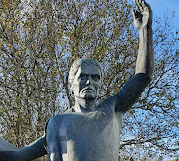
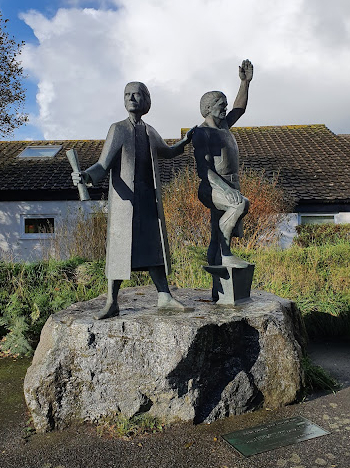
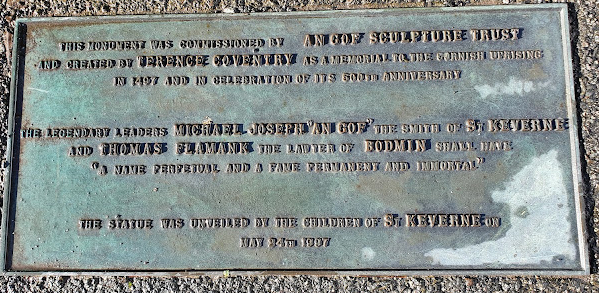
Statues of Michael Joseph An Gof and Thomas Flamank, St Keverne, by Terry Coventry. Unveiled 1997
Michael Joseph An Gof, beetle-browed, muscled, intent, one leg flexed defiantly upon the symbol of his profession. His left arm raised aloft, either in a form of greeting, salute, or of beckoning: gather here. Beside him, with his hand upon Michael Joseph’s shoulder in a gesture of camaraderie, is Thomas Flamank. Less developed physically than his vigorous companion, Flamank nevertheless carries an air of authority in his clothing and the scroll he carries: he is a lawyer, a literate man, an individual of substance.
All this is evident to us, as viewers. What we are also supposed to see, or sense, is the myth of An Gof and Flamank in their statues. As Roland Barthes wrote in Mythologies: “the reader lives the myth as a story at once true and unreal”, myths correspond to “the interests of a definite society” (Vintage, 2009, p153). What are we, as readers/viewers, supposed to make of the myth inherent in the statues of Michael Joseph and Thomas Flamank, and , furthermore, in whose interest has this myth been created?
In short, we are meant to appreciate that, in Michael Joseph and Thomas Flamank, are the first flowerings of Cornish nationalism and independence, a nationalism and independence that continues to this day. This Cornish self-determination is defined against a government that cares little or nothing for the people of Cornwall: in 1497, it was opposition to the taxes of Henry VII to fund war with Scotland; nowadays it is defined, by one commentator at least, as an objection to the Tory administration seeing Cornwall as little more than a “playground” for the wealthy. This sense of nationalism and independence, however, is presented to us in a peaceful, democratic form. Joseph, the blacksmith, and Flamank, the lawyer, cross boundaries of class in a stand of equality, united against English interests. Neither are armed; indeed, Joseph isn’t even brandishing that other symbol of his trade – a hammer. The only “weapon” on view is the scroll in Flamank’s hand, representing the petition objecting to the taxes that he and An Gof, at the head of the force who marched to London in 1497, were to present to the King.
We are supposed to recall their desire to “right a lot of wrongs” for the Cornish people, not just in 1497, but for all time, as is made clear when a speaker at the An GofCeremony of 2020 invokes Michael Joseph’s supposed last words, made shortly before his and Flamank’s execution. He
…should have a name perpetual, and a fame permanent and immortal. (From Cornwall – A History, by Philip Payton, Cornwall Editions 2004, p110.)
The keepers of this myth of An Gof and Flamank are, obviously, Cornwall’s various nationalist groups. For example, the plaque at Blackheath Common remembering the Cornish army’s billeting there in 1497 prior to the battle of Deptford Bridge, is sponsored by the Cornish Gorsedd.
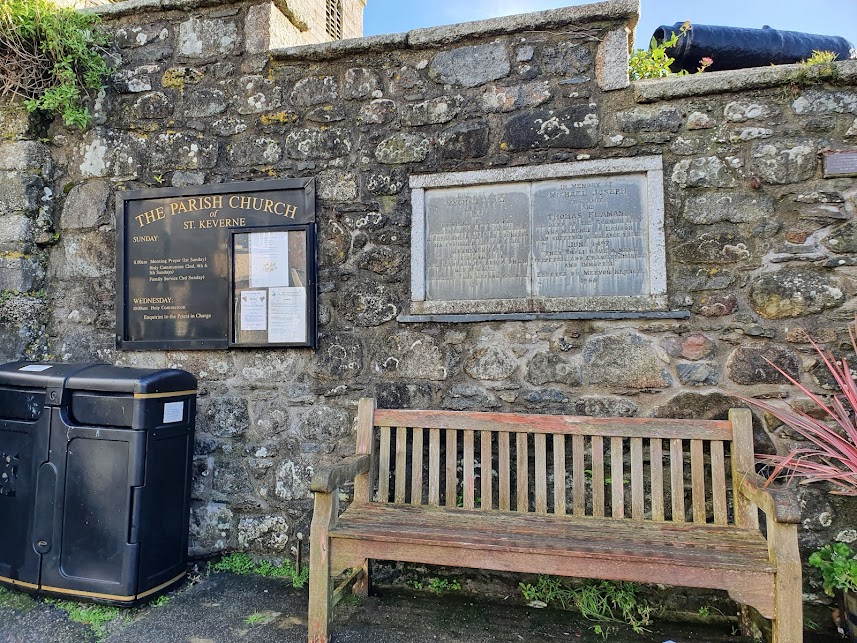
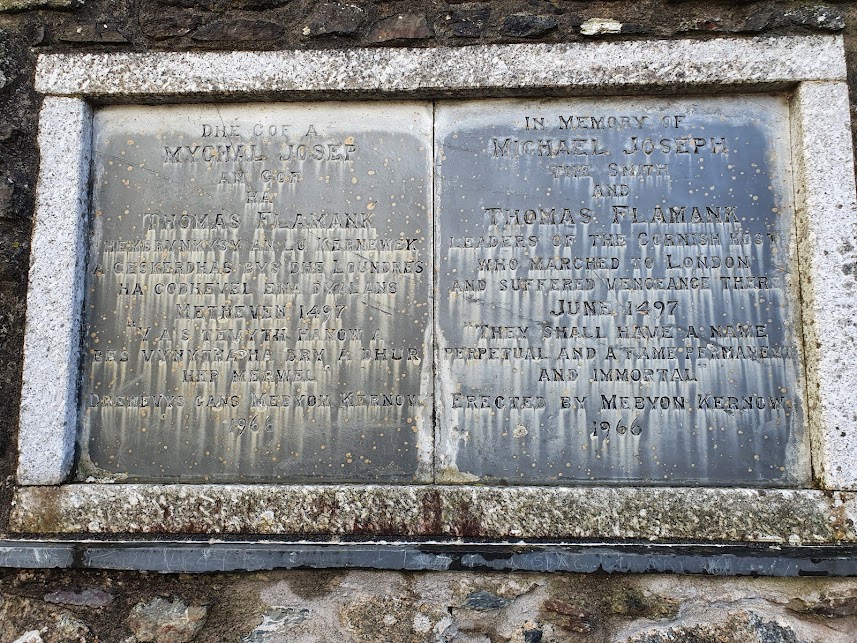
Another plaque, erected for Flamank and Joseph in 1966 at St Keverne church, was endorsed by Mebyon Kernow. Referencing this recently unveiled plaque and taking the theme of Cornish self-help, the Chairman of Cornwall Council, Alderman K. G. Foster, said in a speech that the Cornish
…needed a smith in Cornwall today, an An Gof to deal with the problems in Cornwall of its railways, its roads, and its mines. (From The Cornish Guardian, October 27, 1966, p1.)
The An Gof and Flamank plaque, St Keverne church. Erected by Mebyon Kernow, 1966. 1966 was the inaugural year of the annual An Gof memorial ceremony
The spirit of An Gof was, as we saw in my previous post, also invoked in 1990 by the Celtic League. To object to paying the unpopular Poll Tax of the time was something that Michael Joseph would have favoured, and, therefore, something for the Cornish to unite themselves behind.
1997 saw a great deal of An Gof and perhaps his apogee as a Cornish martyr. The statue of Michael Joseph and Flamank was unveiled, to mark the 500th anniversary of the rebellion, in St Keverne. There was also a much publicised march from St Keverne to Blackheath, with 30-40 people completing the 360-mile retracing of the Cornish rebels’ steps. This time, though, there was no hurdle to drag these “rebels” to Tyburn, but a genuine sense, or hope, that something had been achieved for Cornish self-determination:
…if as a result of all the publicity and the political will of the county’s MPs Cornwall does have a brighter future, then the efforts of An Gof, Flamank and their followers all those centuries ago will have been worthwhile. (From the West Briton, June 26, 1997, p23.)
Another reporter commented that
As An Gof, Flamank and their colleagues showed in 1497, a powerful – but peaceful – voice or gesture is sometimes needed to get the people who matter to sit up and take notice. (From the West Briton, May 29, 1997, p23.)
It was even argued that “another An Gof march” was needed regarding the travails of the Cornwall Development Agency (West Briton, July 31, 1997, p32).
It might be argued that An Gof has become less an historical figure than a symbol, a figure of hope to be conjured up in times of hardship, by Cornish nationalists and those with a vested interest in the independence of Cornwall, to return from a kind of Cornish Valhalla and free his people from the English yoke.
The difficulty inherent with myths, however, is that they are unstable. Remarks Barthes in Mythologies again: every object can be “open to appropriation”, for “there is no law…which forbids talking about things” (p132-3). One of the difficulties with the myth of An Gof is that, although the 1497 rebellion originated in St Keverne and acquired legal polish when Flamank joined its ranks in Bodmin, the man the rebels eventually named as their commander (or at the very least, military commander) was James Tuchet, 7th Baron of Audley, a noble “malcontent” from Somerset, writes Philip Payton in Cornwall – A History (p108). Like Michael Joseph and Flamank, he was executed after the Battle of Deptford Bridge, but is seldom if ever recalled as the leader. An Gof, on the other hand, is recalled by Cornwall Forever! as the man who “led an army to London”; he, along with Flamank, “emerged as leaders”, so much so that the rebellion of 1497 is “usually known as” the An Gof rebellion, according to Penwith Local History.
As Payton makes clear, though, even before the rebels left Cornwall, many other leaders had emerged (Cornwall – A History, p107). And, outside of Cornwall, the rebellion is interpreted very differently by historians. Writes Mark Stoyle:
The rebel force lost its exclusively Cornish nature once it had moved into England…for the Cornishmen were quickly joined by a rag-tag band of followers whose motives were as disparate as their geographical origins (“Cornish Rebellions, 1497-1648”, History Today, May 1997, p25).
Not once in Stoyle’s article does he mention Cornwall’s most famous rebel. In fact the above quote leads us to ask another question: just how democratic and peaceful was the nature of the original march on London? After all, it ended up with a pitched battle being fought, the rebels were definitely armed with cannon, and a detachment of Cornish archers initially put the Royal army to flight. Polydore Vergil, Henry VII’s official historian (so hardly neutral), has it that the
…men of Cornwall…began to get completely out of hand, threatening the authors of this great oppression with death, and daring to seek them out for punishment (from Payton, Cornwall – A History, p108-9).
More recently, and closer to home, the issue of the suitability of An Gof as a proto-democratic symbol and martyr has been raised. In 1966, commenting on the Mebyon Kernow-endorsed plaque to Joseph and Flamank recently erected in St Keverne, the West Briton remarked that, as the rebellions of 1497 (yes, there were two) were largely “abortive”,
…they are not historically the best of inspirations for present-day challenge to the English Government…(October 27, 1966, p13).
Even the proposed erecting of the statues of Michael Joseph and Flamank in the 1990s generated controversy. “An Gof statue divides village” screamed page 6 of the West Briton of May 30, 1996. After a stormy public meeting, Cornwall Council announced it would be objecting to proposed plans to erect the statues in St Keverne village square, outside the church. Due to “public opinion”, an alternative site would be sought. Although An Gof supporters stated that he was “a man who has been revered in Cornwall for 500 years”, a man “who laid down his life for St Keverne”, who “attempted to do something for the suffering of his people”, the naysayers held sway. They claimed the idea of the statue was “politically motivated”, with its possible proximity to St Keverne’s war memorial “offensive to those who served the crown”. An Gof was a rebel, and executed as a traitor, after all:
This whole project…glorifies rebellion and all that goes with it. It smacks of self-gratification and is an act of vandalism to our village square. It is sacrilegious to the church and all it represents.
The nimbys’ victory was pyrrhic, of course. The statue of Michael Joseph and Flamank was finally erected on the side of the main road into St Keverne. A spokesman for the Trust that had commissioned the work was pleased with the result, and stressed that the villagers were “enthusiastic”, even those originally against it. He also took pains to point out that his organisation was “non-political”. Even so, at the traditional An Gof and Flamank remembrance service that year, a wreath was laid at the foot of the statue, with the proceedings being conducted by a member of Mebyon Kernow. An Gof and his myth were being appropriated once more. (From the West Briton, June 19, 1997, p6.)
The other An Gof
Giew Mine, Cripplesease, nr Ludgvan, 1986. By John Luxton
The instability inherent in myth, and particularly here the unifying/democratic/peaceful/martyr myth of An Gof, has of course led to his name and reputation being hijacked by those who further destabilise the An Gof beloved of many Cornish nationalists.
Take a look at the above image, a crude piece of graffiti. This is the An Gof which rejects everything the other An Gof is supposed to represent. You might say that, yes, it’s a piece of vandalism – exactly the same charge levelled at the proposed location of the An Gof statue back in 1996.
The An Gof of the graffiti represents extremism, rebellion, violence, destruction and, in the faceless, random manner in which it operates, anarchy. In fact, this myth of An Gof springs from those aspects of the historical Michael Joseph that his eulogisers would rather have us forget – the “traitor”, rather than the “martyr”. It presents an extreme version of Cornish nationalism totally at odds with those of the democratic political parties in Cornwall. And if, as we have seen, An Gof is the champion of many democratic Cornish nationalists, any stain on his reputation, and therefore on the cause of Cornish nationalism, must be rebutted.
It happened in 1980: the alleged bombing of St Austell courthouse by a man using his name was a “slur on An Gof”, said the Mebyon Kernow chairman (West Briton, December 11, 1980, p1).
It happened in 1981, when the same party condemned An Gof’s claim that it had burned down a hair salon: they “are anti-Cornish vandals, not nationalists” (West Briton, January 15, 1981, p2).
And again in 1984: Mebyon Kernow and the Cornish Nationalist Party both stated they were helping the police in their efforts to stamp out the “idiot” An Gof movement (West Briton, February 23, 1984, p1).
Maybe it even happened on a much lesser scale in 2021, when my Facebook post asking for any information on An Gof with a view to writing about it was called a “deliberate” smear on pro-Cornish interests.
Another response to my request was from a prominent member of Mebyon Kernow: “only the first was a real event”. I took this to mean that only the 1980 bombing actually happened, and was the only event undeniably the work of An Gof. The other events on my list either didn’t happen (and weren’t worth bothering with), or were the work of copycat hoaxers using the An Gof name as cover. But this is precisely the point: of course all the other events covered in this study were imitations. In 1980, a person or persons unknown decided that one symbol of Cornish independence – Stannary Parliament – had failed to gain recognition for Cornish rights. They decided to commandeer for themselves another, more hostile symbol – An Gof – and resort to open violence and lawbreaking to achieve their ends. Quite simply, this An Gof concluded that democracy, or government, had failed. The next step for them was to attempt to overthrow the government, or at least make the gesture.
What happened was a complete inversion of the concept of Holyer An Gof, or Follower of The Smith, which was of course the bardic name of Len Truran, a key figure in democratic Cornish nationalism. (The Cornish Gorsedd honour Holyer An Gof as the title of one of their awards.) All the An Gofs that followed “An Gof 1980” took the first’s lead, for better or worse: the communication to local newspapers, the scare tactics, the arson and vandalism (or claims to such), the vague but emphatic statements of intent (which, my contact Kirsty said, amounted to little more than “English – out”), but above all, the name. To associate the name An Gof with such activities was to denigrate the cause of democratic Cornish nationalism, to equate, in some eyes, as Kirsty observed, Cornish nationalists with such groups as the IRA or the ETA. For example the Guardian in 2007 reported that Mebyon Kernow had spurned “bingo-hall arson for the ballot box”, a clear collation of an An Gof-related event (they falsely claimed to have burnt down a Redruth bingo-hall) with a democratic political party, which is as unfair as it is misleading. Kirsty reckoned a “credible political party” is needed for Cornwall, but how can any pro-Cornish democratic movement be taken seriously when there’s the danger of it being tarnished by a spurious association with An Gof?
Number 2 Court, Carlyon Road, St Austell, 8 December 1980. The courthouses closed in 1996. From the West Briton, December 11, 1980, p1
(Unless otherwise stated, the main text here is from the West Briton Argus, December 8, 1980, p1, and the West Briton, December 11, 1980, p1.)
An Gof or, more precisely, The An Gof 1980 Movement, made its appearance at around 9:35pm on Sunday, December 7, 1980. A telephone rang in the offices of The West Briton newspaper, and a journalist answered. A man was at the other end, “quietly spoken and unhurried”. In his unflustered manner this man claimed to be a spokesman for his group, The An Gof 1980 Movement, and that said group was responsible for the explosion in the St. Austell courthouse, on Carlyon Road, that had taken place in the early hours of Sunday morning. Making sure the reporter would talk to the police after his call, The An Gof 1980 Movement then described how the bomb had been detonated by hand, and contained “conventional” high explosive with a safety fuse ignition. In conversation with the investigating officers, The West Briton concluded that the caller had “some knowledge which only the perpetrator or an accomplice would know”: a window had indeed been smashed and the bomb dropped through it. An Gof also made the following statements:
i) the movement had been in existence for over a year;
ii) there would be other attacks against “English councillors and Communist infiltrators in the Cornish nationalist movement”, that they will “really need to sweat”;
iii) more attacks should be expected; and, just before An Gof’s change ran out on his payphone,
iv) “St Austell has been instrumental in purging the Stannary…”, and the line went dead.
If, in the digital age, anonymous phonecallers issuing threats yet forgetting to have enough change to deliver their message seems rather quaint, The An Gof 1980 Movement were taken seriously enough at the time. After all, a call from a payphone to a local newsroom was the method of claiming responsibility for a terror bombing by the IRA on at least one occasion (as reported in the Belfast Telegraph, July 28, 1970, p3). And the bombing of St Austell courthouse was a serious act. “Considerable” structural damage was caused by the blast in Number 2 court and the magistrates’ retiring room, with cracked walls, broken windows and skylights, and doors busted off their hinges.
Serious enough for an incident room to be set up in St Austell. Serious enough for an investigation involving over forty policemen to be mounted, run by Devon and Cornwall CID. Serious enough for the Special Branch to be kept informed. Serious enough for analysis of the device and explosive used to be carried out by Chepstow police forensic laboratory, with assistance by Home Office scientists. Serious enough for the search for the perpetrators to be conducted county-wide. In St Austell itself, the police were reported to be seeking a man seen standing near the courthouse in a carpark at 1am Sunday morning, the owners of any vehicle parked in the carpark that night, and two cars seen speeding down Carlyon Road within minutes of the explosion.
They also took An Gof’s call seriously, as did the various, more mainstream and democratically-minded Cornish nationalist groups, whom the police questioned about An Gof 1980. The police had never heard of this group, and nor had the Cornish nationalists they spoke to – understandably, they sought to distance themselves from the bombing and the suggestion it was the work of a nationalist terror cell, or more likely (or hopefully), “some crank”.
Mebyon Kernow stated that, yes, their secretariat had been called “An Gof” at one time, but this department was disbanded. It had been headed by Len Truran, one of the people heavily influential in turning Mebyon Kernow into a fully fledged political party in the early 1970s. Truran himself stated that he was “horrified” that violence should be happening in Cornwall, and “felt sure” none of the nationalist groups were responsible for what was hopefully an isolated incident.
(According to Truran’s biography, Following An Gof by Derek Williams (2014), in September 1980 Truran had been made a bard of Gorsedh Kernow and took the name Holyer An Gof, or Follower of An Gof (p1). Truran must have found it deeply uncomfortable to have the name of a man he so obviously revered, and adopted, presented in such a lurid light. The biography doesn’t mention the bombing, An Gof 1980, or Truran’s reaction.)
And the condemnations continued. The use of the name “An Gof” was “deplored”, a “slur” on the memory of a Cornish patriot, as was the use of violence. The Mebyon Kernow secretary at the time, Peter Prior, said the explosion was
…in no way the reflection of a vast national feeling in Cornwall…it is not our way at all. In An Gof’s day, you used the musket. Now we use the ballot box.
(Incidentally, the musket as a weapon was not developed until the 1520s.)
A spokesman for the Cornish Nationalist Party thought the anonymous caller to be a man with a “private grudge” and was trying to link the attack with the nationalist movement for some reason.
Brian Hambley, Lord Protector of the Revived Cornish Stannary Parliament, said the people of his organisation were strongly against the use of violence. Such activities were liable to alienate support for his cause, especially when we recall that the man purportedly speaking for An Gof 1980 stated that St Austell was “responsible” for “purging” the Stannary cause. The implication here was that anyone connected with the Stannary revival (a movement begun in the 1970s to resurrect the ancient rights and independence of Cornish miners and tinners) would perhaps have good reason to attack St Austell’s symbol of loyalty to the English government: its courthouse.
Hambley, who was a St Austell man, omitted to mention his own recent visit to the courthouse. The ‘papers noted that the court, as it had dealt with a “number of nationalists” over the years in cases of non-payment of road taxes, may have been a target for extremists. In 1978 Hambley had been in the dock for refusing to pay his road tax, claiming in defence that as a “privileged tinner” he was exempt from duties owed to the crown and, furthermore, could only be tried in a Stannary court. To cut a rather complex tale of ancient documents and Latin language short, St Austell court first found in his favour, with the prosecution ordered to pay his costs. Hambley was quoted in the West Briton of June 22, 1978 as his victory being “the dawning of a day when Cornwall comes into its own”. More sceptically, as the West Briton noted the implications of thousands of Cornish people observing the precedent set by Hambley’s case and refusing to pay taxes themselves, it commented that “the fabric of local law enforcement could be in tatters”, and that the case “is no longer a comedy” (p11).
Perhaps inevitably, the verdict on Hambley’s case was overturned on appeal, and he was fined and had to pay costs. The tale can be followed in the West Briton of 19 June, 1978 (p9), 22 June, 1978 (p11), 14 December, 1978 (p4), and 8 March, 1979 (p9).
Hambley wasn’t the only Stannary man to be fined by St Austell court. Frederick Trull, the original reviver of Stannary Parliament after a two-hundred year lapse, was caught speeding in 1975, flooring his motor down Stannary Road in Stenalees, St Austell. (You get the impression this may have been an ill-advised publicity stunt.) Trull was suspended from the Stannary and, at his hearing, attempted to arrest the magistrates, clerk, and prosecuting solicitor, it being his belief that, in trying a member of Stannary Parliament, they were breaking the law. He was found guilty and fined whilst being held in custody. Trull’s conscience, he was quoted as saying, was “quite clear”. (From the West Briton, March 6, 1975, p11.)
One person I interviewed, let’s call them Geoff, remembers the bombing in St Austell, the connection with An Gof, and the reactions of people at the time. They had sympathy for what An Gof were trying to achieve, which was an assertion of Cornishness in the face of outside interests and agendas exploiting the county and its people. The Cornish, Geoff told me, “were seen by An Gof as an oppressed people, who had no representation”. Hence An Gof 1980’s criticism of the Cornish nationalist movement at the time. However, Geoff recalled that, at the time, few people in Cornwall – and elsewhere – supported their methods. Another person I spoke to, we’ll name them Kirsty, recollects that most “mature Cornish people thought they were a bunch of cranks and didn’t support their methods.” It seems that, even at the inception of An Gof’s activities, Cornish politicians and the majority of Cornish people alike were dimissive of their acts.
But the caller from An Gof 1980 said more attacks should be expected…
2. Season’s greetings
On December 29, 1980, Peter Prior of Mebyon Kernow received a phonecall “purporting to be from An Gof”, calling for him to resign. Prior’s response in the West Briton of January 15, 1981, was emphatic:
I am not resigning, certainly not. I don’t believe in giving in to this sort of intimidation (p2).
Why an alleged extreme nationalist group would want a fellow Cornish nationalist to throw in the towel is unclear.
3. The Penzance arson
The early hours of New Year’s Day 1981 was a busy one for 25 firefighters from Penzance, St Keverne, St Ives, and Camborne. The Victoria and Albert hair salon, on Causewayhead, Penzance, was ablaze, the inferno eventually causing a reported £15,000 of damage, or around £58,000 today. Obviously a “considerable” amount of wreckage was caused by the fire, and not just to the Victoria and Albert. The fire caused smoke damage to the offices of the Bristol and West Building Society, whose building it was. The police, reported the West Briton of January 8, 1981, were “treating the outbreak as one of arson”, that the fire was started intentionally (p3).
In the week after the above article was published, the police incident room at Truro dealing with the St Austell bombing had to extend their inquiries to include the arson in Penzance. The An Gof 1980 Movement had made two phonecalls to separate newspaper offices, claiming responsbility for the fire. Det. Sup. Geoffrey Warren, commander of the incident squad, stated
We have a strong belief the calls could be coming from one source. There is a similarity between them.
The An Gof on the line this time, besides admitting to the arson, said in a call to the West Briton that his movement were seeking national status for Cornwall, and that “more attacks will follow” if this was not achieved. On the same day (January 8), the offices of the Cornishman newspaper in Penzance received a call from an An Gof, who stated that the next attack would also be of an incendiary nature, but not in Penzance. He said that
We are a guerilla movement and we take as much terrorist action as we need. (From the West Briton, January 15, 1981, p2.)
The “similarities” between the caller, or the An Gof, from St Austell and the Penzance An Gof were superficial: a man from an extreme nationalist group claiming responsibility for an attack in the name of Cornish independence and promising further outrages. In St Austell, the call was made before the bombing was public knowledge, by a man with definite inside knowledge of how the device was made and detonated. There was also a clear reason or motive for the attack, in the connection with the court and the Stannary trials. In contrast, the Penzance An Gof made his calls on precisely the same day as details of the alleged arson were made public: the West Briton of January 8. They provided no information as to how the fire was started, or why a hair salon in a property owned by a building society would be a genuine target for a group of Cornish terrorists.
Maybe the An Gof of St Austell and Penzance were one and the same man, and were behind both attacks, whether or on their own or as part of an organisation. Or the St Austell An Gof, when reading of the Penzance arson in the ‘paper, thought it might be just the kind of event he, or they, could embellish with some nationalist statements. Or yet again, there may have been two An Gof cells, one in St Austell and one in Penzance. Or a Cornish nationalist may have taken it upon themselves to put on the An Gof cloak and stake a claim on the Penzance arson in the cause of independence. Or the calls in Penzance were simply the work of a mischevious hoaxer, or hoaxers. More cynically, my contact Kirsty thinks of the arson “as an insurance job”, and unlikely to be the work of a genuine An Gof.
It’s largely forgotten, now, that 1981 was a bad year for cases of suspected arson in Penzance. A health food store and a warehouse on Old Brewery Yard were completely gutted in October, causing £200,000 of damage – or £784,000 today. £50,000 (£196,000 in 2021) of fire-damage was caused in December to another shop on Causewayhead. In these instances, no An Gof stepped forward to claim this handiwork as their own. We might conclude, then, that anonymous arson was the most likely cause of the salon fire. (From the West Briton, October 22, p11, and December 17, p11.)
The police could make no inroads into the identity of An Gof, and over the weeks the dual investigation ran down. No arrests were made, and in the West Briton of February 12, 1981, Det. Sup. Warren was quoted as saying that
…whether there was a nationalist movement called An Gof or whether the explosion had been the work of an individual with a grudge had not been established (p27).
The main similarities between the St Austell bombing and the Penzance arson was the condemnation of the alleged An Gof involvement by the democratic Cornish nationalists. Richard Jenkins, chair of Mebyon Kernow, declared in the West Briton of January 15, 1981 that
The bombers are a hindrance to the cause of Cornwall’s nationality and are anti-Cornish vandals, not nationalists. We do not believe they care for Cornwall and we condemn them utterly (p2).
It is with some irony, then, that the alleged desire of these “anti-Cornish” vandals – independence for Cornwall – were the same hopes and dreams of the members of Mebyon Kernow. Obviously it was the method, not the message, that the politicians didn’t care for.
Nothing much was heard from An Gof for the next few years.
4. 1984. The “glass on the beach” legend, a councillor silenced, other stunts, and, finally, an arrest
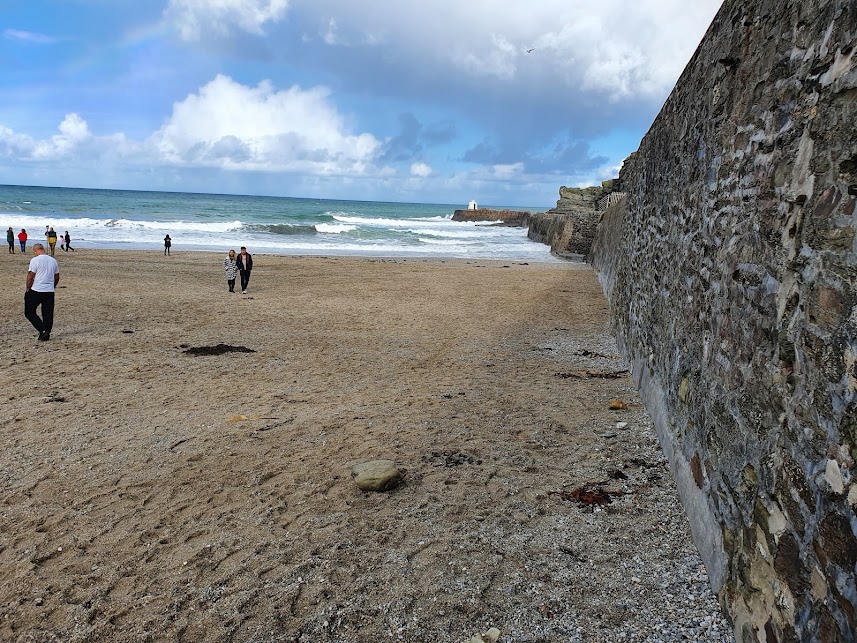
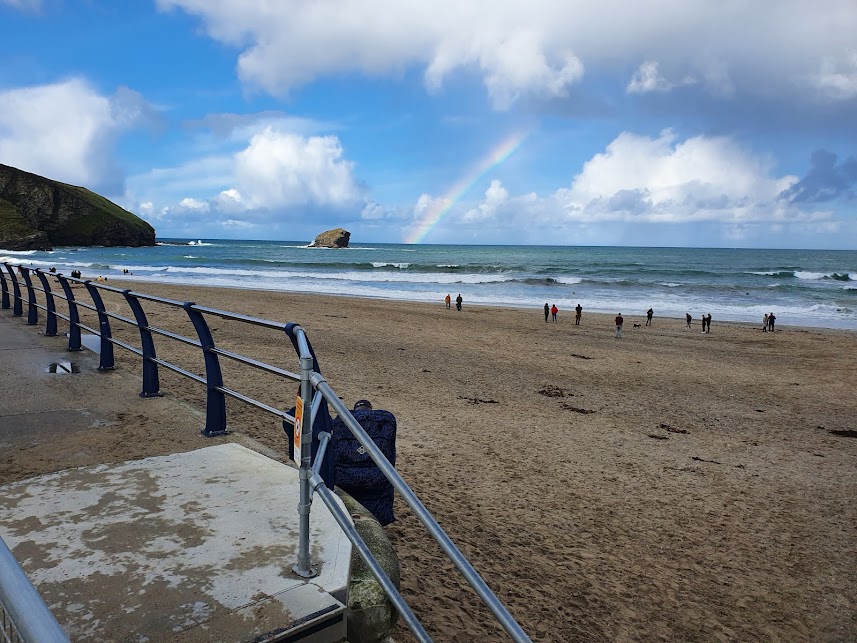
Portreath Beach, November 2021. Scene of An Gof‘s most notorious outrage in 1984?
Enraged by the fact that “outsiders” were smarter than them…An Gof decided to act. They met in a telephone box to discuss tactics…Their average age was 17…Having hatched a deadly plan they drove to the popular beach at Portreath and lined the sands with hundreds of broken bottles…They went home…and drank copious amounts of cider in celebration…Many a Cornish foot needed treatment and many of those feet belonged to local children…a display of incredible ineptitude.
The above is taken from the entry for Camborne on the ilivehere.co.uk website. I don’t know who wrote it, and I could care less. Most of it, for want of a better phrase, is bullshit. However, the urban legend of An Gof putting glass on the beaches to deter tourists is a somewhat persistent one. It’s treated as fact in a blog of 2012, and this blog is one of the sources for the Wikipediaentry for An Gof when it mentions the group placing broken glass on the beach. The other Wikipedia source is from the Falmouth Packet of 2007: An Gof “claimed reponsibility…for placing broken glass in the sand at Portreath…”.
Most legends, or myths, have some basis in historical fact, however. So what’s actually the truth behind this one?
Wednesday, January 11, 1984. A phone rings in the offices of the West Briton, Redruth. Coincidentally, the journalist picking up was the same reporter who had taken the call from An Gof 1980 in connection with the St Austell bombing, but the caller was someone else. This time the reporter had to ask the man at the other end whom he represented. The answer he got was: An Gof. And the warnings and statements of this An Gof were as follows:
i) They had “the intention to take the Cornish nationalist cause to the beaches”;
ii) An Gof would be “planting anti-personnel devices” on the beaches over the summer;
iii) these devices would consist of nails driven through timber, tool knives, and broken bottles. “Horrific injuries could be caused”, warned An Gof;
iv) this was An Gof’s way of hitting at “English” administration and Cornwall’s Tourist Board, and it was up to them, the press and media to warn holidaymakers that these devices were being “indiscriminately placed…throughout the summer”.
As a demonstration of their sincerity, An Gof instructed the reporter to go to Portreath beach, where a sample of a “non-explosive device” had been placed. The reporter did as he was told, and found, in front of a yellow drum placed as a marker, two broken bottles with their “jagged ends” facing up out of the sand. Police were said to be treating it as an isolated incident. (From the West Briton, January 12, 1984, p1.)
This is the only recorded factual instance of glass or broken bottles being deliberately placed on any Cornish beach, by An Gof or anybody else. So, yes, technically speaking, An Gof did place glass on the beach to deter tourists. But only with two bottles, on one beach, once, in January (Portreath beach in January is as barren as it looks in November, if not more so – see the above photos), and they marked the spot with a drum so that, presumably, people would walk around the area anyway. And who knows how long it was there, before the reporter discovered it? Hours, at best? If An Gof had wanted to cause some real damage, would it not have been better – or worse – for this to have been carried out in, say, July? Perhaps An Gof’s timing is as bad as mine supposedly is.
But the myth took on a life of its own, almost immediately. One person I spoke to, “Dave”, was a lifeguard back in 1984. Dave remembered “plenty of people” being concerned and asking about the glass, though Dave believes the attacks never “took place”. Dave would have reassured these people – locals, visitors – but how many were put off holidaymaking on the Cornish coast back in 1984? All I know is, I was almost definitely running round on Portreath beach that summer, and all I got on my feet was tar off the rocks.
(On Thursday January 19, a piece of card was found in the post room of the West Briton’s Redruth office, stating there was a booby trap on Falmouth beach, near the cafe. Nothing was found. It’s unclear if An Gof sent the message. From the West Briton, January 26, p1.)
The Zodiac Bingo Hall, Redruth, 1984. From the West Briton, January 26, p6
1984 was perhaps An Gof’s most prolific year, at least in terms of telephone calls, claiming to be the unseen hand behind various unsavoury activities. On Sunday, January 22, 1984, the Zodiac Bingo Hall on Penryn Street, Redruth, burnt to the ground, causing £250,000 of damage – that’s £821,000 today. The phonecall from An Gof went to a local newspaper on the Monday, stating that “One of our active service units caused the fire at Redruth last night”. The cause, in fact, was a defect in the heating system. (From the West Briton, January 26, p1&6.)
Beacon Village Hall, Tolcarne Rd, 2021. Formerly the village school. Not blown to smithereens in 1984
An Gof also claimed, in one of their calls on Monday January 23, to be responsible for the attempt to blow up the village hall in Beacon. This amateurish attempt at arson (a lit candle placed under a cut gas main) had been foiled by the caretaker of the hall opening the main door, and all the gas rushing out. This happened on January 15; An Gof made their claim eight days later. Why, asked a police officer, “didn’t they make their claim before?” Why, we might add, would the arson of the Zodiac and a village hall further the cause of Cornish independence? Like a “Monty Python sketch”, thought Kirsty, when asked about these events.
If not before, we begin to get the impression at this point that the activities of An Gof were beginning to verge on the juvenile. However, the police thought the threat serious enough to set up an incident room in Truro, and collate all known information about the group – if group it was. (From the West Briton, January 26, p1.)
They soon had some more paperwork for their burgeoning file, with another call from An Gof to a newspaper in February. This was another warning, which resulted in the police visiting Wendron Forge (which of course later became the Poldark Mine attraction), to examine a suspicious package. They discovered a biscuit tin from which protruded a short length of singed rope. Exercising caution, they summoned the Navy bomb disposal unit from Plymouth, who discovered a substance inside which “may or may not have been inflammable”. Treating the incident as a “malicious hoax”, nevertheless the public were warned by the police not to handle suspicious letters or packages. After all, it was not known how malevolent the An Gof movement was. Their inflammatory rhetoric in a press release to the West Briton which threatened a “new wave of military action” against “the self-styled tourist industry – the few who make profits out of Cornish people”, with anti-personnel devices targeting “non-Cornish owned holiday concerns of all kinds”, certainly sounded ominous enough. More suspicious – yet harmless – packages arrived at the offices of The South West Water Board. (From the West Briton, February 23, p1.)
Again, condemnation by Cornwall’s nationalist politicians was immediate. Mebyon Kernow’s deputy chairman, Richard Jenkin, said that An Gof had no real policies, that their actions were
…completely ridiculous, the action of idiots. I do not think there are more than two or three of them and I do not expect there is any sort of organisation at all. They spur one another on to do these stupid things.
His comments were echoed by the MK’s chairman, who bluntly dismissed the activities of An Gof as “completely mad”. The Cornish Nationalist Party described the unknown perpetrators and their tactics as a “bit sad and worrying”. (West Briton, February 23, 1984, p1.)
One person found An Gof worrying enough, however, and he was Peter Young, the founder of the Wendron Forge holiday attraction (though I always remember it as Ha’penny Park). Young came to Cornwall in the 1960s, and his “holiday concern”, to paraphrase the extremists’ press release quoted in the West Briton (see above), had obviously been singled out by An Gof. As a Kerrier Councillor, Young was due to speak in a council meeting regarding whether Kerrier should support Mebyon Kernow’s petition and campaign for a separate European MP for Cornwall. The petition was to be forwarded to the European Parliament, in which it questioned the legality of the Boundary Commission’s recent decision to maintain the Euro-constituency of Cornwall and Plymouth. Would Kerrier back it?
It’s unclear what tone Young’s speech on the matter was to take: he never delivered it. The report continues:
Mr Young was about to speak…when he decided it would be against his interests to do so, in the light of a recent hoax bomb device which was found on his property at Wendron, for which the An Gof movement claimed responsibility…He also claimed his home was being watched.
In what was described as an “emotive” address, Young announced it was now impossible for him to speak openly about Cornish nationalism, that he “cannot take the risk” of anything he says on the subject being reported. His “personal well-being” had been threatened.
Kerrier Council, at the conclusion of the meeting, opted to support Mebyon Kernow’s petition. What Mebyon Kernow thought of all this is unknown; after all, An Gof was nothing to do with them. (From the West Briton, March 29, 1984, p7.)
Later that year, however, Mebyon Kernow claimed a “minor victory” when they were informed that they had “won the right” to take their campaign for a Cornwall-only Euro-constituency to the European Parliament. (From the West Briton, February 23, p1, March 29, p7, and June 21, p6.)
The incident regarding Peter Young perhaps represents An Gof at its most sinister. There was no explosion, no random publicity stunt, no false claims, no denunciations by Mebyon Kernow or the Cornish Nationalist Party. Young was targeted, or at the very least, he certainly thought so. Wikipedia and the few other sources I mention above that tend to “print the legend” of An Gof make no allusion to it. They give reference to the more noisy events, such as the bombing at St Austell, or the downright mindless and bungled, such as the glass on the beach or the “attempt” at arson in Beacon. This is, as far as I can ascertain, the only instance of where An Gof’s scare-tactics (I hesitate to use the word terror) possibly succeeded in furthering an extreme version of Cornish nationalism. Of course, we do not know what Peter Young was supposed to say in that meeting. He might have fully endorsed the petition, or he might have rejected it out of hand. But, if An Gof’s aims were indeed to target and intimidate those who made profit from the Cornish tourist industry, here, sadly, they achieved it.
You could, of course, turn the above argument on its head: An Gof, or whoever planted the hoax device, had chosen Wendron Forge at random and it was sheer coincidence that a councillor was the owner. His believing his property, and himself, to be under surveillance was the result of an overactive imagination. However, it was reported in the West Briton of February 23, 1984, that Peter Young was in fact in the process of moving to Wendron Forge (p8). Following this, An Gof, given their inclinations, would certainly not agree with Young’s enthusiasm, reported in the West Briton of January 12, 1984, for a Kerrier scheme to give American firms and businesses a toehold in the area (p3). If one thing can be certain about An Gof, it was this: they definitely made regular use of the West Briton.
Two more An Gof-related events from 1984. First, in April, there was a senseless attack of arson on a burger van in Park Bottom, Illogan. No one was hurt, but two children were asleep inside the van when the fire was started. Hours after this, An Gof phoned the West Briton to claim responsibility, but apologised for involving “innocent people”: they’d hit the wrong target. The caller said the members of their “commando unit” who’d fouled-up the attack would be punished. Who, or what, the actual target was meant to be is unclear, or indeed why they were to be targeted in the first place. A policeman stated that
This group…may or may not exist…I do not know of anyone who has admitted to being in such an organisation (the West Briton, April 19, p4.)
There was only one arrest, in August, and this person admitted to being a member of An Gof. However, he was an alcoholic schoolteacher from Mounts Bay, who had been caught making a hoax call to Devon and Cornwall Police Headquarters in Exeter, threatening to blow the place up. On his arrest, he was said to have confessed to being involved with the group. It was later satisfactorily proven that he wasn’t. He was fined £100, with costs. (From the West Briton, August 30, p1.)
5. 1990. Another public figure is threatened
After a seeming lapse in activities of six years, An Gof gave the Cornwall branch secretary of the democratic Celtic League, Ian Williams, of Redruth, an alleged “death threat” made by phone in March 1990.
Williams brushed it off. He didn’t even bother reporting it to the police, so far had An Gof’s credibility fallen (and it was probably never especially high) since the early to mid-80s. He told the press:
I have not done anything that would justify the threat…I don’t know of any instance where this threat has been carried out in Cornwall…if there is such an organisation as An Gof I don’t believe they would attack another Cornish man or woman in this way.
The Celtic League unsurprisingly condemned the issuer of the threat made against one of their members. They also took umbrage at the caller’s use of the pseudonym An Gof. They were
…bringing the name of the 1497 martyred St Keverne blacksmith into disrepute. An Gof, they [the League] say, “united the Cornish people at a time when unfair taxes, much like the present Poll Tax, were being imposed on Cornwall’s people.” (The West Briton, March 15, 1990, p3.)
And this seems like a good moment to draw this post to a close. So far, we have been discussing one version, or representation, of An Gof. There are, in fact, two.
Follow this link, The Two An Gofs, to read part three. Thanks!
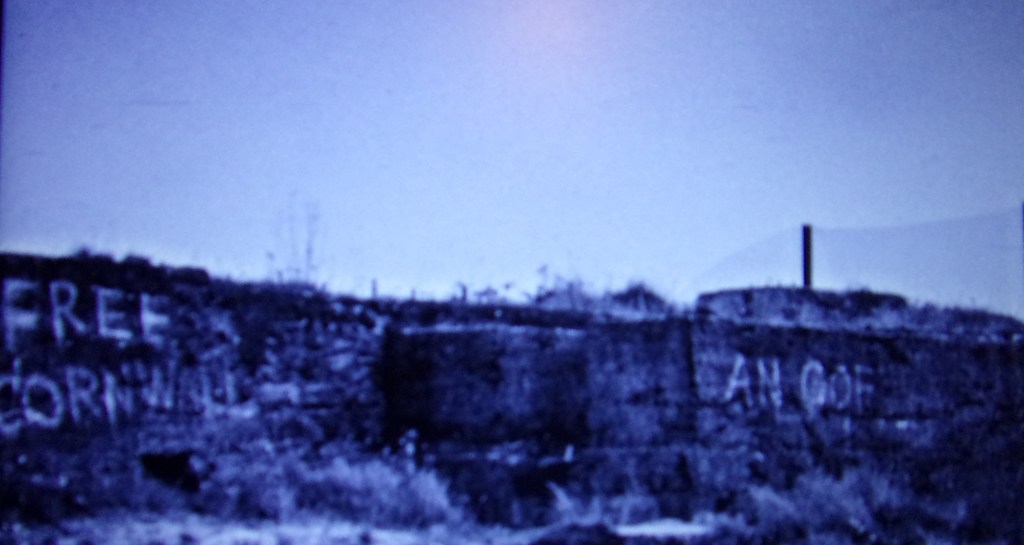
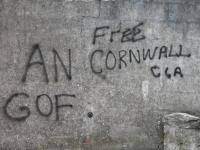
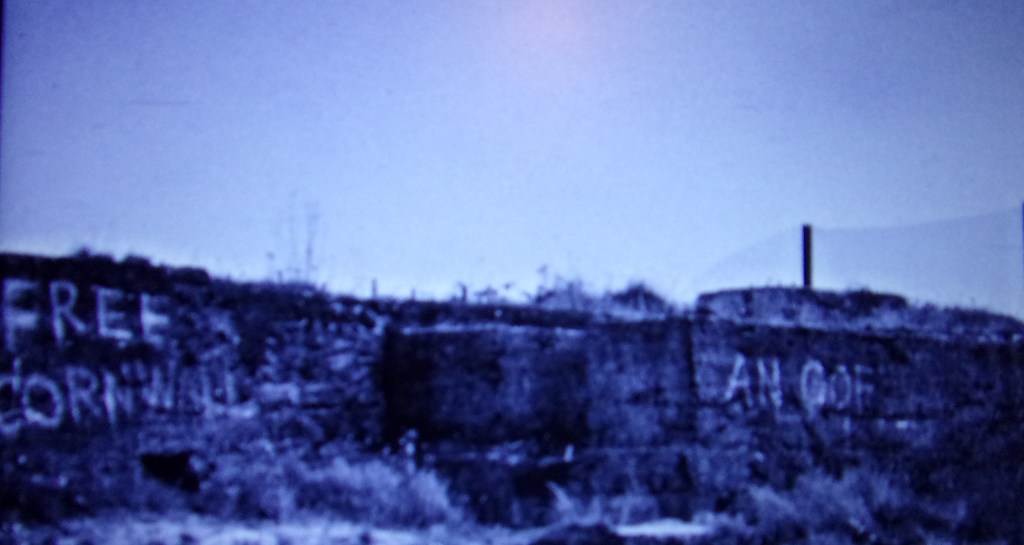
An Gof was seemingly everywhere in 1980s Camborne, when I was growing up. I’m not, obviously, referring to the historical figure of Michael Joseph An Gof – who we shall touch on later – or local historical societies holding public meetings devoted to the events of his life, or even memorable school lessons on the subject of An Gof and the Cornish Rebellion of 1497. (Cornish history wasn’t taught in any of my schools.) No, I’m here referring to the graffiti that was somewhat ubiquitous in the town and elsewhere during those years. No crumbling piece of masonry, road sign, or long-closed mine building was complete without something like the following legend crudely sprayed over it:
Giew Mine, Cripplesease, nr Ludgvan, 1986. By John Luxton
I remember, at the time, giving some thought to what this slogan was supposed to mean, or signify. Free Cornwall: from what, or whom? Is Cornwall, and by extension the Cornish, imprisoned, or enslaved? And, more ambiguously, who the hell is “An Gof”? Are they the person to free Cornwall? Are they an organisation, more than one person? And, seeing as I’m Cornish, isn’t therefore An Gof’s incitement – to free Cornwall, thus freeing myself – something I ought to be endorsing too?
Problem was, Camborne’s elusive, shadowy An Gof never did manage to free Cornwall. All he, or she, or they, seemed to do, was daub brickwork with their emancipating mantra, and my interest waned. A few years later, when I was working (seasonally, of course) in a factory, a colleague confessed in the smokers’ room to knowing one of the An Gof graffiti artists. This workmate then proceeded to fill me in on the details of the genuine Michael Joseph An Gof (Cornish: “the smith”) and his rebellion. An Gof, he told me, had been a Cornish freedom fighter, and his pals had taken the name to represent their own, rather less mature, desires. Occasionally turning the “A” of An Gof into the symbol for anarchy had, they reckoned, given their calling card an extra dimension of revolutionary fervour. (I remember drawing on my fag and nodding sagely.)
But how serious was all this? I also recalled being warned, as a child, about glass in the sand when playing on Portreath beach, and that the same people doing the graffiti were probably responsible for that stunt as well. But was this the act of some bona fide revolutionaries? How is a gashed foot going to “free” anyone? A friend from Camborne described the glass on the beach as “f**king stupid”, and I’m inclined to agree.
Idiotic or not, the question about sincerity remained. What other acts have been attributed to, or claimed by, this An Gof over the years? Wanting a quick answer, I sought out the Wikipedia entry for the supposed An Gof movement and made a list. I then thought it might be a good idea to see if other people could recall the events on this list, to get a personal angle on my research. On October 12, 2021 I put the following post, with a request to email me with any information, on the Cornish History Facebook page:
I’m currently looking into the “An Gof” attacks of the 1980s. If anyone has recollection of, or connection with, the below events, please get in touch. Many thanks
The bombing of St Austell courthouse, 1980
The bombing of a Penzance hairdresser, 1981
Beacon Village Hall fire, 1984
Zodiac Bingo Hall fire, Redruth, 1984
Glass on Portreath Beach, 1984
Some of the comments I received were less than favourable:
I can tell you now that most of this is urban myth. And how strange that at a time when so many of us are working so hard to protect Cornwall, someone finds it necessary to drag up this utter rubbish again. Is there an agenda here?
Or:
It is interesting that the minute the Cornish movement starts becoming visible…there is this rake up of an anglo-myth of Cornish terrorism. If it isn’t an agenda, then it is at best poor timing.
And again, the alleged An Gof attacks were dismissed as:
…fantasy. The myth of Cornish terrorism rises every time the Cornish get up off our knees. It is tiring at best, and deliberate smears at worst.
So, before I’d written my blog or aired an opinion, my work was being tarred and feathered as propagating a supposed anti-Cornish myth that all Cornish nationalists are extremist cranks. And, as all this An Gof stuff was utter nonsense anyway, it didn’t deserve to be written about. Furthermore, my request was then linked in with another recent essay on Cornish nationalism that touched on the An Gof attacks. The person writing this comment on Facebook alleged that the publisher of this piece has decidedly left-wing, even Communist, sympathies. I took the inference to be that my outlook might be similar.
So, not only am I anti-Cornish in writing this post, I might be a raving Marxist too. Oh – and I’ve bad timing as well. At best, this is laughable; at worst, it’s insulting.
Thankfully, the above were the worst comments. Others responded to my request in a positive, even defensive, light. One or two others, outside of Facebook, have even agreed to speak to me as regards An Gof in the 1980s, and for that I am thankful. I’ve also been in touch with the Penzance Old Cornwall Society, asking if any of their members recall the events in early 1981. To date, no response. The St Austell Old Cornwall Society told me that none of their members were able to help, and their former chairman informed me by email that he was “not aware” of any bombing in St Austell in 1980.
All this served to tell me that, myth or not, genuine movement or not (the Wikipedia entry for “Cornish Nationalism” states that it’s “far from clear” if there ever was a movement), the subject of the events attributed to, or claimed by, An Gof, still upsets Cornish nationalists, even forty years on. Why get so worked up about something that’s mere myth, or fantasy? Finding the answer to this question might be worth writing about.
If I must have an agenda for this post, then let it simply be this: as someone who experienced, albeit somewhat remotely, An Gof in my youth, I have a desire to discover more about the subject, and report my findings. I also want to find out why my subject is, in some circles, taboo. As I have written rather a lot, I’ve broken my work down into four separate posts, the first of which is this introduction. The second post, Person or Persons Unknown, is a survey of all the alleged An Gof activities, from 1980-1990, and an analysis of the public’s reactions to them, as well as the reactions of Cornish nationalists. The third post, The Two An Gofs, discusses why many Cornish nationalists have such cultural cache in a version of An Gof totally at odds with the activities of those outlined in Person or Persons Unknown, and the problems inherent in their version. In the final post, An Gof Today?, I’m going to look briefly at An Gof’sactivities in more recent times, and what can be learnt from their history as a whole, as regards Cornish nationalism and the challenges facing Cornwall today.
Service papers, Pte. William George Edwards, Australian Imperial Forces
See boy, you know my Father ‘ad two brothers that were killed in First World War, didn’t ee..?
No, I didn’t know that. In fact, I knew very little about my Family Tree until my uncle told me I had two great-uncles (brothers of my paternal grandfather), that had died in the 1914-18 war. That was the catalyst for my investigations, investigations that dredged up many unknown facts and comprehensively debunked several accepted family truths.
I was also aware that a great many of my relatives were renowned storytellers. That’s been the main method of recording history in the family, as I imagine it is for many others. Some of the tales they told were so irresistible I had to get sleuthing.
What follows is not an extended outline or discussion of all facets and branches of my Family Tree. Although every closet (the Andrews, Williams, Coles etc) has the odd skeleton, I’ve plumped for the edited highlights of the Edwards line.
Of course, I knew the basics about my family. My mother was one of eight children, who grew up in Illogan – Paynters Lane End. My father, one of twelve, grew up in Laity Road, Troon. I have approximately thirty cousins, and God knows how many second ones. This often bewildering number of relatives always discouraged any familial research as just that – bewildering – until I realised that, nowadays, as genealogy is big business, you can unearth a lot sat at home.
Practically any historical document relating to genealogical research – census returns, prison records, army service papers – are available online, for a fee. (Some are mercifully buckshee too.) You no longer have to spend hours in libraries or archives, or go to evening classes, or take grave rubbings, to discover your ancestors. All you need is a laptop and a little expendable income.
That’s not to say finding out where you came from is any easier, it’s just that the approach has changed. Scrolling through page after page of countless hits on your browser is just as arduous and, yes, boring as squinting at a microfilm reader or leafing through those massive leather-bound indexes at the General Register Office. Online research has its own frustrations: clicking to view the record you’re convinced is the one only to be told you’ll have to get your wallet out first and gamble on your convictions, can make you sign out in parsimonious disgust. Plus, the deeper, or further back, you dig, you’re liable to discover records simply aren’t available online. For example, if you want birth, marriage or death records before 1837, you’ll have to check parish records. And that normally means visiting county archives. And that might mean the records simply don’t exist period.
Not again…
If you do need to go further back, or dig deeper, contact me…
Australia
Let’s go back to my two great-uncles, as that’s where it all started. The family story went something like this:
See boy, George an’ John, they were two buggers, they ran ‘way from home, sailed t’bleddy Australia, an’ when war broke out they joined the ANZACS an’ got killed at Gallipoli…
Although it sounded a bit like that Mel Gibson film, I was hooked: two possible n’er-do-wells, redeeming themselves in service to the Empire, paying the ultimate price, romance and tragedy, irresistibly combined. I had to find out more – I had to prove the story true.
I didn’t. But what I discovered was no less fascinating. George first.
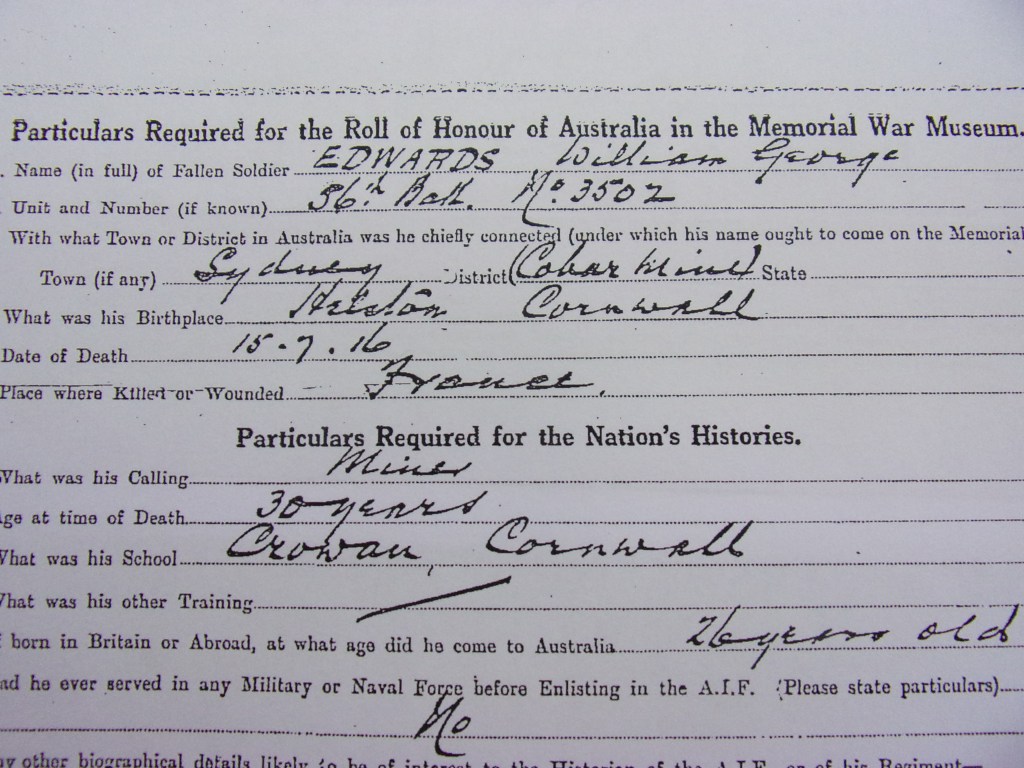
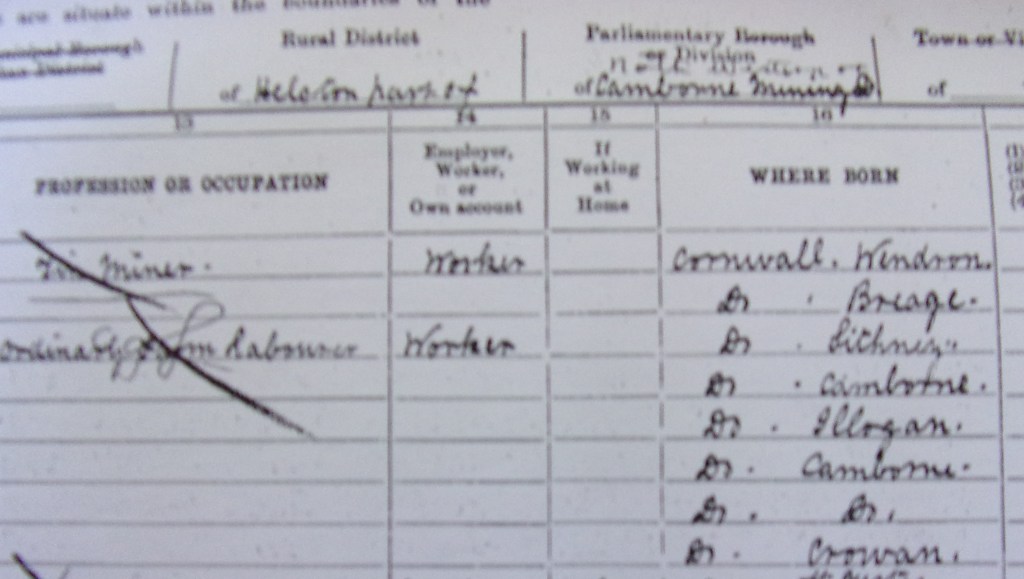
He was in fact William George. William George Edwards was born in 1885 in Sithney. In 1901 he was a farm labourer, living at home in Crowan. In 1911 he was a miner, again living at home, in College St, Camborne. In 1912, presumably in search of work, he sailed to Australia. His town address on one document was “Cobar Mine, Sydney”. In fact Cobar is 500 miles north of Sydney, in the Outback. George had swapped a rock for a hard place. Although Cobar had a suburb called “Cornish Town”, it was one of the toughest places on earth, a true frontier settlement. He would probably have lived in a tent and engaged in fistfights with his fellow miners over the best ore pitches. Philip Payton‘s book The Cornish Overseas (Cornwall Editions, 2005) describes Cobar as an “appalling environment”, with blazing heat, water shortages, and dust storms that could cause temporary blindness (p302).
Cobar is, in fact, nowhere near Sydney
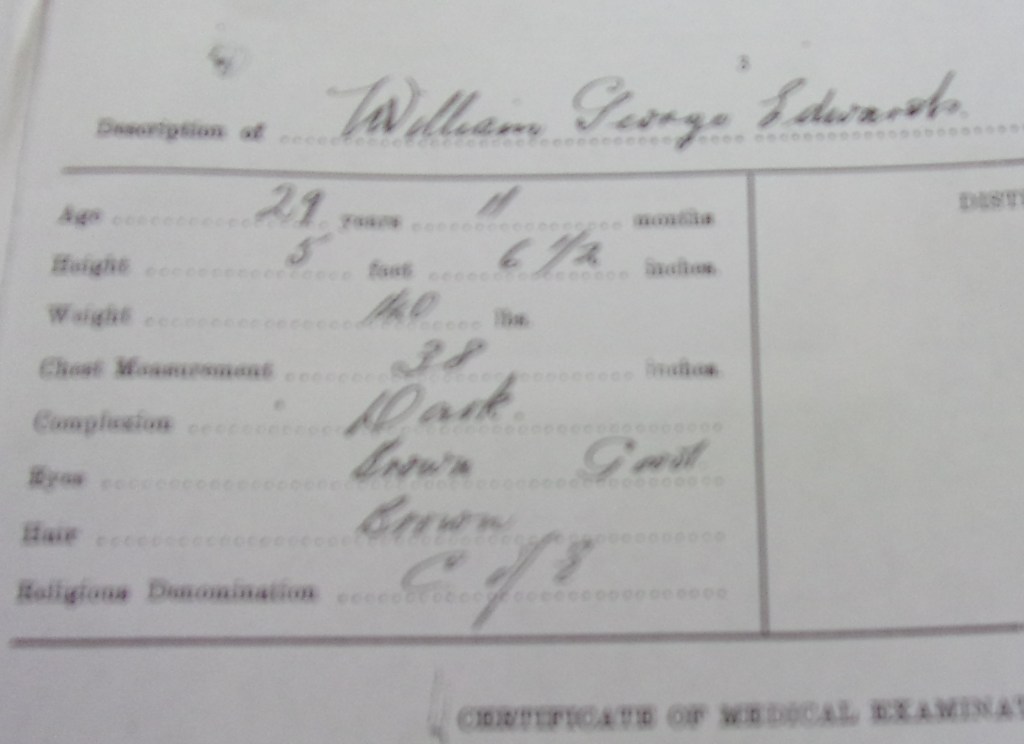
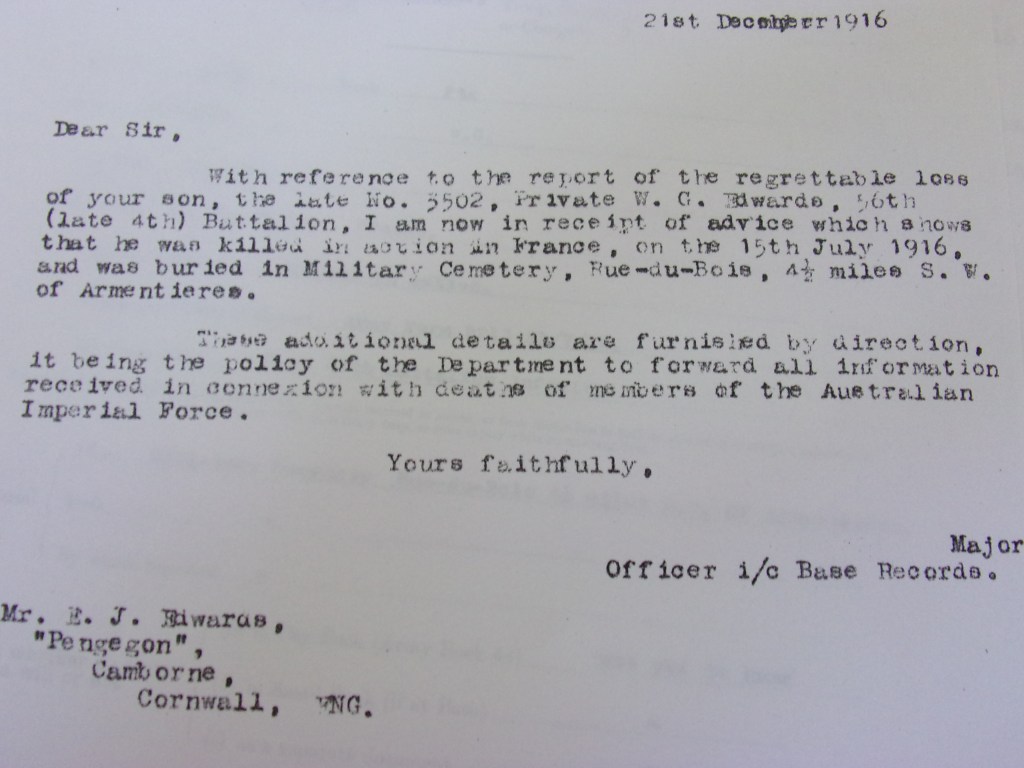
Small wonder, then, that he signed up, joining the Australian Imperial Force in 1915. He was 5ft 6, with a broad chest, and dark-skinned. Not all the soldiers slaughtered in World War I can claim a resonant battle (The Somme, or even Gallipoli) in which to lose their life. George disembarked at Marseilles in mid-June 1916. On July 11, his battalion were in the front line, somewhere near Armentieres on the Western Front. On the 15th, the Germans shelled the line with high explosives all day. One of the soldiers killed was George. The battalion’s war diary notes that one soldier died of their wounds. I hope it wasn’t George. That said, I doubt there’s much of him buried in the cemetery at Rue-du-Bois.
From George’s service papers
War Diary, 57th Battalion, Australian Imperial Forces: “9 other ranks killed, 1 died of wounds…”
From George’s service papers, a copy of the letter sent to Cornwall
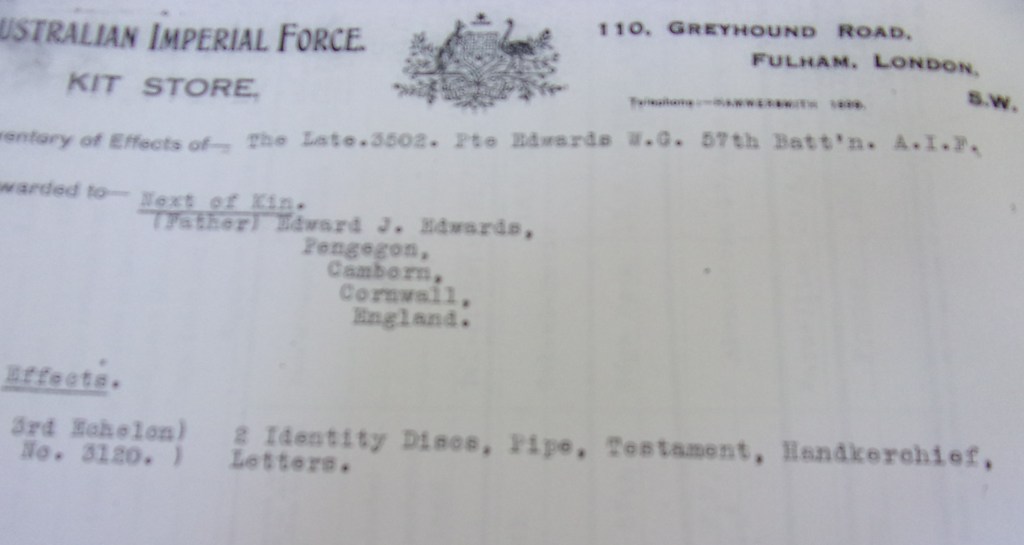
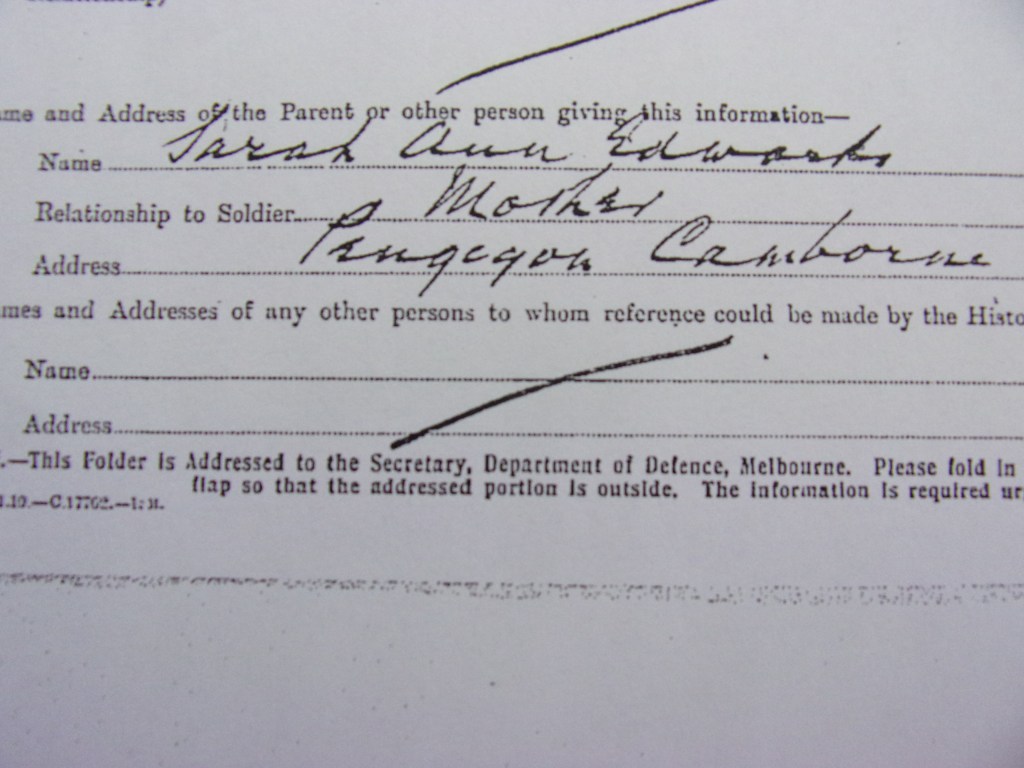
These brief paragraphs took weeks of research. I discovered George’s enlistment and service records online at the National Archives of Australia, and it was truly eerie seeing his own handwriting, or the neat copperplate of his mother (my great-grandmother), or that there was practically nothing on his corpse save a pipe and a handkerchief.
George’s personal effects
My great-grandmother’s hand
What struck me most was the “KILLED IN ACTION” stamp hammered onto the cover-sheet of George’s documents: see the image that opened this post. In World War I death became mechanised, and so did the means of recording it.
John Edwards
John Edwards’ existence on paper is nebulous. I discovered he was a younger brother of George, that his full name was Edward John, and that he was born in 1891. He worked as a miner too. I had believed that, the more I uncovered about George in Australia, sooner or later his kid brother would also materialise. He didn’t.
John never went to Australia, and I went down several dead ends to assert this. I realised that John’s fate – whatever it was – had somehow become conflated with the romanticised version of George’s. I reasoned that maybe he joined the British forces, and then discovered that thousands of WWI service records for the British Army were destroyed by a German bomb in the 1940s. However, the list of soldiers killed are more or less intact. John signed up with the Duke of Cornwall’s Light Infantry, and died fighting in what was then Mesopotamia in January 1916. His name is on a memorial in Basra listing those whose bodies were never recovered. There’s over 40,000 names on the memorial.
All that remains of John’s service records
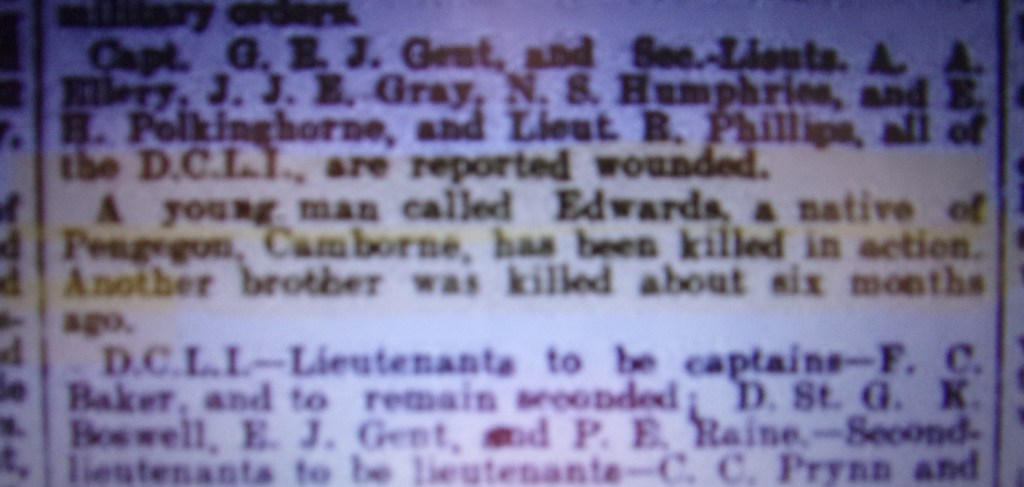
George is commemorated on the Australian War Memorial, and both his and John’s names are on the Memorial at Tuckingmill church. On August 3rd 1916, The West Briton ran the following brief note on page 5:
And there was another brother. He went to…
America
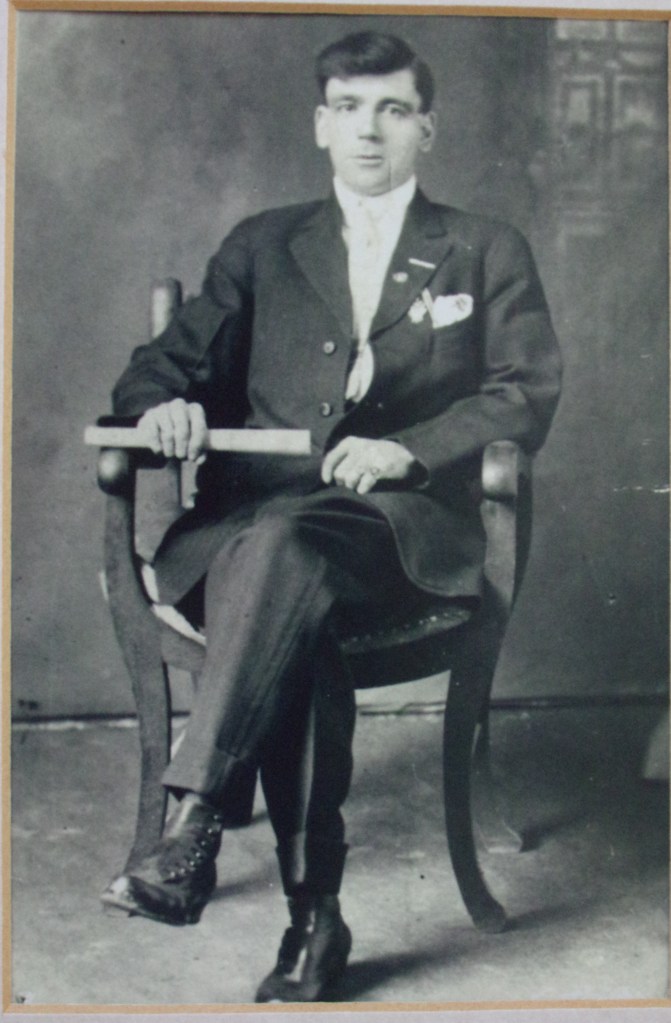
That’s Thomas Edwards (1889-1963), circa 1920. He’s just become a Master Mason. I got in touch with his son, Ed, in the States. Apparently, Thomas Edwards lived quite a life.
He left Cornwall in around 1906-7, sailing on the Lusitania, and alighted in Canada. For a time he lived in Cobalt. He hunted, trapped, and fished his way into North America, becoming a guard at Yuma State Prison, and then Sheriff of Bisbee, Arizona. He then joined the U.S. Army, and fought with General “Black Jack” Pershing against the Mexican bandit Pancho Villa. When discharged, he was awarded American citizenship and settled in Pennysylvania.
Now that’s one hell of a story; all that’s missing is a wagon of stolen gold. I’ve never discovered exactly when Thomas left Cornwall, but it has to have been between 1911 – he’s living in Camborne, College St – and June-July 1918, when he joined the Infantry and gained citizenship. Ed was kind enough to send me images of Thomas’s papers.
Thomas’s enlistment papers, June 20, 1918
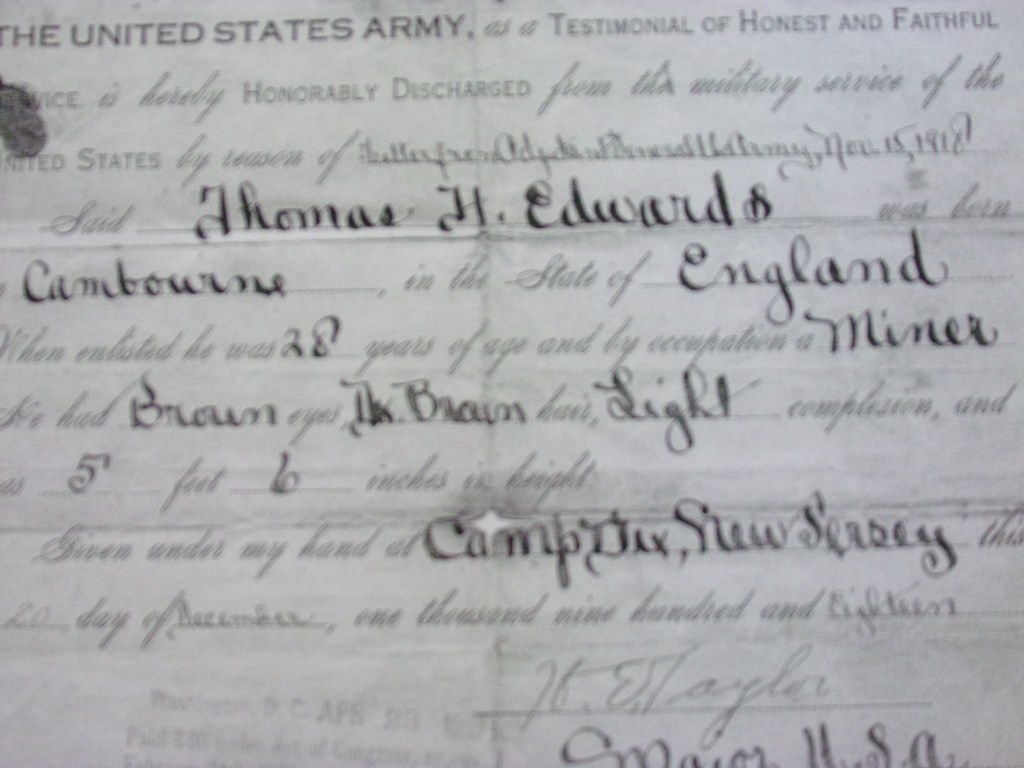
Thomas’s discharge papers, November-December 1918
Thomas’s citizenship papers, July 1918
He can’t have sailed to Canada on the Lusitania: the ship only ever docked in New York. And, alas, he never fought as a soldier in the Mexican Revolution: Pershing’s expedition against Villa took place in 1916. Thomas joined the Army in June 1918, and was discharged in December of that year. I doubt he even fired a rifle. I can neither prove, nor disprove, Thomas’s sojourns in Cobalt, Yuma or Bisbee however – the records that exist are incomplete, though he was definitely not Sheriff of Bisbee. Something tells me to err on the side of caution.
It’s curious, though, that the settlements of Cobalt, Yuma and Bisbee are part of Thomas’s story. Apart from Yuma, which has some popular notoriety as the location of a tough prison, Cobalt and Bisbee are relatively unremarkable and unromantic. The ship, Lusitania, was famously torpedoed in 1915. What I’m trying to say is, in the same way Gallipoli became the mythical resting place of George and John, Thomas’s story acquired a veneer of romance and resonance when becoming associated with Yuma and the Lusitania.
Cobalt, Yuma and Bisbee are all located in heavy mining regions, however, and Thomas Edwards was, 100%, a miner. Maybe, just maybe, he worked in these areas for a time. It’s equally likely however that he only left Cornwall in 1918. Who knows. When I contacted the library in Cobalt asking for assistance, the librarian all the way over in Canada told me her grandfather came from…Redruth. It is, truly, a small world.
I was interested to note, though, that Thomas had the same height, hair and eyes as his big brother, George, though with a paler, less tanned complexion. I have no photo of George, but the two brothers must have looked very similar. And, like George, and John, the realities of their lives bear little or no resemblance to the oral traditions.
How Thomas looked when leaving the army
I had one more myth to shatter.
The Welsh Connection
See boy, your great-grandfather was from Wales, either Pontypool or Pontypridd, I ferget which…an’ the bugger walked to Cornwall to find work! Bleddy hell…
For a long, long time I believed this one, and thought myself to possess a deal of – diluted – Welsh blood. I followed their national rugby team. I went to a Welsh university. I picked up a smattering of the language, more than I ever did of Cornish. I told a few mates about it. And then I read the 1901 census.
1901 Census. Edward J. Edwards, 41, miner…
Where born? Wendron…
My great-grandad, Edward John “Ned” Edwards (1858-1932), was born in Wendron! Honestly! By all accounts a violent, unpleasant, mean individual (and here I actually spoke to relatives who knew the man), he lived his entire life on the right side of the Tamar. Here he is:
That’s him, at the back, menacing the photographer. I’ve no idea who the lad with the dog is. The younger Edward John? Thomas? Likewise the girl on the right. To the left is my great-grandma, Sarah. Her maiden name was spelt on various censuses as Cowls, or Cowles, before finally becoming Coles. The house was called Wheal Top, where my grandad, Frank, was born in 1904, and where the family lived in 1901, so presumably the photo is from the same period. Wheal Top is located in a field, between Carvolth and Treslothan – so between Praze and Troon. All that’s left of it now is a wall.
Maybe, then, Ned’s father, a George Edwards, was Welsh? He wasn’t.
1861 Census. George Edwards is listed as being born in Mawnan. Ned is 3, his older brothers are already earning their wages. Source: Free UK Census Records
George Edwards was, I discovered in the 1861 census, from Mawnan. Okay, what about his dad? It was becoming a minor obsession. I traced George Edwards right back to the 1841 census. All this told me is how poor the family were: Ned’s brothers were working at the mines from the age of 10! I got hold of his marriage certificate, from 1851, when he was living at Carlidnack, Mawnan. His father, my great-great-great grandfather, was John Edwards, a farmer. But where the hell had he been born?
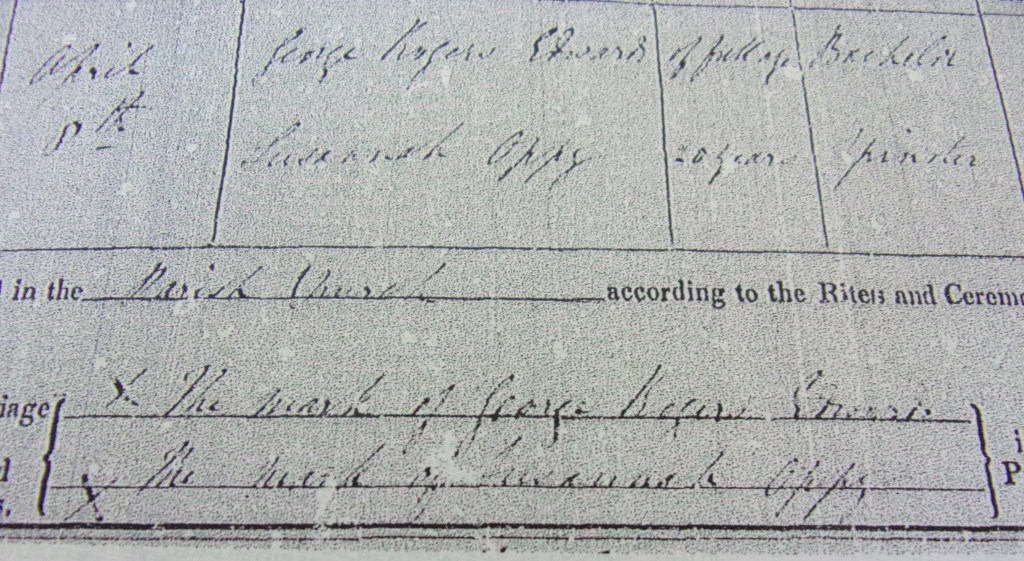
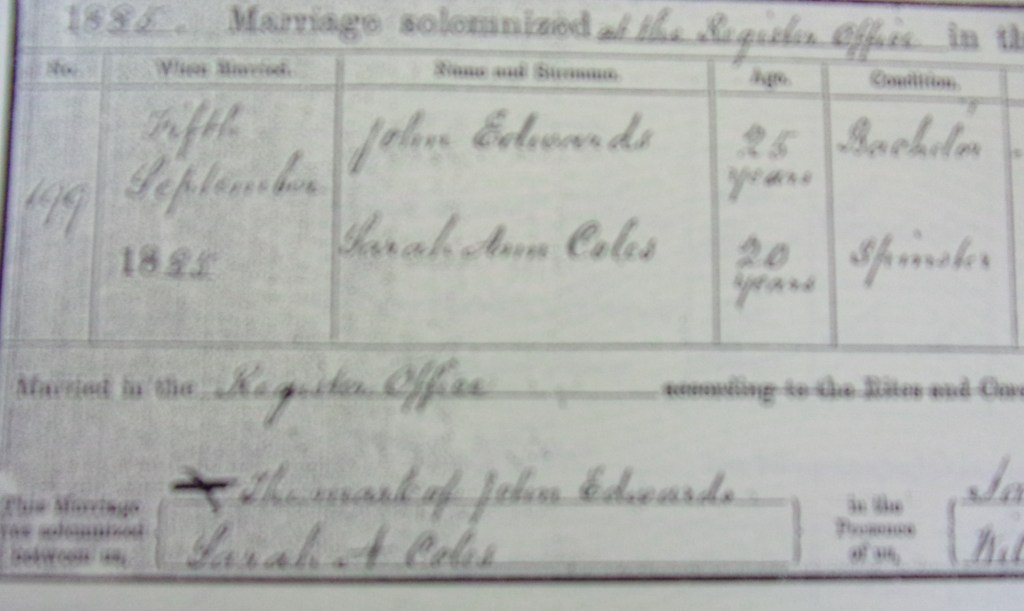
(It may or may not surprise you, but George Edwards signed this certificate with a mark. Ned Edwards made the same moniker on his own wedding day.)
“The mark of George Rogers Edwards”
“The mark of (Edward) John Edwards”
Parish Records
I realised that now was the time to shoot in the dark. The information I wanted – where this John Edwards came from – would not be available online. To discover anything relating to genealogy before 1837 (the year a central register of births, marriages and deaths became a reality), takes dedication. I took a punt on the parish of Mawnan, and volunteered to transcribe all their parish records for the Cornwall Parish Clerks Online database, in the desperate hope that, sooner or later, I would hit an Edwards.
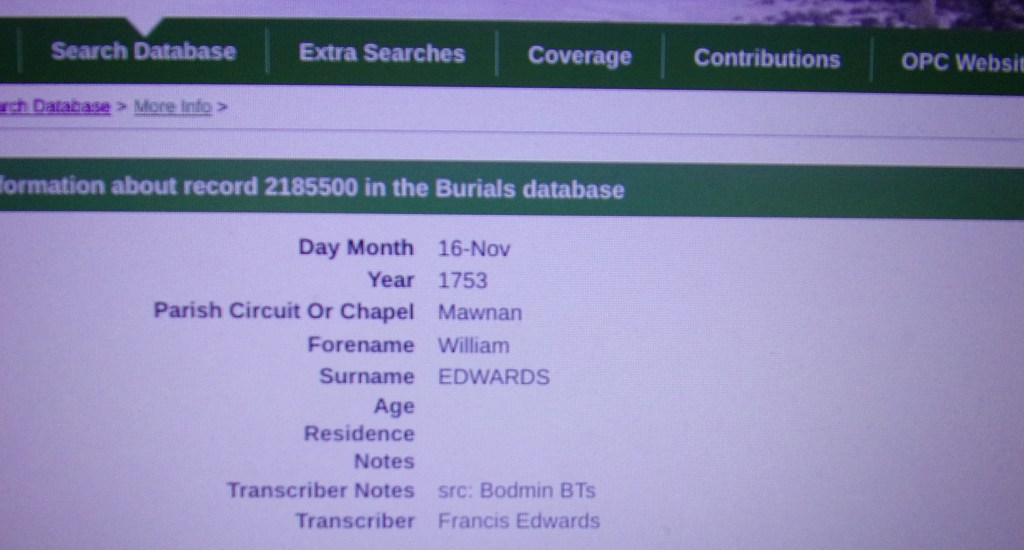
This was a worthy, but onerous, task. The first year I transcribed was for 1678. I didn’t get an Edwards until 1729. George Edwards was born in 1819. His dad, John Edwards, was born in 1776, yes, in Mawnan. He married a Sarah Tranick in the early 1800s. John Edwards’ dad, another John, was born in 1744, and his dad, a William Edwards, died in 1753. All in Mawnan.
The burial record for William Edwards, 1753, from the COPC database. Transcribed by his great-great-great-great-great grandson, yours truly…
At this point I abandoned the project, concluding that, in all likelihood, my family is Cornish back to the Flood.
Reading back this post, I fear it makes me appear that I set out on some kind of zealous mission to shoot down my family’s fireside tales. But this really wasn’t my intention! All I wanted to do was ground these stories in fact, but, sadly, most of them turned out to be just that – stories. True history is always based on evidence, on facts. What kind of historian would I be if I didn’t adhere to this fundamental rule?
Thanks for reading, and, if you’d like help with your own Family Tree research, please get in touch!
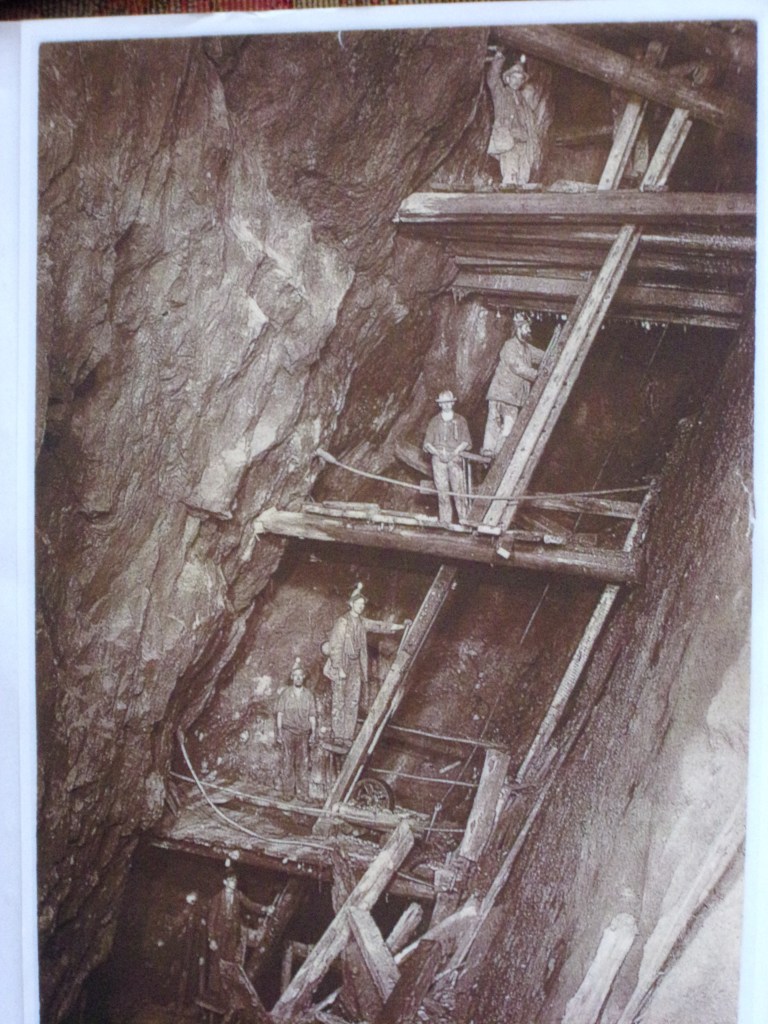
The Man Engine, Dolcoath Mine, by J.C. Burrow, 1890s. Source: Kresen Kernow, ref. AD460/1/1
Okay, first off, I’m going to give you the synopsis, or brief outline, of my novel. It’s what I’ve been hawking around various publishers these past few months! Enjoy!
The police force in Camborne are hated, a bunch of stave-wielding authoritarians managed by a cowardly, non-Cornish despot. They imprison and allegedly abuse innocent women, cheat at cricket, and believe themselves lord and master of all they survey. The people of Camborne, and the town’s miners in particular, have had a gutsful.
One Saturday night, two policemen bite off more than they can chew with the Bawden brothers. Result? They get a hammering, the Bawdens get arrested later that night (after beating off five more officers), and their trial for assault is set for Tuesday. But not if their mine boss, Captain Josiah Thomas (manager of Cornwall’s largest mine), can rig the hearing. He enlists the help of a cocky young pitboy, a compromised philanderer, a hideously injured mine boss, hellfire Methodists and various thugs, and also gets most of Camborne’s population to take to the streets in a show of mass support for the brothers.
But, on Tuesday, it goes badly wrong. The brothers get sent down, and the miners, in the main, take a terrible revenge on those they hold responsible. The forces of law and order are routed in a bloody streetfight. Camborne is subjected to mob rule, and no policeman, or anyone suspected of sympathy towards the police, is safe from the fury of the crowd. Order is only restored when the militia enters the town, and the situation is serious enough for the Home Secretary to get involved. The superintendent is replaced, and the Camborne force is either dismissed or moved to different boroughs. Notwithstanding the fate of the Bawdens, the miners are triumphant. The only figure of authority to emerge with any credit is a local magistrate (and grandson of the safety-fuse inventor), William Bickford-Smith, and even he is powerless.
But then the manhunt for the riot’s ringleaders hots up. The powers that be swear in Special Constables (ironically, key rioters themselves), who are forced to identify suspects whilst, with the silent collaboration of Camborne’s populace, conceal their own involvement. Three men are brought to trial, but there are no convictions, no sentencing: one was a patsy, a simpleton set up by the Specials, and the other two provide witnesses who perjure themselves in order to get their compatriots off. It helps that the counsel for the defence is a smooth-talking crook. In a raucous, dramatic hearing, the authorities are made a fool of. Bickford-Smith is embarrassed. No one, until now, knows who the real rioters were, who commanded them, or what really happened. This, finally, is the true story…
The narrator, in broad Cornish dialect, is Ned, a fictionalised version of my great-grandfather, who was a teenager at the time. (I present myself as merely the posthumous editor of his tale, which was given to me by a relative – I elaborate on this in my introduction.) He claims to have been present at every significant point of the riot: its origins, main flashpoints, and aftermath. His version provides a coarse and ribald counterpoint to the newspaper coverage of the tumult; said coverage actually provided me with the main inspiration for thestory. My novella also includes extensive explanatory notes and biographical details, a glossary of the more arcane Cornish phraseology, and appendices.
Sample, Chapter 23: James Bryant is arrested
In this chapter Ned narrates how he and Joseph Vivian go underground at Dolcoath Mine to arrest James Bryant, who’s been identified as a suspected rioter. It’s Ned’s first time underground and he’s understandably nervous. The Man Engine, or “Captain’s Rod” Ned describes is meant to resemble the one seen in the photograph above, which operated at Dolcoath for fifty years before being replaced in the late 1890s.
James Bryant was actually arrested by Special Constables whilst working underground on 230 fathom at Dolcoath (he was later acquitted for lack of evidence). The reasons behind his arrest were unclear in the contemporary newspaper reports – here I present him as a simple stooge set up by the actual rioters to pacify the authorities and hopefully call off the manhunt. Who arrested Bryant at the mine is also unclear (the ‘papers just say “Special Constables”); in my version I have Ned, and Joseph Vivian make the pinch. Vivian was genuinely made a Constable in the riot’s aftermath, though clearly with much reluctance. In my tale he was actually a key rioter too.
The recording contains some “robust” language. Don’t say you weren’t warned. Happy listening!
Sample, Chapter 23, The Camborne Riots of 1873: An Eyewitness Account
Several months ago I contacted the Camborne Town website, asking if a link to my own site on the Riots of 1873 could be included somewhere on their pages, maybe with their entries for The Red Jackets or the Old Market House.
I’ve heard nothing. So let’s take a brief look at what the site says about these buildings.
The Old Market House, Camborne. From the Camborne Town Heritage Trail page
The website has its entry for the Old Market House thus:
Built in 1802, John Francis Basset funded a rebuild in the 1860’s after a storm caused catastrophic damage. It housed the Town Hall, Magistrates Rooms a Public Hall and Assembly Rooms.
I’d love to add something like:
In 1873 thousands of miners besieged fifty police officers in the building after two of their own got sent to prison. All the windows were smashed and the guards on the door constantly stoned and abused. Realising their situation was untenable, the policemen charged the mob, thus sparking a brutal, bloody battle that became notorious as The Camborne Riots of 1873…
Or maybe even:
Later The Old Market House was home to the infamous Berkeley Centre nightclub, a glorified meat market dealing in gassy lager, sticky flooring and aggressive drunken teenagers. Fistfights and glassings were the main attractions…
What does the site say about The Red Jackets in relation to the Riots?
…named after the militia who were brought in to deal with the riots in 1873…
Given the chance, I’d add:
But a more apt name for the pub might be “The Rioters’ Arms”! The landlord was suspected of sheltering a policeman during the affray, and as a result he was assaulted, the pub’s windows were smashed and a barrel of ale dragged out and drunk in the street. Graffiti reading “A Camborne Mob, its Mark” was daubed on the walls…
You get my point: you’d have to search long and hard to find a mention of the Riots in any tourist guide. Maybe, considering the lack of response and/or enthusiasm for my own historical website, some believe the Riots would be better best forgotten. To be fair to the authors of the Camborne Town website, they’re fighting an uphill battle in marketing Camborne as a tourist attraction, especially when measured up against such prime spots as Newquay or St Ives. When you have to include the whereabouts of a town’s launderette on your webpages, in terms of promoting said town’s greatest assets you’re not so much scraping the barrel as flinging it over a cliff.
From the Camborne Town website. A real talking-point.
So, to my novel, which is really a kind of alternative history of Camborne. As I mentioned in my “Cornwall Writer” post on designing the Riots website, when reading the original newspaper reports of the affray, I got the odd sense that, back in 1873, some kind soul had given me the bare bones, or draft, of a great story. Question was, what to do with it?
Fact or fiction?
One section of the ‘paper reports told me I had to exaggerate the events, or, if you will, make up my own legend, then print it. To whit, one of the policemen gets beaten about the head by an old lady armed with an umbrella. Yes, it happened. Now, I asked myself, how delightful would it be if this harridan was the copper’s own mother, horrified at her son’s career path? Likewise the hints from the ‘papers that the miners and townspeople were united in their destruction of the police force: I felt compelled to develop this into a major conspiracy. I was going to write a novel, but present it as the “never before seen” truth of the events.
Perspective.
What angle was I going to take? You had two opposing forces: the miners or mob, and the police. In the middle you had the people of Camborne. I could write the story from the perspective of the forces of law and order, take the view (and sympathy) of the mob, or have a story from the townspeople caught between the two. I dismissed the idea of the townspeople immediately: they more or less sided with the miners anyway. The police approach was passed over too: I’m the grandson of miners, after all. To not write a story about how miners fought the law and won from their perspective would be tantamount to working-class treason. It’d be like a Tyneside collier having a portrait of Margaret Thatcher mounted in their scullery.
About the 1984 Miners’ Strike. Recommended.
First or third?
Maybe I could write the story in a third person narrative. Then differing views of the events could be presented more easily. Perhaps. But third-person can move the reader a step further away from the events: this was a true story, a violent, breathless story. I wanted a reporter on the scene, in the dirt, maybe flinging the odd haymaker. I wanted the reader to be in there with them. I opted for first person. It would authenticate the more fictionalised aspects of the tale as well.
Who?
If I’m on the miners’ side, my narrator had to be a miner. I also felt that, as none of the actual rioters were ever identified, this miner had to be a rioter too. Further, to give my story more verisimilitude, this miner had to have actually existed. And, if this version of the Riots were to be wryly presented as the “true but unheard-of” one, how come I’m the sole possessor of it? A family tale perhaps, passed down through the generations? My great-grandfather was a miner. He was fifteen at the time of the Riots. It dawned on me: my great grandad was there, he saw the lot, he broke a fair few heads, he was in on the plot but was sworn to secrecy, years later he told the tale to…
Okay, I admit, it’s similar to how George MacDonald Fraser claimed to be in possession of the FlashmanPapers. What I also derived from this series of novels is Fraser’s technique of attributing fictional acts or characteristics to genuine historical figures. The difference here is of course that Fraser’s characters were all well known; my characters had minor fame, if any at all. I took what I could find about them from the ‘papers or elsewhere and either embellished, or turned, these facts on their head. For example, a key witness is, in the reports, a well-respected and charitable man. I present him as a shameless philanderer. Josiah Thomas, manager of Dolcoath Mine and an upright pillar of the community, here vows to do down the policemen he sees as encroaching on his power in the town.
Authenticity?
Again, another trick I picked up from reading Flashman. If you want people to believe the fiction you’re writing actually is the truth, you have to couch your work in historical or explanatory notes. I decided to do this throughout my story. So, when you read in my tale that the geriatric beating on a policeman’s skull with a brolly is actually the victim’s mother, I have a note explaining that, indeed, PC Harris was cudgelled by a hag with a brolly, but my great-grandad’s story is the first source to mention that this hag was, in fact, his own dear ma.
Was he really involved in the Indian Mutiny?!
Humour?
This was impossible to keep out. I wanted the reader to be carried along by the sheer desperation and grimness of the tale – miners fighting for their ancient customs in the face of Victorian modernity – yet at the same time enjoy a kind of gallows humour. I picked up this approach from reading Get Carter, by Ted Lewis: after something unspeakably violent has happened, crack a joke. It relaxes any tension before moving on to the next description of wanton savagery.
Recommended.
Dialogue?
This is from the historian John Rule‘s book Cornish Cases (Clio, 2006), page 10. For him, dialect is
…a cohesive force…dialect offers some possibilities of hearing the voices of the ordinary Cornish…Dialects like language have a history…the tinners spoke and even appeared as a different race…
Taking Rule’s observations as a starting point, and to further add a sense of reality to what I was writing, I had my narrator recount his tale in Cornish dialect, or accent. This involved me writing, or attempting to write, the story in a phonetic, nuanced Cornish, based roughly on how people in the Camborne-Redruth area speak nowadays. To “age” this tone, my narrator uses occasional Cornish words or phrases, some of which – croust, oggy, etc – are still in use today. Sometimes I actually inserted other Cornish words into his speech, not because I knew they were used back in the 1870s, but because I liked the sound. For example, the Cornish word for midnight is hanternoss, which I think is mellifluous and slightly spooky. Hence, I had to use it. Many of these arcane words and phrases I sought to explain in a glossary at the end of the story.
My narrator was a Cornish miner, a working man. The language of your bog-standard working-class individual is salty, to say the least. I should know! It followed, then, that my narrator, and many of the other characters, swear and cuss frequently. This has proved contentious. Several readers have found the profanity challenging, others have found that, after initial struggles, it no longer bothers them and the story flows. The very opening sentence of Irvine Welsh’sTrainspotting uses the word “cunt”, and to my knowledge he’s never compromised or apologised for the brutality of his language. I’ve resolved to do similar. After all, his books sell…
Will my book sell? Would anyone read it?
I’d have to get it published first! I’ve been to several publishers, but no bites thus far. However, the editor of Cornwall Editions, who wouldn’t publish on account of the sad fact that his house is now practically defunct, said that The Camborne Riots of 1873 is
…strong and rumbustious, so I wonder whether it would be worth offering to and independent television producer….
Which is rather encouraging.
Would you like to read and hear more? See my post where I read a sample from one of the chapters and provide a full synopsis of my novel.
For anyone out there with a further interest in The Camborne Riots of 1873: An Eyewitness Account, don’t hesitate to get in touch!
A few months back I wangled a platform on the Cornwall Writers website, a “community of writers living in or inspired by Cornwall”. At the time I was looking for ways of promoting myself and, as this site is mainly for up-and-coming authors and writers I thought it would be a good thing for yours truly to be present there too. Check out the homepage, and you can see me, nestled in beside Winston Graham and Rosamund Pilcher, desperately hoping some of their fame and talent will rub off on me.
Of course, neither Graham nor Pilcher sought permission or had to fling themselves through several metaphorical hoops to warrant inclusion on the site. Indeed we’ll never know what they think of their inclusion; the site’s owner has arbitrarily entered their details in the hope of lending the whole affair some status and authenticity. That’s what I think anyway.
I include here some of my more important and relevant responses to the site’s “Author Interview“. The rather more twee questions I haven’t bothered with here and, at the time, only answered them under duress. For any of you looking for my motivations as a writer, especially of fiction, read on.
One deceptively simple lesson I learnt from the Cornwall Writers website is this: build your own website. Then it’s yours, and yours alone.
HHhH, by Laurent Binet. Recommended.
What are your favourite books?
My favourite novel at the moment is “HHhH” by Laurent Binet, about the assassination of the Nazi SS Chief Heydrich by Czech agents of the SOE in 1942. It’s a fascinating and ultimately harrowing tale, but it’s the questions Binet raises about the process of actually writing historical fiction that I find thought-provoking. Binet’s argument is that, to attempt to fictionally reconstruct an historical event (eg. to invent characters, dialogue, thoughts etc) is a pointless exercise that waters down the impact that particular event might have had. Throughout his book he constantly criticises other novels about Heydrich’s death to make his point. As a writer of historical fiction myself, Binet’s criticism of his own genre made me analyse what I was constructing with my own story about the Camborne Riots: should I invent characters? How can I empathise with people who lived nearly 150 years ago? Why not just write the actual facts, as Binet did with Heydrich? Binet, though, has an advantage over me. In writing about the assassination of Heydrich, all the principle characters in his story are well known and documented. In writing about the Camborne Riots, no names or identities of the most important protagonists – the rioters themselves – have come to light. So what else could I do but make some up? Just because none were ever caught, does that mean they shouldn’t be written about in some small way? Writing a story about the Camborne Riots of 1873 without the rioters would be like writing the story of Heydrich’s death without…without, well, Heydrich himself!
Another recent top read of mine is “Gallows Pole” by Benjamin Myers. This is another historical novel, telling the tale of the Cragg Vale Coiners, a ruthless band of 18th century counterfeiters from the Yorkshire Dales. Like my novel, Myers only had the bare newspaper articles and a few stray documents on which to hang his tale, and although some of the language is overwrought with gravitas, he’s managed to create an entirely plausible world in which the story takes place. Myers, of course, lives in Cragg Vale and is intimate with the area and its surrounds. Coming from Camborne and knowing something of the character and culture of the town put me at an advantage when coming to write a story so unique to the area. I could visualise the events so clearly when reading the articles on the riots because, quite simply, I’d grown up on the same streets as which they’d taken place.
Gallows Pole, by Benjamin Myers. Recommended.
What’s your favourite genre?
My favourite genre is obviously historical fiction, but that’s not to say I have issues with the form. A publisher rejected my manuscript on the grounds that my novel lacked a big historical character – in other words, it lacked a selling point. So, police brutality, mob vengeance, street violence and wanton vandalism aren’t good selling points?! I considered writing WG Grace into the cricket match that opens my story, or having Prime Minister Gladstone take the train to Camborne to view the devastation for himself, but then realised that this was an utterly fatuous exercise. A good story should stand alone, and not be propped up by cheap effects. Granted, it seems any novel featuring Hitler (or one of Henry VIII’s wives, say) will be successful, but so should stories that feature the forgotten, the maligned, and the exploited – like the Cragg Vale Coiners. Or the Camborne rioters. Especially a story about how the forgotten, maligned and exploited people get one over on their oppressors – like my novel! Just because an historical novel features a luminary from the past – “Champion”, by Stephen Deutsch, includes the German boxer Max Schmeling, for example – doesn’t necessarily make it a great read.
Champion, by Stephen Deutsch. Not recommended.
Why do you write?
Generally, I’ve always enjoyed writing, I’ve often been told I’m rather good at it. My job isn’t especially stimulating intellectually and I find writing a decent way of keeping myself fresh. More specifically, I wrote this story about the Camborne Riots of 1873 because I’ve come to believe that representations of Cornwall in the media as a tourist hot-spot marginalise areas of the county that lack traditional tourist attractions. Camborne, with few jobs, no coastline, and no sandy beach, is one of these places. If I couldn’t promote Camborne as a tourist attraction, why not promote the town for what it was once famous for, its mines? I suppose you might argue that my novel promotes Camborne as an anti-tourist attraction, but I believe Cornwall’s mining heritage is as important and as relevant as the tourism industry that props the county’s economy up today.
What inspired your story?
When growing up in Camborne, the last few mines were closing, my dad got made redundant from Compair Holmans (the manufacturer of mining equipment), and my grandad retired from working underground too. Camborne in the 1980s, it seemed to me, was closing down. I was drunk in Camborne’s Red Jackets pub (more than once) back in the 1990s and recall seeing a faux-Victorian newspaper print briefly commemorating the story of the riots tacked to one of the walls. Years later, I found a short online article about the tumult which got my interest going, and I got hold of all the contemporary newspaper articles on the subject. It was fascinating. Brawlers, boozers, corrupt policemen, imprisoned women, Methodist preachers, miners, brutal punch-ups…Camborne, at its boomtown peak, suddenly reappeared. This was Camborne, before it had closed down. It was as if, back in 1873, someone had drafted a story for me to write in the future. Why not, I said to myself, write a story about Camborne as it was, a rich, prosperous, almost lawless town, before the mines closed and tourism came along? The newspapers largely told the story from the perspective of the authorities: the rioters’ activities were generally condemned. Why not write the story from the point of view of the rioters, their lives, their concerns, their motivations? In the end I did two things. I wrote a novel, supposedly the “true” account of the riots, narrated by one of the rioters who also happened to be my great-grandfather. I also launched a website (https://camborneriot1873.com/), which is the historical side to my novel and features most of my research into the subject and analysis of the primary sources. The novel takes the suggestion of complicity, between the townspeople and rioters against the police, that was hinted at in the newspapers, and reveals that, in fact, a plot existed in the town to rid Camborne of the policemen once and for all. For a few short days, the rioters were victorious. And the entire town was involved in hiding the perpetrators’ identities.
What do you find inspiring about Cornwall?
Its history. And here I’m not talking about the various Celtic crosses, Iron Age settlements, dolmens etc, but the other relics of Cornwall’s past: the ruined engine houses, the wastelands where housing estates can’t be built on account of being too undermined, the commemorative buildings of mine dignitaries that are now blocks of flats. So you could say that the Cornish landscape inspires me: the landscape of a dead industry. Another relic that interests me is the Cornish language, and how various words have passed into common usage, even if those who use them fail to recognise them as “Cornish”. All these inspirations find their way into my novel. Cornish culture, or aspects of it, inspire me as well. The importance of sport, especially cricket and rugby, and the local rivalries they give lend to, finds its way into my story: the opening chapter features a cricket match. Cornish insularity and the Cornish people’s traditional mistrust of outsiders is also present in my writing. It’s not insignificant that Camborne’s police chief in 1873 was from the Isle of Wight – you might say that was a mark against him from the start!
Tregenna House, Camborne. Once home to Josiah Thomas, Manager of Dolcoath, the deepest and biggest mine in Britain. Now an old people’s home. Courtesy of Kresen Kernow, ref. corn05093
How do you think Cornwall has shaped your writing?
“The Camborne Riots of 1873” is a grim tale. I’ve been told as much. Yes, it’s earthy, yes, it’s funny, but there’s no getting away from the fact that this is a coarse, grimy, violent slice of life from Victorian England’s underbelly. Did I mean it to be like this? Should I have written a Cornish novel with rugged heroes, windswept heaths and swooning maidens? No, I couldn’t. The Cornwall, the Camborne, that I grew up in, back in the 1980s, could be a grim, grimy place. I suppose it boils down to the old saw: write about what you know. I knew foul language, heavy drinkers, and streetfights, so it followed that this was what I would write about. Camborne’s riots were the perfect inspiration for me to write a novel – it’s the Cornwall I know.
What do you think influenced this story?
In terms of the phonetic dialect which I use throughout, Irvine Welsh and Roddy Doyle. I’ve been told that my use of dialect can challenge the reader (much like Welsh and Doyle) but, after a chapter or so, your reading mind adjusts. The series of Flashman novels proved heavily influential too: a fictional character is inserted into real-life events, and provides the reader with his own, often caustic, observations on these events. But, whereas Flashman was (apart from a shameless cad) a supposedly educated, well-to-do Victorian celebrity, my narrator is an illiterate teenager. George MacDonald Fraser’s level of historical research for his Flashman books have always impressed me and I sought to emulate his eye for authenticity in my own work.
Recommended.
Recommended.
Recommended.
If you would like to discover more about my novel, see my recent post, or contact me!