Rugby Special ~ Part Two

Reading time: 25 minutes

(If you missed Part One, click here…)

As it was…

It’s Saturday, September 3, 1977. There’s a Labour government in power. The Number One single that week was Elvis Presley’s ‘Way Down’. There’s only three television channels. The BBC’s sports flagship Grandstand is fronted by Frank Bough.

Camborne RFC’s opening game of their Centenary Season is against the County President’s Select XV.
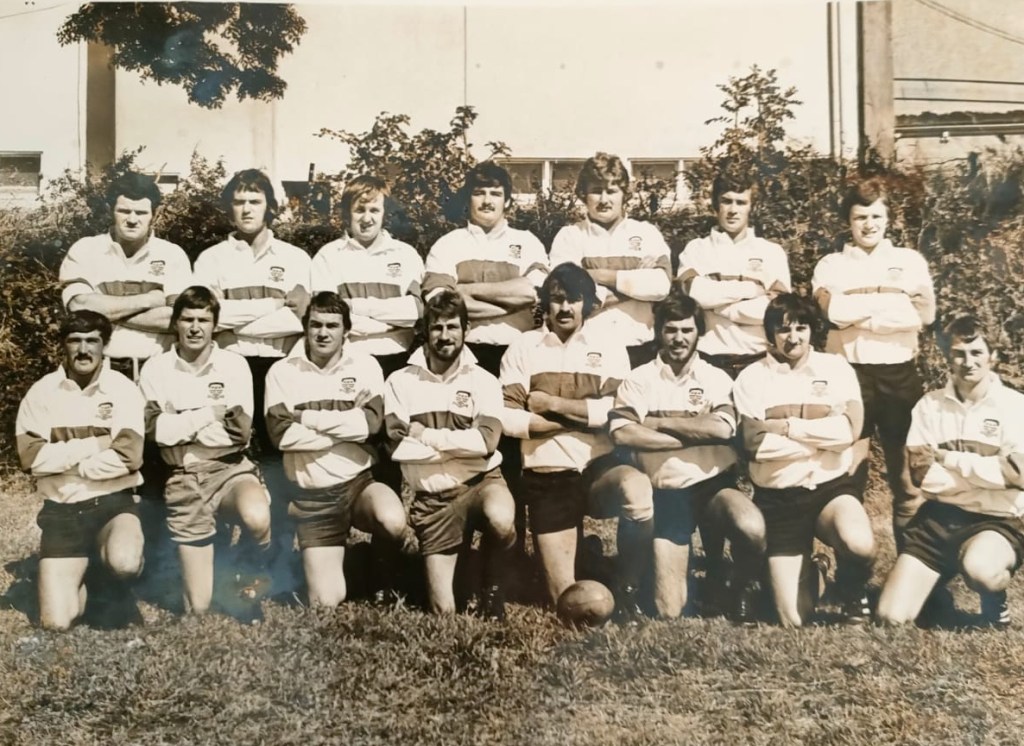
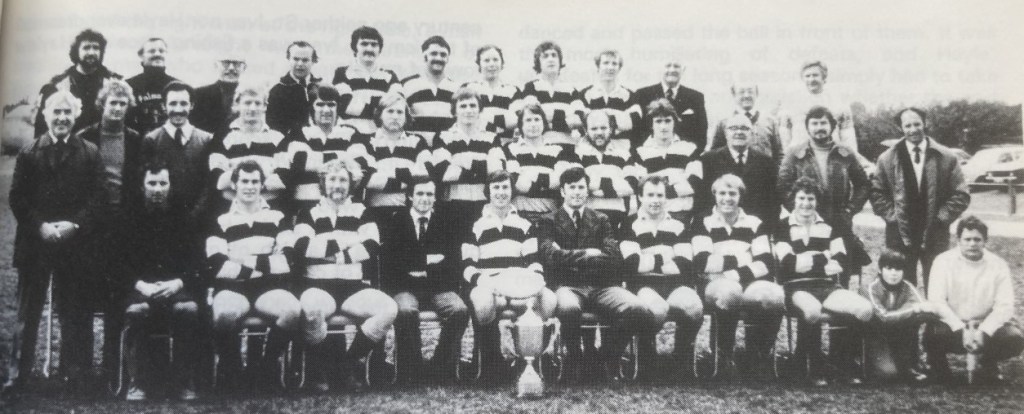
The Camborne side that faced the County President’s XV. Front, l to r: Nigel Pellowe, Mike Eddy, Colin Taylor, Barry Wills, Chris Durant (c), Robert Mankee, Malcolm Bennetts, Bob Lees. Back, l to r: Jock Denholm, Chris Lane, David May, Bobby Tonkin, Paul Ranford, David Kingston, Frank Butler. Steve Floyd, who played fly-half, isn’t present. The photo appears to have been taken on the Camborne School of Mines pitch, behind the grandstand. Image courtesy Paul White

And Camborne were primed. Coach Alan Truscott and RN fitness instructor Barry Wills (Come on fellas…) had whipped the squad into dynamite shape. The thought of that fixture list, featuring clashes against the best in the land, had upped the ante.

A wooden scrummaging machine, knocked together by David Kingston, had been reduced to kindling. (This was the era before the famous ‘Rhino’ designs; the RFU had provided building instructions for interested clubs.) Truscott reckons the contraption took a single, brutal hit from Camborne’s massive pack to be demolished. Kingston, prickly at this perceived slight against his skills as a joiner, claims they wrung six months of use from his creation. (I am devastated that no photograph of this machine was taken.)

Either way, pre-season training was over. Time for the real thing.

Who impressed the selectors..?

The game was, in effect, a County trial, with CRFU President Arthur Pill and his phalanx of selectors joining a full house to view proceedings. Indeed, the XV Pill named featured seven capped men: Redruth’s Dave Parsons (lock) and Nick Brokenshire (centre), Hayle’s Gary Trewartha (hooker) and no. 9 David Mungles, Falmouth’s no. 8 David Muirhead, the Penzance-Newlyn flanker Peter Trudgeon, and, as skipper, the formidable St Ives lock, Roger Corin1.
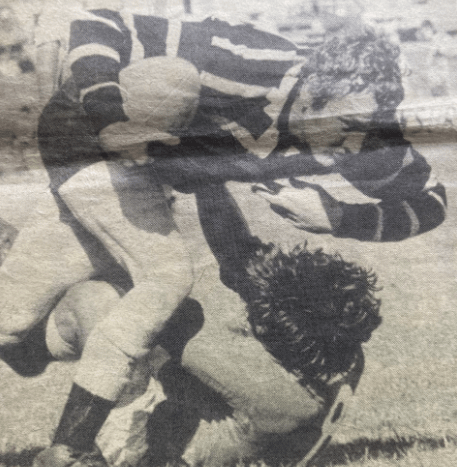
Roger Corin. From the CRFU Centenary Special, Express Western Newspaper Group Souvenir, 1983. Courtesy Phil Meyers

The rivalry between Corin and his fiery Camborne opposite number, Paul Ranford, was such that Ranford could usually expect a pre-match message from him. Corin would pass it down the line that

…he was going to whack me one…

As Paul tells it, “I always got in first…”

For their part, Camborne were not short of County experience either. Captain Chris Durant, his fellow lock Paul Ranford, prop Bobby Tonkin, and 15 Nigel Pellowe had all been capped. Besides this, scrum-half Robert Mankee was in the Cornwall U23 squad.
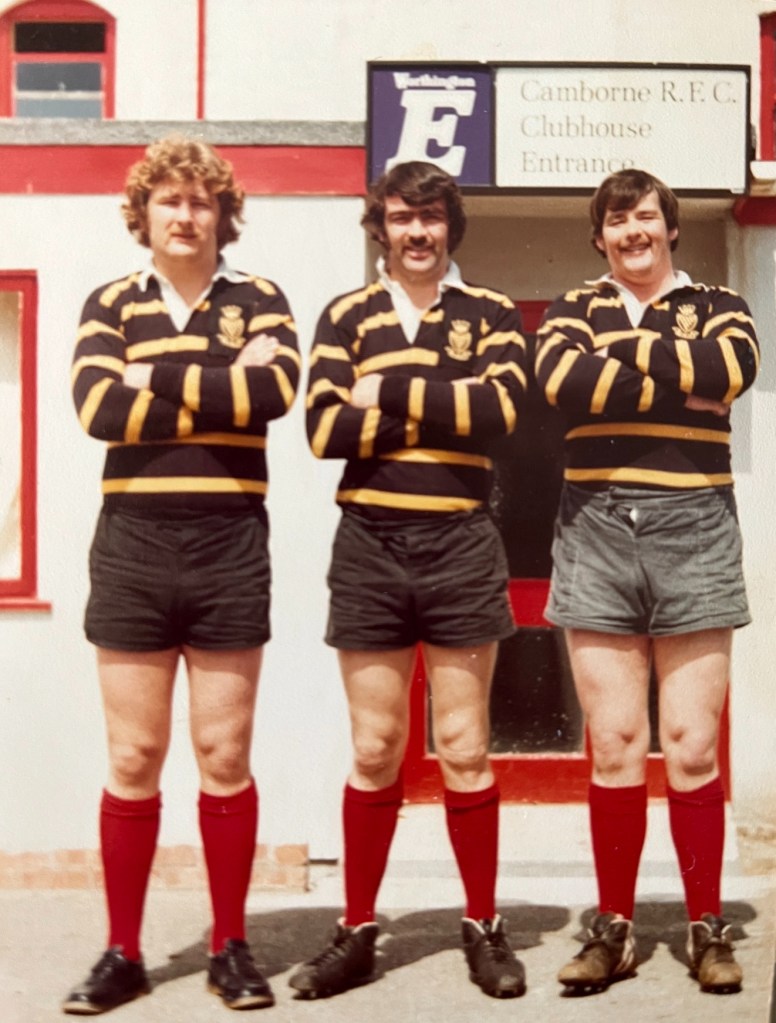
From left, Paul Ranford, Chris Durant, and Bobby Tonkin in Cornwall regalia, outside the Camborne clubhouse on South Terrace. Courtesy Paul Ranford

Plus, David Kingston rated wing Michael ‘Jed’ Eddy as “outstanding in Cornwall”, and Mankee reckoned centre Colin Taylor unlucky not to win a cap.

For all their firepower, lack of time together told for the Select XV, with Camborne winning 12-7. The clinching score, remembers Dave Edwards (who was in the crowd that day, still finishing the cricket season), was made by an interception from Colin Taylor. Taylor “would always” be alert for such an opportunity, said Edwards, and “poor alignment” from the opposition threequarters gifted him the chance2.

Robert Mankee flicks the ball up to Chris Lane, while St Ives’ Peter Hendy lines him up. The Packet, September 7, 1977, p26

Curiously, it wasn’t Taylor, or Camborne’s much-rated pack, that shone that day. In early scrums the Town front row of Bobby Tonkin, Malcolm Bennetts and Jock Denholm found themselves inexplicably shunted around, a sight that was to get rarer and rarer as the season wore on. No, with Steve Floyd at 10, Camborne could play a running game, and it was wing Barry Wills that “impressed the selectors”, scoring a try3.

Indeed, Wills was immediately selected for Cornwall; Jock Denholm and Robert Mankee had to wait until 1979 to wear black and gold4.

The result, said Frank Butler, put down a marker. It was a chance

…to show who we were…

The ‘Barbarians’ of Wales…

That’s how Bob Lees described Captain Crawshay’s Welsh XV, who Camborne took on four days after beating the President’s side.
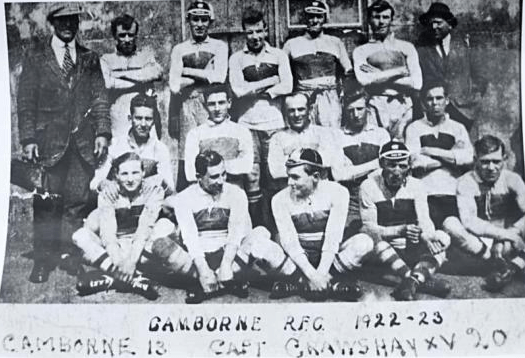
The very first Camborne XV to play Crawshay’s, back in 1923. Courtesy Martin Symons

This was a fixture steeped in history, an occasion to celebrate the traditional camaraderie and sporting ethos of rugby. Captain Geoffrey Crawshay’s (1892-1954) touring sides always featured international and rising Welsh talent, and they always played a fast, entertaining game.

Crawshay’s had visited and played Camborne, with a brief interlude for war, between 1923 and 1964, when Cornwall took over the fixture5. Now, in the year of Camborne’s Centenary, they were back, fielding a team to savour:
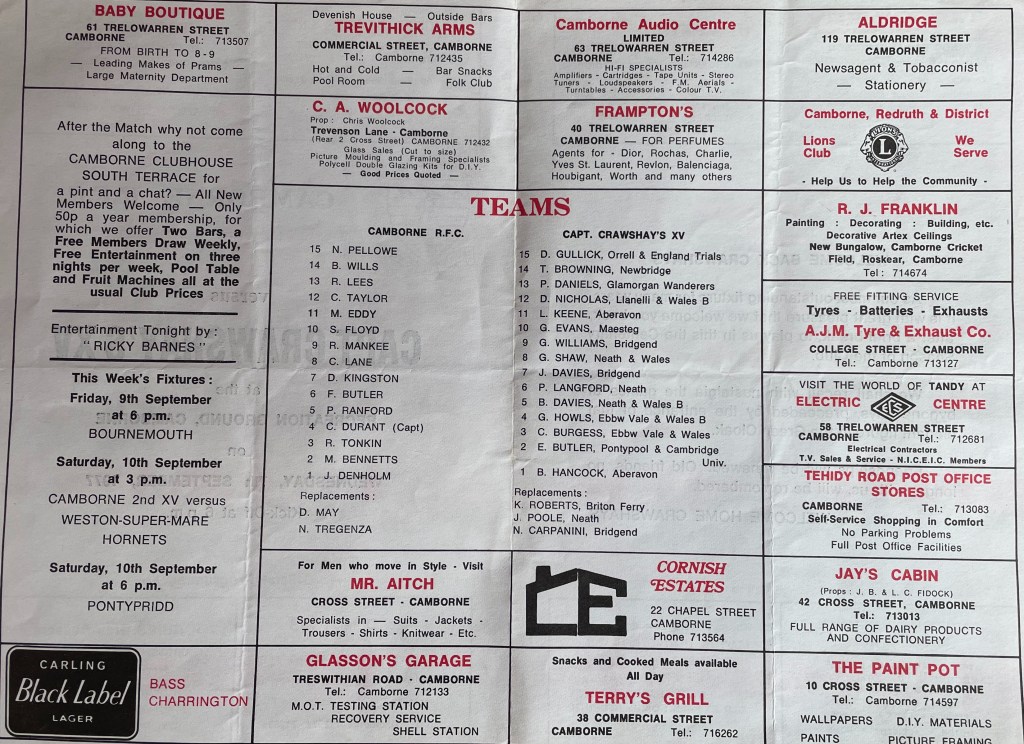
The numbers of the Crawshay’s pack were for some reason reversed; playing in the back row that day was a young Eddie Butler. Courtesy Alan Rowling

Merrill Clymo, Camborne’s Hon. General Secretary, wrote the notes for the programmes whilst working at a local solicitors. (So dedicated was he to Camborne RFC, that his daughter Sally recalls many a Sunday morning spent helping him clean the changing rooms.) Clymo was clearly most effusive about the game:

As our most outstanding fixture for many years, we welcome you back…We shall recall with nostalgia the games of bygone days…Friendships will be renewed. Old friends, no longer with us, will be remembered.
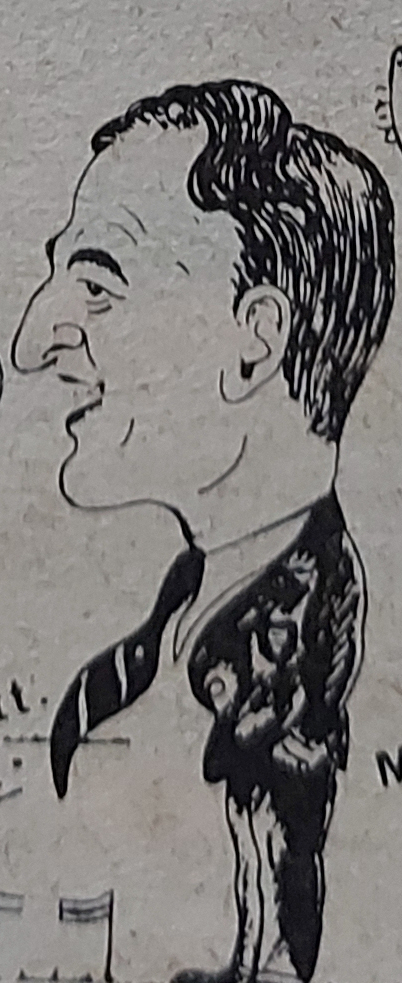
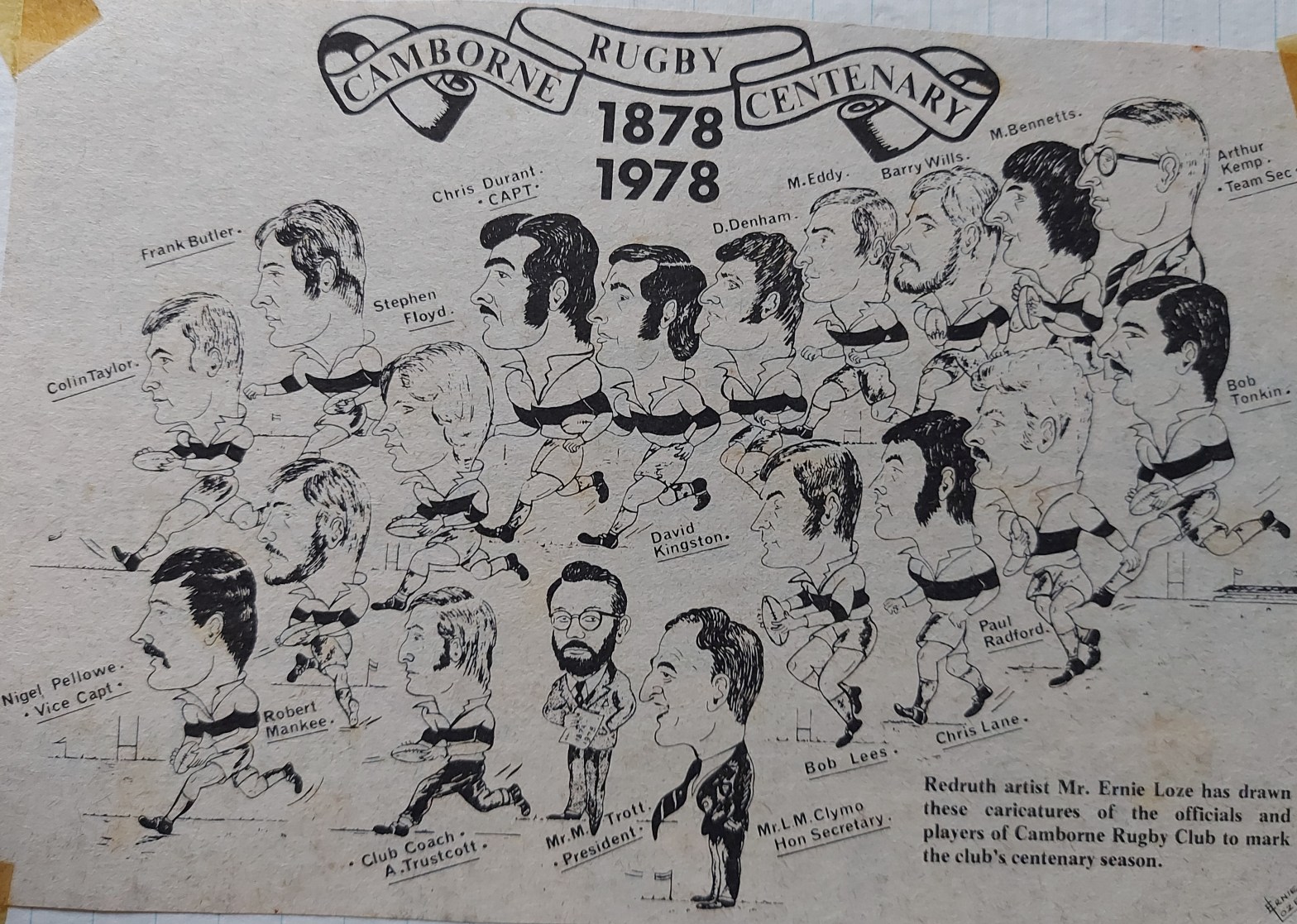
Merrill Clymo, by Ernie Loze

No one seems to have told the players any of this…

If you don’t shut your f_____g mouth…

Crawshay’s 15, David Gullick, (who was invited to tour by dint of a father who was born in, and played for, Pontypool), told me that his club side Orrell were a

…tough team, but nothing like this…

The Crawshay’s skipper, Wales flanker Clive Burgess, was known as ‘The Steel Claw’ or, more simply, ‘The Animal’6. Apart from Orrell’s Gullick, and Cambridge Blue Eddie Butler, these were all hard-working men from the Valleys, up against a bunch of hard-working men from Cornwall.

David Kingston recalls only a few instances about the game, which is hardly surprising: he was so concussed that he turned to Nigel Pellowe and said

…I’m seeing two balls…get us my glasses…

Pellowe, who knew a thing or two about people being scat silly, wisely told Kingston to leave the field of play.

Elsewhere, Robert Mankee was getting no end of grief from his opposite number, Bridgend’s Gerald Williams.
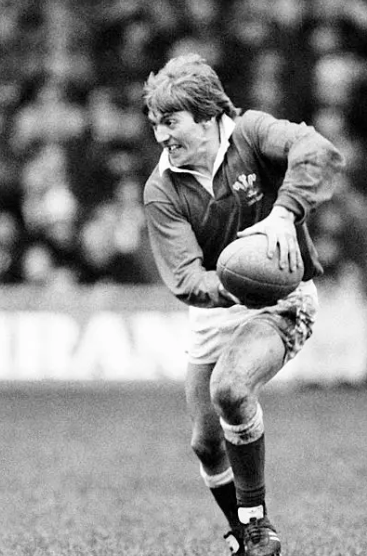
Gerald Williams in action for Wales. Getty Images

One of the few things Kingston does remember is that Williams was “full of himself”, and kept stamping on Mankee’s toes at scrummages, amongst other things. Mankee says he was all talk, and warned him that

If you don’t shut your f_____g mouth…

he could expect repercussions. Williams apparently told Mankee to “F__k off”. Both Kingston and Malcolm Bennetts concur that Mankee

…never warned anyone three times…

…and so it came to pass. At a scrum on Camborne’s 22, in the corner by the turnstile, said Bennetts, an incensed Mankee suddenly

…let rip and punched Williams that hard he split his eye…

Or, as Mankee describes it, he split Williams’ face

…from his eye-socket to his nostril…

Legend will tell you, dear reader, that the sound of Mankee’s right hook making good its connection was heard in the packed grandstand…on the opposite side of the ground.

Williams fell away, blood pouring from between his fingers, and was stretchered off to Treliske for stitches.

Malcolm Bennetts:

There was hellup, the Crawshay’s players wanted to rip Mank’s head off…

Clive ‘Steel Claw’ Burgess instantly, and loudly, demanded vengeance on Mankee. Chris Durant, sensing yet more carnage, advised Mankee to move to the relative safety of the wing, to which Mankee is alleged to have replied,

…I’m not a f_____g winger! I ain’t ‘fraid…bring it on!

(He did, however, accept the sage advice of Frank Butler: “whatever you do, Mank, don’t go on the ground…” Butler knew the only law that existed on the deck was the law of the jungle.)

At the next line-out, said David Kingston, Camborne’s pack all stood in front of Mankee and stared the Crawshay’s men down. Burgess, Kingston told me, “dropped it”.

David Gullick remembers it differently. Crawshay’s, he said, “dealt with” Mankee, “later on…”

A lot of skullduggery…

Where, you may ask, was the referee in all this? Mankee wasn’t sent off, but a penalty was awarded to Crawshay’s. Paul Ranford told me that, in the 1970s, referees “were poor”. Dave Edwards identifies one in particular who was so afraid of Bobby Tonkin that Bobby would virtually “referee the game for him”…in Camborne’s favour.

Terry Symons, then the club’s Asst. Treasurer, and blessed with a memory of Camborne rugby stretching back to the days of John Rockett and Gary Harris, says this was a time when

…a lot of skullduggery went on…

Which is rather like saying that a lot of drinking goes on inside a pub7. Paul Ranford freely admits rugby players at the time “were no angels”, and weak refereeing meant a lot of violence went unpunished. It’s important to bear this in mind for later in the season.

Incidentally, Crawshay’s won, 18-30, with great Welsh threequarter hope Pat Daniels (he was to join Cardiff in 19788) wowing the crowd with searing breaks, though it was Gullick who Frank Butler remembers “cutting us up” that afternoon. Although Camborne “played very tight”, reckons Gullick, Barry Wills scored what David Kingston described as an “excellent” try.

If hospitality was somewhat lacking on the pitch, this was made up for after the match with, the Neath hooker Pat Langford recalls, a guided tour of Port Navas Oyster Farm. In the South Terrace Clubhouse, however, Robert Mankee and Gerald Williams had little to say to each other.

Camborne moved on.

Bobby Tonkin ~ The Smiling Assassin…

Two days later, on the evening of Friday the 9th, Camborne ran in ten tries against Bournemouth, winning 56-9. Faced with obviously lesser opposition than Crawshay’s, and with the expansive Tanzi Lea at fly-half, Town ran amok. Such sides were meat and drink to the Camborne pack in general (who were described as “magnificent”9), and prop Bobby Tonkin in particular, who scored a hat-trick.
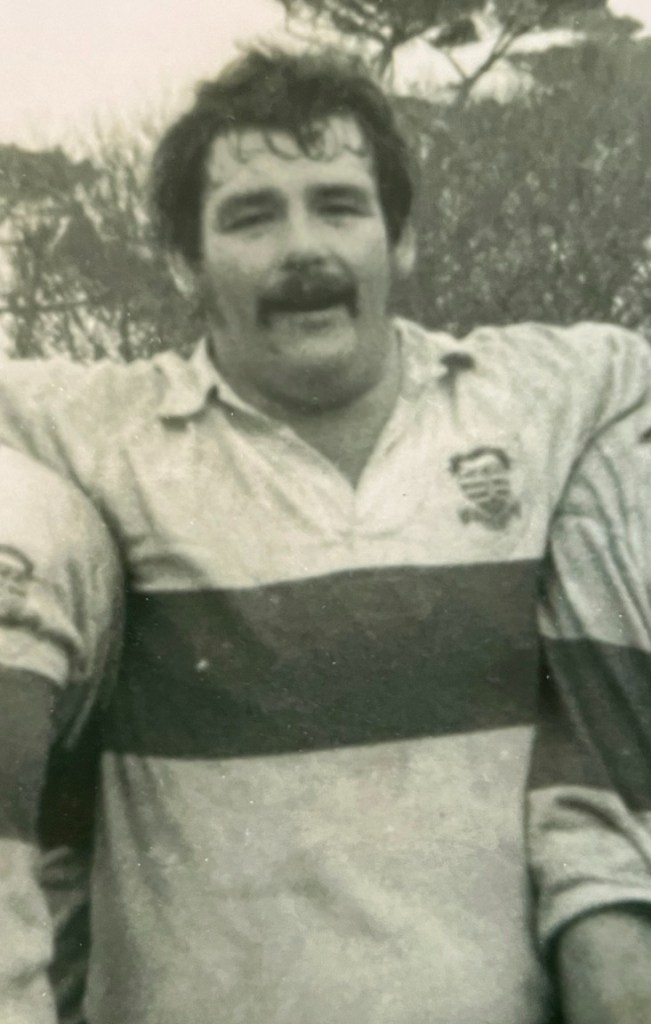
Bobby Tonkin, courtesy of Paul Ranford

Bobby Tonks had it all, in the opinion of Alan Truscott:

…excellent ball skills, good scrummager, and, for a prop, an excellent goal kick…comfortable with ball in hand.

If ever he smelt fear on an opponent – or a referee – Bobby could dominate a game, as Bournemouth, and many others, discovered to their cost. He was a hit with the crowds, and a darling of the press: “well respected”, reckoned Bob Lees.
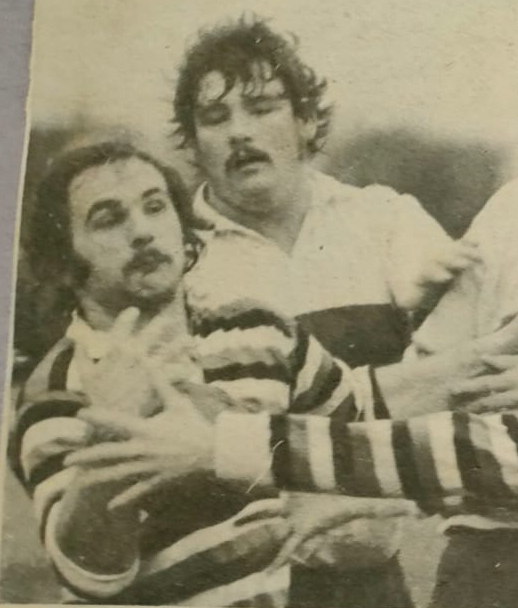
The caption to this snap originally read Big Bobby is watching you…The Packet, January 5, 1978

Tonkin was a “big man, with a big personality”, Jumbo Reed told me, adding

…he either liked you, or he didn’t…

Conversely, and like many other big men with big personalities, you either “liked Bobby, or you didn’t”, reckoned Terry Symons. Either way, he was vital to Camborne’s success, with countless attacks from the line-out, for example the ‘1234’ move. Chris Durant would catch at the front, and feed to Bobby, who would be peeling round the short-side, bullocking forward, body low, chin out, on the rampage. Malcolm Bennetts would grab the opposition hooker and pull him into the line, creating a gap for Bobby to pop-pass to Paul Ranford, who would sprint through to score. Such were his ball skills, said David May, that Bobby was “ahead of his time”, inasmuch that he was often to be found in the threequarters, eyeing up an opposition centre,

…like a smiling assassin.

He must have been a hell of a player.

Never a bleddy try…

The next day, a Saturday afternoon, Camborne entertained Pontypridd. This would be, wrote Merrill Clymo in his programme notes, a “formidable task”. Ponty’s historian, Alun Granfield, informed me that the club were elected Welsh champions for the 1976-77 season by the Western Mail newspaper, as well as being awarded the Sunday Telegraph trophy. Their skipper was international flanker Tom David – yes, that Tom David, a member of the Barbarians XV that beat the All Blacks in what is now seen as the quintessential 1970s rugby match.

Tom David in action for the Barbarians10: This is great stuff…Phil Bennett covering…Brilliant! Oh, that’s brilliant! John Williams, Bryan Williams. Pullin. John Dawes…great dummy! To David, Tom David, the half-way line! Brilliant by Quinnell! This is Gareth Edwards! A dramatic start! WHAT A SCORE! ~ Cliff Morgan, commentator, Barbarians v All Blacks, 1973

And it was tight. Going into the final quarter, Camborne led 9-7, thanks to three penalties by Steve Floyd. Though Ponty had scored earlier with wing Brian ‘Mad Dog’ Juliff outsprinting both Pellowe and Mankee to touch down in the corner, they were down to fourteen men. A fight had broken out at a maul, and the match official (from Cornwall) had no option but to order the visiting hooker, Steve Moule, off the pitch11.

Camborne, egged on by a baying crowd sensing a famous win, fancied their chances – but it was not to be. In the dying moments, who else but Tom David crashed through a desperate tackle to touch down in the top-right corner…or did he?

The decision to award the try, and victory, 9-11, to Pontypridd, still upsets Chris Durant – and you don’t want to upset Chris Durant. The referee gave the try after much persistent shouting and celebrating from the visitors, but Durant insists the

…try was never scored…it was never a bleddy try…

David Kingston recalled that Durant, in cahoots with Mankee, had David in a bear-hug (which must have been quite a tussle), preventing the Welsh legend from touching down. Camborne

…should’ve won…

But they didn’t. And, sadly, for all that David magnanimously praised the “power” of Camborne’s pack, and how Town had Ponty “worried” until the final whistle12, there was to be no rematch. Pontypridd have never played Camborne, or toured Cornwall, since 1977.

Next Friday, the 16th, Camborne easily beat visiting Maidstone 22-4. (Maidstone’s President, Paul Ehrhart, recalls a “very physical match”, from the start.) Highlights included ten points from the ever-trusty boot of Steve Floyd, and a try from Mankee that brought the house down “from a superb, darting solo run”13.

(Doubtless this was a trademark ‘Mank’ break, where he would look to attack on the open-side but in fact go blind, and streak into the opposition’s 22, leaving the would-be covering tacklers coughing in his dust.)

Barry Wills ~ Come on fellas…

Courtesy Paul White

Teignmouth cried off on the Saturday, but on the following Tuesday, Camborne travelled to lowly Truro for the first round of the CRFU Cup. The game was practically a bye, with Town running in fourteen tries, winning 0-67. Michael Eddy, whom Dave Edwards recalls as a fast, dangerous finisher with a lovely outside swerve, scored a hat-trick. The other wing, Barry Wills, notched up four – all in the second half. His form was white-hot, but he was to play only one more game for Camborne that season.

Wills was a Royal Navy PTI, and “one hell of a fitness freak”, according to Paul Ranford. His training sessions with the squad were described as “regimented” by Robert Mankee, and “painful” by Ranford; indeed, he confesses to throwing up after every one. (All Paul hoped for was to make it to Tyack’s on a Thursday evening in one piece.) Regardless of the whining, the squad’s stamina was excellent, thanks to – Come on fellas…and ONE and TWO and THREE and… – Barry Wills.

Malcolm Bennetts recalls a Camborne Ladies versus Camborne Players match (this long before the advent of the WRFU), in aid of the family of a Plymouth Albion player who had tragically died whilst playing Camborne Reserves. The Ladies’ XV trainer was Barry Wills. (He was the kind of man who would volunteer “for everything”, remembers Frank Butler.) Every Sunday for a month (Come on ladies…), Barry had his new recruits doing interval sprints up the banking, scrummaging work, full tackling, and were introduced to the finer points of line-outs, rucking and mauling. The women would come home bruised and exhausted, begging for it to be over. “Come the big day”, said Bennetts, the game was in fact touch rugby, with no line-outs or scrums, and the men not permitted to run. “But”, Malcolm continues, “that was Barry Wills”. All or nothing.

This was reflected in his play. David May praises his “hard, straight” running, while Jumbo Reed called him a

Top player, anywhere in the backs.

Though not much of a kicker, and a worse passer (few and-and-out wingers are), Nigel Pellowe points out his tough streak when on the defensive. If there was

…any trouble, we would sort them out.

Six matches in the Centenary Season, six tries, and four Cornwall caps – his only four – before injury ruled him out. (More on that next week.) A classic case of what might have been.

Camborne maintain brilliant start…

…was the headline in the sports pages of the Packet of September 29th. Town were on a roll. Three days after pummelling Truro, they beat Avon & Somerset Police 32-0. The day after that, Saturday the 24th, Paignton went down 36-0.

Camborne had played 8 games, winning 6, scoring 252 points, and conceding only 61.

They were flying. But the Merit Table fixtures were about to start, and first up were Camborne’s oldest of old foes…

…Redruth. Would the brilliant start be maintained?

You can find out in Rugby Special ~ Part Three here

Many thanks for reading

References

  1. See Tom Salmon, The First Hundred Years: The Story of Rugby Football in Cornwall, CRFU, 1983, p142-3
  2. The Packet, September 7, 1977, p26
  3. The Packet, September 7, 1977, p26
  4. See Tom Salmon, The First Hundred Years: The Story of Rugby Football in Cornwall, CRFU, 1983, p142-3
  5. In recent times a Camborne v Crawshay’s fixture is arranged to signify an event of great import for Camborne RFC. Apart from the Centenary match, Crawshay’s played Camborne in 1991 to celebrate the opening of the Crane Park clubhouse, and again during the 125th anniversary season of 2003. I am grateful to Martin Symons for providing me with this information.
  6. See: https://en.wikipedia.org/wiki/Clive_Burgess
  7. The 1970s witnessed the most violent game, and the most notorious call – “99” – in rugby history. Even in a British Lions Test, match officials could do little to act against the perpetrators. See: https://www.walesonline.co.uk/sport/rugby/rugby-news/lions-99-call-south-africa-18587954, and https://en.wikipedia.org/wiki/99_call
  8. See: https://www.walesonline.co.uk/sport/rugby/rugby-news/what-became-42-rugby-players-24721126
  9. The Packet, September 14, 1977
  10. From: https://www.mediastorehouse.com/colorsport/popular-themes/gareth-edwards/tom-david-passes-ball-barbarians-build-up-gareth-6303968.html
  11. The Packet, September 15, 1977
  12. As Merrill Clymo noted in his programme notes for the Maidstone fixture.
  13. The Packet, September 22, 1977
Rugby Special ~ Part One

Reading time: 20 minutes

…take great pride in the history of your club…achieve new success, set your standards high…make sure that the Centenary playing record of your club…will be the envy of all other Cornish clubs.

R.E.G. “Dickie” Jeeps (1931-2016), RFU President 1976-77, from the Camborne RFC Centenary Programme 1878-1978, by Philip Rule and Alan Thomas, 1977

…we drank beer, we chased the ladies, and played some rugby in between.

Player’s name withheld
PlayedWonDrawnLostFor Against
Falmouth201514331131
St Ives201514390172
Hayle201415288146
Redruth201316291138
Camborne201046226170
Penzance-Newlyn201037203174
Penryn206212204253
Newquay206113155288
St Austell206113116315
Launceston205114181313
Truro202018124411
Cornwall RFU Merit Table, final positions, 1976-77 season. Though both Falmouth and St Ives had identical records, and St Ives indeed scored more points, 390 to 331, than Falmouth, the title was decided by calculating who had the superior ratio of points for and against. Falmouth edged it with a ratio of 2.5 to St Ives’ 2.2. From the Packet, May 6, 1977, p34.

As it was…

At the conclusion of the 1976-77 season, Falmouth were undoubtedly the top Cornish rugby team. They had beaten Hayle 20-9 to win the CRFU Knockout Cup, which was then sponsored by John Player Tobacco1.

As we can see above, they were also inaugural winners of the CRFU’s “new official” Merit Table, a league formed to determine the team with the most success against their fellow Cornish clubs2.

The all-conquering Falmouth side of 1976-77. From The First Hundred Years: The Story of Rugby Football in Cornwall, by Tom Salmon, CRFU, 1983, p47

It had been a close-run affair. Falmouth took the title with their final game of the season, beating Launceston 31-3 to ensure a better points for and against ratio than their nearest challengers, St Ives. ‘The Hakes’ (as St Ives were known), had taken it to the wire a week previously, hammering Newquay Hornets 61-3 in a valiant attempt to improve their own ratio, but it was not enough, and they only had themselves to blame. They had lost at home 13-26 to Falmouth prior to their Newquay fixture – had St Ives won, the title was theirs. Falmouth, with a game in hand over St Ives (they beat Penzance-Newlyn 14-0), made no similar error against Launceston.

It was the end of an era for Falmouth. Their skipper, Graham Bate, and stalwart prop Bruce Cocking both retired after beating Launceston, and were chaired from the field3.

Falmouth’s back-row forward Stephen Lightfoot (who scored twice in that title-clincher against Launceston) told me that the squad were now

…lacking strength in depth in a number of key positions.

Next season, 1977-78, they were not going to be as tough a proposition. Likewise Hayle: long-serving half-back Dave Mungles was retiring, and several “vital” players would also be missing, said their centre Robert Tonkin. Hayle, therefore, were

…without a lot of experience…

Second-placed St Ives, licking their wounds, ruing the missed opportunity, and pondering the mathematical necromancy that saw them come second to a team who’d scored less points than them, must have fancied their chances.

All of which begs the question…

Whither Camborne?

Camborne 1st XV, January 1977. Back, l to r: Alan Truscott (Coach), Les Arnold, Mickey ‘Jesse’ James, Chris Lane, Chris Durant, Paul Ranford, Nigel Tregenza, Trevor Dunstan, Frank Butler, Selwyn Trevithick (Ref.). Front, l to r: David Kingston, Graham Johns, Nigel Pellowe (c), Dave Edwards, Derick Taylor, Robert Mankee, Chris Nicholas. Image courtesy Helen Wardle, Nostalgic Camborne, FB.

In January 1977, Camborne shared the top of the Merit Table with Falmouth and Hayle: P14, W9, D3, L2. Then they let it slip dramatically, winning only one of their last six games, thus leaving Falmouth, St Ives and Hayle to duke it out for the title.

They crashed out of the CRFU Cup in the semi-final to the eventual runners-up, Hayle. And that must have been a choker: their first semi had ended in a 3-3 draw, at Camborne, meaning a rematch at Hayle, which they lost 9-6.

As if that wasn’t bad enough, Camborne lost their final Merit Table game of the season, at home, 3-7, to Redruth. To add further shame and ignominy, the game was televised on the BBC’s weekly Rugby Special4. (If you can remember the theme tune, ‘Holy Mackerel’, you’re humming it right now.)

Various reasons have been given for this distinctly underwhelming end to the the 1976-77 season.

Frank Butler, flanker and Players’ Secretary, attributes Falmouth’s success to their gaining half of the Penryn squad after a fall-out at the Borough. In other words, they had the manpower that Camborne didn’t.

Dave Edwards, wing, reckons that, though the team took “each match seriously”, Camborne

…didn’t really pay much attention to the Merit Table and its potential and standing.

Some perspective is perhaps needed here: Camborne had played an additional twenty or so fixtures to the Merit Table clashes; like many a Cornish team, they regularly entertained touring sides from upcountry.

Dave ‘Jumbo’ Reed, prop, blamed selection decisions:

If anyone walked into the club and mentioned they had been to Cardiff they were straight in the first team.

Paul Ranford, lock, reckons it was an absence of ambition:

…we…didn’t realise how good we could have been…

Ranford also cites a lack of fitness overall, which may explain the late-season fade.

Trussy…

1976-77 was Alan Truscott’s first season as Camborne’s coach, but he was no callow rookie. Having only retired as a player the previous season, he knew his squad intimately and, with a distinguished career for Camborne’s 1st XV, crucially had their respect too. Having taken up coaching in the late 1960s as a schoolteacher, and recently guiding Helston U15s to their County Championship, the club were keen for him to take the job on. His verdict on the 1976-77 season is emphatic:

…we were considerably underachieving…

Next season, 1977-78, Trussy reckoned, would be different. A young squad (mostly aged between 19-24), would be older, stronger, and (hopefully) wiser. The challenge, as he saw it, was to be the top club in Cornwall, a sentiment echoed by Paul Ranford. They needed to grow up, he reckoned, and

…not take any nonsense from any team.

The 1977-78 season had to be better. It had to be special. The 1st XV, from a squad, Truscott remembers, of around 35-40 players, had to improve. The expectations and pressure would be that much greater.

Why? Because the 1977-78 season was Camborne RFC’s Centenary Season.

1877…1977…

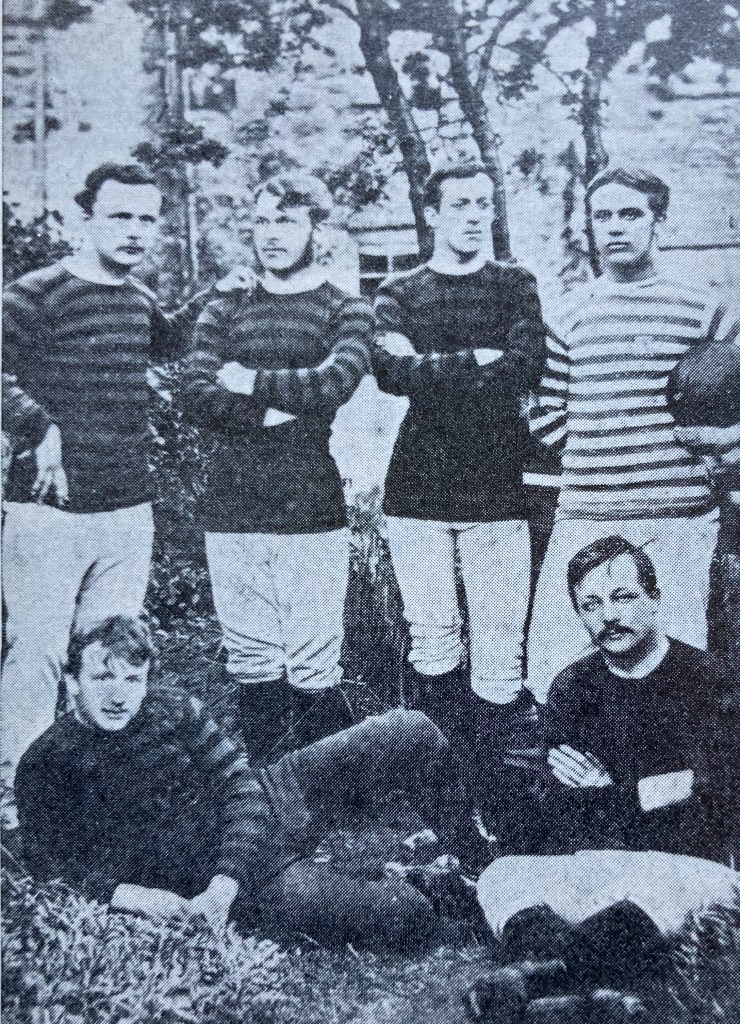
Six members of the 1877-78 squad. Sadly, no names. From the Camborne RFC Centenary Programme 1878-1978, by Philip Rule and Alan Thomas, 1977
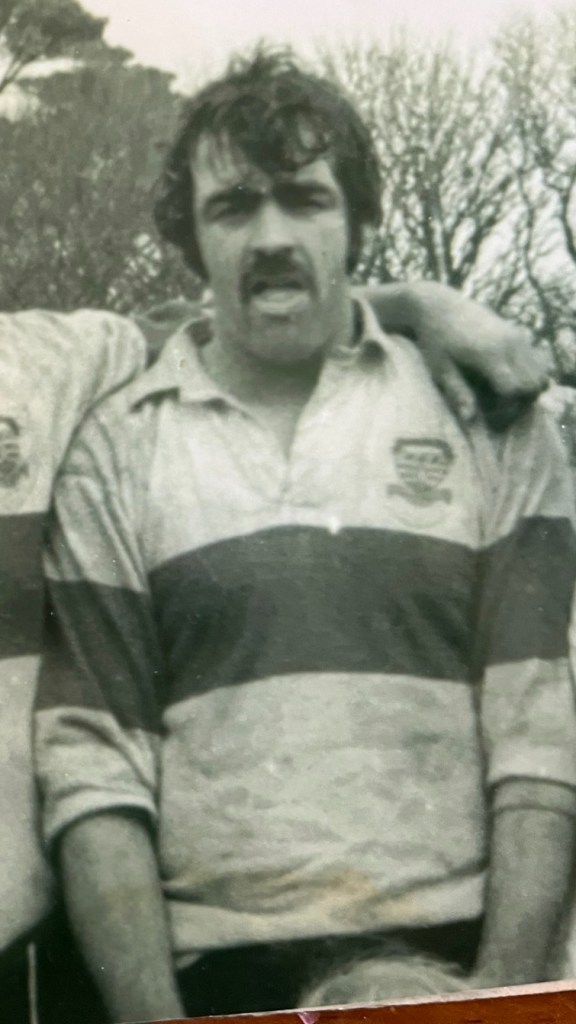
From an inauspicious start in November 1877 (Penzance beat them by three tries to nil5), Camborne RFC had grown to be one of the senior Cornish clubs. It doesn’t take academic books of cultural theory6 to state the obvious, that the Cornish instinctively identify with the sport of rugby, and Camborne was, is, a rugby town. In the inter-war years, there was eleven rugby teams in the area, not including Camborne RFC itself, and featured such XVs as the ‘Camborne Unemployed’. Whenever a member of the Unemployed XV found work, he would have to leave the club, in a bizarre kind of economic revolving-door policy7.

Camborne RFC had prospered with the town; the Unemployed XV, perhaps thankfully, hadn’t, and were no longer around in 1977. Camborne was still a good town to find work in, the mines were still open, and some Town players, such as the hooker Malcolm Bennetts and the livewire scrum-half, Robert Mankee, earned their wages underground.

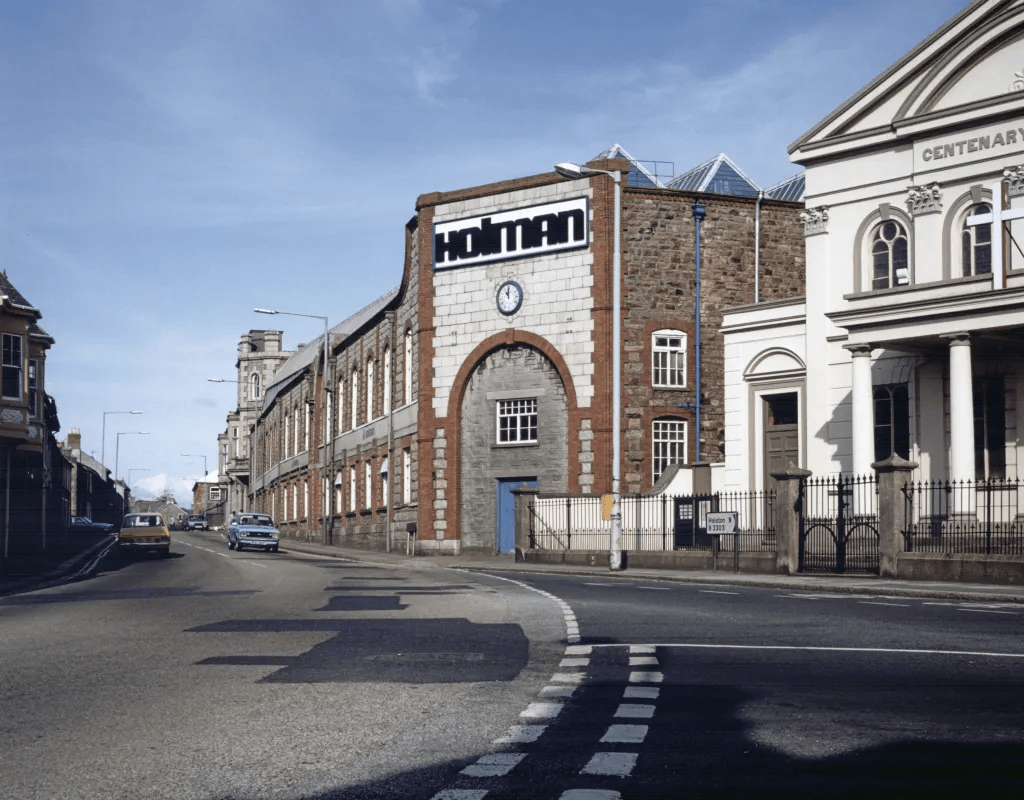
Of course, with a workforce of around 3,000, the big employer in Camborne was the world-renowned engineering firm, Compair Holman.

The Holman’s frontage in Wesley St. Demolished in 1989, there’s now a supermarket on the site8

Many of the Camborne RFC squad found employment there, such as Frank Butler, Derick Taylor (who, in 1976-77, scored a record 193 points in 24 games), Kevin Lean, David Reed, Dave Edwards, Paul Ranford, Dickie Wells, and Martyn Trestrail (who today is the club’s Fixtures Secretary).

Many of Camborne’s regular opposition also worked there, such as Paul Sweeney from St Ives, and Alwyn ‘Slats’ Smitham and Robert Tonkin from Hayle (all three had previously played for Camborne). If your team had lost at the weekend, keeping a low profile when on the shop floor was advisable; Robert Tonkin remembers that Dickie Wells “never missed the chance” to wind him up. He must have been one of very, very many.

The town, and population of Camborne was inextricably linked with its industry, and its sport. For example, when a Holman’s employee married in 1978, it was important to note that the

From the West Briton, June 15, 1978, p24

The season that The Lord St Levan built…

Treve Pascoe (left), Chairman Cyril Rowling, and Alan Truscott. Truscott is obscuring Alan Roberts. Courtesy Martyn Trestrail

The ‘Lord St Levan’ was the sobriquet of Treve Pascoe, Camborne RFC’s Fixtures Secretary. Who Camborne’s 1st XV would be playing in their Centenary Season was his brainchild, an entity, he claimed, that had taken six years to realise9. Luckily, as Alan Truscott recalls, Pascoe was the County liaison officer for all teams wanting to visit Cornwall, and could thus claim first dibs on the touring creme de la creme for Camborne.

Of course, a financial guarantee had to be made to these clubs, and, according to Frank Butler, the ‘Lord St Levan’ had a habit of arbitrarily booking teams without consulting the committee, and leaving the job of scraping together the cash up to them. It may be what the Assistant Treasurer, Terry Symons, is referring to when he good-naturedly describes Pascoe as a

…pain in the ass…

£600 was the target required – that’s £2,800 today. Camborne couldn’t rely on gate takings alone, and Pascoe’s manoeuvres led to such fundraising innovations as this, which raised £40010:

Courtesy of Paul White

(Remember, these financial guarantees were to the clubs themselves, not the players11.)

No matter how he did it, Pascoe had contrived a masterpiece of a season, and Frank Butler believes this is just as well:

…we would not have got as many good fixtures if all was needed to be agreed by the committee…[normally] big clubs would not play the likes of Camborne…

And what fixtures! The original list ran to fifty-four games, and would be more provided Camborne had a good run in the CRFU Cup: 35-40 games was the average for a season, reckoned Robert Mankee.

Besides the regular Cornish opposition in the Merit Table, Camborne would be up against such luminaries as Captain Crawshay’s XV, Pontypridd, Lydney, Plymouth Albion, Saracens, Coventry, South Wales Police, Gloucester, and Cardiff. Cardiff, for crying out loud: that meant Gareth Edwards, Gerald Davies, Gareth Davies, Terry Holmes…

The general reaction to the fixture list is summed up by Steve Floyd, a young fly-half then studying Ergonomics at Loughborough. The squad were generally

Excited. You could be no other…

Dave Edwards reckoned that, though Camborne had played major sides previously,

…this season we felt we were really competing…because of the expectation…to do something special…

Treve Pascoe would also take unilateral action when recruiting players. Back in June 1975, he called on a youthful Illogan Park player, who was newly married and returned home that very day from Cardiff College, where he had qualified as a teacher.

David May began his Camborne career.

Like a machine…

In the 1970s, rugby in Cornwall was a game dominated by its forwards. The “proper Cornish game”, wrote the journalist Jerry Clarke, is one

…in which threequarters are mere spectators.

The Packet, March 23, 1978

Camborne, by common consent, had the biggest, meanest pack in the County, and this isn’t just ‘Town’ old-timers talking themselves up. Practically all of the 25-30 people I’ve spoken to – players, fans, clubmen, deadly enemies – agreed on one thing: Camborne’s forwards were the best. Mickey Stephens of Launceston rates the Camborne fixtures as the

…hardest games of the season…

for this very reason.

And in the Centenary Season, Camborne’s pack got harder. Combining with the ever-dependable hooker Malcolm Bennetts in the front five were County players Bobby Tonkin (prop), and 6ft 4″ locks Chris Durant and Paul Ranford. The new recruit from St Ives was the Royal Navy tight-head prop Jock Denholm, a player Frank Butler describes as

…uncompromising and brutally strong. A very hard man…

With Denholm as immovable as Carn Brea on the tight, Tonkin was now free to exhibit his considerable handling skills on the loose. The “front 5 jigsaw”, said Alan Truscott, “was now complete”.

On the blindside flank was Frank Butler, a genuine terrier. In the days when players were permitted to play the ball on the ground, his job was to win possession, a task, he said, which meant he was constantly

…kicked and raked…

On the openside flank was David Kingston, a tough ex-Gloucester man. When I asked him his main role, the reply was unequivocal:

To kill the opposition half-backs…

Behind them at 8 was usually Richard Thomas, a highly-rated ball player and another County cap.

Whether they meant it or not, a further statement of physical intent was to be made in the man the players elected their Captain for the Centenary Season: Chris Durant.

“When Chris spoke, we all listened”, said Dave Edwards. Courtesy of Paul Ranford

This pack, remembers the ball-boy Tim Carr, would perform “like a machine”, week in, week out.

It was only in the final, and arguably most important, fixture of that long, long season, that the machine finally met its match.

But we’re getting ahead of ourselves. The 1976-77 season was when the team “started to gel”, in the opinion of Robert Mankee. Two more Royal Navy men, hustled up by Alan Truscott, who lived near RNAS Culdrose, had complimented the squad. They were Bob Lees, a threequarter with sniping pace, and Tanzi Lea, a talented back with a sense of adventure. With another RN man from Camborne, PTI Barry Wills taking the fitness sessions (Come on fellas…), stamina became less of an issue, no matter how much the squad griped.

But the “hard edge”, as Frank Butler termed it, remained ever-present. It can perhaps be best exemplified in one of the relatively smaller players on the field…

Nigel Pellowe

A Camborne legend, County stalwart, and crowd favourite who played over a thousand games for the club, from the late 1960s on. A genuine all-round athlete with fitness to burn, in his youth he had been a promising boxer who had won the Junior ABA title, fighting at the Royal Albert Hall. (He never forgot how to throw a punch.) Legend (or rather, Alan Truscott) has it that, as a teenager, he won a cross-country race for West Cornwall, played for Camborne Colts that same afternoon (they won), and then travelled to Plymouth to box for Cornwall ABA in the evening. Needless to say, he won that too.

Nigel Pellowe in full flight, as the crowd cheers him on. From the Packet, September 14, 1977

On the pitch, his talent was such that Malcolm Bennetts reckoned

…he could have played anywhere, even hooker.

As a fly-half, he was 100% reliable, and many people have said he would tackle like an extra flanker. At full-back, he was a kind of Cornish JPR Williams – last in defence, first in attack, and full of aggression. Dave Edwards recalls his defensive work in the back line was “pivotal”, Jumbo Reed rated him the “best tackler on the team”, and Bob Lees told me he had the fundamental perquisite of any 15: a “safe pair of hands”. Offensively, Pellowe was in possession of a sidestep that, remembers Launceston’s Mickey Stephens, would

…torpedo straight through you.

Terry Symons, similarly, reckons he was

…like bleddy lightning…

Oh – and he could kick goals too. Whenever the opposition saw this man take up his position at the rear of the pitch, they must have known a tough afternoon was in the offing.

Bring it on…

Pre-season training, throughout the summer of 1977, got very intense according to Alan Truscott. Everybody wanted a piece of the action, to see how they measured up against some of the very best. That said, Truscott reckoned none of the squad were apprehensive about any of the teams they would be facing, Cornish or otherwise. On the whole, he said, the general attitude was one of

bring it on…

Camborne, then, were going to hit the ground running. They needed to. Apart from an inter-squad match on September 1 (which Martyn Trestrail recalls for the wrong reasons: Dickie Wells bested him in the scrums, and reminded him of this ever after), there was to be no gentle pre-season friendly.

Camborne 1st XV’s opening match of the Centenary Season was to be against the Cornwall County President’s Select XV…

…and you can read all about that in Rugby Special ~ Part Two here

Many thanks for reading

References

  1. The CRFU Cup had been held annually since the 1967-68 season. See: Tom Salmon, The First Hundred Years: The Story of Rugby Football in Cornwall, CRFU, 1983, p144. For 1976-77, it was named the Alan Barbary Memorial Cup after the recently deceased CRFU Secretary. See the West Briton, April 7, 1977, p20. Falmouth, as winners, received a £350 prize from the sponsors, John Player; Hayle got £250, or nearly £1,900 today, for losing. See the West Briton, February 17, 1977, p26. Falmouth, in the 1977-78 season, would then compete in the RFU National Knockout Competition – the John Player Cup. Overall winners that season were Gloucester.
  2. Quote from the West Briton, November 18, 1976, p28. The West Briton of May 6, 1976 (p20) shows a table of the inter-club matches played throughout the 1975-76 season amongst the senior Cornish teams. Falmouth were top, with 19 wins from 23, but fixtures were arranged on an ad hoc basis and their actual position at the top of this table meant little: Launceston and Redruth Albany had only played 17 all-Cornish games, while Penzance-Newlyn amassed 28. The Merit Table brought greater structure, and, as the winner went on to play in the South West Merit Table for the following season, it can be seen on reflection as part of the first steps toward a national league system. See https://en.wikipedia.org/wiki/History_of_the_English_rugby_union_system.
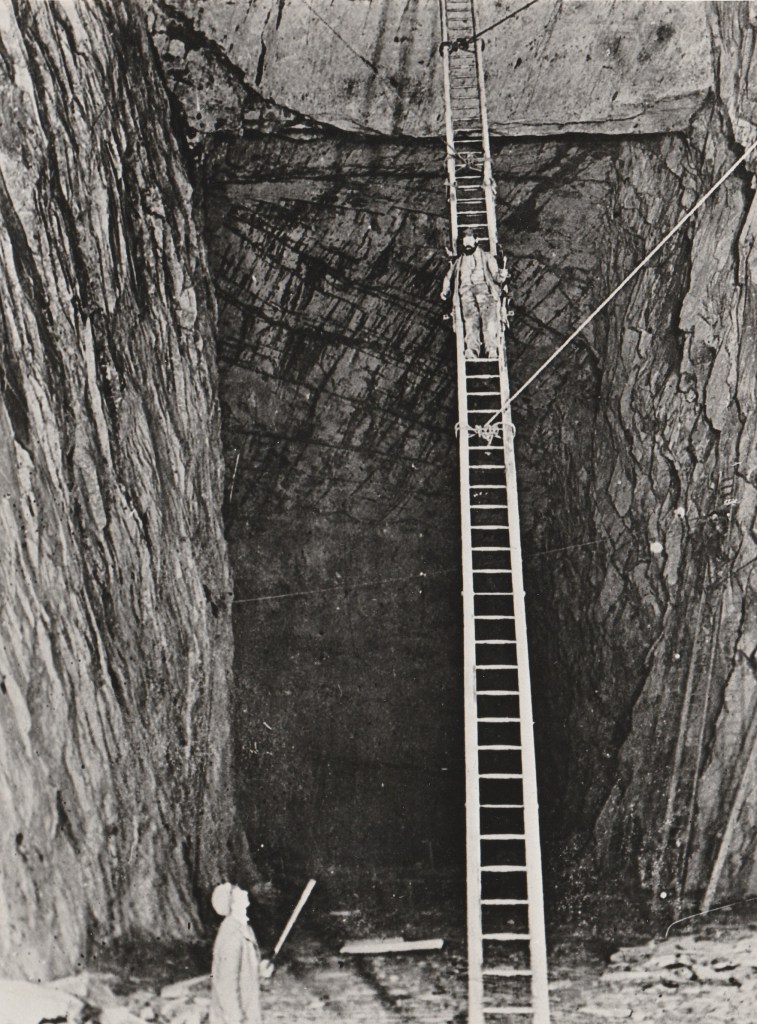
  3. West Briton, April 28, 1977, p26, and May 5, 1977, p26.
  4. West Briton, February 17, 1977, p26, 24 February, 1977, p6, 21 April, p30, and 28 April, p26.
  5. Royal Cornwall Gazette, November 16, 1877, p5. Though rugby journalism was in its infancy, the necessity of recording any injuries or violent play is already entrenched. The reporter dutifully lists a couple of sprained ankles, plus scratches, bruises, and bloodied handkerchiefs, before giving the result.
  6. For example: The Cornish Paradox: Identity and Rugby Union, by Aidan Taylor, MA Thesis, Amazon Kindle, 2013.
  7. From “Between the Wars”, Camborne RFC Centenary Programme 1878-1978, by Philip Rule and Alan Thomas, 1977. Depressingly, one wonders how many sides could be formed among the unemployed of Camborne today.
  8. See: http://cornishstory.com/2021/02/10/holman-echoes-of-an-age/
  9. “Message from E. Treve Pascoe”, Camborne RFC Centenary Programme 1878-1978, by Philip Rule and Alan Thomas, 1977.
  10. West Briton, September 1, 1977, p26.
  11. All Rugby Union back then adhered to the amateur code. If any players actually earned any money from the game, it was only those playing at the very top, it wasn’t very much, and they kept very very quiet about it. Nowadays, the Welsh fly-half Dan Biggar earns a reputed £600K salary for Northampton; his 1970s counterpart, the late, great, Phil Bennett, worked at the Llanelli steelworks. Whenever Bennett represented his country, he lost money on account of not being able to work overtime on a Saturday morning. See: https://rugbydome.com/dan-biggar-salary/, https://www.walesonline.co.uk/news/wales-news/adidas-used-pay-bungs-welsh-1820555, and https://www.walesonline.co.uk/news/wales-news/work-rest-rugby-1935540.

Murder, Debt, Riot: Richard Holloway, Redruth Solicitor

Reading time: 40 minutes

Mr Holloway, the solicitor, in the prosecution of the prisoners Bawden, had to make his escape from the mob at the conclusion of the case, and had to run over a garden and climb a wall.

The Cornish Telegraph, October 15 1873, p2

He must have been terrified. He’d been a lawyer in Cornwall since 1864 and had never seen anything like this. He’d known a lot of unsavoury incidents on the circuit of the Cornwall County Assizes and Petty Sessions. Murder, stabbings, indecent exposures, assaults, even the brutal torture of a horse. He’d been privy to human nature at its most corrupt and bestial.

And now this. Five thousand Camborne miners, baying for blood because two of their own had been sent down. He’d been the lawyer prosecuting. He wasn’t about to negotiate safe conduct for himself from the town, or engage his sharp legal mind with the representatives of the mob, and give them his reasons why James and Joseph Bawden deserved six months on the treadwheel. Now was not the time for discourse. Now was the time to cut and run.

But Holloway wasn’t to know all this on the afternoon of October 7, 1873. All he knew was that he didn’t want to hang around Camborne any longer than was necessary.

But he’d be back. Holloway had known adversity before. This is the story of his professional life in Cornwall, as comprehensive as I can make it. It provides a fascinating window into the murkier elements of Cornish history, the complex relationships of nineteenth-century Cornwall’s lawyers, the business practices of adventurers in the county’s primary industry, mining, and the challenges faced by professional solicitors in forging a career.

The newspaper reports of many of Holloway’s cases are beneficial to the social historian in that they detail “the lives of ordinary people caught up in extraordinary events”. Paradoxically however their extensive coverage of Cornish crime and punishment supported

…systems of law and order rather than challenging or exposing them.

Bethany Usher, Journalism and Crime, Routledge, 2024, p134 and 168

It’s also a tale of family tragedy.

Legal man

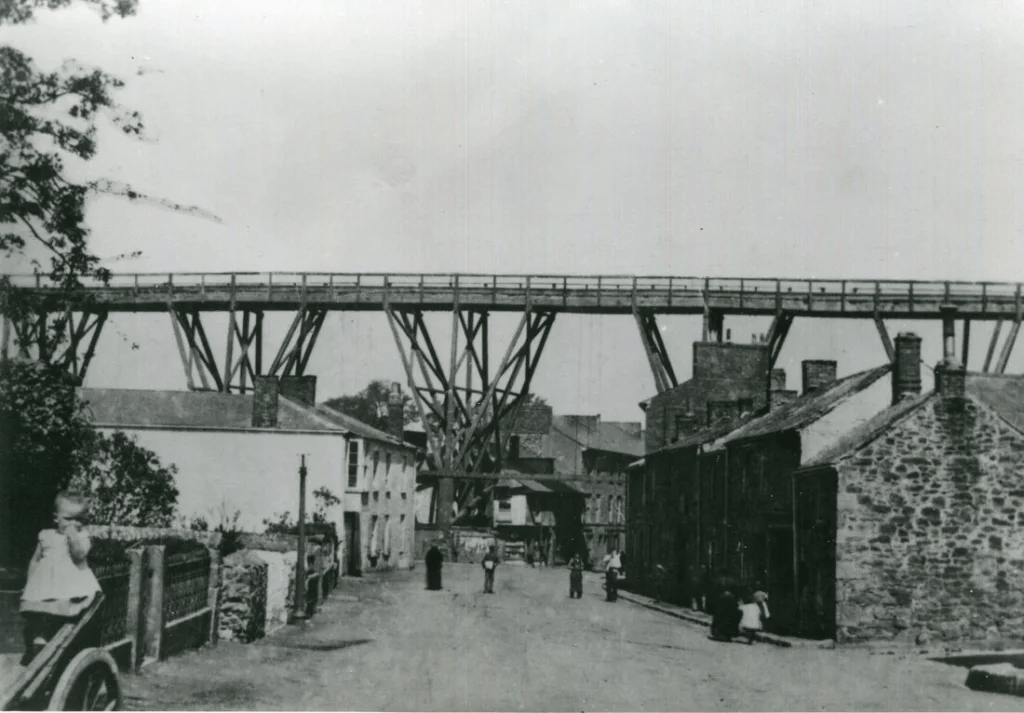
The old timber railway viaduct, Redruth, pre-1887. Holloway lived at Viaduct Cottage in the 1870s. From the Cornwall Railway Society, Paddy Bradley Collection

Holloway was certainly kept busy. If mention in the Cornish newspapers is any true reflection of the amount of cases he was actually involved in, then he must have had a formidable workload. For example, he appeared either for the defendant or the plaintiff in fifty-eight reported cases in 1869. In 1870, he’s reported as one of the acting solicitors in forty-eight cases, and a further thirty-seven more in 1871. Occasionally, Holloway even appears in separate cases at the same session. For example, The Cornubian and Redruth Times of December 6, 1867 (p2) details the Redruth County Court session which had taken place on Wednesday the 4th. Holloway is representing the plaintiff in a case of debt concerning the sale of a horse. Next, he’s acting on behalf of a “poor old woman” who’s owed 30s in rent. After that, he’s involved in a miners’ dispute over their wages. We begin to get the impression of an industrious, London-educated professional, apparently much in demand with Cornwall’s litigants.

Holloway’s cases: “…of a character unfit for publication…”

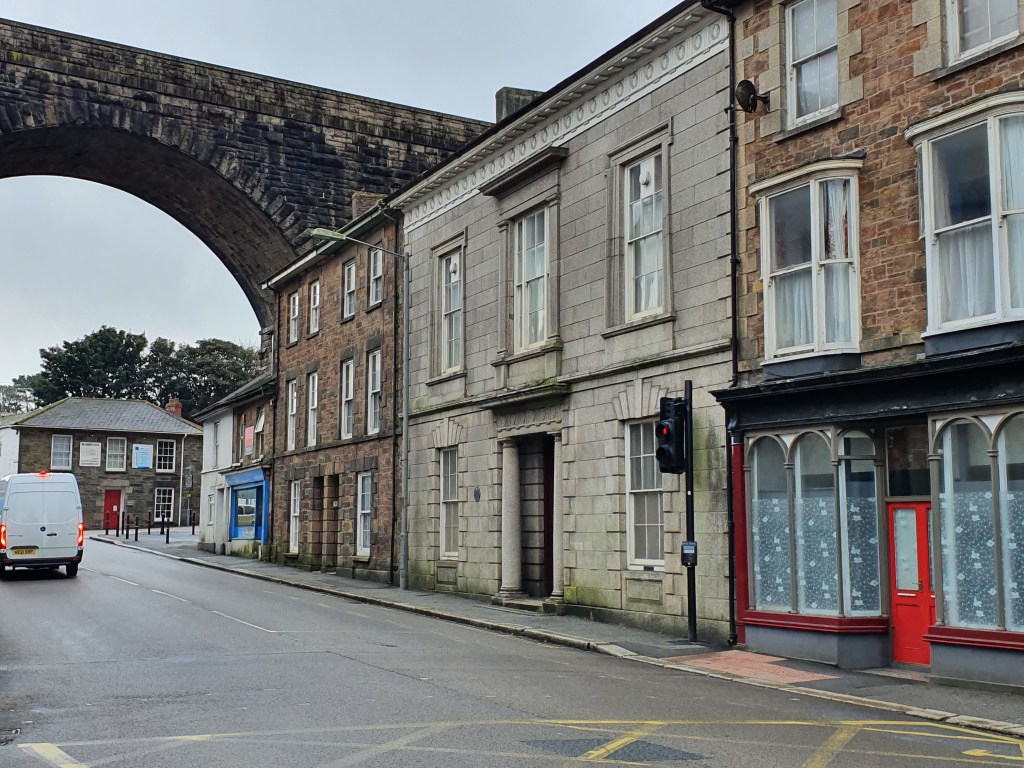
The Old Courthouse, Penryn Street, Redruth. Holloway spent a lot of his career here.
Another view of the Courthouse, with the modern viaduct in view

It’s beyond the scope of this post to itemise every case with which Holloway was involved during his career in Cornwall. I’m going to provide the reader with a summary of his more interesting ones, in order to convey some sense of Victorian Cornwall’s society and its underworld. Holloway dealt with agricultural cases, maritime cases, industrial/mining cases, bankruptcy cases, juvenile delinquents and those whose relations to society were rather more marginal. They’re all here.

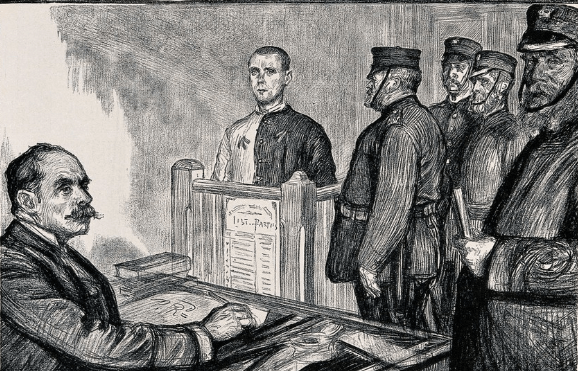
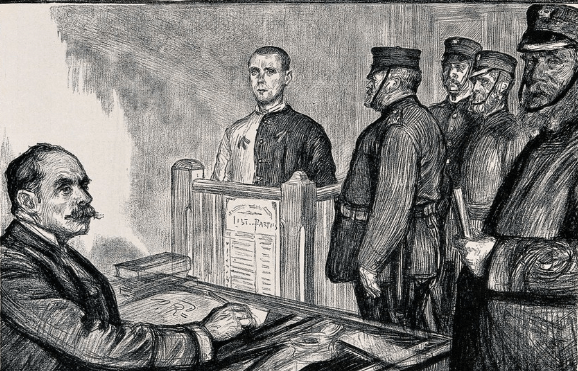
In the dock at Wormwood Scrubs, 1889. By Paul Renouard (1845-1924)

That same year, Holloway was defending a married Scorrier shopkeeper accused by his maidservant of getting her “in the family way”. When she attempted to challenge the shopkeeper on this delicate matter, he was alleged to have kept her “locked up for three weeks, giving her some empty flour bags to lie on”. The maid escaped, only to be held captive again for a further nine weeks, and on release was in a “most filthy state”. (She gave birth to a baby girl shortly after her confinement.) Holloway was unable to convince the court that the child was not the shopkeeper’s, and he was ordered to pay 2s 6d per week to the maid for the baby’s upkeep. As to the alleged confinement, it appears to have been dismissed as “trumped up”, although the shopkeeper was sternly cautioned by the Bench9.

1867 saw an important salvage case in Falmouth. Holloway was defending the owners of the Cardiff brig Isabella, who were sued for £200 under the Merchant Shipping Act. The Isabella was alleged to have been in distress off St Mawes Point in a gale and had been towed into Falmouth by the Lionness. The owners of this tug were seeking recompense for their services – the brig would have sunk without their assistance. Holloway must have displayed considerable verbal dexterity in his arguments for the defence, proving that the Lionness’ assistance was “not a question of salvage at all, but one of towage”. The £200 sought by the owners of the Lionness was knocked down to £7 10s10.

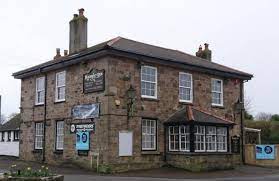
The Railway Tavern, Illogan Highway. From the pub’s Facebook page.

In 1868 Holloway was defending the landlord of the Railway Tavern, Redruth, who stood accused of having his house open at an illegal hour. A policeman had witnessed a local prostitute enter the pub with an empty jug. On leaving the pub, not only was her jug full, but she was in the company of a man. When the constable asked the man who the girl was, he replied “Supposing she is a servant”. (This prompted some laughter from the court.) Although the local girl claimed there was only milk in the jug, it was discovered by the officer to contain beer. The landlord’s wife was asked in court as to what she had served the girl; her response to this question was apparently so obscene the ‘paper left it blank: “______”. Holloway got the case dismissed11.

In 1869, Holloway successfully defended a 12 year-old boy accused of stealing cabbages from a farmer in Gwinear. The farmer had chased the boy to his house and accused him of the theft, which the lad “strongly denied”. Holloway proved the alleged thief’s alibi to be sound12.

Two farmers from Paul, when informed of an exhausted horse found lying on their land, decided to chain the animal to the axle of a cart. It was then “dragged 250 yards in that horrid manner, tearing the flesh and skin from its body as it went”. The horse was then thrown into a pit, where it died, “lying in that deplorable state for two nights and a day”. Holloway successfully found the farmers guilty, and donated a portion of their fine to the Society for the Prevention of Cruelty to Animals13.

At East End, Redruth in 1869 a man tried to break up a vicious streetfight between two miners. The peacemaker got stabbed in the neck for his troubles, “under the angle of the jaw on the left side”. Though Holloway appeared for the man who had allegedly carried out the knifing, bail was refused and he was committed for trial at the next assizes14.

The New Inn, Park Bottom, Redruth. Scene of a murder in 1870. From the St Austell Brewery website

“Murder at Redruth”, reported the West Briton of May 5, 1870 (p7). It occurred on Saturday night, April 30. John Martin, a miner from St Blazey, who had recently returned from America (the ‘paper noted he wore “a moustache and beard trimmed in the American fashion”), was accused of stabbing John Uren, “a quiet, orderly man”, who was a cripple and nearly blind. Martin had been making unsavoury remarks to two women running a fish stall outside The New Inn, Park Bottom. One of the women was Uren’s wife, who ran to get him him in order to see off Martin. There was then a scuffle outside the pub between Martin, Uren, and another man, Prisk, who’d come to assist Uren. Martin stabbed Uren in the “lower part of the bowels” with a knife with a 7″ blade, practically severing his main artery. It took Uren the best part of an hour to bleed to death, leaving his wife and five children unprovided for. Martin, charged with murder and facing the noose, pleaded not guilty and hired Holloway.

At the Assizes, Holloway convinced the jury that Martin had stabbed Uren in an act of self-defence – how the jury concluded Martin needed to defend himself from a partially-sighted cripple, only they will know. He was found guilty of manslaughter and sentenced to penal servitude for life15.

In August 1871 a 15 year-old boy ran naked for 200 yards in front of Four Lanes church, just as the congregation were leaving after evening service. He’d been put up to it by some older lads and the whole thing sounds like a dare that went too far. Holloway, defending the boy charged with indecent exposure, certainly felt that way and convinced the Bench at Helston Petty Sessions to give him 48 hours in gaol and then send him home, where, one imagines, he had a lot of explaining to do16.

And so Holloway’s career continued. He was unsuccessful in defending four men caught trespassing and ferreting for rabbits at Gwithian in 1872. In October of that year he appeared for the defendant in a case of assault which had happened at Lelant. The case was dismissed, but the plaintiff, obviously disgruntled at the outcome, handed Holloway a note stating that, if his client was not bound over to keep the peace, plaintiff would “keep a six-shooter about him”. This wreckless bravado resulted in the plaintiff himself being bound over, and having to pay costs17.

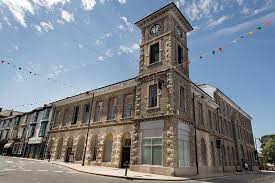
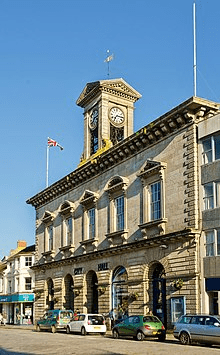
Camborne Town Hall, where the Petty Sessions were held. Built in the 1860s. From the Camborne Town website

The Camborne Petty Sessions of January 1873 can be summarised thus: two cases of drunk and riotous, a case of animal cruelty, two cases of assault, one case of vandalism, and someone let his bullocks stray onto the highway. Holloway was on duty for the assaults18.

In 1878 Thomas Dabb of Mount Hawke let one of his bulls into a field which belonged to his brother. Mary Dabb, his sister-in-law, pointed out to Thomas that the field was not his. Thomas Dabb then subjected Mary to a brutal assault with a whip. Holloway, defending, stated that as “a question of right being involved in the case”, it couldn’t be tried at the West Powder Petty Sessions. Case was postponed19.

In 1879 five youths were charged with “criminally assaulting” an orphaned girl of “weak intellect” from Camborne. The evidence given “was of a character unfit for publication”. Holloway appeared for the defendants, who were dismissed with a mere reprimand – the evidence, whatever it was, had failed to establish the charge20.

It’s clear, then, that Holloway was a prolific, and formidable, lawyer. Here and there we also get some intimation of what kind of person he was.

Holloway’s personality

The evening’s entertainment at a meeting of the Redruth Institute was given over to its members giving readings and monologues for the diversion of those present. Amongst those presenting a recital was Mr R. Holloway, solicitor, who

…read with considerable effect, some humourous sketches from the “Pickwick Papers”, which was a very pleasing change indeed.

Royal Cornwall Gazette, October 14 1864, p5

What does this tell us about Holloway? That he was obviously at ease addressing the public – in his line of work that was fundamental for success. He must also have been very self-assured: this is one of the earliest mentions of him appearing in public, in a new town, a new county, whose populace he’s going to serve in a professional manner. He also seems well-read, and cultured: apparently the choice of reading Dickens was a somewhat unorthodox one, but was well-received. That he was also present at the Institute’s meeting, and was its vice-president for many years, shows his interest in public affairs and the affairs of the town he now calls home. Holloway was setting himself up as a figure in the public eye22.

By 1874, Holloway’s reputation as a solicitor of note was well-established. A local publican, seeking the return of his license to sell intoxicating liquids, sought to employ him in this respect. He knew Holloway as a “painstaking” gentleman. Judging by the amount of times he appeared for the defence over the years (see above), and the amount of times his clients had their sentences/fines reduced or the case was dismissed on a technicality, one must conclude that he was, indeed, a most painstaking and tenacious individual on a case23. But there was absolutely one crime that Holloway never defended. And that was cruelty to animals.

I’ve already outlined the shocking case of cruelty towards a horse in March 1869. What I haven’t mentioned is that, as well as arranging for a portion of the fines to be donated to the Society for the Prevention of Cruelty to Animals, Holloway actually appeared on that organisation’s behalf. And this was no one-off. In 1875, Holloway represented the Society again, this time in a case of alleged cruelty towards sheep. A herd of the animals had been so crammed into a railway truck that seven suffocated and died on the short journey from Camborne to Redruth. Founded in 1824, the SPCA was in its relative infancy when Holloway was practicing; his compassion shown toward members of the animal kingdom makes him seem somewhat modern24.

It’s with heavy irony, then, that the suspected cause of Holloway’s death in 1881 was from a kick to the arm from a horse, possibly on his own farm25. He was “in the prime of life”, and “always affable and obliging”. Before the opening of Redruth County Court on May 17, 1881, the Judge, Montagu Bere, QC, was moved to speak of his former colleague as having

…the advantage of a native intelligence which always prevented him from going wrong, and he had a knowledge of the people among whom he lived, of their manners, their customs, and their habits which rendered him of most valuable assistance to the court.

Cornish Telegraph, May 19 1881, p8

None of these eulogies mention the financial troubles that dogged Holloway’s early career.

Money matters

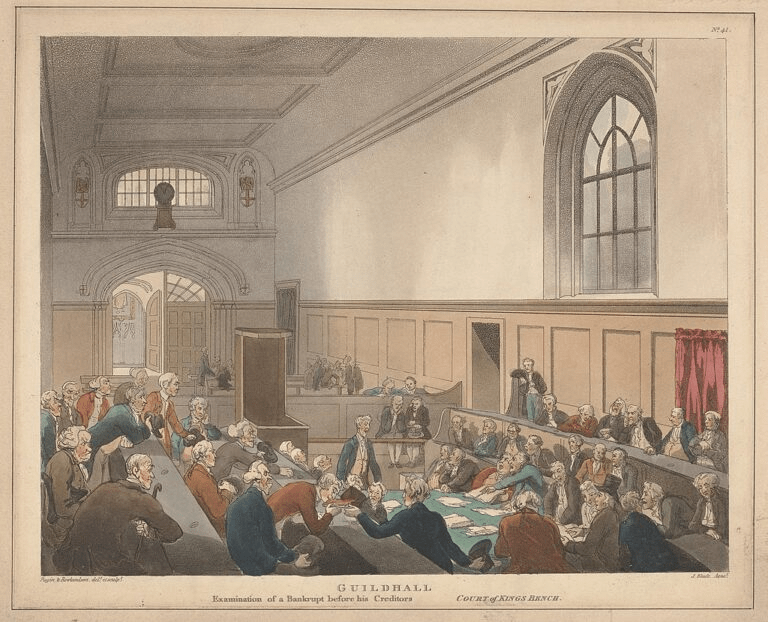
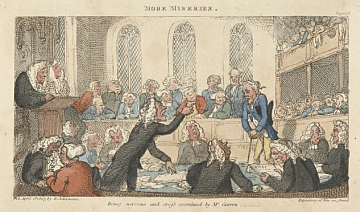
Thomas Rowlandson – Guildhall Examination of a Bankrupt before his Creditors. Thomas Rowlandson, CC0, via Wikimedia Commons

Holloway attended The Exeter Court of Bankruptcy of 5 December, 1867, on a side of the dock he was perhaps not accustomed to. He owed £1,454 to creditors (that’s £135,454 today), £30 on bills, and £935 on his partnership account with Paull and Linton. He had assets of £12. Most of these debts Holloway had accumulated in the past three years, during his time in Cornwall and in partnership with Paull and Linton. He also owed money from as far back as 1857. The Judge looked down his nose at Holloway:

…what a pretty state of things this is, you know; only £12 assets and over £2,000 liabilities. I cannot pass a gentleman in this way, with an immense debt…

Royal Cornwall Gazette, December 12 1867, p3

Holloway’s case was adjourned for further investigation. Before stepping down, he sought to mitigate himself somewhat. When entering into partnership with Paull and Linton in July 1864 it was agreed that he would run the Redruth branch of the firm. He was to have a third of the profits from the branch and £150/year besides. Holloway stated that he “never had a farthing…nor any profits.” Any money he received was sent to Paull and Linton in Plymouth, as they were “continually writing for money to support that establishment.” Linton had already been declared bankrupt, and the firm had been liquidated – Holloway made a final payment of £300 as a goodwill gesture. All his creditors “had sympathized with him, and it was well known in the county why he was in court.” Holloway had to wait until the 20th of that month to see if his career, and his status as a gentleman, was over. If he knew his Dickens – and he did – his fears of destitution must have been profoundly felt26.

It seems that, indeed, Holloway’s creditors sympathised with his plight. Although the case had been adjourned in order to give the creditors an opportunity to oppose the bankruptcy, none stepped forward. On December 20th, Holloway was “granted an order of discharge”: he was free from his debts27.

Victorian society viewed bankruptcy as the penalty for inefficient business practice; to be poor was to be unclean, both physically and spiritually. And bankruptcy happened to lawyers with surprisingly regularity, especially to those in more provincial areas28.

Holloway, however, appears to have recovered relatively rapidly from his regrettable appearance at Exeter Court in 1867. As noted earlier, the 1871 census finds him living the life of a respectable professional, with a servant and governess in his employ. Maybe running his own practice suited him; maybe he just worked tirelessly to keep the income at a steady stream. Significantly, Holloway’s “peak years” of being mentioned in cases by the newspapers occur around this time: 52 cases in 1869, 48 in 1870, 37 in 1871. After that, his name occurs less frequently in relation to court hearings: 20 in 1876, 13 in 1877, 12 in 1878. Perhaps, with a new practice, a young family and a damaged reputation in the late 1860s, the increased workload was the only way to keep the wolves from the door. By the late 1870s, he could cut back on his cases and still afford to purchase a farm.

(Ironically, he represented in numerous bankruptcy cases over the years. For example, there’s one reported in the Cornubian and Redruth Times of February 2, 1868, p3.)

Rather more petty financial squabbles occupied Holloway over the years. In 1871 he was in court again, sued for £10 by a mine broker from St Day. Holloway had allegedly agreed with this man to buy shares in Wheal Uny Mine, then reneged on the deal. The broker was suing for loss of earnings. When the broker had asked why Holloway wouldn’t pay, he replied that “he had been to collect a lot of money in the neighbourhood of Helston, and had not gathered a shilling.” After a lengthy cross-examination of the broker, it became apparent that this man had offered to buy ten shares from another agent, for £9 5s a share, with the sole intention of selling them on to Holloway at £10 5s a share. This other agent hadn’t sold the shares to the St Day man, and the St Day man was suing Holloway £10 because he “would have gained [£10] by selling them.” The case was thrown out and the St Day man ordered to pay costs29.

This is as indicative of the customs and practices of mine brokers and agents in the era as it is of Holloway’s difficulties in collecting fees – and the fact that he was prepared to gamble on mining stocks. We can imagine him, or one of his clerks, tethering his horse in a remote mining district and visiting several homesteads in the hope of a redress for his services, only to be told by a weary tributer that this month’s sett was very poor and he stood to make a loss himself, or to be fobbed off with a few pence and assurances that the whole amount would be there next month. The frequency with which this must have happened was as frustrating for Holloway as it is unknowable for us.

Holloway was also summoned to court in 1880. He was called on to pay a debt of £2 to Thomas Penaluna, of Wendron. Holloway chose to defend himself, and his irritation at having been summonsed is apparent; he “considered it a most iniquitous thing”. It certainly was. Back in 1873 Holloway had paid two men £1 each to stand as bond for the administration of Penaluna’s deceased cousin’s estate. Why Holloway was being called on to pay the £2 now, when he had paid it back in 1873, was utterly beyond him. The Bench, obviously, found in Holloway’s favour30.

This, of course, was one of Holloway’s final appearances at court, a man now so self-assured he could opt to speak for himself in the dock, and with the clout to voice his displeasure at having to be there at all. One of his sons, John Edward Holloway (b.1855), followed his father into the family practice.

Tragically, his career lacked the success of the elder Holloway.

John Edward Holloway and John Rule Daniell

Mr J. R. Daniell, solicitor, of Camborne, has purchased, and will continue Mr. Holloway’s practice at Redruth…as well as the fact that Mr. John E. Holloway, the deceased gentleman’s son, will remain with Mr. Daniell as articled managing clerk.

Cornish Telegraph, May 12 1881, p5

Polstrong 3
Polstrong House, Roseworthy, Camborne From the House and Heritage website

That Holloway and Daniell were acquainted, however, doesn’t necessarily make them friends. It may have been Holloway’s dying wish that Daniell purchase his practice and give guidance to his son, John, as Daniell himself claimed later. Or, alternatively, Daniell may have seen an opportunity to expand his own business, and kept John Holloway on out of respect for his dead colleague and legal opponent. Not having children of his own might possibly have been a factor in Daniell making this decision32.

Whatever the reasons, and whatever tuition and experience Daniell provided for John Holloway, he perhaps lacked the intellect, tenacity and survival instincts of his father. The frequency with which he appears in cases reported by the Cornish newspapers fails to challenge that of Richard Holloway. From 1881 to 1897 he is mentioned on only 47 occasions. In November 1897 his request for a retrial in a case was refused, his reasoning for the request being verbally mocked by the judge, and provoking laughter from those present. By 1898, he had sold his practice to a Mr Harris33.

Lemon Street, Truro, 2021

In October 1899 John Holloway was living in Lemon Street, Truro. For some weeks past he had been complaining of head pains, but on the morning of Friday 6th he awoke and bathed as normal, then returned to his room.

He then put a revolver to his head, and shot himself. His suicide note, along with the Coroner’s inquest, was recorded in the Royal Cornwall Gazette, October 12 1899, p3:

I attribute my unsuccessful professional career in the beginning and end to John Rule Daniell, solicitor, Camborne, who, when I was his articled clerk and he an experienced man, had all my ready cash, £3,000, and crippled me for years. He knows the transaction and promise made me. Now he refuses to answer a letter just to relieve me in a pinch. May God Almighty forgive me and bless my wife and family. We have been a happy one. – J E. HOLLOWAY.

I can’t stand this no longer. I feel my head daily getting worse. – J.E.H.

The jury at the inquest returned a verdict of “Suicide whilst in a state of temporary insanity.”

But before doing so, the Coroner spoke to John Rule Daniell.

Daniell stated that Richard Holloway had asked him “when very ill to do what he could for his son in case anything happened.” Daniell then went on to convincingly refute the claim made by John Holloway in his note that he had held Holloway’s “ready cash” as a young man. Daniell was at pains to point out that Holloway had lost £600 on a land transaction around fifteen years previously and that he still felt Daniell in some way responsible – he wasn’t, as Daniell was at pains to point out. As to the letter Daniell never replied to, Daniell presented it the Coroner and explained that he had never replied to it because, shortly after it was delivered, Holloway visited him, asking for money. Holloway was “in a pinch” as he had wound up his practice in Redruth, had plans to start a new one in Truro, and had lost money in shares at Carn Brea Mine. Daniell claimed he told Holloway that he wouldn’t mind the loan normally, but “he had plenty of demands, and it was not practicable for him to make the advance.”

Daniell was exonerated. The Coroner “would not believe the loss of £600 so many years ago would cause him to take his life”, and wondered why Holloway hadn’t approached his family for assistance rather than Daniell.

Many thanks for readingfollow this link for more top blogs on all things Cornwallhttps://blog.feedspot.com/cornwall_blogs/

References

  1. Royal Cornwall Gazette, March 2 1872, p4.
  2. See the first of my double-bill on the Camborne riots of 1873 here: https://the-cornish-historian.com/2023/09/30/the-camborne-riots-of-1873-part-one/
  3. Devizes and Wiltshire Gazette, September 25 1851, p3.
  4. Cornish Telegraph, May 12 1881, p5.
  5. The Tavistock Gazette, July 4 1881, p1.
  6. Information from: “A comparative analysis of the relative occupational status of lawyers and accountants in nineteenth-century England and Wales”, by Kevin Clarke and Jack Flanagan, Accounting History Review, 29:3, 2019, p345.
  7. See: https://www.redruthrugbyclub.co.uk/a/redruth-rfc-history-40480.html
  8. Royal Cornwall Gazette, July 12 1866, p8.
  9. Cornish Telegraph, October 31 1866, p3.
  10. Royal Cornwall Gazette, April 18 1867, p5.
  11. Cornubian and Redruth Times, March 20 1868, p3.
  12. Cornubian and Redruth Times, February 2 1869, p3.
  13. Royal Cornwall Gazette, March 11 1869, p7.
  14. Royal Cornwall Gazette, June 3 1869, p5.
  15. Cornubian and Redruth Times, August 6 1870, p5.
  16. Cornubian and Redruth Times, August 25 1871, p2.
  17. Cornubian and Redruth Times, September 13 1872, p5, and October 25, p5.
  18. West Britain, January 30 1873, p5.
  19. Cornishman, December 5 1876, p6.
  20. Cornish Telegraph, September 9 1879, p5.
  21. Cornish Telegraph, October 22 1879, p8.
  22. Royal Cornwall Gazette, September 29 1865, p8.
  23. West Briton, October 22 1874, p10.
  24. Cornish Telegraph, May 12 1875, p2.
  25. Cornubian and Redruth Times, May 6 1881, p5.
  26. Royal Cornwall Gazette, December 12 1867, p3.
  27. Cornubian and Redruth Times, December 27 1867, p3.
  28. From: “Bankrupt Accountants and Lawyers: Transition in the Rise of Professionalism in Victorian Scotland”, by Thomas Lee, from Accounting, Auditing, and Accountability Journal, 24:7, 2011, 879-903. It may not consider England, or indeed Cornwall, but Lee’s more general conclusions are helpful and applicable.
  29. Royal Cornwall Gazette, October 14 1871, p7.
  30. Cornishman, February 2 1880, p5.
  31. See: https://the-cornish-historian.com/2023/10/07/the-camborne-riots-of-1873-part-two/
  32. See Daniell’s obituary in the Cornishman, September 9 1911, p5.
  33. Cornishman, November 25 1897, p2, and the Cornubian and Redruth Times, October 7 1898, p5.

The Man Who Photographed the Miners: J. C. Burrow in Cornwall and Wales

Part Two

(If you missed Part One, you can find it HERE)

Reading time: 25 minutes

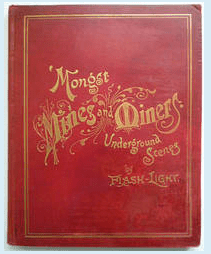
The original cover of Burrow’s most famous publication, 1893

Distinctly remarkable…

1893 was an important year for John Charles Burrow. The photographs he took underground at the Dolcoath, Cook’s Kitchen, East Pool and Blue Hills Mines, were published in his ‘Mongst Mines and Miners. This work not only gained him recognition and celebrity in Cornwall, but also respect, and fascination, in the world of professional photography, and from the general public.

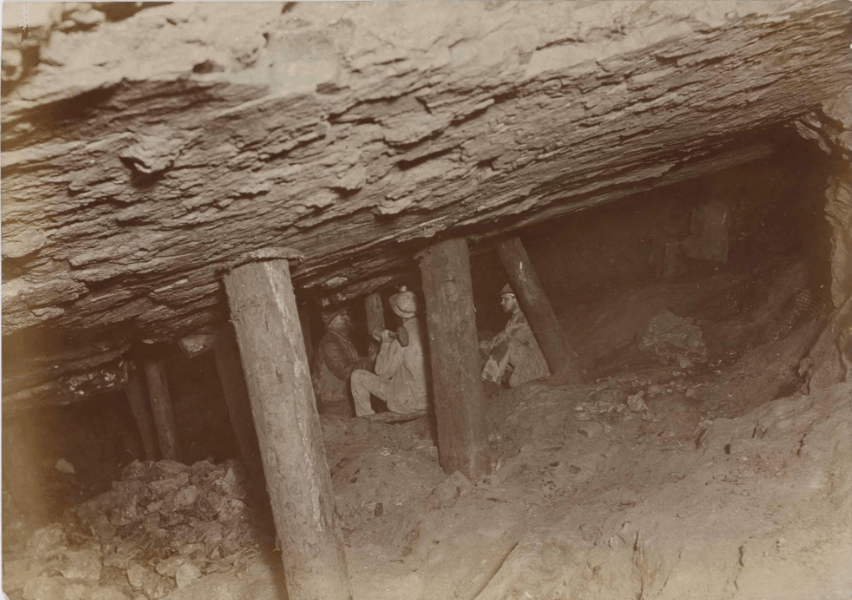
His photos, such as the one below, also brought awareness of the working conditions underground to many people living outside of the mining districts. I might add, they still do.

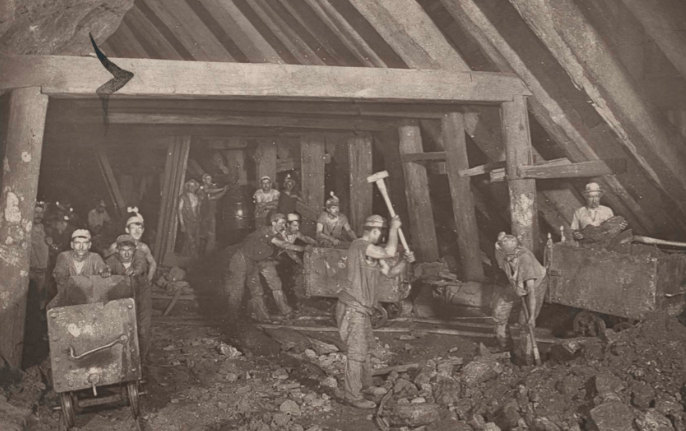
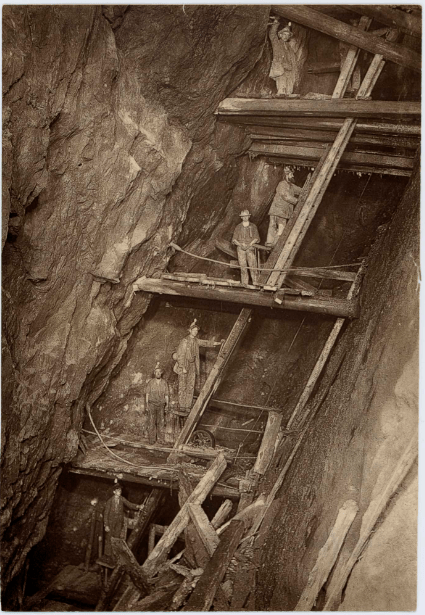
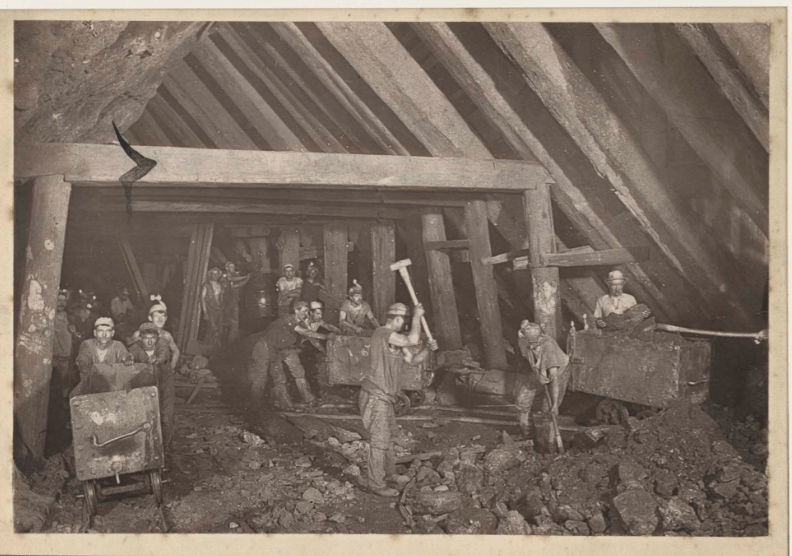
66 Fathom, Blue Hills, St Agnes. Three miners are hammering a new prop into position to support a lode of four to five feet. Image courtesy Kresen Kernow, AD460/1/35. This image originally appeared in ‘Mongst Mines and Miners

Examples of Burrow’s work were displayed in London that year at the 38th Exhibition of The Photographic Society of Great Britain, where he won a bronze medal for his efforts1.

Positive reactions to Burrow’s skill, and his results, were immediate. The Morning Post described his exhibits as “very interesting”2. Other reports were equally appreciative, and more detailed. The miner, as George Orwell wrote in 1937, is

…second in importance only to the man who ploughs the soil…a sort of grimy caryatid upon whose shoulders nearly everything that is not grimy is supported.

From The Road to Wigan Pier, in Orwell’s England, ed. Peter Davison, Penguin, 2001, p68

Therefore, anyone who can successfully, and faithfully, record the labours of an industry that makes civilisation possible, is also important. This was realised by the London Evening Standard:

…the underground pictures of Mr Burrow have supreme merit. The greatest difficulties to portray such scenes…snatched from the darkness of subterranean passages fathoms deep…by the skilful manipulation of limelight and magnesium lamp.

October 11, 1893, p2

The Times likewise noted that

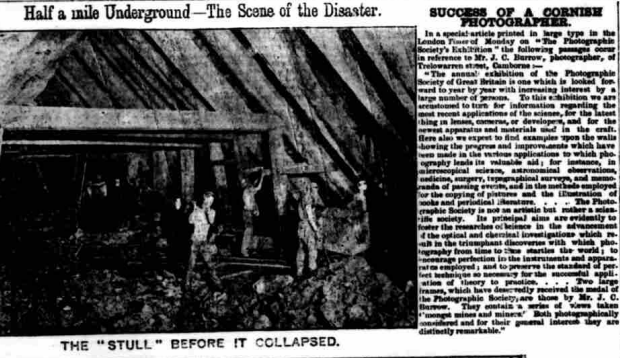
…photographically considered and for their general interest they are distinctly remarkable.

This was actually quoted in the Cornish Post and Mining News of September 29, 1893 (p8), beside Burrow’s photo of the stull at 412 Fathom, Dolcoath Mine, Camborne:

Cornish Post and Mining News, September 29, 1893, p8. This image also originally appeared in ‘Mongst Mines and Miners

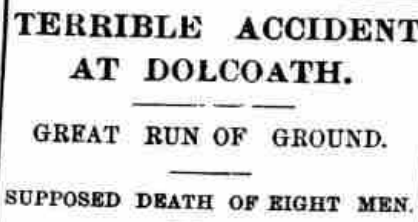
As we saw last week3, though Burrow took this shot in 1892, interest in it increased in the most tragic circumstances. In September 1893, the stull at 412 Fathom collapsed, killing seven miners working to repair it. Postcards of Burrow’s photo did a brisk and morbid trade in the Camborne area, and the image was also used by H.M. Inspector of Mines for the South West, Joseph Martin, during the inquest into the accident.

It was Burrow’s recognition in London, and the Dolcoath Disaster, that probably brought his abilities to the attention of the government.

There was trouble in North Wales.

O Arglwydd Dduw Rhagluniaeth: The Llechwedd Strike of 1893

North Wales Chronicle, May 27, 1893, p2

The Llechwedd Slate Quarry near Blaenau Ffestiniog was the scene of a bitter and protracted strike from May to September of 18934. It began when a quarryman, Griffith Jones, was threatened with the loss of a day’s pay unless he returned to his work station. Jones, who had already worked seven and a half hours that day, refused, and went home. When he returned to Llechwedd the next day, Jones was told he had been suspended for his defiance. In a mass show of solidarity, the entire Llechwedd workforce, totalling 500 or so, downed tools, and vowed that

…we will not return to work without a distinct understanding that we shall all be allowed to return without a single one being left out, and that the present dispute be satisfactorily settled.

Qtd in the North Wales Chronicle, May 27, 1893, p5
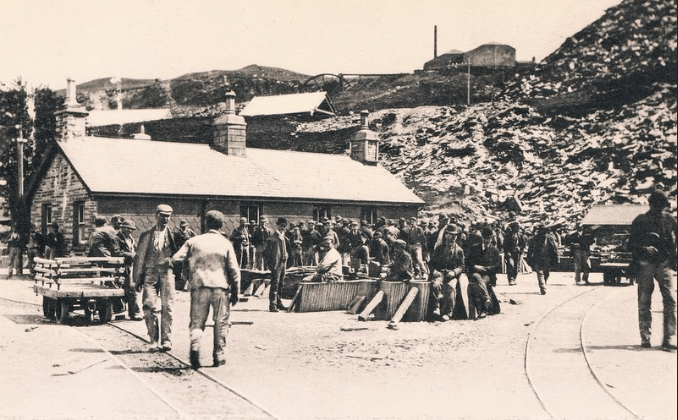
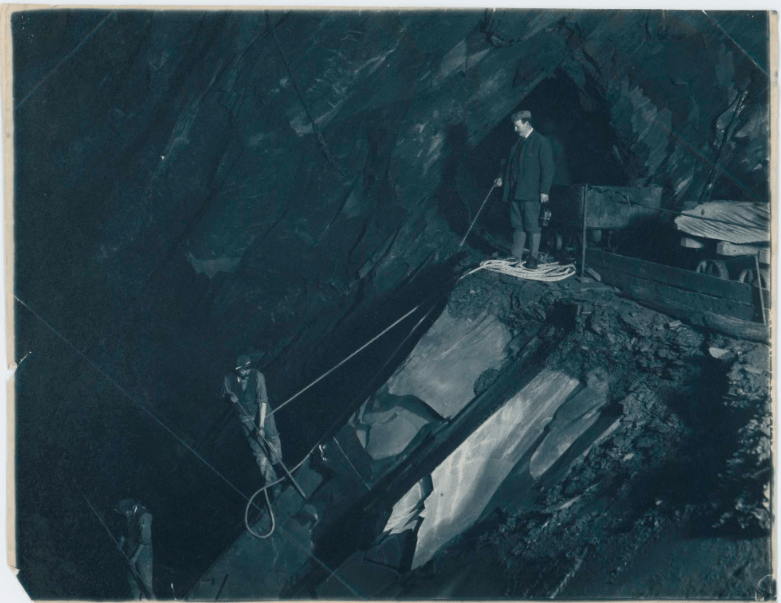
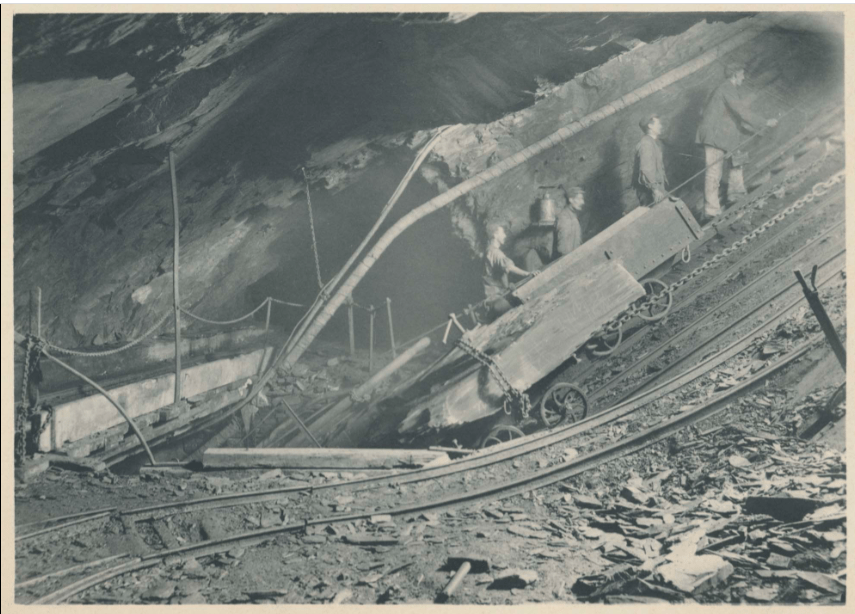
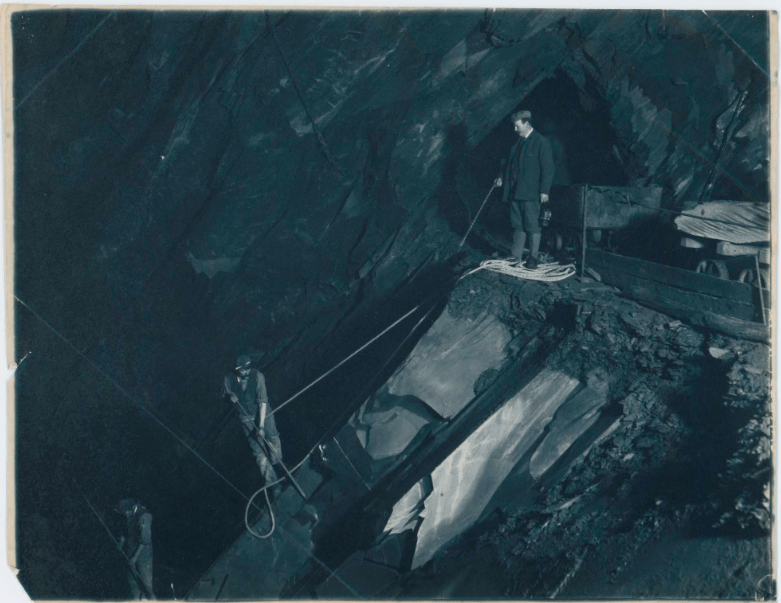
Pay day, Llechwedd, 1890s5. Quarrymen hand-drilled underground in the pitch black with chains round their legs to prevent falls, often spending their entire working lives in the same slate chamber
Today, the Llechwedd Slate Caverns are a tourist attraction in Snowdonia

The quarry owner, John Earnest Greaves (1847-1945), let it be known that those on strike could consider themselves severed from his employ, and he furthermore reserved the right to employ only men he wanted to employ6.

John Earnest Greaves in 1897. From his Wikipedia entry

Thus were the battle-lines drawn, and were to remain as immovable as the Western Front for the next five months. Committees were formed, spokesmen nominated, and delegates presented grievances. In the first flush of optimism, the Quarrymen predicted a “short battle”7, and even had an unofficial anthem, the hymn ‘O Arglwydd Dduw Rhagluniaeth’ (‘O Lord God of Providence’).

The Llechwedd Quarrymen had the official, and financial, support of all quarry-workers in the Ffestiniog, Penryndeudrath, and Bethesda areas. Local firebreathing ministers took up their cudgels too, describing the “present fight” as

…one between gentlemanliness and oppression, justice and tyranny, capital and labour.

North Wales Chronicle, August 19, 1893, p7

The strike was also recognised by The North Wales Quarrymen’s Union, who gave the Llechwedd workers’ plight a nationalist agenda. The Greaves family was from England8, and while the Union was

…willing to respect aliens who might come amongst them, but if their object was to tyrannise over them and act towards them unjustly and unfairly, then it behoved them to lift up their voices against those aliens.

North Wales Chronicle, August 19, 1893, p7

(It may be worthwhile to point out to my readers outside of Wales that the Ffestiniog area was, and still is, proudly Welsh, and proudly Welsh-speaking. In 1893, all the Quarrymens’ meetings were conducted in Welsh, and their correspondence to the Llechwedd officials had to be translated into English before it could be read9.)

The Quarrymen also had the support of the up-and-coming young Liberal MP for Caernarvon Borough, David Lloyd George10.

Sadly, it was not enough.

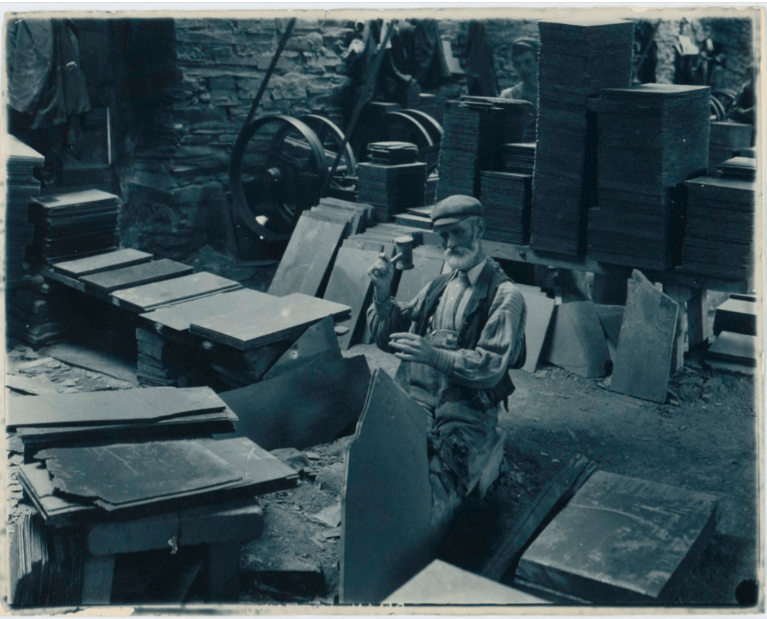
Slate cutter, Llechwedd, 1893. Image courtesy Kresen Kernow, ref. AD460/24

Over 1,100 men, women and children formerly reliant on wages from the quarry were now without regular income. The strike, and by extension their plight, was dismissed in the Press as

…one of the most ridiculous in the annals of labour disputes…

North Wales Chronicle, May 20, 1893, p8

Greaves, by contrast, was portrayed as a

…most generous and considerate employer…

North Wales Chronicle, May 20, 1893, p8

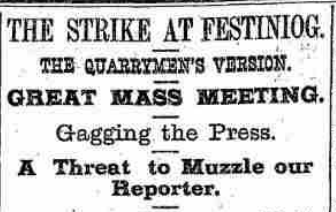
(Indeed, the Chronicle‘s reporter was threatened with a “muzzle” by the strikers for airing such opinions11.)

Furthermore, The North Wales Quarrymen’s Union was condemned as a “beggarly organisation”, spouting “sheer nonsense”12. It was responsible for the “long weeks of suffering of the families of Llechwedd”13.

Perhaps understandably, with these conflicting voices, the community of Llechwedd became divided, and irrational.

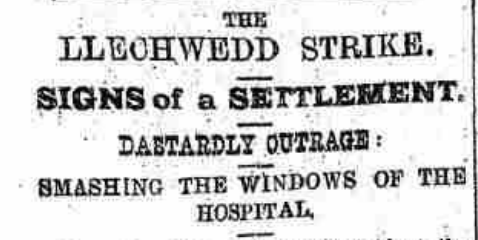
North Wales Chronicle, June 17, 1893, p8

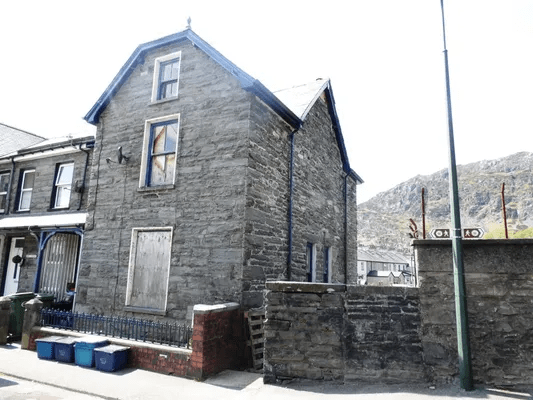
The Hospital in Newmarket Square, Blaenau, was senselessly vandalised by drunken quarrymen for no other reason than it having been founded by Greaves13.

Llys Dorfil, The Square, Bleanau. Formerly the Hospital. With thanks to Llio Wyn and Gareth Jones, Bleanau Ffestiniog UNESCO World Heritage page, Facebook

One man who crossed the picket line and went back to work was “severely condemned”14. What ‘severely condemned’ might be a euphemism for is illustrated by a serious assault on another ‘scab’. He was dragged from his workplace, beaten, and almost thrown over a precipice, where he would have

…met with instant death…

North Wales Chronicle, July 8, 1893, p8

Other men tried to return to work on false pretences. In short, hunger was beginning to win out over principles and, as the North Wales Chronicle of September 9th smugly noted, finally, the strike was “terminated in favour of the masters” (p8). It was later noted that prominent strikers had been refused readmission to the quarry, with many leaving the area15. With yet more gloating, the Press opined that

This result was inevitable from the very start.

North Wales Chronicle, September 9, 1893, p5

Maybe, maybe not. But was there not perhaps something in the quarrymen’s grievances? Was their discontent justified? Could something be done to introduce improvements

…into the quarrying, in addition to adding greatly to the pleasure the workman himself would derive in following his occupation.

North Wales Chronicle, December 1, 1894, p6

Certainly, H. M. Government thought so.

The Commission

The old railway station, Camborne, c1895. The new buildings are under construction on the left. Burrow probably began his journey here in 1893. Image courtesy Kresen Kernow, ref. corn05120

The then Home Secretary, Herbert Asquith, commissioned an investigation into the Merionethshire Slate Mines (of which Llechwedd was one) in November 189316.

Herbert Henry Asquith, 1852-1928. From his Wikipedia page

The Chairman of Asquith’s Commission was Clement Le Neve Foster (1841-1904), the Inspector of Mines for North Wales. Both he and Asquith were probably already familiar with Burrow’s work. As we saw last week, Asquith had been kept abreast of the events of the Dolcoath Disaster – and possibly Burrow’s photographic association with its inquest – by Cornwall’s mining inspector, Joseph Martin. Foster himself had several mining links with Cornwall; what’s more, his father had been a founding member of The Photographic Society of Great Britain, which had awarded Burrow for his ‘Mongst Mines and Miners in 189317.

Whatever the reason, or whoever recommended him, someone must have thought it desirous to have the quarries’ working environments photographed, and Burrow was drafted onto the Commission for this purpose sometime in late 1893. It’s unknown whom he travelled to North Wales with, or whether he transported his cameras, plates, tripods, lenses, limelight burners, oxygen and hydrogen canisters, and magnesium flash equipment by himself. It’s possible he had the tools of his trade sent on ahead, but I can’t imagine Burrow letting his precious, and expensive, gadgets stray too far from his side. Even without this paraphernalia, the journey by rail would have been testing, with many changes from Cornwall culminating in a seemingly endless run of stops along the Cambrian line (Aberdovey, Llanbedr, Llandanwg, Harlech, Tygwyn, to name but a few), before the final change at Minfordd for the Ffestiniog branch line.

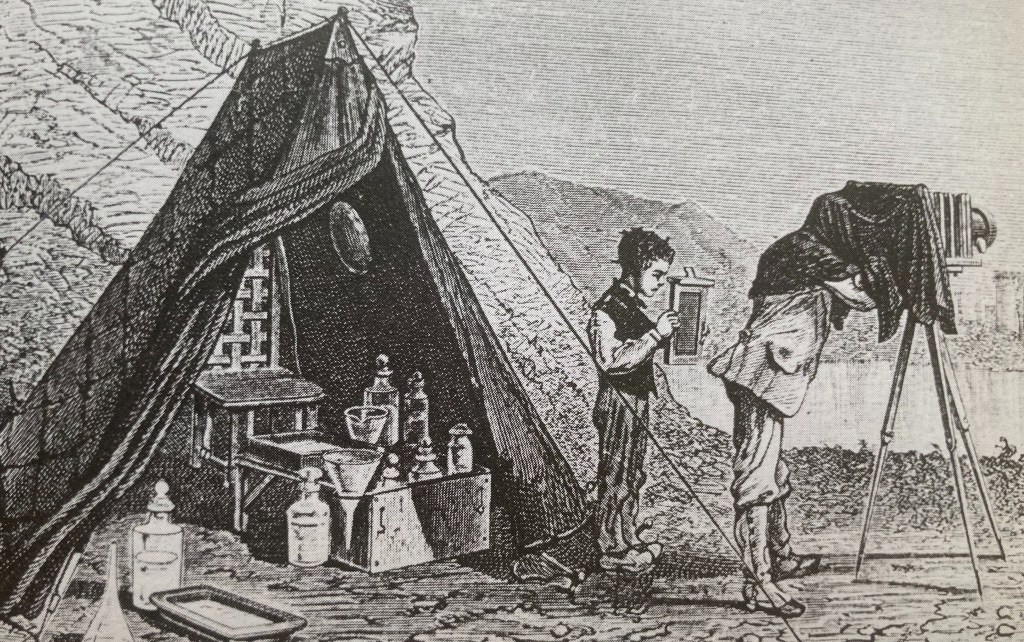
Victorian photographers were regularly lampooned for the amount of implements they required. From: To Photograph Darkness, by Chris Howes, Alan Sutton, 1989, xix

If Burrow did travel solo, it raises an interesting point: who did he get to position and operate his limelight burners? Would he have had to use an interpreter? How were his wishes conveyed to the quarrymen?

The Government’s subsequent Blue Book was published in 1895, under the lengthy title of Report of the Departmental Committee Upon Merionethshire Slate Mines; With Appendices. In the interests of brevity, this publication will hereafter be referred to as The Report.

Mercifully, The Report is not as dry a read as its title might suggest. On the contrary, it provides a fascinating snapshot of 1890s life in the quarries of North Wales in general, and Llechwedd in particular. And life was hard. There were no toilets for the workers, above or below ground; men used old workings as latrines18. Typhus was a threat, men slept two to a bed in filthy barracks, often in the clothes they worked in, and many cottages were damp, having been erected on undrained peat19.

Ruined miners’ cottages, Llanberis, Snowdonia20

Even travelling to and from work on the Ffestiniog Railway was hazardous to health. Men waited on damp sidings in cold, sweaty clothes, there being no bathing, changing or drying provisions at the quarry, before being crammed onto draughty carriages21. This of course exacerbated the many respiratory diseases associated with the inhalation of dust underground. Diet was poor, and the men existed almost exclusively on stewed tea. (Much was made, incidentally, of the miners’ diets, with public lectures on cooking and nutrition subsequently being given in the Ffestiniog district 22.)

I could go on, but this post is not primarily concerned with the working conditions of Victorian slate miners, as seen through the eyes of a 21st century Cornishman. Suffice that The Committee made forty-three recommendations for improvements. Perhaps The Report‘s key finding was that

…the occupation of the Merionethshire man is more risky than that of the average miner of the United Kingdom.

The Report, xvii

Following this, accidents, and deaths, are

…inseparable from the present method of working…

The Report, xv

They certainly were. From 1875-1893, 65 of the 163 deaths in the Merionethshire mines were caused by falls of ground23. In the slate chambers, which men gradually hollowed out over periods of years, the rock roofs could extend over a hundred feet above them, making dangerous runs of debris likely.

Luckily for the reader, Burrow was on hand to capture this perilous working environment:

Image courtesy Kresen Kernow, ref. AD460/23

Above is plate one, figure one of The Report. As Burrow was later to point out, this is the first use of a photograph in a Government Blue Book24. The caption read:

Steps in a worked-out chamber of Llechwedd Mine, for the ascent and descent of the workmen...

As we saw last week25, Burrow probably had his subjects (who, judging by their suits, are members of the Commission) pose in the darkness, with their candles and lantern extinguished. Such light could cause a ‘halo’ on a plate and ruin a take. Burrow would later etch a false ‘light’ onto the plate. What is immediately apparent however is the sheer height of the chamber, and the unsupported nature of the walls.

Here’s another of Burrow’s underground images at Llechwedd. Plate 2, fig 3:

Image courtesy Kresen Kernow, ref. AD460/22. A version is also displayed at the entrance to Llechwedd Slate Caverns today

The caption read:

Upper part of a working-place at Llechwedd…The man on the right-hand side, supported by a chain round his thigh, is using a crow-bar to prize off a block of slate…the man on the left is standing upon a little stage made of two boards, resting upon two iron pegs, and is boring a hole with a jumper…The manager is standing on the tram road…[which]…is fifty feet vertically above the foot of the working face. If the workmen depicted were to slip, they would tumble and roll over a rough and rugged face of rock of nearly that height.

If the written description of extracting slate in the main body of The Report (xii-xiii) doesn’t satisfactorily convey the dangers of slate-mining, Burrow’s photo delivers it, if you will, in black and white.

The Commission visited many quarries, including the nearby Oakeley concern. Burrow went too. Here’s plate three, figure five:

I am grateful to Mr Erik Scott, a quarryman of over twenty years in the Ffestiniog district, for providing me with this image.

The caption read:

Ladder, 86 feet long, erected in one of the chambers of the Oakeley mine in order to examine the roof, which is known to be insecure. The ladder is held in position and stiffened by the guy ropes.

Then there is this image by Burrow, which didn’t make the final cut of The Report:

Image courtesy Kresen Kernow, AD460/21

It’s a postcard, and is described as ‘hauling slate’: it must come from Burrow’s time in Wales.

My contact at Blaenau Ffestiniog Library, Carmen Martin, informed me they actually have postcards of Burrow’s underground images from the quarries. Obviously, Burrow’s plates had a dual purpose: the official, Government-sponsored one, and to make him some money. Equally obviously, Burrow must have taken more, unpublished images. Like this one:

Again,
I am grateful to Mr Erik Scott, a quarryman of over twenty years in the Ffestiniog district, for providing me with this image.

Slate-getters appear to be hand-boring in an underground cavern – from precisely which quarry, it’s uncertain. What other precious images might Burrow have taken? Sadly, many were lost after his death, under the most banal circumstances: the plates were actually used to build a greenhouse26. We can only cherish what we have, and hope for new discoveries.

…we do not yet know its fullest possibilities…

The book Victorian Slate Mining (Landmark Publishing, 2003), by Ivor Wynne Jones, who was a journalist and director of the Llechwedd Slate Caverns attraction, of course covers Burrow’s time in Wales. I am grateful that several people recommended it to me in the course of my research, and for anyone wanting a fuller picture of the industry at this time, go there27.

As with Burrow’s work in Cornwall, his work in the quarries of Blaenau Ffestiniog brought the realities of life underground to a wider public, not just through the publication of the The Report, but also through public lectures on the subject. Lectures which were, of course, illustrated by slides of Burrow’s photographs28. Needless to say, his images are still doing their job to this day. There may have been other men producing underground photography at this time, but none went as deep down, and therefore took as many risks, as Burrow. None contended with the challenges of heat and moisture that he did, and none, it must be said, produced such stunning results29. It was recognised at the time, and continues to be so.

Burrow once remarked that “we do not yet know” photography’s “fullest possibilities”30. Through a comprehensive biography of Burrow’s life, we may finally comprehend the fullest extent of his brilliant career. In Cornwall, his images in ‘Mongst Mines and Miners perhaps overshadows his work in Wales: I was certainly ignorant of his time there, and even the Archivist at Kresen Kernow told me he was unfamiliar with this aspect of Burrow’s profession31.

And there is much of interest. Did Burrow try his hand at painting, before photography32? What about his years as a rifleman for the DCLI33? Or, most tantalisingly, what about the story behind the images he took in a Bristol colliery in the 1890s34?

Surely the greatest photographer of Cornwall’s greatest industry is deserving of a full appreciation of his life and times.

Afterword

That many quarrymen were blackballed in the aftermath of the Llechwedd Strike of 1893 is still well known in Blaenau Ffestiniog. After publishing this post, I was contacted by a resident, Gareth Jones. His grandfather and brother, both prominent strikers, were accused, yet acquitted (to much public rejoicing) of assaulting others “who remained at work after the strike had occurred”35. They were represented by none other than David Lloyd George. Neither worked in Llechwedd again, one man suffering permanent exile to the Durham coalfields. I’ll remember this story as much as I remember Burrow’s.

Many thanks for reading

References

  1. As covered in the Morning Post, September 23, 1893, p5, Lloyd’s Weekly, September 24, 1893, p8, and the London Evening Standard, October 10, 1893, p2. The Photographic Society of Great Britain became The Royal Photographic Society of Great Britain in 1894 and is now, of course, The Royal Photographic Society. See: https://rps.org/about/history/
  2. September 26, 1893, p5. The Post, however, focused its praise more fulsomely on the “most artistic productions” of Italian pastoral youth by Count Wilhelm von Gloeden, who certainly had an interesting life, and career. See: https://collections.vam.ac.uk/item/O1101782/head-of-sicilian-boy-photograph-von-gloeden-wilhelm/
  3. See last week’s post on Burrow here.
  4. Those wanting a more detailed account of the strike are directed here: The Llechwedd Strike of 1893, by Ivor Wynne Jones, Llechwedd Slate Caverns, 1993. My summary is based on the reports contained in the following editions of the North Wales Chronicle: May 20, p8; May 27, p5; June 10, p5; June 17, p8; Juy 1, p8; July 8, p8; July 22, p7; July 29, p10; August 19, p5, 7; September 9, p5; October 21, p5.
  5. Image from: https://www.flickr.com/photos/tallmanbaby/48847787056/in/photostream/
  6. The Greaves family has owned Llechwedd Quarry since the 1830s. See: https://llechwedd.co.uk/tales-from-the-mountains/heritage. For more on John Earnest Greaves, see: https://en.wikipedia.org/wiki/John_Ernest_Greaves
  7. North Wales Chronicle, May 27, 1893, p5
  8. The patriarch of the Greaves slate dynasty, John Whitehead Greaves (1807-1880), had been born in St Albans. See: https://en.wikipedia.org/wiki/John_Whitehead_Greaves
  9. See: https://en.wikipedia.org/wiki/Blaenau_Ffestiniog#Welsh_language, and the North Wales Chronicle, May 27, 1893, p5.
  10. North Wales Chronicle, August 19, 1893, p7
  11. North Wales Chronicle, May 27, 1893, p5
  12. North Wales Chronicle, August 19, 1893, p7
  13. North Wales Chronicle, September 9, 1893, p5
  14. North Wales Chronicle, June 17, 1893, p8
  15. Liverpool Daily Post, May 7, 1894, p7
  16. Report of the Departmental Committee Upon Merionethshire Slate Mines (hereafter The Report), Eyre & Spottiswoode, 1895, vii.
  17. For more on Foster, see here: https://en.wikisource.org/wiki/Dictionary_of_National_Biography,_1912_supplement/Foster,_Clement_Le_Neve. For Peter Le Neve Foster’s involvement with The Photographic Society of Great Britain, see here: https://rps.org/about/history/
  18. The Report, xxix.
  19. The Report, xxi.
  20. From: https://www.pinterest.co.uk/pin/538954280387175557/
  21. The Report, xxii, xxix.
  22. The Report, xxi. For the lectures, see the South Wales Echo, April 9, 1894, p2.
  23. The Report, xiv-xv.
  24. Cornish Post and Mining News, February 20, 1896, p8.
  25. See last week’s post on Burrow here.
  26. Chris Howes, To Photograph Darkness: the History of Underground and Flash Photography, Alan Sutton, 1989, p181.
  27. For an interesting review of this book, see: https://treasuremaps.weebly.com/reviews/victorian-slate-mining-by-ivor-wynne-jones. Jones’s obituary is here: https://www.dailypost.co.uk/news/north-wales-news/obituary—ivor-wynne-jones-2874794
  28. See the North Wales Chronicle, December 1, 1894, p6.
  29. Howes, To Photograph Darkness, p162-82.
  30. Cornish Post and Mining News, February 20, 1896, p8.
  31. Email correspondence, August 2, 2022.
  32. See: https://cornwallartists.org/cornwall-artists/john-charles-burrow
  33. See Burrow’s obituary in The Cornishman, November 5, 1914, p5.
  34. For example, Kresen Kernow, ref. AD460/25.
  35. North Wales Chronicle, October 21, 1893, p5.

The Man Who Photographed the Miners: J. C. Burrow in Cornwall and Wales

Part One

Reading time: 20 minutes

‘Mongst Photos and Photographers…

A few weeks ago, I took my son on a camping trip to North Wales. We weren’t especially fortunate with the weather, and anticipating this I had arranged what I’d hoped to be an interesting indoor activity: an underground tour at Llechwedd Slate Caverns, near Blaenau Ffestiniog.

Underground at Llechwedd. One of my better efforts.

At its peak, in the 1880s, the Llechwedd Quarry employed over 500 men, women and children, and annually transported over 23,000 tonnes of finished slate worldwide1. I emphasise finished slate, because, according to my tour guide, around 90% of what was brought to the surface by the quarrymen was classed as waste and consigned to the massive heaps we can still see in the area today. In other words, 90% of the miners’ efforts were for nothing.

Some of the many slag heaps around Llechwedd

Before descending 500ft, or 83 fathoms, the tour guide gave our party the obligatory health and safety briefing. Whilst talking, he made reference to an old photograph, displayed amongst a selection of slate-cutting paraphernalia. A group of quarrymen (or pare in Cornwall), are hand-drilling whilst precariously balanced on a sheer face of slate. The chains around their thighs are a token gesture to safety: it’s a 50ft drop below. Standing officiously above them is the shift supervisor or foreman. It was taken in the 1890s:

Image courtesy Kresen Kernow, ref. AD460/22

As the image was so clear, clearer than the one above, I was surprised when our guide informed us that this photo had actually been taken underground. The miners were working in pitch blackness, and the foreman wore black so the workers could never know when he was watching them.

The image had been captured by means of flash photography. Now I was really interested.

To my mind, in the 1890s, there was only one man in the United Kingdom using flash photography underground, and you’d have to scour half of Europe to find another one2.

This, of course, was John Charles Burrow (1852-1914). And he was a Cornishman. But didn’t he only ever photograph Cornish miners?

Our guide at Llechwedd didn’t know who had taken the photo. Being familiar with his work, however, I was convinced that only Burrow could have done it.

On returning home, I contacted Kresen Kernow, and discovered that they had images by Burrow taken in slate mines – but the location, or provenance, of these pictures wasn’t stated. On speaking with the Archivist, David Thomas, he told me there wasn’t “much knowledge” of Burrow’s work in Wales, but, as the man travelled a lot, a visit there would not be untypical3.

If Burrow had been to Llechwedd, why did he go there? Who sent him? When did he go there? How did he get there? Who went with him? What were his methods?

To begin to answer these questions, we need to trace the story of Burrow’s work in Cornwall: work which, in the words of David Thomas, made him

…one of the world pioneers of underground photography…

Email correspondence, 2nd August 2022

Cornish Post and Mining News, April 4, 1891, p1. Burrow advertised his services prolifically

Before he was twenty, Burrow had already found his life’s calling. Before he was thirty, in 1881, he was living in Camborne and set up as a “Photographic Artist”; his most well-known residence, and place of business, was “Camara”, on Trelowarren St4.

In short, Burrow had over twenty year’s experience in the medium before producing his most famous work in the 1890s. And he was not working, as it were, in the dark. Burrow was in regular contact with other photographers, and was actively engaged in the main issue vexing the professionals of the time: how do you photograph in the dark5?

It might be stating the blindingly obvious, but we know that Burrow was actively engaged with the current theories, debates, and conundrums because, simply, he succeeded in photographing in the dark.

He succeeded brilliantly.

To achieve this, allied to undoubted skill, tenacity, patience, and courage, Burrow used the very cutting-edge of photographic equipment for the time. It is less well-known that he had also been underground from a young age, and had personally vowed to capture mining life on its lower levels:

…my surprise at the difficulties and dangers of the miners’ work…led me to determine that whenever it became practicable I would show to the world what it meant to extract metals from the hard rocks so far below the surface.

J. C. Burrow, interviewed in the Cornish Post and Mining News, February 2, 1896, p8

The opportunity came in late 1892. He was commissioned (or challenged) by the Camborne School of Mines to take underground scenes at the Dolcoath, Cook’s Kitchen, East Pool and Blue Hills workings6. (Dolcoath was first, and remains the focus of this post.)

To his above resolve, Burrow carefully selected the tools of his trade. His lens of choice was new on the market, manufactured by Carl Zeiss in 18897. His camera, a Kinnear light bellows on a sliding tripod, would have been the latest, 1890s, model8. For the flashlight, he used magnesium powder. This bright burning metal, only discovered in the 1850s, was seemingly invented for photography. A powdered – and at times volatile – variant, flashpowder, had only been patented in 18879. His plates were of the new (late 1870s) ‘dry’ variety; previous to this innovation photographers had to prepare slides on the spot, and the exposure time for them could be excruciating for any sitter10.

Millbank, Lands End, 1898. Note the array of equipment. Back, l to r: William Thomas, co-author of ‘Mongst Mines and Miners, Herbert Hughes, underground photographer of Staffordshire collieries, and J. C. Burrow. The gentlemen in front remain unidentified. Image courtesy Kresen Kernow, ref. corn03899

To this formidable armoury, Burrow contrived what may have been a personal touch. He decided to take several limelight burners to Dolcoath with him, in order to more comprehensively illuminate his tableaux. Limelights, popular at the time in theatres, required an operator and canisters of oxygen and hydrogen to burn a light-emitting block of quicklime11. Burrow may have heard of the application of limelight to photography via the professionals’ grapevine12. Or, possibly, he was personally well-versed in the properties of limelight: in November 1892 he used limelight displays for an evening’s entertainment of the Barncoose Board Schoolroom13.

Deep down…

Such was the novelty and interest surrounding Burrow’s commission to photograph underground at Dolcoath, his adventure was serialised over three weeks in The Cornishman14. The reporter is probably William Thomas, a lecturer at Camborne School of Mines. These articles carry something of the flavour of the Victorian reportage of a newly-discovered land, society, and people; clearly the vast majority of The Cornishman‘s readers had little in-depth knowledge of Cornwall’s primary industry.

Both parties – Burrow’s, and the Dolcoath workforce – show equal amounts of fascination for each other. The sight of Burrow’s equipment, camera, flashlight, tripod, limelight and pressurised cylinders of oxygen and hydrogen excites no little curiosity15. Likewise, the mining natives’ rhythms of speech and dialect are dutifully recorded: one miner had just

clunked some tay to keep un from chacken weth thust after chowen es crowst

Qtd. in The Cornishman, January 5, 1893, p7

Before proceeding, Burrow’s party, comprising a guide, Thomas, and two or three School of Mines students (there to learn their trade, and carry equipment), have to ‘go native’ and don miners’ outfits and hard hats. There was to be no posing in Sunday best here16. This was a necessity: like many a trip to a strange land, danger might lurk around any corner…

Dolcoath Mine, looking over the Tuckingmill Valley, 1893. Image courtesy Kresen Kernow, ref. corn00352. Below is the same view today

When Burrow and his companions visited, Dolcoath was the deepest, and richest, tin mine in the world. With around 1,300 employees and an engine-shaft over 455 fathoms (or half a mile) deep, this was a subterranean land of mystery and riches. For example, at 412 fathom the tin-lode was valued at £600/fathom17. That’s over £53,000 today.

The risk in Burrow’s venture is evident before they have even descended: there was a delay due to blasting, and the area of the mine they are to visit, at 300 fathoms, has to be made safe. Even then, the method of descent is anything but secure. Burrow, his equipment, and party travelled down in a skip or gig, an “oblong iron box on wheels” with an open front, that normally carried up to four men18. Their journey sounds like the scariest rollercoaster ride in history:

Imagine yourself swung over a cliff half a mile high, and being lowered in an iron cage, to the bottom by a rope.

The Cornishman, January 12, 1893, p6

This being done in pitch blackness, down an open rock shaft, with full knowledge that skip ropes have failed, and men had recently plummeted to their deaths19. As Thomas observed, with fine understatement,

One could be excused feeling timorous…

The Cornishman, January 12, 1893, p6

This journey must have left a similar impression on Burrow, for he decided to photograph the skip, containing Joe Semmens, Dolcoath’s timberman, and a young companion. Here it is:

Joe Semmens and companion, the skip, 300 fathom, Dolcoath, late 1892. Image courtesy Kresen Kernow, ref. AD460/1/13

With yet more understatement, Thomas noted that Burrow merely “secured” this photo20. But we must remember that this image, to my knowledge the first ever taken underground at Dolcoath, may have been one of several attempts by Burrow to ‘secure’ it21. He had to, by candlelight, set up his camera, have his assistants position and operate the limelight burners, and pose the sitters for a blinding, smoking, magnesium flash exposure of two to four seconds, all the while contending with heat, water, and vapour threatening to spoil his efforts22. And this was a relatively straightforward shot. I always wonder how he photographed Dolcoath’s Man Engine:

Man Engine, Dolcoath, 1890s. Image courtesy Kresen Kernow, ref. AD460/11

For this, Burrow used yet more limelights, and a triple flashlight; he also had to get the miners to extinguish their candles before taking the shot, and stand, eyes open in the blackness, waiting for the flare. Candlelight caused an eerie glow, or halo, on the plate negatives, and could ruin a take. Burrow, with his eye for authenticity, later scratched a ‘candle’ on to his negatives23:

Detail of the above, with Burrow’s false ‘candlelight’ on his subjects’ hard hats

How he positioned himself, his assistants, and his camera, to get the shot, is unknown. One can only imagine the difficulties, and marvel at the result.

Burrow also had the nature of his sitters to contend with. Besides never whistling, one of a miner’s many underground superstitions concerns light. It is considered unlucky to leave a light burning when you leave an area of the mine, with fire and explosions being a constant fear. Also, too much light in a level will discourage work by illuminating hazards normally concealed in darkness24. This gives us some impression of the twilight world Burrow revealed: the men who reside there actually fear light, and prefer the shadows.

Burrow’s subjects were “astonished” to hear that the light generated by his burners was the equivalent to 400 of their candles, but their guide remarked that “it would not do” to have such “strong” light underground25.

And so the expedition continued on its precipitous route, dropping equipment into pools, banging heads, avoiding yet more blasting, and marvelling at the miners’ labour26. Another trip down in a skip, followed by passing the equipment to each other down a rickety ladder (all by candlelight), and the party came to 412 Fathom, the deepest, hottest, and richest area of the mine. Here Burrow photographed the impressive oak stulls, supporting a mass of attle, or waste rock, above the level. No photograph had ever been taken at this depth before, anywhere:

412 Fathom, Dolcoath, late 1892. Image courtesy Kresen Kernow, ref. AD460/8

It was noted that this image would appear in Burrow’s forthcoming book, ‘Mongst Mines and Miners27. Tragically, it would also be reproduced for very different reasons.

Abide With Me: the Disaster of 1893

Royal Cornwall Gazette, September 21, 1893, p5

One Wednesday, September 20, 1893, a pare of eight men descended to 412 Fathom, Dolcoath. They had been instructed to repair and strengthen the stull, a new piece of lumber having been sent down ahead for the purpose28. The stull was judged to be stable enough, but only “suspiciously” so29. It had been thought best to carry out the repairs prior to their need being serious and the stull itself truly dangerous. Indeed, one miner had been on that level only a day before, and remarked it as being so safe that

I should not be afraid to sleep there 12 hours.

Qtd. in The Cornishman, September 28, 1893, p6

He was lucky. At around 1pm, for reasons never conclusively ascertained, the stull gave way. 110 cubic fathoms of waste rock crashed onto the eight men. That’s a displacement of 678 tons. The force of the blast was so great it knocked over and badly injured other miners working in the vicinity. An empty tram was knocked off its wheels, coming to rest on top of an unfortunate tinner.

Two hours later, the alarm was raised at grass, and rescue parties began work immediately. There was 14 fathoms, or 28 yards, of unstable debris blocking the level from both ends. The men doing the digging knew their efforts would be all but futile. One miner remarked that

I would not give a pipe of ‘bacca for any of them.

Qtd. in The Cornishman, September 28, 1893, p6

And the operation was truly grim. By Friday night, the smell of decay underground was so bad that disinfectant was sent for. As the rubble was worked through, severed limbs were discovered. A day after the accident, one trapped man, William Osborne, was heard, but could not be reached in time. The hymn he was singing, ‘Abide With Me’, turned to groans, and then silence. It was later sung at his funeral.

Relatives of the eight haunted the shaft; in one instance it took four miners to subdue an hysterical mother. Prayers were regularly offered in the many Methodist Chapels of the district. At night, it was said that dogs made “hideous noises” in the streets of Camborne30.

Seven men were killed: William Osborne, John Pollard, Charles White, John Jennings, Frederick Harvey, James Adams, and Richard James. Most left families, and all were God-fearing men. It took until Thursday October 12 to recover all the bodies.

One survived, with little more than a few scratches. Richard Davis (or Davies), 20, was rescued after forty hours underground, and staggered into his house in Troon, like a ghoul, early on the Friday morning. Here he is:

From the Cornish Post and Mining News, October 6, 1893, p7
Davies in later life, pictured with the Holman Works Choir of 1924. See: https://cornishstory.com/2021/02/10/holman-echoes-of-an-age/

This was the worst disaster in the history of Dolcoath Mine, and directly led to

…the formation of a County fund to provide adequate assistance for the bereaved in the cases of fatal accidents in Cornish mines.

Cornish Post and Mining News, October 6, 1893, p7

The official inquest returned a verdict of accidental death. Burrow’s photo of 412 Fathom, taken nearly a year previously, was used at the hearing by H.M. Inspector of Mines, Joseph Martin. (Martin had been keeping the then Home Secretary, Herbert Asquith, abreast of events.) It was compared to sketches made of the accident, and exonerated Dolcoath’s Captain, Josiah Thomas, of any charges of negligence toward his men. All the inquest proved was how

…elaborate are the precautions which are taken at Dolcoath to ensure the safety of the miners…

Cornish Telegraph, October 12, 1893, p4
Burrow’s stamp, on the reverse of a postcard of one of his photos, Kresen Kernow. Many of Burrow’s images only now survive as postcards, and he must have made a brisk trade from them

Burrow’s photo also proved morbidly popular with the public too, and copies, as postcards, were “eagerly snapped up” as memento mori from his Trelowarren Street shop31. In fact, such was the demand for Burrow’s image, the Cornish Post and Mining News published it twice32, with the following caption:

October 6, 1893, p7

What Burrow made of all this is unknown. It’s very possible he was already making preparations for his next commission.

In North Wales.

Part two can be viewed HERE.

Many thanks!

References

  1. https://en.wikipedia.org/wiki/Llechwedd_quarry
  2. In fact, as Burrow is at pains to point out in his ‘Mongst Mines and Miners (1893, p11), two other men, Herbert W. Hughes and Arthur Sopwith, were producing underground mining photography at this time, in the Staffordshire collieries. W. E. Debenham had taken subterranean images of Botallack Mine in the 1860s. See Chris Howes, To Photograph Darkness: The History of Underground and Flash Photography, Alan Sutton, 1989, pp162-82.
  3. Email correspondence, 2nd August 2022.
  4. 1871, 1881, and 1911 census, Ancestry. Burrow currently lacks a biographer. There are brief summaries of his life and work to be found here: the Minerals Engineering blog, Kresen Kernow, and Cornwall Artists. This post in no way attempts a full appreciation of his life.
  5. Howes, To Photograph Darkness, pp170-82.
  6. J. C. Burrow and William Thomas, ‘Mongst Mines and Miners; or, Underground Scenes by Flash-light, London, 1893, v. Burrow lists the tools of his trade on pages 7-11. Burrow’s commission is mentioned in The Cornishman: December 29, 1892, p6.
  7. Helmut Gernsheim, A Concise History of Photography, third ed., Dover, 1986, p19.
  8. See: http://www.antiquewoodcameras.com/ottewill.html
  9. Howes, To Photograph Darkness, pp18-47, 100-5.
  10. As Burrow makes clear in his interview with the Cornish Post and Mining News, February 2, 1896, p8. For more on this process, see Howes, To Photograph Darkness, p79-82.
  11. See: https://min-eng.blogspot.com/2015/05/an-appreciation-of-jc-burrow-pioneering.html
  12. Howes, To Photograph Darkness, p83-5.
  13. Cornish Post and Mining News, November 11, 1892, p5. Burrow’s dexterity with limelight was evidently much in demand; in 1899 he provided the effects “beautifully” for an opera in Redruth (Cornubian and Redruth Times, January 20, 1899, p5).
  14. December 29, 1892, p6, January 5, 1893, p7, and January 12, 1893, p6.
  15. Cornishman, December 29, 1892, p6.
  16. Cornishman, December 29, 1892, p6.
  17. Cornishman, December 29, 1892, p6.
  18. Cornishman, January 12, 1893, p6.
  19. Cornishman, January 12, 1893, p6.
  20. Cornishman, January 12, 1893, p6.
  21. Burrow admitted in 1896 that around nine out of every ten images taken underground were useless failures. Cornish Post and Mining News, February 2, 1896, p8.
  22. See Howes, To Photograph Darkness, p176-7.
  23. ‘Mongst Mines and Miners, p10-11. Of course, as Thomas makes clear in The Cornishman, as hair-raising as travelling on a gig or man engine can be, such devices greatly eased the miners’ labours. They were far more inviting a proposition than the endless scaling of ladders, and left the men less susceptible to serious, and deadly, chest infections, when encountering cold moist air on coming to grass. January 5, 1893, p6. On candle ‘halo’, see Howes, To Photograph Darkness, p175.
  24. Cornishman, January 12, 1893, p6.
  25. Cornishman, January 12, 1893, p6.
  26. Cornishman, January 12, 1893, p6.
  27. Cornishman, January 12, 1893, p6.
  28. The main narrative of this section is taken from the following articles: Royal Cornwall Gazette, September 21, 1893, p5, and October 19, p2; The Cornishman, September 28, 1893, p6, and October 5, p3; Cornish Post and Mining News, 29 September, 1893, p8, and October 6, p7; Cornwall and Devon Post, September 30, 1893, p8; and the Cornish Telegraph, October 12, 1893, p4-5.
  29. Royal Cornwall Gazette, September 21, 1893, p5.
  30. The Cornishman, September 28, 1893, p6.
  31. The Cornishman, September 28, 1893, p6.
  32. Cornish Post and Mining News, 29 September, 1893, p8, and October 6, p7.

Works in Progress, May 2022

Derry, 1913. Nationalists preparing to burn an effigy of Sir Edward Carson. Courtesy of Chris McKnight, Facebook

Dear All…

I realise it’s been some time since my last post on Paul Rabey the Younger, and no new articles as yet! I can only apologise; the demands of a full-time job and a family means I always research and write my work whenever I have a spare moment. But never fear, new and interesting items for you to read will be appearing soon…

A Cornish Wife Sale

In fact, you can now read one of my articles in its entirety in the 2022 Journal of the Cornwall Association of Local Historians. Copies are available from Kresen Kernow and the Courtney Library, Truro Museum, or can be ordered from crown.house@polperropress.co.uk. The grim and harrowing tale of the events and lives surrounding a wife sale that happened at Redruth Market in 1819 are given a sensitive case-study!

It’s my first appearance in print, and I’m rather proud of myself!

Effigy Burning

A new article has also been submitted to Cornish Story Online. This examines the phenomenon of effigy burning in 1800s Cornwall. People who enjoyed extra-marital sex, or were abusive toward their spouses, or happened to be unpopular authority figures and employers, could all expect to have their effigy paraded through the streets of their town by an angry mob playing cacophonous music. The effigy would then normally be fired over a barrel of tar.

Effigy burning was a frequent feature of Cornish life in the 1800s, and firings occurred from Treen, in the far west, all the way up to Callington and Launceston. The authorities were often powerless to stop these demonstrations. My article examines the motivations behind effigy burnings, and addresses the reasons why burnings increased in frequency as the century wore on. I also provide plenty of juicy examples!

When this post goes live, I will share it with you all!

Rugby Special

Members of Camborne RFC, 1978

My current, and rather demanding, project is a departure from my normal areas. Camborne RFC‘s 1977-78 Centenary Season was a particularly successful and memorable one: the “Chiefs”, or 1st XV, won the double of the Cornwall Merit Table and the Cornwall Knockout Cup. They played over fifty matches, and took on the might of such teams as Saracens, Cardiff, Gloucester, and Pontypridd. The season paved the way for a golden period of rugby success, and the team remains highly rated to this day.

I am tracking down the former players, clubmen, barmen, fans, ballboys and opposition to tell, in their own words, the story of the 1977-78 season.

This is still in the research stage and is, trust me, my most ambitious project to date! But I have a feeling it’s going to be a very popular and satisfying one.

So, I hope this is plenty for you all to look forward to!

Thanks, as always, for reading and enjoying. Watch this space…

Francis

Paul Rabey and The Foreign Girls’ Protection Society: They Died With Their Shoes On, Part Five

Reading time: 20-25 minutes

Harriet Refuses to Listen to the Procuress, G. Stiff, 18461

A Commission on the Sale of Flesh and Blood2

In June 1868, a solitary teenage girl sailing from Antwerp to London was found onboard with a letter directing her to Number 22, Somerset Street, Portman Square, London. The address in question was that of a well-known, ‘quality’ brothel, filled with a large number of young “foreign ladies”. This particular joyhouse was run by a Madame Durant, who enjoyed a profitable arrangement with procurers of young prostitutes across the Channel. Madame Durant took great offence when the hapless Belgian teenager was intercepted by the authorities, and conveyed to Mansion House, which at the time was the seat of the Mayor of London, before being sent back to Antwerp. Madame Durant went to Mansion House in person, threatening legal proceedings, and demanded the release of the girl, whom she took to be her property. Durant’s concerns were, of course, purely fiscal. The non-delivery of her Belgian girl meant she “would sustain a very serious loss”.

Mansion House, London. EC4

Shamefully, this expose into the Victorian traffic in human flesh did not result in multiple arrests, the foreign girls being released from their enslavement, or the closing of the brothel. Ironically, proceedings against the Somerset Street vice-ring was refused on the grounds of cost: £100 was a price the Marylebone Borough could ill-afford to initiate the action. Instead, a letter was written to 22 Somerset Street, requesting that they “abate the nuisance”. I’m sure the missive was very successful.

The import and export of girls for the purposes of prostitution is one of the more unsavoury aspects of Victorian society, and was unfortunately more rife than was once thought. For example, Mary Kelly, believed to be the final victim of Jack the Ripper, is thought to have spent some part of the 1880s in France, as a prostitute, held against her will3.

The ambivalence of the authorities to this practice was sometimes reflected in the media, which expressed outrage that such dens of iniquity might “ruin a fashionable street”4, implying, of course, that running brothels and kidnapping girls for the purposes of vice was acceptable in less well-to-do districts. However, many of the public also felt that “unprotected” girls faced “social degradation” from traffickers utterly lacking in “virtue and morality”5.

Some members of the public actively campaigned to heighten social awareness of, and stamp out the practice of, the activities outlined above.

The Foreign Girls’ Protection Society

Temperance Movement poster, 1800s6

The Victorian age was the great era of philanthropic societies, each with their own particular agenda. By 1869 there were over 200 such organisations in London alone, it being a middle-class trend to be seen to be helping the less-fortunate. There were countless temperance societies, a Labourers’ Friend Society, and the brilliantly named Metropolitan Drinking Fountain Association7. Every group sought to improve an aspect of society its members believed to be in some way inadequate, unhealthy, or immoral.

The Foreign Girls’ Protection Society was just such a body. Claiming to have been in existence for over a decade, it was charitably run out of a house in Brompton as a haven for any unfortunate continental young lady rescued from a life of sexual exploitation. The events centred around Somerset Street’s house of ill-fame prompted the Society’s secretary, Henry Bedwell, to publish the following plea:

London Evening Standard, June 29, 1868, p1

Bedwell served a committee comprising the following gentlemen: Major Thomas Ross, of Kilravock House, Norwood; William Hicks, Solicitor, of 18a Orchard Street, Portman Square; Henry Weston, of the same address; J. L. O’Doherty, an ecclesiastical agent living on the notorious Somerset Street; John Woolams, of Cavendish Square; a Mr Mills, of New Broad Street; John Davies and Henry Wills, a mining secretary, both of New Broad Street; and Mr Barber, of Baker Street, Portman Square. The girls themselves were cared for by a “Superioress”, Eliza Evans8.

If this series of posts has taught us one thing, it might be this: never take a Victorian gentleman’s good intentions at face-value. The Foreign Girls’ Protection Society was a fraudulent sham.

There is no reference to it before June 1868; the claims to its being in existence for ten years is totally spurious. The society’s name and supposed worthy intent was used to extort various goods and services from several London businesses and tradespeople. Bedwell, ostensibly the secretary, had in fact “carried on a system of swindling”9 for over two years previously. Now, under the guise of an active member of an honourable society, he procured for himself a horse and brougham, and a set of brushes for the girls – there were never any girls, and Bedwell simply pawned the brushes. He also tried to procure goods from the Blind Institution of Oxford Street, again to be pawned for ready cash10.

Thankfully, Bedwell was caught before he could milk his con any further. In court, it was proven that both Hicks and Weston had never lived at the Orchard Street address. Eliza Evans, the erstwhile ‘Superioress’, was in fact merely Bedwell’s servant. Nearly all the gentlemen on the Society’s ‘committee’ “emphatically” denied having any connection whatsoever with Bedwell, or to his Society, in “any way”11.

Indeed, Messrs Woolams, Mills, and Davies all came forward at Bedwell’s trial to denounce him and his use of their good names. Major Ross put a notice in The Times to the same effect12. Henry Weston might have done the same, but he was already dead at the time of Bedwell’s trial, and Bedwell took this opportunity to implicate Weston in his scam13.

Bedwell was sentenced to five years14.

The Fall Guy?

Although the mining secretary Henry Wills stated that he knew Henry Weston15, it was never made clear at Bedwell’s trial that the other gentlemen knew each other, as much as they all claimed to have never known Henry Bedwell. Was Bedwell acting on his own, and merely drew up a list of respectable names to lend his scheme some front? Or were all the members of The Foreign Girls’ Protection Society on the take, and callously let Bedwell take the fall, which was easy enough, given his reputation as a rogue? The authorities believed the former version of events, but, perhaps, given the close proximity of their addresses, these men were in some way connected.

In fact, there is a link between some of the reluctant members of The Foreign Girls’ Protection Society: Major Thomas Ross, William Hicks, Henry Weston and John Davies. They all knew each other before the advent of The Foreign Girls’ Protection Society, at least by April 1868.

We can prove this because they all knew, or were aware of the activities of, another man.

And that man, was Paul Rabey, the Younger.

The Kilravock House Con

Kilravock House, Ross Road, SE25. Nowadays divided into flats, it’s thought to be the inspiration for Pondicherry Lodge in Arthur Conan-Doyle’s The Sign of Four16

Major Thomas Ross, of Kilravock House, Norwood, had, states his biographer, been

…in business since he was a young man, and had dealt successfully in the ownership and management of property.

Eric Kings, Major Thomas Ross of Kilravock House: His Life and Times, 2006, p57

Now in his seventies, and it being known in London’s polite society that he was keen to invest in mining stock, Ross allowed himself to be taken in by Rabey, who was by now residing at Tavistock Square, Bloomsbury17.

Tavistock Square. Later the address of Virginia Woolf18

Ross, believing the Cornishman “to be a gentleman”19, befriended Mr and Mrs Rabey20, often having them call at his home. On one of these visits, Rabey told Ross that he was the owner, or very shortly to become the owner, of the Wheal Emily Silver Mine, near Callington21. All he needed to secure the lease was a loan of £100, which Ross, somewhat obligingly, handed over. Rabey also convinced Ross to buy a number of shares in Wheal Emily; the mine was, Rabey said,

…such a good thing.

Royal Cornwall Gazette, May 13, 1868, p6

On the morning of April 1st, 1868, Rabey visited Ross, tapped the breast-pocket of his coat and told Ross that

…my mind is easy now, as I have got the lease here all right.

Royal Cornwall Gazette, May 14, 1868, p6

Rabey, banking on Ross and a female friend who was present, Ann Lloyd, to implicitly trust a gentleman, then brazenly offered to show them his lease for Wheal Emily. They declined. His word was enough.

Rabey, of course, never owned Wheal Emily, and there was no lease in his pocket. But this didn’t stop him from selling Ross 150 shares in the mine for £337, and then a further 2,000 shares at £1 each. Rabey also prised £75 worth of shares out of Ann Lloyd22. Today, that’s a total of over £290,000.

Ross might have been old, but he still had teeth, and made inquiries about Wheal Emily in the City. It must have caused him some consternation to discover that the mine was owned by a Mr Langford, who had in fact granted no lease to Rabey, or anybody else.

Ross’s digging told him that, originally, John Davies had filed a suit in Chancery to obtain the lease of Wheal Emily from Langford. Henry Weston had filed the suit for Davies, and received 40 shares at £1 each in the mine as payment. Weston had then sold these shares on, but had to take them back and return the money once it was discovered that, whoever had originally given him the shares had no authority to do so. Weston complied, and was left out of pocket23.

Ross, Davies, Weston: three members of The Foreign Girls’ Protection Society.

Was Rabey’s bill, or suit, for Wheal Emily, the same one Davies had filed via Weston? Had Rabey somehow got Davies to file the suit on his behalf? Was Rabey not only playing Ross, but Davies and Weston also? The fact that Weston was paid for his efforts with worthless shares rather suggests it.

Maybe, maybe not. But Thomas Ross still had enough business sense to realise he was being ripped off.

Trouble Brewing

Shortly after Rabey’s visit to Ross and Ann Lloyd, the following notice could be read in the ‘papers:

London Evening Standard, April 8, 1868, p1

The Thomas Evans mentioned here was Rabey’s brother-in-law, who authorised the sale of the shares on Rabey’s behalf – needless to say, he lacked the authority to do so24. In the same way that, as in Bristol, J. K. Thomas was Rabey’s front man, so Evans was here25.

However, the solicitor whose name appended this notice was William Hicks, of Orchard Street, Portman Square. The same William Hicks implicated, along with Ross, Davies, and Weston, in The Foreign Girls’ Protection Society scandal. The same William Hicks whose clerk was, in fact, Henry Weston26. The same William Hicks who, when the story about The Foreign Girls’ Protection Society broke, was not present at Orchard Street, Portman Square. Nor, for that matter, was Weston27. The notice regarding Rabey, however, proves that Orchard Street was Hicks’ normal place of business.

Perhaps, in this instance, Rabey was attempting to punch above his weight. In the same way that the association with The Foreign Girls’ Protection Society was not to stick to Ross, Hicks, Weston or Davies, these men also washed their hands of Paul Rabey the Younger. It seemed that way to the media:

Taunton Courier, May 13, 1868, p7

They Died With Their Shoes On

As Paul Rabey and, a few weeks later, Henry Bedwell discovered, it didn’t pay to cross Messrs. Ross, Hicks, Weston and Davies.

Events happened fast. There was to be no delaying of the trial by claiming illness, counter-charges, or last-minute back-handers to the plaintiffs28. On May 6, 1868, at the Surrey Sessions, Paul Rabey the Younger was sentenced to five years for defrauding Thomas Ross. His previous conviction at York in 1861 counted against him, as did his “questionable” dealings in Bristol29.

He was held at the Woking Male Invalid Convict Prison, and appears there on the 1871 census.

Wokingham Prison30

A previous inmate had been William Strahan, another white-collar criminal who had embezzled his clients’ funds in the 1850s31. Even behind bars, Rabey shamelessly hounded Ross’s estate, with he and his wife issuing suits to recover the money he claimed he was still owed for the spurious Wheal Emily shares32.

Rabey had also vowed revenge.

On his conviction, he is supposed to have bitterly cried out,

They will die in their shoes!

qtd in Cornubian and Redruth Times, October 16, 1868, p4

It was an unfortunate characteristic of Rabey that, when he vowed to take a man down, he pursued his quarry with a certain ruthlessness. Witness the experiences of William Harvey and William Brunt33.

This facet of Rabey’s personality was recognised by a malicious letter-writer to a Cornish newspaper:

It is a remarkable fact that the chief instigator of the proceedings against Mr Rabey was three months afterwards found dead in Plymouth under awful circumstances, and another person concerned died suddenly at his dinner table a few days ago.

“One who was present at the trial”, Cornubian and Redruth Times, October 16, 1868, p2

Henry Weston, at the time of The Foreign Girls’ Protection Society scandal, was

…found dead in a water-closet at Plymouth.

London Morning Herald, August 10, 1868, p234

Major Thomas Ross was also dead by September 186835. His biographer doesn’t state whether he died whilst eating dinner. Indeed, whilst a whole chapter is dedicated to Ross’s involvement with Rabey, the matter of The Foreign Girls’ Protection Society is accorded a brief paragraph36. We can now see that Ross had rather more involvement with other ‘members’ of the Society than he was perhaps given credit for.

It’s also unknown whether either Ross or Weston died with their shoes on, and whether Rabey’s alleged outburst as he was sent down turned out to be a horrible coincidence, or something much darker.

Others believed Rabey to have been “ruined” by The Foreign Girls’ Protection Society. In the same way that Henry Bedwell had been forsaken by the other members of the Society, so it was argued that “poor” Rabey had been made a “pack horse” to “hide their dishonest acts”37. Which, when you consider his career, is rather ironic.

No one listened to these claims that Rabey had been the “victim of foul play”38. He was the victim of his own greed. No proof of foul play has ever been uncovered in the deaths of Weston and Ross, and the reputations of Ross, Weston, Hicks and Davies survived 1868 unblemished.

Paul Rabey the Younger was to die in Woking Prison in June, 1872. He was 5439. Again, it’s also unknown if he actually died with his shoes on.

Many thanks for reading

References

Paul Rabey and the Bristol Con: They Died With Their Shoes On, Part Four

Reading time: 20-25 minutes

‘G for Gentleman’, engraving by William Nicholson (1872-1949), 1898

Bankrupt

Perry’s Bankrupt Gazette, June 30, 1866, p6

Paul Rabey the Younger was now bankrupt. Again. Under the bankruptcy regulations, Rabey couldn’t manage a company, start a company without court consent (which was unlikely), or indeed manage a company under a different, or assumed, name.

But none of this stopped Rabey. The way he probably saw it, he needed the following to be able to operate:

  • Expendable, or start-up, income;
  • Something to sell for a profit;
  • Someone to sell it for him, a front man;
  • Someone with the same name, and, preferably, equally dubious morals;
  • People gullible enough to buy what he had to sell;
  • A new area in which to operate, hopefully beyond the reach of William Harvey1.

Ready cash, and another Paul Rabey?

Redruth Town Council Offices, Penryn Sreet. Formerly Barclays Bank and, in Rabey’s day, Messrs. Williams & Co. Bank2

Rabey the Younger found the answers to the above rather close to home. As we observed in our previous post, Rabey’s father, Paul Rabey the Elder, was retired after a notable, and highly profitable, career in mining. He held an account at Messrs. Williams & Co. Bank in Redruth, and in early 1865 gave his son, Paul Rabey the Younger, permission to draw on this account3. In return, the ever-wily son gave his father what was later described as a “counter-undertaking”4, meaning in this instance that

…the business in the mines was the father’s only and not the son’s.

Bristol Mercury, March 31 1866, p3

Rabey the Younger now had working money. He could also conduct business once more and justifiably claim it was all the work of Paul Rabey – the Elder.

A location, and a front man?

Queen’s Hotel, Queen’s Road, Clifton, Bristol5

By the spring of 1865 Rabey had chosen a new location for his activities. Why he selected Bristol is unknown, but presumably he needed a large, wealthy city in which to conduct business. Bristol in the 1860s was certainly large and wealthy, thanks to its relatively new rail links to London and a port capable of building the biggest steamships in the world. With its massively expanding population and increased opportunities, money must have been flowing in and out of the city6.

It was also a city Rabey had no previous connections with. As we saw in my first post, he operated in many areas over the years7. And I also mean ‘previous’ in a criminal sense: for example, back in 1861 Rabey was sentenced to twelve months in prison, at York. His crime? Fraud8.

Whatever the reasons, Bristol it was to be. Rabey arrived in the city in May 1865, his father’s gelt enabling him to employ a liveried servant, travel about the town in a coach and pair, and, after a brief stay at the Queen’s Hotel, reside in the fashionable areas of Clifton, such as Brighton Park and Rodney Cottages. Paul Rabey the Younger looked the part. Now he needed someone to do his business for him9.

Georgian townhouses, Melrose Place, Bristol

And that someone was John Kempson Thomas (1819-1877), a stockbroker of Melrose Place, Clifton9. A businessman with over ten years’ experience, he was also perhaps not unfamiliar with irregular trading practices10. It’s unclear whether he knew Rabey was a bankrupt who couldn’t legally conduct business, or whether he was indeed ‘in’ on the whole scheme. Thomas was later to state in court that he only became “aware of the fact that Paul Rabey’s father was living” after he began acting on behalf of Rabey the Younger12. If that’s true, he can’t have therefore known the son’s money was in fact his father’s. Thomas also stated to the authorities that he only conducted business at the “order” of Rabey the Younger13. It was all him, Your Honour…Maybe Thomas was a true front man, who asked no uncomfortable questions of his clients, or he was in denial of all knowledge of any sharp practice between himself and Rabey.

Perhaps tellingly, Thomas was later accused himself of selling worthless mining shares to a Bristol businessman. These shares had come into his possession by way of…Paul Rabey, the Younger. Thomas talked his way out of trouble, and was acquitted14.

Something to sell?

Liskey Hill. Now, South Wheal Leisure is around here somewhere..?

If you can find any surviving relics of South Wheal Leisure Mine, on Penwartha Coombe, Perranzabuloe, you’re doing very well. The site of the original Wheal Leisure Mine is now a carpark near Perranporth RFC, but South Wheal Leisure has vanished without trace.

Wheal Leisure Carpark, Perranporth15
Wheal Leisure, c1910. Courtesy of Clive Benney, Memories of Perranporth, Facebook

By 1865, South Wheal Leisure was heavily in debt; indeed, it was

…doing nothing, and not a single ounce of ore had been raised for a considerable period…

Western Daily Press, April 6, 1866, p3

This worthless mine, however, is what Paul Rabey the Younger was to attempt to sell shares in, on the Bristol stockmarket. His cousin, John Rabey, lived in the count-house and cottages above the mine, and moreover owned the land: he could warn any unwelcome visitors off his property. And, if shareholders were to visit, the Rabeys hit on the following ruse:

…certain men were set to work with barrows, and a few hundreds of coal were burnt to set the engine at work; but when the shareholders’ backs were turned, the engine was stopped and the men discharged.

Western Daily Press, April 6, 1866, p3

As one ex-employee put it, the mine “would go quiet till some person came again”16. If, on the odd occasion, a gentleman with an interest in South Wheal Leisure happened to visit and found the mine idle, they were told that, on the day in question, there was a general holiday in the mining districts17. Of course, this was a brazen lie.

If South Wheal Leisure’s status as a profitable, functioning mine is obviously questionable, the other concern which Rabey peddled in Bristol, Bolingey Hill Consols, simply did not exist.

Liskey Hill/Bolingey Road junction

There are no ruins, relics, photographs, nor a location on mindat.org. It was described as little more than a

…piece of land with a hole in it, and a windlass and bucket…worse than valueless.

Hereford Journal, March 31 1866, p7

Valueless or not, these mirages are what Rabey was selling. Soon, advertisements like the one below appeared in Bristol broadsheets:

Bristol Times and Mirror, February 22, 1866, p1

What Rabey the Younger was selling, of course, was the timeless lure of a get-rich-quick scheme. Invest, and ultimately reap the profits. The only person to genuinely get rich quickly, though, was Rabey himself. And to do this, small, anonymous advertisements weren’t nearly enough. Rabey also needed personal charm and considerable powers of persuasion – and he must have had these qualities in spades.

This charisma was put to work on potential investors in his mines. And these men required but two criteria for Rabey: that they be wealthy, and that they know little or nothing about mining.

The Victims

St Augustine’s Parade, Bristol, 1890s18

William H. Brunt, a music-seller on St Augustine’s, regularly received visits from Rabey. Brunt was no stranger to investing in Cornish mines, previously buying shares in Wheals Laxton and Martha. Unfortunately, he wasn’t especially successful in these earlier speculations, yet he allowed himself to be taken in by Rabey, who ordered an harmonium from him, claiming it was for a chapel in Cornwall. (Rabey was never afraid to splash his cash if it would provide dividends.)

When Rabey called on Brunt he was of course conveyed by carriage, and these visits often involved Rabey boasting of his wealth, displaying his healthy billfold, prosing on about his latest expensive trinket, and assuring Brunt all the while that he “was no man of straw”. Rabey told Brunt that he

…should be worth £20,000 or £30,000 at the end of the year.

Western Daily Press, April 6, 1866, p3

£20,000 in 1865 is over £2 million today. Rabey also showed Brunt samples of ore allegedly taken from South Wheal Leisure and waxed lyrical on the value and promise of his mine (Rabey was obviously banking on a Bristol music-dealer having scant knowledge of ‘profitable’ ore). Brunt was hooked, and bought 125 shares in South Wheal Leisure for £532 – that’s £71K today. He then scooped up 500 shares in Bolingey Hill Consols for £200. (These were all shares owned by Rabey’s father.) Rabey the Younger was doing a roaring trade19.

Rabey must have made a similar impression on the following Bristolians: James Bigwood, a merchant20, Mr William Atchley, a solicitor, a Mr Pring, William Chilcott, a bullion merchant, and Mr Hyde21.

All were taken in by Rabey’s patter, and to further assure these businessmen he was no ‘man of straw’, some or all of them even visited South Wheal Leisure, and came away smugly satisfied with their investment22.

Rabey later admitted to making over £14K (that’s £500,000 today) from the Wheal Leisure and Bolingey shares. He skillfully rigged the market by buying shares back from his investors and then selling them on again, ever-increasing their price – and his profits. In the meantime, his mines stood idle, not earning a penny23.

Rabey was obviously now swimming in money, boasting his phony shares would soon be worth £10 each24. However, as a bankrupt, he couldn’t be seen to be conducting business, managing a firm, or making money.

So how did he do it?

The Play

Bristol Harbour Hotel and Spa, Corn Street. In Rabey’s day, this was the Bristol Joint Stock Bank25

Rabey wasn’t just conning the Bristolians, he was attempting to pull the wool over the eyes of the authorities, and his creditors too. Through the good offices of John Kempson Thomas, stockbroker, he had opened four separate bank accounts for his dealings, all under the the simple name ‘Paul Rabey’26. Thomas then authorised the sales of the shares (which were held in Paul Rabey the Elder‘s Redruth account, but which Rabey the Younger was authorised to draw on), and the profits from these shares were entered into the accounts under such fantastical names as “Mexican Shares”, or “Turkish Consolides”27. For example, £1,786 (£238K today) was paid into the Bristol Joint Stock Bank by

…Paul Rabey, without saying “senior” or “junior”…

Bristol Mercury, March 31, 1866, p3

Similarly, with the cost-book for the fictional Bolingey Hill Consols, Rabey the Younger also merely signed it ‘Paul Rabey’. It must have caused him no little consternation, therefore, when the Bristolians convinced him to append “Junior” to his moniker. There were two Paul Rabeys, after all – Brunt for one had met the elder Paul Rabey in Cornwall. Later, in court, it was discovered that “For Paul Rabey, Senior” had been surreptitiously added to the cost-book also28.

Whose were the shares to sell? Rabey the Younger’s, or Rabey the Elder’s? In whose real name were the accounts? Who was conducting the business? Whose shares in South Wheal Leisure were being sold in Bristol? Who really was the purser of Bolingey Hill Consols? Come to mention it, where the hell was Bolingey Hill Consols?

Who really benefitted from this smokescreen? Paul Rabey the Younger, of course. A wealthy, yet infirm, gentleman. Would I deceive anyone, he said, being

…a cripple, with one foot in the grave, and not knowing how soon I might meet my God..?

Western Daily Press, April 6, 1866, p3

His play was beautiful. But it was short-lived.

William Harvey again

William Harvey was one man certainly not taken in by Rabey – truly, once bitten, twice shy. After the way Rabey had treated him in the past, he must have wanted revenge. And he got it29.

By the summer of 1865, over £1,800 resided in the Redruth bank account of Rabey the Elder: profits from the sale of valueless shares. As noted above, £1,700 (£250,000 today) of this filthy lucre was transferred to the account at the Bristol Joint Stock Bank, named for Paul Rabey, without specifying Elder or Younger30.

Harvey was the court-appointed assignee in Rabey’s bankruptcy and, under the terms of that bankruptcy, Rabey was unprotected for six months. This meant that, if Harvey could prove, between January 1865 to the end of July of that year that Rabey had money, it should be distributed amongst Rabey’s creditors, of whom Harvey was one also.

Harvey, convinced the £1,700 in the Bristol account was Rabey the Younger’s, pounced, and ordered the account to be frozen, pending an arrangement to have the money shared out accordingly. This must have been a happy moment for Harvey, but he should have remembered that Rabey was not parted from cash easily31.

Harvey knew Rabey to be an absolute fox in business, and a vindictive one at that. But even he must have been utterly gobsmacked by the Rabey family’s next ruse.

Paul Rabey the Elder accused Harvey of wrongly freezing the Bristol account, claiming the £1,700 was his. Not his son’s, but his. An interpleader case was undertaken, and suddenly, Harvey was standing in the dock at Taunton Assizes, to explain his actions to the learned gentlemen.

The Interpleader

Shire Hall, Taunton, home of the Somerset Assizes in the 1860s32

Simply, an interpleader action is a civil procedure whereby a holder of property (in this instance, Rabey the Elder), initiates a suit between two or more claimants to the same property. Here, the two claimants were his own son, and William Harvey.

If all this sounds bizarre today, then rest assured, it was out of the normal run of affairs at the time also. “Suspicious”, observed the Royal Cornwall Gazette33, whilst the London Morning Herald thought the whole matter “Extraordinary”34.

It was made even more bizarre in court by the antics of Rabey the Elder. He was rumoured to have a “very defective memory”35, and certainly played as much to the gallery. The old man denied he had ever heard of the accounts in question, or, indeed, had ever heard of Bolingey Hill Consols (which is undoubtedly surprising, seeing as his name was on that mine’s cost-book). Could such a senile old man really have made such an action against Harvey?

Rabey the Younger also gave evidence – he had to be carried into the courtroom – but was almost as vague as his Father. He needed to be. Rabey was in trouble. His time in York gaol for fraud was dredged up, as were his two recent bankruptcies, the false imprisonment of the accused in the case, William Harvey, not to mention his time in Bristol as a “gentleman without a shilling”36, selling dodgy mining shares and possibly forging a signature in the Bolingey cost-book.

It was the opinion of Harvey’s counsel that held sway with the jury:

…the whole matter was a “juggle” between the father and son, and that the money in dispute belonged to the creditors, and ought to be divided amongst them.

Royal Cornwall Gazette, March 29, 1866, p8

The Judge added that Rabey the Younger’s shares

…were such that no man in his senses would touch them with a pair of tongs. Whose was the action?…should [Rabey the Elder] die tomorrow into whose pocket would the £1,700 sought to be recovered go? Why, into the pocket of the son.

Royal Cornwall Gazette, March 29, 1866, p8

Harvey, finally, had won, and he took steps to distribute the £1,700 to Rabey’s creditors37. Presumably, he also claimed the £125 Rabey owed him. Though victorious, Harvey must have lived the rest of his life regretting ever meeting Paul Rabey the Younger.

Similar emotions had been stirring in Bristol.

I have done with Bristol…

Several of the Bristolians duped by Rabey had also been called as witnesses in the interpleader hearing, but they must have heard rumours beforehand that South Wheal Leisure and Bolingey Hill were perhaps not the soundest of investments. It’s not inconceivable that William Harvey tipped them; in any case it’s never revealed how the Bristol men discovered that they had blown their money.

Whatever the reasons, by July 1865 these whispers reached the ears of the music-merchant, William Brunt. Previous to this, relations between him and Rabey had been pleasant: Rabey was making money off Brunt, and Brunt believed he was making money thanks to Rabey. Now, though, he was having reservations, and one day addressed Rabey thus:

Mr Rabey, there’s some talk about these shares; they are not so valuable as they are represented. You seem to have a great opinion of these shares, will you take them off my hands?

qtd in the Western Daily Press, April 6, 1866, p3

Rabey, who had up until then had been “all civility and politeness”, turned nasty:

…the shares are not worth sixpence a piece. If you open your mouth to say a word against the mine I will ruin you: I will have the skin off your back. I have done with Bristol, and am going back to Cornwall.

qtd in the Western Daily Press April 6, 1866, p3

Understandably perplexed, Brunt travelled to Cornwall and visited Rabey the Elder, hoping the elderly, respectable parent would intercede with his venal son. But, of course, no such thing happened, and Brunt returned to Bristol even more out of pocket, and to worse news.

Under the cost-book system in Cornish mining, shareholders in the mines were liable to answer a ‘call’ to make up any monetary deficits in the output of the said mine38. These calls were proportionate to the number of shares they owned. Although Rabey was ostensibly a purser, he held no shares in the mines he fronted (they were all in Rabey the Elder’s account in Redruth and, lest we forget, he also bankrupt). To exact vengeance on Brunt, Rabey did the following:

He got a number of tradesmen who had supplied the goods for the working of the mine, to bring actions for the recovery of the value of these goods against the unfortunate shareholders…Mr Brunt might be sued for thousands.

Western Daily Press, April 6, 1866, p3
Gentleman arrested for debt, 184339

Rabey was out to ruin Brunt, by getting others to do the dirty work for him. Brunt, however, refused to cave in, publicly repudiated the shares, and took Rabey to court in April 1866. He accused Rabey of

…intending to deceive the plaintiff [Brunt, and] fraudulently representing that…the mine was free from debt, and that there was a balance in hand for carrying on the working of the mine.

Western Daily Press, April 6, 1866, p3

This was a major undertaking for Brunt; in blowing the gaffe on Rabey, he must have known his own status as a gentleman and sound man of business would take a knock also.

And so it was to prove. Under examination, Brunt was ridiculed. His previous failings in mining transactions were laid bare for the amusement of the public gallery, as was his further gullibility regarding the Rabeys. He must have blushed to his roots and cringed to his entrails at the hilarity generated by his stating he was “quite taken up” with old Mr and Mrs Rabey when he visited Cornwall40.

Taken in, more like.

But Brunt toughed it out, and Rabey the Younger’s Bristol con was brought to light, as it had also been several days previously in the same court regarding the Rabey the Elder’s interpleader hearing. Again, Rabey the Younger’s previous charges and his handling of Harvey were discussed, along with his nefarious dealings in Bristol. This must have been as uncomfortable for Rabey as it was at times excruciating for Brunt. If he was convicted of fraud again, he could expect a weightier sentence. What to do?

What Rabey the Younger always did. He struck a deal.

The Backhander

While court was in session, an “arrangement was effected”. Rabey made a gallant show of faith in the validity of both his mines and his shares, and purchased the shares back off Brunt, for £225. Brunt instantly dropped all charges. Rabey the Younger was free41. And very wealthy.

Altogether, Rabey lost £1,925 in Bristol. But he still had shares to peddle, and, if we are to take him at his word (admittedly a chancy undertaking), he made £4K from the Bristolians42, giving him a gross profit of £2,075. That’s over £277,000 today.

His reputation in Bristol was, by now, utterly poisonous. The name “Rabey” had become within that city’s polite society a byword for all that was criminal and corrupt in the world of business43.

But none of this bothered him. He’d come away from Bristol considerably wealthier than when he’d arrived, and there was always another city, and another wealthy fool, to take advantage of.

Would his luck hold in London?

Click the link below for the final instalment of They Died With Their Shoes On:

Paul Rabey and The Foreign Girls’ Protection Society

Many thanks for reading!

References

The Two Paul Rabeys: They Died With Their Shoes On, Part Three

Reading time: 10 minutes

Father teaching his son, 1830s woodcut
Rabys Row, Scorrier. Alas, the street sign has disappeared1

Bankrupt…again…

As we saw in the previous post, William Harvey had successfully sued Paul Rabey the Younger for false imprisonment in April 1864. Rabey had been ordered to pay Harvey £125 in damages. That’s around £13K today. Of course, Rabey had absolutely no intention of paying Harvey. But he had every intention of making quick money, and by questionable means, if that’s what it took.

To avoid paying Harvey, Rabey opted for the morally dubious (but not entirely out of character) expedient of declaring himself bankrupt, claiming that he had no assets. His bankruptcy claim was filed in early October 1864.

Of course, it was one thing for Rabey to claim he had no assets. However, as a mine purser and shareholder, indeed, as a gentleman, it most certainly had to be proven that he was truly, and utterly, broke.

(Even Rabey holding shares in his mines is open to question. As William Harvey wryly observed, “Sometimes he is, and sometimes he is not. It depends whether he is sued by any creditor for a debt due from the mine”. In short, if Rabey’s mine was profitable, he was a shareholder; if it was doing badly, he wasn’t2.)

Proving his insolvency would be tricky, as Rabey no doubt realised. After all, his previous period of bankruptcy had only ended in March, 18633.

Therefore, for the purposes of a successful bankruptcy, forestalling Harvey indefinitely, and generating income, Rabey needed assistance.

And the person he turned to was his father: Paul Rabey, the Elder.

Paul Rabey the Elder

Radnor Manor House, near Scorrier. Home of the Rabeys in the 1860s4

Born in 1789, Rabey Senior was by now an elderly man; indeed, he was to die in June 18675. In his day, though, he had been a mine agent6 and a Mine Captain, being in charge of operations at South Wheal Leisure (in a more successful period of its existence), as well as previously being Captain of Wheal Seton, Camborne, and Wheal Damsel, Carharrack7. Besides this, he also owned, and leased, an amount of land8, leading one commentator to note that old man Rabey had, indeed,

…amassed a considerable sum of money and property…

Bristol Mercury, March 31, 1866, p3

during the course of his long career. For example, his effects on his death in 1867 were valued at around £450 – that’s £53K today9. In short, he was nobody’s fool, regardless of the performance he once gave in court of an old man with a “very defective memory”10. This performance (in defence of his son and namesake), with its almost comical display of senility (at one point Rabey claimed that he didn’t know “any more than what’s up in the moon”11), raised several knowing laughs from the public gallery. But Rabey the Elder rather gave the game away when he finally let slip the advice he had given to his son:

He was to buy cheap…and to sell dear…

Bristol Mercury, March 31, 1866, p3

If ever you want the capitalist spirit of the age captured in one pat epithet, look no further12. Rabey the Elder’s son had, of course, taken this lesson to heart.

Was the Father as big a rogue as his son, or was he, in his dotage, manipulated by his immoral offspring?

Read on…

Sleight of hand

Exeter Post Office, Queen Street. Home to the Bankruptcy Courts in the 1860s13

Rabey the Younger’s action for bankruptcy was filed in October 186414. Including the £125 owing to William Harvey, Rabey claimed to have other debts totalling £945 (£127K today), and “not a farthing” to pay them15.

He certainly didn’t. Before filing for bankruptcy, in June 1864, Rabey transferred all his assets, 3,900 shares in South Wheal Leisure mine (out of a total of 5,671 shares), to Rabey the Elder16. Rabey the Younger was now the penniless purser of a mine in debt (South Wheal Leisure was in the process of “winding up”, ie being closed down17), and he had no shares with which to trade – the shares were worthless anyway. He was now free to declare himself bankrupt.

Rabey the Elder, suddenly the proud owner of meritless shares in a failing mine, stated at the Exeter Bankruptcy Court in November, 1864 that he “could not remember” when he became a shareholder in South Wheal Leisure. This selective amnesia didn’t stop him from selling on the shares – shares of utterly no value – for a profit, naturally, and an “arrangement” existed between father and son that any shares unsold could be transferred back to Rabey the Younger, at a convenient date18.

It’s perhaps obvious, then, that the two Paul Rabeys were in cahoots with each other. It’s a trick pulled again, later in our story. Rabey the Younger dragged the case out for as long as he could (he avoided at least one hearing by claiming illness19), and he may have begun to think himself clear of his financial obligations to William Harvey. At the hearing in Exeter, his other debts were viewed with the highest suspicion, inasmuch that they were probably “fictitious”, and that the whole process had been instigated by Rabey the Younger in order to “render” Harvey’s judgement against him “useless”20.

Strong Opposition

“Being nervous and cross examined by Mr Garrow”, by Thomas Rowlandson, 1806. Copyright British Museum

William Harvey would not go away. He was actually the Official Assignee in Rabey the Younger’s bankruptcy case, meaning he was the court-appointed individual responsible for dealing with Rabey’s assets, distributing these assets to pay off his debts, and checking on his activities. He also had a vested interest in fighting the bankruptcy tooth and nail to get the money he was owed. And he was very nearly successful, for Rabey the Younger’s discharge from his debts was almost refused altogether.

It was the belief of the court that Rabey had previously used his father’s money

…in the ostensible purchase of shares…if the speculations turn out well, he reaps the benefit…he will transfer them to the father as security…if the worst comes to the worst he can make himself bankrupt again…and…enter into possession of his father’s property…

Royal Cornwall Gazette, February 3, 1865, p7

The court believed Rabey the Elder was being manipulated by his “clever and unscrupulous” son21. With hindsight, they were almost definitely wrong, and it’s also rather surprising Rabey the Younger wasn’t charged with bankruptcy fraud.

He was, though, finally declared bankrupt on January 26, 1865, for a period of two years – the normal duration was twelve months. He was also ajudged to be unprotected from the bankruptcy for six months, meaning his creditors could move against him to reclaim their debts during this time, if it could be proven he was in any way solvent22.

For the next two years, Rabey couldn’t direct a company, start a company without court consent, or indeed manage a company under a different name. He couldn’t legally conduct business. But, to Paul Rabey the Younger, these were mere challenges for him to overcome.

Harvey, no doubt seething, would have to wait yet again for his money. But as assignee he could officially monitor Rabey the Younger’s movements very closely. Someone needed to.

By the late spring of 1865, Rabey was operating again, this time in Bristol…

Click the link below for part four of They Died With Their Shoes On:

Paul Rabey and the Bristol Con

Many thanks for reading!

References

  1. A branch of the Rabey family was living at Rabys Row, Scorrier, in 1890. (See: Cornubian and Redruth Times, June 13 1890, p5.) I have yet to discover when this street was so named, and if it was definitively named in connection with the Rabeys. However, it seems reasonable to think so, considering the proximity to Radnor and the obvious status of Paul Rabey the Elder. For the woodcut image, see: http://resourcesforhistoryteachers.pbworks.com/w/page/125659502/Conducting
  2. From the Royal Cornwall Gazette (hereafter RCG), August 26, 1864, p7.
  3. RCG, February 2, 1865, p7. He was also declared bankrupt in 1856: North Wales Chronicle, September 13, 1856, p2.
  4. As mentioned in the Bath Chronicle and Weekly Gazette, August 9, 1866, p3.
  5. England & Wales Civil Registration Death Index 1837-1915, vol.5c, p166, Ancestry
  6. Census, 1851 and 1861.
  7. Western Daily Mercury, August 23, 1862, p7.
  8. RCG, July 18, 1845, p1.
  9. 1875 England & Wales, National Probate Calendar Index of Wills and Administrations, 1858-1995 for Paul Rabey, Ancestry.
  10. Bristol Mercury, March 31, 1866, p3.
  11. Bristol Mercury, March 31, 1866, p3.
  12. Indeed, Eric Hobsbawm’s 1975 book on the era is entitled The Age of Capital 1848-1875.
  13. See: http://britishpostofficearchitects.weebly.com/1850—8384-queen-street.html
  14. RCG, February 3, 1865, p7.
  15. RCG, February 3, 1865, p7.
  16. Exeter and Plymouth Gazette, 2 December 1864, p9.
  17. Exeter and Plymouth Gazette, 2 December 1864, p9.
  18. Exeter and Plymouth Gazette, 2 December 1864, p9.
  19. RCG, February 3, 1865, p7.
  20. RCG, February 3, 1865, p7.
  21. RCG, February 3, 1865, p7.
  22. RCG, February 3, 1865, p7.

Paul Rabey and the False Imprisonment: They Died With Their Shoes On, Part Two

Reading time: ten minutes

Punishment cell, Newgate. By Thomas Miller, 18521

Promising to stay poor

South Wheal Leisure Mine, of which Paul Rabey the Younger was purser, was struggling throughout 1864. As one former worker stated, “It was very poor, and promising to stay poor”2. No ore had been raised at all for a year, the mine was in debt, and all the miners were either laid off, or had simply quit because they hadn’t been paid. The tinners, for their part, appear to have just quietly accepted their lot and gone in search of more promising setts, but the mine’s agent, William Harvey, from Cardrew Downs, was owed money. A lot of money – £36. That’s around £4,800 today.

Chapel Hill, Bolingey, looking towards Wheal Leisure and Perranporth

Blood from a stone

Determined to get his money, in early 1864 Harvey sued an adventurer in the mine, one Teague – but this went against Rabey’s advice. Why would a purser not want his agent to be paid? When that purser is Paul Rabey, there were several reasons. Firstly, Rabey hated to be parted from money, even money that wasn’t his. Secondly, he seems to have had a morbid fear of appearing in court: he didn’t want to appear as a witness against Teague, as there was a real danger of his South Wheal Leisure account books coming under legal scrutiny. (Indeed, Rabey claimed to be too ill to appear in court three times throughout 1864-5.) In the event, Teague quietly paid Harvey off out of court; Harvey also successfully sued another adventurer for £18 in April 1864.

However, when Harvey met Rabey in his carriage on Blackwater Hill on April 16, 1864, he asked him for the remaining £6 (£800 today) that he was owed. Rabey refused point blank, and rode off3 .

Blackwater Hill today4

Rabey would have viewed Harvey as a threat, rather than a needy colleague. Firstly, he was legitimately in debt to Harvey, and for all his displays of wealth Rabey resented opening his wallet unless he could gain advantage from it. Secondly, it would have been obvious to Rabey that Harvey was litigiously-minded and determined enough to sue people for what they owed him. After all, Rabey would have doubtless done the same had the tables been turned. Who knew what dirty linen of Rabey’s might be washed in court? Rabey preferred to appear in the public eye on his own terms, if at all.

What happened next is what we may consider to be a classic Rabey manoeuvre, the move of a “clever and unscrupulous” man5: to strike first, and hard.

Trumped-up

That same evening, April 16, Rabey paid Harvey a visit, with a local policeman. The officer of the law, at Rabey’s instigation, searched Harvey’s premises, and found (as Rabey told him he was sure to find), a box of scales and weights for Wheal Leisure, which in fact Harvey had bought and paid for with his own money two years previously. For convenience, he kept them at his home, as Rabey well knew. Rabey claimed to the policeman they were his, and the bemused Harvey, after some ineffectual protests, was arrested and led from his home to the (now long vanished) lockup at Scorrier.

Harvey’s wife, we can imagine, was understandably distraught; his children, upset. Perhaps curious neighbours peered through windows or stood by, adding to Harvey’s shame. His mood would not have been improved by Rabey maliciously adding the following commentary from the comfort of his carriage:

…bring out the black guard rogue…

Royal Cornwall Gazette, August 26, 1864, p7

Harvey was conveyed from Scorrier to Truro, and led handcuffed through the streets (on a busy Saturday evening) to the lockup there on Pydar Street6.

He was held in prison until Monday morning, when he faced the magistrate to hear the charges brought against him7.

Without any probable cause…8

Hall for Cornwall, Boscawen Street, Truro. In the 1800s the magistrates’ courts were housed here9

That Monday, Harvey stood in the dock to discover that Rabey had further twisted the knife. Harvey was now not only accused of theft, but also fraudulent book-keeping: a charge of £2 19s had allegedly been entered into the accounts by Harvey for a non-existent employee of South Wheal Leisure. Harvey stated that, yes, he had indeed made this entry; it was in fact for his son, who had done some work for Rabey, but Rabey had convinced Harvey to enter the payment under a false name because

…it would not look well in his account…[that amount] for a boy of his age…

Royal Cornwall Gazette, August 26, 1864, p7

Rabey was now using his own sleight-of-hand to ensnare Harvey, as Harvey now claimed. The £2 19s had in fact gone to Rabey, as was later proven in court, and Harvey also soundly demonstrated that the scales were not Rabey’s.

Understandably, the case was thrown out.

Harvey was free to lick his wounds, but he was still owed £6 from Rabey, and would no doubt be fostering a great deal of personal resentment. On May 6, 1864, he charged Rabey with false imprisonment, and sued for damages10.

Three months later…

I note the date that Harvey filed his charges against Rabey, for it was over three months before the case was finally heard, at the Stannary Court in Truro, on August 19. Rabey had already achieved one postponement by claiming illness; he tried the same trick in August, yet the hearing went ahead, in his absence. Such was Rabey’s contempt for the actions against him, no solicitor represented his interests in court either.

Harvey won the case, and Rabey was ordered, in absentia, to pay £100 in damages which, with costs, came to £125. The jury were of the opinion that Harvey was

…an honest man, and has been badly used.

Royal Cornwall Gazette, August 26, 1864, p7

Rabey was shown to have plotted the accusations against Harvey, and Harvey’s subsequent incarceration, with malice aforethought. Witnesses testified to overhearing Rabey say that Harvey

…is a d____d rogue, and I will have him up again, if I rot in hell for it…It is better for anyone to begin with the devil, than to meddle with me.

Royal Cornwall Gazette, August 26, 1864, p7

If Rabey had sought to blacken Harvey’s name, then his own reputation fared little better during proceedings. His conduct, it was noted, should

…not be tolerated in this kingdom.

Royal Cornwall Gazette, August 26, 1864, p7

He was motivated purely by “the most malignant feelings”, the charges against Harvey were “trumped up”, and the whole affair was succinctly summarised as a “gross outrage”11.

Whither Paul Rabey?

A gentleman swindler, 186812

As noted earlier, Rabey wasn’t even present at his own trial, allegedly being ill in London. Presumably, he couldn’t have cared less about the outcome. The important thing was, his account books, over which there was much “suspicion” (Rabey had apparently told Harvey they’d both be in gaol if the ledgers were ever openly scrutinised), were safely out of the public eye13.

He also had no intention of paying William Harvey.

If nothing else, Rabey’s actions against Harvey, and his subsequent repeated ducking of his own trial, brought him time to plot his next schemes. He also may have hoped that Harvey had been warned off any thoughts of crossing him in future, but here he was mistaken, as we shall see. This unsavoury tale also demonstrates that Paul Rabey was a genuinely unpleasant individual, who sought to destroy anybody who opposed, or tried to uncover, him. It’s a characteristic that reappears in our story.

Early commentators on white-collar crime believed it was undertaken without animosity on the part of the offender, or of physical injury and/or alarm to the party being defrauded14.

Paul Rabey the Younger did not fit this common perception…

Click below for part three of They Died With Their Shoes On:

The Two Paul Rabeys

Many thanks for reading!

References

  1. See: http://www.victorianlondon.org/prisons/newgate.htm
  2. Western Daily Press, April 6, 1866, p3.
  3. Royal Cornwall Gazette (hereafter RCG), August 26, 1864, p7.
  4. See: http://cornishstory.com/2020/06/11/blackwater/
  5. RCG, February 3, 1865, p7.
  6. Like the Scorrier lockup, this has long gone. See: https://www.prisonhistory.org/prison/truro-town-prison/?fbclid=IwAR0BkB08wdpdDqL5siP5nBp_3awLPFAeB7Vl8kNGFb8d5cQHTe5W01C1RDM
  7. From RCG, August 26, 1864, p7.
  8. From RCG, August 26, 1864, p7.
  9. See: https://en.wikipedia.org/wiki/Hall_for_Cornwall
  10. From RCG, August 26, 1864, p7.
  11. RCG, August 26, 1864, p7.
  12. See: https://www.npr.org/sections/npr-history-dept/2015/02/12/385310877/how-scams-worked-in-the-1800s?t=1647549718867
  13. RCG, August 26, 1864, p7.
  14. See Sarah Wilson, “Fraud and White-collar Crime: 1850 to the Present”, in Histories of Crime: Britain 1600-2000, ed. Anne-Marie Kilday and David Nash, Macmillan, 2010, p147.