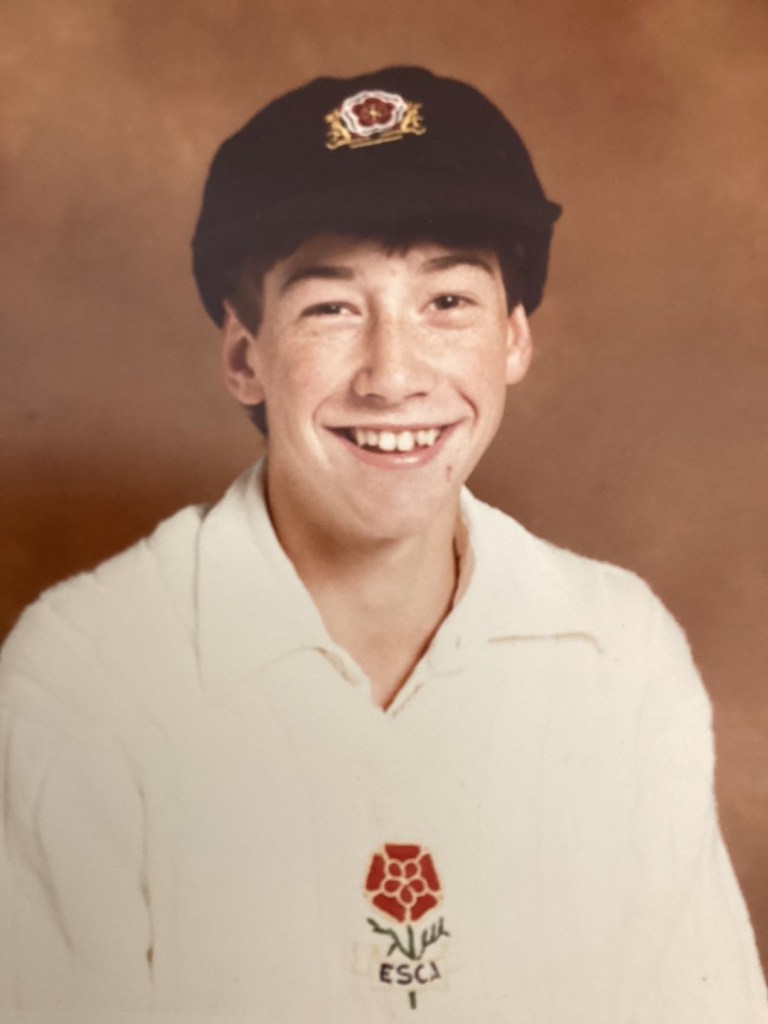
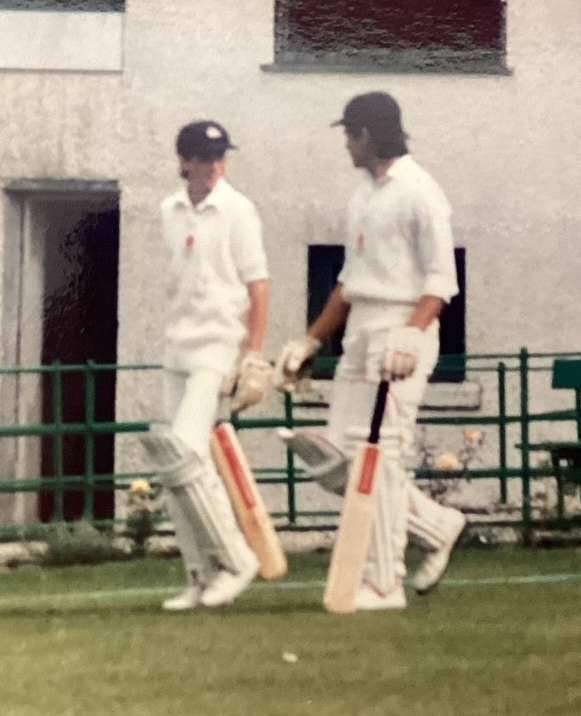
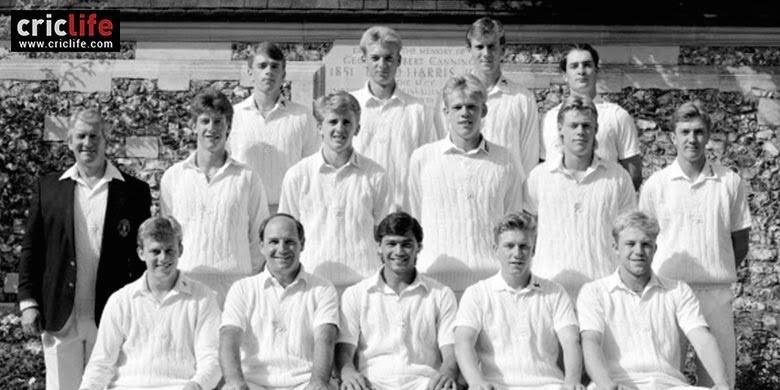
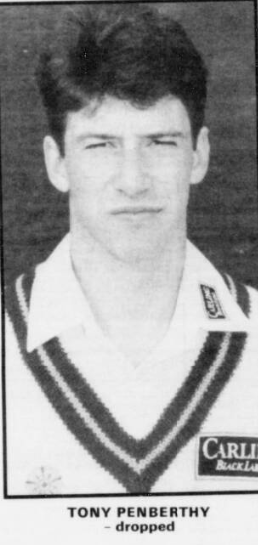
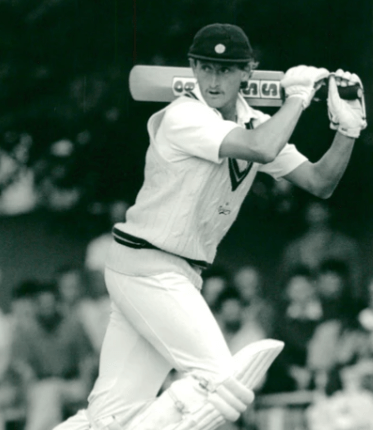
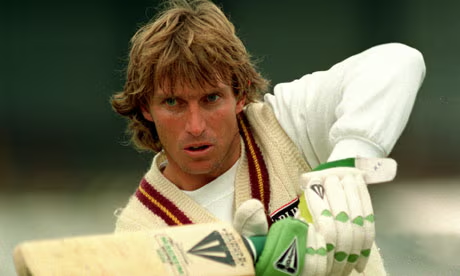
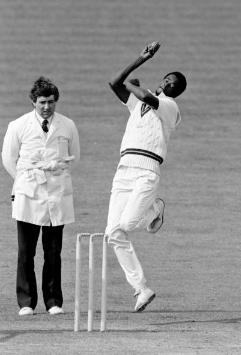
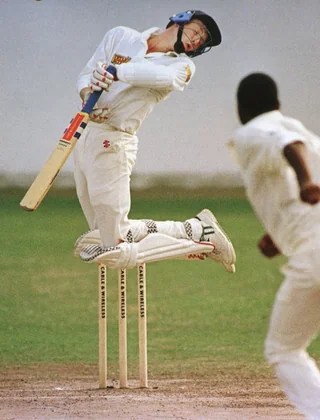
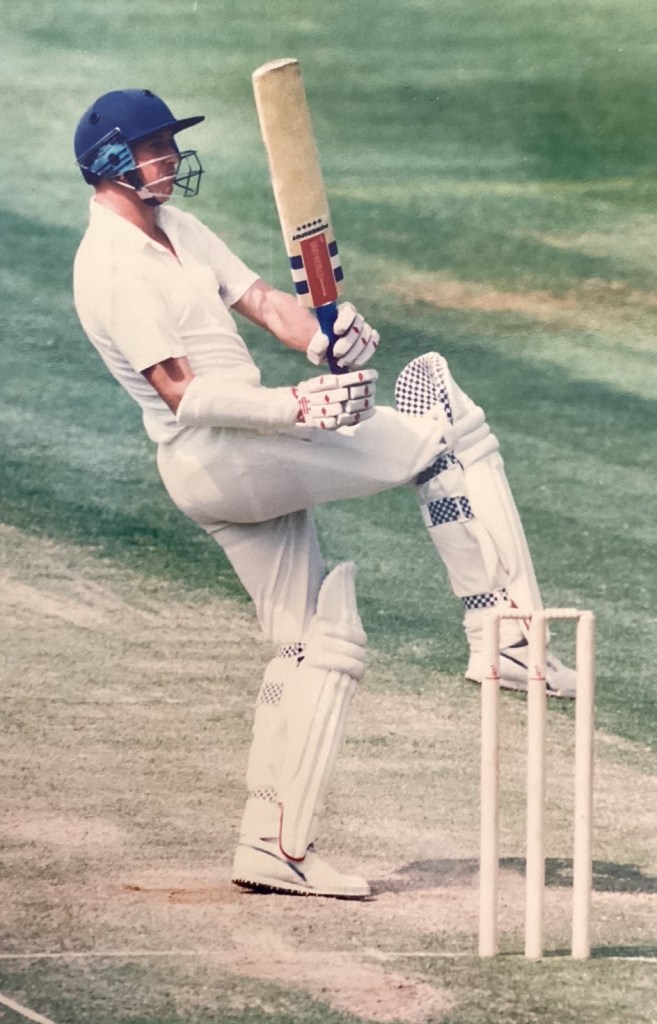
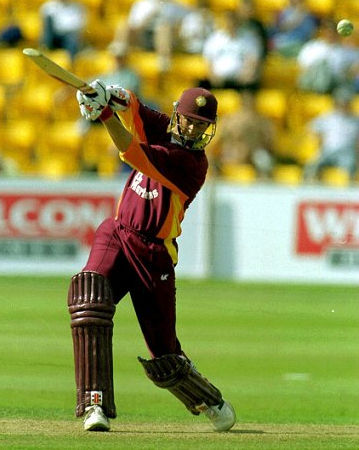
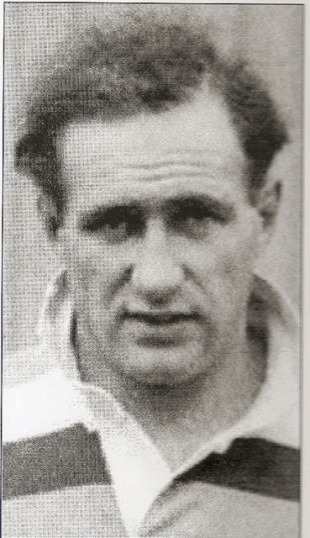
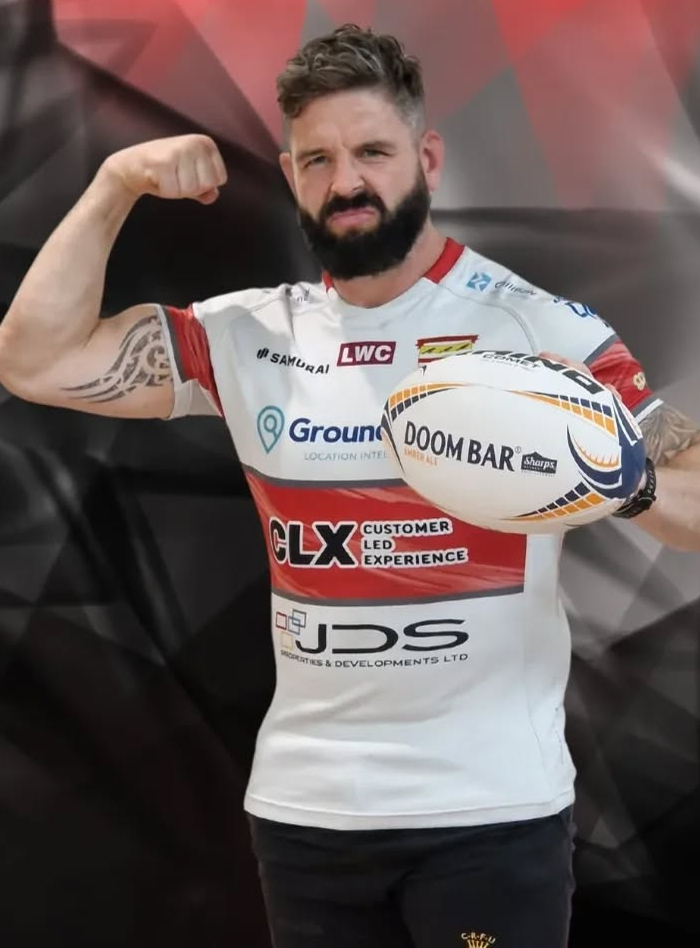
Cornish Sporting Heroes, #5: Tony Penberthy: Troon, Cornwall and Northants Cricket

Reading time: 30 minutes

He’ll play at Lord’s one day… ~ an unidentified sage appraises a young Penberthy at the home of cricket in 1972

…it’s not all glamour, and it’s not all good… ~ Tony Penberthy gets real

Cornwall’s First Class cricketers

Since the 1970s, there haven’t been many Cornish cricketers who have broken through to play professionally with a First Class County XI. If memory serves, for the men there’s been Mike ‘Pasty’ Harris, Malcolm Dunstan, Michael Bryant, Jack Richards, Malcolm Pooley, Piran Holloway, Ryan Driver, Tim and Neil Edwards, David Roberts, Carl Gazzard and Charlie Shreck. For the women, it’s Laura Harper, Emily Geach and Rebecca Odgers. Apologies if I’ve left anybody out.

When I was watching cricket on TV in the 1990s (this was when domestic cricket was shown on terrestrial television, long before anyone had thought of The Hundred), a Cornishman regularly featured for Northamptonshire. And he was good. He bowled at a decent pace, he was a sharp fielder and he went for his shots. A Cornishman was holding his own against some of the biggest names in world cricket. The commentators invariably made a hash of pronouncing his surname, with no emphasis on the second syllable.

The cricketer in question was Tony Penberthy, from Troon. Penberthy. A man who excels at pretty much any game you care to mention, it was cricket that was always going to win out. As a three-year-old in 1972 he was present at Lord’s when Troon won the inaugural Haig Village Knockout Cup.

Already mad keen on the sport, Tony would wear his own whites and patrol the boundary, hoping the ball would come his way. After the match, whilst playing with some other lads by the Tavern, Tony’s mum, Wendy, was told by an onlooker that

He’ll play at Lord’s one day…for me, luckily, it came true.

The Troon team that beat Astwood Bank at Lord’s in the Haig National Village Cup Final, 19721. Back, l to r: Keith Lean, Peter Thomas, Peter Johns, John Spry, Gerald Dunstan, Brian Carter, Jimmy Vincent, Trevor Angove (scorer). Front, l to r: Tommy Edwards, Brian Moyle, Terry Carter (capt.) David Rashleigh, Mike Sweeney.
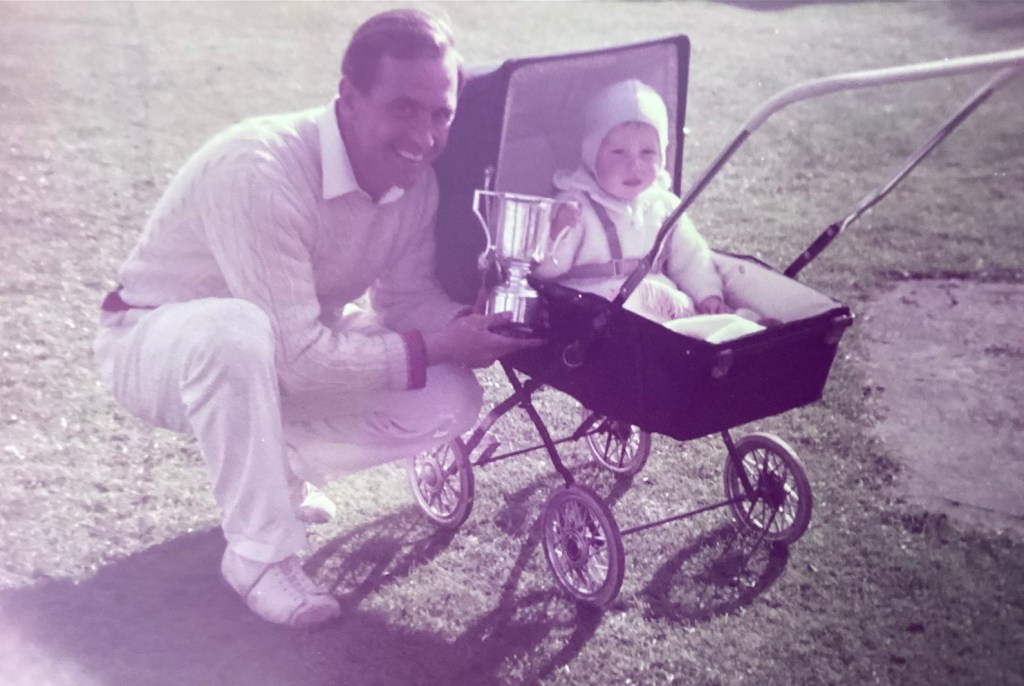
Troon won the Village Cup again in 1973, 1976, and were runners-up in 1983, although here Tony and his father Gerald are holding aloft the Western Morning News Trophy won by Troon 2nd XI

That said, initially another sport took precedence:

I would honestly say that football was my first love. I think I was probably still at primary school when Plymouth [Argyle] showed an interest. There was a scout who was at Trewirgie School, but obviously in those days there was no football academies or stuff like that, and I was far too young to go for a trial. So as far as signing me goes, that was never anywhere near!

Argyle got round to inviting Tony for a trial when he was 14, but he was already spending Easter and summer holidays with the Northants cricket squad:

I realised when I came to Northampton and spent two weeks playing and training with the first team, that was the life for me.

Committing to one sport professionally didn’t mean abandoning the other. Even Ian Botham still found time to turn out for Scunthorpe United, and like Beefy, Tony found time to play for Troon AFC. His parents were heavily involved with the club; spending winter playing soccer and seeing his old mates was the ideal salve after a hard summer’s cricket.

It was also good for me to have a break from the cricket. I was also only on a six-month contract, so there was nothing the club [Northants] could do about it! Loved those times. It was always good to come home and play a bit of sport.

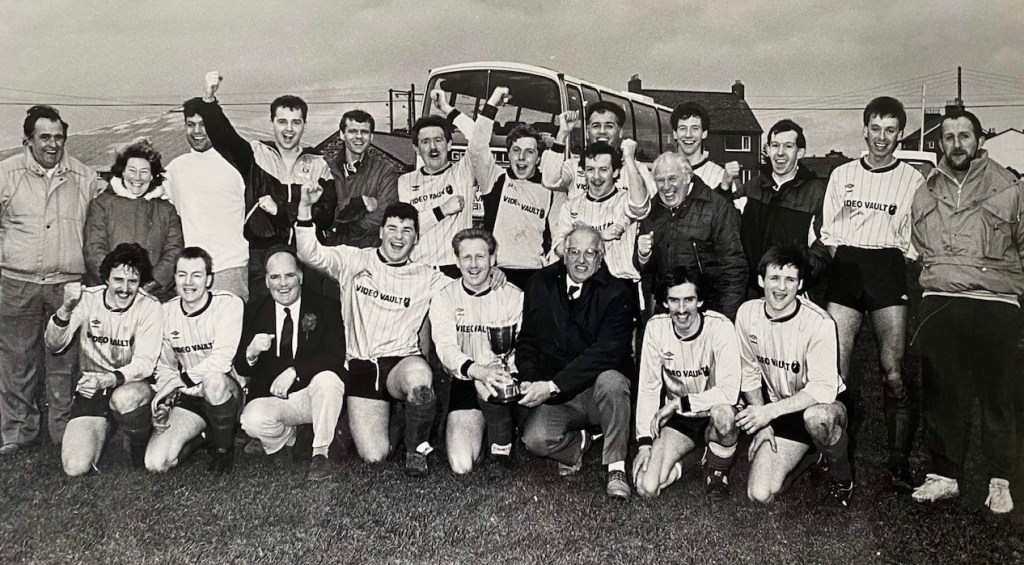
Troon AFC, Western Division and Junior Cup winners. Back, l to r: Gerald and Wendy Penberthy, Andy Ward, Phil Wilkes, Phil Meyers, Greg Wood, Kevin Thomas, Micky Maggott, Brian Smeeth, Tony, George Carter, Nigel Parkyn, Paul Cook, Dick Howlett. Front, l to r: Graham Jewell, Steve Webber, Viv Kneebone, Willie Garwood, David Jenkin, Colin Thomas, Wayne Brown.

Cornwall Schools, England Schools

Tony was also fortunate that his secondary school encouraged and nurtured sporting prowess:

I think we were very lucky at Camborne School at the time. We had three male PE teachers, there was Pip [Tuckey], Roger Randall and Andy Dawe. They were great! If you loved your sport, they would encourage you and work with you all the way. I felt very lucky.

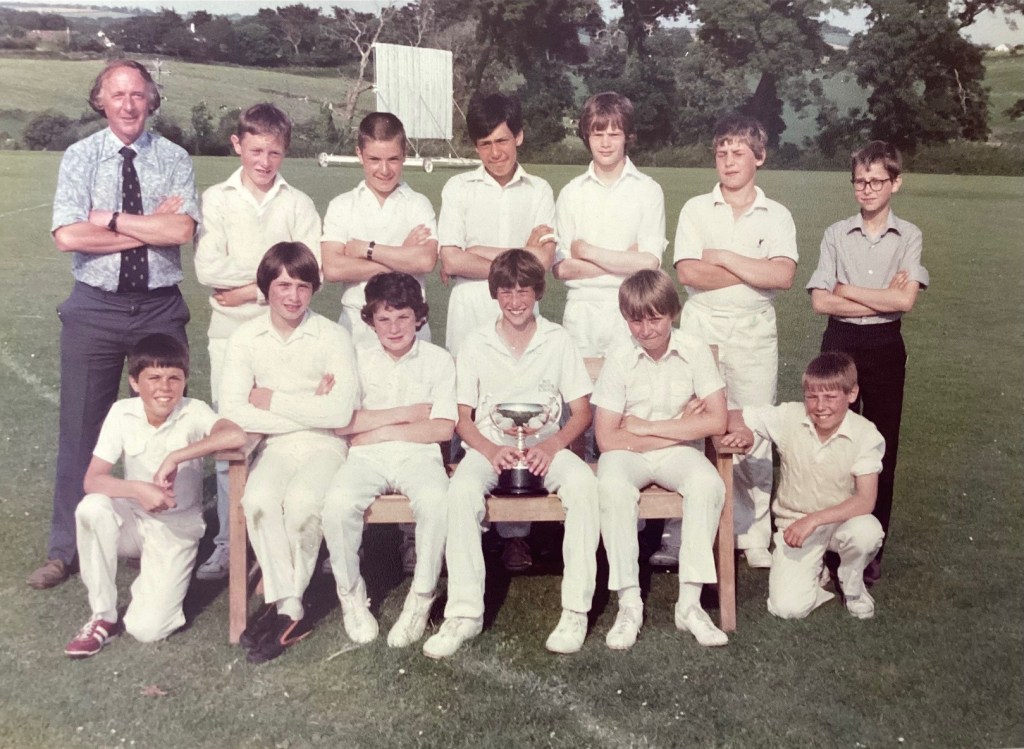
Pip Tuckey with yet another successful Camborne School team in the early 1980s. His colleagues, Roger Randall and Andy Dawe both played rugby for Cornwall. Back, l to r: Steven Miners, Simon ‘Rudi’s Message’ Isaacs, Mark Harris, Daniel Wells, Robert James, Jamie Tellam. Front, l to r: Mark ‘Gibbo’ Gibson, Nicky Hardman, Paul Fletcher, Tony, James Male, Alan ‘Sammy’ Hampton.

Tony’s parent club were no slouches where youth development was concerned either. Youngsters were always being encouraged in an atmosphere of success.

Troon had U13s and U16s ever since I can remember; I think I played in the U13s when I was about 9…Monday nights was junior coaching at Troon and it was always busy.

I think because of the success that Troon had had in the village competition, you know, it went through the village, and beyond, I think, winning a national competition…but for us kids, you know, it was just football and rugby in the winter, and cricket in the summer!

For all that, Tony’s introduction to senior cricket was not with Troon. Gerald, his dad, was finishing his playing days with Holmans, and Tony would turn out for their Second XI. Don’t think for one second he was there to make up the numbers. At the age of 12, he was bowling 24 overs against Camborne, and would strive to bowl out Pip Tuckey when playing Penzance2.

He was shortly registering for Troon, though – Tony was too good an asset to lose. To be sure, players in their early teens aren’t normally in such high demand for senior XIs. Tony’s talent must have been prodigious, and not just as a bowler:

My dad always said to me, if you’re batting and you’re bowling, you’re always in the game. If you don’t get any runs or you don’t bowl well, you’ve always got a second bite of the cherry, really. And he was right.

It definitely got me into teams, because of the fact that I could bat, bowl and field. Back in the day, when I started [for Northants], you could possibly get away with being a bowler who couldn’t field; nowadays and towards the end of my career, you had to be a two-dimensional cricketer, at worst. If you were a bowler, you had to be able to field, else you just stuck out like a sore thumb. If you can’t field to an adequate level, it’s not acceptable, and it can cost you your place.

It was the best advice my dad ever gave me, to always be in the game. It was always good to have an opportunity to make an impact on the game, one way or the other.

I always think batting was my strongest suit though. But it was ironic that bowling got me in the first team at Northants, you know, the fourth seamer who could bat

Tony had the dedication to back up his ability. Coaching books would be devoured. Boxes of balls would have their seams chalked (Tony wanted to make sure the ball left his hand correctly) and be carted down to the nets. He was 14, and wanted to get into the England Schools XI. ‘I was always very driven’, he told me.

Practice makes perfect…

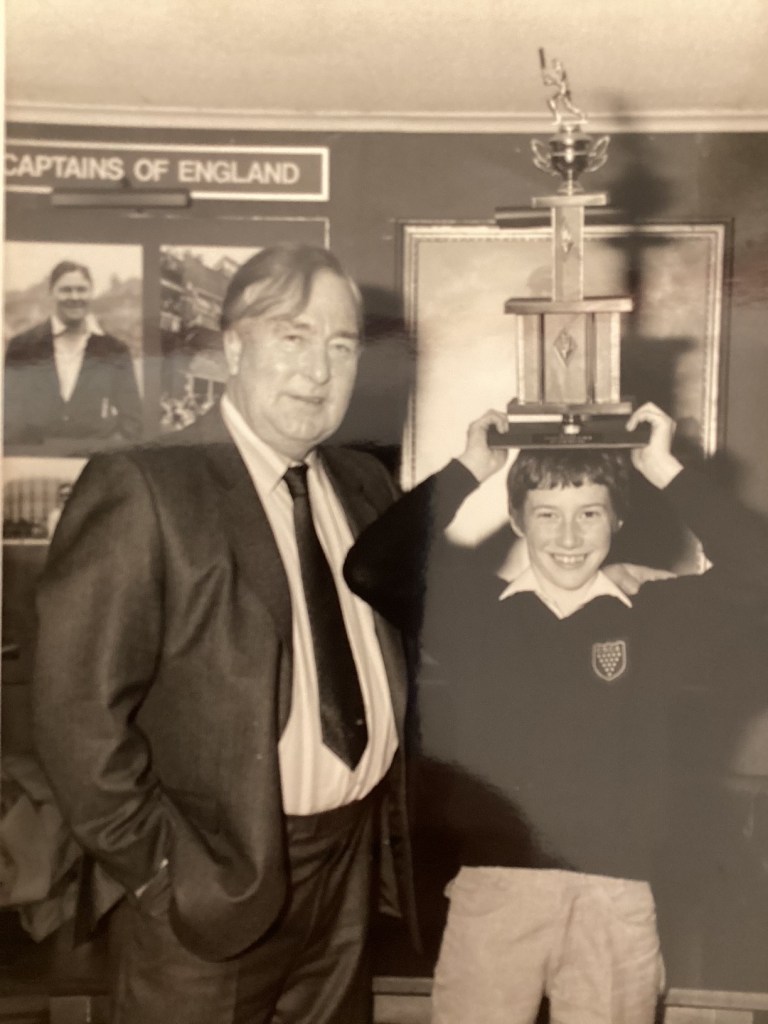
Northamptonshire started taking an interest in Tony at this point, yet it wasn’t down to his performances in any schoolboy representative XI. A coaching course on a family holiday at Butlin’s led to Tony being invited to a more prestigious course at Clacton. His performance and attitude there got him two days at the MCC indoor school at Lord’s. There, he won Boy of the Year:

The impressive trophy was presented by the brylcreem boy, Denis Compton, and made the Cornish ‘papers3

One of the Butlin’s and MCC coaches, John Malfait, was a Northants man and passed Tony’s name on. Impressing in a county schoolboy match, Tony was invited up for a trial. He tuned up for this by scoring 140 for Cornwall U15s, then presented himself at The County Ground on Abington Avenue:

I walked into the changing room, and there was all these kids, 19, 20, I thought I’d got the wrong day! I was only 14 and not very big in those days. They said to me I was to come back in April for two weeks, and that’s basically what I did for Easter and summer holidays whenever I was available. Made my debut for Northants Seconds when I was 15. When I was 16, I was up for four or five weeks in the summer…

They really looked after me, I was billeted out to a family who couldn’t do enough for me. Really exciting time for me as a young person to be experiencing that kind of…you know, it was great!

It might be an old saw, but it’s certainly applicable in Tony’s case: talent always comes through. Tony didn’t just need to be good. He needed to be exceptional. Children from state schools are at a massive disadvantage compared to public schoolchildren when it comes to progressing in sport, especially cricket, and it’s getting worse. As there are very few public schools in Cornwall, the gulf is less pronounced and children are, by and large, on a level playing field. The further upcountry you go, and further up the cricketing ladder you climb, the more you discover that where you schooled matters as much as how you play a cover drive4.

England schoolboy. One of Tony’s least favourite photos
Opening the batting for England U15s with Mark Ramprakash

When we went as the West of England squad to the England Festival, the majority of [my team] were either from Millfield or Taunton. And then when I got into the England Schools set-up, there was probably only two or three of us in that England team that went to a Comprehensive. All the rest were from private schools.

I think it’s sad, cricket’s not coached enough, I think it’s all left to clubs, a lot of clubs have really strong junior set-ups. It seems to be an elitist sport, and private schools seem to benefit. It’s very much the way it is.

I remember…I think we were at the England Festival, at Hull, and I got some runs against the Midlands, my mum overheard two men talking, ‘I wonder which school this boy goes to..?’ My mum just turned around and said, ‘What does it matter?’

Unfortunately, whether we like it or not, the responsibility’s gonna fall on clubs, and build a relationship with local schools, that the schools can always push a child somewhere. It’s not an ideal situation, but thankfully I think a lot of clubs are doing the best they can to give kids the opportunity to play cricket.

Speaking of clubs, in August 1983 Tony made his First XI debut for Troon, in Senior One (West)5. Trust me, this is the best cricket in Cornwall:

I thought at the time I was probably just gonna make the numbers up! It was against Helston and we fielded first. Just before we went out to field, Terry Carter said to me, ‘First over at the top hedge?’ So I got the new ball!

It was a really great opportunity for me. Christ, you don’t get any better than that! It would have been easier [for Troon] to pick someone older in the Second Team, but for me it was dream come true! Ever since I was a kid it was all I could think about, they were my heroes, I could never ever see much further than playing for Troon First Team, so to do it so young was fantastic.

Tony wasn’t the only talented youngster in Cornish cricket at that time. Aged 16 in 1986, he made 41 for Troon First XI. For Camborne, that same week, another 16-year-old called Malcolm Pooley made 118 against Holmans. If Tony could take a hat-trick against St Just, Malcolm could notch up a ton against Penzance. To look back on these reports, it’s almost like the two teenagers were trying to out-wow the other6.

Malcolm signed professionally for Gloucestershire at the same time as Tony went to Northants (1988-89). In the 1990s he was Camborne’s star player, scoring runs for fun and forming a fearsome new-ball partnership with a tearaway fast bowler, Paul Berryman.

Me and Malcolm played a lot of Cornwall Schools together, we played for England South in an international tournament in Belfast…and won it! But there was rivalry as well, let’s be honest here, it was Camborne and Troon!

But I’d like to think that, with Malcolm and myself, we encouraged each other and pushed each other to get better. There’s not many Cornish lads that go on to play professional cricket, and when you’re out there you look out for each other, and hope that you’re all getting on and doing well.

When he went back to Camborne, it was sad, to be honest, because he’d done so well at Gloucester. Malcolm will always have my respect, he was a very very fine cricketer.

Northamptonshire professional

The Young England side that took on New Zealand in 1989. Back, l to r: Keith Butler, Wayne Noon, Mark Ilott, Piran Holloway. Middle, l to r: Tony, Dominic Cork, Richard Edmunds, Nick Knight, Ian Salisbury. Front, l to r: Ian Houseman, Graham Saville, Mark Ramprakash, Martyn Ball, Chris Adams.

With such a long immersion in the culture of professional cricket, Tony had no qualms about signing for Northants on a two year contract when he turned 18. This was extended after his first year, and he made his First Class debut a year later. But he still had a lot to learn:

When you play professionally, the bowling’s a little bit quicker, the batsmen hit it a little bit harder. The fielding…that for me is probably the biggest difference. The speed to the ball, and the anticipation. The really good fielders, they’re half-a-yard there already, whereas in club cricket sometimes people are sleeping, thinking ‘bout what they’re gonna do later.

That and the fact that there’s less bad balls, and mistakes just get punished. You bowl a bad ball in First Class cricket, invariably it’ll go for four. You might get away with it in club cricket.

Tony made the dream debut. In June 1989 he was picked to play the touring Australians:

I had Mark Taylor, the captain, first ball, then Geoff Marsh, the other opener, and Dean Jones. Pretty good – missed Allan Border though, that was the only thing!

Taylor played over 100 Tests for Australia, and both Marsh and Jones were 1987 World Cup winners, though Jones is perhaps best remembered for his near-mythical 210 against India in 19867. Tony returned figures of 3 for 56 off 15 overs, and must have been well pleased with his work. But cricket has a way of coming back to bite you. Batting in his first innings, Tony had to face up to Merv Hughes, a walrus-moustached bear of a man who classed all batsmen as prey. Second time round he met Terry Alderman, who wasn’t as quick but had bucketloads of skill8:

Wicket with my first ball, then a pair! The highs and lows of First Class cricket! Obviously that was my first exposure to these international cricketers…I was really unlucky the first innings, I just went to turn one off my hip, and I got a little nick, hit my thigh pad, bounced up, and David Boon was there at short leg. Second innings, I think I was LBW…well, many people have been ‘LBW, Alderman’ in their career, really!

But, y’know, if someone had said to me, you’ll get a pair, but you’ll take a wicket with your first ball, I think I would have taken that, against Australia!

First Class all-rounder?

Northampton Chronicle, April 24 1992, p34

The highs and lows…listening to Tony talk about his career reminds me in many ways of Simon Hughes’ award-winning 1997 cricketing tell-all, A Lot of Hard Yakka. If you want further insight into the life of a professional cricketer, go there. Tony initially struggled to secure a regular First Team spot, the local press labelling him early on as a one-day specialist9. Northants’ all-round kingpins at the time were David Capel, a man good enough to play 15 Tests for England and be hailed as the next Ian Botham, and Kevin Curran, a Zimbabwean who represented his country at the 1983 World Cup.

David Capel in action
Two of Kevin Curran’s sons, Tom and Sam, would go on to represent England10

Those two guys were top quality performers. And also, extremely fit guys. I think for me, seeing these guys operate, seeing what they did, that was good for me as a young player coming through.

It’s one of those things people don’t appreciate about professional sport. It’s bloody hard. It’s hard, just doing your skill sets, batting and bowling against the best players in the world. But then, obviously, you’ve got to manage the disappointments. Whether it’s injury, or lack of form, or lack of opportunity, they all come along at some point in your career.

But you’ve got two options. You either give in, or you deal with it. I did get categorised early on as a one-day player, because I could bat-bowl-field, and if you can do those three disciplines pretty well, you’re an asset to any one-day team.

Tony could score 130 and take two wickets for the Second XI, yet had to feed off scraps when promoted to the First XI11. You have to admire his resilience:

It was hard for me at the beginning, because I was batting in the top three in the second team, and sometimes opening the bowling, sometimes first change. So then when you come into the first team, you’re batting at seven or eight, and in those days it was three-day cricket. So if your team went well in the first innings, you might be going in with not many overs before you were going to declare.

I just felt it was quite hard for me to promote my batting at that time, I probably didn’t do myself justice. I probably should have scored more runs, but on the other hand the opportunity was not always there, batting that low down in that kind of cricket.

Thankfully later on in my career I was batting further up the order and got more of a chance to prove myself, really.

County Cricket in the 1990s

When Tony talks about the best players in the world, he isn’t kidding. Every County XI in the early 1990s could boast one or more international stars:

[Northants] was a very strong side. When I made my debut we had nine internationals. We had some really good overseas players, we had Winston Davis and Curtly Ambrose, and in those days you could have two overseas players and you could alternate them.

So…you could find yourself playing Lancashire Second XI, we had Ambrose, they had Patrick Patterson! Having that lessened your workload, obviously, but it really raised the standards of second team cricket.

Winston Davis hugs the stumps…
…Curtly Ambrose gives Mike Atherton some ‘chin music’…
…and Patrick Patterson limbers up12

Patterson was lightning…I can vouch for that! I opened the batting when we played him, second innings the game was pretty much dead, and he bowled four overs at the beginning, probably at three-quarter pace. Then he bowled me a full toss and I hit him for four. And I was probably strutting down the wicket a bit…

…the next ball hit my shoulder before I’d moved, and he looked at me as if to say, look, if you really want me to try…

There was some quick lads around and, on their day, if they got it right…it’s very difficult to say who was the quickest. I faced Shoaib Akhtar at Northampton on a slow one and he was still very very quick. Waqar Younis, Wasim Akram, Malcolm Marshall…top top performer. Then we had Greg Thomas13 early on in my career, who was touted to be the fastest white man on the planet, and when he got it right, he could really get it through.

In other words, even in a second team game you could be facing the fastest, nastiest bowlers on earth. Every team had one, and Northants had Curtly Ambrose, who was fearful to watch, even on television. Behind the scenes, though…

He was a totally different person. He didn’t like talking to the media. It wasn’t that he thought he was better than anyone else, he just didn’t feel comfortable. But with us, in the dressing room, he was great. He was always joking around, always funny, loved his music…what a person to have in your team! What a performer! I found him nothing but good value, really, and I travelled with him a few times in the car, and he was very supportive of us as a bowling unit.

To counter Ambrose’s complaints about dropped catches in the slips, Allan Lamb moved the big man himself to that position, and to have Curtly Ambrose geeing you on from the cordon was manna to Tony.

Allan Lamb knew how to socialise as well and moved in circles beyond the reach of mere cricketing mortals. Thanks to him, Tony’s 21st birthday was celebrated at Peter Stringfellow’s London nightclub. Let’s just say, their names were down.

Clearly the Northants changing room was a lively one, but some subjects were taboo. Lamb’s involvement with Ian Botham in the highly publicised and highly expensive ball-tampering scandal of the early 1990s was a place where his Northants team did not go. It was his money, Tony told me, so you let him spend it.

Litigants Allan Lamb (left) and Ian Botham attempt smiles14

Lack of first team opportunity early in his professional career was offset by Tony’s working relationship with the coach, Mike Procter. An all-action South African all-rounder, on his country’s isolation from international sport in the 1970s he joined Gloucestershire, his exploits for the county being such it was nicknamed ‘Proctershire’15. His laid back, self-expressive approach to cricket helped Tony settle in.

Tony ‘settles in’ to fielding at silly point

Plus, on occasion Tony could count on a familiar face from Cornwall. David Roberts, a fellow Troon boy, joined the club in 1996. In 1991 the West Indian all-rounder Eldine Baptiste joined Northants, and led the averages with 49 wickets. He had previously played Cornish cricket for St Gluvias, and is arguably the fastest, most terrifying bowler seen in Cornwall to this day16.

‘Bapo’. Copyright Getty Images

He was great with us young guys! He would give us loads of advice, but also he loved coming out and having a beer with us on Friday nights. We used to go into town, ring him up, ‘Eldine, we’re going into town…’ It could be your first year on the staff or you could be Allan Lamb, he was just the same with everyone. Really, really good.

Some reminders of the West Country in professional cricket though were less welcome. Warwickshire had a pugnacious batsman at the time called Roger Twose, who was born in Torquay. Eventually he played test cricket for New Zealand and is currently the Director of New Zealand Cricket17. What he called Tony in a match where Tony was batting was so bad Tony complained to the umpire; I’ll refrain from printing the actual words here. But I will reproduce Tony’s response to Twose:

If you ever say that again, I’ll beat this bleddy bat ‘round your ‘ead!

Meanwhile, David Capel and Kevin Curran practically took Tony under their wing:

There was always encouragement. You’re always fully aware when you’re playing sport that one of your mates is also trying to take your spot. It’s just the way it is. I never felt that there wasn’t that encouragement, you tried to enjoy each other’s success as well. But they were two fine players, sadly no longer with us.

A professional’s cricket season is arduous. Before the County Championship adopted a two division format in 2000, a County XI would play 22 matches from late April to mid-September. That’s before you add in the Sunday League fixtures, and the two (Benson and Hedges, Natwest) one day competitions. In 1991, for example, Northants finished a game against Glamorgan in Cardiff on May 24. They had to be in Leeds the following day to start a fixture against Yorkshire. They were in Maidstone playing Kent on July 4; on July 5, they were in Leicestershire18.

It’s a tough life as well, it’s not all glamour, and it’s not all good. When you’re a young player as well, especially back then, wages were rubbish! My first full year, first contract at 18, I was on two grand for six months, and I had to pay £960 in rent! You’re not playing for the money! Basically, if you get on and become a capped player, you’ll do fine. But it’s a hard road getting to that point, and a lot of people don’t make it.

In those days, [a season] was 90 days of cricket. That’s a tough old season! And the travelling, we used to drive ourselves, there was no buses in those days, no team bus, not ‘til the last year of my career!

Interviewed by the West Briton in 1995, Tony stated he drove on average 10,000 miles every summer, plus all the cricket19.

One conjures up an image of the country’s motorways clogged during the summer months with the vehicles of numerous professional cricketers, crammed with hungover and/or injured passengers and unwashed kit, flooring it to a venue several hundred miles away. Once there, they’re expected to perform to the best of their abilities, all over again. The glory days, however, make it all seem worthwhile.

A Cornishman at Lord’s

On the balcony at Lord’s. From left: Mike Procter, Tony, Kevin Curran, Curtly Ambrose

Northants beat Leicestershire at Lord’s to win the 1992 Natwest Trophy. Tony was in the XI, and was treated to an article in a Northampton ‘paper:

Northampton Chronicle, September 5 1992, p31. Tony’s father Gerald had played for Troon at Lord’s in 1973

Generally described as a dull, one-sided affair (Leicester crawled to 208 off 60 overs; Northants took most of 50 overs to pass the total for the loss of two wickets), playing a Lord’s Final is always special20:

It was wonderful! We bowled really well, we fielded really well. We suffocated Leicester, really. We lost an early wicket, but then Alan Fordham and Rob Bailey had a really good partnership and then all the nerves settled. You just felt that the longer the day went on and the more the sun got on the wicket, it would have been ours to lose, and it turned out that way. We won comfortably.

It’s a great feeling to play in a Lord’s Final, I was very lucky to play in three. But to win one is just a super experience. It really is.

You can play at Lord’s when there’s hardly anyone there and there’s an atmosphere, when it’s 30,000 full it’s just amazing. Empty or full, any day of the week! Derby on the other hand was just a soulless ground. Taunton’s a lovely ground to play cricket, very close. Supporters are very close to you, always a good atmosphere.

1992 was a good year for Tony. He was the Second Team’s player of the year, winning a cheque for £25021.

Tony soaks it up

1992 was a busy year for me. I was in and out of the First Team, when I wasn’t playing First Team I was playing Second Team…and I think in August I played something like 28 days out of 31, or something stupid! It was crazy, when you’re living on your own, you’re a bunch of lads and you’ve got to do your own washing, it wasn’t much fun!

But yeah, I played really good cricket that year, I think winning the Second Team player of the year was mainly down to the fact that I’d played a lot of First Team cricket.

Tony was committed, and he was loyal. The only time he seriously considered a move from Northants was in 1998, when Kevin Curran was captain. Curran only wanted one all-rounder in the XI (himself), and Gloucestershire were making approaches, but…

…I’d had a good year, forced my way into the First Team. And the club had got wind of Gloucester, so they wanted to keep me and offered a three year contract.

So I had a little bit of bargaining power, and I was getting near a benefit as well. So…I stayed at Northants, and they looked after me financially. I’ve got no regrets on that, as nice as it would have been to be closer to home, I was pretty settled in Northampton at that point. I feel quite proud of the fact that I only played for one club.

Tony stuck with Northants, and learnt to cope with Wasim Akram reverse-swinging the ball at 90mph on Old Trafford’s super-fast track, or to grudgingly accept that Graham Gooch (upright stance, massive bat, hunger for runs) was usually going to score a ton. In 1994 he was awarded his County Cap after a match at Taunton:

We were chasing 300-odd and were about 150-5! Me and Curtly put on a partnership, and I ended up on 80 not out, I think we won by about two or three wickets. And I got my cap that day.

Tony hooks one away

That was really important for me, you know, your money goes up as soon as you’re a capped player! So that was a big thing. But also I think it was the realisation of my efforts over those years had not gone unnoticed and finally, you feel like you’ve served your time. That was a really important day.

Other important days were around the corner. Tony played in two more Lord’s one day Finals, against Warwickshire in 1995 (Natwest), and Lancashire in 1996 (Benson & Hedges). In the first, two catches were dropped off his bowling (including a chance from his old friend Roger Twose, who went on to make 68), Trevor Penney ran him out for five, and Dermot Reeve survived a plumb-LBW shout to make a match-turning innings. ‘We were stuffed’, Tony said22.

Prior to the 1996 Final, Tony had form against Lancashire, putting on 112 for the eighth wicket with John Emburey in 1995 to steal a one day cup-tie against the Lancastrians. A year later, he was optimistic ahead of the Lord’s showdown, and said so in the Press:

We believe we are a good side when the pressure is on whereas Lancashire, we feel, are inclined to panic a little…

The Independent, July 12 199622

Chasing 245, Lancashire’s Ian Austin picked up four wickets and Northants were dismissed for 21423.

Northants #1 all-rounder

Tony carves one over the top in a one day game

By 1999 Tony had a new contract and was fully committed to Northants. Two other things happened to make this year the most successful of his career. The first was a change in how cricketers prepared themselves for a long season:

One of the best things that happened in the latter part of my career was that cricket became more professional, there was more money in it, and we started having training programmes. I learnt a lot more about myself and the fitness side of things.

I would work on my overall fitness during the winter months. I didn’t pick up a cricket bat from the end of the season until January. I had a month off at the end of the season, and then November to January would be spent in the gym or running, six days a week. Then after Christmas we would up the training but also bring in the skills in the indoor school. It worked for me, it doesn’t work for everyone!

Fitness for a cricketer no longer meant bowling off a few paces in the nets followed by some gentle catching practice. A beer in the changing room after play was replaced by an ice bath (which, I have to say, was an innovation Tony doesn’t look favourably on).

I was probably late 20s, then all of a sudden you’re finding that you’re growing, you’re getting stronger and you’re getting quicker even as you’re getting older, because of the education you’re receiving from the trainers around you. 

Look, being an all-rounder is a tough job. There’s no respite from it. So if that’s a career that you want, you have to be fit enough to do it. I always felt that was the one thing I could really control, you can’t control what decisions happen on the pitch, sometimes your form dips or whatever. But if you know that you’ve taken care of the fitness side of it, and you need to make sure you’re fit enough to get through a season…

From when I finished [2003], to where cricket is now, it’s a totally different game. You see the guys playing one day cricket in the field, they’re top quality athletes, they really are!

All his cricketing life, Tony had worked hard and driven himself to get where he was. His new-found focus on overall fitness meant he was ready for the next step.

By 1999, David Capel had retired and Kevin Curran was looking to move on. The position of prime all-rounder in the Northants first team was suddenly looking vacant. Tony, with a long apprenticeship and greater conditioning, was ready to step up, and being Tony, he grabbed the opportunity with both hands. No longer a one-day specialist for the reporters, suddenly Tony was a

…pivotal figure… [who was] …revelling in the all-rounder’s position.

Another ‘paper noted he had finally ‘Stepped out of Curran’s shadow’. And then some. He was Northants’ Player of the Year and even captained the side in several matches25.

I thought it got the best out of me, having added responsibility…it’s hard work in one day cricket, when you’re trying to bowl and think about the next things, it’s very mentally draining. And towards the end of my career I was vice-captain at the club and obviously stepped in to the role as and when needed. If [the captaincy] came to me, great, I had a lot on my plate anyway, and when I did it I was very proud to do it, but I wasn’t shouting for it!

This one is Tony’s personal favourite

Tony was now a top five batsman, a front-line seamer and vice-captain with Northants. In 2002, he was awarded a benefit season, a largely tax-exempt financial bonus that long serving and successful professionals traditionally look on as a nest egg toward the latter part of their careers26.

Devastated

Northampton Chronicle, September 4 2003, p40

Yet by the close of the 2003 season, and completely out of the blue, Tony’s contract wasn’t renewed. The club issued the following statement:

At the end of the day, it was felt the club couldn’t make a commitment to him until he had proved his fitness over a lengthy period in competitive cricket.

Source: Cricinfo, September 4 2003

At the time, Tony himself was quoted as being ‘devastated’27. Even now, it still rankles:

It disappointed me because…the thing is, I’d been very lucky, all my career, with regards to injuries, and in 2001 I played a whole season with a prolapsed disc in my back which was really difficult! I got through the season, and two games before the end of the season I needed an injection in my shoulder as well. So I’d put my body on the line and literally I think it was two or three weeks after the end of the season I had an operation on my back.

I’d never been one to miss a lot of cricket. And then I just had a silly Achilles tendon problem, that occurred the Christmas before the [2003] season started. These things can really take time to heal and it wasn’t ready for the start of the season. I was able to practice but I couldn’t run a lot.

Tony would have skippered a lot of games that season, and Northants were desperate to get him back on the pitch. In the end, though, he spent a lot of time in surgery and only managed one Championship game in 2003. Northants gained promotion to Division One28.

An anti-inflammatory injection into the tendon merely led to another injury, and Tony was back to square one.

I played a lot in the Second Team, just batting and fielding at slip. I couldn’t bowl. Running between the wickets was a real problem, but I was keeping my eye in, you know? I was getting runs, and feeling confident, so if I did get fit, and got back in the First Team, I was ready.

…then I niggled it again in my recovery, but I got back in August. I played in the Second Team, bowled 20 overs in the day, I was back in the squad for the Sunday League…

Playing a gentle game of soccer in a Second Team warm up, Tony felt like he’d been ‘shot in the leg’: the muscle had ruptured again.

That was the end of my season – but my contract was up.

Northants had also been taken to the cleaners by one of their accountants to the tune of £80K29.

And the club…decided…not to give me another contract. But I’d been told, with rest over the winter, that I would make a full recovery.

Another player who had had an injury-hit season had been given until April 2004 to prove his fitness, but not Tony.

I said to the club, look, the reason I’ve been having these injuries is because I’ve been trying to get back on the pitch, and feeling like I’ve been pressurised to get back on the pitch. I’ve done everything I can to get back…I asked them if they’d spoken to the club doctor, and they said no!

So I said, you’re basically concerned about my fitness, but you haven’t spoken to the club doctor. That’s rubbish! After twenty years’ association with this Club, and everything I’ve done, be honest with me.

I just thought it was really poor. You always know the day’s going to come, when you’ve got to make the decision, or the decision’s made for you, but if you’re going to do it, do it the right way.

Time’s a great healer, but it wasn’t good, the way it was done.

Troon Boy

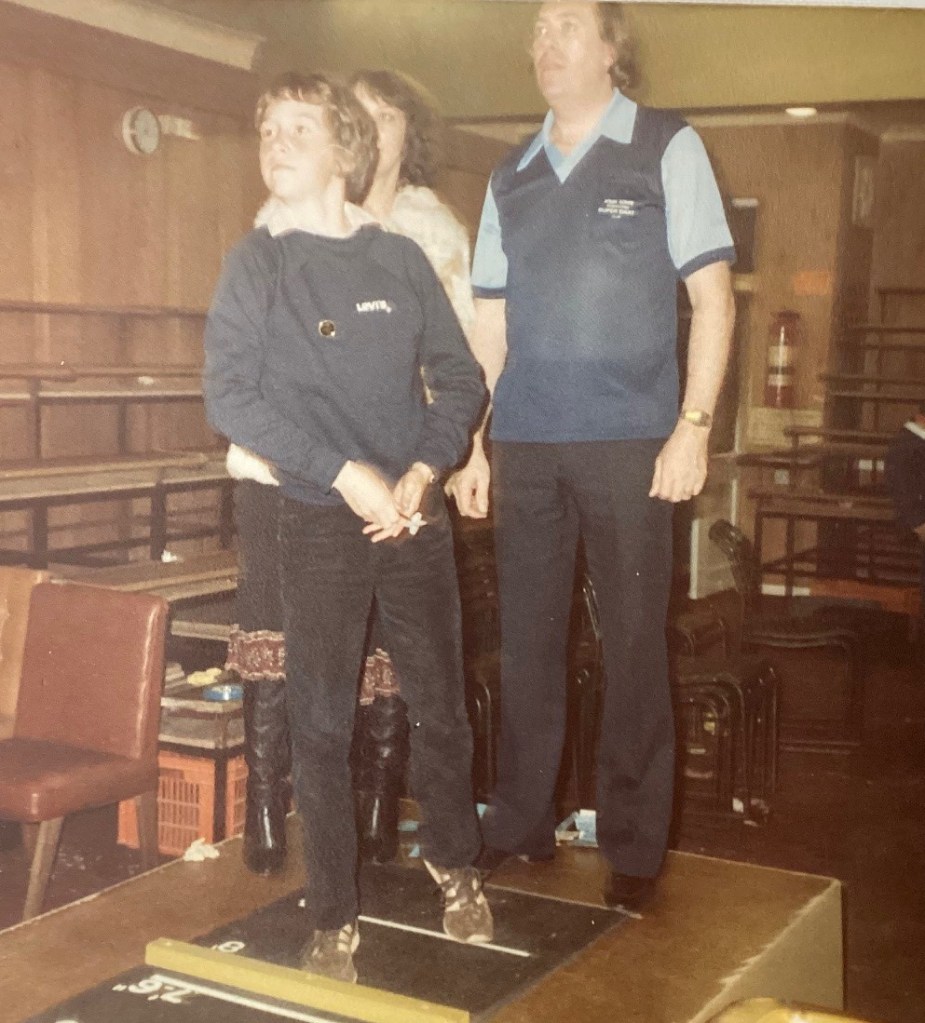
A young Tony on the oche at the old Troon clubhouse with John Lowe. Being Tony, he won

Tony’s benefit had happened at the right time. He now runs the UK office of a German owned joinery company in Northampton.

It seems, though, you can take the boy out of Cornwall, but you can’t take Cornwall out of the boy. Tony played Minor Counties cricket for Cornwall until 2006, thus proving to a certain extent that he still had gas in the tank. He also keeps an eye on Troon, his old club, who after withdrawing from all forms of cricket in 2021, reformed a year later. This year, 2025, Troon CC celebrates its 150th birthday30.

It was really sad [when they folded], really sad. When you look at iconic clubs in Cornish cricket, Troon is right up there. So to see something that has been quite a big part of my life, not only the club but the clubhouse, that used to be separate to the club, I spent hours down there as a kid! To see all that go, and the club struggle and not play for a season, was really sad.

You just hope that the club keeps going. 150 years is a fantastic achievement. You hope that the cricketers of today and those running the club will keep going and keep being an inspiration to the younger kids in the village, and giving them the opportunities that we had, when we were young.

I’m forever grateful for the cricket club, and the village, for what they gave me.

My previous Cornish sporting hero was John Collins, the Camborne, Cornwall and England Rugby player. Find out all about him here.

Many thanks for reading; follow this link for more top blogs on all things Cornwallhttps://blog.feedspot.com/cornwall_blogs/

Do you enjoy my work?

All content on my website is absolutely FREE. However managing and researching my blog is costly! Please donate a small sum to help me produce more fascinating tales from Cornwall’s past!

£5.00
£10.00
£15.00

Your contribution is greatly appreciated.

Donate

References

  1. Image from: https://www.nationalvillagecup.com/classic-match-troon-versus-astwood-bank-national-village-cup-final-1972/
  2. Such a long spell would never be allowed now for a youngster. Prior to the formation of the Cornwall Premier League in 2001, all innings in the Cornish cricket leagues consisted of 48 overs per side. Thus for many years the maximum number of overs a player could bowl was 24 – regardless of your age. I personally remember toiling through a 17-over spell at the tender age of 14 in a senior match. This maximum number of overs for a bowler was reduced to 16 at the same time (find reference?), and gone were the days when two spinners would bowl unchanged through an innings. As of 2022, the maximum number of overs a bowler can bowl is ten. To reduce injury to young players, nowadays a player of Tony’s age can only bowl five overs in a spell with a maximum of ten in a day. See: https://en.wikipedia.org/wiki/Cornwall_Cricket_League, https://resources.ecb.co.uk/ecb/document/2020/03/16/bf713bed-4a76-4218-9ef0-f4edb8ed2c2d/2020-Fast-Bowling-Directives.pdf, https://www.facebook.com/cornwallcricketleague/posts/overs-per-bowler-clarification-div-2-3-is-now-a-max-of-9-following-the-close-sea/406689847959573/
  3. West Briton, January 20 1983, p35.
  4. See: https://schoolsportmag.co.uk/state-school-cricket-in-crisis-or-at-crossroads-apr-2024/
  5. West Briton, August 4 1983, p40.
  6. West Briton, June 12 1986, p24; May 7 1987, p23.
  7. These were players of the highest calibre. See: https://en.wikipedia.org/wiki/Mark_Taylor_(cricketer), https://en.wikipedia.org/wiki/Geoff_Marsh, https://en.wikipedia.org/wiki/Dean_Jones_(cricketer)
  8. Naturally, Tony’s feats made the West Briton: June 22 1989, p23.
  9. Northampton Chronicle, April 25 1992, p36.
  10. Images from: https://imsvintagephotos.com/products/david-capel-vintage-photograph-931689?, and https://www.theguardian.com/sport/2012/oct/10/kevin-curran-zimbabwe-bowler-coach-dies
  11. Northampton Evening Telegraph, July 7 1992, p27.
  12. Images from: https://cricketlife.co.uk/player-profiles/winston-davis/, https://www.reddit.com/r/Cricket/comments/1bf8knb/chin_music_michael_atherton_athletically_avoids_a/, https://www.sporting-heroes.net/cricket/west-indies/patrick-patterson-2248/test-record_a01861/
  13. Greg Thomas’ career was wrecked by two things: injury, and always being picked to play the West Indies. See: https://en.wikipedia.org/wiki/Greg_Thomas
  14. Image from: http://news.bbc.co.uk/1/hi/uk/348740.stm. For more on this story, see: https://www.independent.co.uk/news/uk/lamb-goes-on-front-foot-over-balltampering-lawyer-attacks-cricket-administrators-after-libel-case-ends-amid-claims-of-coverup-1505593.html, https://www.independent.co.uk/news/botham-and-lamb-bowled-over-by-defeat-in-pounds-500-000-high-court-test-1307606.html
  15. For more on Procter, see: https://en.wikipedia.org/wiki/Mike_Procter
  16. See: https://www.espncricinfo.com/cricketers/eldine-baptiste-51211, and https://nccc.co.uk/first-team-history-1905-2019/. For more on Roberts, see: https://en.wikipedia.org/wiki/David_Roberts_(cricketer,_born_1976)
  17. For more on Twose, see: https://en.wikipedia.org/wiki/Roger_Twose
  18. See: https://static.espncricinfo.com/db/ARCHIVE/1991/ENG_LOCAL/CC/
  19. February 7 1995, p49.
  20. See: https://www.espncricinfo.com/series/national-westminster-bank-trophy-1992-418852/leicestershire-vs-northamptonshire-final-418885/full-scorecard, and Northampton Chronicle, September 7 1992, p26.
  21. Northamptonshire Evening Telegraph, September 26 1992, p27.
  22. See: https://www.espncricinfo.com/series/national-westminster-bank-trophy-1995-418986/northamptonshire-vs-warwickshire-final-419021/full-scorecard
  23. Available at: https://www.the-independent.com/sport/penberthy-reveals-grounds-for-optimism-1328526.html
  24. See: https://www.espncricinfo.com/series/benson-hedges-cup-1996-491646/lancashire-vs-northamptonshire-final-491703/full-scorecard
  25. The quotes and information can be found in: Northampton Chronicle, June 12 1999, p44; Northamptonshire Evening Telegraph, July 22 1999, 74; September 20 1999, p20.
  26. See: Northamptonshire Evening Telegraph, June 14 2001, p78. For more the benefit system, see: https://en.wikipedia.org/wiki/Benefit_season
  27. Northampton Chronicle, September 4 2003, p40.
  28. See: https://en.wikipedia.org/wiki/List_of_Northamptonshire_County_Cricket_Club_seasons, https://www.espncricinfo.com/story/northants-release-penberthy-133430
  29. Source: http://news.bbc.co.uk/1/hi/england/northamptonshire/4026837.stm
  30. See: https://www.falmouthpacket.co.uk/news/19261589.troon-cricket-club-withdraws-cornwall-cricket-league/

Cornish Sporting Heroes, #4: John Collins: Camborne, Cornwall and England Rugby

Reading time: 30 minutes

John Collins too sticks out in my mind…the kicks, phew! ~ A rugby fan of the early 1950s looks back 

I always had ambitions to go as far as I could. ~ John Collins

…down in the John Collins country they know a good full-back when they see one. ~ West Briton, November 11 1953, p2

Austerity rugby

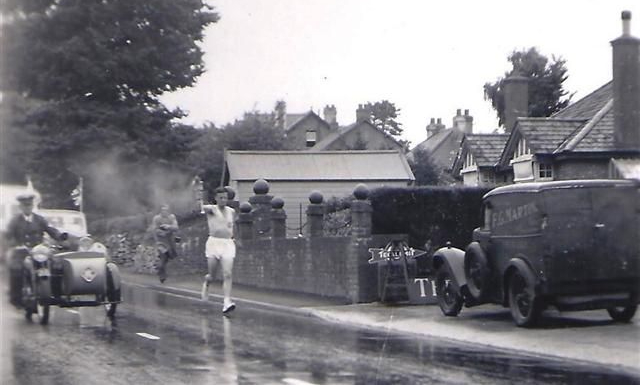
The Olympic torch passes through Chudleigh, Devon, in August 19481

Post-war Britain saw a boom in sport. People, starved of entertainment since 1939, needed something to take their minds off rationing and austerity. The 1948 London Olympics, with its extensive media coverage and torch processions reinforced a sense of unity and recovery through games, no matter the reality2.

This was a boom in spectator sport: the austerity generation was the last generation without televisions in their homes. People still had to, by and large, leave their homes to go and witness a good contest. In West Cornwall, that meant going to watch rugby. Austerity rugby in Cornwall might have only boasted eight senior clubs (Camborne, Redruth, St Ives, Falmouth, Hayle, Camborne School of Mines, Penryn and Truro3), but they were willing to travel, and they were willing to entertain. There was

…an increased tendency to abandon the typically forward game in favour of throwing about the ball in plenty of open movements. This is the only type of rugby that will draw the crowds, and it is commendable that such a universal endeavour has been made.

Western Morning News, May 3 1949, p8

Even with limited Cornish opposition and no dual-carriageway in Cornwall, Camborne’s 1st XV could still play 37 fixtures in 1950-51. By 1954-55 they would host clubs like Exeter University, Public School Wanderers, Cambridge Wanderers, Newcastle Medicals, Royal Military College of Science, Imperial Club XV, Bridgwater, and Captain Crawshay’s XV. Allied to this, a local derby could pull a crowd of 4,0004.

Luckily, there’s a man who can tell us what post-war rugby was like. And that’s John Collins. He was born in November 1928.

England’s oldest living rugby international is excited. You get the impression he relishes the opportunity to turf out his extensive memorabilia and spend an afternoon reminiscing. He’s read my questions and he’s done his homework. The living room of his terraced house has, this afternoon, been made over to a photographic archive. John has a formidable memory, and he seems to use each of his photos as a cue or prop to trigger off a recollection or an anecdote. Without John, the images remain what they are: pictorial records of post-war Cornish and international rugby. With John, they are suddenly brought to life. He provides a provenance no simple caption could ever hope to attain. Because he was there

Holmans apprentice, rugby apprentice

The first photograph I’m handed, along with a cup of strong tea, was taken in 1930, when John was about two years old. 1930

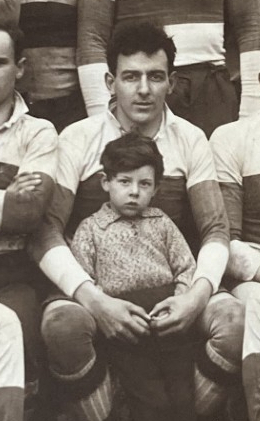
Treloar’s Butchers, Trevenson St, Camborne, 1930. John is being held by his grandfather, the proprietor. His grandmother stands left, and the shop assistant stands centre

My grandfather had a pork butcher’s shop there, just down from Martin’s garage it was. I was born on Centenary Street. Brother, Malcolm Peter, was born before me but died after ‘bout three months. That shop-front is still there now.  

John’s father, Phil Collins, is remembered today as one of Camborne RFC’s greatest players. He was good enough to play for Cornwall against the 1924 All Blacks5.  

Father and son well caught in 1932

Given John’s sporting background, it’s little surprise what one of his earliest memories is: 

My father was a very heavy tackler, not a dirty tackler, proper tackle, put’n down on the floor. And he’d always turn the man, so he’d be underneath and father would always be on top.

I was ‘bout five or six…I can just remember my father playing for Camborne at Plymouth Albion. And in those days you had an excursion train going from Camborne to Plymouth. Everybody went on that! And when we were in the stand, there was an Albion man sitting next to my mother…

Father had a few heavy tackles, and that man was calling all over my father! And near the end, Camborne had a free kick and father hesitated ‘bout what to do, and I shouted out ‘Kick high, and follow up!’ Well that let the cat out of the bag then, the Albion chap knew who we were!

[After the game] you would walk down through the town, go to a restaurant, have a cup of tea and all the team would be there as well. Weren’t no cars in those days, might catch a bus if you were lucky. Lot different. 

It certainly was. John was 14 when he left school.

I failed my eleven-plus and went to Basset Road school. But I couldn’t start my apprenticeship [at Holmans] until I was 16. So I had to go Tech [Technical College, Pool] for two years. I started my apprenticeship New Year’s Day, 1945.

Hitler was still alive. The Atomic Age was yet to dawn.

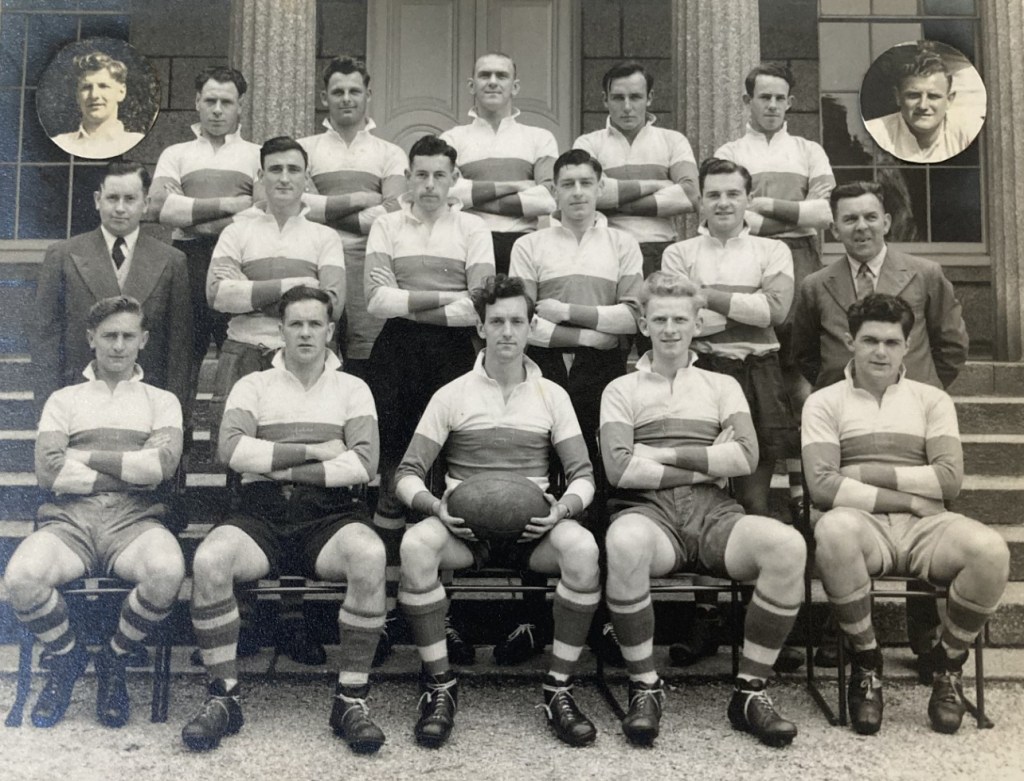
Here is the earliest photo we have of John as a rugby player, that of Camborne Reserves, in probably 1945 or 1946. Obviously a lot has changed in rugby since then, but lesser XVs having to scrape around for manpower has always been a constant. 

Back, l to r: A Cornell, R Williams, P Rowe, L Rowe, K Allen, T Pascoe, F Williams, R Richards. Middle, l to r: W Bosanko, D Arthur, W Dower, R Harris, K Moyle, V Hocking, G Rowland, W Floyd. Front, l to r: J Collins, L Hocking.

With the Reserves, you’d just turn up with your kit. If anybody was short, you’d fill in.

John was so young that, in his very first away matches for Camborne Chiefs, the baggage man was told to keep an eye on him.

No ‘Old Boys’ in those days. No Colts, no youth, no nothing. Not in the time when I was playing, when I started. Used be Camborne Chiefs, Reserves, then Corinthian Blues and Camborne Wesley RFC. 

Tell you a tale about them…Had to pick up sides, they were always one or two short. One game they kicked off, at the first scrum, they had four props in the scrum, and when they counted there was 18 players out there, so they lined ‘em up on the halfway line, and the last three had to go off. And the three that went off were the ones originally picked! 

There was no coaching. I never had a training session in my life! I would do a bit of line kicking, but that was that! My father told me, ‘Never buy a dummy, always take the man with the ball.’ 

First time we had a coach [in the mid 1950s] was Chalkie White. He was schoolmaster up Truro school, and he was playing for Penzance-Newlyn, and then [Pirates scrum-half] Peter Michell come back from the Forces, and he became first-choice then. So Chalkie came to Camborne, and someone said to him, what about doing a bit of coaching? 

Herbert ‘Chalkie’ White (1929-2005) was a PE instructor who had served in the Royal Navy. He had great success as a coach at Leicester, but his ‘professional’ attitude ensured he never received much recognition by the RFU. Here he puts Camborne’s Minis through their paces6

The next image is of the first post-war Camborne XV. Standing left is a man called Harry Glanville: 

Camborne RFC, 1945-46. Back, l to r: H Glanville, C Lovelock, C Jenkin, M Ham, D Harris, K Vivian, T Kelly, K Butler, J Angove, W Calloway, H Baker. Middle, l to r: R Allen, Norman Wakeham, Col. Whitworth, L Charleston, G Williams, A Trevarthen. Front, l to r: H Oliver, D Williams, F Matthews.

In my time, the only chap that went North was a man called Harry Glanville, Oldham, or something like that. He worked for the Council here, he didn’t play much for Camborne, it was after the war like…I knew him quite well, but he didn’t make it [in Rugby League]. 

Glanville appears to have signed for Oldham, aged 25, in May or June 1947, yet only made 20 appearances. Still, he would have had a lucrative signing-on fee and been provided with a job, and thus perhaps considered it a gamble worth taking7.

Around the back of the grandstand, cleaning off his boots after a match, John himself was approached by an anonymous gentleman, recommending he turn pro with the Rugby League:

I said no, not really! I don’t think physically I weren’t big enough to play Rugby League. It wasn’t much of a kicking game either, not really. So what I was strongest at weren’t good enough for Rugby League.

Post-war rugby rivalry

John is one of the few players around today to have played in Camborne’s Feast Monday fixture (generally the second Monday in November), which, after the War, meant hosting Redruth. The fixture itself was disbanded in 1963, when Holmans stayed open, offering its employees an extra day off at Christmas instead. As the firm employed every sportsman in the Camborne-Redruth area, the move effectively killed the tradition8.

Boxing Day was the top match, because only Camborne people were on holiday for the Feast. Christmas, Boxing Day, everyone was on holiday. It would still be quite a good gate, like, but not as good as it would be on Boxing Day. [Camborne was] on complete shut-down, Holmans, most businesses, but not Climax, they were Redruth area. 

‘Course, when I worked over Climax, [Redruth and Cornwall star] Tony Bidgood was over there, and there was always hassle! Monday mornings and Tuesday mornings you’d talk ‘bout the game on the Saturday before, and Wednesday, Thursday you’d be talking ‘bout the games coming on in the future.

These were the days when the Holman-Climax concern would employ around 3,500 workers. On a Monday morning, those whose team had been successful at the weekend walked to work like they’d just been given a raise; those less fortunate looked like redundancy would be a blessed release.

Holmans shift-change, Foundry Road, Camborne, 1950. Courtesy Denise Truscott

Due to the Camborne Feast tradition, from 1935 to 1963 the Boxing Day fixture against Redruth was, for Camborne supporters, always an away match:

They’d all be queued up in Camborne Square for buses. There’d be several buses on Boxing Day. They’d be queued up all around down the corner, down past where Boots used be, two or three deep! Supporter buses would be sorted out in the week. Earlier on it would’ve been by tram. 

Those unlucky enough to miss the charabanc would pace around Commercial Square, awaiting a telegram informing them of the result.

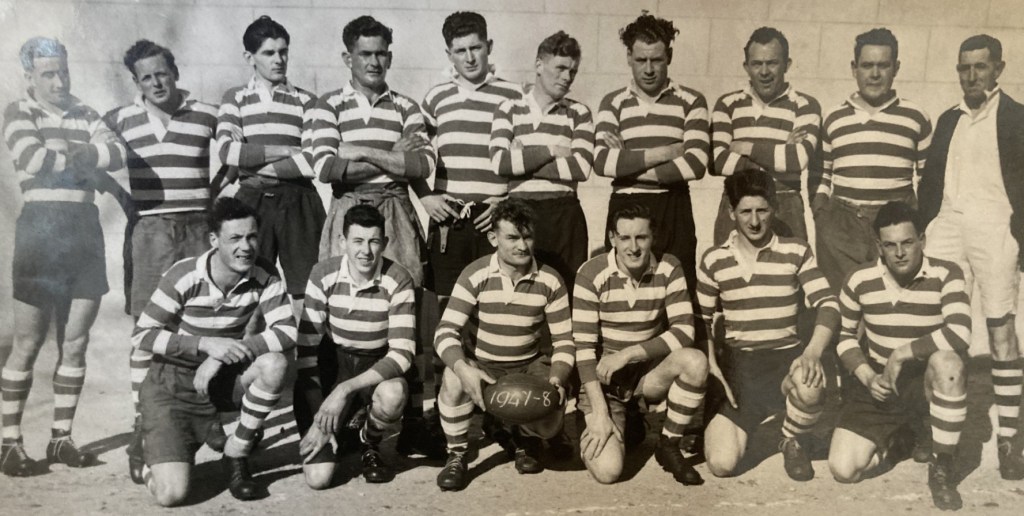
Another photo, this of the Camborne 1st XV for 1947-48.

Back, l to r: R D Kennedy, J Paull, A Visick, T Kelly, D S Hurrell, F Matthews, T Burt, C Rogers, K Butler. Front, l to r: T G Williams, J Collins, Norman Wakeham, T Harris, J Hocking, W T Tom.

Standing left is Bob Kennedy, whose main club was in fact The Camborne School of Mines (CSM). The chance appearance of Rhodesian-born Kennedy in this image, who won three England caps whilst with CSM9 , gave rise to an interesting discussion. Kennedy only really played for Camborne on Feast Mondays, helping Camborne to victories in 1946 and 1947… 

…until Redruth put paid to it. They went to the County [Cornwall RFU], and it was returned that if you played for School of Mines, you couldn’t play for Camborne on Feast Monday.  

Which is true. In a CRFU minute-book from March 1950 is a reference to bylaw #33. Regarding CSM players, 

…it has been ruled that when the school is out of normal session, its members shall be free to play for another club if invited…On occasional holidays the school is not considered as being out of session.

Cornwall RFU Minutes, 1950. With thanks to Bill Hooper, CRFU

Another schoolboy guest, albeit from Truro, was a youngster called Robert Shaw: 

He scored the try in Redruth when we lost 6-3 [Boxing Day, 1947]. That was my first game. He scored the try up in the corner where the scoreboard is now, which was the changing rooms before.  

Shaw of course went on to star in From Russia With Love and Jaws. Courtesy Jason Mitchell

Camborne RFC on tour

John hands me another team photo, from the 1951-2 season, which was taken on the steps of Rosewarne House which in those days was the Holman Bros. administration block.

We had no clubhouse, or nothing like that, only thing you had after a match was a big tea urn, for cups of tea. And at half-time, you had either oranges cut up, or lemons. You never went off the field, you stayed on. If you was winning, you had the oranges! 

Insets unnamed. Back, l to r: R Warren, T Burt, D Cook, R Honeywell, G Harris, T Selwood, G Willoughby. Middle, l to r: S Dunstan, T Phillips, J Collins, T Smitheram, F Caddy, A Harris. Front, l to r: G Mitchell, D Williams, M Biddick, T Cory, B Eddy.

The game of rugby might have altered beyond all recognition, but one thing remains true. Any XV on an away trip accepts that high jinks is part of its remit:

The team always went by bus. Troon buses. I was only a youngster then, we went and played up Barnstaple. We lost 3-0. On the bus back, nobody was allowed go sleep. From Barnstaple to home, we always kept them awake! One chap got so fed up in the end he got up, with his kit, and he tried to open up the door at the back of the bus and jump out, with the bus goin’ on! When we dropped the chap off, he said he’d never play for Camborne again, and he went Redruth!

Bear in mind this was in the days before the Tamar Bridge, which opened in 1961…

In those days you only had the [Torpoint] ferry, no bridge up there then, see, and if you didn’t catch the midnight ferry home you ‘ad wait another hour! Anyway, we got on, and there was an announcement,

‘Will the two gentlemen in the engine room please remove themselves, the ferry isn’t going anywhere until they do…’ It was two of our blokes in there!

In those days you had a 10 shilling note gived to you, buy your dinner, tea, pint of beer or go to the pictures. For Camborne this was, all above board! I earned 18 and 11 a week as an apprentice, and a decent meal out then would cost three and six.

Telling these stories, John is a young man again. Living for the weekend:

Another time we was up Barnstaple, we had leave a certain time. Everybody was there except Gerald Wakeham. Waiting, waiting, waiting, we waited ‘bout three-quarters of an hour, we weren’t going to wait no more, so we came home.

Turned out Gerald had caught the train to Salisbury to see his girlfriend, wife afterwards, and never told nobody!

Cornwall RFU selection

John was 19 when he debuted for Cornwall, against Monmouth at Penzance in April 1948. In those years, John said, Monmouth would tour at the end of the season for friendly matches. Cornwall lost in atrocious conditions, but the young full-back showed promise10. His calm assurance contributed to a 14-6 win over Somerset in November 1948:

Young Collins (Camborne) played a sterling game at full-back, finding long touches with the nonchalance of a veteran.

West Briton, November 29 1948, p3

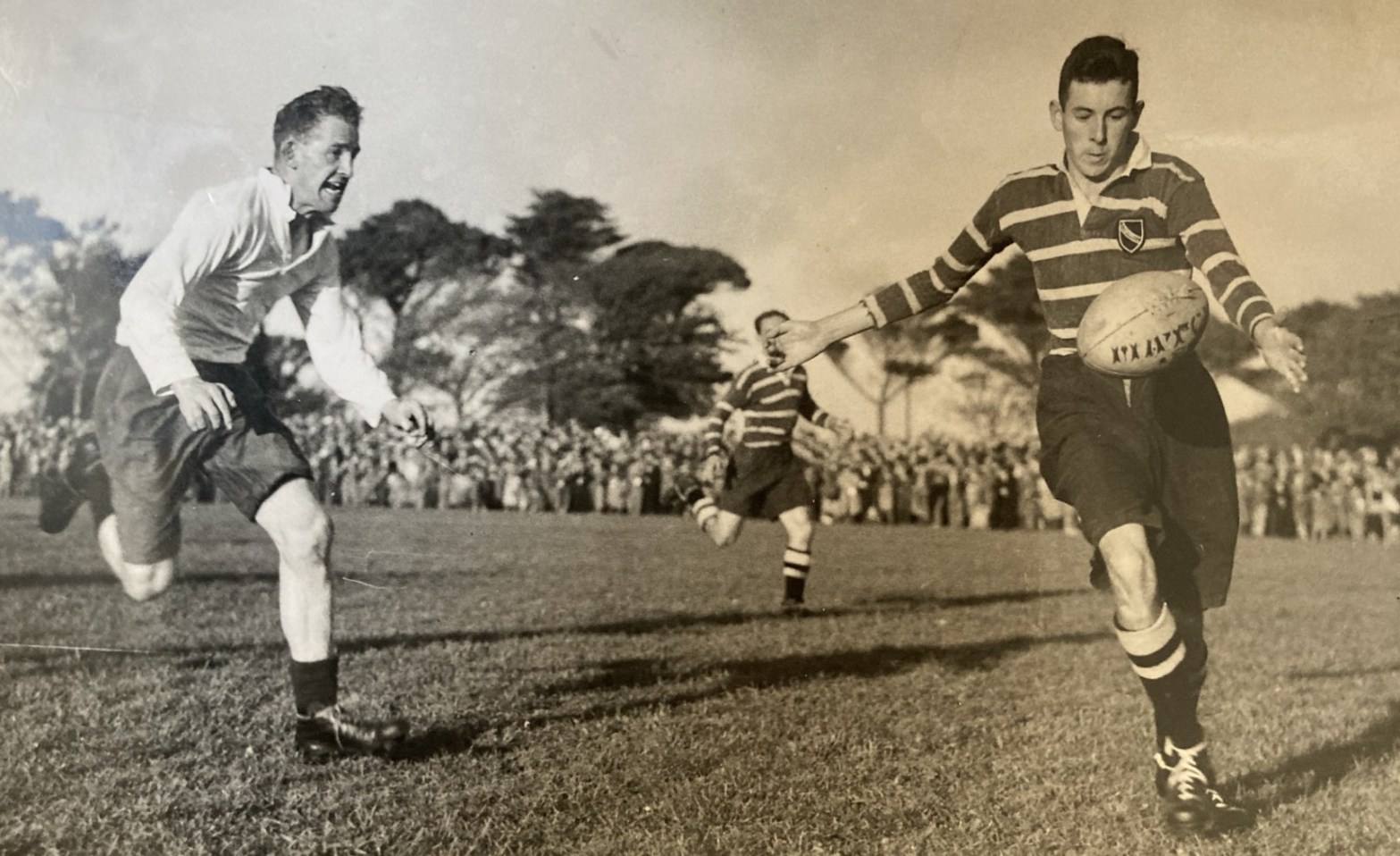
John had a massive left-footed kick, and probably rivalled the great John Jackett in this regard.

John on debut against Monmouth
In austerity Britain, kicking tees were unheard of. Here John places the ball for Harry Oliver against Berkshire in Redruth, 1950. Cornwall won 29-011

The longest drop-goal I ever kicked was from my own ten-metre line, up Camborne, in a county trial, with a gale blowing behind me! All I had do was lift the ball up!

Not boasting, but I was in the top three in the country for kicking the ball. No stats, just the opinion of reporters who watched the games. If I was on the right-hand side of the field, and the wind was behind me, I would kick for the far side of the field.

At Camborne, John was undoubtedly the tops. He was top scorer for the 1950-51 season, with 69 points12. But all this rugby came at a cost. In Camborne, the wheels of industry only stopped on Feast Monday. John told me he had to work extra hours at Holmans on a Monday night to enable him to have his entire Saturday free to play rugby.

‘…young Collins came through with flying colours and fielded and kicked magnificently.’ Cornwall v Police Union, West Briton, October 7 1948, p2

RFU County Championship

Monmouth, Berskhire and the Police Union were essentially warm-ups for the serious stuff: the County Championship.

…my first Championship game was against Gloucester. I made headlines that day: ‘Collins fails to save.’ I touched it [the ball] down, but [Sid] Dangerfield13 came and dived on it and they gived the try. Referee said you didn’t have enough downward pressure on it. We lost 9-8, in the last minute Ivor Richards broke through the middle of the field, and I said to myself, ‘This’ll be the saviour for me,’ but he didn’t score. 

We came off the field and I thought I’m in for a bollocking now, and Keith Scott14 said, ‘Collins, I want to speak to you, never leave that ball on the floor again, when you save it, keep it in possession – I hope you learn by your mistakes.’ 

A change in the rules for that season was John’s undoing. As the ball rolled loose in Cornwall’s dead-ball area, he dived to touch it dead, but ‘failed to show the necessary pressure’, and Dangerfield capitalised15.

Western Morning News, October 25 1948, p5

So the next home game, they kicked it and I touched it down, put it under my arm and walked off with it. Someone in the crowd said, ‘You silly bugger, you should’ve done that last Saturday!’ 

John hands me an image of Cornwall’s 1948 team: 

Back, l to r: George Thomas, trainer (Camborne), Les Semmens (Redruth), I Richards (Penryn), Tony Bidgood (Redruth), J Lowry (Falmouth), D Hurrell (CSM), John Collins, Harvey Ham (linesman). Middle, l to r: Mike Terry (Penzance-Newlyn), J George (Falmouth), Vic Roberts (Penryn), Keith Scott (Redruth), Billy Phillips (Redruth), Les Williams (Cardiff), Bob Kennedy (CSM). Front, l to r: J Taylor and Harry Richards (both Penzance-Newlyn).

Yeah, we had some side. Les Williams on one wing, Mike Terry on the other, Keith Scott and Kennedy in the centres, Harry Richards and the scrum-half down Penzance [Taylor]… 

The team was tipped to

…bring further honours to the county this season.

West Briton, October 7 1948, p2

There were no honours, but their only Championship loss came in the Gloucestershire match16. This Cornish XV was selected from just six teams, and given the intense club rivalries during this era, I was curious to know if this ever impinged on Cornwall’s performances: 

Not in my time, might’ve been in my father’s time, I can remember when two players were sent off in Redruth, they come off in front the stand and bowed to the crowd! I think post-war was different to pre-war. More live and let live. 

Such things are relative. The Cornishman of November 24, 1949 noted that Cornish teams could play open attractive rugby against non-Cornish opposition. But any local derby would see regular rule infringements, heavy forward play and a desire to win at all costs. There was still room for the hard men: 

Vic Roberts was quite physical, but that was his job, to nail the fly-half. He was never a dirty player, hard, but you’d never see him play dirty. Then again John Kendall-Carpenter, he wasn’t a great scrumming forward, put it that way! He played prop for England, as well as No. 8, he was a good footballer, but people used to say he ought be doing something else rather than play second full-back! 

John Kendall-Carpenter had an illustrious career as an RFU administrator and, to be fair to him, had a reputation as a fine tackler17

One Camborne player whose name is always mentioned in this context is Gary Harris. A Charles Atlas devotee and local doorman, he was nevertheless a quietly-spoken individual… 

Gary Harris in 1952

He [Gary] was quiet, he didn’t drink or nothing. What would take four men to do a job, Gary would do by himself. He was quiet on the pitch until someone worked him up a bit. I was playing St Ives, chap kept jumping on his back, and Gary said, ‘If you keep doing this, you’re goin’ have one.’ Course, he kept doing it, and Gary clunked to’n right in front of the referee. So he had be sent off. Actually he was suspended by the Cornwall Rugby Union, but our chairman, he had a bit of brains, he appealed against it, and Gary got off.  

Gary played one more game, then he finished. He never played no more. 

I met the St Ives man a few years ago. ‘Do you know who I am?’ I said no, he said ‘I’m the man that left my teeth behind on Camborne Recreation Ground.’ 

England international trialist

John didn’t play a single Championship game for Cornwall in 1949:

I weren’t playing as well as I should’ve done. I ain’t got no complaints ‘bout it, not really. 

In newspaper columns – and, I’ll wager, several workplaces – debate raged as to who was Cornwall’s best full-back. Camborne asserted it was John; Redruth naturally put forward their own candidate, Frank Partridge18. In 1949, it was Partridge who was the form horse; he was described as ‘virtually perfect’ for Cornwall in the position19.

John’s nemesis: Frank Partridge in 1949. From Cornish Memory

John was still learning his craft, but he was learning quickly. In October 1950 Cornwall lost 9-20 to Somerset, and his positional play was criticised in the Press20. By December of that year however, John had improved rapidly. Against Gloucestershire he

…far outshone Hooke, the international trialist.

Cornishman, December 14 1950, p13

Back in his living room in 2025, John says that

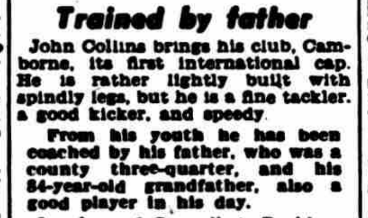
I always had ambitions to go as far as I could. What my father had done, I wanted to try and equal him…I didn’t dream of playing for England, but as things went on, it emerged I was knocking on the door a bit. But for my size and that, I didn’t think I was big enough to do it.

My first [England] trial was at Leicester. Five Cornishmen played in that trial. Kendall-Carpenter and Vic Roberts was on the white side, blues side was me, Harry Oliver from St Ives and Freddie Sampson from Hayle. We kicked off, and Kendall-Carpenter caught the ball, and he kicked it straight down to me! I thought, well done, good start this, and I knocked it on! 

By early 1951, he was selected for an England trial at Twickenham.

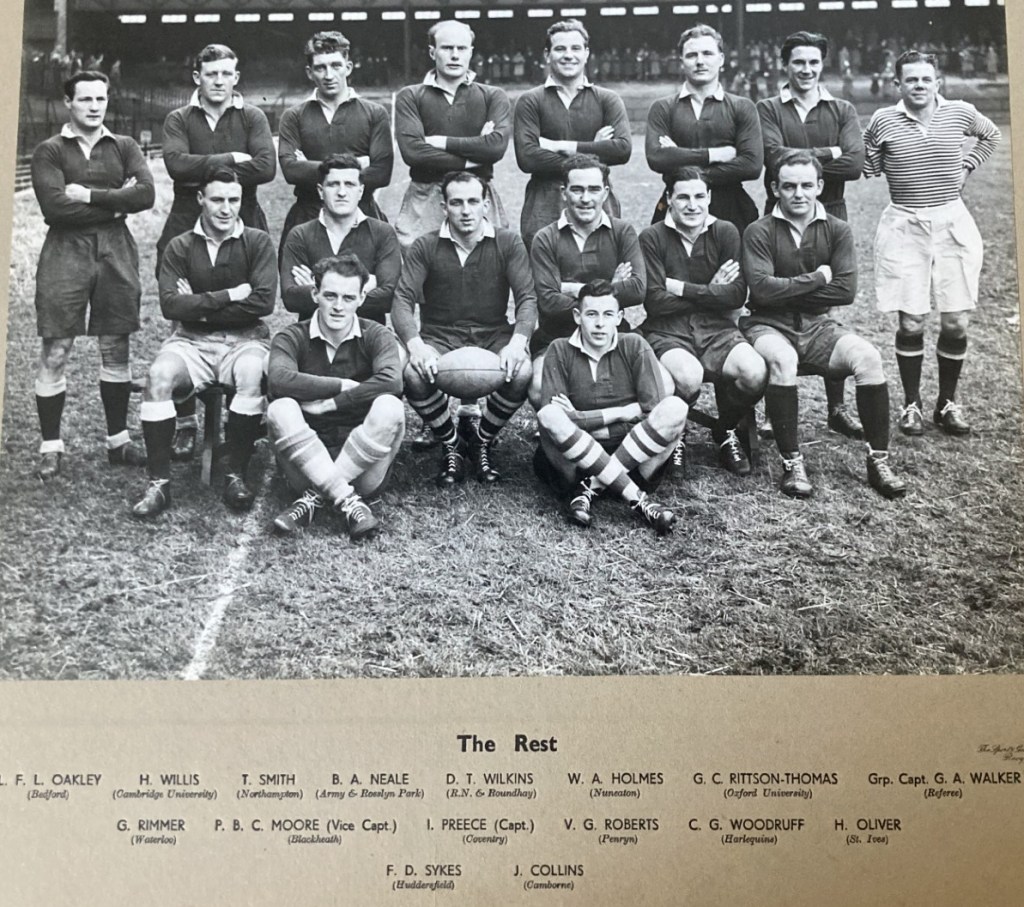
The Rest, 1951

It was noted that his opposite number outplayed him, and maybe his chance had gone. John wasn’t selected for the trial to take place in December of that year21.

However John was still playing well; the 1951 Boxing Day fixture, ‘one of the hardest games seen between these clubs’ ended in a 3-3 draw, with him ‘right at the top of his form’22. He’d also represented the South West against the touring Springboks in October, it being written that

…no one did better than John Collins. He kicked a colossal length, and his fielding was impeccable.

West Briton, October 15 1951, p3

John stands third from right

Sometimes, you don’t need to be in a trial. Sometimes, you need a bit of luck. Sometimes, you need to be in the right place, at the right time.

England cap, England debut

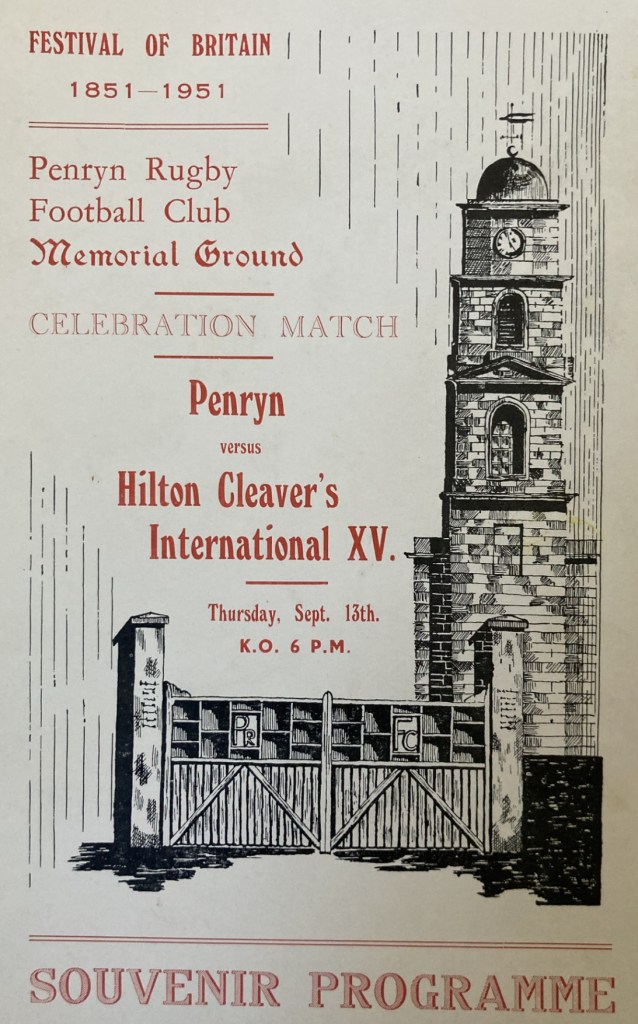
The sense of British rebirth and reemergence from austerity after 1945 was further reinforced in 1951 by the Festival of Britain, described by its director as a ‘tonic to the nation’23. The events even reached Cornwall, with Holman Bros. organising a week of entertainment in Camborne that August24. Sport was part of the Festival’s agenda, and John took part in an exhibition match organised by the journalist and ripping yarns-style author Hylton Cleaver, who was that year’s President of the RFU:

John turned out for Penryn

Lest we forget, the motivations of the Festival were in part to make the nation forget its woes. Rationing was still in force, with the meat allowance in Cornwall being described as ‘miserable’25.

Cleaver must have liked the look of young Collins. Maybe he put a word in the ear of the incoming RFU President for 1952, Percy Holman, whose family’s firm just happened to be John’s employer.

Percy Holman died at Redruth RFC on February 1, 1969. Cornwall were playing East Midlands in the County Championship semi-final26. Image copyright Cornwall Museum and Art Gallery

John hands me a flimsy scrap of paper:

Captain Geoffrey Crawshay toured annually with a select XV of up-and-coming Welsh talent. Barring the War, they played Camborne annually from 1922 to 1965, it being one of the season’s biggest fixtures27

I ‘ad that from Captain Crawshay. I met him first when I was about six or seven. Father introduced me to him, behind the ‘stand. Played Crawshay’s nearly every year. Back in those days, we’d play Devonport Services first, then play Crawshay’s Easter Monday. Sent me that when I was picked for England.

I was over working in the drawing office [Holmans], chap come over to me and said ‘John, manager want to see you, right away up in his office’. I never thought nothing ‘bout rugby! I thought in my mind, what ‘ave I done wrong now!

Went up there, opened the door, there was Reggie Parnell, father, Uncle Tom…they said the President [of the RFU, Percy Holman], phoned them up and said I’d been picked for England, ‘gainst Ireland. I got all the facts and figures, all the information, but it wasn’t a surprise!

Daily Herald, January 29 1952, p6

‘Course, then the King [George VI] died, so it [the game] was all put off then. I’m thinking now, maybe someone was out because they were injured, and they might be fit next time around, but it wasn’t so, and everything turned out alright.

The Ireland fixture was cancelled. England kept the same XV for the next fixture, against Scotland at Murrayfield28.

I felt there was a lot of good people in front of me who, in their time, didn’t have a sniff-in. At that time, you had to be a bit higher-class people to play for England. [The exception was] Bert Solomon, I always regretted not meeting him, I met his son, Alfred John, always had bit chat with him. Very quiet chap, he got picked to play ‘gainst the Wallabies, at full-back, never played full-back in his life! Alfred was a good man with the dummy, and a very good goalkicker, but he wasn’t all that interested whether he played or no, just like his father really29

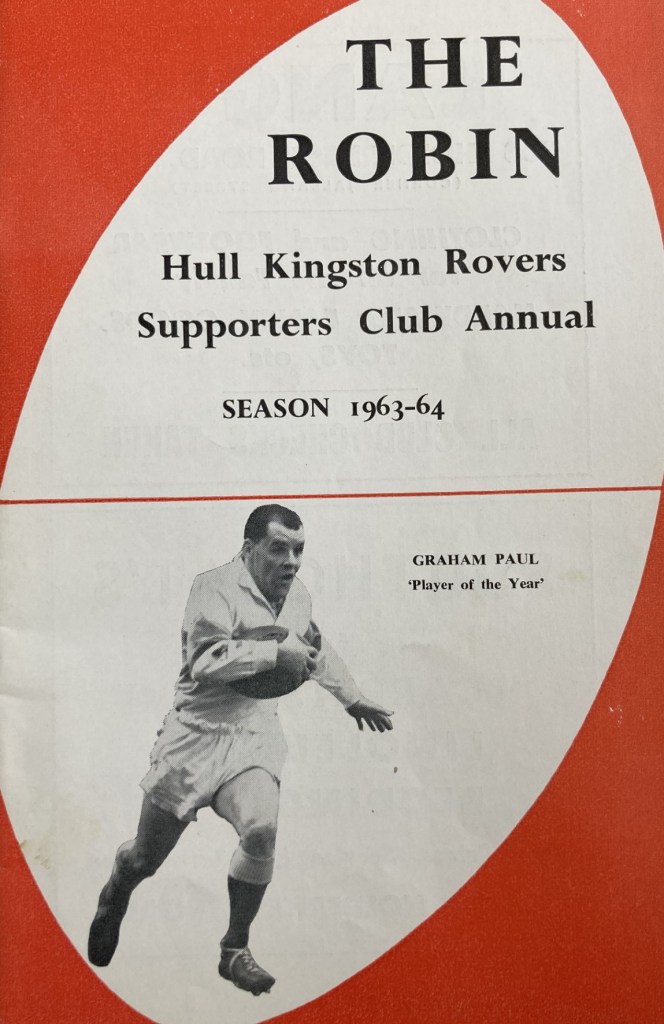
Like his near-contemporary and fellow Cornish rugby star Graham Paul, John knew all too well the social barriers that kept working men from playing rugby union at the highest level. Paul would ultimately sign a professional contract with Hull KR; much like Bert Solomon, John’s talent was simply too great to be ignored30.

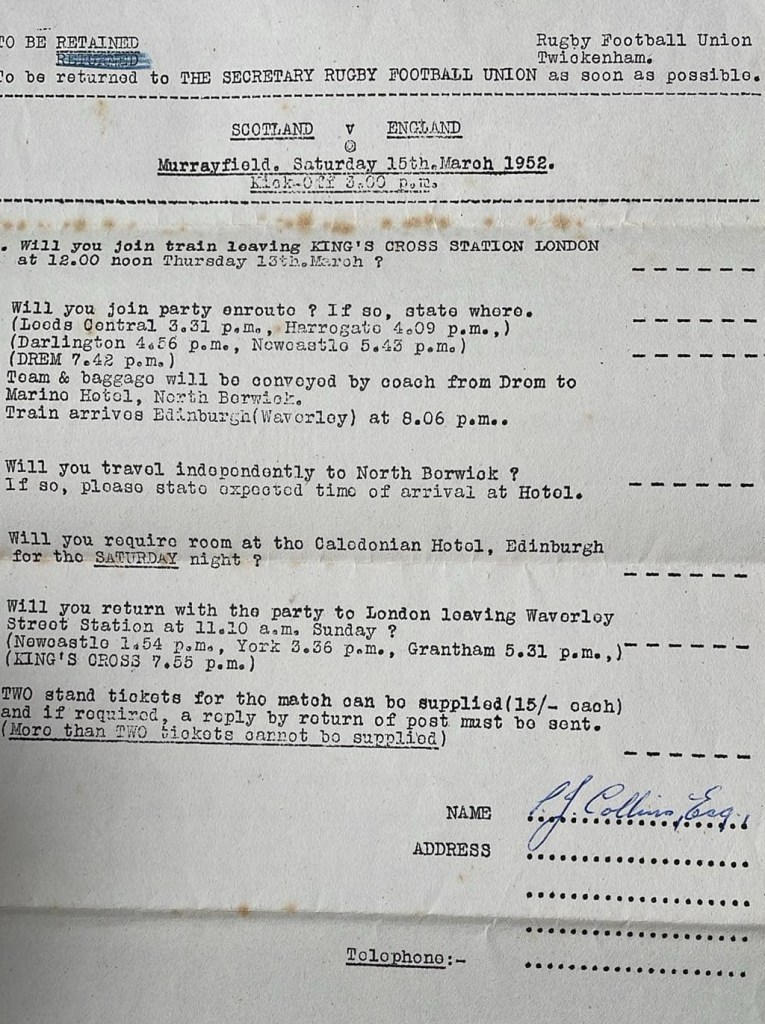
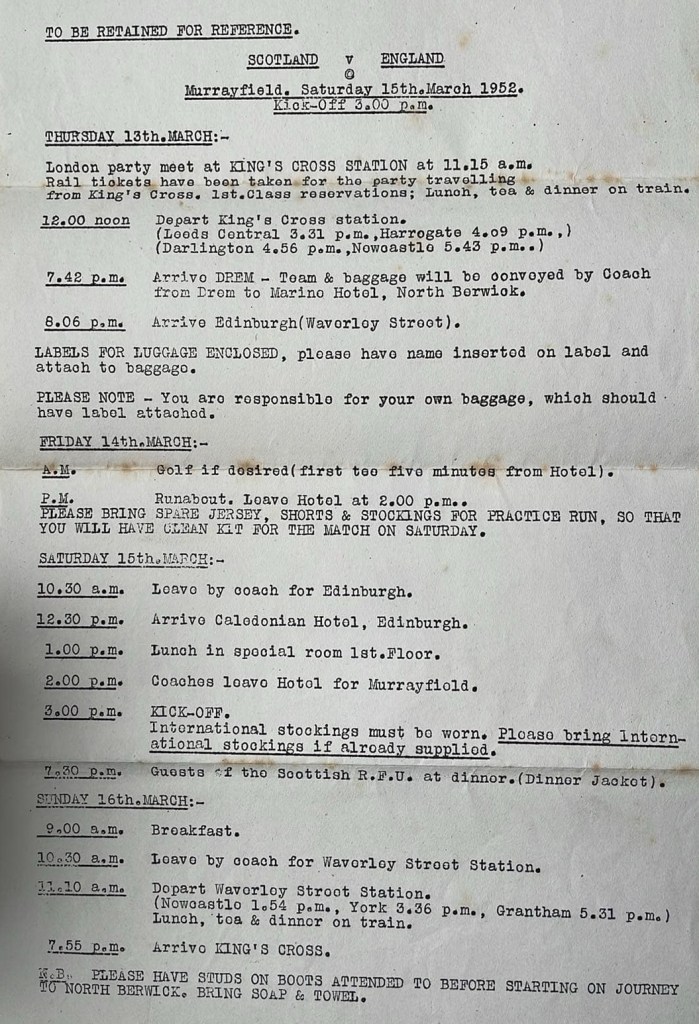
He shortly received the following itinerary from the RFU:

Tickets were available – but only if you paid
‘Bring soap & towel…’

Went play for England, never had a training session, no talk, no nothing. Only get-together we had was playing snooker, darts or cards. Never had no tactics or nothing like that. Anyhow, [Chris Winn] scored in the right-hand corner, which was the right corner for me being a left-footer. ‘John! Take the kick…’
In the days before kicking coaches, kicking tees or even jugs full of wet sand, a team-mate would balance the ball just off the ground for the placekicker. John indicates to me that his assistant at Murrayfield that day held the ball sideways, that is, with his hands over the middle of it…

Normally, I said, I have top and bottom! He said, ‘You’re the kicker, you can have it which way you like!’ So he held it top and bottom, then he dropped it and it rolled over as I kicked it, and it went near the corner flag!

Same game, I had a chance for a drop-goal, ‘bout 45 metres out, right in the middle of the field. I kicked it, and it went just outside the upright. 

England won 19-3, claiming the Calcutta Cup at Murrayfield for the first time since before the War. John perhaps made a nervy debut:

His kicking was short and often sliced.

Daily Herald, March 17 1952, p5

There is a Pathé newsreel available of the match, but John’s attempted conversion has been edited out. Maybe that’s no bad thing31.

A Camborne player at Twickenham

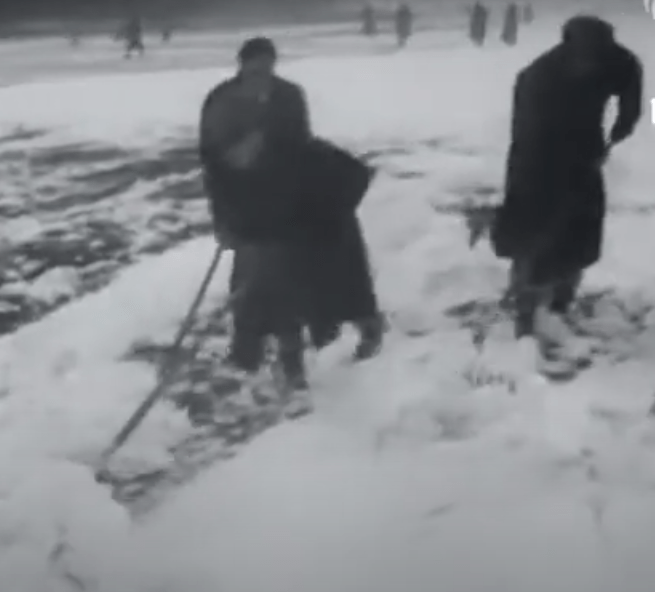
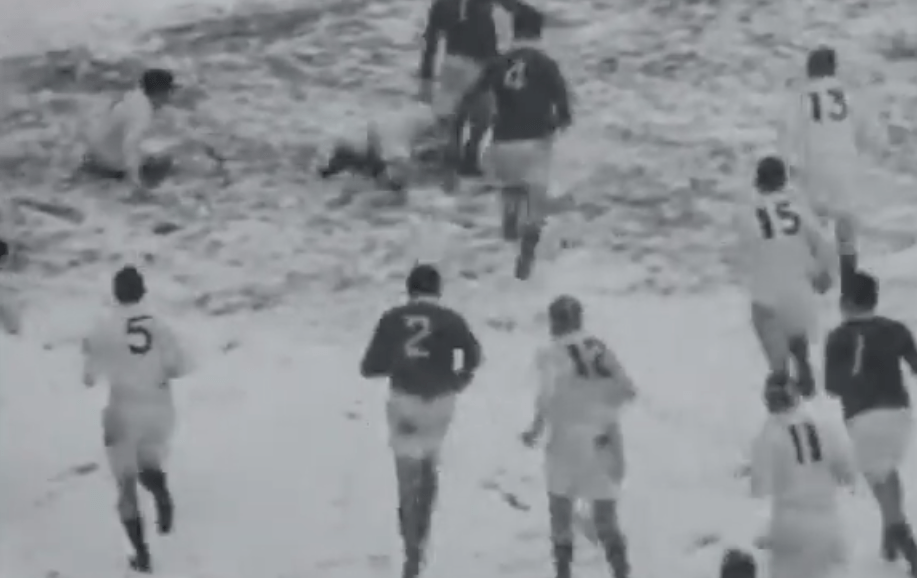
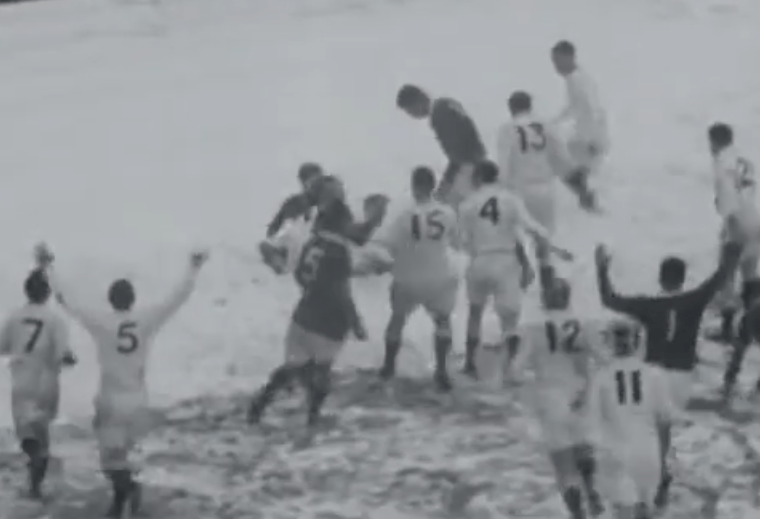
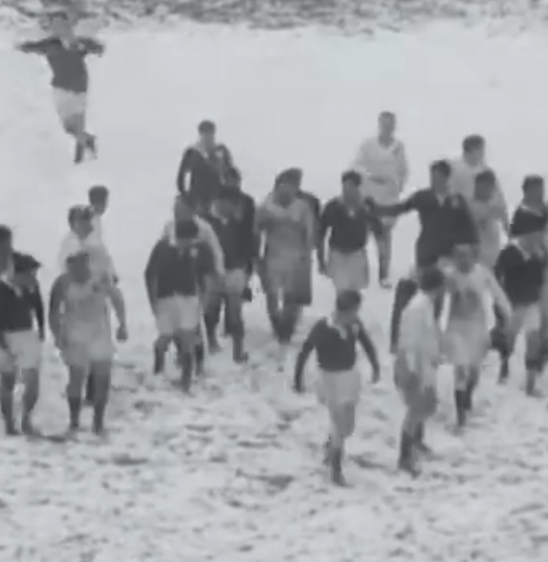
The same month, March 1952, England played the rearranged match against Ireland at Twickenham. Played mostly in a blizzard with half the pitch covered in a blanket of snow, one newspaper described the match as ‘grotesque’32.

Playing conditions were challenging, to say the least
John is in action, top left
England have just scored – I think
At full time, Irish players start a snowball fight33

England won 3-0. ‘Long’ John was the star player:

…always the frail figure of Long John Collins barred the way. He flung himself fearlessly at the feet of the Irish forwards; he was never flummoxed by a ball as slippery as a bar of soap; he kicked a long length with that deadly left foot.

Daily Mirror, March 31 1952, p11

There was no talk of the game being abandoned, but certain precautions were taken:

Only thing that happened was the photograph was taken underneath the ‘stand, we didn’t go out on the pitch. We came off at half time, you normally didn’t in those days. We changed jerseys and carried on. The other one didn’t have no rose on’n, only was a plain white shirt.

The snow was overnight. They got people in, they cleared half the field, lengthways, of snow. Other half was left! Lowest crowd ever seen at an international at Twickenham! 20,000! 

Several of the crowd, including John’s parents, had made the long trip up from Cornwall. A Holmans employee in charge of transport had hustled up a train. No doubt management turned a blind eye.

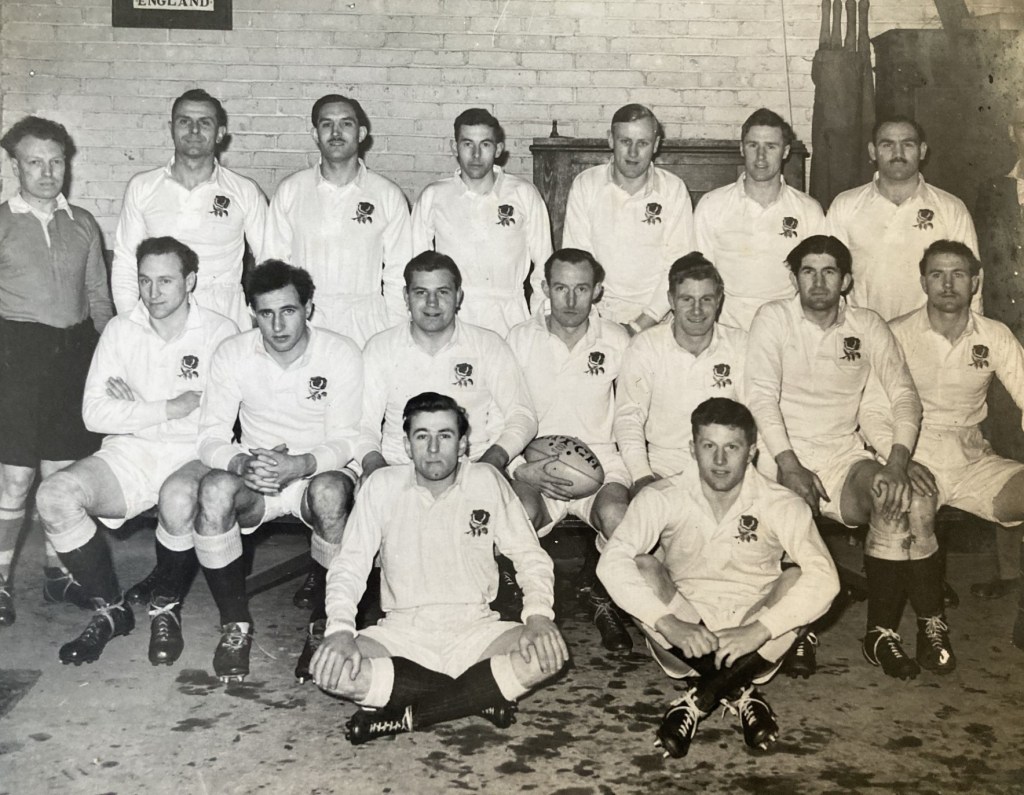
The England XV under the grandstand at Twickenham, 1952

1952 Five Nations

England’s final match of the Championship was against France, at the Stade Colombes. French rugby in 1952 was in turmoil, with several clubs being accused of professionalism. There was even a rumour that the England fixture would be Les Bleus last ever Championship match34.

I left here on the Wednesday. Got up London, stayed the night. Thursday, went across to Paris. Trained on the Friday or, what training there was, won’t no training as such, not really! Played on the Saturday, come back on the Sunday night, ferry from Paris, come back on the night train…Leslie May was waiting for me at Camborne station, I had to play Captain Crawshay’s XV that day! But I couldn’t play, I was injured, hurt my rib. 

[In the game] I made a mark, in they days you could make a mark anywhere on the pitch. Anyway I made a mark in the middle of the pitch, and two French players struck me the exact same time! Knocked the wind out of me! 

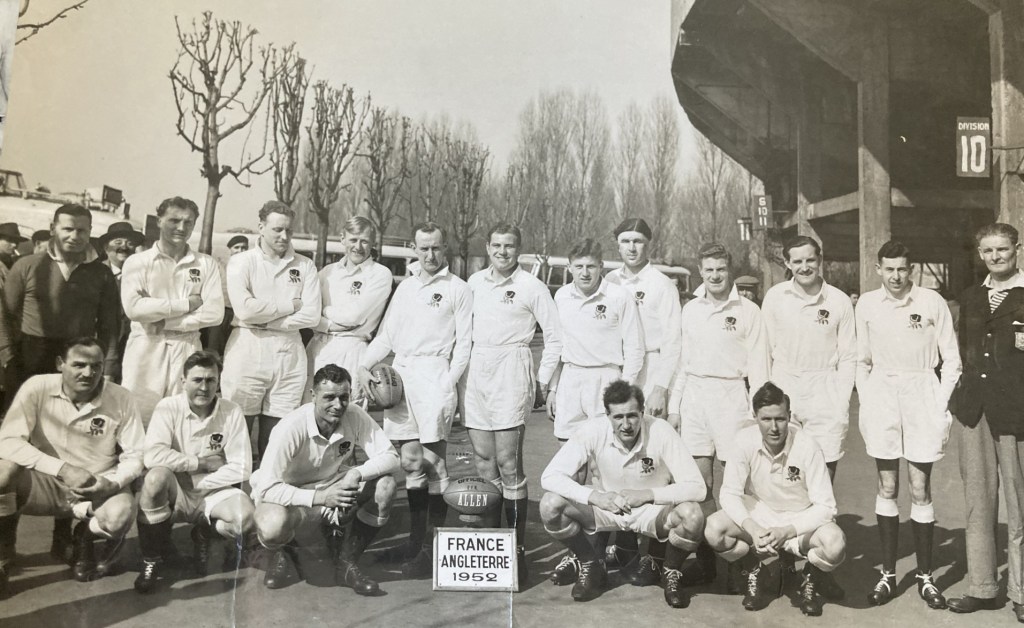
The England XV at the Stade Colombes, 1952

England’s 6-3 win over France was described as the ‘dullest’ game of the Championship. Although France were down to 14 men for most of the second half due to an injury, England barely capitalised35. Nevertheless, England’s three victories with John at 15, noted for his ‘resolute’ tackling in France, meant they finished second overall, behind a Welsh Grand Slam36.

John finished his first international season undefeated.

It would also be his last international season.

Feast Monday, 1952

Some of John’s memories don’t require photographic aid. I asked him about his injury; John of course had several injuries over the course of his career, but there’s only one injury that matters. And that was sustained against Redruth on Feast Monday, November 195237.

Gale wind, straight up through the field. We was playing’ straight against the wind. I caught the ball, and first thing I did was move closer to the touchline. But I ran two paces too far, an’ as I kicked the ball, he tackled me. And I felt something go…

That put paid to me for the rest of the season. 

His recovery and progress received much attention in the Press, so quickly had John’s star risen in Cornish rugby circles. Indeed, 

…down in the John Collins country they know a good full-back when they see one.

West Briton, November 5 1953, p2

Camborne RFC was asked to give statements. The West Briton wished him a speedy return to Cornish and international rugby38. By February 1953 John himself told a reporter that

It might be as well for me not to play this season, but, despite rumours, I’ve no intention of giving up the game. I hope to start playing next season.

West Briton, February 26 1953, p2

I didn’t have any treatment, at that time. He [the doctor] thought I’d strained ligaments. I saw a man up Truro Infirmary, and he said I shouldn’t play no more, for so long. 

John’s leg was put in splints, and he was sent to a specialist in London. This man sent him to Leicester, where he was discovered to have torn ligaments and cartilage in his knee. Told to go back to London for the operation, John made sure he got married first, which was the sensible thing to do, for he was laid up in a hospital bed for eight weeks. Camborne fans travelling to Twickenham for the internationals would visit, bribing the matron with Rodda’s cream to gatecrash John’s ward en masse.

The operation seemed to have done the trick. John was back playing for Camborne at the start of the 1953-54 season, but had his eyes on one particular fixture:

I wanted to do something what my father had done. He’d played against the South Africans, and the All Blacks…

John had played the Springboks, back in 1951. A Cornwall-Devon XV were due to play the 1953 All Blacks in early December. That was the target.

Before the All Blacks game, Cornwall was playing Devon away. I had the ball, and John Stark was coming towards me. I beat him, and went and kicked to touch, he turned quickly, came behind me and tapped my ankle, and my knee was gone again!

John did nothing wrong, but he might have been disappointed that he’d done that. I was quite friendly with him.

John Stark, a wing for Exeter, skippered Devon to their 1957 County Championship victory. He died aged 88 in 2013.

I went to see the doctor again, and he said, ‘I advise you to give up. If you was a professional, I could operate on you and shorten your ligaments, but as an amateur I wouldn’t advise it.’

West Briton, October 22 1953, p2. Cornwall beat Devon 11-12 on October 1039

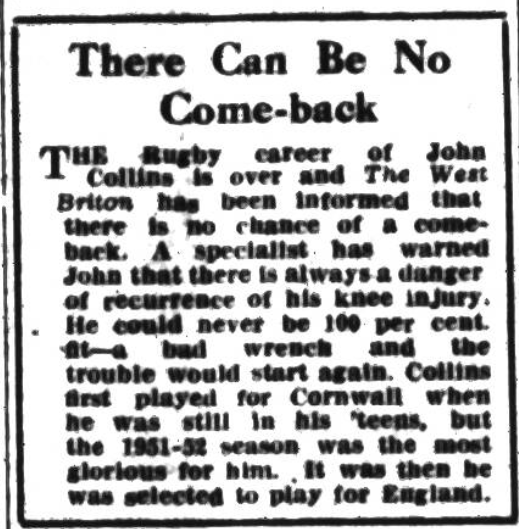
John’s retirement was described as ‘tragic.’ He was 2440.

I look at it both ways, really. I’ve still got my leg! 

One of John’s sons, David, played a Boxing Day fixture a few years ago in Redruth. In the bar, a man approached him and said: 

I never meant it. I never meant it…

The man who had inadvertently caused John’s injury on Feast Monday, 1952 still carried the blame.

Camborne’s first England international

It’s important to remember that John’s rugby career lasted less than ten years, and that there’s more, much more, to him than just ‘John Collins, Camborne’s first England international’. It’s only over time, and with no additional Town players donning the Red Rose, that John’s feat has gained legendary status, yet simultaneously threatens to overshadow his many other achievements41. The sense of what-might-have-been is evident in histories of Cornish rugby:

Those privileged ever to have seen John Collins kick for touch need never seek another kicker.

Tom Salmon, The First Hundred Years: The Story of Rugby in Cornwall, CRFU, 1983, p44

John, standing second right, in the late 1950s for Camborne CC. Seated second right is a young Des Rodda, who I had the pleasure of playing with

For example, John played cricket for many years with Camborne and Holmans. He was also a fine snooker player, who once took on the great Joe Davis. His sons, Malcolm and David, both played rugby for Camborne, Malcolm going on to represent Cornwall. Above all, he’s a true gentleman, and I was honoured to chat to him.

With special thanks to Honor Collins, Malcolm Collins, and David Collins.

My previous Cornish sporting hero was Richard Pascoe, of Saint Piran Cycling. Find out all about him here.

Many thanks for reading; follow this link for more top blogs on all things Cornwallhttps://blog.feedspot.com/cornwall_blogs/

Do you enjoy my work?

All content on my website is absolutely FREE. However managing and researching my blog is costly! Please donate a small sum to help me produce more fascinating tales from Cornwall’s past!

£5.00
£10.00
£15.00

Your contribution is greatly appreciated.

Donate

References

  1. Image from: http://chudleighhistorygroup.uk/articles/1948_olympic_torch.html
  2. Peter J. Beck, “Britain and the Olympic Games: London 1908, 1948, 2012”, Journal of Sport History 39.1 (2012), p21-43.
  3. As listed in the West Briton, November 27 1947, p2.
  4. West Briton, July 12 1951, p2; July 1 1954, p10. 4,000 watched an early season victory for Redruth over Camborne: West Briton, October 7 1948, p2.
  5. For more on Phil Collins’ exploits, see: https://the-cornish-historian.com/2024/09/21/the-magnificent-seven-meet-the-invincibles/
  6. For more on Chalkie White, see: https://en.wikipedia.org/wiki/Chalkie_White_(rugby_union). Image from: Tom Salmon, The First Hundred Years: The Story of Rugby in Cornwall, CRFU, 1983, p103.
  7. From: https://orl-heritagetrust.org.uk/player/harry-glanville/, and Halifax Evening Courier, June 3 1947, p2.
  8. For more on the Feast Monday sporting tradition, see: https://the-cornish-historian.com/2023/08/26/cambornes-feast-day-rugby/
  9. For more on Kennedy, see: https://en.wikipedia.org/wiki/Robert_Kennedy_(rugby_union). He was always known, and selected for England as, a CSM player: Western Morning News, January 25 1949, p6.
  10. Cornishman, April 29 1948, p7.
  11. Cornishman, November 11 1950, p7.
  12. West Briton, July 12 1951, p2.
  13. Sid Dangerfield was a prolific scorer for post-war Gloucestershire: https://www.gloucesterrugbyheritage.org.uk/content/people/player_profiles/sid-dangerfield#
  14. Truro-born Keith Scott represented England in 1947 and 1948: https://en.wikipedia.org/wiki/Edward_Scott_(sportsman)
  15. Cornishman, October 28 1948, p7. 
  16. Cornwall hammered Dorset-Wiltshire 52-3, beat Somerset 14-6 at Falmouth, and drew 8-8 with Devon. From: Tom Salmon, The First Hundred Years: The Story of Rugby in Cornwall, CRFU, 1983, p118.
  17. For more on Kendall-Carpenter, see: https://en.wikipedia.org/wiki/John_Kendall-Carpenter. Image from: https://www.bathrugbyheritage.org/content/heritage-topics/people/player-profiles/kendall-carpenter-john-3
  18. Western Morning News, May 13 1949, p6.
  19. West Briton, October 6 1949, p2.
  20. Cornishman, October 19 1950, p9.
  21. West Briton, January 11 1951, p2; December 13 1951, p2.
  22. West Briton, December 27 1951, p2.
  23. Quote from: https://en.wikipedia.org/wiki/Festival_of_Britain
  24. West Briton, August 2 1951, p7.
  25. West Briton, March 22 1951, p4.
  26. West Briton, February 6 1969, p18. Image from: https://artuk.org/discover/artworks/percy-miners-holman-18951969-14315
  27. For more on Crawshay, see: https://www.crfu.co.uk/crawshays-the-camborne-connection/
  28. West Briton, March 6 1952, p2.
  29. Alfred Solomon represented Cornwall and Devon against the Wallabies in September 1947. The Wallabies won, 17-7. From: From: Tom Salmon, The First Hundred Years: The Story of Rugby in Cornwall, CRFU, 1983, p132.
  30. See my interview with Graham Paul here: https://the-cornish-historian.com/2025/04/12/cornish-sporting-heroes-2-graham-paul-the-cornish-express/. Solomon only played once for England; an employee at a local factory, his lack of social polish embarrassed him so much in front of the rest of the XV he refused to put himself through it ever again. See: Bert Solomon: A Rugby Phenomenon, by Allen Buckley, Truran, 2007. For more on the class barrier in rugby union, see: Tony Collins, A Social History of English Rugby Union, Routledge, 2009, p96-129.
  31. View the footage here: https://www.youtube.com/watch?v=JYi93OR89NA
  32. Daily Herald, March 31 1952, p6.
  33. See the full newsreel here: https://www.youtube.com/watch?v=roNFv701_w8
  34. Evening News (London), March 31 1952, p8; Daily News (London), April 5 1952, p5.
  35. Sunday Express, April 6 1952, p9.
  36. The People, April 6 1952, p10.
  37. Another brutal war of attrition ended in a 6-6 draw. West Briton, November 13 1952, p2.
  38. November 20 1952, p2.
  39. West Briton, October 15 1953, p2.
  40. West Briton, December 3 1953, p2.
  41. John was interviewed by EPCR in 2012: https://www.epcrugby.com/european-professional-club-rugby/content/rugby-legend-john-collins-reminisces, and was the subject of an RFU article in 2023: https://www.englandrugby.com/follow/news-and-media/camborne-honour-englands-oldest-former-player

Camborne RFC’s Top Try Scorers

Reading time: five minutes

Congratulations to Camborne RFC’s hooker Ben Priddey! The two tries he scored at Macclesfield brought his haul for the 2024-25 campaign to 45, thus setting a new club record. Alex Ducker was the previous champion, with a mammoth 44 tries racked up in the 2018-19 season.

Alex Ducker scores…again. Image copyright Steve Mock

But who, I hear you cry, were Town’s previous top try scorers?

Though Camborne RFC played its first game in November 1877, it wasn’t until January 4, 1879 that a player actually crossed the line. Only a handful of fixtures had actually been played during this time, but the first try was scored, fittingly, against Redruth. Frustratingly, the report doesn’t tell us who the scorer was, and worse still, Camborne lost1.

More pleasingly, less than a month later, the two sides met again, and this time Camborne won, by five tries to two. First in the list of scorers for Town was Charles Vivian Thomas2.

Thomas (1859-1941), captured in 1900. Detail from a Kresen Kernow image, ref. corn05399

The son of Josiah Thomas, a staunch Methodist and manager of Dolcoath Mine, Charles was educated at Taunton Wesleyan College and Cambridge. In Camborne he set up practice as a lawyer, gaining a reputation as a firebreathing Wesleyan preacher along the way.

Thomas had a sharp mind, a sharper tongue and a strong body. He also enjoyed rugby football, which he played while at College. There it was noted of him that he was

…a quick runner, a good scrag, and backs up well.

Wesleyan College Quarterly Magazine, 1877, p114. With thanks to Geoffrey Bisson, Queen’s College, Taunton

He was also a founder-member of Camborne RFC, and its first captain. It’s therefore rather apt that he is Town’s first (named) try scorer3.

The first player of note as a touchdown specialist is Sam Carter (1888-1967). Carter was a miner who had worked in the USA and British Columbia. Though starting his rugby career as a three-quarter, he became a back-row forward of some note, being capped for Cornwall in this position. In the 1911-12 season, he was reported to have scored 16 tries.

Carter in 1912. Courtesy Andrew Selwood

Facing a three month ban at the end of that season for spectacularly knocking a Redruth player cold on the pitch, Carter left Cornwall behind him, signing a professional contract for Northern Union side Rochdale Hornets. He was a member of their victorious 1922 Challenge Cup squad, yet lived the last years of his life on Treswithian Road, Camborne. His house, ‘Buersil’, was named after a district of Rochdale4.

Leonard Hammer in 1923. Courtesy Kelly Hamblin

The first player to have his try scoring exploits defined as a record was Leonard Hammer (1895-1979). A veteran of the Western Front, Hammer was a centre who won 13 caps for Cornwall, was given an England trial and attracted the interest of Northern Union outfit Halifax. In fact, Halifax were so impressed they asked him to state his own terms. The terms Hammer gave them was presumably ‘no thanks.’

In the 1922-23 season, Hammer touched down 24 times, and formed a deadly partnership in the centre with Phil Collins. Yet later that year, the Holmans employee was offered a clerical job in Birmingham, and took the opportunity. He also joined the city’s rugby club.

But he never forgot his roots. On a visit to Camborne in 1949, he was invited to kick off the Feast Monday match against Redruth, being described as a ‘star’ of yesteryear5.

Reg Parnell, 1925. Courtesy Leslie Fiedler

Wing Reg Parnell (1899-1970) is the try scorer every Camborne fan remembers – and with good reason. The record he set, that of 36 tries in the 1926-27 season, stood for the best part of 60 years.

With players like him, Hammer, Collins, Bill Biddick, Rafie Hamblin, George Thomas and Herbert Wakeham, it’s small wonder Town’s exploits of the 1920s are legendary. Parnell, a Climax rock-drill engineer from Carn Brea, was an integral part of the team’s success and must have been a lethal finisher.

Parnell might have set the record with 36 tries, but it was in the 1924-25 season that he actually topped Hammer’s tally, with 29. For all that, he only played five times for Cornwall.

Less well-known is Parnell’s charity work during World War Two. Though all official play had been suspended, Parnell organised morale-boosting invitation matches, and the local communities, starved of entertainment, could watch their heroes of days gone by once more6.

With thanks to John Collins
Parnell could even get Bert Solomon to run touch for him

Nobody could hold a candle to Parnell’s tally for decades. The best efforts came from Ivor Moyle, a back-row forward who won two caps for Cornwall and was a champion javelin thrower. He scored 25 tries in 1961-627. Wing Mike ‘Jed’ Eddy, a Royal Navy man, went two better in 1975-76.
Ivor Moyle (1935-1989), in 1957. From Cornish Memory
Mike Eddy in 1977

Honourable mentions must be made for Forrester Matthews, who chalked up 18 in 1945-46. John Rockett, Camborne’s ‘most dangerous attacking player’8 of the 1960s, managed 15 in 1962-63. Dave Edwards crossed the line 17 times in the 1977-78 Centenary Season – a strike rate, legend has it, of two tries for every three passes. Nigel Pellowe, who needs no introduction, scored 14 the year after9. (Apologies for any omissions.)

Forrester Mathews (1918-1992), 1948. On returning home after six years at war in 1946, he scored eight tries in one match10
John Rockett (1940-2018), 1964
Dave Edwards, 1978
Nigel Pellowe, 1978

It wasn’t until 1985-86 that Parnell’s pre-war feat was surpassed. David Weeks, another wing, raised the bar to 39. It was believed he’d beaten Parnell with 30 in 1984-85, but fortunately for Weeks Camborne’s 1980s successes rivalled those of the 1920s, and he was given ample opportunity to definitively claim the mantle the following season. His fellow wing, Jon Bowden, was nearly as prolific.

David Weeks in 1985

Like Parnell before him, Weeks was a try machine, scoring over 250 for Camborne in 500 games. He also won 69 caps for Cornwall, including two County Championship Final appearances at Twickenham (but not, sadly, in 1991), and is a true club legend11. David’s club record stood for over 20 years, until Alex Ducker bested it in 2018-1912.

So now you know…

Many thanks for reading; follow this link for more top blogs on all things Cornwallhttps://blog.feedspot.com/cornwall_blogs/

Do you enjoy my work?

All content on my website is absolutely FREE. However managing and researching my blog is costly! Please donate a small sum to help me produce more fascinating tales from Cornwall’s past!

£5.00
£10.00
£15.00

Your contribution is appreciated.

Donate

References

  1. West Briton, January 9 1879, p5.
  2. Cornishman, February 6 1879, p5. Actually, the report just records his surname, but as he was such an influential figure in the club’s early history, it’s fitting that Thomas was first.
  3. For more on Thomas, see: https://the-cornish-historian.com/2023/08/26/cambornes-feast-day-rugby/
  4. Carter’s story is recounted in more detail here: https://the-cornish-historian.com/2024/02/03/the-great-cornish-rugby-split/. Individual appearances for Cornwall are taken from: The First Hundred Years: The Story of Rugby Football in Cornwall, by Tom Salmon, CRFU, 1983.
  5. Cornishman, April 23 1919, p7; Cornubian and Redruth Times, July 26 1923, p5; Western Morning News, November 30 1923, p2; December 1 1923, p2; November 15 1949, p8.
  6. Cornubian and Redruth Times, May 7 1925, p5; Cornish Post and Mining News, April 30 1927, p8.
  7. From: Camborne RFC Centenary Programme 1878-1978, by Philip Rule and Alan Thomas. Moyle was Cornwall’s champion javelin thrower for several years. In 1958 he threw 169ft, or 51m in a meet at Par. From: Cornish Guardian, July 10 1958, p12.
  8. West Briton, October 22 1964, p2.
  9. Rockett’s tally is noted in the Camborne RFC Centenary Programme 1878-1978, by Philip Rule and Alan Thomas. Matthews’, Edwards’ and Pellowe’s totals are mentioned in Tom Salmon’s The First Hundred Years: The Story of Rugby Football in Cornwall, by Tom Salmon, CRFU, 1983, p44.
  10. Forrester’s afternoon in the sun is reported in the Cornishman, February 7 1946, p7. A Troon boy, Matthews had served in the DCLI.
  11. West Briton, September 5 1985, p5; September 8 1986, p5. County appearances are listed on the Cornwall RFU website. The relevant County Championship Final entries are here: https://en.wikipedia.org/wiki/1991%E2%80%9392_Rugby_Union_County_Championship, https://en.wikipedia.org/wiki/1990%E2%80%9391_Rugby_Union_County_Championship, https://en.wikipedia.org/wiki/1988%E2%80%9389_Rugby_Union_County_Championship#
  12. Curiously, Ducker’s Wikipedia entry lists only 39 tries scored for that season, yet elsewhere the total is 44.
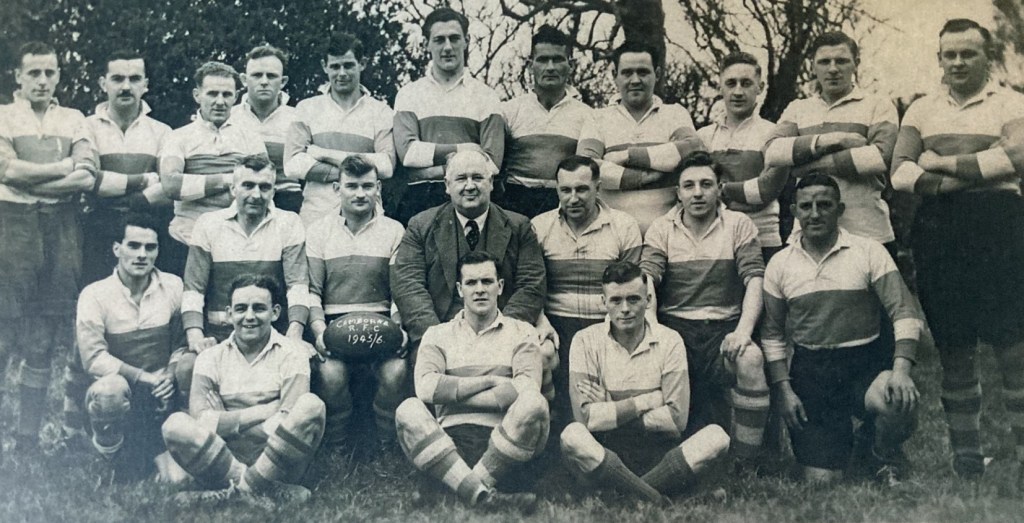
Cornish Sporting Heroes, #3: Richard Pascoe, Saint Piran Cycling

Reading time: 30 minutes

We built something up that was world class. From Cornwall. ~ Richard Pascoe

Alright, rosbif? ~ Bernard Hinault

I meet Richard, or Ricci as he’s known in the cycling world, at the Saint Piran Café and Bike Hire, Bissoe1. Driving from the west, you go through Scorrier, Crofthandy, Wheal Maiden, United Downs and the Bissoe Valley. You’re certainly off the beaten track, and when arriving I was put in mind of the remote cycling hubs you’d normally expect to run across in the Forest of Dean. Though it’s an early morning in March, the place is bustling with dog-walkers, joggers and hardy cyclists. It’s easy to imagine biking one of the numerous trails hereabouts on a hot summer’s day, returning in the early evening when the sun is hitting the numerous picnic tables, and enjoying some well-earned refreshment. (They’re licensed, before you ask.)

From the Saint Piran website

I’ve time to reflect on this because I’m slightly early, and Richard is slightly late. If I’m being honest, I count myself lucky to have secured this interview, because Richard Pascoe is a significant figure in not just Cornish, but British cycling too. He’s a successful businessman; besides the Bissoe venture he’s meeting me at, he’s owned the Bike Chain at Mount Ambrose for 40 years. Soon he’ll also be opening a Saint Piran Service Course store at the old Mining Exchange in Redruth, as part of the Buttermarket redevelopment2.

Think about it: Saint Piran at a mining exchange. You couldn’t be more Cornish if you tried. And Richard Pascoe is all about Cornwall.

But remember I said British cycling. In the early 2020s, Richard’s Saint Piran Pro Cycling outfit was one of only two teams in Britain operating on the UCI Continental Tour (Ineos Grenadiers are two steps above this, at World Tour level). They raced in around 30 events annually and placed 6th on General Classification in the 2023 Tour of Britain. One rider in Richard’s stable, Charlie Tanfield, won the Team Pursuit Silver Medal at the 2024 Paris Olympics. Another, Jack Rootkin-Grey, is now a World Tour rider with EF Education. Richard counts Mark Cavendish and Sir Bradley Wiggins as friends. He’s done charity rides with Stephen Roche. He’s ridden mountains with double Tour de France winner Alberto ‘The Kid’ Contador, whom he later describes as being able to climb ‘like an angel’3.

Now, he’s about to meet me. I’m hardly William Fotheringham or Daniel Friebe, but I am Cornish, and Richard likes my work. Plus, I suspect that, for one reason and another, he isn’t overly keen on being interviewed by Cycling Weekly nowadays. Call it intuition.

In he comes, bringing more hustle and bustle with him, greeting his team, greeting everyone. The man exudes garrulous energy. He sees me, cracks a joke, orders coffee and porridge, and we’re off. But he takes a while to settle. He fidgets. He checks his phone. You get the impression of a man spinning several plates at once, which is understandable because that, metaphorically speaking, is exactly what he’s doing. Gradually, the concerns of the morning shift to the background…

As Laurent Fignon once said, We were young and carefree. Courtesy Richard Pascoe4

A Redruth boy, Richard showed early promise at chess, and as a scrum-half played rugby to a high standard, being coached by Redruth and Cornwall greats Harold Stevens and Terry Pryor. Richard graduated from Lancaster University in the early 1980s with a degree in Management Sciences, but at this stage running a business was far from his mind:

It was to cycle and train harder for another three years…when you’ve got an ambition, follow it. Was it [the degree] a fall-back? Yeah, course it was!

While in Lancashire, Richard joined CC Bowland, and within a year had achieved elite-level racing status. For all his self-deprecation, he clearly had guts and talent. In 1986 he finished 9th in the 94-mile Battle of Sedgemoor, in Somerset. Conditions were so bad only 23 of the 44-strong field finished5:

I wasn’t particularly talented at one thing, but pretty good in most…I could repeat a lot of things. I could continually close a gap, or do a sprint, repeatability was probably one of the good things that I could do. But to be honest, on the big mountain stages, and the climbers were top ten over the mountains, I’d be 12th, or of it was a sprint, the top five sprinters would be first, and I’d be sixth…so always on the edge of things. I had a very talented brain, I could read a race, feel a race, but you’ve got to have the minerals to do it as well.

I did go from third to first category in a year, there were 50 of us in the country at the time out of 10,000 cyclists. But I probably tried stepping up too soon, going abroad…I probably should’ve taken more care and built up more of an endurance base…but you follow your dream, don’t you? You’ve got to live in France and go and race!

The 1980s saw professional cycling, and the Tour de France in particular, become more cosmopolitan. In Britain, Channel 4 began broadcasting the race, a move which coincided with the emergence of several non-continental cycling stars: Sean Kelly, Stephen Roche, Robert Millar, Sean Yates and of course Greg Lemond6:

There were some pretty iconic figures then…but there are some very good characters around now, every year there are exceptional people, world-class people…look at Cavendish, he was media gold, he would say it as it was, and Bradley Wiggins? I’d say we’ve become quite good friends, we’ve had some ups and downs, last year’s Tour of Britain, we probably spent four or five hours together, sitting drinking coffee, talking about life…what a character!

But Lemond…he went to France and spoke English, there was Kelly, there was Roche, I’ve been fortunate enough in my lifetime to become acquainted with some of them, it’s quite nice to share your stories.

Like Lemond, Richard went to France, more precisely Brittany, but came equipped with more than a smattering of the native tongue:

When you’re on a team of young lads, you don’t want to be just saying ‘yes’ or ‘no’ at breakfast…I speak French like a Spanish cow now! I lived with a family, which was great, they were really good to me. I called them my French family, they were well immersed in Brittany, in cycling…eventually I lived in the Palais Saint-Georges [in Rennes], which was effectively the fire station, and literally it looked like Buckingham Palace. I had my own room in the rafters, I think the ceiling height was something like 40 feet, what an impressive room!

Below is an image of Richard’s digs when in Rennes. Small wonder he looks back on that time with fondness:

The Palais-Saint Georges, Rennes, and one its very 1980s residents7
Courtesy Richard Pascoe

He had a career to pursue as well, signing up for CC Rennes, a feeder club for a more prestigious outfit:

They linked straight into La Redoute-Motobécane8…the French system was very interesting, little bit like rugby to a certain extent in Cornwall and the South West, you would have a team attached to a pro team, say five feeder teams, feeding that pro team, and those setups still exist today.

I think we can learn a lot from France, and Belgium. We should be incorporating some of their structure into the UK…on the World stage we’re doing fantastic, domestically I think the scene has got some way to go.

It’s apparent that, no matter where you’re from, one thing counts in professional cycling. How you race:

I was never at the front of the race, when the good guys were riding, I never saw them! But when you’ve grovelled in the gutter, we used to call it riding on the rivets, (‘cos years ago they used to have rivets on the end of saddles), then that makes you one of the brethren. I found, that if you made the effort with the French, they would treat you as family…but they always loved a winner, if you were winning they loved you, and if you weren’t winning…but if you made the effort, and you spoke to people, it’s just human dignity and manners.

Though trying to immerse himself in French culture and the local racing scene, Richard could always count on a familiar face if things got tough:

At the time, we were classed as sort of semi-pros, at one stage we had eight first category cyclists in Cornwall, with a little bit of Devon, out of the 50 in the UK, so that was huge. Danny Deakin was on an elite licence, Gary Bryant from St Austell…Nick Giles lived in Newquay. There was five or six that came through, which was exceptional for a county of this size, but I think that gravitated around what my father [Len Pascoe] did. Then there were pockets of really good people, at Redruth School you had Chris Raine, that set up Redruth Cycling Club, there was 30-40 of us there.

Once you got the schools primed, people take to it. It’s a very individualistic sport, you show a little bit of talent, you then go where the races are, ride better races, then you get selected…so that regional basis was probably as strong as what I’ve known in my lifetime.

So Danny and I were very good friends, we would meet up at a race, and it was amazing. You’d try and skulk at the back and chat, which you couldn’t do, because you had to speak French all the time!

Riders from Kernow CC (left) and Penzance Wheelers on the Mounts Bay Pursuit, 1985. Richard’s late father Len set up many Cornish clubs, mentored thousands of cyclists and founded the English Schools Cycling Association. Image from the Cornish Cycling Archive, Facebook9

Or maybe have a breather. It’s stating the obvious, but professional cycling is one of the most extreme sports on the planet. As Robert Millar said,

Most bike riders at that level aren’t normal human beings. What they are thinking and how they go about what they want to do are not what a normal person would call nice or sane.

William Fotheringham, Bernard Hinault and the Fall and Rise of French Cycling, Yellow Jersey Press, 2015, p161

This was the milieu in which Richard found himself:

You were either full-time, in which case you were in one of the five or six essentially French pro teams, and then if not you were then sitting in one of the feeder structures. So it was almost like a downgrade, you’d be called an elite rider in the UK, it was almost like they’d kick you down [in France] to make you prove yourself. So you’d ride all the place-to-place races, they’re called sort of semi-classics, they’re two steps away from the big stuff, which is your dream.

My first year, I look back, and I think I raced 72 times. So if you think each race was over 100 miles, for four hours, and you were doing three races a week, probably too many! Your races were always 400 miles a week, so 20,000 miles a year, which was your base.

As we’ve learnt, certainly in recent years, it’s about looking at performance, and looking after the individual, it’s not all about the miles.

Richard rode before the use of banned blood-booster EPO became rife in the pro peloton during the 1990s. I fell out of love with the Tour de France in those years because it seemed to me that what I was watching onscreen wasn’t real, it was in some way enhanced, or false. Lance Armstrong, Bjarne Riis, Floyd Landis, Marco Pantani, the Festina scandal…It was only later that, instead of shunning the sport, I tried to understand just why these men took the steps they did, to cheat en masse. The answer lies within the nature of the sport itself, the driven, single-minded nature of the men at cycling’s peak, and the massive financial incentives dangled in front of them. What I found, sadly, is that no generation is entirely clean10.

Lance Armstrong powers away from the peloton to win at Sestrieres in the 1999 Tour de France. Journalist David Walsh watched the events with other reporters: ‘At the moment of Armstrong’s acceleration there was a collective and audible intake of breath and, as he rode clear, there was ironic laughter and shaking of heads.’11

Considering this, Richard is really choosing his words:

It’s really difficult…You’ve got to be good to race at the top level anyway, so whatever you’re doing isn’t going to dramatically change your performance, you still have to have the gene-pool and you have to have the minerals.

It was a time that was…look, it’s a brutal sport, and I’ve seen it as a mentor of world-class cyclists, if you don’t perform, there’s no bread on the table, I’ve seen it as a team owner, if you don’t go to these races, if you don’t get invited to these races, then you’re not going again, then you don’t get the start money, then the team ceases to exist…

I mean, I understand the pressures, I really do, but [the 1990s] were an era where you could see that there were classy people that were, y’know, their performances were starting to become remarkable…it was the appearance of a manufactured state…

But you look at racing now, riders are having two or three good days, and then occasionally a bad day, which is indicative of a more level playing field. [A cyclist’s form] is finite now. Once you’re at that level, it’s how you’re looked after. And the care these days, and the science, it’s absolutely awe-inspiring.

Look, [taking performance-enhancing drugs] is not something I condone obviously, but when I rode…yeah, it happened.

Richard wasn’t in France very long. I was curious to know when he had the moment that every young professional sportsperson dreads: the realisation that I ain’t gonna make it…

The first pedal stroke! With every rider that passes through your hands now, you can more or less see where they are instantly. It’s very hard, because you’ve got somebody that’s worked for years…

You try and train harder, you try and race smarter…but I had a particularly good race, there was six of us in a break, and we had something like a [lead of] a minute and a half, ten miles to go. I’m thinking, Yeah, I’m gonna get top six in a really big race, this is unbelievable. And we were doing 30mph. With the gears that we had, we couldn’t do any more revs, literally maxed out.

And then, we did a mile, and the chalkboard [a motorcyclist displaying a hand-written time gap] came up, it had gone from one minute 30 to 45 seconds! We did another mile, and it was 20 seconds…

We looked behind, and one rider was coming across [from the peloton]. Suddenly I felt a little tap on the shoulder, and I turned around. And it was [Bernard] Hinault, and he said to me something like

‘Alright, rosbif?’

Tap on the shoulder, world-class cyclist, can’t remember where we were riding or what the race was…and…he just rode away from us…

Le patron…Hinault at the centre of a cyclists’ strike in 1978: ‘Before today’s strike, people were asking if the Tour had a boss. Today that was answered. His name is Hinault.’12

You get the sense Richard still can’t quite believe what he saw. Okay, Hinault won the Tour five times and at his peak dominated the peloton like nobody else has managed to do since. But the race where he skinned Richard wasn’t the Tour or, for him, even a major race. No, while Richard and his cohorts had their balls to the wall, Hinault was training.

You just know there’s class, and you can tell classy riders…But the bottom line is, I wasn’t good enough as a cyclist, so I always felt my life was characterised by failure.

To be, in his own words, riding on the rivets, and having the next level laid bare in such a fashion, perhaps told Richard all he needed to know. But he (quite literally) isn’t a man to sit still for long. What he perceived as failure was rapidly turned into an opportunity.

I came up with the business to try and fund my racing, and I was coming up with some innovative stuff at the time. We were making locally, clothing, padded shorts, sales were amazing, we were exporting, doing mail order, funnily enough in Cycling Weekly! We did very well with the mail order, that was growing and growing, exponentially…Lamorna Leisurewear13 used to make the clothing.

Every business needs seed money though:

The Enterprise Allowance Scheme14 made a hell of a bleddy difference at the start. I thought I could race in this country, and run a business – you can’t. You can’t suddenly travel from Cornwall to Newcastle, come back home…Y’know, France, Belgium, that’s where the structure was. You just couldn’t do it [here]. And I suppose my head fell off, in real terms!

We just threw all that ambition into the business, Ricci…And that grew to be quite an animal, quite a size.

Richard was 23 when he opened the Bike Chain. At a time when every other bike shop still seemed to be selling Raleighs or was jumping on the mountain bike bandwagon, Bike Chain was different. European. Continental. Serious. Young and upwardly mobile, Richard was not without his detractors15:

One man said at the time, ‘There’s no money in bikes, you won’t make a success of it,’ which hurt really…It was hard, I was ambitious, I was brash, but if you’re going to stand up and do something, you’ve got to put yourself above the parapet…

People in the Establishment as well, I’ve seen distributors come and go, that wouldn’t supply us, all come and gone. Customers would drive down from Scotland to have a handmade bike, and they still do! We go full circle, we’re building bikes again, we’ve got our own relationship going with some bicycle manufacturers now. Funnily enough, out of all the kerfuffle we had with the team, it taught us who to deal with…

And we’re going to expand, at a time where everywhere else is closing. 

Witness Aldridge’s bike shop in Camborne, which finally closed for business last year. But a shop wasn’t enough for Richard. During the May Bank Holiday of 1988, Redruth closed its streets for a crowd of 4,000 to watch 40 high standard cyclists race pell-mell through the town16. Richard had been the principal organiser:

They told me it couldn’t be done…you only get 10,000 people in Redruth for two reasons. One is a fire, the other is a bike race! It was Redruth Town Council, and I had a conversation with them, and said ‘I want to put a cycle race on in the town centre’, and they said ‘What do you know about cycling?’ So I went along to a Council meeting, they asked me ‘How do you know it’s going to be a success?’ I said, ‘Well, because we’ll run it, there’s no guarantee, but that’s life!’

To their credit, they agreed to underwrite the cost, then we could make it a success. They underwrote £7,500 that first year, which was a lot of money then.  And I think we went into profit in year one. So we got that money back, we closed the streets, two days racing, there was also a road race at Leedstown, then it grew to a time trial on the bypass, and we ran it for seven, eight, nine years…

Malcolm Elliott rode, Dave Rayner rode, some real big hitters…17

Fore Street, Redruth, 1988. From the West Briton, June 2 1988, p29
The Leedstown Road Race, 1992. Courtesy of the Cornish Cycling Archive, Facebook

In the early 1990s, the series of races came to be known as The Celtic Challenge, with Cornish, Irish, Scots, Welsh and Breton riders regularly taking part. Redruth was the only town in the South West to close its streets for bike racing18.

In 1988 a 65-mile sponsored ride from the Bike Chain to Lands End and back raised £600 (£1,640 today) for the British Heart Foundation. In 1990 The Celtic Challenge road race was 85 miles and coincided with the start of the Tour of Britain’s progenitor, the Milk Race, which that year rolled out of Penzance19.

Not 1990, but this shot of the 1992 Milk Race Prologue in Mousehole is too good to leave out. Courtesy Nostalgic Penzance and Newlyn, Facebook

I had imagined Bissoe’s Saint Piran Café, which opened over 25 years ago, to be another step in Richard’s masterplan. A gap in the market, an opportunity

I bought it with my heart, didn’t I? I paid a lot of money for it, but it was part of The Mineral Tramways20, visitor numbers were really low, it was kind of just a stopping place. So I thought we could do a lot with it.

It’s only been in the last few years that I’ve really focused on it. Suddenly we’ve got commercial kitchens, new chefs, breakfast menu, lunch menu, quality produce…We’ve tried to make it a beacon of excellence, but we’re not shouting about it, we’re growing the business organically…

I bought it with real ambition…about 18-20 years ago I took a project to the RDA (Regional Development Agency). The plan was to have five of these in Cornwall: one here, one at the Eden Project, one at Goonhilly, one at Mounts Bay, one at Heartlands. If you’ve got five centres, you start getting people round, you’ve got activity, you’ve got transport, you’ve got health…

I took it to the head of the RDA, who said We’re not giving you the money because you’re in the private sector…that conversation didn’t last long! Typical me!

But The Mineral Tramways are so unrepresented, and yet with a bit of sideways thought, clever investment, you wouldn’t need to spend thousands, they’re old railway lines, mountain bikes’ll roll over them easy, bit of bleddy weeding and you’re done!

So Bissoe was a dream to connect Cornwall, but let’s just develop the facility here and let people come and enjoy it, and get out on their bikes…

Look, we want to keep employment here, we’ve got The Buttermarket, we’ve got The Mining Exchange in two months, and we want to make that a flagship store. We’ll make it work! It’s a high-end concept, but we want to be all things to all people, I want people to be able to buy a mountain bike at a cheap rate and go out cycling. I want both.

Courtesy Richard Pascoe

We’ve got our online presence, which we’re growing. It’s a commercial look this year. We also want to build up the Saint Piran Café as well, and make sure more people come through and enjoy…

And we’ve got one or two really good business projects, we’re developing prototype wheels and a frameset, but all these things take time.

Speaking of bikes, how did the idea to run a professional team germinate?

It was always out of failure…I’d helped to set up clubs, and it all goes through the same pattern, you want people that get involved, they’ve got passion, yet it’s all on a voluntary basis. And that’s like a lot of sport in this country; problem is those people get burnt out in three years, five years, they come and they go…

Big headline: I don’t think there’s any space, at the moment, for volunteers in sport…we should be rewarding our volunteers. We cannot keep relying on them for nothing. Because they fall over, and it’s that falling over that stops the progression of the club. But it happens in every club, no matter what, the direction, the drive, and it can stall because the resources aren’t there.

You set clubs up, and all of a sudden you’re on a committee, and the drive goes…but it should be about the young people, about the progression of talent out of Cornwall, it’s what I’ve always said…

I set up One and All Cycling21, and that was huge. Became one of the biggest clubs in the country, had 400 members, national academies…and then committees get involved, and sadly my DNA doesn’t mix very well…

So I set up the ‘Bike Chain Ricci’ team, obviously based around the business, we had success at the Olympics, great racers, national champions. It [the knowledge] was always there, when I’d raced in this country for CC Bowland, and eight of us in that team were in the top 50 in the country, you learnt what excellence in a team looked like…

Why ‘Saint Piran’?

I wanted something that was clearly connected with the region. I was really lucky, the typeface, the brand, is owned by myself. One and All had come and gone, and I thought, ‘Right, what does something need to look like, if you could start something that was pure at the beginning, with no interference?’

I reached out to [former Team Sky racer] Jon Tiernan-Locke, who’d had a bit of bad press22, talented boy from Devon, and I was driving back from his place in North Cornwall, trying to think of some names, and I saw this sign, think it was for St Tudy…

202023

What about the Cornish tartan?

Don’t ask how much it cost! But now we own it, there’s no issues with copyright or what have you. We got things right with a lot of stuff, and that Cornish tartan looks great. But we were a club team, we were literally a club team, but you’ve got to start somewhere. Build your brand, build your subscription, build the community…

Look, you set up sponsorship on your jersey, and let’s just say you’ve got your accountants, and they help you for two to three years…but after twenty years, you’ve exhausted all your avenues in Cornwall.

So I learnt from the other sports, I thought, plain, classic, everybody wants one, build it into a brand…

I now say that the Saint Piran team was used to build the brand, so we can do lots of things with it, and at the end of the day we’re a local company supporting local people: staff, jobs, employment. We should look at that, focus on that, and make sure that those people are being built up…

Of course, cyclists of all ages and abilities can ride under the Saint Piran banner, and this is what Richard is keen to stress:

What we’re trying to do now is open up, from the bottom. So we’ve got Saint Piran Delivra, which is Cornish for ‘free’. So you can join our cycling club for free. It doesn’t cost you anything to join. No money, no cost, with a host of benefits. You wear the blue jersey, you’re in the organisation, you support the values.

I thought, if you had a UCI team, then a UK elite team and so on, get it all under one umbrella, in-house, that would be a more meaningful structure, with a broad base. Essentially that’s what they do in Belgium and France. It’s what I admire about their system: if you’re in a French feeder team, 1,000 members, 700 of those will be leisure cyclists, 200 fourth category, 80 third, 60 second, 15-20 elite and then maybe one or two pros. But what they do, they all wear the same helmet! So those at the bottom would buy and the top would get for free.

Whereas with our club system in our country, it’s Oh, we don’t do that. We don’t buy into the reward schemes, we don’t buy into it collectively, but I think it’s a great model. So why don’t we incorporate that into our structure? Which is what I did…

So if you’ve got everything under the one structure, it is about the ones that are making it through to the top…Oh, but that’s not fair, what about inclusion?…But there’s no cost to join us, so it is all-inclusive, there’s no barrier.

The scale of the operation, and the challenges faced by Richard and his team to get the project off the ground, and achieve what they did with the resources they had, are staggering:

We were innovative, we would try and do things, on a budget that was incomparable. When you’re spending your own money, you think smart!

Budget: all in, for everything, a million pounds. For everything. Vehicles, hotels, race entries, riders, it’s just…and you think, if you look at UAE, or Ineos, or anybody, they’re probably operating on £50-100 million disposable, because they’ve already got the vehicles etc…

We built something up that was world class. From Cornwall. You’re saddened that it’s not there at the moment…the infrastructure’s there, the knowledge…it’s all there

We would race in Belgium on a Sunday. You can’t really train properly again until Wednesday morning, time you travelled overnight Monday, you’re absolutely mullered on Tuesday, can’t do nothing till Wednesday! Whereas the World Tour teams, straight in the hotel, sleep there, ride the next day…it’s rest, rest is the problem.

Life as part of a pro cycling team has its perks. Here Richard’s son Lowen meets some bloke called Cavendish.
At the Tour of Britain, Richard ensures the sponsor is in shot. Courtesy Richard Pascoe

To give more perspective, in the early 2020s Saint Piran was one of only two UCI continental teams operating in the UK. The other was Trinity Racing, run by Andrew McQuaid24.

I love him – he’s a team owner! Of course there was healthy rivalry, any domestic race in the UK, we smashed his riders, which was great! But he had a better programme, they rode the Baby Giro [the U23 Giro d’Italia] for Christ’s sake! He knew what he was doing, he was an agent too, so if his riders made it, he was getting paid, so it was self-fulfilling. He gave me one piece of advice:

Never trust anybody in cycling..!

Rivalry’s good. You need rivalry, but once you’re on the continent, you work together. If one of their riders needs a bottle, or food, you just do it.

But he’s had to stop this year because you can’t fund it in the UK. His way was by selling advertising, ours was more inclusive, we needed everybody, the media, the magazines, and sadly we didn’t get everybody.

Formed in 2018 as an Elite National team, by 2021 Saint Piran had progressed to the UCI Continental level. Next steps were UCI Pro, then UCI World, and UCI World means the Tour de France. In his mind’s eye, Richard was catching up with Bernard Hinault. In 2021 Tom Mazzone won the Grand Prix de la Somme. In 2022 Alexander Richardson won the Grand Prix de la ville de Nogent-sur-Oise. Saint Piran held all three podium places of the prestigious Lincoln Grand Prix in 2023. In 2024 they took a stage of the Tour of Japan25.

Josh Ludman, stage 4 winner, Tour of Japan. Courtesy Richard Pascoe

In the 2023 Tour of Britain, Zeb Kyffin finished sixth on General Classification. He was 23 seconds behind overall winner Wout van Aert which, if you know your cycling, gives you some idea of the standards Saint Piran had reached26. I followed the 2024 Tour of Britain religiously, and was bellowing at my screen right along with a certain Team Principal:

A picture you can actually hear. Courtesy Richard Pascoe

Yet by November 2024, it was all over. The Pro and Women’s Elite teams would not be lining up in 2025.

Read the official statement here

In June 2022, bikes totalling £30K were stolen from a Saint Piran team vehicle in the Netherlands. As Richard said at the time,

Teams such as ours, particularly at a continental level, cannot afford to sustain these losses.

Cycling Weekly, June 21 202227

Later that year, it was reported that Saint Piran had engaged lawyers to recover £100K in costs from bike manufacturer Lapierre. The firm had issued 60 machines to Saint Piran, but the team stated that these bikes were ‘potentially susceptible to failure’, and therefore declined to use them28.

Forced to look elsewhere for bikes, Saint Piran sourced machines from China. In October 2024, an article in Cycling Weekly, which was subsequently picked up by Cycling News claimed Saint Piran were using frames that were not UCI-approved – the Chinese frames. More damningly, it claimed the Team had tried to disguise this by fixing UCI stickers to the bikes themselves29.

Richard was quoted in the Cycling Weekly article:

Saint Piran acted on the advice of the manufacturer and an external expert and understood they were in line with UCI regulations at all times. It appears that advice was incorrect. We have now reported this to the UCI and will abide by their ruling.

Cycling Weekly, October 17 2024

The UCI made the following statement:

The UCI can confirm that an investigation is currently underway regarding the potential use of a non-homologated frameset by UCI Continental team Saint Piran in past events on the UCI International Calendar.

Cycling News, October 17 202430

Due to these reports, and the ensuing investigation, Saint Piran rapidly lost £500K in sponsorship. Chickenfeed to a team like Lotto-Soudal, but when your budget is only £1M, it effectively broke Saint Piran. Where does Richard sit with all this?

Because you’re under investigation, it’s hard to go for a licence. We’re in disciplinary now. We didn’t register some black frames. Was it our responsibility to? Yes. Our team representative that we had at the time hadn’t registered them. We bought them off a wholesaler who bought them off a manufacturer. The manufacturer per se should have had the dialogue with [the UCI], but it was post-Covid and we were on those bikes because the Lapierre machines failed.

They’ll probably say, Look, this wasn’t great, and there’ll have to be ratification, but we all make mistakes in whatever process you’re doing, and we wouldn’t have made that mistake if the [Lapierre] machines hadn’t failed on us. We were trying to race UCI races, and if you don’t meet those obligations, you get fined! I reckon it’ll take the length of this year, then we can have a fresh optic for 2026.

We had a great sponsorship arrangement with Lapierre [in 2022], and the bikes failed. And bizarrely enough, five weeks ago, they’ve done a worldwide recall on the bikes.

In January of this year, Lapierre recalled the very models Saint Piran had claimed were faulty back in 202231.

Richard is taking all this on the chin – he readily admits an error was made. What rankles is the presentation of him and Saint Piran in the media:

To lose that momentum because of an article, it shows the power of the media. But bizarrely that very same magazine is supposed to be promoting cycling within the UK. Taking away 20 riders, six staff, £500K in sponsors, overnight…

I used to spend £100K a year with Cycling Weekly, and later on they write some very dubious reports. How can you be in the cycling industry, that’s supposed to be about the benefit of sport, and write an article that helps destroy a team?

Indeed, he claims the closure of Saint Piran was

Pump-primed by the media. It’s tinged with quite a bit of sadness really. We were looking at a bigger budget, getting more sponsors in, you’re trying to set something up, you’re trying to pass it on to the next generation. That was our next step, this year, we had riders under contract that were absolutely phenomenal. We would have gone up, and we were sustainable.

What’s done is done. Is there a way back for Saint Piran Pro Cycling?

Not running a professional cycling team, I’ve suddenly got 70 hours a week back! We’ve got some very healthy conversations going on currently, and I need to decide whether I return to the sport, and in what format. But there has to be a change in the way certain things are done.

There would have to be conditions, to protect myself and my family. I had a car accident last year, my father was dying, we were moving house, and the business pressures…it’s been a year! I think you need your media partners onside…it’s there, and the knowledge is there, but it has to be done with certain conditions, because otherwise you’re sacrificing your own personal health.

Saint Piran were ranked among the top 50 cycling teams in the world. When you see that, you think, wow, all that happened from little old Cornwall…

Let’s all hope it happens again soon.

(If you missed my previous Cornish Sporting Hero, Rugby League star Graham Paul, click here.)

Many thanks for reading; follow this link for more top blogs on all things Cornwallhttps://blog.feedspot.com/cornwall_blogs/

Do you enjoy my work?

All content on my website is absolutely FREE. However managing and researching my blog is costly! Please donate a small sum to help me produce more fascinating tales from Cornwall’s past!

£5.00
£10.00
£15.00

Your contribution is greatly appreciated.

Donate

References

  1. I highly recommend: https://saintpirancafe.com/
  2. For more on The Buttermarket, see: https://www.buttermarket.org/. See the Saint Piran press release here: https://saintpiranprocycling.com/news-stories/2025/2/26/saint-piran-service-course-to-open-new-cycling-hub-in-redruths-historic-mining-exchange
  3. For more on Charlie Tanfield, see: https://saintpiranprocycling.com/news-stories/2024/1/20/define-redemption-lets-talk-about-charlie-tanfield-. For more on Jack Rootkin-Gray, go to: https://en.wikipedia.org/wiki/Jack_Rootkin-Gray. Stephen Roche is one of only three riders (the other two being Eddie Merckx and Tadej Pogacar) to win the Tour de France, Giro d’Italia and the World Championship Road Race in the same year (1987): https://en.wikipedia.org/wiki/Stephen_Roche. For more on Contador, see: https://en.wikipedia.org/wiki/Alberto_Contador
  4. In fact, it’s the title of Fignon’s fascinating autobiography: We Were Young and Carefree, Yellow Jersey Press, 2010.
  5. Bristol Evening Post, August 5 1986, p31.
  6. For more on the rise of British involvement in the Tour de France, see William Fotheringham’s Roule Britannia: A History of Britons in the Tour de France, Yellow Jersey Press, 2005.
  7. Image from: https://en.wikipedia.org/wiki/Saint_George_Palace
  8. See: https://en.wikipedia.org/wiki/La_Redoute_(cycling_team)
  9. Len Pascoe passed away earlier this year: https://www.falmouthpacket.co.uk/educationservices/fpeducationschools/24998255.funeral-cornish-cycling-legend-len-pascoe-redruth/
  10. There’s a whole sub-genre of cycling literature that examines the use of drugs in the sport. I recommend: Put Me Back on My Bike: In Search of Tom Simpson, by William Fotheringham; The Secret Race: Inside the Hidden World of the Tour de France, by Tyler Hamilton; Racing Through the Dark, by David Millar; The Death of Marco Pantani, by Matt Rendell; and Seven Deadly Sins: My Pursuit of Lance Armstrong, by David Walsh.
  11. David Walsh, Seven Deadly Sins: My Pursuit of Lance Armstrong, Simon & Schuster, 2012, p65. Image from: https://pezcyclingnews.com/features/armstrong-contador-what-really-happened/
  12. Quote from: William Fotheringham, Bernard Hinault and the Fall and Rise of French Cycling, Yellow Jersey Press, 2015, p91. Image from: https://bikeretrogrouch.blogspot.com/2015/07/badger-badass-bernard-hinault.html
  13. This company sadly went bust in 2013: https://www.thegazette.co.uk/notice/L-56622-242
  14. For more on the Scheme, see: https://en.wikipedia.org/wiki/Enterprise_Allowance_Scheme
  15. Even the Cornish Press flagged up Richard’s youth: West Briton, December 3 1987, p8.
  16. West Briton, June 2 1988, p29.
  17. For more on Malcolm Elliott and Dave Rayner, see: https://en.wikipedia.org/wiki/Malcolm_Elliott, https://en.wikipedia.org/wiki/Dave_Rayner_(cyclist)
  18. West Briton, March 29 1990, p4; May 23 1991, p7.
  19. West Briton, March 17 1988, p12; February 8 1990, p19.
  20. Fore more information on The Mineral Tramways, see: https://www.cornwall.gov.uk/environment/countryside/cycle-routes-and-trails/the-mineral-tramways/
  21. See: https://www.oneandallcycling.com/
  22. See: https://en.wikipedia.org/wiki/Jonathan_Tiernan-Locke
  23. Image from: Image from: https://saintpiranprocycling.com/news-stories/2020/3/9/saint-piran-2020-team-launch
  24. See: https://trinityracing.co.uk/
  25. Information from: https://en.wikipedia.org/wiki/Saint_Piran_(cycling_team)
  26. For the 2023 Tour of Britain, see: https://en.wikipedia.org/wiki/Saint_Piran_(cycling_team). Wout van Aert rides for Team Jumbo-Visma and has won stages of the Tour de France: https://en.wikipedia.org/wiki/Wout_van_Aert
  27. Article here: https://www.cyclingweekly.com/racing/british-racing/tens-of-thousands-of-pounds-of-bikes-stolen-from-saint-piran-team
  28. Article here: https://www.cyclingweekly.com/news/british-team-saint-piran-and-lapierre-uk-distributor-call-in-lawyers-over-pound100000-dispute
  29. See the articles at: https://www.cyclingweekly.com/racing/exclusive-british-professional-team-glued-fake-uci-compliance-stickers-to-bikes-purchased-from-china; https://www.cyclingnews.com/news/british-continental-team-saint-piran-admit-to-faking-uci-approval-for-unmarked-chinese-frames/
  30. From: https://www.cyclingnews.com/news/british-continental-team-saint-piran-admit-to-faking-uci-approval-for-unmarked-chinese-frames/
  31. See: https://www.cyclingweekly.com/news/lapierre-issues-stop-ride-notice-and-recalls-aircode-drs-and-xelius-sl3-over-safety-issue-with-fork

Cornish Sporting Heroes, #2: Graham Paul, Rugby League Star

Reading time: 30 minutes

A working-class hero is something to be ~ John Lennon

You done okay, but you’ve come out of Daniel Place, and they’re never going to let you forget it. ~ Graham Paul

Graham was born on June 6, 1934 and brought up at Daniel Place, just off Morrab Road in Penzance. His earliest rugby memory is the amalgamation of deadly rivals Penzance RFC and Newlyn RFC in 1945:

Was there any friction? There wasn’t. My explanation for it is, it was 1945, all these guys had been away in the services, and that brought them together…also, fortunately the Mennaye Field was available, and it’s mostly in Penzance but some of it’s on the Newlyn side, so that was ideal…

His father, Arnold, worked for the local laundry. Apart from a spell in the Army, this was a job he held his entire life. His mother, May, ran the household, raising Graham and his two siblings:

It was a whole row of terraced houses, little houses. Each house had a kitchen, a middle room, and a front room. Upstairs there were three bedrooms. No bathroom, there was no water of any description in there, the water was a tap in the back yard, also the toilet was in the back yard outside…there was mother, father, me, my sister, my brother Trevor, and my granny, all living there. It was chaos! I look back on it and I just can’t believe it.

Daniel Place in the 1930s. Courtesy Jim Thompson, Facebook

The outcome, really, was that I left home at 17. I’d had enough! I was in the grammar school, got to 17 and father said to me, you’ve gotta get out and work. All my friends were going off to college, but father wouldn’t entertain that. So what I did was, I went to Redruth, I went into the RAF recruitment centre, and I joined the RAF…this was in October, November time [1951], they said we can’t take you until you’re 17 and a half! So I left home on the 25th of January [1952], went into the RAF, never lived at home again. Never!

By now, Helena and I were courting, she was still at school, and the way we met was, I had to do this period from September through to January, and father said you can go back to school. So I went in, went to see the headmaster, explained the situation, so he said what’re you going to be the in the RAF?, so I said a PTI [Physical Training Instructor], so he said how about you go and work in the gym?, so I said, great! The Boys’ School and the Girls’ School decided for the first time ever to get together and produce a show, it was by Benjamin Britten, and the gymnasium was to be the theatre, so I was down there painting scenery for the opera, Helena came down, she was domestic science, she was helping make the costumes, and that’s how we met, pure fluke!

By now, there was no room for Graham at Daniel Place. On leave or at weekends he would stay at Helena’s parents’ spacious B&B in St Ives.

When I left home, my father gave me two and ten, that’s what I left home with, that was the only money I ever got! Alright, it doesn’t sound very much now, but two pounds and ten shillings then was probably half of his week’s wages!

Pirates’ Colts, 1949-50. Graham (with horse) is seated second left. Courtesy Phil Westren

Still in his teens, Graham had to adjust to life away from home. His sporting ability helped him settle:

I went to the RAF School, PT School, which was just outside of Wolverhampton, and one of the sergeants there played scrum-half for Wolverhampton, and he said d’you want a game of rugby, so I played three games, and that was my first introduction to senior rugby. Up to that stage I’d only played in the U16s at Penzance, and then for a bit in the U18s.

I played three games at fly-half and I thought, I like it out here, and that’s really what changed the way I played, up till then I’d always been a scrum-half.

Hard to comprehend is how rugby union was played then, but Graham found an attacking method to suit:

It was a totally different game to what we watch now. In those days you had a big pack of forwards that won the ball, and gave it to the backs. And the forwards didn’t do anything else, basically! Win the ball, get it to the backs, and the backs scored the points! So, what I found was, particularly later in my career, I could take the ball, give it, drop around behind, and support anybody that was breaking…I was never, ever a great defender! I just wasn’t big enough! The forwards stuck to their job, and the rest of the pitch was left to the backs, so there was space everywhere.

Helena went to college, she did three years at Stafford. So while I was at various places in the RAF, I could always make my way over to Stafford for half term and whatnot.

Graham was first stationed at RAF Upwood in Cambridgeshire and was invited to play for Bedford RFC. However, an incident involving a horse wrecking a biplane he was supposed to be guarding and the subsequent fallout (Graham was cleared of any neglect of duty, but his superior officer wasn’t), meant he was swiftly transferred to RAF Waddington, near Lincoln. There, he had two seasons with Nottingham RFC:

I had the time of my life! As my game developed in Nottingham, it came to the light of the RAF, and I ended up playing for Bomber Command, and then I played for the RAF. Then the RAF themselves decided my rugby career would be better served if I was down in Cornwall, so the RAF sent me down to St Mawgan, so I could play for The Pirates, and hopefully play for Cornwall!

Being in the RAF, Graham came into contact with a form of rugby not normally witnessed in Cornwall:

Playing for the RAF, I met a lot of Rugby League players, good players, who were doing their National Service. Alex Murphy was one of them, probably one of the most famous Rugby League players of all time1, he did everything in the game. He was in the RAF, and he had a deal with them, if they allowed him to play for St Helens, he would play in the inter-service games [Union] for the RAF, and that’s why I never got an inter-service game. Alex always got the inter-service games! Years later, in my very early days at Hull KR, we played St Helens away, and Alex was playing opposite me, he came out of a maul, screaming, and the packs just piled into one another! I’m standing looking at this, thinking, should I get involved?, and I started to move in, and Alex ran, put his arm round my shoulder, he said ‘This is f___ all to do with us!’

Once back with Penzance-Newlyn, Graham formed a formidable partnership on the pitch with scrum-half Peter Michell, who sadly died aged 90 in 2023:

Peter Michell would play over 500 games for the Pirates, and win over 50 Cornwall caps. He represented Cornwall and Devon against the 1960-61 Springboks, and South West Counties against the 1963-64 All Blacks. Courtesy Phil Westren
Peter in action against Lancashire in 1958. From Cornish Stuff

We came from totally different backgrounds, his background was a big house in Heamoor, which had a tennis court…very very wealthy family, Michell’s the jewellers, but Peter had no side to him, Peter was great, he got me on a sevens team once, The Public School Wanderers, in the Twickenham Sevens!

After sharing the bridal suite of a hotel in Bagshot, Peter, Graham and the other Wanderers were knocked out in the first round. Chalk and cheese, the two Pirates men were close friends:

Peter could do three things on a rugby pitch: one is catching the ball, two is kicking, and third was the way he passed the ball…but he never ran five yards! So I was out there waiting, and basically he was either going to kick it, or pass it. And the passing was good, it was always right there…

Here Graham indicates where Peter, without fail, would deliver him the ball: right in front of his stomach, at elbows-length – where every player wants to receive a pass.

Playing for the RAF, I’d never played with a scrum-half who could run, until I played with Onllwyn Brace, Welsh scrum-half who was in the RAF at the time…I played with Onllwyn several games, and found once you had a running scrum-half, it gave you a lot more room, it would suck people in…

For all his flair, Brace2 was probably the exception rather than the rule. In Cornwall, 1950s rugby is remembered chiefly for its powerful, intimidating forwards, such as Redruth’s Bonzo Johns or Camborne’s Gary Harris. But who was the toughest?

Vic Roberts. He was as hard as any of them. He wasn’t the biggest by a long way, a lot of them were just throwing their weight around, but Vic was amazing. He would pick people twice his size, and flatten them! He was ferocious!

Vic Roberts (1924-2004), a flanker who played club rugby for Penryn and Harlequins. He represented Cornwall on 45 occasions, won 16 England caps, and toured with the 1950 British Lions3

As my late uncle John had been a massive fan, I felt honour-bound to ask Graham about Camborne’s Gary Harris. His response gave an evocative window on how the game was played back then:

It was a funny set-up in those days, d’you know, forwards and backs, you’re on the same team, but you never really mixed. You tended to mix just with the people that are with you on the field. Hey, those guys just get the ball and give it to you, that’s their job, forget them…there was no real interaction.

Forwards always trained together, scrummaging, lineout, that was their game, and the backs trained together. You very rarely trained as a team. You trained as two units with a job to do.

Cornwall [for the 1958 Championship] would train on a Sunday. That was it. Everybody was working, everybody had jobs…the situation when I was there, the full-back, came from St Ives, Harold Stevens, lovely guy, he actually became a pastor, and if we met on a Sunday, to train, we had to go to the chapel first! We had to go through the morning service in the chapel, and then we could train in the afternoon. But he insisted the whole team went to the chapel first.

Harold Stevens (d. 2014). He played club rugby for St Ives and Redruth, winning 60 Cornwall caps. He also played for Cornwall and Devon against the All Blacks in 1953, the Wallabies in 1958 and the Springboks in 19604

The image of the entire Cornwall XV kneeling in prayer before training because their skipper for the 1957-8 season happened to be a man of the cloth is irresistible.

Graham debuted against Gloucestershire in October 1957, Cornwall winning 15-6. His play was praised in the Press as a

…revelation. He took his chance in fine style.

Daily News (London), October 14 1957, p10

Not only that, two England selectors were watching. But Graham plays down any international ambitions he may have had:

The only reason I was in the team, was Richard Sharp broke his arm…in my mind, I could see the selectors thinking, Who’s Peter Michell’s partner for Penzance? That guy Paul, we’ll have him…I consider I got in that team on the back of being Peter Michell’s partner. But having got in there, I thought this isn’t going to last, I’m having a bit of fun! I played as if I didn’t care a toss!

That season [1957-8], I played every fixture, I absolutely we thought we could do it, particularly going into the semi-final against Lancashire. Harold Stevens came to me before the game, ‘Quick word, I think we can beat them in the pack. The problem is the threequarters, they’re really good. I want you cut [the Lancashire fly-half] Bev Risman off. I want you to get up flat to him, get between him and the backs’…There was actually a comment in the ‘paper about my inability to tackle Risman…what invariably happened was, just occasionally he got a kick in, but he would usually turn back inside me, and our openside flanker, played for Harlequins, David Mills, he would come up and flatten him!

A Camborne man, David Mills won nine caps for Cornwall. He played for Clifton, Harlequins and represented Cambridge in the 1958 Varsity Match. Image courtesy Phil Westren
Bev Risman (1937-2023) represented England and the British Lions before switching codes. He eventually represented Great Britain in Rugby League5

It worked. An estimated crowd of 13-20,000 at Redruth RFC saw Cornwall beat Lancashire 14-8. The Liverpool Daily Post reckoned the heavily partisan crowd was worth at least three points for Cornwall6, and Graham’s memories give some impression of what the atmosphere must have been like:

They actually built a huge stand on the other side of Redruth ground, it was built over in the field, behind…

In other words, you had two stands in Redruth that day, the Hellfire stand and the temporary one on the opposite side of the pitch. For Lancashire, there was to be no escape. This victory set up the Final on March 8 against Warwickshire, at Coventry.

Two things I distinctly remember, the first one is, we stayed at the Leofric Hotel, which was built after the War, it was the first hotel I’d ever stayed in where every room had a bathroom suite!

Second, the morning of the game, Peter and I woke up (we were in the same room together) and went down for breakfast, and Peter said, ‘I can hear singing, what the hell’s that?’ We went and looked outside, all the Cornwall supporters were there singing Trelawny.

Helena was expecting, and when I left to join up with the Cornwall team, she said to me, ‘Go, play your rugby, don’t bother getting in touch until after.’ And when the game was all over, Peter Michell went and rang Helena, and she was in labour! John was born the morning after!

5,000 Cornish fans made their presence felt in Coventry. The young man under the pasty-wielding lad’s left leg is Claude Brian Stevens. For Penzance-Newlyn, Cornwall and England he would be better known as ‘Stack’ Stevens. Image courtesy Phil Westren7

At half-time, Cornwall were 5-0 up:

The first quarter of an hour, we were up on their 25, and Peter got the ball and flashed it to me, it was a bleddy awful pass, bleddy awful, it almost went behind me, I got the ball, and I’m going back almost to get it, very rare for Peter, and as I straightened up, the openside wing forward went where I should have been, he went past me, and I just ran inside him, looked left, Vic Roberts was the blindside, he was coming down the touchline, I gave him the ball, he went over and scored…

Vic Roberts crashes over. Courtesy Phil Westren

Lest we forget, this was long before VAR…

Years and years later, Cornwall won the Championship, first time for a number of years [1991]. The team that I played in was invited to the Final. We were given expenses, seats, everything, even had a hospitality suite…it was amazing! Virtually all the Cornwall players were there, but no Vic Roberts. I wondered, where the hell is he, he’d gone down to the President’s suite. I went into the room and, in the left-hand corner of the bar, was Vic, having a drink with a couple of others. He saw me come in, and he shouted ‘Hey, Graham, come here!’ You’ve gotta remember that he’d captained England, Lions, he’d done everything, played thousands of games of rugby, and as I walked towards him, he said,

‘That was a bleddy forward pass, you know’. And it was! Nobody saw it, well actually everybody saw it, ‘cept the referee…

(Graham’s other favourite memory of the 1991 Final at Twickenham is overhearing the Duke of Edinburgh ask one of his aides what the mass of security guards were attempting to do with the thousands of Cornish fans invading the pitch. ‘They’re sweeping the pitch, Sir’, the aide said to His Highness. ‘Is that for mines?’, queried the Duke…)

Graham (right) ready to receive the ball as wing John Morgan and a Warwickshire player get up close and personal. The game is remembered as one of the roughest Finals ever played. Image from the Daily Mirror, March 10 1958, p23

Back in 1958, there was a feeling that five points wasn’t enough…

It was worrying, because we’d got so many injuries, Roger limping on the wing, and our prop, Alan Mitchell, he’d had a back knock, he ended up going to hospital. So we were concerned, but I don’t think we ever thought we were going to win.

General consensus is that this was one of the hardest Finals in Championship history. A Camborne man, Terry Symons, was in the crowd that day and recalls seeing Vic Roberts and David Mills collide early on, effectively neutralising both of them. Back in Camborne after the match, he bumped into Gary Harris, with his face ‘scrawled’ up. Harris had carried the Cornish front five single-handedly, and it showed. Several Camborne fans reckon he was never the same player again.

Roger Hosen, a centre for Penryn, Nottingham and England, spent most of the game hidden on the wing with his thigh heavily strapped. In the days before substitutions, Alan Mitchell played on with a broken jaw. Make no mistake, Cornwall were tough, but Warwickshire’s pack were a step up. Cornwall needed to score early in the second half. Graham attempted two snap drop goals8:

The first, I was totally off-balance, they were the only times when I’d pre-thought the drop-goal, which I’d never done before…and I got the ball, had a knock at the same time, and that happened twice…

Graham claps his hands in disgust. Warwickshire gradually took control, their ‘mighty steam-roller pack’ overwhelming Cornwall’s to win 16-89. But they didn’t have it all their own way:

You know what the Cornish supporters are like when they’re wound up…but really you were too involved in the game, your job is on the field…I can’t remember looking at them [the crowd], or thinking about them, you can’t!

We accepted the fact they were probably a better team than us anyway…this was the first time Cornwall had got to the Final in God knows how many years [1928], we were pretty pleased with ourselves having got there!

Cornwall, 1958. Back, l to r: G Riches (linesman), David Mills (Harlequins), Kenny Abrahams (Redruth), Alan Mitchell (Redruth), John Phillips (Redruth), Gary Harris (Camborne), Alvin Williams (Penzance-Newlyn), Jimmy Jenkin (Penzance-Newlyn), E Barnes (referee). Middle, l to r: Gerald Luke (Penzance-Newlyn), John Morgan (Falmouth), Vic Roberts (Penryn), J Richards (President), Harold Stevens (Capt, Redruth), Roger Hosen (Penryn), Charles ‘Bonzo’ Johns (Redruth). Front, l to r: Graham Paul, Peter Michell (both Penzance-Newlyn). Image courtesy Phil Westren

Much was made in the national Press of Cornwall’s unruly, partisan support, but we might do well to remember that in Cornwall itself, its XV’s exploits were met with indifference east of Truro. The Cornish Guardian, produced in soccer-dominated North Cornwall, devoted one meagre paragraph to the Final10. One only has to consider the handful of clubs the XV was picked from (above) to conclude this was essentially a team from West Cornwall.

Graham obviously had the temperament for a big game. He was 23, at his peak, and three England selectors had watched the Final11. One reporter noted his quick feet when on the attack12, but when I asked if he considered himself close to international honours, the answer is firm:

No. I didn’t have the background. You done okay, but you’ve come out of Daniel Place, and they’re never going to let you forget it.

His main competitor at the time for the 10 jersey was Richard Sharp, himself no slouch. But Sharp himself knew who the better man was:

Graham Paul was the fly-half and was considered the key member of the side so there was no question of an alternative.

Winning Rugby, Pelham Books, 1968, p30

(Graham himself says Sharp’s statement was ‘very generous’.)

Graham has gone on record elsewhere regarding his thoughts on the RFU’s perceived selection policy at the time. In 2008, he spoke of Mike Blackmore, a Barnstaple wing who also signed for Hull KR, and played with Graham in the 1964 Challenge Cup Final:

Like me, Mike was from what you might call a modest background and it always seemed to be someone from the establishment who was selected…Background counted for a lot in those days and I think that was one of the main reasons he switched.

Independent, February 20 200813

In his living room, Graham continues:

Mike was a good player, his background was certainly better than mine, but wasn’t right up in the top bracket, and the other thing was, they [Hull KR] offered him a lot of money!

Graham may have a point. Mike Blackmore captained Devon in three County Championship Finals, and had had five England trials by the time he was 22. It’s hard not to reach the conclusion that Mike’s secondary modern education would forever count against him where the RFU were concerned. Small wonder he signed for Hull KR14.

It was at this time, around March 1958, that Graham found himself at a crossroads. He would shortly be leaving the RAF, having served his time.

Graham hands me a letter. It’s an old, important letter. In fact, it’s a very important letter. Ultimately, it changed Graham and Helena’s lives.

When I was leaving the RAF, it became pretty common knowledge in the rugby world, and that I was looking for something or other. Bedford wrote to me, and this is the letter…

It’s dated March 18, 1958, ten days after the County Final, and is from Peter Perkins, the Chairman of Bedford RFC
The text reads: Dear Graham, There is a job going, at the Silver Jubilee School here, for a man to take charge of the gym, when the school re-opens in September. If you are interested, we could probably help quite a bit; and it would be nice to have you here again.

The implication is clear: come back to play for Bedford RFC, and we’ll see you right. Technically, under the RFU’s amateur regulations this was an offence, albeit one of the more flouted ones. But that didn’t perturb Graham:

I rang him [Perkins] up, and spoke to him on the ‘phone, and said to him, ‘This is all very well, but I’ve got a young wife and a son. Where are we going to live?’ And he said, ‘That’s no problem, you’ll get a house.’ But that was off the top of his head!

So I went to the Pirates, and I took that letter, and I showed it to the Treasurer of the Pirates, and I said to him that I’d been offered a house too, and asked him, ‘What’s on the cards for me, here?’ And he said, ‘Nothing, we can’t get involved.’

And that’s what sent me to Rugby League.

Graham didn’t need to make enquiries about switching. Even if he had, and those enquiries reached the wrong ears, he would have faced suspension from the RFU. The rugby grapevine was strong enough to be heard further north than Bedford, and did all the work for him…

There was a guy called Fairfax, he was Welsh, and he was an agent for several Rugby League clubs. I don’t know if that’s his real name even! He came to me and said, ‘Would you be interested in Rugby League?’ He came to me out of the blue…he phoned me, then came to see me. He said there were three clubs he worked for: Halifax, Wigan and Hull KR. He said, ‘Which one interests you most?’ So I said, ‘Not, Wigan, if I go Wigan, I’ll have to be a star overnight, and I’m going to have to learn this game.’ Of the other two, I said either one, and he went to Halifax, and apparently Halifax said no, we don’t need another stand-off half, we’ve got two! So, he went to Rovers, and the rest is history…

The historian Tony Collins told me that Arthur Fairfax was a top League scout in Wales and the South West. He signed Roy Francis for Wigan in the 1930s, and tried to procure Carwyn James for Halifax in the 1950s.

Fairfax had come to see me in Newquay, and then we arranged to meet in Hull, and he took me to Rovers. Would you believe, he had a fee, he was expecting a fee, and I said to him, ‘I am going to negotiate my terms, not you, you’ll get your money, but I’m negotiating the terms.’ What I didn’t want was him going in there blabbing big this and big that, I just went in there and said, ‘Look, you’ve seen me, what’s on the table?’

Hull KR had certainly seen Graham in action. On November 8, 1958, the Club’s directors had travelled to Bristol to watch Gloucestershire beat Cornwall 8-6. Scoreline notwithstanding, they obviously thought Graham a useful prospect15.

They came up with £1000, I came up with £2000, and we met in the middle!

As Graham told the Hull Daily Mail in 1991, this was

…an offer I couldn’t refuse.

January 1 1991, p12

Indeed, he and Helena were set for life:

How many people can say, they’ve never had a mortgage, or never had anything on hire-purchase? Never! And the basis for that was signing for Hull KR. They gave me a cheque for £1500 [£29,900 in 2024]…it was quite demanding at the time, selling up here, and moving up there…they [Hull KR] fixed me up with a flat, which strangely enough was over a fish shop! It was a bit smelly but okay for a while. It was also thankyou to Rovers that I got in the licence trade, because when I first got there they said, ‘We’ll find you a job…you’re going to be a car salesman.’ I said, ‘I beg your pardon?’ I couldn’t even drive a bleddy car!

And the level of secrecy?

Huge! Absolutely huge! One person knew what was going on, Helena, nobody else. Not my mum, my dad, nobody. I signed for Rovers, and I had a deal with them, that they wouldn’t release the news to the Press, they would let me go one last game for the Pirates [Graham’s 100th match], and that last game was Penryn away.

I played the game, I enjoyed it, and I’m walking off, and Peter was just ahead of me, and I caught up with him, put an arm around him and said, ‘Quick word, Peter…that’s our last game together.’ And he just stopped, and said ‘What? What are you talking about?’ So I said, ‘I’m telling you this, what you want to do with it, it’s up to you, but I’m going to play Rugby League for Hull Kingston Rovers, it’s signed and dealed, this is our last game.’

Peter said, ‘Can I tell everybody?’ And we went in the changing room, and he stopped everything that was going on, and he said ‘Stop! Graham’s just played his last game for us, he’s now a professional Rugby League player, he’s going to Hull Kingston Rovers.’

And there was a second of silence, and then ‘WOW!’

Nobody held it against me. Only thing was, word got to one or two supporters, and they’d told my father back at the Club, he knew! When I got back to the Club, he saw me and said, ‘What the hell have you done now?’

Hull KR’s latest signing, November 1958. Courtesy Phil Westren

Of course, the Pirates’ fans, Graham’s family and fellow players had nothing but admiration for his switching codes. One team-mate (and fellow 1958 Finalist) who certainly didn’t object was Jimmy Jenkin, who signed for Hull KR too in early 195916. But understandably you get a sense of the regret within the Pirates’ upper echelons. Committee man Cyril Ladner was quoted as saying

The club did what they could, but they could not compete with the offers that Rugby League clubs were able to make.

West Briton, June 18 1959, p2

Graham also knew that, under the RFU’s regulations, he could never play Rugby Union, or be admitted into a Union club ever again. As Gareth Edwards once said, ‘You’d be damned to bloody hell!’17

Graham’s new club appreciated this:

Rovers really looked after me. They were very, very considerate, they appreciated the fact that it was a different game for me, it was a new game. They had a very good stand-off half called Rowley Moat, he could play wing as well, and we used to switch…in the end I ended up on the wing permanently.

Rowley Moat (left) and Graham on a training run for Hull KR18

They signed Alan Burwell19, and he was a superb player, and he was a stand-off half. And they actually came to me and said, ‘Look, we’ve signed Burwell, can you play on the wing permanently?’ And I thought Phew, I’ll live longer!

Modern professional sportspeople talk of having a ‘safety net’, a backup plan, in case things go awry. Not Graham:

There was no backup plan. I was going to make a success of it.

The game was harder in those days, harder than Union, because the ball was handled so much, and there was no ‘six goes, now you have the ball’20…sometimes you could go 10, 15 minutes and never touch the ball…it was physically very, very tough, but hey, you’ve got to live with these things!

I mean, I was always pretty fit, I was a PTI, but never fitter than when I played Rugby League…my big asset was speed, and speed off the mark. From standing still to flat out was about three paces!

Graham must have been like a young Jason Robinson. In September 1959 he scored a hat-trick against Halifax who, lest we forget, could have signed him themselves and must have spent the afternoon washing egg off their faces. An enterprising stringer for the Hull Daily Mail conjured up the nickname by which Graham is famous:

September 14 1959, p9. The nickname’s coining has been attributed to Eddie Waring

Other journalists deployed the moniker as a cheap pun, like at York in 1961:

It was Easter weekend, and my mother sent us up some cream [Rodda’s] to have with the kids…on the day before the match we had rhubarb and cream…the only problem was that night I had the runs something terrible, and I got down to the ground for the match, and I said to Colin Hutton, the coach, ‘I can’t play, there’s no way’ and he just said, ‘Get in there and get changed!’ There was no substitutes in those days, anyway I set a club record, I scored five tries, and there was a headline in the ‘paper:

Hull Daily Mail, April 1 1961, p8. In pre-war League, Gilbert Austin scored six tries in a match back in 1924

Ill or not, Graham Paul, The Cornish Express, was a lethal finisher. He scored 116 tries in 197 appearances for Hull KR.

Graham has extensive scrapbooks. Only when he returned to Cornwall in 1965 did he discover that his father had saved every cutting he ever sent home

It shouldn’t be forgotten though that he also had a day job. Graham’s work in Hull, that of a publican and hotelier, was no sinecure. Helena told me that she never watched Graham play. One of them had to be on hand to run the business, as well as raise three children.

In 1962, Graham suddenly found himself back in Cornwall, as part of a League recruitment drive. Hull and Hull KR had decided to stage a series of exhibition matches at Penzance, Camborne and Falmouth.

The souvenir programme makes regular appearances on Ebay

They [the Hull Clubs] thought there was a source of Rugby Union players worth looking at, and starting to get them interested…the rugby standard in Cornwall was high enough that Rovers felt an exhibition Rugby League game was a worthwhile investment.

It had its problems…they gave me a week to go down and organise everything. Where were we going to play? Well, that was solved by the fact that it was close-season, and the grounds were the property of the local councils, so that was that problem solved.

Problem two, all the Clubs said to me, ‘You’re not having our goalposts.’  So…the council organised this, at all three grounds, they removed the goalposts, they put another set of goalposts up, and then immediately after the first game, those goalposts were taken down [at Penzance], taken to Camborne, same thing up there…

Next problem we had was, the Pirates wouldn’t let us use the clubhouse. Fortunately in Penzance, the soccer ground is only 300 yards up from where the Pirates were, we were able to change there, then walk down to the Mennaye Field.

When the game was over, we weren’t allowed in the clubhouse.

The Press coverage wasn’t especially inviting either21. Clearly for some, professionalism was a contagious disease, and those infected had to be corralled away from the healthy, amateur populus.

In 1962-3, Graham broke the club record for tries in a season, 34. He started the final game level on 32 with Mike Blackmore. It was a feat that was only bettered in 198522. Clearly, Graham’s decision to switch codes was the right one:

Another of Graham’s prized possessions

Graham is also one of very few rugby players to have played in a County Championship Final and a Challenge Cup Final. In 1964, Hull KR played Widnes in front of 85,000 people at Wembley. Alas, they lost, 13-5. Online you can find a few brief minutes of match footage23. Graham catches the ball, skins his opposite number on the outside (as you would expect), and gets clean away down the touchline:

Courtesy Phil Westren

But as in 1958, it was not to be. For once, The Cornish Express was brought down short. I was curious to know which Final meant more:

No different. Equal. I lost both of them so they were equally disappointing! They were both great Finals, the Cornish support [in 1958] was amazing…

To be honest, when we played at Wembley, I was already thinking, What’s next? Helena, three young boys, we were at a crossroads, and I was offered a job as backs coach for Hull KR, because they appreciated my career was coming to an end. Helena had been offered a job as well, and I’m thinking to myself, What do you really want? I wanted the boys to grow up in the environment that we grew up in, which was Cornwall. So we dumped everything and came back to Cornwall!

Of course, even for an ex-Rugby League player, going to watch a game of Rugby Union was out of the question:

I accepted the fact that I couldn’t go back to the Mennaye Field, I couldn’t watch the Pirates, I wouldn’t be allowed in the ground. Now I think, in the bottom of my mind, if I went down there, they wouldn’t stop me. But the other side of the coin is, I didn’t want to put anybody in a position of having to say, Look, you can’t come in.

So I stayed away, which meant I could concentrate on running the pub!

On retiring from League in late 196524, Graham, Helena and their family returned to Heamoor, and ran the Sportsman’s Arms. Fame and a steady stream of visitors from Hull meant the business prospered handsomely. Acquiring property along the way, Graham also became a handy golfer, boasting a handicap of 11. He wore a Hull KR jumper for a bet during a match where he was paired with Bill Bishop, then on the committee of the RFU. Bishop saw the funny side, and asked Graham if he would like his amateur status back:

He fixed it. I never applied…

Graham hands me another significant letter. It’s from the RFU, dated November 1991. Twenty-six years after his retirement, Graham’s amateur status was reinstated. He could enter the Pirates’ clubhouse once more.

At least Hull KR know how to treat their former players:

Graham in Hull. Courtesy Phil Westren

In 1991, Graham was interviewed by the Hull Daily Mail:

…there have been a lot of things in my life that I’ve enjoyed, but I enjoyed my time in Hull more than most of them…My only regret is that I wish I’d gone to Rovers [Hull KR] earlier.

January 5 1991, p12

Hearing this quote, Graham reflects:

Looking back on it, I would have liked to have had a longer career in Rugby League, but…Rugby Union taught me how to play. That’s where I learned the game. So I’ve got to except that.

I’ve had a life…

Graham stops, checks himself, glances at Helena:

We’ve had a life, that I never believed would be possible. It’s been fantastic.

With special thanks to Helena Paul and Phil Westren

(If you missed my previous Cornish Sporting Hero, international distance runner Emma Stepto, click here.)

Many thanks for reading; follow this link for more top blogs on all things Cornwallhttps://blog.feedspot.com/cornwall_blogs/

Do you enjoy my work?

All content on my website is absolutely FREE. However managing and researching my blog is costly! Please donate a small sum to help me produce more fascinating tales from Cornwall’s past!

£5.00
£10.00
£15.00

Your contribution is greatly appreciated.

Donate

References

  1. For more on Alex Murphy, see: https://en.wikipedia.org/wiki/Alex_Murphy_(rugby_league)
  2. For more on Brace, see: https://en.wikipedia.org/wiki/Onllwyn_Brace
  3. For more on Roberts, see: https://en.wikipedia.org/wiki/Vic_Roberts
  4. Image from: https://www.redruthrugbyclub.co.uk/news/harold-stevens-rip-1249096.html, information from: https://www.trelawnysarmy.org/harold-stevens/
  5. The information on Mills is from: http://www.cliftonrfchistory.co.uk/blues/cambridge/mills/mills.htm. For more on Risman, see: https://en.wikipedia.org/wiki/Bev_Risman, and https://www.skysports.com/rugby-league/news/12196/12908491/bev-risman-former-rugby-dual-code-international-dies-aged-85
  6. February 17 1958, p9.
  7. For more on Stack, see: https://en.wikipedia.org/wiki/Stack_Stevens
  8. Daily Mirror, March 10 1958, p23; Sports Argus (Warwickshire), March 8 1958, p7.
  9. Sunday Express, March 9 1958, p7.
  10. March 13 1958, p11.
  11. Daily News (London), March 9 1958, p8.
  12. Birmingham Weekly Mercury, March 9 1958, p27.
  13. From: https://www.independent.co.uk/news/obituaries/mike-blackmore-dualcode-rugby-player-784370.html
  14. From: https://www.northdevongazette.co.uk/news/sport/1199844/loss-of-a-rugby-legend.html
  15. Hull Daily Mail, November 24 1958, p8.
  16. West Briton, January 15 1959, p2.
  17. Edwards is quoted in The Rugby Codebreakers, BBC documentary, 2018. It can be viewed here, and I highly recommend it: https://www.youtube.com/watch?v=Lo8nAtxhUl0
  18. Image from: https://hullkr-heritage.co.uk/record/rowley-moat-graham-paul/
  19. For more on Burwell, see: https://en.wikipedia.org/wiki/Alan_Burwell
  20. When Graham played, there was no limit to how many times a team in possession of the ball could be tackled before handing it over to the opposition. The four-tackle rule was introduced in 1966, and was extended to the familiar six tackles in 1972.
  21. West Briton, June 7 1962, p11.
  22. Hull Daily Mail, June 3 1963, p6, and https://hullkr-heritage.co.uk/record/triesinaseason/
  23. Go here: https://www.facebook.com/watch/?v=845623330024811
  24. Huddersfield Daily Examiner, October 19 1965, p8.

Cornish Sporting Heroes, #1: Emma Stepto, International Distance Runner

Reading time: 20 minutes

Hero (noun). A person who is admired for their courage or outstanding achievements.

(OED, 10th edition, 2001)

In this series, I interview people from the world of Cornish sport who you, the reader, have intimated to me are admirable for their courage and/or achievements. (Naturally, I had my own shortlist too.) Over the next few weeks, you can expect to find out more about the careers and ambitions of Richard Pascoe (Saint Piran Cycling), John Collins (Cornwall and England Rugby Union), Cassie Patten (Olympic swimmer and medalist), Gerry Cawley (champion Cornish wrestler), Tony Penberthy (First Class cricket), and Graham Paul (Rugby Union and League star).

First up though is the international distance runner Emma Stepto, who is quite simply inspirational.

Emma after having completed the Dorney Lake Marathon, Windsor, in October 2020. She raced in the V45 field, and her time? 2hrs 56min. Courtesy Emma Stepto

Her family moved to Cornwall from Essex when Emma was three, and she grew up in St Minver, St Mabyn, St Kew and Bodmin. Cornwall is all she remembers! School was Wadebridge Comprehensive, which

I absolutely loved…there was so much sports on offer, there was a big sports field, tennis courts, a swimming pool and a gym. We also used to do cross-country, down towards the Camel Trail. We were really lucky, looking back, especially now so many places have lost their sports fields…we did athletics, hockey, football, touch rugby, tennis, a real good variety!

With a degree in Hotel and Catering Hospitality at Bournemouth University, her career path for several years meant Emma left sport in general, and running in particular, behind:

Athletics came later really, what with the nature of the job, seriously long hours, split shifts, which I actually loved, and I was able to live-in at the hotels I worked for…but you are so shattered at the end of the day when you’ve been on your feet for 12-14 hours, you don’t feel like doing any sport!

It was something of a career-shift at around the age of 35 that brought Emma back to running:

The athletics came back really when I moved more to an office job, doing admin at a car dealership, and I wasn’t getting that opportunity for physical activity which I like, and I had to find an outlet for it in sport.

The sport Emma rediscovered in the mid-1990s was distance running:

I found it so comfortable, and you could kind of get into a zone with your running, also the solitude of it actually…not that I didn’t want to be with other people because it’s a great team sport and I enjoy that, but being able to concentrate, being able to listen to your breathing, your footfall and the surroundings, it’s kind of hypnotic, the rhythm of it…with sprinting, you don’t get that, it’s adrenalin and it’s over really fast, it’s a totally different feeling you get from it. Distance running is just what naturally appealed to me I think.

It’s compulsory to include the Basset Monument in any picture of the Cornwall AC track at Carn Brea. Image from Cornwall AC

In 2007 Emma joined the Cornwall Athletics Club (CAC), based at Carn Brea Leisure Centre, which is quite obviously her spiritual home:

CAC members have a real pride in their Club, they really do tend to stay a long time, there’s a real commitment to the heritage and the history, it’s been going for so long, and even the coaches, volunteers and officials who were there since the very beginning, 1982, many of them are still there now, and that gives you a pride in the Club, and you want to be part of the team!

Certainly CAC has a massive following:

The Club has a wide range of ages, from u11s up to 80 years, a real range of abilities too and a real sense of belonging, nobody’s judged, it’s a real welcoming community! We must be around 250 members, with quite a large junior section, with field events as well, and around 30 coaches, and some really well-established endurance coaches, and that experience is priceless, and to have that passed on, year after year – I think that is a real special feature of the Club.

This experience has certainly fed into the Club’s success. A quick scan of CAC’s impressive list of international representatives1 throws up such luminaries as Dave Buzza, Mark King and Molly Caudery, to name but three2. Unsurprisingly, it wasn’t long before Emma’s prowess on the track attracted attention:

Initially I was just joining up unsure I’d be able to keep up with anybody! But I was okay, I managed it, I fitted in…Dave Buzza used to take the Thursday night social runs, which was one of the first runs I went to, and I think he sort of said to Alan Rowling, this person’s joined up, she’s doing a mile in seven and a half minutes, keep an eye on her! I mean, I didn’t have a clue what pace was good or bad! It was also my first experience of running and training with other people, and although it was in a friendly way, it naturally brings out a kind of competitive side as well, because you want to keep up with somebody…and then you want to keep up with the next person, and the next person…

Emma works best when she has a target or a goal, which might be something as simple as keeping up, or overtaking, the runner in front of her, all the way up to running a marathon in a certain time. Her natural focus and determination were honed when she teamed up with her long-term coach, CAC legend Alan Rowling3.

Alan and Emma at the 2013 British Championships in Birmingham. Emma competed in the V40 5000m4

Alan will help anybody who wants to improve, and get the best out of them…I don’t think I was anything special specifically, it was just that when I had that help from Alan, I knew I wanted to make the most of it, to be the best that I could, and to make him proud as well. I think he instils that in everybody that he coaches. We would structure my training very specifically, into macro and micro programmes…I knew what my target races were for the year, how my build-up worked, training races, what weekly sessions I’d be doing and how they’d progress in intensity and duration.

The devil is in the detail as well:

Alan is very analytical with numbers, timings, performances…but he’s never pressurising or overstretching you, he’s very aware of what you’re capable of…Alan is very quiet and unassuming, but so supportive, and you just want to do him proud…acknowledgement from him that you’ve done a good job, that’s fantastic, that’s what you wanted!

From a Thursday evening social run in 2007, in 2008 Emma raced in twenty-four organised V35 (aged 35-40 years) events, including cross-country, track and half-marathons, mainly in the West Country. It’s an impressive first season, to say the least. Emma won the Duchy Open 3000m at Carn Brea, and was second in the 5000m County Championships at Par5. In 2010, further honours beckoned. Emma was selected for the England Masters Cross Country (5K), to be held in Dublin:

It was a surprise for me when Alan said, ‘do you want to run for England?’, I never thought I’d hear those words, and I remember blurting out ‘Yeah, of course I do – can I?’…and Alan said ‘Look, you can go down the Masters route, this is the aim, this is what you’ve got to do, and I think you can do it’. So I followed the plan, I trusted him, 100 per cent…and I got to hold my England vest up for the first time, and it meant the world to me, and you never forget that feeling.

Image from CAC

It was Emma’s first experience of racing abroad:

I travelled over on my own, but when we were over there, and obviously you’re running as a team as well, I got to know the girls on my team and you form a bond so quickly, it’s lovely, I made some really good friends…it was a great trip, it went really well and it certainly got me hooked to try for more!

One of Emma’s (many) cherished possessions. Courtesy Emma Stepto

In 2011 Emma raced the same event, but in Glasgow this time, and then prepared for a whole new challenge, marathon running. In April 2012 she ran the London Marathon (in 2hrs 44mins) as preparation for the Toronto Waterfront Marathon in October:

That was really my main target, it was my first full England vest, not as a Master but as a Senior [V40]…it was absolutely magical to achieve that, and be able to do it, and to get a PB, even though it was a really tough race! My family went with me and it was really special to have them there…for them to have that commitment to go with me was great…you have to try really hard then, because you owe it to them!

Emma’s then-PB which she achieved at Toronto was 2hrs 42mins, but the route was challenging:

Although it was a flat course, it was very windy, and there was lots of long, long sections, like the last six miles was pretty much all in one direction, but with a head-wind, and there was quite a small field in the elite race, we were quite spread out, you didn’t have anybody to run with, there were sections where there weren’t spectators out, it was quite a lonely race…it was very difficult to keep your head in the game, to concentrate and keep that pace, when you’re battling wind and you can see straight ahead, I really did hurt after that.

It was such a tough, windy race and I hurt so much afterwards I had to walk backwards to the bus…so embarrassing, the elite bus, and the only elite runner who had to walk backwards!

No marathon is easy (trust me!) but the long, straight routes and open, windy conditions make Toronto’s course especially challenging6

Being an armchair athletics fan, I had to ask Emma how Toronto differs from the London Marathon:

Noise level! It’s got such a different feel to it because it’s such a big charity event as well…it’s a lot more of a festival atmosphere, I just love it when you get there and they’re playing the London Marathon theme, it just gives you goosebumps! The support is the whole way, there’s spectators the whole way, obviously it’s a historic race, and finishing in The Mall, that’s priceless, you can’t compare that to anything!

Emma at the 2015 London Marathon: running at 2hrs 35mins in the elite women’s race, she retained the veterans’ title at V45 level7

In 2014, Emma was as successful as she was prolific. She won the RunBritain Grand Prix (an event scored on performances over six races8), came seventh at V40 level in the Frankfurt Marathon (with a PB of 2hrs 32min), and raced the 5000m European Championships in Birmingham…

Everything sort of fell into place that year and I think it’s very rare when things do…you’ve trained for so many years, to get that one time when everything is just right. It was just such a special year, and at the time you kind of don’t realise, because you’re so focused on what’s next and what the progress is, you don’t realise what you’ve achieved until you look back at it, and you say Wow, was that me? Did I actually do that?

They’re priceless memories from that year, Frankfurt was incredible, a fantastic marathon to run, and running in the European Championships on the track I felt so out of my comfort zone, I’m not really a track runner, but to be running with people like Jo Pavey, Charlotte Purdue9, it was amazing…I’m glad I have pictures from it because I probably wouldn’t believe it otherwise…

Training for an event is one thing, yet the sheer physical toll of the event itself is another matter altogether. However it’s somehow comforting to discover that elite athletes sometimes recover from extreme exertion in the same manner as us mortals…

I’d usually take a week or two off completely, and then very gradually get back into it, sort of do a reverse-taper and build back up on mileage…it probably took me a month to get back to where I was.

I was so shattered after Frankfurt, I remember going out with my Dad for a pizza, honestly it was the biggest pizza I’d ever seen, it was hanging over the plate, I was tired from the marathon, I’d given it everything, how I didn’t fall asleep and drown in this pizza I don’t know…I can’t even remember if I managed to eat it or not!

The races that made up the 2014 Grand Prix were the Mizuno Reading Half Marathon, the Bristol 10km, the Bupa London 10,000m, the BMC Track Festival (Trafford) 10,000m, the Cardiff Half Marathon, and the Age UK Leeds Abbey Dash 10km. (Of course, Emma raced 22 other events that year too.) After the Abbey Dash, she was ten points clear of her nearest rival and could claim the £3000 prize. Yet it all happened by accident:

I won a couple of the races just because I happened to be doing them, and realised that they were part of the series and thought well, actually the other races are really great quality races as well so I discussed it with Alan and it fitted in with our plans, and so without expectations I thought, well I’ll do those as well…and to win it was just amazing.

The £3000 prize was Emma’s biggest career haul, and it’s here we genuinely begin to appreciate her sheer dedication:

Nothing else compares to that really…a lot more were local races…the prize money suddenly started to decrease around that time…a lot of races used to offer travel, accommodation, things like that, but it’s quite difficult to find that now, which is a shame, but yes, it was definitely my biggest, and gratefully received!

I did consider going professional, I think if I’d been in my 30s, I probably would have taken the plunge, but being in my 40s and thinking realistically how many more years at that level have I got, can I give up a career and a stable job with a decent salary on a gamble of having maybe another year or two…and I’d struggle to make an income from it…

I do kind of look back and wonder how much more I could have done if I’d been able to train, and rest, and not work…but I’m glad I did what I did!

Emma may race and compete as an amateur, but the level of training and commitment required certainly looks professional. Courtesy Emma Stepto

Fortunately, Emma was able to acquire sponsorship deals:

I used to have a local running shop, sadly it’s not going now, they gave me amazing support, it was called At Your Pace, based in Helston, they used to supply me with Brooks running shoes, my go-to, and that was a massive help because there’s just no way I could have even afforded to keep going racing…the speed I was going through them, with the mileage I was doing, just couldn’t have afforded to buy all those shoes…

A quick glance at the Brooks website tells me their women’s Glycerin Max shoe starts at £180. At her peak, Emma was running between 80-100 miles a week:

I’d have different shoes for different sessions, racing flats don’t last very long at all, you should replace your training shoes every 500 miles, and when you’re running about 80 miles a week that doesn’t last long! I did used to make them last longer but they would have holes in and be falling apart…

So Brooks and At Your Pace were very supportive, and that really did help because the cost of travelling, hotels and entry fees…they really did mount up, even just entering a lot of local races, they’re £15-20 a time, and you’re doing 20 of them a year, it’s a lot of money. Even just going to the London Marathon you’d probably have to spend £500 with the train travel, hotel for two to three nights…it’s a few hundred, just for one race! But it’s worth it, for the memories.

And what memories! In 2015 Emma finished the London Marathon a whole minute faster than Paula Radcliffe, and while I’d personally dine out on this feat for evermore, Emma herself is modest:

If she [Paula] was at her fittest and at her peak, there’s no way I’d be anywhere near her. I’ve got far too much respect for what an incredible runner she is to even compare myself as I’m so far off that mark…it just so happens that she would have had a lot more years of competitive, international running in her legs since she was a junior, she’d had a long break, she hadn’t been targeting that race throughout the year…I didn’t in no way see it as a competition against her. It was just an honour, really, to be able to run in the same race.

Of course, some memories are less cherished. Emma has had her fair share of injuries along the way:

I’ve had a few falls, which aren’t great and I’ve had a couple of cracked ribs, and quite a few stress fractures in my feet and ankles…maybe three metatarsals and an ankle…it’s incredible how painful they can be…

The second time I ran the Frankfurt Marathon, I pulled out with a stress fracture at seven miles. That was incredibly painful! I think I’d had it for a couple of weeks but had been resting, tapering, and then you set off at that speed…bang!

I had to find my way back across the city, with no map, no idea of where I was, and I could only speak a little bit of German…and I’m limping through Frankfurt in a crop-top and shorts, and I managed to ask a German couple where the sports stadium was, bless them they took me on the Metro, took me to the closest station to the stadium, and luckily I was able to find my father…I was so grateful because I was completely lost, I had no idea, I had no money for the Metro, I never race with a phone, God no!
Frankfurt’s indoor finish at the Festhalle is truly spectacular10

Emma has nothing but love for the track and facilities at Carn Brea Leisure Centre:

That’s where I first ran on a track in Cornwall when I was at school, it’s where I feel at home, and to be able to see the Carn Brea monument, which I first saw when I was at school, it’s really special to think I’m back there now.

Courtesy Emma Stepto

Emma also highly recommends the Penrose Park Run in Helston11. In 2016, 2017 and 2018 she placed first nationally for Park Runs at V45 level:

It’s beautiful, it’s through a National Trust area in the woods, it’s stunning, it’s really well supported and organised, it’s nice seeing the same people there and having that little competitive thing…you come out at Loe Bar and the sea at Porthleven, just a gorgeous place to run…Lanhydrock if you want a good workout, it’s quite hilly, not the one you’d go to run a good time, but if you’re going for endurance and strength, it depends what you’re training for!

My favourite place is definitely the Camel Trail12, ten miles from Bodmin to Padstow and ten miles back, so you can get a 20 mile training run in, you run down through the woods and out along the estuary, it’s an old train-track and it’s just the most beautiful place, a good running surface, usually really quiet first thing in the morning, it’s just so peaceful…

Find Emma-Lou Gardening on Facebook…

Of course, Emma is always focusing on the next target, the next goal. Besides building up her own gardening business in West Cornwall, for the last two years she’s been developing her abilities as a triathlete:

It’s given me a new challenge, a new route, new things to learn, and new targets, so I’m really enjoying it…we’re signed up to do the Windsor Triathlon in June…the most challenging thing for me is staying warm, I’m quite lean, I get cold really quickly, and to get out of the pool, and then get onto the bike, and be cycling for an hour, everything’s soaking wet and I really struggle with the cold…I’ve kind of had to toughen up!

She’s also a qualified coach, having taken the Leadership in Running and Fitness qualification13:

I love seeing people progress, just to see how proud they are, and if you can give a bit of advice, and see it pay off, that’s really rewarding!

Sport in general, and Cornish athletics in particular, has given so much to Emma, and it’s fantastic to hear she wants to give that knowledge and experience back. Cornwall AC will be well-served for many years to come!
Courtesy Emma Stepto

Many thanks for reading; follow this link for more top blogs on all things Cornwallhttps://blog.feedspot.com/cornwall_blogs/

Do you enjoy my work?

All content on my website is absolutely FREE. However managing and researching my blog is costly! Please donate a small sum to help me produce more fascinating tales from Cornwall’s past!

£5.00
£10.00
£15.00

Your contribution is greatly appreciated.

Donate

References

  1. See: https://www.cornwallac.org.uk/content/HallOfFame.asp
  2. For more on Dave Buzza, see: https://www.city-runs.co.uk/dave-buzza-qa. For more on Mark King, https://www.thepowerof10.info/athletes/profile.aspx?athleteid=39738. For Molly Caudery, see: https://en.wikipedia.org/wiki/Molly_Caudery
  3. For more on Alan’s achievements and contributions to Cornish athletics, see: https://www.cornwallac.org.uk/content/NewsDetails.asp?ID=1101
  4. Image from: https://www.city-runs.co.uk/emma-stepto-qa
  5. For a comprehensive breakdown of Emma’s races and times, see: https://www.thepowerof10.info/athletes/profile.aspx?athleteid=77736#2007
  6. Image from: https://www.torontowaterfrontmarathon.com/event-info/#marathon
  7. Image from: https://athleticsweekly.com/event-news/emma-stepto-retains-vets-title-at-london-marathon-21547/
  8. See: https://athleticsweekly.com/featured/scott-overall-emma-stepto-win-runbritain-grand-prix-13886/
  9. For more on Jo Pavey and Charlotte Purdue, see: https://en.wikipedia.org/wiki/Jo_Pavey, and https://en.wikipedia.org/wiki/Charlotte_Purdue
  10. Image from: https://www.frankfurt-marathon.com/en/frankfurts-rise-to-become-one-of-the-worlds-fastest-marathons/
  11. For more information, see: https://www.parkrun.org.uk/penrose/
  12. For more information, see: https://cameltrail.co.uk/
  13. For more information, see: https://www.englandathletics.org/coaches-and-officials/coaching-qualifications/leadership-in-running-fitness/

1908 and All That

(A version of this post was originally published as part of the story of John Jackett, 2024)

Reading time: 20 minutes

Cornwall’s largely unexpected victory in the Final of the 1908 RFU County Championship against Durham is a story many people think they know. Bert Solomon. A pasty on the goalposts. Redruth RFC. Thousands of fans. Endless renditions of ‘Trelawny’, and so on.

What is largely overlooked these days is the heavily influential role in this victory of Cornwall’s captain, John Jackett, and other key players. Triumph is normally ascribed to Solomon’s mercurial genius, masking Jackett’s development of the side over several seasons, a development that would ultimately bear fruit in 19081.

Also forgotten is the fact that the internal squabbles of the Cornwall RFU (CRFU) in the build-up very nearly scuppered its team’s chances of victory. It was only after the final whistle at Redruth on Saturday March 28, 1908 that some semblance of unity in Cornish rugby was achieved.

John Jackett (1878-1935)
Bert Solomon (1885-1961). He only wore that England jersey once…2

To begin to see why all this might be so, we need to begin with a discussion of Cornwall’s very first Championship campaigns, which were less than inspirational, to say the least.

They’d first entered the South Western Division (joining Devon, Somerset and Gloucestershire) of the County Championship in the 1892-3 season, and for some years following had been the region’s whipping boys.

From that inaugural year up to the start of the 1900-01 season, they’d played 23 matches…and lost each one3.

Cornwall’s first Championship XV, 1892. From the CRFU website

In the press, resignation was prevalent. Before the 1893-4 fixture against Devon, the pundit ‘Spectator’ had already thrown in the towel:

Victory will undoubtedly rest with the Devonians…

Cornish Post and Mining News, November 24 1893, p3

Spectator was correct. At Exeter, Devon stuffed Cornwall 38-3, majorising four of an eyewatering six tries.

That said, Cornwall were in a tough draw. After the formation of the Northern Union in 1895 had broken the dominance of the Lancashire and Yorkshire XVs, Rugby Union’s power-base switched to the West Country. In the years John Jackett played for Cornwall (52 times from 1898-1911), Devon won the Championship in 1899, 1901, 1906 and 1911. Gloucestershire won in 19104.

Cornish insularity, hostility to the CRFU and inter-club rivalry were contributory factors to Cornwall’s poor showings too.

On the eve of the Devon match mentioned above, two Penzance players were named in the line-up5. In the event, the club withdrew their players’ services in protest at the CRFU’s decision to move the venue of the forthcoming fixture against Gloucestershire from Penzance to Redruth, their committee arguing that

…the removal has been done improperly and illegally.

Cornish Telegraph, November 30 1893, p5

Although 1897’s campaign was another whitewash, the journalist ‘Impartial’ (who was anything but) saw a glimmer of hope – and an opportunity to have a sly dig at Devonport Albion, a club long suspected of acquiring players by offering them cushy local jobs6. Cornwall had

…shewn a bolder front to their opponents. With a few big industries (a dockyard for instance) we shall be able to cope with the adjacent shires…

Cornishman, April 21 1898, p6

Was it time to be even bolder? Blood some youth? What did Cornwall have to lose?

By October 1898, Falmouth’s twenty year-old full-back John Jackett was a Cornwall player, and was being tipped for a bright future7. The upturn in the team’s fortunes though was far from immediate. Cornwall only registered their maiden Championship victory, against Somerset in the 1900-01 season. 3,000 in Redruth witnessed the two tries to nil win. Jackett played a prominent role:

…the Falmouthian did all that was required of him in a style unequalled by any custodian turned out by Cornwall…Jackett…came out of the ordeal with flying colours.

‘Touch’, Cornish Telegraph, November 14 1900, p8

(Also playing well that day was a young fly-half from Redruth, James ‘Maffer’ Davey.)

This victory however was a false dawn. Cornwall didn’t win another Championship fixture until the 1904-5 round, when they beat Gloucestershire 18-9 in Bristol8.

It was Jackett’s first game as captain. By now, he had had playing experience with Plymouth and Devonport Albion. He would shortly sign for the formidable Leicester Tigers and be selected for England. In other words, he was hitting his peak. It was therefore no coincidence that this was also the beginning of a new era for Cornish rugby. Belief. Flair. Success.

And it was John Jackett who threw down the gauntlet. Here’s his opening statement – at 10 – in that match. There was

…a sensational incident, for from the first scrimmage J. Jackett slipped past Butcher and found a clear field in front of him, save for the full back. On reaching the latter, he punted, and then ensued a foot race for the line…

‘The Bounder’, Cornish Echo, November 4 1904, p2

It didn’t, alas, result in a try, but Gloucestershire were stunned. Cornish XVs didn’t normally play with such gay abandon. Jackett gave his men confidence, coupled with a fast, open game plan based on what he’d seen at Devonport Albion and would shortly experience with Leicester. This is how it’s going to be.

With handling “worthy of a first-class Welsh team”9, Cornwall were easy winners, Jackett kicking the crucial three goals which bested the home XV’s three tries.

He’d been given the tools for the job too. The CRFU had for once picked a team based

…on form, instead of reputation…

‘The Bounder’, Cornish Echo, November 4 1904, p2

And four of those form-horses that day would be with Jackett in 1908: his brother Dick, the wing Barrie Bennetts (Penzance and Richmond), and two more forwards, Nick Tregurtha of St Ives and John G. Milton of Camborne School of Mines. (Bennetts and Milton would also win international honours10.)

Cornishman, November 17 1904, p2

They went on to beat Somerset, but came unstuck against Devon. Jackett, maybe not a natural 10, was criticised in both games for demonstrating the fly-half’s cardinal sin: greed11.

Cornwall reached the playoffs, did the double over Somerset, but once more Devon proved the stumbling block. Jackett’s men had failed to win the South West Division, but Cornwall had notched up their most successful Championship to date12.

They were no longer the South West’s makeweights. They were competitors. But it was Devon, always Devon, that thwarted them. In 1905-6 they lost 19-0 in Devonport; in 1906-7 they were on the wrong side of an agonisingly tight 8-6 scoreline at Camborne13.

Cornwall had never beaten Devon in the Championship. If they wanted to progress, they would have to overcome one of the strongest XVs in the whole Championship.

*

The 1907-8 campaign started well. Somerset were hammered 25-6 in the opener at Taunton. Jackett by now had reverted to 15, with cross-kicks that held The Cidermen back. A youngster from Redruth, Bert Solomon, was a constant threat in the centre. Also, a Leicester team-mate of Jackett, as big and physical as brother Dick, who claimed he was Cornish and said his name was Fred Jackson (which it wasn’t), kicked five goals14.

But then it unravelled in Plymouth against their old nemesis, Devon, who won 17-8 in atrocious conditions. Their pack dominated, which gave the Devonians’ scrum-half, Raphael Jago, an open invitation to make a real menace of himself. Starved of decent possession, Maffer Davey, recently returned from the Transvaal15, had a game to forget at 10. Bert Solomon’s partner at centre failed to create space for the wunderkind to work his magic.

Jackett was one of the few to finish the game with any credit. Cornwall were gutted. Not another season as bridesmaids.

There was a glimmer of hope: if Somerset lost to Devon, and The Pasties beat Gloucestershire, the latter three XVs would have to meet again to determine the South West’s champion16.

In a roundabout way, it was at this point that Cornwall’s luck began to change. A frozen Redruth pitch postponed the Gloucestershire fixture. Gloucestershire appealed to the RFU, arguing that, as Cornwall had failed to protect their pitch, they (Gloucestershire) ought to be given home advantage for the rearrangement.

They weren’t, and the postponement meant that Jackett, at first doubtful, could make the rearranged date. On Saturday January 25 1908, a crowd of 5,000 in Redruth watched Cornwall hand the reluctant visitors a 34-10 beating17.

To the playoffs. Devon were coming to Redruth.

It’s one of those fixtures where you wish you had been there with the other 6,000 fans to watch, or at least be lucky enough to stumble across some archive footage of the match at Kresen Kernow. For Cornwall finally realised

…the ambition of years – to thrash Devon…

West Briton, February 17 1908, p3

Jackett, as was his wont on winning the toss, elected to play uphill in the first half: let them come at us, then we’ll have a crack later on. His display overall was described as “faultless”. Fred Jackson’s kicking saw him carried off the field by a delirious mob. Maffer Davey was a general at 10. And yes, Bert Solomon scored that try:

He feinted to send Bennetts in, and the latter was so perfectly deceived that he actually proceeded to dive for the line…Solomon then with a clear course coolly romped over…

West Briton, February 17 1908, p3

Cornwall 21, Devon 3. No longer world-weary harbingers of doom, the Press were talking up the Cornishmen as likely winners of the whole Championship. What of Gloucestershire, next victims in the playoffs?

…[they] will have to show a vast improvement on their form of a fortnight ago to make even a draw of it.

West Briton, February 17 1908, p3

And what of Middlesex, potential opponents in the semi-final? They were dismissed as mere

…Varsity men and public school boys, who will probably crack up when opposed to the hurricane tactics of the Cornishmen…

West Briton, February 17 1908, p3

Not only were Cornwall going to win, they were going to rough up some toffs. The Cornish rugby identity was already resolutely working class – and proud of it.

Gloucestershire lost at home 15-3, giving Cornwall the South West Division18. The CRFU won the toss to decide the venue of the semi against Middlesex. Cornwall would have home advantage. The burning issue was, which club would have the honour of hosting? The CRFU’s Hon. Secretary, W. Dennis Lawry (a Penzance man), proposed Redruth.

A Falmouth representative proposed his own club, stating

…Redruth had had its share.

Cornishman, February 27 1908, p4

Falmouth threatened to boycott the CRFU when their proposal was dismissed. Redruth’s representative, William Hichens19, played the martyr. Getting the ground ready for such a big fixture was a “great amount of work”, but

…they should do everything for the team…He would sink his own feelings and take on the work again.

Cornishman, February 27 1908, p4

Furthermore, John Jackett

…had said that he knew every inch of the [Redruth] ground, and that was a very important thing…

Cornishman, February 27 1908, p4

Redruth’s slope fitted his gameplan.

Camborne grumbled too, and expected to host the Final – nobody seemed to doubt Cornwall would make it. But for now, Middlesex would come to Redruth. Hichens made a show of rolling his sleeves up…and doubtless afforded himself a smug grin in private20.

Jackett won the toss, and made his team play uphill first. After a tight initial forty, it was a try apiece. However,

Gradually the homesters wore down the visitors…

Cornish Echo, March 13 1908, p8

John Milton, a South African-born, six-foot, 15-stone beast of a forward, took two Middlesex men with him over the line. Shortly after, swift passing ignited by Maffer Davey put Bennetts in on the wing. Another try in the closing minutes was the coup de grace.

Cornwall 19, Middlesex 3. It might have been closer, were it not for John Jackett. He was judged

…a tower of strength…he saved his side as no other full back in England could possibly do…

Cornish Echo, March 3 1908, p8

This set up the Final, against Durham.

The Cornwall XV that faced Durham. The players first. Back row, l to r: Barrie Bennetts (Devonport Albion), A J Wilson (Camborne School of Mines), Fred Jackson (Leicester), John G Milton (Camborne School of Mines), Nick Tregurtha (St Ives), A J Thomas (Devonport Albion). Seated, l to r: A Lawry (Redruth), Dick Jackett (Falmouth), John Jackett (Leicester), F Dean (Devonport Albion), Bert Solomon (Redruth). Ground, l to r: R Davey (Redruth), J Jose (Devonport Albion), T G ‘Chicky’ Wedge (St Ives), James ‘Maffer’ Davey (Redruth). CRFU Committee, l to r: Gil Evans, W Dennis Lawry, R C Lawry, J H Williams, C F Hopley, J Quick, F W Thomas, W Hichens, H Skewes. From the CRFU website

Cornwall’s XV for the Final contained seven men who had been, or would shortly be awarded, international honours. It also contained four from Devonport Albion, which amply demonstrates how ‘attractive’ a club it must have been. Wing Barrie Bennetts, scrum half Tommy Wedge, Bert Solomon and mining students Arthur ‘Ajax’ Wilson and John ‘Jumbo’ Milton all represented England. John Jackett and Maffer Davey played for England and toured with the British Lions. Fred Jackson, though not capped by England, went on the same 1908 Lions Tour as Jackett and Davey21.

Additionally, Dick Jackett had been an international trialist, and is reckoned to be the best player never to win recognition by England22.

This is surely the greatest Cornwall XV. It needed to be. Durham boasted six internationals themselves, and ‘The Monkey Hangers’, as they were known, had been County Champions in 1900, 1902, 1903 and 1905 (they shared the title with Devon in 1907)23.

This was the game of the season. The two best sides in the land. Today’s equivalent would be the Gallagher Premiership Final.

As with the Middlesex match, Cornwall had drawn home advantage. Predictably, within the CRFU debate raged as to which club would host the great occasion.

Charles Bryant, of Camborne RFC, proposed his ground. Improvements had been made to the facilities, and besides,

To have four matches at Redruth and none at Camborne is not a fair nor a proper thing.

Cornubian and Redruth Times, March 19 1908, p3

Clearly Bryant couldn’t give a tinker’s damn about the hopes or merits any other rugby club in Cornwall had of being hosts. William Hichens stamped all over his proposal. Gone was his feigned reluctance to preside over yet another county match:

They [Camborne] did nothing until they saw everything was going successfully at Redruth…such a puerile argument…

Cornubian and Redruth Times, March 19 1908, p3

Hichens claimed to have the players’ interests at heart, but Bryant was far from pacified:

You take it we shall not continue members of this Union if you have all the matches at Redruth…

Cornubian and Redruth Times, March 19 1908, p3

This was not the last time Bryant and Hichens locked horns, nor the last time Camborne threatened to quit the CRFU24.

Ultimately, Hichens and the team’s sentiments held sway. Jackett had been approached on whether the venue ought to be changed for the Final. His response was succinct:

Certainly not…

Cornubian and Redruth Times, March 19 1908, p3

Redruth it was. The West Briton‘s big game preview ran profiles of the Cornwall XV. Here’s what ‘The Celt’ said of John Jackett:

He is perhaps the soundest full-back that has represented England in recent years for he possesses great kicking power, fine judgment, and is a deadly tackler…

March 26 1908, p3

This match would be the pinnacle of his four years as leader of Cornwall. He’d taken them from tournament also-rans to being one victory away from the accolade of The Best in the Land. Yes, he’d played for England. Yes, he’d led his Cornish XV against the All Blacks and the Springboks. He was doing great things at Leicester.

But in a few months, John Jackett would be thirty. Not the young gun anymore. There surely wouldn’t be many more chances, if any, to lead Cornwall in a Cup Final, to win some silverware. To be the first. To make history.

He must have wanted it badly.

The Cornwall XV leave Tabbs Hotel in Redruth to play Durham in the County Championship Final, March 28, 1908. Image courtesy Mr John Jackett, Falmouth

So did his team. So did the 17,000 spectators shoehorned into hastily-erected stands in Redruth. This was easily the club’s biggest gate until the 1969 Final, when an estimated 23-25,000 were packed in to watch Lancashire win 12-9. As we have seen, county matches regularly drew crowds of between 3-6,000, but 1908’s gate was off the scale. Crammed in amongst the fans that day was a young lad from Four Lanes, Bill Osborne, who would, where watching Cornish rugby was concerned, have the happy knack of being in the right place at the right time25.

Not that they were all there to cheer on Cornwall. A member of the Durham contingent displayed their mascot – a lynched toy monkey – on a very visible gallows: the crossbar of one of the goalposts.

For balance, a pasty in a paper bag was strung up on the ‘posts at the opposite end of the pitch.

Image from Cornwall Forever

The reporters present (and here we can imagine ‘Impartial’, ‘The Bounder’ et al) suffered the indignity of having some railings crash on them, suspending play for a time. Finally, all was ready.

The ground was firm, which suited Cornwall’s fast play. Durham had won the toss, and elected to start downhill. Jackett gave his best poker face. Fine with us, boy.

From the get-go, he was on it. Cornwall’s tactics – indeed, Jackett’s own – were to absorb pressure in the first half and catch their opponents on the break. It required steely resolve, and a full-back up to the task.

That was Jackett. His trademark (said trademark being a great distance) kicks relieved the pressure. His tackles kept Durham honest, and their scoreboard quiet. Rushes were stopped. Dribbles cleared up. And, when the opportunity came, the flair men were waiting. Durham cleared messily, and Bennetts pounced, putting Solomon in for a try. Jackson failed to majorise.

Action from the game. Note the crowd26

More pressure from Durham. More last-ditch efforts from Jackett. Another Durham attack – and Solomon intercepted, drew the 15, and put in Bennetts for a second try. Jackson walloped over the conversion.

Excitement was mounting. Is it our day?

Jackett was punishing Durham, his kicks covering half the pitch. Time and again the visitors’ heavy forwards had to turn and trudge back up the slope after another Jackett bomb had sailed over their heads.

Half time. Cornwall led by a goal and a try to one penalty.

The second half followed the first, except Durham were now playing against the gradient, and had to chase the game. Jackett by now was torturing the Monkey Hangers, his punts keeping them exclusively in their own 25.

And then it happened.

Solomon broke from a Davey pass, with Bennetts outside him. In a similar situation, previously Solomon had passed to his wing, but not this time. The dummy. The swerve. The acceleration. The uproar in Redruth as Solomon ghosted over the line, a brace of Durham defenders trying in vain to halt a phantom. Photographers were on hand to immortalise what has become the Final’s seminal moment.

Nobody was stopping Solomon…
…and in that instant, Durham knew the game was gone27

Although Nick Tregurtha bagged another try late on, Solomon’s score put the result beyond doubt. Durham had barely got to the half-way line in the second half – thanks to John Jackett.

Cornwall 17, Durham 3. History had been made. Jackett was more than aware of his XV’s monumental achievement. In Cornwall, he later said, rugby is

…not of the first class…[teams] are composed mostly of miners and fishermen, and the way they make up their fixture lists is to play each other three or four times a season…So you can well see why Cornwall should always be more or less a weak rugby county…

Yorkshire Evening Post, February 3 1912, p3

In an era when the RFU was consciously trying to eradicate working-class influences from the game, Cornwall’s victory with ‘miners and fishermen’ was a sweet kick in the face of The Establishment. Jackett, in flagging up his players’ backgrounds and the circumstances of Cornish rugby, realised this.

John Jackett did many great – and several controversial – things in his life. But ‘Cornwall, County Champions, 1908’, has to be his greatest achievement.

Fred Jackson might have kicked 38 points in the competition prior to the Final28. The Final itself might be remembered as Bert Solomon’s match, and he was indeed the “outstanding star” on the day29.

But John Jackett gave

…an International display…No one knows better than the forwards what an advantage such a sound touch-finder is…Time after time he gained three parts of the field with his kicking…

West Briton, March 30 1908, p4

Add to this his tackling, his nous, his leadership, and you begin to realise that Cornwall could not have done it without him.

If you think this presumptuous of me, in 1909 Cornwall were the Championship Finalists again. Again, their opponents were Durham. This time, however, the venue was Hartlepool.

The 1909 Final in Hartlepool. Note Durham’s mascot30

This time, Cornwall lost, 12-0. This time, Jackett played through injury. This time, as a result, his kicking wasn’t up to scratch.

But no matter. At the post-match dinner it was anticipated that the two XVs would line up in next season’s Final, and that Cornwall would win…31

A below-par Jackett was also evident when Cornwall played Australia at the White City Stadium in the 1908 London Olympics.

The White City Stadium, 1908. Demolished 198532

The whole tournament was something of a farce. Only two XVs – Cornwall and Australia – entered, with France failing to raise a side. Thus only one match was played. Cornwall lost 32-3, but were guaranteed silver medals.

The Wallabies dominate in London, 190833

Jackett, along with Maffer Davey, had only recently returned from New Zealand with the British Lions. His play, for once,

…was a disappointment and seemed stale…

Cornish Telegraph, October 29 1908, p8

No doubt he was exhausted, and out of condition after weeks spent at sea. He didn’t even get a consolation medal. Only one was ever awarded, and the players drew lots for it. The lucky winner was St Ives’ Thomas ‘Chicky’ Wedge, and to this day the medal remains at his old clubhouse34. Here’s a replica:

Courtesy Danny Trick, Falmouth RFC

After 1909, Cornwall would reach the Championship Final in 1928, 1958, 1969 and 1989. But it wouldn’t be until 1991, against Yorkshire at Twickenham, that they would again be victorious. Bill Osborne, the lad who saw the 1908 triumph in Redruth, was 103 in 1991 and witnessed that Final too. He watched Chris Alcock’s Cornwall do something that, at the time, only John Jackett and his ‘miners and fishermen’ had also managed, 83 years previously35.

They must have both been sweet moments.

Many thanks for reading; follow this link for more top blogs on all things Cornwallhttps://blog.feedspot.com/cornwall_blogs/

Do you enjoy my work?

All content on my website is absolutely FREE. However managing and researching my blog is costly! Please donate a small sum to help me produce more fascinating tales from Cornwall’s past!

£5.00
£10.00
£15.00

Your contribution is greatly appreciated.

Donate

References

  1. For more on Jackett, see: https://the-cornish-historian.com/2024/06/29/in-search-of-john-jackett-king-of-cornish-sport-part-one/. For more on Solomon, see: Bert Solomon: A Rugby Phenomenon, by Allen Buckley, Truran, 2007.
  2. Images from: https://www.trelawnysarmy.org/ta/Pictures/cornwall-team-1908.html, and https://cornwallyesteryear.com/cornish-rugby-once-a-way-of-life-by-michael-tangye/
  3. Tom Salmon, The First Hundred Years: The Story of Rugby Football in Cornwall, CRFU, 1983, p115.
  4. For the full list of winners, see: https://en.wikipedia.org/wiki/County_Championship_(rugby_union)
  5. Cornish Post and Mining News, November 24 1893, p3.
  6. For more on Albion’s activities, see: https://the-cornish-historian.com/2024/02/03/the-great-cornish-rugby-split/
  7. He took part in a trial in October; by November, he was making his debut against Devon – as a Penzance player. Cornish Post and Mining News, October 21, p5, and November 3, p5.
  8. For the results, see Tom Salmon, The First Hundred Years, p115.
  9. ‘The Bounder’, Cornish Echo, November 4 1904, p2.
  10. For more on Barrie Bennetts, see: https://en.wikipedia.org/wiki/Barrie_Bennetts. For more on Milton, see: https://www.bedfordschool.org.uk/head-masters-assembly-values/. For more on Tregurtha, see: https://en.wikipedia.org/wiki/Nicholas_Tregurtha
  11. Cornish Echo, November 18 1904, p6; West Briton, November 28 1904, p3.
  12. Cornishman, March 30 1905, p6.
  13. Tom Salmon, The First Hundred Years, p116.
  14. Cornubian and Redruth Times, November 7 1907, p3. The story of Fred Jackson, who played with Jackett at Leicester and the 1908 British Lions, is one of the most fascinating in all sport. See: Tom Mather, Rugby’s Greatest Mystery: Who Really Was F. S. Jackson?, London League Publications, 2012, and https://the-cornish-historian.com/2024/07/20/in-search-of-john-jackett-part-four-the-king-of-cornish-sport/
  15. For more on Davey, see: https://en.wikipedia.org/wiki/James_Davey_(rugby_union)
  16. Cornish Telegraph, December 12 1907, p3.
  17. The CRFU had to front Gloucestershire’s expenses as a slap on the wrist for neglecting the Redruth pitch – but must have been mighty glad to retain home advantage. Lake’s Falmouth Packet, January 24 1908, p6; Royal Cornwall Gazette, January 30 1908, p7.
  18. West Briton, February 24 1908, p4.
  19. Hichens was formerly President of the CRFU from 1896-1905, and also President of Redruth RFC from 1893-1903. Not renowned for his diplomacy in CRFU meetings, another taste of his style can be seen in an article of mine here: https://the-cornish-historian.com/2024/02/03/the-great-cornish-rugby-split/
  20. Cornishman, February 27 1908, p4.
  21. For more on Barrie Bennetts, see: https://en.wikipedia.org/wiki/Barrie_Bennetts. For more on Milton, see: https://www.bedfordschool.org.uk/head-masters-assembly-values/. For more on ‘Chicky’ Wedge, see: https://en.wikipedia.org/wiki/Thomas_Wedge_(rugby_union). For more on Davey, see: https://en.wikipedia.org/wiki/James_Davey_(rugby_union). For more on Solomon, see: Bert Solomon: A Rugby Phenomenon, by Allen Buckley, Truran, 2007. For more on Wilson, see: https://worldrugbymuseum.com/from-the-vaults/players/lest-we-forget-arthur-james-wilson-england-31-07-1917. For Fred Jackson’s amazing story, see: Rugby’s Greatest Mystery: Who Really Was F. S. Jackson? by Tom Mather, London League Publications, 2012.
  22. See his obituary in the West Briton, July 28 1960, p4.
  23. For a grisly explanation of the ‘Monkey Hanger’ moniker, see: https://www.historic-uk.com/HistoryUK/HistoryofEngland/The-Hanging-of-the-Hartlepool-Monkey/. For a full list of County Champions, see: https://en.wikipedia.org/wiki/County_Championship_(rugby_union)
  24. See my post on the subject here: https://the-cornish-historian.com/2024/02/03/the-great-cornish-rugby-split/
  25. Unless otherwise stated, the narrative of the Cornwall-Durham Final is taken from the West Briton, March 30 1908, p4. The information on the 1969 Final is from: https://en.wikipedia.org/wiki/County_Championship_(rugby_union)
  26. Image from: Tom Mather, Rugby’s Greatest Mystery, p26.
  27. The first image is from Hellfire Awaits: 150 Years of Redruth RFC, by Nick Serpell, Pitch Publishing, 2025, the second from Tom Salmon, The First Hundred Years, p6.
  28. West Briton, March 26 1908, p3.
  29. West Briton, March 30 1908, p4.
  30. Image from: Image from: https://worldrugbymuseum.com/from-the-vaults/club-rugby/durham-countys-golden-era
  31. West Briton, March 29 1909, p3. As of 2024, Cornwall have won the Championship in: 1908, 1991, 1999, 2015, 2016, 2019 and 2022. They have been runners-up on eleven occasions. Information from: https://en.wikipedia.org/wiki/County_Championship_(rugby_union)
  32. Image from: https://en.wikipedia.org/wiki/White_City_Stadium
  33. Image from: https://en.wikipedia.org/wiki/Rugby_union_at_the_1908_Summer_Olympics
  34. See: https://en.wikipedia.org/wiki/Rugby_union_at_the_1908_Summer_Olympics#
  35. As mentioned in Nick Serpell’s Hellfire Awaits: 150 Years of Redruth RFC, Pitch Publishing, 2025, p120-1.

The Great Cornish Bake Off

Reading time: 25 minutes

…there were always people who were responsible. The bad guys. ~ Stieg Larsson1

The Napoleonic Wars created shortages of practically everything in Britain. As victory on the Peninsula looked increasingly certain, the financial consequences of a wartime economy looked equally dire. Luxury goods were at never-before-seen premiums (which resulted in a late flourish for smuggling), as were the everyday essentials. Arguably the pinch was felt most here regarding wheat, flour and bread2. When bread was available, it was of dubious quality and origin:

There is at present scarcely a white loaf to be bought in London, half of which does not consist of the very worst foreign and heated flour mixed up with…other ingredients, to make it please the eye.

British Mercury, September 18 1811, p2 (emphasis mine)

Part of the problem was that the British people, on the main, preferred white bread. Healthier brown, wholemeal and coarser-grained loaves were the traditional foodstuff of labourers, peasants, the dirt-poor, and even horses3.

This stubborn – and erroneous – insistence that white bread is the best bread reached its apogee in the early 1900s with the advent of the mass-produced sliced white. A sliced brown loaf was a non-starter, and from this we may deduce that the general public took a lot of convincing that brown bread is better for you. In 1847, another time of dearth, the British people were exhorted to see the error of their ways and buy wholemeal4:

…it is known by men of science that the bread of unrefined flour will sustain life, while that made with the refined will not.

The Leamington Spa Courier quotes from the Monthly Journal of Medical Science, February 13 1847, p4

The whiter and finer the flour, the less healthy it is. Men of science might have known this, but they were largely ignored. Thus, when the wholemeal National Loaf replaced the ubiquitous white in 1942, it was met with popular opposition:

…the public has consistently turned a deaf ear to all arguments and allurements.

West Briton, April 16 1942, p45

The despised National Loaf was nicknamed ‘Hitler’s Secret’6

In the final years of the Napoleonic Wars, however, no voices of officialdom or science appear to have preached the benefits of wholemeal flour to a predominantly disdainful – and snobbish – public. White was best, and the whiter, more refined, the flour, the better. The purer.

White flour, though, was relatively scarce, and therefore expensive; but even money-saving tips downplayed the wholemeal option. One newspaper recommended adding boiled rice to your dough. This produced a loaf that was

…very palatable, and lighter and whiter than wheaten bread.

Pilot (London), November 8 1811, p3 (emphasis mine)

In purely economic terms, the demand was for white bread, but supply couldn’t keep up with this demand. This created a gap in the market. Some merchants, millers and bakers realised this, and took steps to fill the gap.

Unscrupulous steps. Refined white flour was expensive. The solution was to mix the flour with another white substance. Said substance would be cheaper to buy and more readily available than flour, and also denser. (If it made your flour whiter too, that was an added bonus.) Any loaves baked could then be sold on to unwitting shoppers for the stipulated price, at the stipulated weight. This practice was as dishonest as it was illegal.

The production of bread was heavily regulated (after all, the health of the nation was at stake), but the strain of the War perhaps led to a lowering of watchfulness. For example, the medieval Bread and Ale Assizes had fallen into desuetude by the early 1800s. Furthermore, the Making of Bread Act (1757), introduced to punish those who sought to further ‘purify’ flour by adding whiteners such as alum (a compound of aluminium and potassium), failed to perturb any rogue baker during the period of our concern7.

Bakers were regularly satirised for their apparent lack of hygiene. By Thomas Rowlandson (1756-1827)8

In May 1811 the Liverpool Militia bridled at a batch of bad bread that had been consigned to them. Their superiors’ solution was to flog a private for insubordination9.

In 1813 an Oxford baker was caught making loaves from flour mixed with alum and potatoes. He used this method, he claimed, for

…the purpose of improving the flavour of the bread.

Oxford University and City Herald, October 2 1813, p4

In October of that year another baker in Greenwich was fined for combining his flour with a “Derbyshire stone” which he had burnt and then ground10. That same month, inspectors raided a baker’s shop in Clerkenwell and discovered a bathtub full of mashed potato, ready to be mixed with a batch of dough. Another was caught employing the same technique over Christmas11.

The situation was bad enough for flour merchants to publicly reassure buyers as to the purity of their flour, and the honesty of their trade. A Birmingham businessman took just this course of action in April 181312.

It was realised that the cost of flour wasn’t rising as fast as other foodstuffs because, due to adulteration practices, less was being sold. The use of potatoes had

…become so prevalent as to over balance the extra consumption…Three years back…Potatoes were frequently hardly saleable; whereas the quantities bought up these last two winters, for the avowed use of adulterating bread, have been immense.

Evans and Ruffy’s Farmer’s Journal, April 18 1814, p1

Leaving the obvious dishonesty aside, a loaf of bread part of which contained potato wasn’t all bad. The buyer may have been duped, but at least they were getting some nutrition. Cutting the flour with alum, say, or ‘Derbyshire’ stone however was downright dangerous, and concerned newspapers sought to inform their readers how to identify an adulterated loaf13.

A loaf baked from flour mixed with alum or plaster of Paris will be denser and heavier than an uncontaminated white loaf14

There was one fail-safe way to conclude that you’d been sold a spiked loaf: it made you ill. As one food historian has observed, if a miller sold a baker adulterated flour, which was in turn adulterated further by the baker himself, there could be serious consequences:

If you were a worker eating 2lbs of bread a day and not much else, when you consider that a third of what you’re eating won’t benefit you at all, you can see why chronic malnutrition is such an issue. And when your adulterants are things like plaster of Paris and alum, you can also see why chronic gastritis [an inflamed stomach caused by excessive intake of acid] is a problem…you’re going to start off with constipation, then…irregular bowel movements, and that will lead to chronic diarrhoea…in workhouse children, that will lead to death15.

The whitest flour and the whitest loaf could ironically have been the purest poison. To be sure, the bakers mentioned above were, in criminal terms, small fry. Their cottage industries of adulteration, though despicable, would only affect people in their immediate vicinity.

One group of men, though, had the raw materials, financial wherewithal, network, greed and total lack of morality to, where adulterating flour was concerned, think big. They turned a grubby backstreet act of swindling into a full-scale operation.

And they were Cornish.

The consequences of consuming adulterated foodstuffs were genuinely feared. From 185816

James Osler and William Trahar were prosperous Truro businessmen, Osler being described as a grocer. Trahar was a flour merchant at one of Truro’s more desirable locations: the newly-developed and quintessentially Georgian Lemon Street. For reasons already discussed, Trahar may have been struggling financially: in early 1813 he was auctioning off land for rent. He also turned to more dubious business practices. Back in 1811, a Scorrier man had issued copper trade tokens or ‘Cornish pennies’ for exchange; Trahar had produced his own cheap counterfeits with a view to ripping off his competitor17.

An 1811 Cornish penny, issued by John Williams of Scorrier…or is it one of Trahar’s imitations?18

Much of Osler and Trahar’s collateral, though, was tied up in their mills: Osler owned one at Penweathers, Traher’s had his at nearby Treyew (both are long-vanished). Judging by the plan both men seem to have concocted around 1812, the mills weren’t generating much income: maybe local grain crops were of a quality too inferior to compete with finer produce elsewhere19.

Whatever the reason, Osler and Traher were conscious of the necessity to produce the finest, whitest flour they possibly could – it’s what the public wanted. They were obviously prepared to do this by any means possible. And that meant adulterating their flour, which in turn meant breaking the law and endangering public health.

So be it. Question was, what to adulterate their flour with? They needed something cheap, denser than the product they were claiming to sell, readily available nearby, and with a seemingly inexhaustible supply. Oh – and it had to make their flour whiter too. Such additives as alum and plaster of Paris were, for Cornwall, out of the question. The transport overheads and attendant hassle would not be easily overcome. That old standby, the humble potato, doesn’t appear to have been considered either20. Then either Osler or Trahar had a brainwave:

What about china clay? It ticked all their immoral boxes.

For all their crookedness, Osler and Trahar were men of their times: venture capitalists of the Industrial Revolution. They sought to buy, and produce, an item in the cheapest market, and sell it in the dearest. China clay (cheap) would become refined white flour (dear).

They also appreciated the need to incorporate others into their scheme, create a convincing cover-story, and (as much as possible), stay in the background.

A Redruth haulage firm, Trenerry & Co., were sent to the china clay works at St Stephen-in-Brannel. There, they bought a quantity of clay, ostensibly for transport to a pottery on the Isles of Scilly. Of course, no such business existed, but a credible reason for buying up large amounts was required, as was a fictional location that was difficult to check. Osler and Trahar were not spending pennies on a hundredweight of clay here and there21.

No. Trenerry & Co. must have presented a vast order at St Stephen. From 1812 to 1814, it was estimated that two hundred tons of china clay had been

…vended to the public…

Taunton Courier, May 19 1814, p7

…under the guise of flour from the mills of Osler and Trahar.

The clayworkers at St Stephen must have thought Christmas had come early. This is the Tregargus Works in the early 1900s. Image copyright The Keasbury-Gordon Photograph Archive / Mary Evans22

Though cheap, buying two hundred tons of clay was a considerable outlay. It retailed at £6/ton, so Osler and Trahar invested £1,200 in the raw materials. That’s £80,900 today23.

They must have been confident in the success of their scheme.

Trenerry & Co. never took the clay to the Scillies. It was transported straight to the mills at Penweathers and Treyew. In other words, Trenerry was in the know, and they were probably paid off. After what must have been a big first shipment, Osler and Trahar decided to keep this part of the operation in-house. One of Trahar’s employees, James Rowe, and a servant of Osler’s were charged with the cross-country clay run24.

The businessmen also desired to (literally and figuratively) keep their hands clean of the adulteration process at their mills. From Christmas 1813 (or so he would later claim), Trahar let his mill, Treyew, to John Rowe, the brother of James. Osler went a degree further in cunning. His front-man at Penweathers was Henry Rundle; he claimed to be renting the mill from a shadowy Mr Dunstone – maybe Osler had sub-let Penweathers to this man. Either way, both Osler and Trahar now had ‘cut-outs’ in place, and the whole operation could proceed25.

A ‘travelling bridge’, with dried clay in preparation26

The refined clay brought from St Stephen was described as having

…in appearance the finest hair powder, [and] is quite soft to the touch…It improves the appearance of the flour with which it is mixed in a considerable degree, so that persons, not aware of the cheat, would prefer it to that which is pure.

Taunton Courier, May 19 1814, p7

Just how much clay was being mixed into the flour varied. The “villains concerned”, one report ran,

…finding the imposition pass so readily, gradually increased the quantity…until at length one fifth, and sometimes one fourth, of the whole was clay.

Taunton Courier, May 19 1814, p7

It was also noted that two quarts of adulterated flour weighed as much as three quarts of normal, uncontaminated flour. A Falmouth physician later analysed samples of flour that had been sold to the people of the town. One contained one-ninth of clay, the other was wholly clay27.

(As we shall see, Osler and Trahar would ultimately make the outrageous decision to completely abandon the notion of cutting flour with clay, and just sell the clay…as flour.)

The ever-increasing confidence and recklessness of the perpetrators goes some way to explaining the varying amounts of clay found in their flour, but the haphazard preparation methods must also have been a contributory factor. John Holman, an employee at Treyew, would later describe mixing heaps of “whiter” flour and a duller variety with a spade. He also saw John Rowe empty “four or five” peck tubs (a peck was around 9 litres) of “white stuff” into the six gallon tub of flour that he was mixing28.

Clearly, precision was not the order of the day, and ingesting clay in any great amount is far from advisable:

When taken by mouth: Clay is POSSIBLY SAFE when taken by mouth for a short period of time. It has been safely used in doses up to 3 grams daily for 3 months or 4 grams daily for 6 weeks. Side effects are usually mild but may include constipation, vomiting, or diarrhea. Clay is POSSIBLY UNSAFE when taken by mouth for a long period of time. Eating clay long-term can cause low levels of potassium and iron. It might also cause lead poisoning, muscle weakness, intestinal blockage, skin sores, or breathing problems.

Webmd.com

The ill-effects of imbibing clay were also realised at the time:

Upon the clay no acid will operate, consequently it resists all the powers of the juices of the stomach, and must have had the most serious effects upon the health of those who were in the general habit of using this pernicious mixture.

Taunton Courier, May 19 1814, p7

In short, eating clay makes you constipated.

Mary Arthur of Falmouth baked a loaf from Trahar’s flour, which failed to rise. Her entire family objected to it, and she herself

…found that it lay hard on her stomach and made her ill.

West Briton, August 23 1816, p3

This came from a bag purported to be “the best” at Treyew mill – one dreads to think what ‘the worst’ was like. The Falmouth shopkeeper who purchased it, and sold some to Arthur, correspondingly paid “the best price” for it29.

What we must understand is that Mary Arthur was perhaps merely one of dozens, hundreds, even thousands who fell foul of Osler and Trahar’s activities. As I remarked earlier, both men thought big. The extent of their operation, and their arrogance, is breathtaking.

Lemon Quay, Truro, 1905. Truro was a bustling port in the early 1800s30

On May 2 1814 the sloop Diligence, skippered by a Thomas Chapman, was impounded at Plymouth and searched. It had sailed from Truro. The sixty-four sacks of “fine” flour in her hold turned out to be anything but. Twenty-four sacks (some of which had already left the port), contained a mixture of flour and clay, and were for Mr W. Smith of Plymouth. They had been sent from Osler. The other forty, though shipped by John Rowe of Treyew, had been sold by Trahar and were for Mr John Bartlett of the nearby Widey Mills. These sacks

…consisted entirely of pulverized china clay, resembling flour of the best quality.

Taunton Courier, May 26 1814, p5

The Diligence had a deadly cargo.

The authorities must have been distressed to discover several other sacks of ‘flour’, via Osler at Penweathers, had arrived in the city some 6 to 8 weeks previously. Then, on May 14, the local magistrates busted a baker on Market Street by the name of Potter. He was in possession of thirty-six sacks of Osler and Trahar’s adulterated flour, and was viewed to be

…knowingly concerned in this shameful imposition.

Taunton Courier, May 26 1814, p5

Therefore, the question we have to ask is, how much adulterated flour (or pure, unadulterated clay) did Osler and Traher manage to ship out of Truro? There may have been more vessels, and other ports, but we only know for certain that the Diligence, with Chapman (who of course would claim ignorance at the contents of the sacks), sailed the flour from Truro to Plymouth.

If the two-year lifespan of the operation is accurate, the Diligence made the journey from Truro to Plymouth on ten other occasions31.

Let’s assume the Diligence carried the adulterated flour on each voyage, and also assume that sixty-four sacks was the normal amount shipped. Each sack would have been the regulation weight, 280lbs, so sixty-four sacks would have been 17,920lbs.

That’s around 8 tons of clay/flour. So, for the ten shipments Diligence made prior to discovery, we can posit that 80 tons of Osler and Trahar’s poisonous substance was sent to Plymouth alone.

If that isn’t frightening enough, remember that Osler and Trahar purchased at least two hundred tons of clay from St Stephen-in-Brannel. They must have had other outlets. We’ve already observed how their flour appeared in Falmouth; three more sacks were located in Flushing and unceremoniously dumped in the sea32.

The compound was also delivered to

…all neighbouring mines.

West Briton, May 13 1814, p2

Indeed, the Adventurers of Wheal Unity near St Day clubbed together a £50 (£3,300 today) reward for anyone who could put the finger on the men who made their workforce ill33.

Stories abounded that the contaminated flour had been sold to the Army on the Peninsula, to the Royal Navy, and to the PoW prison at Dartmoor34.

(Over time, these tales have grown with the telling. I can find no further contemporary evidence to confirm much later reports of the Wheal Kitty Adventurers at St Agnes offering a similar reward as their counterparts at St Day, or that the flour turned up at the RN depot at Deptford, or the Army stores in Spain. Of course, it could have happened; at least one baker, a Portsmouth man, was convicted of selling adulterated flour to Dartmoor Prison. Alas, we aren’t told what the flour had been cut with35.)

If true, Osler and Trahar were war profiteers, as well as criminals. Clearly people championed white flour in peacetime as well as periods of conflict, but the Napoleonic Wars probably presented them with another market to exploit.

And the money rolled in. It was estimated that Osler and Trahar made between £4-5K from their adulterated flour. In 2024, that would be a return of between £269,900 and £337,000. Even when you account for the overheads (labour, transport, shipping, raw materials, bribes etc), you’re still looking at a massive profit36.

All this is easily calculable. What is impossible to measure, is how many people and families in Cornwall, Devon, possibly the entire South West region, were affected. How many were made ill? How many suffered malnutrition? How many lost their jobs as a result, their income, their homes? How many wasted away and died?

Undernourished street sweepers, London, 1800s37

All the while, Osler and Trahar gave the appearance of gentlemen. Both donated to a public subscription to provide aid for a German population much distressed by the War. Which, when you think about it, is rather ironic38.

It must have been beautiful. But it couldn’t last. It didn’t last. Osler and Trahar, in the end, were undone by their own stupendous greed. Trahar appears to have had to step in on several occasions to reduce the cost of flour sold by his man Rowe after complaints were made about its quality. Also, the public by now had been well educated on how to detect a suspect loaf – and Trahar’s must have been suspect. Indeed, people later remarked that they had never seen

…flour like it…

West Briton, August 23 1816, p3

…much less want to eat it. Eyebrows would have been raised, questions would have been asked. Suddenly, the heat was on. Although in two years the Diligence made ten trips to Plymouth before the fateful final voyage, five of those took place between September 1813 and March 1814. Osler and Trahar must have been rapidly selling off the evidence39.

As the 1800s wore on, flour adulteration almost became the norm. This is a Christmas card from 189340

Every good crime story needs a grass, and this one has it. We are never told who tipped the wink to the Truro magistrates, but a strong candidate has to be John Osborne, a local carter. He had already intimated to Rundle at Penweathers that he would blow the whole gaffe, and had been strongly discouraged from this course of action by the Rowe boys. Osborne had once been part of the transport leg of the operation, but wasn’t to be trusted. As a precaution, Penweathers received no further deliveries of clay for six months41.

Nevertheless, on April 28, 1814, two constables, Edward Clemence, Richard Brown, plus a surly bunch of locals raided Penweathers and Treyew. The former, with Henry Rundle present, contained a small amount of adulterated flour. Rundle, like all good (and well paid) front men, stated that he rented the mill off a Mr Dunstone, and that Osler had only ever asked him to grind clay, never flour.

John Osborne, though, gave the authorities the link between Osler, Trahar and the adulterated flour trafficking ring. It was he who said that Osler’s servant had been on the clay run with James Rowe, who was of course linked to Treyew through his brother42.

At Treyew, John Rowe was caught bang to rights. Over a dozen sacks of adulterated flour were discovered, ready for sale. In another room was around two tons of fine clay, all of which was later slung over the side of Lemon Quay. Cross-examined, Rowe played his part. The clay and flour were his property. He was renting the mill for his business from Trahar. He had never mixed clay with flour. The clay was only there for sale. He couldn’t remember who he’d sold the clay to, or for what purpose. In fact, he couldn’t remember who he’d bought the clay off in the first place, Your Honour43

Rowe and Rundle were each fined £10 (£670 today). The magistrates expressed

…their regret that the law did not allow them to inflict a punishment more proportionate to the enormity of the offence…

Royal Cornwall Gazette, May 7 1814, p2

The Press also harboured suspicions that the two men were

…by no means the principals in this nefarious transaction.

Royal Cornwall Gazette, May 7 1814, p2

Who were the real bad guys? Equally pressingly, how much adulterated flour had already left Truro? With as much urgency as they could muster, revenue officers followed the trail all the way to the Diligence, which had recently sailed for Plymouth.

Before Osler and Trahar could be (hopefully) brought to book, there was an outcry, and the public believed they knew who the culprits were. On Wednesday May 11 two effigies were paraded and burnt on the streets of Truro. Though unidentified, the figures represented

…two persons supposed to be no strangers…

West Briton, May 13 1814, p2

…to the events. One imagines Osler and Trahar kept their curtains drawn that day. Besides the bounty posted by Wheal Unity, a dozen Cornish flour merchants offered their own cash reward, as well as professing their non-involvement in such practices44.

(Only the Truro constable, Richard Brown, ever received a reward. He blew his £5 on the public rejoicings at the end of the War45.)

One broadsheet described the trafficking as “beyond belief”46, while another waxed lyrical on the

…abominable composition by which the health, if not the lives, of so many people have been put in jeopardy…

Royal Cornwall Gazette, May 14 1814, p2

In London, one journalist blithely wondered if it would

…not be a great improvement of this system to send the clay to market in balls ready for eating, which would save the expense of baking?

Sun (London), May 23 1814, p3

On the whole, though, there was outrage, and small wonder. Bread, the staff of life itself, the very foodstuff starving rioters used as their banner, had been corrupted and poisoned. People in the areas worst hit must have viewed their loaves with a caution bordering on paranoia47.

An 1846 food riot, replete with a loaf held aloft on a staff48

Trahar himself hit back in print, making a public and strident denial of ever having adulterated flour. John Rowe, doubtless assured of a good drink later, backed his boss up, stating that he would “at any time make oath” that he ran Treyew on his own account. Another employee took up the cudgels, making clear his belief that clay had never been used at the mill. Trahar even published another worker’s statement, that of Peter Hancock, making similar denials, but Hancock was not easily bought. In the same newspaper, Hancock issued a rebuttal of what Trahar had put his good name to, and wrote that in July 1813

…I was discharged from Mr Trahar’s service, in consequence of my refusal to adulterate wheaten flour with barley meal.

Royal Cornwall Gazette, June 18 1814, p3

Hardly a smoking gun, but it must have served to further blacken Trahar’s reputation. Bills had apparently been prepared against him, Osler, Trenerry and John Rowe49. The public waited for justice to be done. In fact, they waited two years, until August 1816.

Only Trahar and Rowe stood trial, for

…defrauding the public and endangering the health of His Majesty’s Subjects.

West Briton, August 23 1816, p3

Evidently the screen Osler had built around himself was more bulletproof than Trahar’s. Trenerry & Co.’s complicity was relatively peripheral and thus easy to play down.

The key witness was of course John Holman, who we met earlier. He could put Trahar in Treyew Mill whilst the adulteration process was taking place, as well as describe how the practice was undertaken. Sadly, Holman was a dud. A drunken one. Trahar’s counsel neatly demonstrated how the man stood in court “evidently intoxicated”, and could rubbish his whole testimony. William Trahar was a free man50.

John Rowe had no guardian angel. He must have known he was going down, especially after the testimonies of constables Brown and Clemence. He was fined a further £10, and sentenced to two years in prison51.

He was the only member of the gang convicted.

Yet, Osler and Trahar’s trust credit was utterly, and unsurprisingly, destroyed by the events. Osler was already bankrupt by late 181452.

Trahar sold up and left Truro in 1817. By 1826, we find him bankrupt too, in Southwark53.

It’s difficult, if not impossible, to have any sympathy.

Many thanks for reading; follow this link for more top blogs on all things Cornwallhttps://blog.feedspot.com/cornwall_blogs/

Do you enjoy my work?

All content on my website is absolutely FREE. However managing and researching my blog is costly! Please donate a small sum to help me produce more fascinating tales from Cornwall’s past!

£5.00
£10.00
£15.00

Your contribution is greatly appreciated.

Donate

References

  1. The Girl Who Played With Fire, Quercus, 2009, p78.
  2. See: David Cannadine, Victorious Century: The United Kingdom, 1800-1906, Allen Lane, 2017, p59-104; Gavin Daly, “English Smugglers, the Channel, and the Napoleonic Wars, 1800-1814”, Journal of British Studies, 46.1 (2007), p30-46; Walter M. Stern, “The Bread Crisis in Britain, 1795-6”, Economica, 31.122 (1964), p168-187.
  3. See: William Rubel, “English Horse-bread, 1590-1800”, Gastronomica, 6.3 (2006), p40-51.
  4. See: Aaron Bobrow-Strain, “White Bread Bio-Politics: Purity, Health, and the Triumph of Industrial Baking”, Cultural Geographics 15.1 (2008), p19-40. Late 1840s Cornwall was not a place for the hungry; see my series of posts on the 1847 food riots here: https://the-cornish-historian.com/2022/01/09/the-cornish-food-riots-of-1847-background-and-context/ . Nowadays, the benefits of the brown loaf have finally been taken on board. Sales of white bread have fallen 75% since 1974. From: https://www.theguardian.com/lifeandstyle/2017/jan/04/i-love-sliced-white-bread-its-the-best-thing-since-er-sliced-white-bread
  5. For more on the National Loaf, see: http://www.teatoastandtravel.com/the-national-loaf/. The West Briton article quoted goes on to summarise the events of 1814 which are the main content of this post.
  6. Image from: http://www.teatoastandtravel.com/the-national-loaf/
  7. See: https://en.wikipedia.org/wiki/Assize_of_Bread_and_Ale , https://en.wikipedia.org/wiki/Making_of_Bread_Act_1757 , and J. Kirkland, “Bread Laws and the Price of Bread”, Economic Journal 5.19 (1895), p413-423.
  8. Image from: https://www.meisterdrucke.uk/fine-art-prints/Thomas-Rowlandson/163700/Dinners-Drest-in-the-Neatest-Manner-%28Satirical-Cartoon-on-Culinary-Hygiene%29.html
  9. The News (London), June 2 1811, p6.
  10. Johnson’s Sunday Monitor, October 17 1813, p2.
  11. Star (London), October 23 1813, p4; Sun (London), January 7 1814, p1.
  12. Aris’s Birmingham Gazette, April 12 1813, p1.
  13. Pilot (London), November 2 1813, p4.
  14. Still from: New Killers of the Victorian Home, Sterling Documentaries, 2018: https://www.youtube.com/watch?v=j9gv5528JZQ
  15. Dr Annie Gray, New Killers of the Victorian Home, Sterling Documentaries, 2018: https://www.youtube.com/watch?v=j9gv5528JZQ
  16. Image from: https://www.mediastorehouse.com/heritage-images/great-lozenge-maker-hint-paterfamilias-14829229.html
  17. Osler was probably born in 1764 (https://www.cornwall-opc-database.org/search-database/more-info/?t=baptisms&id=4750114), Trahar in either 1769 (https://www.cornwall-opc-database.org/search-database/more-info/?t=baptisms&id=4746031), or 1782 (https://www.cornwall-opc-database.org/search-database/more-info/?t=baptisms&id=6545087). For a brief outline on the development of Lemon Street, see: https://bernarddeacon.com/2021/04/24/the-rise-of-the-lemons/. See also: Royal Cornwall Gazette, October 31 1812, p1, and February 13 1813, p2. John Williams, the Scorrier businessman in question, publicly uncovered Trahar’s forgery in the West Briton, February 19 1813, p1. For more on Cornish pennies, see: https://en.wikipedia.org/wiki/Cornish_currency#
  18. Image from: https://www.ebay.co.uk/itm/225658937071
  19. When the crime was uncovered in April-May 1814, it was estimated to have been in operation for around two years. West Briton, April 13 1814, p2.
  20. Which is surprising: the 1812 harvest had been so successful that potato prices were expected to rapidly fall. Royal Cornwall Gazette, August 15 1812, p3.
  21. West Briton, May 13 1814, p2; Royal Cornwall Gazette, June 18 1814, p3. It was never proved that Trenerry ever did transport the clay, but they were involved in some respect and a Redruth firm was suspected of doing the work. Plus, Trahar mentions them by name when publicly refuting the allegations made against him.
  22. Image from: https://www.prints-online.com/new-images-july-2023/tregargus-china-clay-quarry-st-stephen-cornwall-32364032.html
  23. The price of clay is noted in the Taunton Courier, May 19 1814, p7.
  24. West Briton, May 6 1814, p2; Royal Cornwall Gazette, May 7 1814, p2.
  25. West Briton, May 6 1814, p2; Royal Cornwall Gazette, May 7 1814, p2, and June 18 1814, p3. John Rowe would claim in the latter newspaper that he had been in residence at Treyew since February 1814. Generally speaking, he never contradicted Trahar.
  26. For the image, and more on the china clay industry, see: https://cornishstory.com/2021/01/02/the-china-clay-industry/
  27. West Briton, May 6 1814, p2, August 23 1816, p3.
  28. West Briton, August 23 1816, p3. Holman, when giving his testimony, was found to be intoxicated, and thus discredited.
  29. West Briton, August 23 1816, p3.
  30. Image from: https://www.hallforcornwall.co.uk/heritage/the-collection/lemon-quay-1905/. For more on Lemon Street and Quay, see Petroc Trelawny, Trelawny’s Cornwall: A Journey Through Western Lands, Weidenfeld & Nicolson, 2024, p257-9.
  31. For the record, as recorded in: West Briton, April 24 1812, p4, February 19 1813, p3, September 24 1813, p3, December 24 1813, p3, March 25 1814, p3; Royal Cornwall Gazette, April 17 1813, p3, June 12 1813, p3, July 3 1813, p3, September 10 1813, p3, November 6 1813, p3.
  32. Royal Cornwall Gazette, August 20 1814, p4.
  33. Royal Cornwall Gazette, May 14 1814, p2.
  34. West Briton, May 13 1814, p2.
  35. These probable embellishments are from: West Briton, April 16 1942, p4; Cornish Guardian, October 8 1959, p9. The Portsmouth conviction is noted in Johnson’s Sunday Monitor, November 27 1814, p4.
  36. Figures from: Taunton Courier, May 19 1814, p7.
  37. Still from: New Killers of the Victorian Home, Sterling Documentaries, 2018: https://www.youtube.com/watch?v=j9gv5528JZQ
  38. The list of subscribers is in the West Briton, February 25 1814, p2.
  39. See note 31.
  40. Image from: https://www.mediastorehouse.com/mary-evans-prints-online/new-images-august-2021/bakers-bread-christmas-card-23076524.html
  41. Royal Cornwall Gazette, May 7 1814, p2.
  42. Royal Cornwall Gazette, May 7 1814, p2.
  43. Royal Cornwall Gazette, May 7 1814, p2; West Briton, August 23 1816, p3.
  44. West Briton, May 20 1814, p1. See my study of the Cornish cult of effigy burning here: https://the-cornish-historian.com/2024/11/05/effigy-burning-in-1800s-cornwall/
  45. West Briton, June 17 1814, p2.
  46. West Briton, May 13 1814, p2.
  47. For more on food riots in this era, see: E. P. Thompson, Customs in Common, Penguin, 1991, p185-259. See my series here on the Cornish food riots of 1847: https://the-cornish-historian.com/2022/01/09/the-cornish-food-riots-of-1847-background-and-context/
  48. Image from: https://en.wikipedia.org/wiki/List_of_food_riots
  49. As noted in the Royal Cornwall Gazette, August 20 1814, p2.
  50. West Briton, August 23 1816, p3.
  51. West Briton, August 23 1816, p3.
  52. West Briton, October 7 1814, p3.
  53. Royal Cornwall Gazette, May 24 1817, p3; Public Ledger and Daily Advertiser, October 25 1826, p1.

Death or Victory: The Bodmin Jail Riot of 1827

Reading time: 20 minutes

The real and only test of a good prison system is the diminution of offences by the terror of punishment…as monotonous, irksome, and dull as possible…no work but what was tedious, unusual, and unfeminine…to keep the multitude in order, and to be a terror to evil-doers…

~ The Reverend Sydney Smith, 1822

“Step in young man, I know your face, It’s nothing in your favour, A little time I’ll give to you: Six months unto hard labour.”

~ The Treadmill Song1

The Rake in Prison, by William Hogarth (1697-1764), gives us the classic view of a Georgian jail: men, women and children mix freely, alcohol is readily available, and the filthy dishevelled prisoners are left to their own dissolute devices2

The Penitentiary Act of 1779 was the Government’s response to reformer John Howard’s 1777 report The State of the Prisons. Independently-run jails were found to be unsanitary sinks of vice and corruption. If you couldn’t afford to buy decent food from the easily-bribed turnkey, you would probably starve to death. That’s if typhus didn’t claim you first.

Either clapped in irons all day or lying in cramped, unlit communal cells swarming with vermin, small wonder the prisoners sought refuge in sex, alcohol and violence (so did their jailers). Although in practical, state prison-building terms, the Act was largely a failure, combined with Howard’s work it generated public debate and opened the way toward prison reform3.

The debate centred around the following question: what are we going to do with them all? You couldn’t transport convicts to North America anymore, though New South Wales was looking promising. Also, public opinion was beginning, on the whole, to turn against executions too except for the most serious crimes. Though what has retrospectively become known as ‘The Bloody Code’ demanded death for over two hundred offences by the late 1700s, judges regularly declined to don the black cap, a practice that led to the more lenient 1823 Judgment of Death Act4.

Two social groups were prominent in the debate on this new era of penal punishment. The Evangelicals, centred around the Quaker Elizabeth Fry, argued that the convicted criminal ought to be reformed through the application of solitude and clean-living piety. The Utilitarians (simply, a group of theorists that encouraged actions leading to the greatest good for the greatest number), led by Jeremy Bentham, wanted prisoners to be productive and simultaneously provide a deterrent to others5.

Both groups agreed that they

…did not want less punishment…but more refined and effective punishment.

U. R. Q. Henriques, “The Rise and Decline of the Separate System of Prison Discipline”, Past and Present, Vol. 54 (1972), p63

Bentham (1748-1832) was so committed to his own philosophy that he ensured his corpse was to be dissected in order to further medical knowledge. His dressed skeleton and wax effigy of his head now reside in the Student Centre of University College, London. In 2013, in response to many legends surrounding Bentham’s remains, he attended a meeting of the UCL Council, were he was listed as “present but not voting”6

One man heavily influenced by the findings and recommendations of Howard, the Evangelicals and the Utilitarians was Sir John Call (1731-1801), an engineer and politician from Devon. The jail he designed and had built on Berrycombe Road, Bodmin, by 1779 was seemingly conceived with the reformers’ specifications in mind7.

Sir John Call in 1779, with possibly the newly-opened Bodmin Jail in the background. Of course, the original building bears little resemblance to the imposing, Gothic creation it later became8

When John Howard visited in 1784, he certainly approved. Each prisoner had a separate cell for personal reflection, there were baths, an infirmary, the inmates (segregated by gender) earned a percentage of their labours sawing or polishing, and liquor was strictly verboten. Howard wrote that

By a spirited exertion, the gentlemen of this county have erected a monument of their humanity, and attention to the health and morals of their prisoners.9

A monument to humanity: each cell at Bodmin measures 8’2″x5’8″, and is 7’2″ high. Image copyright Jackie Freeman Photography10

By 1812, the jail was a pious, bustling site of industry. Another reformer, James Neild (1744-1814) paid a visit. He described the “orderly and devout” nature of the inmates during Divine service, and during daylight hours

The Women card and spin wool, or make, mend and wash the other prisoners’ clothes and bedding. The Men are chiefly employed in sawing timber…or in sawing and polishing head-stones for church-yards; or else in weaving at the looms…11

Neild further mentioned that those in prison for debt kept what money they earned; the rest, half. He was informed that one convict had learnt the trade of sawyer during his enforced stay, and was now earning good money on the outside.

In the early 1820s, the Committee of the Society for the Improvement of Prison Discipline observed similar:

At Bodmin, the employments of the prisoners are thrashing, and grinding corn, sawing and polishing stones for chimney-pieces, flooring, tombstones, &c; also making clothing, shoes, and blankets. The females are employed in spinning and knitting, making and mending, and washing clothes for themselves and the male prisoners.

Public Ledger, October 5 1821, p1

And this was the problem: the Industrial Revolution witnessed inside the many prisons of the land, and not just Bodmin’s, was having an adverse affect on the Revolution outside. Convicted felons could produce goods cheaper than their more honest counterparts, plus

…if prisoners became more industrious and were seen to prosper, gaols would cease to be dreaded.

U. R. Q. Henriques, “The Rise and Decline of the Separate System of Prison Discipline”, Past and Present, Vol. 54 (1972), p67

And, if jails became more like apprentices’ workshops, crime would surely rise, and prisons overcrowd, as more people would seek to gain a bed, food and learn a trade inside a prison’s welcoming walls. Suddenly, public opinion swung back to the notion of actually punishing those who had broken the law. Which is precisely why the Quaker-dominated Committee of the Society for the Improvement of Prison Discipline was visiting jails in 1821: to increase discipline:

The efficacy of such a system of hard labour on the minds and habits of an offender has not, even yet, been generally tried, or fully appreciated, in this country; but where the experiment has been fairly made, the benefits have been most striking. Few who have been subjected to this species of punishment, regard imprisonment without terror…

Public Ledger, October 4 1821, p1

The same question was being asked in 1821 as in 1779: what are we going to do with them all? The answer now was, to make them bitterly regret transgressing the laws of the land. But how?

Enter engineer William Cubitt (1784-1861), and his latest invention: the treadwheel.

The treadwheel at the Middlesex House of Correction, 1874, by Michael Fitzgerald12

Cubitt’s device was simple. An iron frame held a large hollow cylinder of wood, around which was a series of steps about 7-8″ apart. Depending on the size of the ‘wheel (and the capacity of the jail in which it operated), between five and thirty prisoners could endure it at any given time, separated by boards and compelled to tread uphill in silence. As the felons walked forward, the ‘wheel would revolve, weights and machinery ensuring each would take their steps in turn.

If judged medically fit at the start of each day, a prisoner sentenced to hard labour would tread the wheel in 15-minute stints, with a 5-minute break…for six hours13.

An early treadwheel (minus dividing screens) at Brixton Prison, 1827. No image of the treadwheel at Bodmin survives. Image copyright Photos.com/Getty Images14
The treadwheel at Beaumaris, Anglesey.
Note the screens, and simple handle for the prisoners to steady themselves.
Though treading in silence, its heavy gearing ensured deafening noise15.

Each day, inmates would be climbing between 7,500ft and 8,640ft, or 1.4 to 1.6 miles. That’s pretty much to the top of The Shard. Some treadwheels were deployed constructively. One such in Gloucestershire was used to grind corn, another in Lancashire was attached to a loom and produced cloth. These were the exceptions16.

Bodmin’s treadwheel was ordered in 1822, to be erected in the Bridewell Yard. This, going by what we know of the prison layout of the time, situated it close to the day-rooms of the male prisoners17. It was still under construction when a law student visited that year, who noted it was to have a capacity of ten, but was not yet

…applied to any useful purpose.

Thoughts on Prison Labour, by a Student of the Inner Temple, London, 1824, p117. Retrieved from Google Books

When up and running, it wouldn’t grind corn, or produce cloth. No, at Bodmin, its

…purpose was much more sinister.

David Freeman, Bodmin Jail: Bridewell Revisited18

Its job was to mentally and physically crush those unfortunate enough to be subjected to it. Your monotonous, silent, solitary toil was, in practical terms, utterly pointless. In fact, it bordered on torture, and thus carried with it a vestige of earlier, bloodier methods of punishment, as one historian has realised:

…a punishment like forced labour…has never functioned without a certain additional element that certainly concerns the body itself…imprisonment has always involved a certain degree of physical pain…there remains, therefore, a trace of ‘torture’ in the modern mechanisms of criminal justice…

Michel Foucault, Discipline and Punish: The Birth of the Prison, Penguin, 1991, p13-14

Foucault may have been far removed from the nature of the treadwheel when he wrote in the 1970s, and was indeed considering hard labour per se, but at the time, controversy raged as to the effects of the ‘wheel on the prison population.

Horror stories began to emerge. The treadwheel wasn’t merely disciplining and punishing prisoners.

It was killing them.

It is a hideous irony that, a device introduced as part of the extended (and largely ad-hoc) programme of penal reform was in turn attacked by the reformers themselves. An anonymous London law student visited many jails, and in 1824 produced, much as John Howard had back in 1777, an excoriating account of the country’s prison system, in particular the employment of the treadwheel. Thoughts on Prison Labour is now available on Google Books, but its more sensational passages were serialised in the reformist, democratic newspapers of the day, notably the then-weekly Liverpool Mercury.

The editorial introducing the extracts made it plain:

…at the very time when the British are interesting themselves…on behalf of their suffering fellow subjects in the West Indies, they should permit an instrument of torture to be erected under their own eyes, which exceeds the severities there exercised in an incalculable degree…

Liverpool Mercury, May 21 1824, p7

The Mercury is referring to the Slave Trade Act of that year, which would be granted royal assent in June, and further reinforced the abolitionist movement. The editorial, therefore, is accusing the British people of hypocrisy: they can abolish slavery on the one hand, yet condone torture with the other19.

Furthermore, use of the treadwheel was “illegal” and “inconsistent with the law”20. Perfectly acceptable (and suitably exhausting) forms of hard labour had existed previously, wrote the law student, but this new

…penal machine…[has] been introduced WITHOUT THE EXPRESS SANCTION OF THE LEGISLATURE…a mode of punishment to which every individual…is liable…ought not to be established, without the consent of the people through their representatives…

Qtd in Liverpool Mercury, May 21 1824, p7

To arbitrarily introduce such an unprecedented instrument of punishment was undemocratic and unconstitutional. The magistrates who ordered the ‘wheels, and their manufacturers, however, could only see the profit.

By 1823, there were twenty-three treadwheels in operation; models had also been sent to Dublin, to Russia, to New South Wales and Philadelphia. Where the ‘wheels were harnessed to produce flour, the returns on the sale of this commodity were rapidly discerned. It covered the cost of the treadwheel’s installation, and ran at a dividend. Cheap prison labour also made economic sense, it kept the inmates busy, and there was a neverending supply, no matter how much agriculturalists might complain that it threatened their business21.

The treadwheel was, in all honesty, a product of the Industrial Revolution. And like many an innovation of that age, the human cost was conveniently ignored22.

Pentonville Prison, 189523

In 1821, a male convict in Leicester died whilst on the treadwheel. Two years later, similar happened at the same institution. At another prison in 1824, a man knelt down on the ‘wheel, was caught in the mechanism, and crushed to death. Pregnant women forced to endure the ‘wheel miscarried. These were all findings noted in Thoughts on Prison Labour, and run in the Liverpool Mercury24.

The female inmates of Coldbath-Fields would regularly faint and fall off the treadwheel, or simply cry in agony. After being revived, they would be forced back on. It broke some of the guards too, not normally a class you’d associate with sympathy. One remarked that

…how often the finest of them, after having been a few weeks at work, are worn down and emaciated…

Qtd in Liverpool Mercury, June 4 1824, p3

Clearly the judgment ‘medically fit’ to work on the treadwheel covered a broad church of conditions, and it was the same for the men as for the women. The male convicts were put on the wheel even when they had ruptured hernias. As one Governor at Brixton observed,

They had several prisoners at their wheel who had ruptured, and when they had fitted them with trusses, they were usually worked with the rest.

Qtd in Liverpool Mercury, May 28 1824, p1

Others, held together with improvised bandages,

…complained most bitterly…

Qtd in Liverpool Mercury, May 28 1824, p1

…when the student asked them about the mental and physical distress caused by the labour.

Conflicting voices made themselves heard too. One noted how prisoners

…retire from it [the treadwheel] in the evening, in that fatigue of body and exhaustion of animal spirits, which renders them less inclined to mischief…that it is held in considerable dread by offenders is certain, and the fear of returning to it may operate favourably…

Bath Chronicle, July 31 1823, p2

The aforementioned Committee on Prison Discipline certainly approved:

…the primary feature in the character of ‘hard labour’ should be severity…a severity that shall make those who have violated justice, feel the penalties of law…the Tread-wheel is…a punishment of this description, and that no house of correction should be without it.

Bath Chronicle, February 10 1824, p2

In May 1824, a petition was presented to Parliament. It highlighted the unlawful introduction and barbaric nature of the treadwheel, but to no avail25.

With all this considered, then, the events at Bodmin Jail in May 1827 ought to come as no surprise. Complaining to sympathetic ears was one thing, but Bodmin witnessed a far more direct form of protest.

An 1890 mugshot of a twenty year-old member of a Manchester street-gang called ‘The Scuttlers’26

In the years before the invention of photography, portraiture captured the likenesses of the upper-class and nobility; a sketched ‘Wanted’ poster or a prison sentence offered a chance for the lower orders to have their appearance (briefly) recorded for posterity. To ensure a positive ID and track possible repeat offenders, jail registers often gave a brief description of new inmates, noting distinguishing marks (I’ve read of scars and missing thumbs), and behaviour.

It’s not an exact science; the researcher is relying heavily on the diligence of the prison registrar. But sometimes, you strike gold.

With James Sowden, we are unlucky. Either his prison record has yet to be transcribed by the amazing volunteers at Cornwall Online Parish Clerks, or it no longer exists, and we will never have any idea what Sowden looked like, or his age when he was sent down.

All we know for certain about James Sowden is this: he lived in Camborne, he was a miner, he got six months hard labour at Bodmin for assault, and…well, all in good time27.

But we can make educated guesses as to his biography. He may well have been the same James Sowden who married Catharine Richards in Camborne in 1832; neither could write. In the 1841 census, Sowden is listed as a copper miner. The couple resided at New Downs, near what was once Treswithian Downs, and had six children. He gave his age as 30, though ages in early census returns are rarely accurate, and 1841’s means of recording age was particularly eccentric. If this James Sowden is our James Sowden, he would have only been around 17 at the time of his visit to Bodmin Jail28.

In 1851, the family are living on College Street, Camborne. Here James Sowden told the census officer he was 34. He died in 1863, aged around 4829.

If this is the same James Sowden who was behind bars in 1827, then we might also say this of him: he was one hell of a fighter, he had courage beyond his years, he had a certain sense of the dramatic, and he was no champion of penal discipline.

Sowden was arrested on the streets of Camborne with two other miners, John and Richard Cock. John was 23, stood 5’8″, had grey eyes, a pale complexion and sandy hair. Richard was two years younger, an inch shorter, and had dark hair30.

The three men were doing time for assaulting both of Camborne’s (voluntary, unpaid) parish officers, Henry Eva and William Terrell, “in the execution of their duty”31. Sowden and the Cocks were probably drunk and violent when the officers intervened, and said officers were made to bitterly regret taking this course of action. Eva and Terrell may very well have been the first law enforcement officers to come second to Camborne’s miners, but they weren’t the last32.

At the Truro Easter Sessions, all three were given six months at Bodmin. On the treadwheel.

A handcuffed prisoner awaits transportation to Bodmin from St Columb in the 1880s33

Several other likely lads were handed similar sentences at the same hearing. Three miners from Kea (between Carnon Downs and Truro) got nine months on the ‘wheel for beating up their parish constable. They were Robert Northey (21), James Francis, also 21 and who stood an impressive 6’1″, and John Bastian (22)34.

Joining them from Illogan were another trio of miners, on a 15-month stretch for riot and assault: Stephen Rickard (21), William Martyn (20) and Richard Branch (21). Like their fellow convicts from Camborne and Kea, they were to have the pleasures of the treadwheel too35.

I dwell on these eight men who were sentenced with Sowden because, although it’s only his name that’s connected with the events at Bodmin Jail on May 14, it’s likely these men acted with him. In the case of Rickard, Martyn and Branch, highly likely. The records describe their behaviour as being

…not very orderly…very disorderly…very disorderly…36

Who knows what Sowden’s entry read.

So, they were sentenced on April 24, and entered Bodmin Jail on Thursday April 26. Less than three weeks later, on Monday May 14, enough was enough.

Prisoners exercising at Wormwood Scrubs, 190737

Miners are conditioned to hard work, but they also expect a material return for their labours. Bodmin’s treadwheel would offer them no such recompense, plus this early incarnation of the device at the prison was especially fiendish. Though as noted earlier it only sat ten, it was

…regulated by friction only, a very uncertain method. The wheel is made of wood, and from its rough manufacture revolves very unsteadily!

Thoughts on Prison Labour, by a Student of the Inner Temple, London, 1824, p94. Retrieved from Google Books

(By 1883, Bodmin’s wheel had a capacity of thirty-two inmates, and would grind corn38.)

If one convict pushed too hard, he would throw his fellow sufferers off their rhythm, causing them to overbalance and, like as not, injure themselves. Treading on rough, unfinished timber all day must have made the experience all the more hellish.

We are not told how many prisoners were to be on the ‘wheel that day, but obviously there cannot have been more than ten. They lined up in the yard after another night in solitary and a thin breakfast chewed in silence, and faced up to another day of agony39. If they had a plan, it may have been no more than a hasty whisper: I’m not going on; who’s with me?

Suddenly, they refused to step on the treadwheel, or rather

…manifested signs of insubordination…

Royal Cornwall Gazette, May 19 1827, p2

We can imagine Sowden, identified for all time as the ringleader, standing forward of the rest, arms folded, staring down the guards.

The guards patently lacked the numerical superiority to take on a bunch of defiant miners. They also lacked the stomach; after all, these were men who made a pastime out of battering officers of the law. They panicked, and when subordinates panic, they look to their superiors, which is exactly what happened.

Two magistrates were on hand that day: Joseph Pomeroy, and Nicholas Kendall (1800-1878). Kendall wasn’t the kind of man to panic; in fact he made it his business to quell riots quickly and bloodlessly. He was to do it again at St Austell in 184740.

Kendall was at various times the High Sheriff of Cornwall, Conservative MP for East Cornwall, a County Magistrate, and also a Captain of the Royal Rangers Militia41

At the magistrates’ appearance, the miners armed themselves, tearing up the treadwheel’s railings. They then assumed battle formation.

Kendall showed the quick decision-making that was to be crucial in 1847. The unrest needed to be stamped out rapidly, before other inmates got similar ideas and the situation got out of hand. Kendall needed a show of strength. Fast.

The 32nd Regiment of Foot (later, the Duke of Cornwall’s Light Infantry) was in Limerick, but the militia of the Royal Cornwall Rangers were conveniently nearby in the town. It’s unknown how many of this irregular fighting force Kendall was able to rustle up, but he did it in short order – in all, the events of that day took several hours at most42. They lined up in the prison’s outer courtyard. Kendall informed the rebellious inmates of their presence. Last chance.

At this point, the hastily-assembled militiamen would have known they were in for a fight. Loud cheering came at them over the prison wall, and the cry went out,

…death or victory…

Royal Cornwall Gazette, May 19 1827, p2

Kendall, thus being challenged to do his worst, obliged, and ordered the soldiers in.

Once they got past the gate, the prisoners, with no regard for personal safety, fell on the riflemen, thrashed at them with their improvised weapons, and struggled to gain possession of the muskets themselves.

It’s at this point that the riot could have turned into a massacre. If one or more of Sowden and his desperate cohorts had got hold of a rifle, or an excitable Ranger had opened fire, who knows what carnage would have ensued.

We may detect the hand of Kendall here. If a shot was fired inside that prison, he was in serious trouble. Discretion and forbearance was required, and would have been stressed on the soldiers. It was a lesson he took with him to St Austell.

Rifle-butts and elbow-grease did the job. When it was over, several convicts lay prone on the ground, and the rest had retreated. Five of the worst were dragged off to the detention cells.

Except James Sowden:

…being the ringleader, [he] was again ordered by the Magistrates to ascend the wheel.

Royal Cornwall Gazette, May 19 1827, p2

All eyes were on Sowden. He probably drew himself up, stuck his chin out at Kendall, and

…positively refused…

Royal Cornwall Gazette, May 19 1827, p2

This was the last straw for Kendall. An example had to be made. Sowden had just volunteered himself.

He was strapped down and whipped, right there in the yard.

How intransigent prisoners were punished in the 1800s. Image copyright Photos.com/Getty Images43

Whatever fight the prisoners had left was crushed by this horrifying sight. Sowden was probably whipped unconscious, and left bleeding in his ropes for a while. The men he had led to rebel, possibly including his mates from Camborne, the Cock boys, knew it was over. Back to the ‘wheel they went.

For James Sowden and his fellow prisoners, there was no death or victory, only brief defiance followed by pain and humiliation.

The use of treadwheels in Britain’s prisons was only abolished in 1902. That same year, we discover that Bodmin’s modern, 32-man monster ‘wheel had been sold on44.

Sowden’s uprising changed, or achieved, nothing. Nor, you could argue, did the object of his riotous wrath. One historian has commented that

There was no evidence that the treadmill had any impact on crime rates, or the size of the prison population.

Professor Rosalind Crone, Open University45

Many thanks for reading; follow this link for more top blogs on all things Cornwallhttps://blog.feedspot.com/cornwall_blogs/

Do you enjoy my work?

All content on my website is absolutely FREE. However managing and researching my blog is costly! Please donate a small sum to help me produce more fascinating tales from Cornwall’s past!

£5.00
£10.00
£15.00

Your contribution is greatly appreciated.

Donate

References

  1. Quotation from: U. R. Q. Henriques, “The Rise and Decline of the Separate System of Prison Discipline”, Past and Present, Vol. 54 (1972), p61-93. Henriques notes that Smith was actually pushing for prison reform. The ‘Treadmill Song’, also known as the ‘Gaol Song’, was sung to a folklorist by Dorset workhouse inmates in 1906; its origin is probably much earlier. See: https://mainlynorfolk.info/lloyd/songs/gaolsong.html
  2. Image from: http://www.artuk.org/artworks/a-rakes-progress-7-the-rake-in-prison-123979
  3. See: U. R. Q. Henriques, “The Rise and Decline of the Separate System of Prison Discipline”, Past and Present, Vol. 54 (1972), p61-93. For more on Howard, see: https://en.wikipedia.org/wiki/John_Howard_(prison_reformer). For a brief overview of the Act, see: https://en.wikipedia.org/wiki/Penitentiary_Act_1779
  4. See: Douglas Hay, “Property, Authority, and the Criminal Law”, in Albion’s Fatal Tree: Crime and Society in Eighteenth-Century England, 2nd ed., Verso, 2011, p17-64. For a brief overview of ‘The Bloody Code’, see: https://en.wikipedia.org/wiki/Bloody_Code. For more on the history of transportation, see: https://en.wikipedia.org/wiki/Penal_transportation
  5. From: U. R. Q. Henriques, “The Rise and Decline of the Separate System of Prison Discipline”, Past and Present, Vol. 54 (1972), p61-93. For more on Elizabeth Fry, see: https://en.wikipedia.org/wiki/Elizabeth_Fry
  6. Image from: https://londonist.com/london/jeremy-bentham-ucl-body-auto-icon-where. Bentham’s eccentric afterlife is as well-known as his work. See: https://en.wikipedia.org/wiki/Jeremy_Bentham, https://blogs.ucl.ac.uk/transcribe-bentham/jeremy-bentham/, https://blogs.ucl.ac.uk/museums/2013/07/12/bentham-present-but-not-voting/
  7. For more on Call, see: https://en.wikipedia.org/wiki/John_Call. How Bodmin Jail was built can be read here: https://www.theprison.org.uk/BodminCGB/
  8. Image from: https://en.wikipedia.org/wiki/John_Call. The photographer Jackie Freeman asserts that the building behind in Call is Bodmin Jail: https://www.jackiefreemanphotography.com/bodmin_jail.htm
  9. Quotation from: https://www.theprison.org.uk/BodminCGB/
  10. John Howard measured the cell dimensions during his visit of 1784: https://www.theprison.org.uk/BodminCGB/
  11. From: https://www.theprison.org.uk/BodminCGB/. For more on Neild, see: https://en.wikipedia.org/wiki/James_Neild
  12. Image from: https://wellcomecollection.org/works/vem7sjza/images?id=ejbzn8sq
  13. Information from: https://www.britannica.com/topic/Britannica-on-the-treadmill-1998450#ref1205851. Of course, being judged medically unfit to tread the wheel didn’t mean you were excused hard labour. Instead you were made to sit and turn ‘The Crank’, a steel box filled with sand with a handle on side. See: https://www.bbc.co.uk/ahistoryoftheworld/objects/04G2X6rXSsiAvbotujleew
  14. Image taken from: https://www.britannica.com/topic/Britannica-on-the-treadmill-1998450#ref1205851
  15. Stills from: https://www.open.edu/openlearn/history-the-arts/history/the-legacy-the-victorian-prison-treadmill
  16. Figures from: https://www.britannica.com/topic/Britannica-on-the-treadmill-1998450#ref1205851 and https://www.open.edu/openlearn/history-the-arts/history/the-legacy-the-victorian-prison-treadmill. The treadwheel uses are noted in: Bristol Mercury, February 24 1823, p4, and Salisbury and Winchester Journal, December 29 1823, p2.
  17. Exeter Flying Post, October 24 1822, p4, and https://www.theprison.org.uk/BodminCGB/
  18. See: https://www.jackiefreemanphotography.com/bodmin_jail.htm#treadwheel
  19. For more on the Act, see: https://en.wikipedia.org/wiki/Slave_Trade_Act_1824
  20. Liverpool Mercury, May 21 1824, p7.
  21. Bath Chronicle, July 3 1823, p4.
  22. For examples, see: E. P. Thompson, The Making of the English Working Class, Penguin, 1991, p207-232.
  23. Image from: https://cdn.nationalarchives.gov.uk/documents/education/victorian_prison.pdf
  24. May 21 1824, p7.
  25. See: https://hansard.parliament.uk/Commons/1824-05-05/debates/6f72505c-a667-42fa-8688-cf14cb80f052/Tread-Mill%E2%80%94PetitionOfSirJCHippisleyAndCAgainstTheUseOf
  26. Image from: https://www.manchestereveningnews.co.uk/news/greater-manchester-news/fascinating-1800s-mugshots-reveal-greater-24842983
  27. Easter Sessions, Truro, April 24 1827. Kresen Kernow, ref. QS/1/11/254. Another James Sowden was given six months hard labour at the Bodmin sessions of 1829; but as this Sowden resided at Lostwithiel, it’s unlikely to be the same man. Kresen Kernow, ref. QS1/11/500.
  28. For the 1841 census, see: https://en.wikipedia.org/wiki/1841_United_Kingdom_census. The marriage record is available here: https://www.cornwall-opc-database.org/search-database/more-info/?t=marriages&id=1858413
  29. The burial record is available here: https://www.cornwall-opc-database.org/search-database/more-info/?t=burials&id=5261897
  30. See the Cocks’ prison records here: https://www.cornwall-opc-database.org/search-database/more-info/?t=institution_inmates&id=149011, https://www.cornwall-opc-database.org/search-database/more-info/?t=institution_inmates&id=149010
  31. Easter Sessions, Truro, April 24 1827. Kresen Kernow, ref. QS/1/11/254. Of course, there was no police force; Cornwall Constabulary was only formed in 1857.
  32. In 1873, Camborne bore witness to the largest anti-police riot in Cornish history: https://the-cornish-historian.com/2023/09/30/the-camborne-riots-of-1873-part-one/
  33. Image from: One & All: A History of Policing in Cornwall: The Cornwall Constabulary 1857-1967, by Ken Searle, Halsgrove, 2005, p18.
  34. Easter Sessions, Truro, April 24 1827. Kresen Kernow, ref. QS/1/11/254. See the descriptions of the three Kea convicts here: https://www.cornwall-opc-database.org/search-database/more-info/?t=institution_inmates&id=149015, https://www.cornwall-opc-database.org/search-database/more-info/?t=institution_inmates&id=149017, https://www.cornwall-opc-database.org/search-database/more-info/?t=institution_inmates&id=149016

35. They had been inside since March, but were only sentenced on April 24. See: Easter Sessions, Truro, April 24 1827. Kresen Kernow, ref. QS/1/11/254, and https://www.cornwall-opc-database.org/search-database/more-info/?t=institution_inmates&id=148969, https://www.cornwall-opc-database.org/search-database/more-info/?t=institution_inmates&id=148971, https://www.cornwall-opc-database.org/search-database/more-info/?t=institution_inmates&id=148970

36. See the links in note 35.

37. Image from: https://blog.britishnewspaperarchive.co.uk/2021/04/15/exploring-life-behind-prison-bars/

38. Cornish Telegraph, December 6 1883, p8.

39. Only one Cornish newspaper covered the riot, and that was the royalist, conservative Royal Cornwall Gazette of May 19 1827, p5.

40. See: https://the-cornish-historian.com/2022/02/06/trouble-in-clay-country-the-food-riots-of-1847-part-five/

41. Image from: https://artuk.org/discover/artworks/nicholas-kendall-b-1800-14110. For more on Kendall, see: https://en.wikipedia.org/wiki/Nicholas_Kendall_(Conservative_politician)

42. The Rangers had formed in 1760. See: https://www.lightinfantry.org.uk/regiments/dcli/duke_timeline.htm

43. Image from: https://www.britannica.com/topic/flogging

44. See: https://en.wikipedia.org/wiki/Penal_treadmill, and Cornish Guardian, August 1 1902, p3.

45. From the OU film available here: https://www.open.edu/openlearn/history-the-arts/history/the-legacy-the-victorian-prison-treadmill

The Piskie Trap Podcast: Mary Hartley of Rosewarne

Listening time: 1 hour

To read my own post on Mary Hartley, click this link

The Piskie Trap is a popular podcast produced by the great Keith Wallis, a folklorist from Tywardreath. He’s been taking his show on the road; in April you’ll find him giving a talk at St Austell Arts Centre, and in May he collaborates with Liz Dale, ‘The Cornish Bird’, at the Port Eliot Mystery and History Conference. Full details can be found on Keith’s podcasts.

Keith has a nose for a good ghost story, and invited me to talk on his show about Mary Hartley, the ‘Madwoman’ of Rosewarne House, Camborne. It’s a tragic tale of vast wealth, betrayal, insanity, secret tunnels and a dash of the supernatural.

Hit play, sit back, and enjoy…

Many thanks for reading; follow this link for more top blogs on all things Cornwallhttps://blog.feedspot.com/cornwall_blogs/

Do you enjoy my work?

All content on my website is absolutely FREE. However managing and researching my blog is costly! Please donate a small sum to help me produce more fascinating tales from Cornwall’s past!

£5.00
£10.00
£15.00

Your contribution is greatly appreciated.

Donate