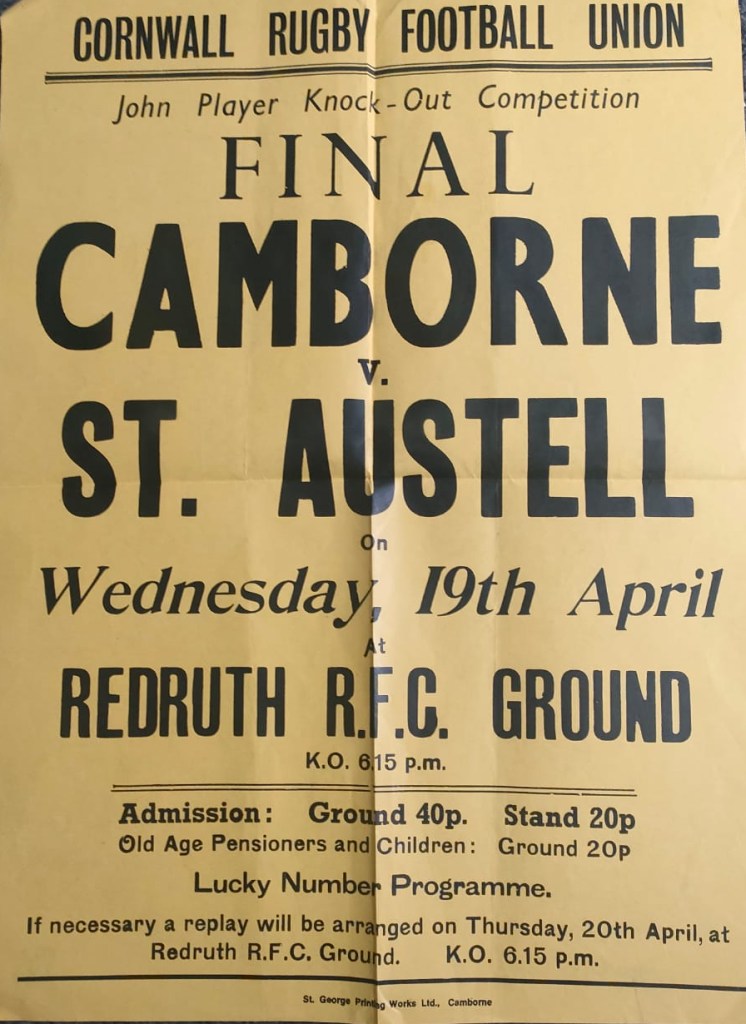
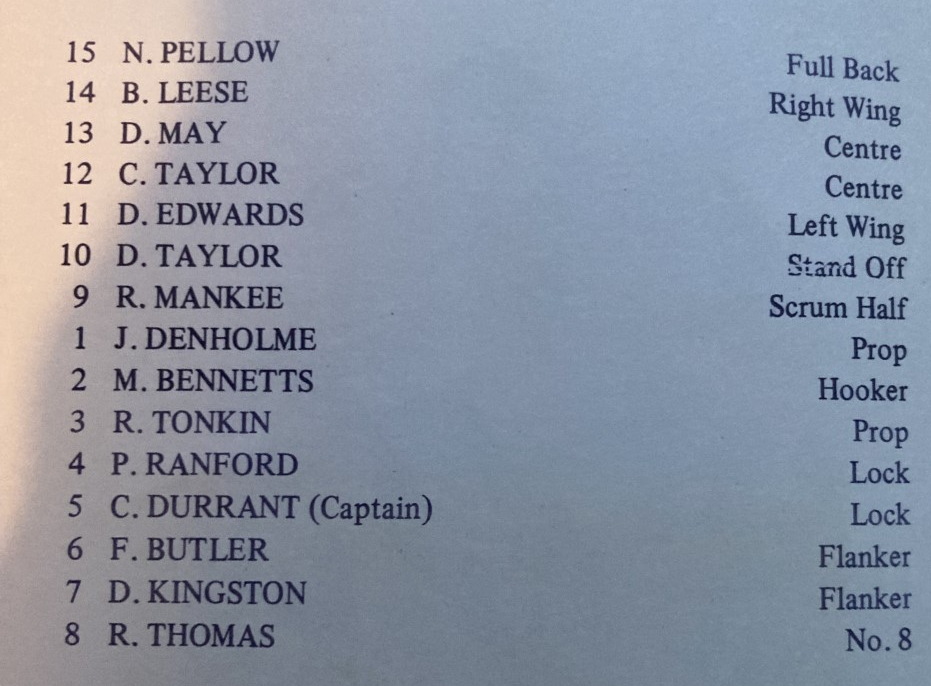
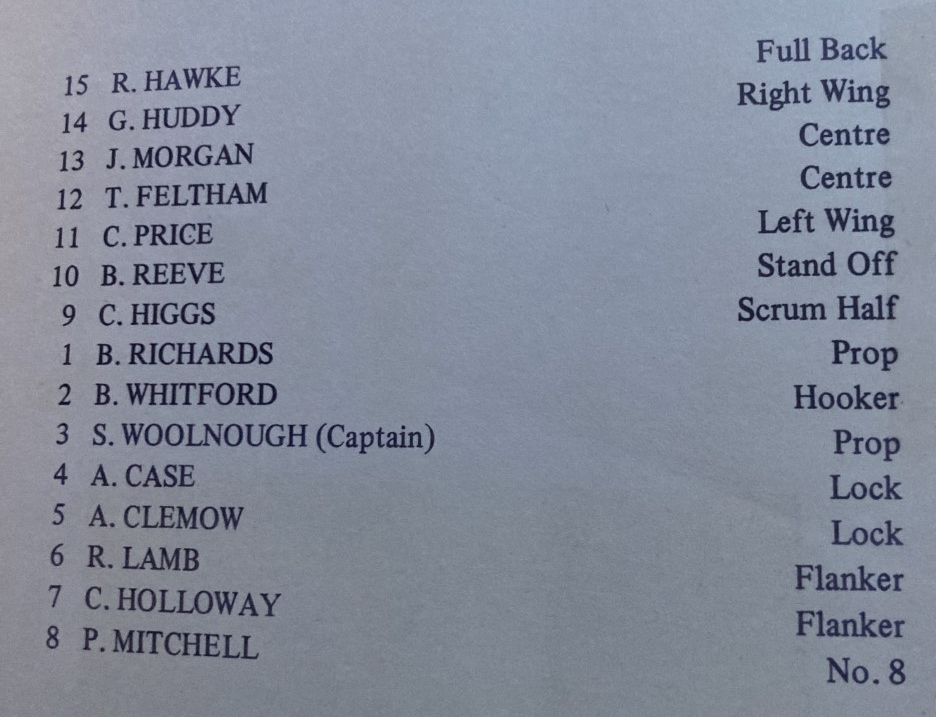
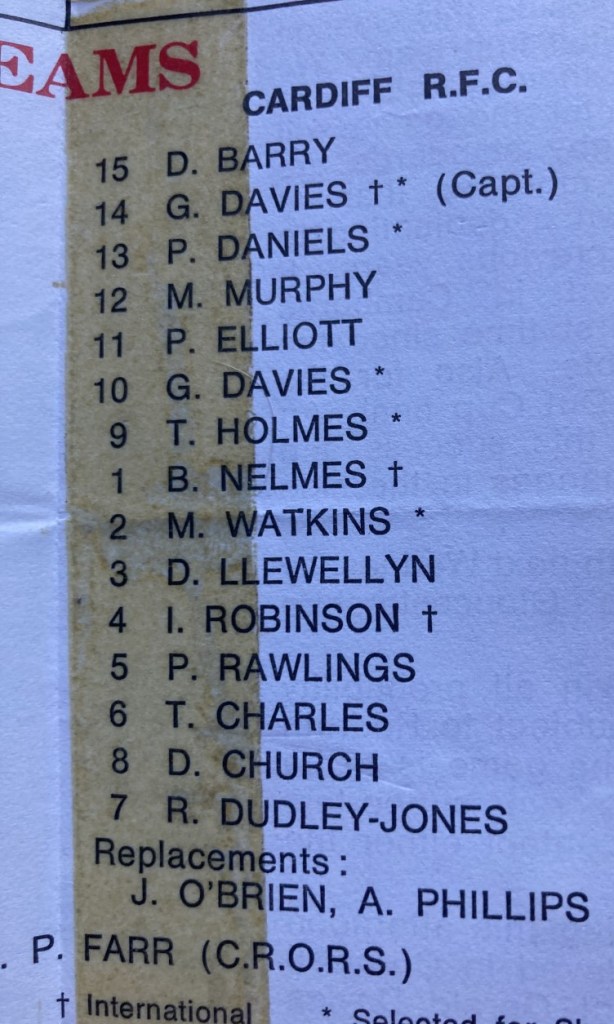
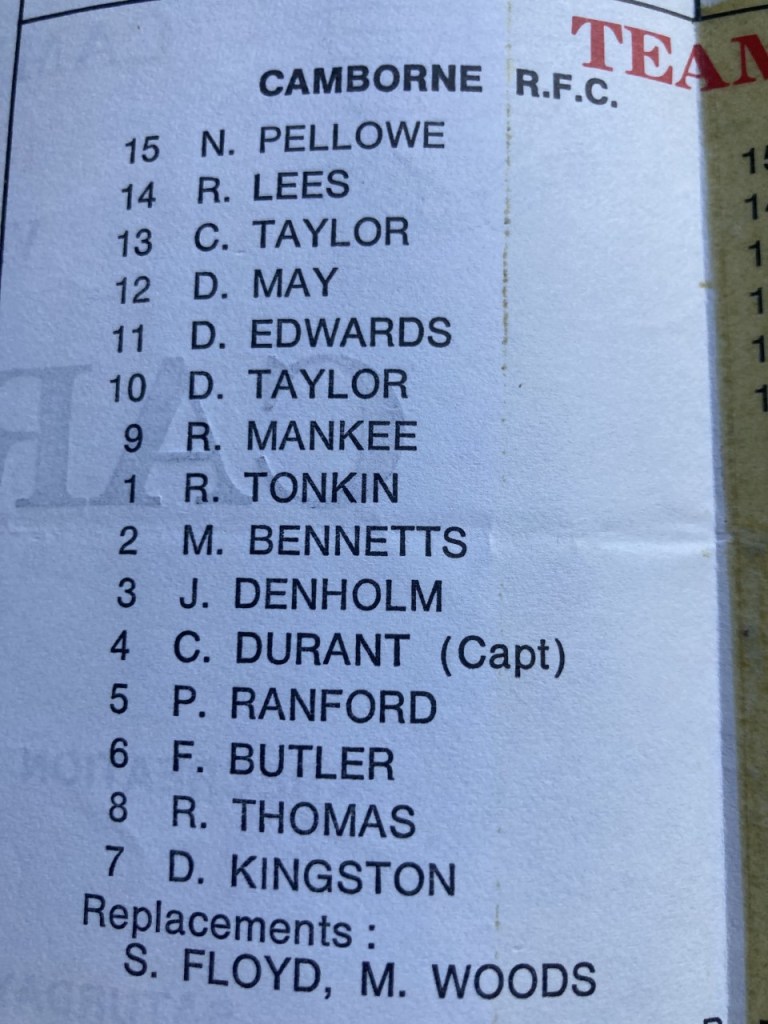
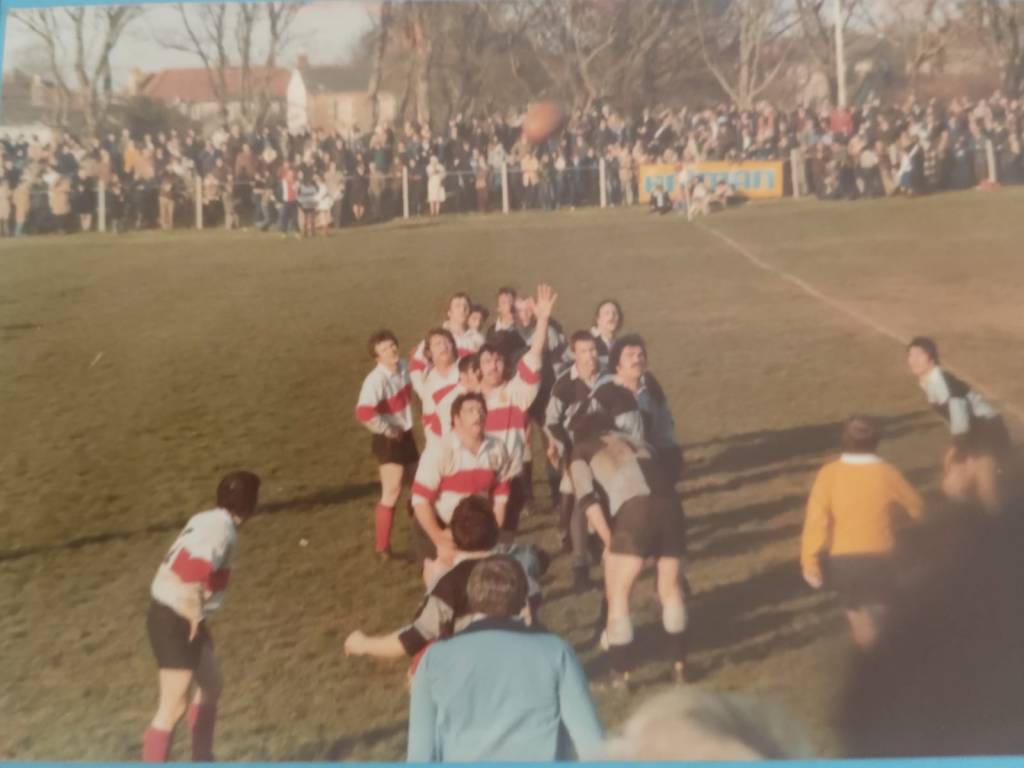
Camborne’s Feast Day Rugby

Reading time: 20 minutes

The Feast that the Rev. Chappell built…

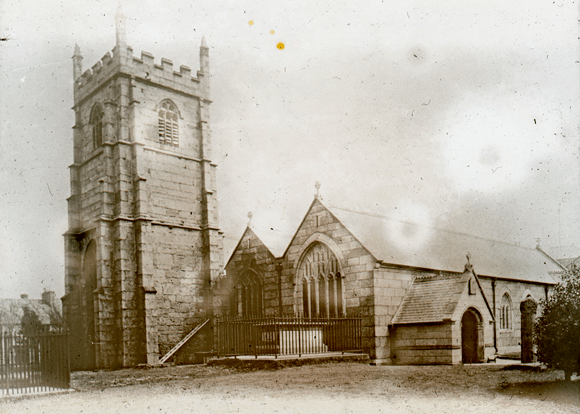
The Church of St Martin and St Meriadoc, Camborne, 1900. Kresen Kernow, ref. corn05074

Up to the mid-1800s – and the centuries before – a Cornish town’s annual Feast Day, held in honour of a Patron Saint, was regularly an excuse for a Rabelaisian fair of gluttony, boozing, sports and lechery. For example, in 1857 the well-oiled attendants of St Clement’s Feast in Truro partook of a game of hurling through the streets, which culminated in violence and vandalism over a disputed goal. The offending goal-scorer was later fired in effigy outside St Clement’s Church1.

Camborne’s Feast was no exception. It was nominally held in celebration of the life and works of St Martin of Tours, who, along with St Meriadoc, is commemorated in the local church of the same name. The Feast is traditionally held over the weekend nearest to November 11, ‘Martinmas’2, and previously encompassed

…great hospitality, and the fullest enjoyment…of the good things of life, and not paying much, if any, regard to the origin of the festival…

Cornish Post and Mining News, November 12 1921, p6

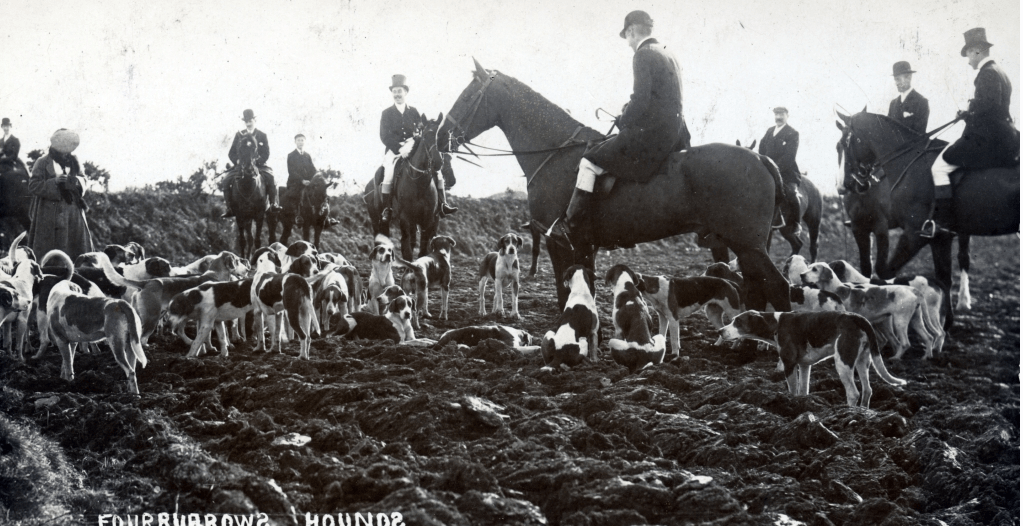
“Intemperance and disorder” were the main characteristics of the celebrations. On 1824’s Feast Monday, a “sporting” gentleman of Camborne accidentally (we are told) shot a local woman3. The man in question may well have been an enthusiastic (and/or intoxicated) member of the Four Burrow Hunt, who traditionally rode from the town centre over Martinmas weekend.

Members of the Four Burrow Hunt at Scorrier, 1930s4

(Of course, nowadays a much-reduced ‘Feast’ is kept up by the Camborne Old Cornwall Society, and the Four Burrow Hunt still rides – legally or illegally, depending on which source you trust5.)

Camborne Feast’s glory years were in the late 1800s and the early 1900s, and this was due in the main to the efforts of the Rector of St Martin and Meriadoc’s, William Chappell (1829-1900).

Chappell sought to improve the reputation of his church, both visually and within the community. It’s due to the restoration work undertaken during his tenure (from 1860 until his death) that the building appears as it does today6.

Chappell was also a formidable cleric. He had to be, with the influence of Methodism and other nonconformist sects ever ready to shepherd away some of his flock. It was said of him that

…his church services grew on the affection of his people, and he was unremitting in visiting the sick and suffering…

Cornish Post and Mining News, November 12 1921, p6

But it was Chappell’s efforts to inject new spiritual vigour into Camborne’s Feast for which he is chiefly remembered. Year on year, church teas and suppers were provided, sermons digested, choirs applauded, and public lectures well attended.

In fact, so successful were Chappell’s innovations that Camborne’s Methodists, Wesleyans and Bible Christians of all stripes became involved. By 1880 posters advertised the Feast attractions well in advance, and townspeople, flushed with civic pride, whitewashed their houses in anticipation7.

Cornish Post and Mining News, November 7 1890, p4

The Feast took on a more orderly, Godly and teetotal manner. Nobody was reported as being drunk and disorderly over the Feast weekends in 1878 and 18828. A corrective sermon was delivered to the young in 1887 on the perils of “Gadding about”9, and the title of the public lecture in 1880, described as “interesting”, is worth quoting in full:

Reminiscences of a yachting tour in the Mediterranean…

West Briton, November 18 1880, p5

The Feast, in the jaundiced eyes of one commentator, was not being

…kept up the with best days of our forefathers…

Cornish Telegraph, November 16 1893, p8

But, fortunately, the old ways and customs died hard; indeed, in Camborne, they enjoyed an uneasy truce with the Feast’s new-found staidness. With the mines and factories in the area decreeing Feast Monday a half-day, there was still potential for, well, fun10.

In 1882 you could attempt to climb a greasy pole for a leg of mutton or race on a donkey. In 1883, you could gamble your pay on a wrestling match. In 1884 the ‘marrow-bone’ tradition (where a bone from a butcher’s is paraded about the town) was revived, and involved a good old-fashioned pub-crawl11.

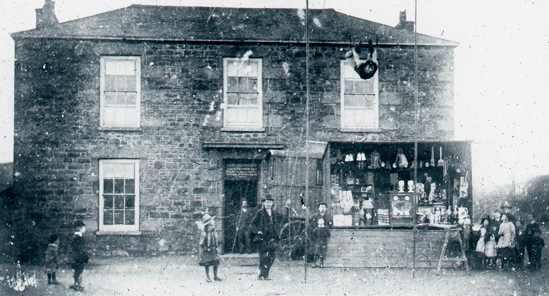
A trapeze-artist performed at Beacon for the 1891 Feast. The pub is the Pendarves Arms. Kresen Kernow, ref. corn05142

Evidence of such activities may serve as a corrective to the notion that the Industrial Revolution, and rise of the fervently religious middle-class in 1800s Cornwall (the ‘protestant work ethic’) sounded the death-knell for many old games, sports and celebrations of the working classes12.

In any case, by the late 1870s, there was a new game in town. It vaguely resembled hurling, was easy to follow, and carried a frisson of violence.

The game? Rugby football.

Rugby pioneers…

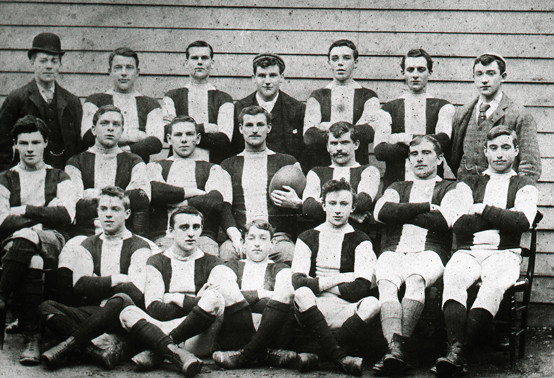
Six members of Camborne RFC, 1878. Back, l to r: Charles Vivian Thomas, Charles W. Boot, James M. Holman, Charles Carkeek. Front, l to r: John Bawden, Josiah Rowe. Courtesy Brenda Webster, Facebook

Camborne’s pious middle-class had no option but to tolerate rugby football because, at this early stage of the sport’s incarnation, it was the almost exclusive preserve of well-heeled, muscular Christian young bucks. They were the kind of gentlemen who would nod thoughtfully at a Feast-weekend lecture with such a title as “Scriptural Holiness”, before retiring to a nearby field to beat seven bells out of each other in the name of character-building recreation13.

The historian and archivist David Thomas has highlighted the 1800s link between “mining, business and Methodism”14; to this we may add sport.

Elements in the Church of England and other Protestant denominations stressed the importance of exercise and recreation to

…refresh the strength and spirits after toil…both to the student and to those who were engaged in business…

Cornish Post and Mining News, October 27 1894, p415

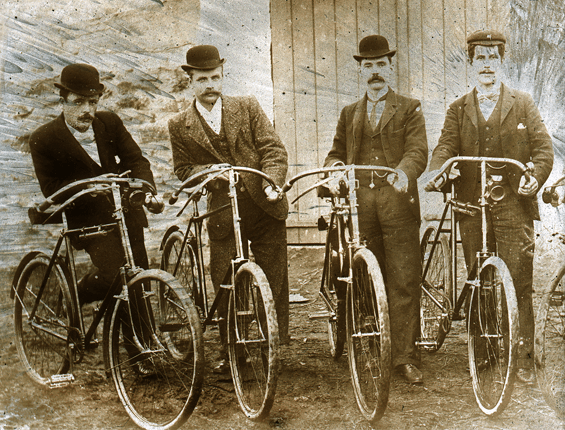
Take, for example, Charles Vivian Thomas (1859-1941). The son of Josiah Thomas, staunch Methodist and manager of Dolcoath Mine, he was educated at Taunton Wesleyan College and Cambridge. In Camborne he set up practice as a lawyer, gaining a reputation as a firebreathing Wesleyan preacher along the way, coupled with a “magnificent physical development”16.

Camborne Cycling Club, 1900. Charles Thomas is believed to be the figure on the left. Kresen Kernow, ref. corn05399

Thomas brought a sharp mind, a sharper tongue and a strong body home to Camborne. He also brought rugby football to the town, which he played while at Taunton Wesleyan College, where it was noted of him that he was

…a quick runner, a good scrag, and backs up well.

Wesleyan College Quarterly Magazine, 1877, p114. With thanks to Geoffrey Bisson, Queen’s College, Taunton

According to the Wesleyan’s records, Thomas returned home in the summer of 1877. He must have been desperate to continue playing rugby.

Fortunately for him (and for posterity), circumstances dictated that the time was now for rugby in Camborne. Redruth, after all, had formed their own club in 1875, so why shouldn’t Camborne have one?17

Camborne already had at least two cricket teams, Rosewarne and Roskear18, and the former club felt that, in the late summer of 1877,

…a football club [ought to] be formed in lieu of cricket…

Royal Cornwall Gazette, September 7 1877, p4

Charles W. Boot (1861-1938), a prominent member of the Rosewarne/Camborne Cricket Club, certainly agreed, and is often credited as the man responsible for forming Camborne RFC19.

A languid Boot well snapped for Camborne CC in 1880. Detail from a Kresen Kernow image, ref. corn05426

Boot certainly had the right pedigree – indeed, those biographies I’ve traced of the town’s early footballers so far read like a Victorian Camborne’s Who’s Who. His uncle was William Bickford-Smith, his brother-in-law John R. Daniell, the lawyer. Boot’s wife, Florence, was the daughter of Wiliam Rabling, manager of Mexican silver mines, lumber merchant and Wesleyan kingpin20.

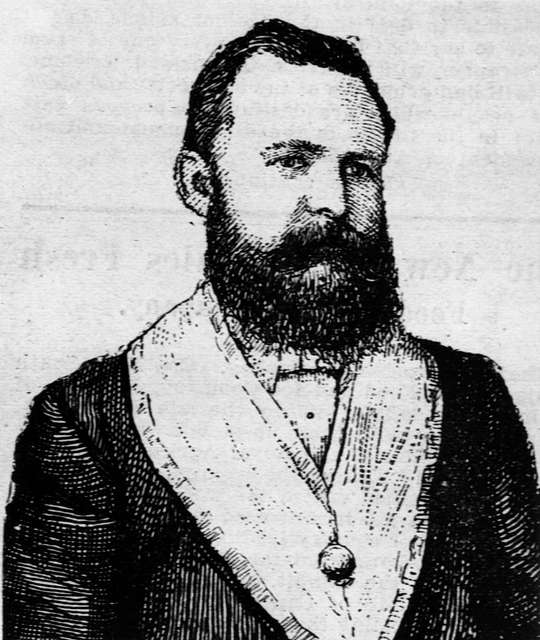
Boot himself was from Staffordshire, and an artisan smallware manufacturer. He was also a member of the Cornish Lodge of Freemasons, a Company Commander in the DCLI, and a Wesleyan preacher at Ponsanooth, who later promoted his faith in America21.

Boot had a team-mate who fancied chancing his arm (or breaking it) at rugby football: Josiah Rowe (1857-1932).

Josiah Rowe, Camborne CC, 1880. Detail from a Kresen Kernow image, ref. corn05426

Rowe’s father was a mine-manager, and Josiah himself ran William Rabling’s lumber yard (where Camborne Bus Station is now located). Besides spending several years in South Africa and playing cricket and rugby, Rowe filled his spare time as Captain of Camborne Fire Brigade. Charles Carkeek (1858-1903) emigrated too, and wound up as Mayor of Blackall, Queensland22.

The son of a mine captain who became a journalist: Charles Carkeek in 1896. Image from Queensland State Library

James M. Holman (1857-1933) perhaps needs no introduction. MD of Holman Bros. from 1908 until his death, he was also a JP for Cornwall, a mining and banking director, as well as a governor of Camborne School of Mines23.

Holman in 1897, by J. C. Burrow. From Reddit

A Freemason like Boot, he must have also possessed some of Charles Thomas’s physical attributes in his youth. As part of Camborne’s 1879 Feast he was a ‘fox’ in a cross-country paper-chase, running 14 miles over rough ground in just over two hours24.

Thomas’s obituary in 1941 described him and Holman both as

…the pioneers of Rugby football in Cornwall…

Cornish Post and Mining News, January 18 1941, p3

In reality, Thomas, Holman, Rowe, Boot, Carkeek, and the ten other men who made up Camborne’s first ever XV in 1877, were all pioneers25. Without them, Camborne RFC may not be celebrating the 150th year of its existence in 2027.

Feast Monday Rugby…

An 1877 map of Camborne, showing the location of Higher Rosewarne. From Francis Frith

Camborne RFC’s first ever game was on Feast Monday, Martinmas itself, November 11, 1877. They played Penzance in a field let to them by Thomas Bath, owner of Higher Rosewarne Farm. Bath was not averse to hiring out his land; after all, Rosewarne CC were already established there, and he allowed a band to perform a concert on his property in 187926.

What’s more, in June 1877 Bath’s farm hosted the Annual Exhibition of the Royal Cornwall Agricultural Association, with a grandstand erected in one his pastures to hold a thousand spectators27. What better location for Camborne’s latest sporting venture? Indeed:

It being Feast-day, some hundreds of spectators were present; and at times became so enthusiastic that they could not restrain themselves from kicking the ball.

Cornish Telegraph, November 13 1877, p3

Camborne lost, by three tries to nil. Yet despite the defeat (and these rugby pioneers were playing for exercise, you understand; playing to win was seen as vulgar and demeaning to their station28), those who watched obviously enjoyed themselves, and Cornwall’s nascent sporting press made good copy from the event.

The Cornish Telegraph gave a list of both XVs, and a detailed report29. Meanwhile the Royal Cornwall Gazette salaciously listed

…two sprained ankles…stained handkerchiefs, scratches, bruises…

November 16 1877, p5

Rugby football was a hit. What the Rev. Chappell made of all these goings-on during his parish’s celebrations of the life of St Martin of Tours is unknown, but he can’t have minded all that much. Both Chappell’s sons played rugby for Camborne and by 1888, a club bearing the name ‘Camborne Church’ (which is local shorthand for St Martin and St Meriadoc’s) had been formed30.

All over Cornwall, rugby clubs were springing up like mushrooms31.

Large gates and annual customs…

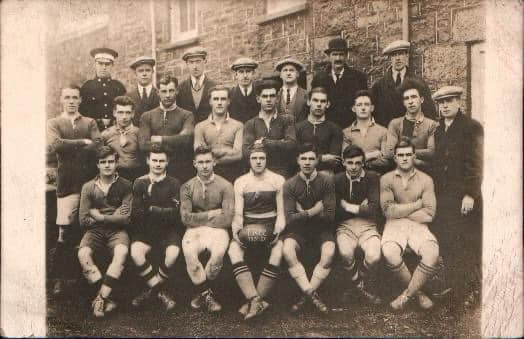
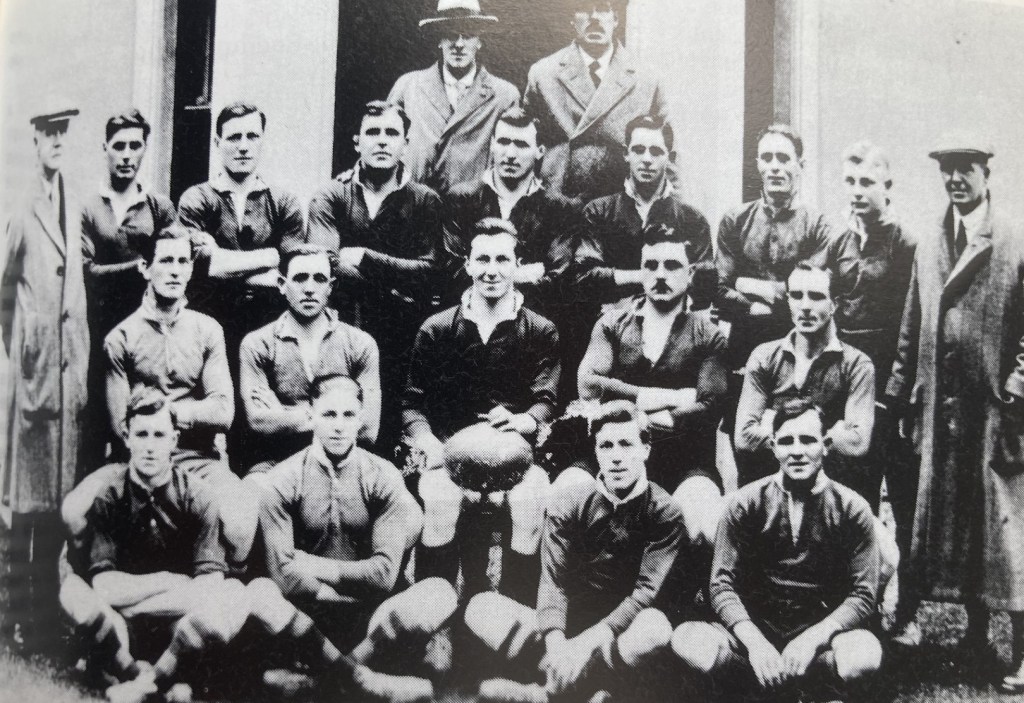
Camborne RFC, 1888. Kresen Kernow, ref. corn05419

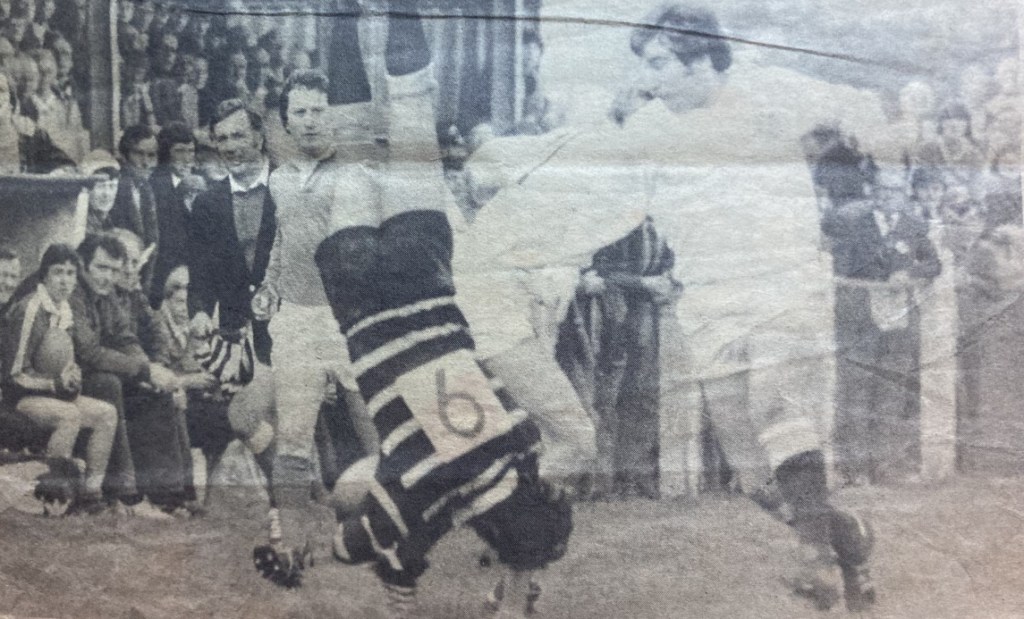
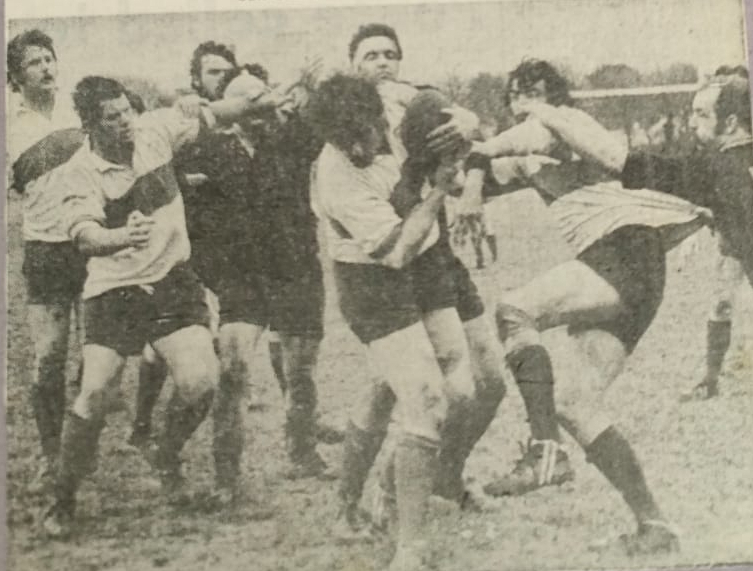
Given the success of Camborne’s inaugural match, there are no reports of fixtures involving the club on Feast Monday until 1883, when they hosted a team simply known as ‘The Rovers’, and then again not until 1890 when Devon Albion visited32.

These gaps can be explained by recalling that fixture-arranging in this era was haphazard, and the reporting sporadic. Although the game had novelty value – a training session was worthy of an inch of column in 187933 – journalists would rather cover the religious aspects of the Feast, rather than the social. Rugby was played, as more clubs formed to accommodate a sport that had a broader class appeal than, putting it bluntly, a bunch of toffs hacking at each other for seemingly hours on end.

By the early 1890s, the Camborne XV already had a reputation as “burly miners”, and many local rivalries meant the gentlemanly notion of playing for playing’s sake (a modern coach might say, we’re not results-driven), had been forgotten34.

If Camborne didn’t play on Feast Monday, other teams in the town did. In 1895, Camborne Blues played Harlequins ‘A’ somewhere near Dolcoath Road, in a match of no real consequence other than the play being “very rough”35. We may rest assured that, if a match in these years is described as ‘very rough’, it must have been a borderline riot.

CSM’s 1st XV was a match for any team in Cornwall – and their Reserves were no mugs. Kresen Kernow, ref. AD2583/1

By the late 1890s, most Cornish newspapers ran columns dedicated to Association and Rugby football, naturally giving the game more coverage36. Camborne School of Mines RFC, formed in 189637, played four consecutive Feast Mondays against Redruth, and Camborne enjoyed parallel fixtures with Penzance or Newlyn38.

The CSM-Redruth fixtures were serious. The 1898 clash was “streets ahead” of the recent Cornwall fixture in terms of quality. The students approached it with great intensity; indeed

…they [were] practising hard every day…

Cornubian and Redruth Times, November 18 1898, p5

…for a fortnight before the match. Was this to be the great Feast Day rivalry?

No. Camborne, with their home now the Recreation Ground, first played Redruth on Feast Monday in 1900 (it was a scoreless draw39), but by 1908, of

…the many and varied attractions associated with Camborne Feast Monday, none can compare with the annual match between the local and Redruth Rugby Chiefs…

Cornubian and Redruth Times, November 12 1908, p10

(Redruth won, 14-8. Bert Solomon broke a collar-bone.)

This “annual custom”40 continued until 1919, and included some controversial wartime fixtures41. The crowds regularly rivalled that of Cornwall’s matches.

2,000 watched Redruth win in 1908; 4,000 saw Camborne win 8-6 in 190942. Fans wouldn’t just flock to the matches. Victorious ‘Town’ XVs would be lustily cheered in the streets by hundreds of well-wishers on their return to a Camborne hostelry to celebrate43.

In 1919, 4,000 saw Camborne win 6-3, and the club recorded its then biggest gate: £160 (£6,600 today). Its impossible, sadly, to calculate what the entrance fees were; women (regularly “a good many hundred”) had been allowed to spectate for free since 1903 at least, though it was chauvinistically observed that

…probably very few know anything of football…

West Briton, November 12 1903, p5
The Recreation Ground, 1900. Doubtless Town selection policy is being discussed before that afternoon’s match. Kresen Kernow, ref. corn05080

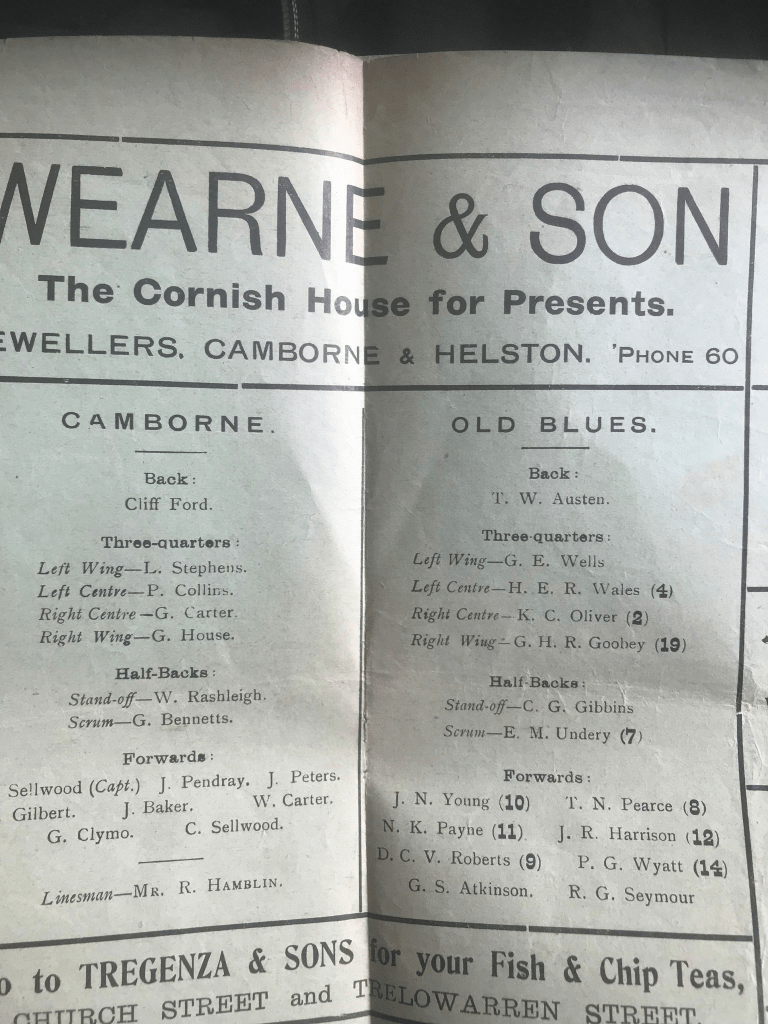
Even when a dispute with Redruth suspended their Feast Monday derbies in the early 1920s (more on that to follow next week), Camborne played Surrey’s Old Blues RFC on the date until the mid-1930s. There was no falling-off in interest: crowds still regularly topped 2,000, and the Blues could count on local support too. CSM students would bait their parent club mercilessly in the hope of an upset44.

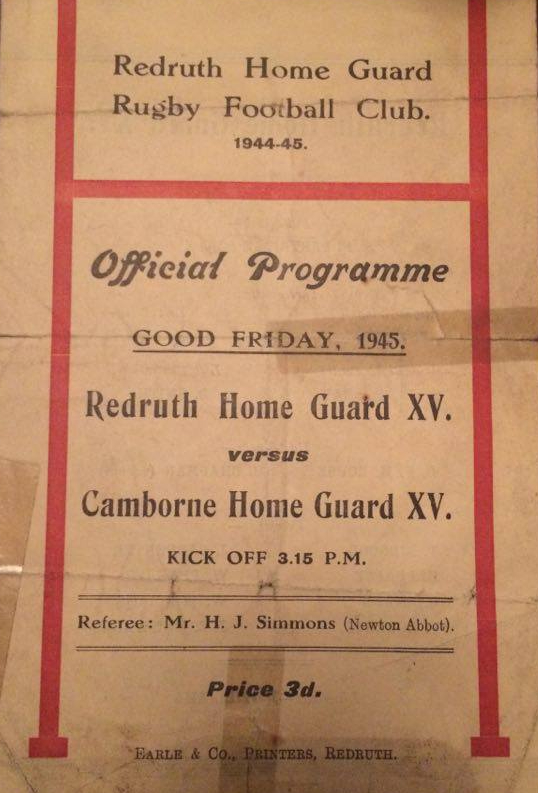
Programme of the 1931 Feast fixture. Camborne won, 15-6.
Courtesy Mark Warren

The Old Blues were no fixture-padding also-rans. In a legendary era of Camborne rugby, with players such as Reg Parnell, Bill Biddick, Fred Rogers and Phil Collins (the father of John), the Blues “badly trounced” Town 31-5 in 192745.

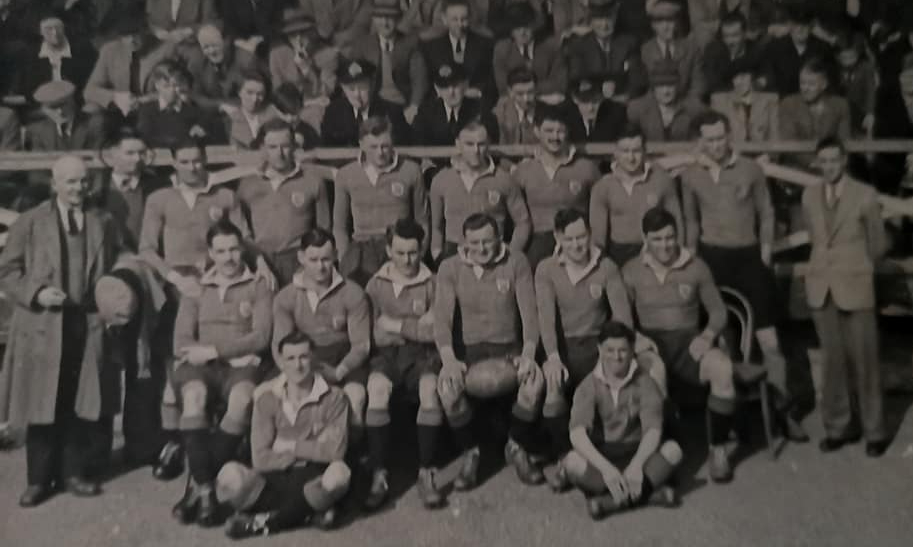
The combined XVs of Camborne and Redruth, photographed in Redruth, c1935. Phil Collins is sixth from the right for Camborne. Courtesy John Collins and Mark Warren

Feast hostilities with Redruth resumed in 1935. By 1937, Feast Monday was a half, or whole holiday for the entire town, schools included. The afternoon rugby match was the “great attraction”46. Camborne Town Band would lead the proud players from their changing quarters (Tyack’s, or Commercial Hotel) through the packed streets to the Recreation Ground, and perform for the masses at half-time, as in 194647.

Results would be the talk of both towns for days afterwards, such as in 1956 when Redruth humbled Camborne 41-348.

To state the obvious: Camborne’s Feast Monday fixture with Redruth was as big a game in Cornish rugby as the annual Boxing Day clash. The whole atmosphere of the occasion, with a holiday, hunt and livestock show showed that Camborne still knew how to do its Feast tradition proud, but above all it

…still has the same spirit in its Feast Monday football…

Cornishman, November 16 1950, p5
The Holmans frontage in Wesley St. Demolished in 1989, there’s now a supermarket on the site49

But the last game was played in 1963, and the writing had been on the wall since 1962. That year, Holmans had remained open (and would remain so) on Feast Monday, offering their thousands of employees (many of whom played, or followed rugby) an extra day’s holiday at Christmas. Other businesses followed suit, and quickly it became apparent that a Feast Monday rugby match would be a non-event, in terms of both fans and players.

Despite complaints as early as 1964 that, mainly due to the loss of the rugby, the Feast “isn’t what it used to be”, a great Cornish sporting tradition had definitively come to an end50.

A Holman gave birth to a club, and a tradition. The works that were his family’s legacy ironically ended that tradition. The Industrial Revolution had belatedly caught up with the Camborne Feast.

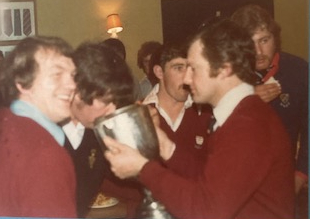
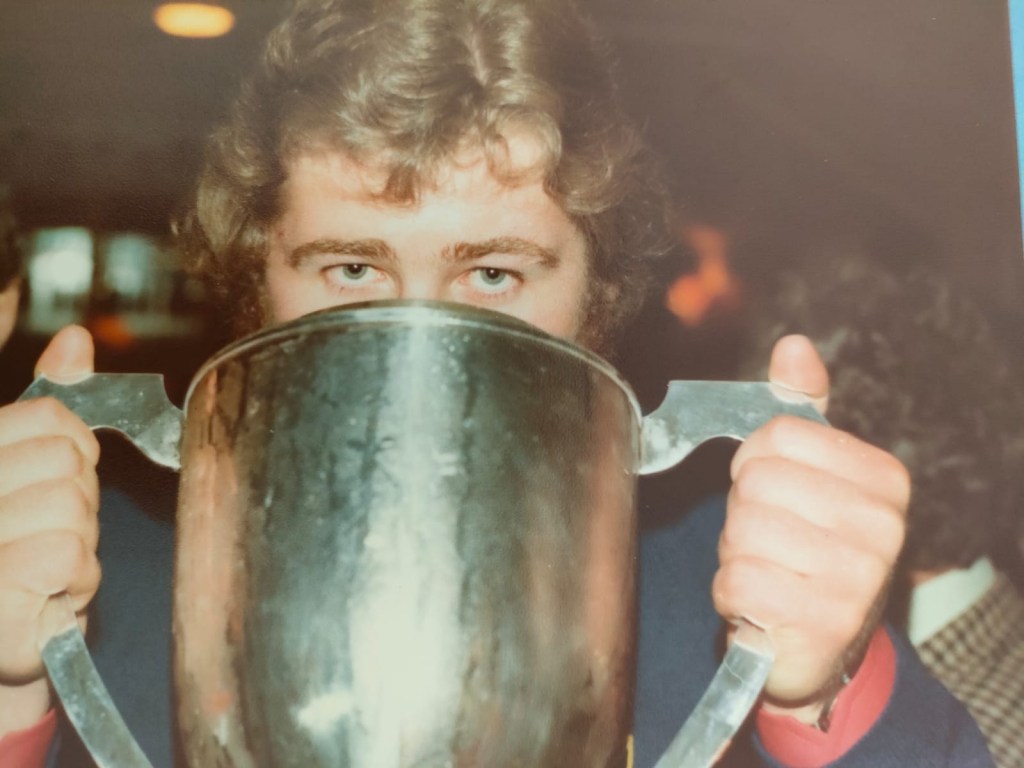
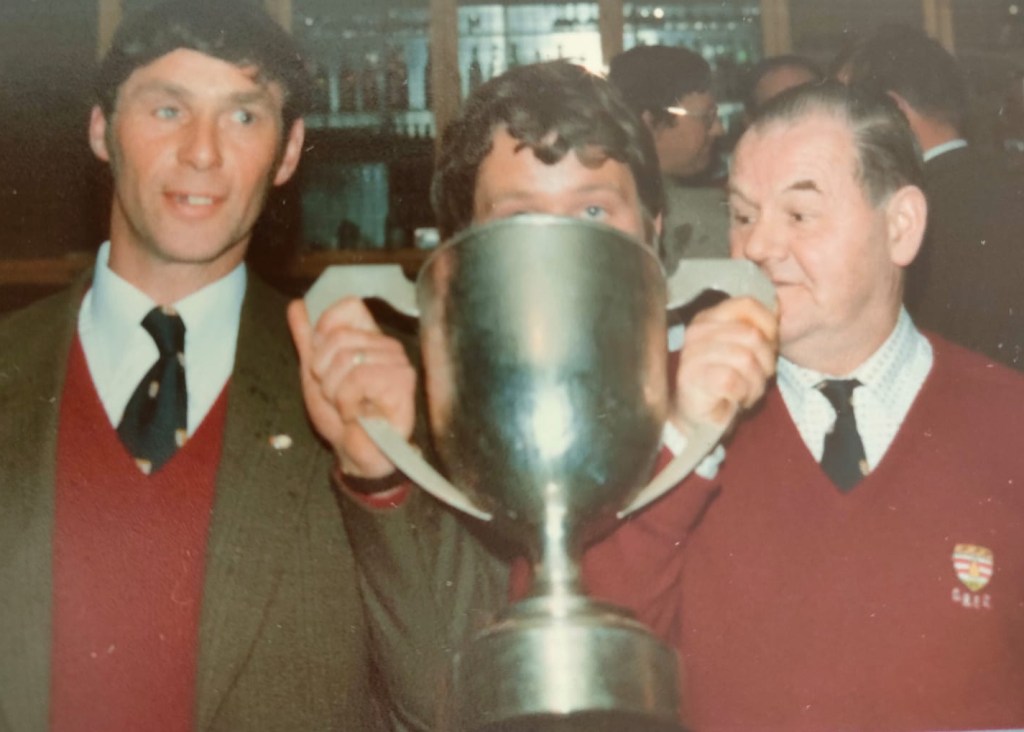
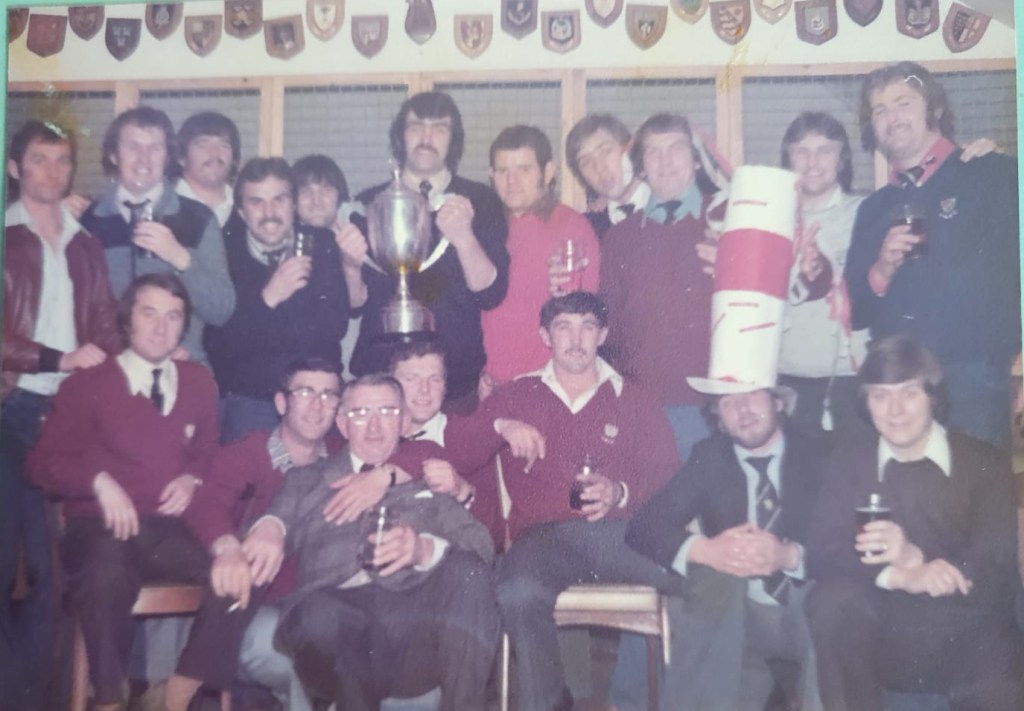
From 1877 to 1963, Camborne RFC had played over sixty Feast Monday matches.

With no competition, the Camborne-Redruth Boxing Day derby (held solely in Redruth from 1935 to 1963), rapidly increased in importance. Nowadays, it is believed to be the oldest continual rugby fixture in the world.

But is it? Find out by clicking here

Many thanks for reading. Follow this link for more top blogs on all things Cornwall: https://blog.feedspot.com/cornwall_blogs/

References

  1. Royal Cornwall Gazette, November 27 1857, p5. For more on Cornwall’s Feast Days, see Cornish Feasts and Folklore, by Margaret Courtney, 1890. See my article on effigy burning in 1800s Cornwall here: https://cornishstory.com/2022/07/02/effigy-burning-in-nineteenth-century-cornwall/
  2. See: https://en.wikipedia.org/wiki/St._Martin’s_Day
  3. Royal Cornwall Gazette, November 20 1824, p2. The ‘intemperate’ nature of the Feast in days past is recalled in the Cornishman, November 18 1886, p5.
  4. From: https://www.cornishmemory.com/item/BRA_18_171
  5. David Thomas, Archivist at Kresen Kernow, assures me the Feast will go ahead this year. For dates, see: https://kernowgoth.org/member-societies/camborne-old-cornwall-society/. Four Burrow Hunt was still going strong – and killing animals – in the 1990s: see the West Briton, November 16 1995, p20. Follow these links for more on its post-ban activity: https://www.wildlifeguardian.co.uk/hunts/four-burrow-hunt/, https://www.cornwalllive.com/news/cornwall-news/cornwall-hunt-accused-putting-dogs-8124091, and the Hunt’s own Facebook page.
  6. See: https://cambornecluster.org.uk/camborne-church/history/, and https://en.wikipedia.org/wiki/St_Martin_and_St_Meriadoc’s_Church,_Camborne
  7. Royal Cornwall Gazette, November 12 1880, p8. See the Cornish Post and Mining News, November 12 1921, p6, for more on the involvement of other religious groups, and Chappell’s obituary in the Royal Cornwall Gazette, February 8 1900, p7. On Victorian civic pride, see Asa Briggs, Victorian Cities, Penguin, 1968.
  8. As remarked in the Royal Cornwall Gazette, November 15 1878, p5, and the Cornish Telegraph, November 16 1882, p5.
  9. Cornish Telegraph, November 17 1887, p8.
  10. The local half-day is mentioned in the Royal Cornwall Gazette, November 15 1878, p5.
  11. Cornish Telegraph, November 16 1882, p5; Cornubian and Redruth Times, November 16 1883, p7; Cornishman, November 20 1884, p7. The ‘marrow-bone’ tradition is also mentioned in Margaret Courtney’s Cornish Feasts and Folklore, 1890, p10.
  12. A. K. Hamilton Jenkin makes this assertion in The Cornish Miner, 3rd ed., George, Allen & Unwin, 1962, p124. See Max Weber, The Protestant Ethic and the ‘Spirit’ of Capitalism, Penguin Classics, 2002.
  13. “Scriptural Holiness” was the lecture on offer at the 1888 Feast; from the Cornish Telegraph of November 15 that year, p5. Tony Collins has traced the middle- and upper-class origins of rugby (and how it supplanted the more plebeian hurling) in Rugby’s Great Split: Class, Culture, and the Origins of Rugby League Football, 2nd ed., Routledge, 2006.
  14. From: https://cornishstory.com/2022/03/25/mapping-methodism-beacon-wesleyan-chapel/
  15. The quote is taken from a debate on the necessity of sport by the Camborne Wesley Guild. It may not surprise you that Charles Vivian Thomas was present.
  16. As gleaned from the 1881 census, the Cornish Telegraph, August 25 1875, p3, and Thomas’s obituaries in the Cornishman, February 20 1941, p6, and the Cornish Post and Mining News, January 18 1941, p3, where the “physical development” quote is taken. He gave a notably “fiery” sermon on the alleged folly of ritualism, as noted in the Cornishman of November 24 1898, p7.
  17. Nick Serpell, Redruth RFC’s historian, and myself have searched in vain for the source of the following quote in Tom Salmon’s The First Hundred Years: The Story of Rugby Football in Cornwall (CRFU, 1983, p41) on the origins of Camborne RFC: “After all, Redruth have got one”. Alas, the quote may be apocryphal, but the sentiment probably wasn’t.
  18. The two clubs played each other regularly, for example see the Royal Cornwall Gazette, June 29 1872, p5.
  19. Noted in the Cornishman, January 5 1961. Nick Serpell, Redruth RFC’s historian, has pointed out that Boot’s industry got fifty players on Camborne’s roster, and secured Bath’s field at Rosewarne for play: Royal Cornwall Gazette, October 19 1877, p4.
  20. See https://en.wikipedia.org/wiki/William_Bickford-Smith, and https://cornishstory.com/2022/03/25/mapping-methodism-beacon-wesleyan-chapel/ for information on William Rabling. For Boot’s connections see the obituary of his grandmother in the West Briton, March 11 1886, p4, Florence’s obituaries in the Cornishman, July 27 1941, p8, the West Briton, July 27 1941, p5, and the 1881 census.
  21. Taken from: the 1881 and 1891 census, the United Grand Lodge of England Freemason Membership Registers, 1751-1921 (Ancestry), Royal Cornwall Gazette, August 28 1890, p6, and Florence Boot’s obituaries (above).
  22. See Rowe’s obituary in the Cornish Post and Mining News, October 22 1932, p5, and him in the action for the fire brigade in the Royal Cornwall Gazette, December 27 1894, p4. David Thomas notes the location of Rabling’s yard here: https://cornishstory.com/2022/03/25/mapping-methodism-beacon-wesleyan-chapel/ . The information on Carkeek comes from: Royal Cornwall Gazette, April 14 1892, p8; Cornishman, June 16 1904, p5.
  23. From Holman’s obituary in the Cornish Post and Mining News, March 4 1933, p4.
  24. Cornish Telegraph, November 12 1879, p5. Evidence of his freemasonry can be found at: United Grand Lodge of England Freemason Membership Registers, 1751-1921 (Ancestry).
  25. The team was named in the Cornish Telegraph, November 13 1877, p3. Early rugby matches, in fact, regularly featured sides of twenty players.
  26. See the 1881 census for information on Thomas Bath. Camborne’s game is reported in the Cornish Telegraph, November 13 1877, p3, and the Royal Cornwall Gazette, November 16 1877, p5. The Gazette has them actually playing on the cricket pitch. The concert on Bath’s farm is reported in the Cornishman, June 5 1879, p5. It wasn’t until the 1898-99 season that Camborne started playing at the Recreation Ground: see the Cornishman, September 22 1898, p2.
  27. From the Cornish Telegraph, June 12 1877, p3.
  28. See Tony Collins’ Rugby’s Great Split: Class, Culture, and the Origins of Rugby League Football, 2nd ed., Routledge, 2006, for more on the amateur ethos of early rugby.
  29. November 13 1877, p3.
  30. In September 1888, Camborne RFC was actually forced to wind up its affairs and fold: a debt of just over £2 (£213 today) is cited as the cause. Into this rugby vacuum the Camborne Church club was formed a month later; doubtless it contained many names from its previous incarnation. By late November, though, Camborne RFC had reformed at the Golden Lion pub; Camborne Church was still fielding a team in 1907. Hence, there was no Feast Monday game in 1888. See: Cornish Telegraph, September 27 1888, p5 and October 11 1888, p5; Cornish Echo, October 13 1888, p6; Western Morning News, November 23 1888, p6. The Rev. Chappell’s sons playing for Camborne is mentioned in the Camborne RFC Centenary Programme 1878-1978, by Philip Rule and Alan Thomas, 1977.
  31. As documented in Tom Salmon’s The First Hundred Years: The Story of Rugby Football in Cornwall, CRFU, 1983.
  32. The Rovers beat Camborne; no score is recorded for the Albion match. From the Cornubian and Redruth Times, November 16 1883, p7; and the Cornish Telegraph, November 16 1890, p5.
  33. The Cornish Telegraph noted the Camborne side were playing “by moonlight”: obviously, this was an evening workout. December 3, 1879, p5.
  34. The Camborne side were described as such in the Cornishman, November 24 1892, p10.
  35. Cornish Post and Mining News, November 15 1895, p5.
  36. For example: Cornish Post and Mining News, December 14 1899, p2; Cornishman, November 9 1899, p2.
  37. As documented in Tom Salmon’s The First Hundred Years: The Story of Rugby Football in Cornwall, CRFU, 1983, p95-6.
  38. For the CSM matches, see: Cornishman, November 12 1896, p5; West Briton, November 4 1897, p11; Cornubian and Redruth Times, November 18 1898, p5; Cornishman, November 23 1899, p3. For the Camborne matches, see: Cornishman, November 24 1898, p7; Cornishman, November 23 1899, p3.
  39. Royal Cornwall Gazette, November 15 1900, p3. Camborne had been playing at the Rec since the 1898-99 season: see note 26.
  40. Cornish Telegraph, November 16 1905, p5.
  41. Although the CRFU had stopped play by November 1914, that year’s Feast derby went ahead, and came in for criticism: why aren’t these healthy young men at the Front? That said, all takings were donated to a patriotic fund. See: West Briton, November 30 1914, p2; Cornish Telegraph, October 22 1914, p2. Ironically, soldiers on leave enjoyed the 1915 derby, and the 1916 edition (against Plymouth) drew a large collection for the Royal Naval Hospital, Truro. See: West Briton, November 18 1915 p6; and November 16 1916, p8. Only two games were played on Feast Monday in World War Two: in 1944, the Camborne Home Guard played RNE Devonport, and lost. In 1945, Camborne beat Redruth 6-5. See: Cornishman, November 16 1944, p6; and November 15 1945, p6.
  42. Cornubian and Redruth Times, November 12 1908, p10; and November 18 1909, p10.
  43. As observed in the Cornubian and Redruth Times, November 17 1910, p5.
  44. From the Cornish Post and Mining News, November 14 1925, p8.
  45. Cornish Post and Mining News, November 19 1927, p6. In the scoring system of the time, a try was three points, but a converted try was 5 points, with the original try not to be added to the total. The Blues put five goals and two tries past Camborne. Converting a three-point try to a five-point goal was known as “majorised”: West Briton, November 15 1906, p3-5.
  46. West Briton, November 18 1937, p8.
  47. West Briton, November 14 1946, p7. The Camborne XV’s musical guard of honour for home fixtures is mentioned in the Camborne RFC Centenary Programme 1878-1978, by Philip Rule and Alan Thomas, 1977.
  48. West Briton, November 15 1956, p2.
  49. See: http://cornishstory.com/2021/02/10/holman-echoes-of-an-age/
  50. See: West Briton, November 15 1962, p9; November 14 1963, p5; November 19 1964, p6.

Bodyline at North Roskear

Reading time: 20 minutes

Saturday, September 15, 1934

A view of Camborne CC taken in 1924. New Dolcoath Mine is in the background; the famous ‘stack’ that still dominates the ground to this day had only been recently completed. From: Mining in Cornwall: Volume 8: Camborne to Redruth, by L. J. Bullen, History Press, 2013, p82.

There were 6,000 people crammed into Camborne’s cricket ground at North Roskear. Fans, children and autograph hunters of all ages were there. The place was rammed. You could sense the anticipation. You were about to see something special1.

An adjacent field – presumably the one that later became the home of Heathcoats CC – had been given over as an overspill carpark. To avoid a crush at the entrances, people had been advised to buy their tickets in advance2.

A. E. Rodda, the local dairy kingpin, was providing refreshments. Such had been the demand that he had requested, and been granted, a licence to sell alcohol at the ground for the day. Doubtless, he made a killing3.

A. E. Rodda (1878-1953), in 19104

The crowd weren’t here to witness Camborne’s all-conquering team, even though they had been the alpha-XI of Cornish cricket for eight consecutive seasons5.

Camborne CC 1st XI, 1930s. Note the trophy in front of the skipper, Clarence Paull. Not an uncommon sight. Kresen Kernow, ref. corn05429

Camborne’s captain, Clarence Paull, was a man who played cricket and rugby for Cornwall, boasted a decent golf handicap, and still found time to manage South Crofty mine6.

He wasn’t the big draw. Nor was Fred Rogers, the popular all-rounder born of a Cornish father and an Indian mother7.

The crowd weren’t especially bothered that the team Camborne were to play was a County XI, in an end-of-season friendly.

And, obviously, it wasn’t the Vinter Cup Final night8.

No. The people in the ground that day had eyes for only one man. A short, broad figure with long arms, pawing the turf near the top of his run-up. No doubt he bowled downhill, towards the pavilion.

The umpire called play. The expectant murmuring, the buzz, ceased. Glasses, halfway toward open mouths, paused. Pipes and cigarettes stayed unlit. The bowler began his run.

That bowler was Harold Larwood. The fastest the world had ever seen. And he once played at Camborne.

The Wrecker

Oh, they’d be a lot calmer,

In Ned Kelly’s armour,

When Larwood, the wrecker, begins.

From an Australian music hall song, qtd. in Duncan Hamilton, Harold Larwood, Quercus, 2009, p15
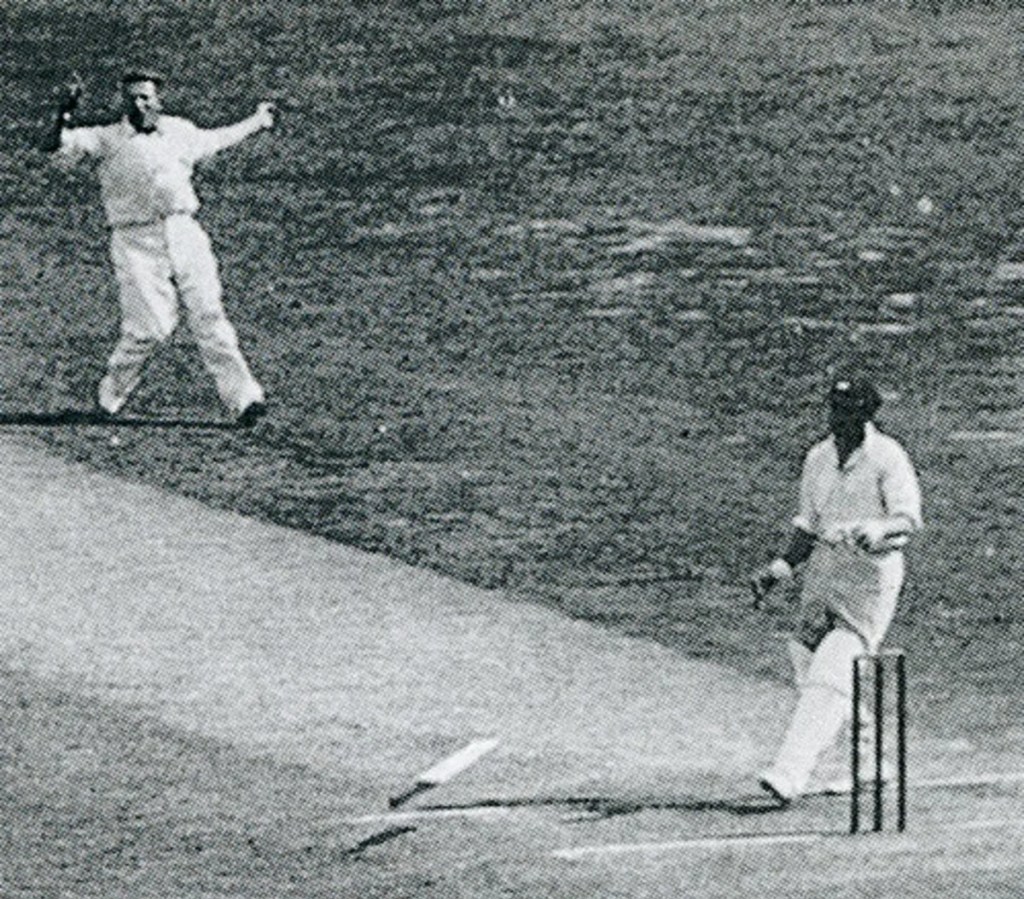
Harold Larwood poised to unleash. One of the fastest bowlers the game has ever seen, with one of the purest actions. Getty Images

By the early 1930s, Harold Larwood had gone from a pale, undernourished Methodist pitboy who called everybody ‘Sir’ and only sipped shandy, to the chain-smoking, ale-swilling, vengeance-wreaking quickest thing in cricket9.

Cutting-edge equipment (stopwatches) timed his deliveries at anywhere between 96-100mph. His Nottinghamshire coaches streamlined his action so perfectly he could hit a florin placed on a length at 90mph for fun.

Take Mark Wood’s sheer pace and combine it with Jimmy Anderson’s unerring accuracy and skill. Then imagine facing this unholy alliance without a thigh-pad, chest-guard or helmet.

The result? Unadulterated carnage.

In cahoots with his fast-bowling blood brother Bill Voce, Larwood was the terrifying scourge of county sides in the late 1920s and early 1930s. Fuelled by ale carted to his changing-room in a bucket, a hundred wickets a season was the accepted norm. He petrified countless batsmen and became a crowd favourite.

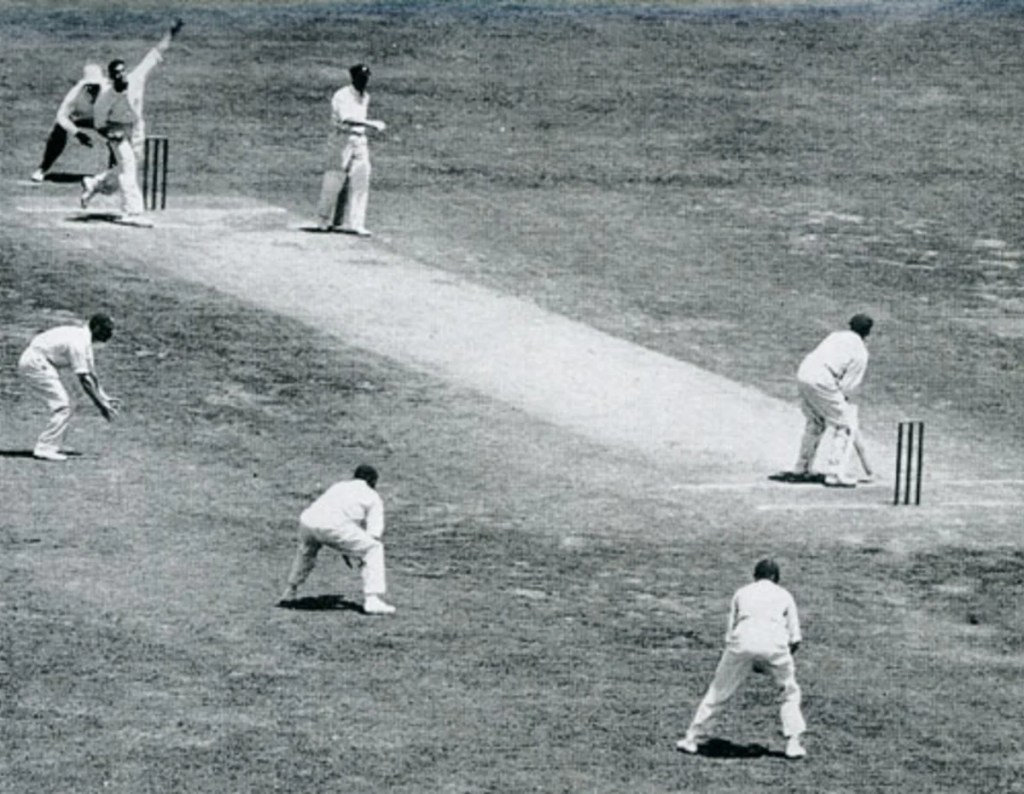
Bill Voce in action, 1933. Although not as quick as Larwood, his height and left-arm variety made him the ideal foil: there was to be no escape. Note the umpire’s cheroot. Copyright Illustrated London News/Mary Evans Picture Library

Amateur batsmen would regularly cry off a fixture involving Larwood. Others were to be found cowering in the toilets when their turn to face him came. Many received injuries. Some were stretchered from the field of play. The man was truly dangerous, especially when riled – and batsmen, as a rule, tried not to agitate him.

He could hit the peak of a man’s cap with a bouncer and send it swirling toward his slip-catchers, often to win a private bet with Voce. Cloche hats, an item of feminine sartorial elegance, were employed by enterprising batsmen to manufacture makeshift helmets. It made little difference to the outcome.

Whenever a team hosted Nottinghamshire, they would deliberately prepare a slow wicket, in an attempt to neutralise Larwood and Voce. The pair of them, with their team-mates, would urinate on any suspect pitch under cover of darkness in protest.

Small wonder that the England Captain, Douglas Jardine, wanted both Larwood and Voce to spearhead his attack for the 1932-33 Ashes Tour to Australia.

It’s f__king mutual

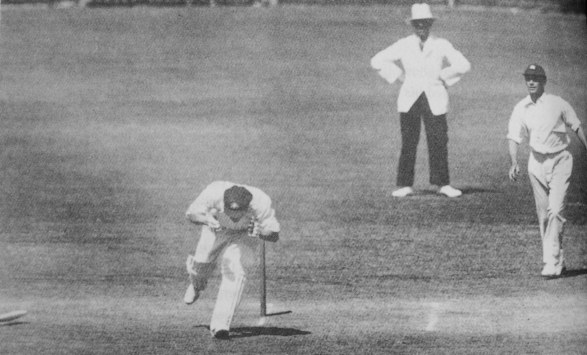
Bill Woodfull drops his bat in agony after being struck by Larwood10

This was the meanest, most unpleasant Ashes Tour in cricket history – the ‘Bodyline’ series. Larwood, with Voce, consistently bowled fast and short at the Australians’ ribcages, to a leg-side field prowling with catchers. It was Jardine’s brainchild, born of the necessity to curb the near-freakish run-machine that was Don Bradman.

Jardine’s XI didn’t speak to the Press, alienating the media. They also took their nets behind closed doors, alienating the public as well. Jardine only ever referred to Bradman as ‘the little bastard’, and insisted his men do the same. When someone suggested to him that, after a period of his being barracked in a match, the Australians didn’t seem all that keen on him, Jardine shot back:

It’s f__king mutual.

Qtd in Duncan Hamilton, Harold Larwood, Quercus, 2009, p129

England’s cricket was intense, almost brutal. Bill Voce sums it up best:

…if we don’t beat you, we’ll knock your bloody heads off…

Qtd in Duncan Hamilton, Harold Larwood, Quercus, 2009, p143

Jardine’s Bodyline tactics (the term was an Australian invention), lethally deployed by Larwood, laid accusations of unsportsmanlike play at the MCC’s door and caused uproar. But it worked.

Larwood, supping ale during drinks breaks, gave his hecklers the v-sign – and he was called ‘bastard’ more than Bradman ever was. He poleaxed two batsmen in Adelaide – nearly provoking a riot – and needed a police escort from the ground. Hatemail arrived by the sackload. Yet he reduced Bradman to a frantic, jittery shadow of his former self.

The extreme toll on Larwood’s body and mind caused him to vomit at the end of a day’s play and wring the blood from his socks – yet he took 33 wickets. England won the Ashes 4-1. Larwood returned home a hero – a working class hero.

Yet he never played for England again.

I won’t sign

Nottingham Journal, April 10 1933, p5

Larwood has carried the day for England, and the tour will ever be memorable for his exploits, and the childish outcry set up “down under” against his bowling, which had Australia’s star batsmen always at his mercy…

Nottingham Evening Post, February 16 1933, p8

Unfortunately for Larwood, the ‘childish’ outcry had very adult ramifications.

Such was the Australian anger Larwood provoked in his outspoken, ghost-written ‘paper columns and book about the Tour, it dawned on the MCC that their original endorsement of England’s Ashes victory – in effect, a rubberstamping of Bodyline – would have to be reversed.

The Australian Cricket Board was very clear: if (if) their team was to tour England in 1934, there must be no repeat of what happened in 1932-33. They even pressed the MCC to alter the laws of cricket that regulate the number of fielders allowed on the leg-side: less leg-side fielders, less chance of Bodyline11.

The MCC was in handwringing turmoil. No Australian tour meant a massive loss of revenue and, more importantly, the accusations that their team had been unsporting meant a massive loss of face.

Jardine, sniffing the wind, resigned the captaincy. But it was not enough.

The MCC needed a blood sacrifice. It couldn’t be one of their entitled own. Larwood, having recently put his name to some phrases describing Australian complaints about his bowling as “effeminate”12, fit the bill perfectly.

In May 1934 an MCC flunky tried to coax Larwood into signing a paper apologising to the Australians for the way he bowled, and assuring them he would do no such thing in the future. Sign, and he could play for England again.

But he didn’t sign. Still carrying the foot injury he had suffered in Australia that robbed him of a yard of pace and a season with Notts, his international career was over.

His dignity may have been intact, but Larwood was short on money, down on his luck, and not playing much. The dejection that would see him retire from cricket in 1938 and, with great irony, emigrate to Australia in 1950 had set in.

Then, at some point in 1934, a letter arrived from an old acquaintance, offering him – and Bill Voce – a short holiday, appearance money in a cricket match, and the chance to show another mining community what he could do…

Top-hole

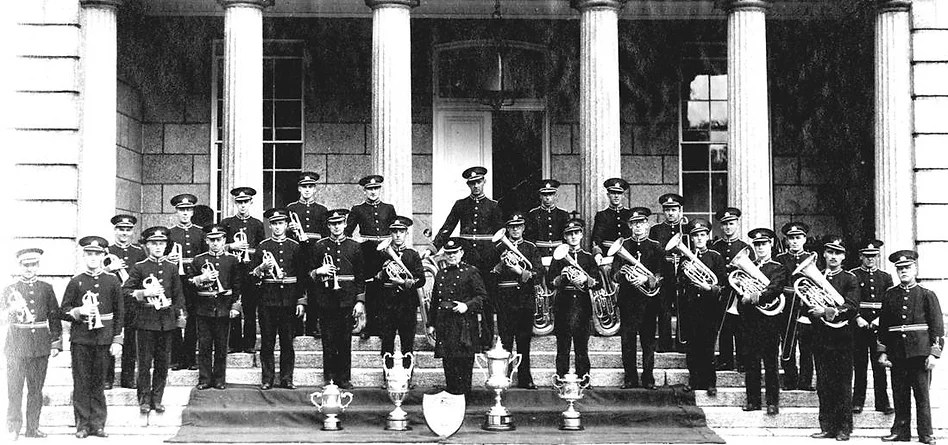
Camborne Town Band display their impressive silverware on the steps of the Wesleyan Chapel in 1936. Alfred W. Parker stands centre-stage13

That acquaintance was the esteemed conductor of the Camborne Town Band, Alfred W. Parker. Parker had formerly played in the Kirkby Colliery band, situated in Kirkby-in-Ashfield, Notts. Kirkby was only a couple of miles from Larwood’s birthplace, Nuncargate, and Annesley Colliery, where he had worked as a boy14.

Obviously a cricket nut, Parker was more than aware of the challenges faced by Camborne CC in 1934. The club began the season in a state of

…financial chaos…

Cornishman, September 13 1934, p11

Debts totalled £224. That’s £12,931 today. In any era, that’s a serious deficit15.

Various ventures were undertaken to alleviate the monetary stress. The club’s secretary, Stanley Williams, undertook what he called the “ten thousand sixpences” scheme. This involved him walking around Camborne and cadging shrapnel from anyone in sight for the club’s coffers16.

Luckily for the club, Parker had the contacts, and the imagination, to think bigger. He must have approached the committee with his plan:

Arrange an end-of-season game…our lads against a County Invitation XI…charge entry…we’ll split the profits 50/50…why? I can get you Larwood and Voce

So Parker wrote his letter, and probably said “top-hole”17 when Larwood sent the following response:

Both dates (Sept. 14, dance, Sept. 15, cricket), will suit us, so we will leave everything with you, the only request we both make is, No speech-making by either of us. Looking forward to our visit…

Cornish Post and Mining News, September 8 1934, p6

Larwood wasn’t about to utter anything about Bodyline in public again in a hurry, and Voce, as ever, took his lead.

Grinning, Parker went quickly back to the committee. Raising two teams shouldn’t prove difficult – who would turn down the opportunity of telling their grandchildren they once played with Larwood and Voce – and he wanted to get the rumour mill grinding for his coin-spinner18.

Bodyline at North Roskear

Action from a game at Camborne, 1930s. From Nostalgic Camborne, Facebook

There was a strong agitation for the inclusion of these two outstanding bowlers in the England team against the Australians…but for some mysterious reason neither took part…

West Briton, September 17 1934, p3

6,000 people at North Roskear cheered Larwood and Voce to the rafters as they took to the field. No doubt both were rather bleary-eyed after spending the previous evening hosting a dance given in their honour at the Town Hall, with Camborne Town Band providing the tunes19.

6,000 people watched Larwood (who, with Voce, was representing Camborne) thunder downhill at the batsman awarded the dubious honour of taking first dig.

This was Falmouth’s Wearne Cory, an ex-Camborne player good enough to score a hundred against his old team the previous season20.

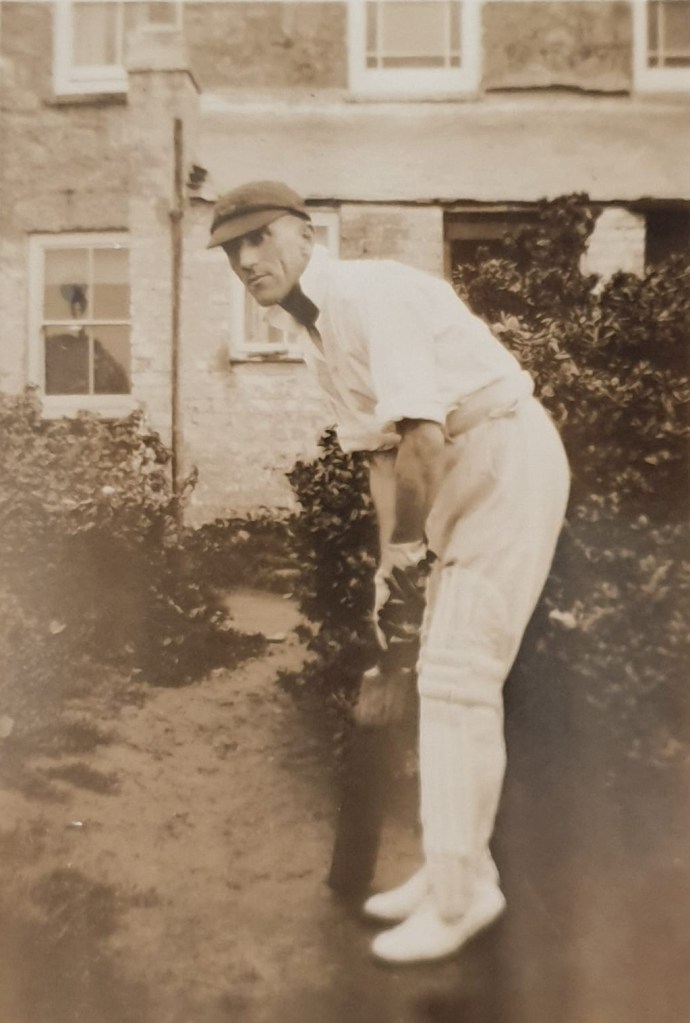
Wearne Cory takes guard in his mother’s back garden, Barripper Road, 1925. By kind permission Tom Cory, Nostalgic Camborne, Facebook

The ball whistled past his ear before he could even react. The ‘keeper, Liskeard’s G. H. I. Bickford, a Cornwall captain21, was slow on the uptake also and Larwood’s missile scorched toward the boundary. The crowd roared its approval.

Make no mistake: ‘The Wrecker’ was in town.

This wasn’t so much a game of cricket as an exhibition of just how good – or lethal – Larwood and Voce actually were. The result was immaterial; indeed, the County XI batted a second time, just to give the evening spectators a look at the Notts’ speedsters. As the West Briton noted,

…they gave a demonstration of how destructive they could be when fully extended…

September 17 1934, p3

Several players even joined the autograph hunters to get their own bats signed. Others received more immediate, or physical, mementoes.

Voce worked up such a head of steam that he dislocated Bickford’s finger when he managed to gather one of his deliveries. Not wanting to leave the field, a local physician popped Bickford’s stray digit back into its socket and he was able to continue.

George Rogers, one of six Camborne players to be selected for Cornwall that season22, was seriously roughed-up by Voce before one of his exocets broke his bail. Larwood, not to be outdone, made a total mess of one tail-ender’s wicket and actually reduced one of M. G. Cullen’s stumps to kindling. Both items were claimed as souvenirs.

(When playing for Notts, Larwood did this so often that spare sets of stumps were kept handy whenever he was operating.)

St Austell’s L. Martin would win a Jack Hobbs bat award in 1935 for his unbeaten 138, made against Fowey23. Larwood smashed him with a delivery to the face and there was a stoppage in play for several minutes.

This was serious. In Australia, a similar Larwood effort had fractured Bertie Oldfield’s skull. But Martin played on.

Bertie Oldfield about to collapse on the pitch after wearing a Larwood bouncer in the Adelaide Test24

Oldfield famously didn’t blame Larwood for his injury (he was one of very few Australians to do so), and similar happened at North Roskear:

…no blame could be attached to the bowler, as Martin leant forward to hook the ball, but it kicked…

West Briton, September 17 1934, p3

Lest we forget, both Notts men could hold a bat too. Voce was a dangerous lower-order hitter, and Larwood…well, Larwood had made 98 in Australia as a night-watchman.

So when their turn for Camborne came, they put on 70 runs in under half-an-hour of glorious, uninhibited slogging.

Voce smoked three sixes and nine fours, including a massive heave into New Dolcoath mine. In local parlance, whenever a batsman dismisses the ball to that location, it’s known as went stack.

This was no shameless tonking of a below-par attack. Cullen, the bowler Voce most took a liking to, was of course out for revenge after Larwood had ruined his stump. He had also forced his way into the Camborne side that season after a promising showing for the School of Mines XI25.

Of course, the crowd, already glutted on the performances thus far, would not have been truly sated unless they saw one thing: a spell of Bodyline. They were to be obliged.

It had probably been quietly agreed beforehand: the Notts’ bowlers would set the field and, if not quite go through the motions, then at least give the public their money’s worth.

In the event, only Voce bowled Bodyline. Larwood, maybe sensing after his earlier exploits that he was simply too rapid for the opposition, declined.

Voce bowls with a Bodyline field in position, Adelaide, 193326

E. M. Cunnack, of Helston, was to be in the firing line, but he was no stooge, and was recognised in Cornish cricket as one of its “outstanding personalities”27. He made over 30, and withstood the threat of Voce who, it was euphemistically noted in the Press, “changed his method” from earlier in the day28.

West Briton, September 17 1934, p3

Successful effort29

From left: Larwood, Voce, and Clarence Paull saunter off the pitch at the end of the day’s play. So, what did you call Bradman again? By kind permission David Wilson, Nostalgic Camborne, Facebook.

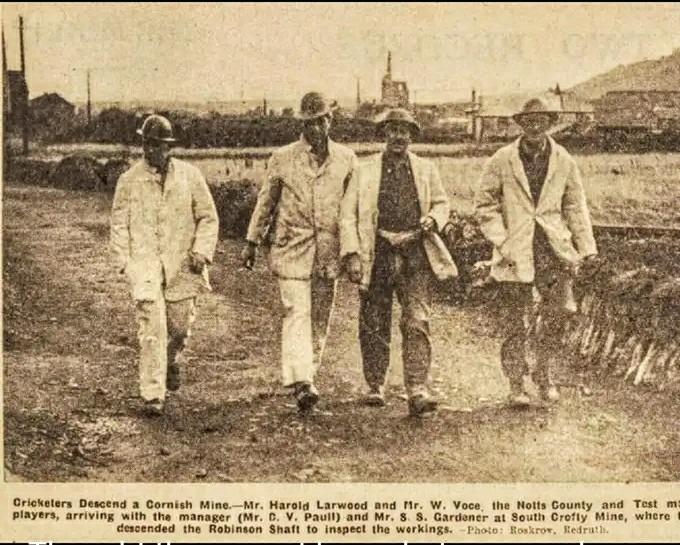
Camborne’s Cricket Club and Town Band realised a profit of over £100 (£5,700 today) which they shared evenly. Larwood and Voce received commemorative tankards for their efforts, and were treated to tours of Crofty and Holmans before returning north. They also each received £12 (£690 today), and were well fed and watered30.

By kind permission David Wilson, Nostalgic Camborne, Facebook.

Camborne CC had gone some way toward clearing their debt, but I like to think that, for those who were lucky enough to be there that day, monetary concerns were an irrelevance. You can see it on the peoples’ exhilarated, smiling faces in the photograph below.

Harold Larwood and Bill Voce, seated middle row in caps, flank the Camborne skipper Clarence Paull, North Roskear, Saturday September 15, 1934. Courtesy Mark Richards, Camborne CC.

They had witnessed something unforgettable. They had seen Harold Larwood bowl.

Many thanks for reading

References

  1. The Cornish Post and Mining News of September 22, 1934 (p6) puts the total number of spectators at 6,000. The West Briton of September 17, 1934 (p3) says 5,000. The Newquay Express of September 20, 1934 (p12) estimated 4,000. Let’s go with the bigger number.
  2. Cornish Post and Mining News, September 8 1934, p4.
  3. Cornish Post and Mining News, September 13 1934, p4.
  4. From: https://www.roddas.co.uk/
  5. In those days, the ‘alpha-XI’ of Cornish cricket was determined each season by the winner of the top Western League playing their Eastern counterpart, on neutral territory. The victor – Cornish Champions – were presented with a fine trophy, which was sponsored by the Western Morning News. Camborne won this trophy every season from 1927-1933.
    In 1934, the News commissioned a brand new trophy, allowing Camborne to keep the old one in perpetuity. They won that too. See the Western Morning News, January 15 1934, p5&8, and the Cornishman, September 13 1934, p8.
  6. From his obituary in the Cornishman, November 24 1949, p2. Gates were opened in his memory at Camborne’s North Roskear ground in 1950. From the Cornishman, July 27 1950, p9.
  7. From the West Briton, March 26 1981, p52. The obituary also mentions Rogers’ less-than sensitive nickname: Darkie.
  8. In fact, 1934 was the inaugural season of the popular Vinter Cup, an evening knockout competition. I remember the ‘Final Night’ being the busiest of the year for Camborne CC, with the ground at maximum capacity. See the Western Morning News, May 15 1934, p14.
  9. The details of Larwood’s life, career and the events of the 1932-33 Bodyline Series are taken from Harold Larwood, by Duncan Hamilton, Quercus, 2009. Also highly recommended is David Frith’s Bodyline Autopsy, ABC Books, 2002.
  10. From: https://www.espncricinfo.com/photo/bill-woodfull-drops-his-bat-after-being-hit-by-harold-larwood-316667
  11. In 1935, the MCC decreed that ‘direct attack’ bowling (ie, Bodyline) was unfair and was the responsibility of the umpires to identify and stop. It wasn’t until 1957 that the laws were altered, permitting only two fielders behind square on the leg-side. From the Wikipedia page on Bodyline.
  12. From Harold Larwood, by Duncan Hamilton, Quercus, 2009, p195.
  13. Image from: https://www.camborneband.com/PHOTOGALLERY
  14. If Camborne’s cricket team were a source of civic pride, they were rivalled in this respect by the town’s brass band. Under Parker’s leadership, Camborne Town Band became “generally recognised as one of the premier brass bands in the country”. During his twenty-plus year tenure, the band won a whole host of accolades, enjoyed regular live broadcasts by the BBC, and even performed at the Royal Albert Hall. See the Cornish Post and Mining News, January 31 1925, p5, and the West Briton, October 25 1951, p5. That Larwood worked at Annesley is asserted by his Wikipedia entry here. The West Briton of February 12, 1931 (p6) asserted that Parker was in fact Larwood’s brother-in-law, but this cannot be true as Larwood only had brothers, according to Duncan Hamilton’s biography (p51). I am grateful to Mr Martin Gilbert for showing me this last reference.
  15. Cornish Post and Mining News, September 22 1934, p6.
  16. Cornishman, June 7 1934, p6.
  17. The phrase was uttered by Parker on at least one occasion: Cornishman, November 17 1949, p3. He was commenting on his band’s performance at the Royal Albert Hall.
  18. The rumours first saw print in the Cornishman, August 30 1934, p6, and were confirmed that same day in the West Briton, p6. The Cornish Post and Mining News of September 1 1934 (p5) retold the whisper that Larwood had “half promised” to visit Camborne for a year or two. Indeed, he had previously threatened a visit, according to the West Briton of February 12, 1931 (p6). Clearly, Parker and Camborne CC were content to feed the Press and stoke the publicity.
  19. The narrative of the match is taken from the West Briton, September 17 1934 (p3), Newquay Express, September 20 1934 (p12), and Cornish Post and Mining News, September 22 1934 (p6).
  20. Cornishman, September 14 1933, p6.
  21. Western Morning News, June 24 1936, p12.
  22. Cornishman, July 12 1934, p6.
  23. London Daily News, July 12 1935, p6.
  24. From: https://commons.wikimedia.org/wiki/File:Bodyline_3rd_Test_Oldfield_02.jpg
  25. West Briton, May 3 1934, p9, and Cornish Post and Mining News, May 5 1934, p6.
  26. From: https://www.espncricinfo.com/photo/bill-voce-bowls-to-bill-ponsford-with-a-bodyline-field-316668
  27. Cornishman, November 29 1934, p10.
  28. Cornish Post and Mining News, September 22 1934, p6.
  29. From the West Briton, September 27 1934, p7.
  30. Cornishman, 20 September 1934, p5, and West Briton, September 27 1934, p7.

The Cornish Butter Boycott of 1920

Reading time: 25 minutes

…the great edifice of nineteenth-century civilization crumpled in the flames of world war…

Eric Hobsbawm, Age of Extremes: The Short Twentieth Century 1914-1991, Abacus, 1995, p22

Men who had fought in the war came home to be starved.

Unnamed miner, Cornishman, February 11 1920, p2

Comrades…

Graphic, December 9 1916, p755

West Penwith, Saturday, February 7, 19201. Policemen are nervously guarding the Genatosan Factory at Stable Hobba, near Newlyn. A subsidiary of Sanatogen, the works produced ‘tonic food’2 and other dairy products. Consequently, it purchased a lot of milk in the region.

Illustrated London News, February 20 1909, p292

The officers – there’s only four of them – scan the road ahead and check their watches. Somewhere, a thousand striking men and women are coming.

And they’re hungry.

Cornwall hadn’t seen a march for food in over seventy years, but everyone knew the drill3.

St Just’s town crier had let it be known the night before. The following morning, miners from nearby Geevor and Levant joined forces. The workers at the Holman’s Foundry, Tregaseal, downed tools and went to join them for a rally in St Just Town Square, where a councillor addressed them as “Comrades all”4.

Leading them was Arthur Wilkins of the Workers’ Union, and Jasper Richards of the Dockers’ Union. They asked of their followers that they should

…keep within the strict observance of the law…in a legitimate constitutional fight.

West Briton, February 9 1920, p2

Off they went, for a seven mile cross-country stank to Stable Hobba. The clayworkers of Balleswidden joined them en route. The numbers swelled.

Peaceful or not, constitutional or not, a thousand people on a protest march is an awesome, intimidating sight.

Hence the presence of law and order at Stable Hobba.

Let’s ask the obvious question: why is all this happening?

…a state of chaos

Cornish Post and Mining News, January 3 1920, p2

Not for the last time, Cornwall was experiencing a cost-of-living crisis. “There are”, asserted Arthur Wilkins,

…two essentials to maintain life today, milk and fat.

Cornishman, February 11 1920, p2

By ‘fat’, Wilkins meant butter. Margarine, introduced in the war as an ersatz alternative to butter5, was an object of scorn, an item

…not fit for human consumption…it is 80 per cent water and 20 per cent nothing…If margarine is not fit for food for the upper classes, it is not fit food for us…

Cornishman, February 11 1920, p2

At Penzance Market in January 1914, butter was available at 1s 3d/lb6. Then war began, and the UK, heavily reliant on imported foodstuffs from its Empire, was threatened with defeat-by-starvation courtesy of the German U-boats7.

By 1916, and with pricing now under Government control as a result of the crisis, butter now cost 2s 6d. Even this was “sixpence too much” in the eyes of many8.

Now, in February 1920, butter was to go back on the free market9. Inflation could be the only result. “We shall never again see”, remarked one commentator,

…the prices of milk and butter back to anything like what they were before the war.

“Argus”, West Briton, January 5 1920, p5

With control now lifted, butter now cost 5s 6d/lb11. From 1914 to 1920, that’s an increase of 340%.

340%.

The Holman’s Foundry at Tregaseal, 1900s. From the Royal Cornwall Museum

The wages of many hadn’t correspondingly increased either11. In 1920, it was far cheaper to import foreign tin than have it mined in the UK, with the attendant disastrous results for Cornwall’s primary industry. Tincroft Mine was shouldered with debts that year of £13,107 – that’s nearly £469,000 today. By July 1920 nearly 300 workers had been laid off at Grenville and Dolcoath. The number of men unemployed in West Cornwall alone stood at 3,000. Soldiers returning from the Front could find no work. Many emigrated12.

“I thought”, grumbled one miner,

…our boys went out to war for liberty and freedom, but it does not look like it.

West Briton, February 9 1920, p2

Men could no longer

…stand by and see their wives and children go short…

Cornishman, February 18 1920, p2

“We cannot get”, said Arthur Wilkins, “milk for our kiddies”13. Milk, also unfettered by Government price control, was as exorbitantly expensive as butter – and it took two-and-a-half gallons of milk to make one pound of butter14. Cornwall was heading for a “state of chaos”15.

Hence the march to the Genatosan Factory, perceived as a major drain on local dairy produce.

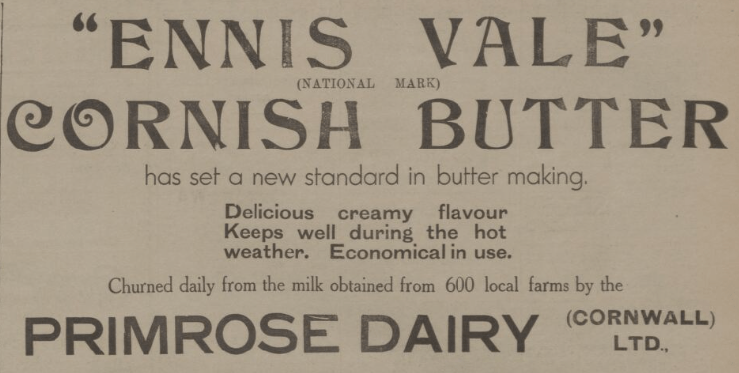
The Primrose Dairy at nearby Sancreed avoided any trouble. Though founded in 1910, it only really began expanding in the 1930s. From the Cornishman, July 11 1935, p11.

Butterless…

A fine example of a Genatosan van. From the Remember Loughborough Facebook Page

Messrs. Telfer and Marsden of the Genatosan works received the marchers’ deputation, led by Wilkins and Richards, “courteously”16.

It pays to be polite when a thousand-strong mob is at your gate, and Genatosan had been the object of the locals’ ire in the recent past17.

Wilkins and Richards were sharp enough to realise that might was on their side, and could infer that Telfer and Marsden felt intimidated, police guard or not.

They also knew that giving their forces the word to raise hell would ultimately solve nothing. Wilkins would later remark that

I want to prove to these people that we have got as much dignity as they have…

Cornishman, February 11 1920, p2

As chief prosecutors in the enquiry, Wilkins and Richards issued no threats to the Genatosan men. They didn’t need to.

The disgruntled fellow-members of the deputation did that for them.

Thus, the unspoken sub-text of the whole discussion was something like this:

Treat us reasonably now, and negotiate some sensible options…or…

It was a masterly display of silk glove, iron fist.

For example, the marchers wanted to know why the price of butter, once 2s 6d/lb under control, was now so much higher.

Genatosan’s reply was that, obviously, because milk was so dear: 3s 3d/gallon. Lest we forget, it took over two gallons of milk to make a pound of butter.

Wilkins dismissed this. The way he saw it, the farmers were profiteering. Furthermore, and equally obvious to everyone, there was a milk shortage “all over the place”18.

One of Wilkins’ entourage then bulled his way forward: the Genatosan vans took all the milk in the area, he asserted, and kept the prices high:

The carts come and take the milk away, and we are butterless.

Cornishman, February 11 1920, p2

Wilkins called this “exploitation”19. You’re profiteering, just like the farmers.

Marsden and Telfer’s counter-claim, that they had actually been producing butter at a loss, provoked cynical laughter. (They claimed that Government control had kept the price falsely low.) One man asked:

Are you prepared to withdraw your carts from the district?

Cornishman, February 11 1920, p2

Telfer, hastily, refused. The response his refusal garnered told him his side weren’t the only ones prepared to play hard-ball:

Then we shall have to stop it.

Cornishman, February 11 1920, p2

We can imagine a staring contest. Wilkins then interposed, airing his opinion that the factory could sell butter for 2s 6d/lb…if they really wanted to…

Another forthright statement was heard from a local miner:

We’re out for butter at 2s 6d, and we’re going to have it…Can I afford to pay 4s 6d for butter? No, I have to eat margarine and go down Levant mine to work. I’m not going to have it.

Cornishman, February 11 1920, p2.

The screw was tightening. Marsden and Telfer offered to supply their milk to St Just.

Wilkins and Richards waited patiently, politely. Is that the best you can do?

The Genatosan men didn’t exactly crumble, and they bought themselves some breathing space. If Wilkins and his entourage could get the farmers to sell butter at 2s 6d, Genatosan would transport the farmers’ milk to their factory, produce the butter (keeping the skimmed milk for themselves), and have the farmers sell the butter at the agreed price.

It sounded good. Everybody got something: Genatosan, free skimmed milk (and their factory left intact); the marchers, butter at what they perceived to be a ‘fair’ price; and the unpopular farmers could make some money and give their standing in the community a much-needed boost20.

Wilkins was sure he could convince them.

The marchers and their leaders left for Newlyn and Penzance, where they received a heroes’ welcome for their “courageous action”21.

Marsden and Telfer very probably reached for one of their company’s tonics: a large one.

Even when a Genatosan van was later attacked in Penzance and a few pails of milk thrown into the quay, Wilkins was happy to play peacemaker. Rome didn’t have to burn for him to win the battle. But it could burn, all the same, if required.

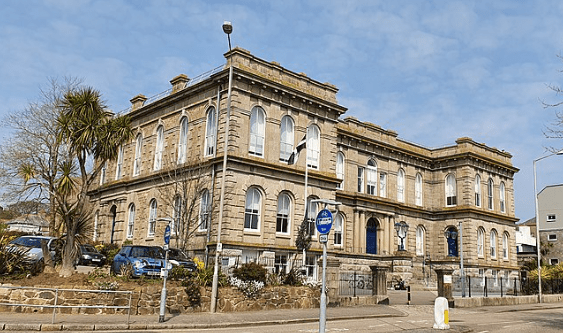
St John’s Hall, Alverton St, Penzance. Formerly the Public Buildings

Questions were asked in Parliament regarding the gunboat diplomacy at Stable Hobba22, but Wilkins and Richards had little or no time for the current coalition government. In a rousing speech given in front of Penzance’s Public Buildings Wilkins described Lloyd George and Churchill et al as “this crowd”:

We have been told for the past five years that we have been fighting a despotism that would enthral this country in slavery. Our women have given their sons and husbands to go out and fight against this horror…

(Jasper Richards may have felt a trifle uncomfortable here: during the War, he had been a conscientious objector23.)

But has there ever been in the world’s history a law laid down, written, unwritten or spoken, that there should be one class of people born into this world who must work, work, work, and then barely live, with no beauty in life, no recreation, but like worms and earwigs, simply crawl through life, and at the end be thrown on the scrap heap…

Cornishman, February 11 1920, p2

Not that Wilkins was all bombast. On Saturday February 14, a week after the march, a “factory lorry” delivered butter for sale at 2s 6d to Geevor, Levant, and the Holman’s Foundry24.

A “pest to society” is how a “local dairy concern” described Wilkins. One can easily infer the name of the company. Conversely, others believed they owed Wilkins a

…debt of gratitude…

Cornishman, February 18 1920, p2

For or against, his community had secured an affordable supply of butter, and he’d pulled it off without any major disturbances.

Will know the reason why…

1879 map of Redruth, detailing where the main disturbances in 1920 took place25

For just under a month, the march on the Genatosan Factory remained an isolated incident. Many other Cornish districts lacked such an obvious target of opprobrium.

Many people in these districts also lacked the means with which to pay such excessive sums for essential goods.

The simple solution was to go without – a boycott. You may believe that the decision of, say, a few dozen people to keep their purses shut would have a negligible affect on the dairy industry.

But people shunned butter in their thousands:

A determined boycott of butter is being made throughout the country, and local trade in this produce is practically at a standstill.

West Briton, February 12 1920, p4

At Penryn Market on Saturday February 7, there was no butter sold.

Likewise in Helston.

At Truro on Wednesday 11th: “no sale”26.

There were complaints of butter being overcharged in Newquay – not that anyone bought any.

The shoppers of Lostwithiel enjoyed a period of “abstention” from butter27.

The Camborne Food Committee resigned en bloc, citing overwork28.

Those that could, sought to employ servants skilled in the art of butter-making29.

Union organisers encouraged the boycott and protests in general. We’ve met Arthur Wilkins, but Camborne’s William Uglow was cut was from the same cloth, later being described as the “People’s Champion”30.

At a protest meeting he chaired, it was stated that

The workers did not want riot or bloodshed, but they could not stand by and see their wives and children go short…If the price of butter was not reduced, the workers in that division would know the reason why.

Cornishman, February 18 1920, p2

(This wasn’t the first time Uglow had taken up the cudgels against high prices either31.)

The West Briton‘s reporter-at-large interviewed some of Truro’s “dairymen and provision merchants” to give the reader a sense of matters32:

  • Some asserted that the boycott would lower prices;
  • Others believed the boycott wouldn’t lower prices, as producers/farmers would send their milk and butter upcountry;
  • Some thought the Railwaymen would refuse to send butter out of Cornwall;
  • Others reckoned butter was going out of Cornwall: local supply depots bought surplus butter – of which there was a glut – at the given price, and kept prices high.

Even the farmers refused to further hoick up the cost of dairy products, as requested by their own Union:

We are a hated class now, and if we carry out the resolution sent us from Truro we shall be hated more.

West Briton, February 9 1920, p2

Clearly, something had to give.

And it gave in Redruth.

Chuck him out…

Market Way, Redruth, 201933

The Buttermarket might well be the apple of the Redruth regeneration scheme’s eye34, but in its former incarnation the place was no stranger to disturbances or unsavoury goings-on.

For example, in 1819 a man successfully negotiated the sale of his own wife there. Then, during the food riots of 1847, a crowd of 5,000 starving people ransacked the market and raided local stores35.

The market on Alma Place, Redruth, c1915. The entrance to Market Way is in the background36

On Wednesday February 25, Union officals presided over a large, open-air meeting in the town to “protest” against the high price of butter. It was understood that

…the employees of the various mines…will assemble [on Friday] and march to Redruth to meet the butter retailers as they enter the town…

West Briton, February 26 1920, p2

Friday 27th was market day37.

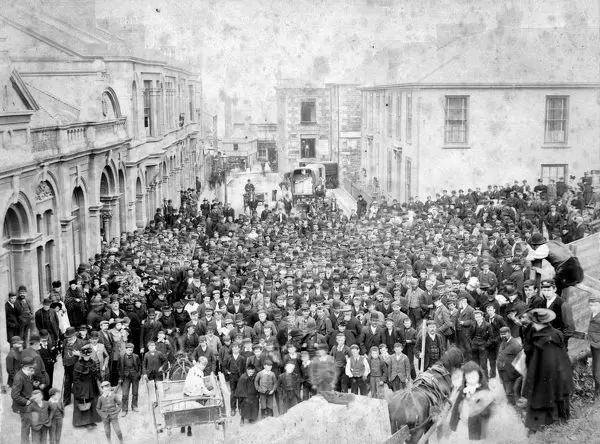
A photo of an earlier protest on Alma Place and Station Hill, 1889. Over a thousand people congregated in the same place on February 27, 1920. Image by James Chenhalls.

8.30am. The miners of East Pool, Tincroft, Tresavean and South Crofty downed tools and marched on Redruth. Their employers let them go – the men had no grievance with them (or not that much), and after all, this was an official, Union-sponsored protest.

Would it go off without a hitch, as at Stable Hobba?

En route, the several hundred miners gained reinforcements. By the time a halt was called, 1-2,000 people filled Station Hill and Alma Place to hear the speeches, of which a selection is given here:

…the price of butter must come down to 2/6…in a land of plenty the working man could not afford to buy the daily essentials of life…The Government…could not build an A1 worker on C3 diet…It was time they rose up…in order that men might live…

West Briton, March 1 1920, p2

Whilst all this was being cheered to the heavens, one man did rise up.

The wrong man, at the wrong moment.

Mr Tregurtha, a farmer and butter-dealer from North Country, stood on a chair to express his solidarity. He seriously misread the crowd.

Another voice rose up:

Chuck him out…

West Briton, March 1 1920, p2

It was the catalyst. Tregurtha was dragged down, and beaten up. He took cover in a shop on Alma Place.

For several hundreds gathered there, marching through Redruth as part of a peaceful protest was not the immediate solution they had been hoping for.

Instead, they rioted in the Buttermarket, demanding 2s 6d/lb for butter, and assaulting any dealer who refused. So reckless were they, some precious butter was spoiled.

Several dealers got the hell out of town. Others concealed their wares in the back-streets, and thus evaded detection by the mob, who were relentless in their quest.

Local grocers’ shops – even a private dwelling – were raided, the elderly female proprietor of one establishment forcing the invaders to beat a hasty retreat by threatening them with a knife.

Alas, any dialogue that might have occurred during the above incident is lost to history.

Mr Dunstan, a dairy farmer from Wendron, unwisely drove his heavily laden goods vehicle straight down Clinton Road toward the crowds on Alma Place.

Opting for discretion over valour, he ‘agreed’ to sell all his butter for 2s 6d, and enjoyed a roaring trade. He also went home unmolested.

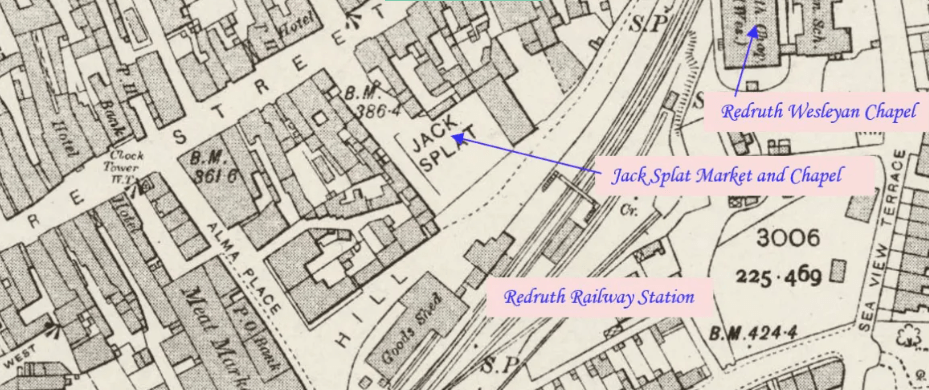
Another van was commandeered in the area of Station Hill known as Jack’s Splat (see map above). From here, butter, milk and eggs were distributed freely, to much celebration.

Redruth Market, c1870. Note the wooden railway viaduct in the background. Kresen Kernow, ref. corn02860

The dealers that had remained in Redruth took the hint: 2s 6d, or else. By “early afternoon”,

…there was no butter to be purchased in the town.

Cornish Post and Mining News, February 28 1920, p5

Butter must come down…38

Cornish Post and Mining News, March 6 1920, p5

While all this was happening, the Workers’ Union were negotiating a price of 3s/lb for butter at next week’s market with the Farmers’ Union.

As claimed by the Genatosan men, the farmers contended that the government price had been too low, and they had actually sold at a loss. Be that as it may, 3s/lb was the going rate announced to the crowd waiting on Station Hill.

And then the news of the disturbance broke. It was publicly condemned by the representatives of the Workers’ Union (what their private thoughts were is unknown), and they were exonerated in the Press:

The Trades’ Union leaders were not in the least responsible for the few unpleasant incidents…

West Briton, March 4 1920, p2

The blame was put on a few (or several hundred) bad apples, and they were never caught.

The immediate effect, with William Uglow actively campaigning for higher wages in Camborne’s mines39, was a near-total breakdown of the dairy market.

Further negotiations with the Farmers’ Union for a price of 3s/lb for butter broke down40.

Redruth’s tradespeople, and the people who came to Redruth to trade, protested against the actions of the protesters themselves41.

At the next market day in Redruth, March 5, the traders performed a boycott of their own, despite a heavy police presence protecting against undesirables. There was

…little butter in the market.

Cornish Post and Mining News, March 8 1920, p2

There was still stalemate a week later. The Union wanted 3s/lb, the farmers, 3s 3d. Many women, doubtless throwing up their hands in frustration, voluntarily paid 3s 3d for what butter there was in Redruth. It was observed that

…the workers’ wives thus showed they had far more sense than their husbands’.

Cornishman, March 17 1920, p7

Even as late as May, the two sides were at loggerheads42.

It wasn’t until early June that the price of butter finally came down to 2s 6d/lb43. The butter boycott had finally succeeded where negotiating, protesting and rioting had ultimately failed:

When control is absent, price is determined by the demand.

“Argus”, West Briton, February 9 1920, p2

Many thanks for reading

References

  1. The narrative of the march is taken from the West Briton, February 9 1920, p2, and the Cornishman, February 11 1920, p2. The events are also recalled here: https://www.penwithlocalhistorygroup.co.uk/on-this-day/?id=38
  2. For a survey of the early history of protein powders, see: https://www.tandfonline.com/doi/full/10.1080/20549547.2021.2010977
  3. See my series on the Cornish food riots of 1847 here. For Cornish food riots, see John Rule, Cornish Cases, Clio, 2006, p35-74; for food riots in general, see E. P. Thompson, Customs in Common, Penguin, 1991, p259-351.
  4. Cornishman, February 11 1920, p2.
  5. See Matthew Richardson, The Hunger War: Food, Rations and Rationing 1914-1918, Pen and Sword Books, 2015, p99-129.
  6. West Briton, January 22 1914, p2.
  7. See Matthew Richardson, The Hunger War: Food, Rations and Rationing 1914-1918, Pen and Sword Books, 2015, p99-129.
  8. West Briton, February 9 1920, p2.
  9. Decontrol of dairy products was noted in the West Briton, March 18 1920, p2.
  10. West Briton, February 9 1920, p2.
  11. Cornishman, February 11 1920, p2.
  12. See: West Briton, February 23 1920, p2; Cornishman, Febuary 11 1920, p4 and February 25 1920, p2; Cornish Post and Mining News, July 3 1920, p2.
  13. Cornishman, February 11 1920, p2.
  14. West Briton, February 9 1920, p2.
  15. Cornishman, January 28 1920, p2.
  16. Cornishman, February 11 1920, p2.
  17. The works had been accused of misuse of milk. See: West Briton, December 27 1917, p4.
  18. Cornishman, February 11 1920, p2.
  19. Cornishman, February 11 1920, p2.
  20. Even the farmers’ themselves knew their name was mud: see the West Briton, February 9 1920, p2.
  21. Cornishman, February 11 1920, p2.
  22. As recorded here.
  23. See the Cornishman, April 6 1916, p8.
  24. Cornishman, February 18 1920, p5.
  25. For more on the ‘Jack’s Splat’ (there were various spellings) area of Redruth, see here.
  26. All from the West Briton, February 12 1920, p4.
  27. Both from the West Briton, February 26 1920, p5.
  28. Cornish Post and Mining News, February 28 1920, p5.
  29. As advertised by a St Austell family in the West Briton, February 26 1920, p1.
  30. Cornishman, April 3 1947, p5.
  31. See the West Briton, November 20 1919, p4.
  32. These are taken from the West Briton, February 9 1920, p2.
  33. From a feature article on the Buttermarket here.
  34. For more on the regeneration project, go here.
  35. See my post on the wife sale here; for more on the food riots of 1847, see my post (as part of a series) here.
  36. From: https://docs.planning.org.uk/20210927/5/QZB64GFGG4900/djcoie5tfixr4xme.pdf
  37. The narrative of the protest, riot and aftermath is taken from: Cornish Post and Mining News, February 28 1920, p5; West Briton, March 1 1920, p2, and March 4 1920, p2.
  38. West Briton, March 4 1920, p2.
  39. Cornish Post and Mining News, March 6 1920, p5.
  40. Cornish Post and Mining News, March 8 1920, p2.
  41. West Briton, March 4 1920, p5.
  42. West Briton, May 20 1920, p4.
  43. Cornishman, June 2 1920, p3.

The Wheal Agar Disaster of 1883

Reading time: 20 minutes

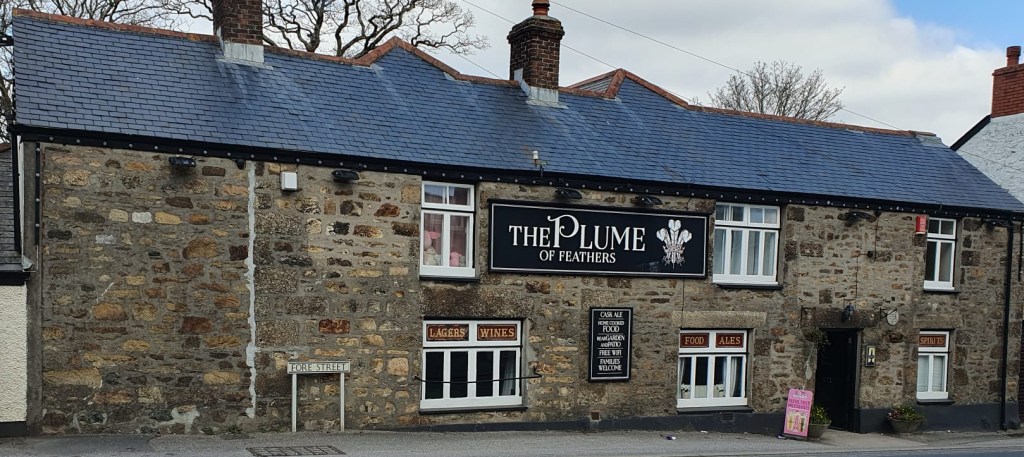
Memorial plaque on the Plume of Feathers pub, Pool. Now part of a popular walking tour1

Home in his bed…2

It’s around 7am on August 15, 1883. On 190 Fathom at Wheal Agar, off Agar Road, Pool, the night core is waiting to come to grass.

Unlike the nearby Dolcoath Mine, there’s no Man Engine here. Ingress to and egress from the mine’s levels are achieved by use of ladders, or riding in the cage.

Agar’s iron cage, also known as a gig or skip, was of a bespoke design, fashioned on-site for the particular contours of its own shaft. It had two compartments for miners to stand in, and wooden runners attached to the sides of the shaft steadied its passage.

There was no official carrying capacity for the cage, but riding on top was strictly forbidden. Notices prohibiting this practice had been posted in prominent areas around Wheal Agar, and several miners had been caught and fined.

Example of a double-compartment cage in the Rhondda Valley, 1972. Photograph by David Hurn

It’s unknown if there was a barrier, or gate on the skip; probably not, if we consider the design of Wheal Dolcoath’s own four-man skip:

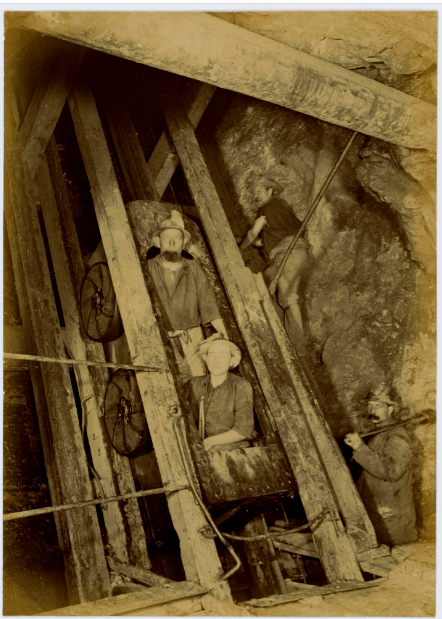
300 Fathom, Wheal Dolcoath, 1890s. Image by J. C. Burrow. Kresen Kernow, AD460/1/133

A journalist who rode down Dolcoath’s skip urged his readers to

Imagine yourself swung over a cliff half a mile high, and being lowered in an iron cage, to the bottom by a rope.

Cornishman, January 12 1893, p6

At Wheal Agar the cage was lowered and raised by a whim engine, the rope being wound round a rotating drum.

The cage was watched to grass by a lander, who in this instance was John Long. He would notify the engineer on shift, John Harris, by means of a bell as to when he ought to raise, lower, and decrease the rate of the cage.

The whim-rope had indicators on it to inform Long what depth in the shaft the gig was at.

All this was standard mining practice, and in keeping with regulations.

The Whim Engine at Levant Mine4

However, in the early hours of the 15th, the whim-rope was discovered to be faulty.

Sub-agent Ralph Daniell, the man in charge that night (Captain William Trevena was at home), had the damaged rope removed and replaced with a steel capstan rope.

This capstan had a normal breaking strain of 40 tons. The weight of Wheal Agar’s cage, even containing a number of miners, was estimated at around 2-3 tons. Daniell later stated that he’d feel as safe riding in the cage with that capstan as being

…at home in his bed.

West Briton, August 16 1883, p4

However, on the Saturday the capstan had been employed in lowering 20 tons of pumping gear underground. HM Inspector of Mines for Devon and Cornwall, Robert James Frecheville (1847-1930), was of the opinion that

It would be the duty of the managers to see that a rope after being subjected to such a strain was not used for raising men.

Cornish Telegraph, August 25 1883, p5

Also, the capstan had no indicators on it. Long, the lander, and Harris, the engineer, would be operating largely by guesswork.

As Frecheville observed, under the Metalliferous Mines Act (1872), this was illegal.

If Harris paid out too much when lowering the skip, the coils of capstan could develop a kink, severely weakening it.

Captain Trevena, the Manager, also said of the capstan that two months previously it had been discovered to be “unsound” and “corroded”, but had since been repaired. As Trevena was, on the 15th, at home in his bed, he was unaware of Daniell’s decision to use the capstan on the cage5.

Is it not your duty?

Wheal Agar today

Daniell, assisted by Thomas Long (possibly a relative of John Long, the lander), and Samuel and William Osborne, attached the capstan to the cage some time before 6am. The checking of this rope was perfunctory at best; indeed, it appears that, at Wheal Agar, regular inspections of rope gear was no one man’s duty.

Samuel Osborne

…could not say whether it was anybody’s business to examine the rope…

Cornish Telegraph, August 25 1883, p5

That morning, Osborne had

…looked over the rope casually…

Cornish Telegraph, August 25 1883, p5

The other Osborne, William, didn’t inspect the capstan at all. In any case, identifying a fault in this rope would have been challenging, caked as it was in layers of tar and grease.

Captain Trevena, though, asserted that

…it was the duty of the lander, with the engineer, to see that everybody connected with the cage was safe.

Cornish Telegraph, August 25 1883, p5

He was pressed on this statement at the inquest. Grenfell, the County Coroner, retorted that

You exercise a supervision over these persons…Is it not your duty to look to the ropes?

Cornish Telegraph, August 25 1883, p5

Trevena’s response to this is concerning now, and may have been equally so in 1883:

We do look at them [the ropes] occasionally. There was no particular time for examining the ropes.

Cornish Telegraph, August 25 1883, p5

Once more…

Miners underground at King Edward Mine, Troon, waiting for their turn to ride in the cage, which is visible in the background. Photo by J. C. Burrow, 1890s. Kresen Kernow, AD460/12

7am, 190 Fathom, Wheal Agar. The cage has already returned one work-crew, or pare, to grass. It descends again. Now another group are ready to come up – well, most of them are. One miner has fallen asleep at his drill, and his comrades decide to leave him where he is.

Both compartments of the skip now have five men in them. A youngster, James Trengove, tries to get on but is turfed out by another young man, Francis Woolcock, 19, of St Agnes. Woolcock isn’t, you understand, concerned about the numbers in the skip: it’s simply not Trengove’s turn.

In any case, there’s no regulations, or limit, as to how many can ride in the gig at any given time. The only verboten act concerns travelling on the cage’s roof.

And, seeing as Ralph Daniell had been called to surface several minutes before (he had been due to ride with this pare), there’s nobody around to enforce this rule.

Thus, three men, including James Carbis of Gilly Hill, Redruth, scramble on top of the cage.

The cage is now carrying thirteen miners.

Away it goes.

There are hymns sung on the way up, which may have been led by Henry Thomas, 17, of North Country. Not only a scholar at his local Sunday School, he’s also a member of the Band of Hope.

In fact, many in the gig are religious men. Edward Dawe, 19, plays in the Redruth Mission Band.

Redruth Mission Band, c1880s-90s6

Charles Trevena, 27, is a member of the Redruth Philanthropic Society, as well as being a teacher at Carn Brea School. He might be thinking about getting home to his wife and children.

Likewise Joseph Roberts, 43, of Illogan, a noted United Methodist Preacher.

Giving full voice in the cage with Woolcock, Osborne, Thomas, Carbis, Dawe, Trevena and Roberts are Paul Pope, 23, and James Caddy, 21, both of Illogan. There’s William Cavill, 27, from Redruth, and 19 year-old Thomas Richards of Mawla.

George Clemens, 27, and Thomas Cock, 18, live on Bullers Row, Redruth. Both are going home to widowed mothers.

Waiting at surface, hand patiently on the bell-rope to notify Harris when to halt the engine, is John Long.

Up the cage comes. The top two feet are now visible in the morning light. Long can see the tops of the miners’ heads. Waiting to go down on the gig is an elderly miner. He recognises Charles Trevena:

Well Charley, you are got up once more…

Trevena replies,

Once more.

Cornubian and Redruth Times, August 17 1883, p7

Two other men, Lenten and Symons, are poised to take their spots on the gig.

Suddenly, Long “heard something going”:

…I glanced up to see what was the matter…one of the men, I cannot tell his name, said “What is that going up over head?” I perceived the rope was parting…

…Carbis was on top of the cage, and he sprang off, and at that same moment the cage disappeared. I looked over into the shaft, and heard the men give a despairing cry as the cage went out of view. I was so frightened that I felt my blood almost turn to water.

Cornubian and Redruth Times, August 17 1883, p7

The cry was heard over fifty yards away.

Shaft cage from an unidentified Cornish mine, c1900. Kresen Kernow, c06316

In 1863, the West Cornwall Hospital for Convalescent Miners was opened on Blowinghouse Hill, Redruth, with an accident ward being added in 1871. By the 1880s, over 200 miners were being treated there annually7.

Tragically, Osborne, Clemens, Trevena, Pope, Caddy, Roberts, Cavill, Dawe, Cock, Richards, Thomas and Woolcock were beyond all aid. Those gathered by the pit-head knew they were doomed. They raised the alarm, and sent word to the nearby cottages8.

The violently plummeting cage tore off most of its runners and eventually overturned and crashed at 130 Fathom, where the perpendicular shaft turned underneath itself.

Miners at 190 Fathom heard the commotion and climbed up to 130. But they were already too late.

Over the next 24 hours, bodies were recovered from all levels, going as deep as 235 Fathom. That’s over 400 metres underground.

I’ll refrain from any horrific detail. In Wheal Agar’s makeshift mortuary (the carpenter’s shed9), shocked and grieving families had to be told which lifeless bundle, wrapped in hessian or ‘bal shag’, was theirs to bury.

Identification was nigh-on impossible.

Locking the stable door, after the steed has been stolen…10

West Briton, August 16 1883, p4

Naturally, the disaster cast a pall over the communities of Brea, Illogan and Redruth. Reporters on the spot in these areas noted

…a sad exhibition of sorrow-stricken humanity…

West Briton, August 20 1883, p2

Almost immediately, questions were asked:

  • Why did the rope break?
  • Why was the rope not properly inspected?
  • Why, after the original whim-rope was found to be corroded, did the miners not simply come to grass by ascending the ladders?
  • Why are there not regulations limiting the number of miners in a cage?
  • Why were men riding on top of the cage when it is clearly forbidden by the mine owners to do so?
  • Why was it originally feared that two other miners, Samuel Trevern and John Kent, both of St Day, had been killed? Their clothes had been found in the dry, and they were believed to have been on shift that night. In fact, they were both safe at home, and had clearly found a way of skiving off.
  • Why was there not a brake, or system of safety catches on the cage? Such devices were regularly employed in mines elsewhere, both in the UK and Europe. Indeed, a Redruth man, Prisk, had patented a design.

The argument against this final suggestion went that many Cornish shafts weren’t perpendicular, and actually ran underneath themselves. To be fully secure, a safety cage had to operate in a perpendicular shaft.

However, in relation to Wheal Agar, this argument is fatuous. The rope failed when the cage was less than a yard from the surface, in a perpendicular part of the shaft. Had there been a safety device on the cage, the men would have been saved.

A mini-fever of safety-cage designs was engendered by the disaster, many being demonstrated at that year’s exhibition of the Royal Cornwall Polytechnic Society11.

Many of these questions were raised in the sermon read at the funerals of Trevena and Clemens on Sunday the 19th. The Rev. J. W. Lane “respectfully” asked if the disaster might not

…lead to a more personal sense of responsibility on the part of the employers as regards the safety and comfort of all whom they employ…[had] the access of the miner to his work…hitherto occupied its proper place in the minds of the adventurers..?

West Briton, August 20 1883, p2

Of course, none of the answers to these questions would bring back the deceased of Wheal Agar.

It was simply a case of being

Cornish Telegraph, August 18 1883, p5

The biggest question, however, was this:

Was anyone responsible for the deaths?

Thus the full inquest, to be held on Wednesday the 22nd, was

…awaited with great interest.

West Briton, August 20 1883, p2

Manslaughter

The Plume of Feathers, Fore Street, Pool, where the inquest was held in 1883. The commemorative plaque is beside the lintel above the entrance.

Under the Employers’ Liability Act of 188012, the families of the twelve miners were entitled to three years wages – if it could be proven that the owners of Wheal Agar were in some way responsible for their tragic deaths.

In other words, Ralph Daniell, the man in charge on the night of the disaster, was in trouble.

At the hearing, R. J. Frecheville, HM Inspector of Mines, demonstrated that the capstan rope was internally corroded at the point where it broke.

This rope was only subjected to the briefest of inspections before it was attached to the cage.

Regardless of the capstan’s faulty condition, such a rope should not, stated Frecheville, have been used when it was a question of miners’ lives being at stake.

Furthermore, the capstan had no depth indicators attached, in direct conflagration of the Metalliferous Mines Act (1872).

Daniell readily informed those present that it was he who had taken the decision to have the capstan attached to the cage.

In summing up, Grenfell, the coroner, stated that

If the jury considered the accident was caused by an improper rope being used to raise men to the surface, and that Captain Daniell had cognisance of such a rope being used for that purpose…he (the coroner) did not see how the jury could do otherwise than return a verdict of manslaughter against Captain Daniell…

Cornish Telegraph, August 25 1883, p5

Crowds had gathered outside the Plume of Feathers.

It took the jury thirty minutes to reach their verdict.

That of accidental death. We can only imagine the reaction of those related to, and acquainted with, the twelve men.

Wheal Agar in 191013

The jury, stated the Cornish Telegraph, had

…arrived at a verdict in spite of the evidence.

August 30 1883, p4

Daniell was later fined £2, with costs, for

…not having attached a proper indicator…

Cornishman, September 27 1883, p8

to the fatal rope. That’s just over £190 today.

The bereaved families received donations from the adventurers of Wheal Dolcoath and such philanthropists as J. Passmore Edwards, as well as from humbler sources. Compensation was belatedly arranged14.

On his death in 1924 aged 76, Ralph Daniell was described as being “highly respected” in mining circles15.

The Wheal Agar Disaster of 1883 was a catastrophe

…in respect of the loss of life and the manner of it, is without a parallel in Cornwall.

West Briton, August 16 1883, p4

Many thanks for reading

Do you enjoy my work?

All content on my website is absolutely FREE. However managing and researching my blog is costly! Please donate a small sum to help me produce more fascinating tales from Cornwall’s past!

£5.00
£10.00
£15.00

Your contribution is greatly appreciated.

Donate

References

  1. For more information on walking tours in the area, go here: http://www.carnbreaparishcouncil.gov.uk/Trails_29180.aspx
  2. The main narrative of this post is taken from the following newspaper articles: Cornish Echo, August 18, 1883, p5. Cornishman, August 16, p8. Cornubian and Redruth Times, August 17, p7. Cornish Telegraph, August 18, p5, 23rd, p3, 25th, p5, 30th, p4. Royal Cornwall Gazette, August 17, p4-5, 24th, p4. West Briton, August 16, p4-5, 20th, p2-3, 23rd, p4, 30th, p6.
  3. For more information on the photographer John Charles Burrow, see my posts on him here.
  4. From: https://commons.wikimedia.org/wiki/File:Whim_engine,Levantgeograph.org.uk-_1050855.jpg
  5. Cornish Telegraph, August 25 1883, p5.
  6. From: https://cornishnationalmusicarchive.co.uk/content/cornish-brass-bands-redruth/
  7. For more on the hospital, go here: https://bernarddeacon.com/2020/06/05/the-miners-and-womens-hospital/. Several weeks previous to the disaster, a miner from Wheal Agar, James Nettle, was treated there after falling ten fathoms. He never recovered (from the Cornish Telegraph, August 2 1883, p3). For more on the hazards faced by miners in the 1800s, see A. K. Hamilton Jenkin, The Cornish Miner, 3rd ed, George Allen & Unwin, 1962, p203-45.
  8. Telegrams from Redruth reached major newsrooms across the UK that same morning, and the first reports of the disaster could be read that same day: for example, the Sunderland Daily Echo, August 15 1883, p3. Cornwall’s newspapers first ran the story on the 16th.
  9. Not the Plume of Feathers, as the plaque which opens this post erroneously claims.
  10. The Cornishman gives its verdict on the various recommendations made in the Press as to miners’ safety, September 27 1883, p8.
  11. From a supplement to the West Briton, September 13 1883. A design can be viewed at Kresen Kernow, ref. X1163/8.
  12. See: https://en.wikipedia.org/wiki/Employers%27_liability_act_of_1880
  13. From: https://www.mindat.org/photo-825293.html
  14. The Cornubian and Redruth Times of September 14 1883 (p7), notes a disaster fund in existence at Wheal Agar.
  15. West Briton, May 22 1924, p6

Rugby Special ~ Part Twelve

Reading time: 25 minutes

(If you missed Part Eleven, click here…)

…it is going to be the most one-sided cup final ever seen in Cornwall…

Jerry Clarke, Packet, April 19, 1978, p33
Courtesy Paul White

As it was…

It’s Wednesday, April 19, 1978. Barbara Windsor storms off the set of Carry On Emmanuelle, claiming it’s nothing more than “soft porn”. At Wembley, Ron Greenwood’s England are playing Brazil1.
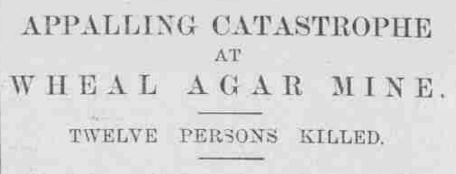
That morning, Camborne’s scrum-half Robert Mankee is enjoying a coffee and a sausage roll at Terry’s Grill, on Commercial Square – it’s something he likes to do on the morning of a big match. But he isn’t interested in the soccer.

No. That evening, ‘Mank’ is playing for Camborne in the CRFU Cup Final, against St Austell, in Redruth. If Camborne win, the prize of a Cup-Merit Table ‘double’, the first in the Club’s history and achieved in its Centenary Season, no less, is theirs.

Mankee isn’t worried. Not much phases Robert Mankee, and the prospect of playing St Austell certainly doesn’t concern him.

Maybe Mankee is idly leafing through the sports pages of that day’s Packet; if he did, he certainly skimmed through Jerry Clarke’s preview of the evening’s match. Although perhaps affronted that Clarke hasn’t mentioned his name, he may have afforded himself a wry grin when he considered the headline:

Packet, April 19, 1978, p33

Mankee may even have growled something like bleddy right under his breath…

…the major miracle of our times…

The language of Clarke’s article is almost biblical, and equally chock-full of hyperbole. If St Austell managed to pull off the inconceivable in Redruth that night – beat Camborne, lift the trophy – it would constitute

…the major miracle of our times.

Jerry Clarke, Packet, April 19, 1978, p33

In other words, a St Austell victory would be deemed an Act of God, a marvel beyond all rational or scientific explanation.

The Saints had only won two Merit Table games all season, and conceded over 300 points. Camborne had been champions for just under a month.

St Austell RFC had only formed in 1963; they had only been a senior club since 19762. Camborne were one of the biggest, most successful clubs in Cornwall, and had been around for over a hundred years, facts which made Clarke believe their success was predestined:

Nothing now is going to prevent them from capturing the double.

Jerry Clarke, Packet, April 19, 1978, p33

To reach the final, Camborne had had to knock over the likes of St Ives and Redruth. St Austell, in contrast, had hammered the decidedly junior Redruth Grammar School Old Boys in the quarters, and then scraped a 3-0 semi-final victory over Penryn at their Cromwell Road ground, a venue, Clarke noted,

…notorious for its levelling effect.

Jerry Clarke, Packet, April 19, 1978, p33

There was to be no home advantage for the Saints tonight.

At the time, in Chris Durant, Paul Ranford, Bobby Tonkin, Richard Thomas and Nigel Pellowe, Camborne had five players with County experience. St Austell had none.

The imposing Camborne XV. Courtesy Frank Butler
The St Austell XV. Mike Chantry replaced Whitford at 2, who had a broken hand. Nigel Allen played in the centre. Courtesy Frank Butler

Clarke highlighted the Camborne front five of Jock Denholm, Malcolm Bennetts, Tonkin, Ranford, and skipper Durant as “fearsome”3, the best in Cornwall, and likely to make all the difference in the match.

Jock Denholm flicks the ball out, with Bobby Tonkin on his left shoulder. Behind them, from left, are Paul Ranford and Chris Durant.

Clarke could only single out the Saints’ captain, ex-Camborne prop Simon Woolnough, as one who would take the fight to Town. But, Clarke opined,

…I am absolutely certain that his all will not nearly be enough.

Jerry Clarke, Packet, April 19, 1978, p33

Clarke, in fact, was committing the cardinal error of the sportswriter – that of gazing into their crystal ball:

…Camborne must surely win by 30 points. It would be a fitting finale to their most successful season.

Jerry Clarke, Packet, April 19, 1978, p33

He wasn’t the only one convinced that Camborne would win, and to nail his flag to the post so publicly. The local artist Ernie Loze had sketched souvenir caricatures of the Camborne squad before the match:

Courtesy Frank Butler

Loze emblazoned his belief that Camborne would be crowned champions for all to see on his drawing…prior to kick-off.

Replete, Mankee strolls out of Terry’s Grill, and turns his collar up to the rain. If the precipitation continues, he probably reflects, he may have to employ a dive-pass later on, as opposed to his favoured spin-pass, and ask Derick Taylor to stand closer at 10.

But, whatever the conditions, Camborne will win. To continue with the biblical motif, victory for Town is graven in stone.

St Austell haven’t got a prayer.

Call for Jumbo…

Dave ‘Jumbo’ Reed. Courtesy Paul White

As the hours till kick-off ticked by, it became apparent that Camborne might not have it all their own way.

Bobby Tonkin, The Smiling Assassin4, must have been relishing the prospect of tonight’s game. A big crowd, lesser opposition, a weak pack…yes, Bobby was itching to get on the pitch and lord it over St Austell.

Jerry Clarke reckoned him a “real force to be reckoned with”, who

…has had his finest season ever…

Packet, April 19, 1978, p33

His great friend Paul Ranford described him as “immense” at loose-head. But he couldn’t play; indeed, a broken hand meant he would be out for the rest of the season. Although Jumbo Reed reckons Tonkin

…didn’t make a lot if it…

…he can’t have been happy. In contrast, Jumbo himself was ecstatic: originally on the bench, now he’d be starting.

Although on paper losing Bobby was a setback, Jumbo reckoned he was super-fit, and had “learned a lot” under the expert tuition of Tonkin and Jock Denholm both throughout the season.

Frank Butler backs this up, saying Jumbo always

…did a fantastic job when called in to cover…

David May rated Jumbo a “completely wholehearted” player, and could doubtless fill Tonkin’s boots admirably – he’d done it before, after all.

In any case, Camborne still had more than enough firepower for The Saints.

Sharky…

In Camborne and Redruth it had been raining heavily. I’ll rephrase that: it pissed it down all day. Terry Symons, preparing to go and cheer Town on, reckoned the weather was “atrocious”.

This suited St Austell perfectly – more than it suited Camborne.

Alright, rugby players aren’t especially adverse to wet, muddy circumstances on the whole. But if Camborne were going to win in the manner befitting champions – by, say, 30 points – agreeable weather conditions would have made this more achievable.

St Austell RFC, Circus Field, late 1970s-early 1980s. Back, l to r: Chris Holloway, Bill Reeve, ?, Andy Clemow, Charlie Russell, ?, John Snelling, Ivor Price. Front, l to r: Tom Williams (Team Sec.), Geoff Huddy, Tommy Riddle, Clive Higgs, Richard Lamb, Barry Whitford, Peter Hadley, Nigel Allen. Whitford became the first Saints player to be capped by Cornwall in 1979. As identified by Simon Woolnough

St Austell’s pitch at the time, Circus Field on Cromwell Road5, covered some of the old, flooded, Polmear Mine workings. This meant the ground itself was almost permanently sodden. Even in summer, recalls Simon Woolnough, the massive puddles stubbornly refused to evaporate. Woolnough told me that on Circus Field

…you had more chance of drowning than having a half-time orange…true to say, no other team liked playing there…

That night, Redruth’s Recreation Ground would be a home-from-home for The Saints.

Camborne would still win, just maybe not especially attractively.

Simon ‘Sharky’ Woolnough, the St Austell skipper. Courtesy of the man himself

Simon Woolnough today readily admits his team’s underdog status that night; reaching the Final alone had made their season. On the whole, his plucky XV were merely “happy to be there”.

Being happy to be there and letting your opposition win, however, are two mutually exclusive things.

St Austell had played (and lost) to Camborne twice that season, in October and December. They would have known Town’s game intimately.

Moreover, ‘Sharky’ Woolnough (so named for his swimming and water polo prowess) was an ex-Town man, and a vastly experienced, tough competitor. Jerry Clarke reckoned he was unlucky not to be capped for Cornwall6.

Sharky knew all the pressure was on Camborne, in their Centenary Season, not St Austell.

Sharky knew this was the first CRFU Cup Final this young Camborne side – indeed, any Camborne side – had reached. They’d play the occasion as much as play St Austell.

Sharky knew this was a two-horse race. To win a two-horse race, you’ve got to be in it at the end, and not let your opponent get away.

Sharky knew the location, and conditions, didn’t suit Camborne. They’d have to win the CRFU Cup in the mud, in the rain, and in Redruth.

Sharky reckoned his side were in “with a shout”.

Sharky, it must be said, was also one hell of a sportsman.

Toss-up…

So inclement was the weather, and so similar were the finalists’ jerseys – Town, white with a single red stripe; Saints, red and white hoops – the match officials reckoned they’d have a deal of trouble identifying who was who in the downpour.

Reluctantly, the two captains, Durant and Woolnough, tossed a coin. The losing XV would play the CRFU Cup Final – in the mud, in the rain, in Redruth – in neutral kit.

(Judging from Paul White’s photos, I believe the colour of this strip was black. Or dark green. Or whatever.)

Camborne lost the toss. I’m glad I wasn’t there to see the look on Chris Durant’s face.

Simon Woolnough was there, and something told him that, in their Centenary Season, it was only fitting that Camborne should play in their cherry and white.

St Austell would leave their traditional colours in the changing room.

The two men shook hands, and went back to their respective teams.

It was the last favour Woolnough did Camborne that night.

Jockstrap…

Durant trudged back to Town’s changing room, and told his men they could keep their jerseys on. As usual, he’s hungry – he never eats before a match.

As usual, Jumbo Reed is being copiously and audibly sick in one of the stalls. He’s notoriously nervous before kick-off.

Jock Denholm, said David May, would be

…kicking holes in the wall and threatening anyone not focused…

Others testify that Denholm would in fact be punching the walls; several confirm he once made to grab the laid-back Derick Taylor and slap him awake.

Harder than Richard Trevithick’s statue…

…is how Dave Edwards remembers him.

As if this wasn’t intimidating enough, Denholm would never put his jersey or shorts on until the last minute. The only item of clothing covering his modesty was a jockstrap.

Not only did you want to avoid Jock’s piercing stare, but you didn’t much fancy an eyeful of his bare arse either.

I bet even that looked angry.

Then there was a knock on the door. It was time.

Both sides ran out, into the mud and the rain. Durant led Camborne out, followed by Malcolm Bennetts – Bennetts had to be second onto the pitch, no matter the game.

Mankee knelt to rub some dirt onto his hands, as was his wont.

The Saints had brought along a coachload of supporters, who, judging by the surviving images, huddled in the grandstand alongside Camborne’s faithful who, remembered Jumbo Reed, made up the majority. In any case, there were very few people braving the elements on the banking.

St Austell’s fans wanted their team to make a good go of it, Town’s, to see the double brought home in style.

The whistle blew.

Then it all went badly wrong.

…never a good Cup team…

Action from the game, though it’s difficult to accurately describe what’s happening, so bad was the weather. Courtesy Paul White

According to many of the Camborne players I spoke to, this XV were never a good, or great, team in the CRFU Cup.

This belief would dog their knockout performances in the coming seasons.

It was a belief sown on that awful night back in April 1978.

At first, and possibly guilty of swallowing Jerry Clarke’s propaganda wholesale, Camborne tried to ignore the rain lashing in their faces and move the ball quickly.

Robert Mankee told me,

…nothing went bleddy right…

Passes were spilled, or simply fell short of the would-be receiver. The ball was knocked on. Players slipped in the mud. Lineouts were scrappy. Set-piece moves, honed and perfected since last summer, failed. No-one could see what the hell was going on. Hands got numb. In the threequarters, bodies were cold, saturated, and almost forgotten.

Frustration, and then doubt, set in.

St Austell were loving this. As a team that

…revelled in the mud,

Packet, April 26 1978. Courtesy Frank Butler

they let Town have the ball, come at them, and fed off their mistakes. Indeed, they

…continually harassed…

Packet, April 26 1978. Courtesy Frank Butler

their supposed betters and, when the opportunity presented itself, hacked horrible, skiddy kicks upfield that had Camborne gracelessly sploshing around trying to clear up. Dave Edwards remembers having to desperately clear one such unpleasant grubber that looked all-but certain to give St Austell a score.

It wasn’t pretty. It wasn’t meant to be. St Austell were under no obligation to entertain or play like champions. They didn’t so much tear up the script that night as stomp it mercilessly into the sludge. When it really mattered, said David May, The Saints

…were good…we weren’t…

Jumbo Reed sums up St Austell’s tactics succinctly. They were

…in giant-killing mode, and stifled us…

Fear of failure set in for the Camborne XV. Dave Edwards said that David May twice

…made an outside movement in the centre to make space but each time failed to pass the ball to me…

May usually knew when to pass the ball, and you didn’t have to throw Edwards too many passes before he would score.

As Richard Thomas put it,

…we froze…

As I mentioned earlier, even in the lineouts, for so long the preserve of Paul Ranford and Chris Durant, possession was far from a given:

Malcolm Bennetts’ service, for once, goes awry. Courtesy Paul White

At half-time, St Austell were still in the race. Even better, they were winning. Full-back Roger Hawke, another ex-Camborne player, had slotted over two penalties for The Saints, to much excited roars from their damp contingent in the grandstand.

Under normal circumstances, a 6-0 deficit after forty minutes would not present too much of a challenge for Town. They’d recently come from behind to knock over Saracens7. But this was far from normal.

Back in the changing room, with moisture dripping from their noses and steam rising from their shoulders, Jumbo Reed remembers that

…Chris wasn’t happy…

How could he be? How could any of them be buoyed by their showing? However Durant “never raised his voice”, said Jumbo: Chris Durant didn’t need volume to make himself heard. Not much was said, but worried glances would have been exchanged.

Great teams find a way to win, no matter what.

Camborne needed to find a way – any bleddy way – to turn their possession into points.

St Austell were forty minutes away from a

…remarkable victory…

Packet, April 26 1978. Courtesy Frank Butler

Or, if you will, a miracle.

The second half, in terms of spectacle, had about as much going for it as the first. But in terms of sheer engrossing, gut-wrenching, nail-biting tension, it was all you could ask for from a Cup Final.

Benny…

Malcolm Bennetts as a Colt, receiving the clubman of the year award. Even in black and white, that tie is an eyesore. Courtesy Mark Warren

Of Camborne’s gargantuan front five, Malcolm Bennetts is often the least recalled. But lest we forget, without his abilities in the scrum, or accuracy of throw into a lineout, Town’s much vaunted pack couldn’t win possession of the ball.

A diligent practitioner of his craft (when not training, or working at Pendarves Mine, he would practice lineout drills in his back garden), he wasn’t a confrontational player; however, when sandwiched between such abrasive types as Denholm and Tonkin, with Durant and Ranford nearby, he saw more than his far share of the action.

David May reckons that, like “so many on the team”, ‘Benny’

…did his job effectively…

So effectively, in fact, that Chris Durant rated him

…the best thrower-in I’ve ever played with…

Alan Truscott described him as

…unflappable…[Bennetts] rarely had a bad game…

Frank Butler called him a

…solid hooker with no frills…did a lot of unseen work…

In the years before scrummages were beset by a litany of regulations, and hookers would regularly compete to win the ball from the 9’s feed, having an effective ‘strike’ was an essential part of any no.2’s armoury.

Jumbo Reed describes Bennetts as a

…brilliant striker of the ball…

Unmentioned by anyone is Benny’s powers of endurance. In the years that followed, a certainty developed that he had appeared in every fixture that season. The truth is he featured in most, yet definitely missed the game against Eccles8.

But he was present on that windswept, torrential night in Redruth.

And it was here that his unseen work was finally noticed, and his scrummaging skills brought to the fore…

…thank f__k for that…

As St Austell’s 9, Clive Higgs, fed the ball into a scrum on St Austell’s 25-yard line, Bennetts sensed his opposite number, Mike Chantry, wasn’t quite as ready to strike as he should be.

That’s all it took. A momentary lapse. Bennetts’ instinct took over, and in a breath he’d snapped the ball back through Camborne’s pack.

A heel against the head. The crowd, or rather those that could see what was happening through a veil of torrential rain, turned the volume up in anticipation.

Suddenly, it was on. Camborne broke out of their stupor. Mankee, strangely becalmed until now, executed the move he’d become famous for: a blindside break. He didn’t need to think about it; he just did it. Fast.

Bob Lees, on the blindside wing, saw Mank dart quickly to his side of the scrum: he, too, sensed it was on. Lees did what all good wingers do: he stayed wide, knowing full well that Mank would draw the flanker, then pass to him, leaving Bob with only his opposite number to beat.

As Bob started to move, he flicked a glance at his opponent, Geoff Huddy. He looked panicked. He was where every defending wing hates to be: caught off-guard, isolated, with your back to the line, and knowing your attacker holds all the aces.

Especially an attacker like Bob Lees.

By the time Bob caught Mank’s pass, he was already in fifth gear. He no longer felt the rain on his face. He knew exactly where he was going.

20 yards. Veering ever wider, and appearing for all the world like he was going for a touchdown in the corner, Lees drew Huddy with him. The touchline was Huddy’s friend: if he could get there before Lees, he could barrel him out of play. Lees had already factored this in.

15 yards. Bob sprinted further over. Huddy followed. He had no option. 10 yards. Bob suddenly jinked to his left. 5 yards. Huddy was caught off-balance. He couldn’t right himself on the swampy pitch. 3 yards. Bob dived, and stretched for the line. Huddy’s desperate, flailing right hand caught nothing.

Bob splashed down into the mud, in the rain, and in Redruth. He’d made it. He heard the cheering, and looked behind him, with his mouth agape and chest heaving over the ball. Chris Durant was jogging up. Chris didn’t look jubilant. Chris looked relieved. A man of few words, he caught the moment perfectly:

…thank f__k for that…

Perhaps understandably, Durant missed the conversion, from an acute angle, in driving rain and a gale.

6-4, St Austell. Still over half an hour to play.

Under the sticks, Woolnough, The Saints’ “ace”, said Jumbo Reed, demanded yet another massive effort from his men. Sharky knew that now, Camborne were going to come at them with everything they had.

This wasn’t so much a game of rugby any more as a dogfight.

Nightmare…

Nothing could separate the two teams. “It was that close”, noted the Packet of April 26. Courtesy Paul White

Camborne had forgotten all about winning in style. The fans didn’t exist any more. All that mattered now was winning. Keep it tight, wear them down, keep bashing on the door. They’ll tire before we do. They have to.

If these were despairing times for Town, The Saints were getting desperate too, and Woolnough knew it. His XV were absorbing tremendous amounts of pressure. His only hope was that Town would punch themselves out.

All his hopes were dashed when Camborne were awarded a penalty in the final quarter of the match.

Right in front of the posts.

Durant threw the ball to Derick Taylor. Derick Taylor, possessor of a massive kick. Derick Taylor, scorer of over 200 points last season, thanks to that sweet right boot. Derick Taylor, a man of calm, assured demeanour.

This was precisely the moment Derick Taylor had been picked for.

Derick Taylor missed.

Today, Taylor states he doesn’t remember the kick at all. Jumbo Reed, on the other hand, recalls the treacherous wind taking the ball off-course, and it striking an upright.

The effort was described as a

…nightmare miss…

Packet, April 26 1978. Courtesy Frank Butler

On the Camborne side, shoulders dropped. Chests sagged. All that, for bugger-all

Woolnough saw it. In that moment, Woolnough realised St Austell could win. He exhorted his team to go to the well once more. Durant did likewise. Both skippers knew their resources were all-but dry.

St Austell still led, 6-4.

…when the heat was on…

There’s ten minutes to play. St Austell could win, but Camborne still had all the possession. In the seventieth minute, they were handed another opportunity to convert their near-endless pressure into match-winning points.

A penalty, 35 yards out, on the touchline. Chris Durant didn’t much fancy running it. Durant, and his forces, were soaked through and exhausted. The faces of his men stared at him gaunt and pale.

Durant opted to kick it himself. He probably told himself that he’d kicked goals from a similar range and angle on this very pitch, in the semi final against Redruth9. In these conditions, though, 35 yards was more like 60. The ball had absorbed so much water it must have felt like a cinder block.

Courtesy David May

However, this was Chris Durant. Robert Mankee said of him that

…when the heat was on, [he] would take a crucial penalty…

Now was the moment. Durant put his boot through the ball and his piston-like leg followed, straight and true.

It’s testament to his accuracy and power that, in the mud, wind, and rain, he got anywhere close. But not close enough.

Like Taylor previously, Durant’s effort struck the woodwork. Not even he could win the game for Camborne.

6-4, St Austell. Minutes left.

…on another day…

Camborne were out of ideas, out of steam, and almost out of time. If Chris Durant couldn’t save them, who could? All they could hear from the grandstand was the St Austell fans, not daring to celebrate just yet, but celebrating anyway.

The Saints’ 10, Bill Reeve, belted another filthy punt into Camborne’s half, and scarpered off after it. Why not? Let Town come at them, in the wind and rain. They were practically out on their feet, and launching any kind of long-range attack now would be like running up a sand-dune.

Wearily, Dave Edwards ran to cover, with Reeve noisily stomping up behind him. As Edwards went to gather the ball, he appeared to slip.

Reeve gathered.

Reeve ran.

Reeve scored.

10-4, St Austell. The crowd went beserk.

Except it wasn’t. The try was disallowed. The referee ruled that Reeve had obstructed Edwards. 6-4, St Austell.

Whether the try should have been permitted to stand or not depends on who you ask.

Jumbo Reed: it was

…definitely not a try…

David May: he could

…see nothing wrong…

with the try.

Simon Woolnough: the referee’s decision

…was a dubious one…on another day it would have been a try…

Dave Edwards:

…I was tripped from behind…

I even asked a couple of fans who had seen the game:

…Dave didn’t trip…he slipped over…

But the decision that mattered was that of the official in charge of the game. No try.

Four minutes to go.

Fifty quid’s yours…

Yes, four short minutes. In the stands, Town’s fans are all but resigned. It wasn’t to be. Jerry Clarke is finding every word he wrote in his preview article nauseously hard to swallow. Ernie Loze is wondering if he can quickly sketch the St Austell players as they leave the pitch victorious for their souvenir caricature plate.

Until, that is, Saints’ flanker Richard Lamb is penalised in a ruck.

Right under his own posts.

There’s only one man who can kick this.

Chris Durant. All his team turned to him. They had nothing left. It was all on Chris.

As Frank Butler said, Chris was

…never going to miss…

You just knew the man Merrill Clymo singled out “first and foremost” for his leadership that season was going to slot this one over10. So did Simon Woolnough. Durant kicking that ball spelt defeat for him and his team. As Durant took a few steps back from where he’d spotted the ball and took aim, Woolnough spat something from his lips and murmured to him that

Fifty quid’s yours if you miss that f__king kick…

Today, Woolnough is coy about the remark:

…I may have said something like that…

But if he did (and Durant assures me the offer of cold hard cash was made), Woolnough must have known that he would have had a better chance trying to bribe Eliot Ness. It didn’t even work as a piece of gamesmanship, or distraction.

No. In the mud, in the rain, in Redruth, when all was seemingly lost, with fifteen pairs of hollow, ghoulish eyes willing him to pull a shank or hit a post (again), Durant kicked the winner.

7-6, Camborne. Jumbo Reed remembers the

…sheer relief…

as the ball sailed over. Not elation, mind. Jumbo was too far gone for that. They all were.

…we were lucky…

Camborne were the CRFU Cup Champions. But, said Dave Edwards, their

…performance had dampened things.

They had “squeaked it”, said David Kingston, and how. David May and Terry Symons agree that Camborne

…were lucky…

to lurch over the line. So did Durant. Upon receiving the trophy in the grandstand, and hoisting it aloft for the benefit of Camborne’s jubilant – and relieved – support, he handed the cup to Woolnough, allowing him to do the same.

Durant knew how close Woolnough had come to beating him, and that St Austell had made the game.

*

Slowly, it sunk in. They’d done it. Camborne RFC, Cup and Merit Table Champions, Centenary Season, 1977-78. This feat would be talked about for years.

As they returned to the clubhouse on South Terrace, they were met with a guard of honour. Fans, players and clubmen lined the route to the bar, cheering and applauding their heroes all the way…

Chris Durant is congratulated by Team Secretary Arthur Kemp. Courtesy Paul White
Frank Butler lets Bobby Tonkin quench his thirst. On the left is Colin Taylor, to Bobby’s left is Nigel Pellowe. In the background, Paul Ranford fortifies himself with a cucumber sandwich. Courtesy Frank Butler
Paul Ranford takes his turn. Courtesy Paul White
Squad member Mike ‘Crash’ Evans is ably assisted by Ewart White (left) and Fred Tregidga. Courtesy Paul White

The celebrations continued long in to the night:

Back, l to r: Bob Lees, David May, Bobby Tonkin, Jumbo Reed, Malcolm Bennetts, Chris Durant, Jock Denholm, Richard Thomas, Colin Taylor, Dave Edwards, Paul Ranford. Front, l to r: Alan Truscott, David Kingston, Arthur Kemp, Frank Butler, Nigel Pellowe, Robert Mankee, Derick Taylor. Courtesy Dave Edwards

It wasn’t until the early hours that the trophy was discovered to be missing. As it turns out, Simon Woolnough, who with his team had returned with Town to South Terrace, nimbly climbed onto the roof of the building and had the cup passed to him through an open window.

The CRFU Cup returned to St Austell on the team coach. Woolnough generously left Camborne the lid to drink from.

What more?

They’d exceeded everyone’s, and their own, expectations. The Centenary Season would not have been as memorable were it not for their amazing success, and their achievements might not have been manageable were it not for that desire to live up to the expectations such a showpiece season had demanded of them. One fed the other.

Indeed, wrote Merrill Clymo,

What more is there to say?

Programme notes, Camborne v Gloucester, April 22, 1978. Courtesy Alan Rowling

As it turns, out, there was plenty more to say. Most of it controversial.

Read all about it in the final Rugby Special here.

Many thanks for reading

References

  1. Daily Mirror, p3 & 30.
  2. See: https://www.pitchero.com/clubs/staustell/a/brief-history-of-st-austell-rfc-36100.html?page=1
  3. Packet, April 19, 1978, p33.
  4. See Rugby Special ~ Part Two here.
  5. Purchased in 1967, the club sold the ground to Asda in 1986, and of course now play their rugby at Tregorrick Park. See: https://www.pitchero.com/clubs/staustell/a/brief-history-of-st-austell-rfc-36100.html
  6. Packet, April 19, 1978, p33.
  7. See Rugby Special ~ Part Eleven here.
  8. See Rugby Special ~ Part Eleven here.
  9. See Rugby Special ~ Part Ten here.
  10. Programme notes, Camborne v Saracens, March 24, 1978.

Rugby Special ~ Final Part

Reading time: 25 minutes

(If you missed Part Twelve, click here.)

Matson. What a game…

Steve Floyd

Fed up…

It’s Saturday, April 29, 1978. For Camborne RFC, it’s the day of their final game of the Centenary Season: the fifty-first.

The season has exceeded all expectations: a CRFU Cup and Merit Table ‘double’, the first in the club’s history and achieved in this most auspicious playing year, has given them the undisputed title of the best rugby team in Cornwall.

Back, l to r: Dickie Bray, Martyn Trestrail, David Kingston, Les Arnold, Kevin Lean, Malcolm Bennetts, David ‘Jumbo’ Reed, Michael ‘Delme’ Thomas, David Roskilly. Middle, l to r: Alan Roberts, Derek Barrett, Michael Woods, Barry Wills, Peter May, Chris Lane, Bobby Tonkin, Brian Smale. Front, l to r: Michael ‘Jed’ Eddy, Frank Butler, Colin Taylor, Nigel Pellowe, Chris Durant, Dave Edwards, David May, Paul Ranford, Martin Uren. Courtesy Dave Edwards
Colin Taylor was Clubman of the Year. Frank Butler remembers him as a “very strong” inside centre who developed the younger players. Courtesy Dave Edwards
The Players’ Committee Medal. In the absence of a commemorative medal for the XV that won the CRFU Cup, Frank Butler and Jumbo Reed of the club’s Players’ Committee commissioned their own. Courtesy Dave Edwards and Frank Butler

Yet, and maybe understandably, the end cannot come soon enough for some. One player told me that, by as early as Easter, he

…began to get fed up with it…

A season of 35-40 fixtures was the accepted norm. But the prestige of the Centenary Year, combined with the recognition and pressure brought about by their success, meant the season’s duration as originally contrived by Treve Pascoe, (a masterpiece described as “inestimable” by Jerry Clarke1) had begun to feel like a millstone for several of the squad.

Lest we forget, they were all working men: no one was paying them for their services. Most had young families: Chris Durant, Malcolm Bennetts and Nigel Pellowe, to name but three. Coping with home life, work, training, and matches ultimately took its toll. Dave Edwards, for example, missed games – and took days off – as he found night-shifts at Holman’s so gruelling.

Today, Chris Durant simply couldn’t

…believe the amount of games…

when I gave him a fixture list to study. Likewise Malcolm Bennetts:

…how did Camborne get away with playing over 50 matches in a season?…what our wives and families put up with was amazing…

But they were almost done. One game remained, a fixture that had to be honoured as a direct result of Town’s victory in the CRFU Cup.

This was a John Player National Knockout preliminary round fixture at Matson RFC, a club in Gloucester. If they beat Matson, next season Camborne would compete in the competition proper. To win the John Player Cup meant you were the best XV in England.

Yet again, there was a lot to play for. Camborne weren’t just representing themselves any more. They were representing Cornish rugby.

Punishing…

But before they travelled to Gloucestershire, there were yet more matches to play. It wasn’t for nothing that Town’s season at this stage was described as “punishing” in the Press2.

The very day after beating St Austell in the CRFU Cup Final, Thursday April 203, Camborne hosted Porthcawl.

Obviously, this was a very different XV from the one that prevailed over The Saints, but Durant (conversion, two penalties), Richard Thomas (try), and Malcolm Bennetts all took part in a 12-6 victory for Camborne.

Bennetts wanted to play because he was out for revenge. When Town played the Welshmen last season, someone had thrown dust in his eyes at a ruck, leaving him in agony and having to be led, temporarily blinded, from the pitch.

As Chris Durant reminded the team in his pre-match speech:

…remember last year boys…they nearly blinded Benny…get stuck in today…take no prisoners…

After this, said Bennetts, he and the team were so pumped they wanted to

…rip someone’s head off…

As Benny charged onto the pitch, ready to dish out some retribution, Durant turned to him and whispered that it had in fact been him that had accidentally got the dust in his eyes last season. Bennetts stood there gobsmacked, while Durant winked and told him to keep quiet. He’d got the team psyched up, which was just what he wanted, and no mean feat after the previous night’s events.

The Boot…

Peter ‘The Boot’ Butler. Nearly 3,000 points for Gloucester, including an amazing 574 in one season. From Gloucester Rugby Heritage

Two days after this, Camborne were pretty much back to full strength. That season’s John Player Knockout Champions, Gloucester, were visiting the Rec.

The teams. Camborne reverted to their ‘tight’ formation, with Tanzi Lea at 15. Courtesy Alan Rowling

Gloucester fielded five internationals – Peter ‘The Boot’ Butler, Peter Kingston, Alan Brinn, Mike Burton, John Watkins – and won 3-16.

It was Butler’s play that proved Town’s undoing, as he took the full house of try, conversion, penalty and drop-goal in the victory.

‘The Boot’ remembers all Cornish opposition as “tough and abrasive”, and singles out Nigel Pellowe as a worthy example.

In the bar, a few Town players spoke to Mike Burton about Matson. They were curious to know something of the side they would visit in a week’s time.

Malcolm Bennetts said that Burton’s face

…was a picture…good luck with that one [said Burton]…they’re nutters…our second team refuse to play them…

Mike Burton toured with the Lions in 1974, but even he didn’t much fancy Matson. From Gloucester Rugby Heritage

David Kingston, himself an ex-Gloucester player, remembers being told similar.

Bennetts reckons Burton’s statement was one “we should have taken notice of”, but on the other hand, Benny thought,

…we cannot get any harder matches than we’ve already played…

Dave Edwards and David May echo this. Town

…didn’t do their homework…

on Matson.

Big bastards…

On Monday 24th, Camborne played South Wales Police, and lost 0-18.

Playing for Town, in one of his first appearances for the Chiefs, was full-back Kevin Lean. “Big bastards” was his term for the rangy opposition.

They were “huge”, said Malcolm Bennetts, and they were good.

At a lineout on the Home 25, the opposition’s 8 gathered the ball and clattered Chris Durant – yes, Chris Durant – to the ground. He then, recalls Bennetts, “stormed over” Mankee, and charged,

…knees up to his chest…flat-out…straight at the last man standing…

who was Kevin Lean. This 6ft, 16 stone bull obviously wasn’t about to attempt a sidestep.

Ten yards from Lean, and Kevin suddenly stood to one side, guiding the Policeman through, like a copper directing traffic.

Bemusement quickly gave way to hilarity. Durant, trying hard to keep a straight face, asked of Lean just why he had done that. Well, said Lean,

…if eight forwards and a scrum-half can’t stop him, how the hell am I?

All joking aside, Kevin Lean had

…the heart of a lion…

reckoned Bennetts.

*

Two days before the trip to Matson, Camborne were due to play Tredegar. For once, Town talked their visitors out of making the fixture. That really would have been a game too many.

Furthermore, the day of the Matson game had originally been that of the Centenary Season’s grand finale: a showpiece clash with arch-rivals Redruth. The Reds cancelled without too much fuss. They couldn’t upset the party now.

…a story in itself…

Matson RFC.

If Camborne had done their homework, they would have known that Matson were certainly no pushovers.

The club had booked their slot in the John Player competition that season by winning the Gloucester Combination Cup. In 1977-78, they had only lost one game, conceded only two tries, and scored 944 points4.

Matson held a “junior” station in Gloucestershire5, but the team had little or no regard for status or reputation.

Camborne took a coach-full of players, clubmen and fans up to Gloucester, leaving South Terrace at 4pm on the Friday. Two players didn’t make the trip: Nigel Pellowe was still recovering from a shoulder injury, and Steve Floyd was preferred at 10 to Derick Taylor, a decision, Taylor told me, that

…f__king pissed me right off…

(To this day, whenever Taylor bumps into Steve Floyd, he always remembers to enquire of Floyd whether he enjoyed his trip.)

They only arrived at their hotel in the early hours of Saturday morning.

En route, the bus broke down, and the whole party had to wait for a replacement charabanc. Once in Gloucester, and desperately searching for their digs, the driver was booked and fined for driving the wrong way down a one-way street.

You couldn’t make it up, and I’m not: Malcolm Bennetts recalls the trip vividly.

He also recalls him and his room-mate, travelling reserve Mike ‘Delme’ Thomas, being woken up at around 7am by workmen digging up the road outside. As preparations for a big game go, Camborne’s could have been better.

They were about to learn all about Matson. To complete the quotation from Steve Floyd with which I opened this post:

Matson. What a game, for all the wrong reasons…

Likewise Malcolm Bennetts:

…it put shivers down my spine just mentioning that name…

The trip, stay, and the match itself certainly have all the qualities of

…a story in itself…

David May

…tactical thuggery…

The sides. Courtesy Paul White

Even the drive to the pitch, through Matson itself, a post-war inner-city estate, gave a sense of foreboding. Malcolm Bennetts remembers that

…people stopped and stared…very intimidating…

The changing rooms in the Matson clubhouse were in fact one large room, divided by a curtain.

Matson players – and supporters – regularly wandered through this flimsy divide on their way to the bar, bathroom, or to simply to size up the opposition. If this was a deliberate ploy to put the visitors off their stride, it wasn’t without success. Bennetts said that

…we didn’t seem to have any time for a warm-up or a private talk…

In contrast, Matson’s Vice President (and left wing that day), Clive Locke, told me that

Camborne only turned up an hour before kick-off which we thought was a bit late…they seemed very relaxed…

From the kick-off, Matson’s approach of what Dave Edwards terms “tactical thuggery” came to the fore:

…late tackles, punches thrown at lineouts and scrums…

As Paul Ranford admits, Camborne were of course “no angels” in this regard, but

Matson took it to another level…

Steve Floyd

Matters deteriorated rapidly at the first lineout. A large crowd had gathered to generally hurl insults at Camborne’s players, which was “nothing unusual”, said Bennetts, but here they stood a bare metre from the touchline, with only a piece of binder-twine keeping them honest.

Bennetts had the ball heaved at him by the spectators, who followed this up with threats screamed in his face. As he turned to throw, one fan jabbed him in the ribs.

Matson won the ball and hoofed it downfield, but play was forgotten. Both sets of forwards started a mass brawl on the pitch, Matson’s ranks being bolstered by several over-zealous spectators.

Richard Thomas, said Chris Durant, was “laid out” almost immediately (“the most intimidating place I’ve ever been”, said Thomas later). Matson’s entire front row then turned its attention to Malcolm Bennetts. Fortunately for Benny, Jock Denholm and Mike ‘Slinger’ Woods were on hand, with them both

…coming in horizontally…boots and fists flying…taking on the whole pack and loving it…and me thinking I’ve got a wife and two kids, I want to get home tonight in one piece…

Malcolm Bennetts

(Bob Lees recalls another instance where it looked as if Jock was being “pummelled to death”.)

Order, or some vague semblance of it, was eventually restored by the referee who otherwise

…just let the wanton violence happen…

Steve Floyd

“Weak” is the verdict of many Camborne players on the match official.

And so it continued. Dave Edwards tackled a player into touch and was set upon by a mob brandishing umbrellas.

Chris Durant described the match as “hellup”, and threatened to lead his men off the pitch.

David May told me that

…there were punches thrown after every lineout…

Matson’s no. 8, Hemming (described as “an absolute maniac” by David Kingston) was tackled at one point by Bob Lees. Lees remembers Hemming

…headbutting me on the way down…

Hemming also targeted Robert Mankee. Mank informed me that this

…didn’t worry me, [but they] booted the shit out of me…[a] bunch of f__king heathens [that] frightened a lot of people…

Edwards recalls having to “help” Mankee with Hemming at least once.

David Kingston went off injured. Tanzi Lea popped a shoulder and had to go to hospital.

Even though Town had brought two reserves for the game, they still finished the match with thirteen men.

…a defeat for Cornish Rugby…

Camborne lost, 22-3. Matson ran in three second-half tries. “We outplayed them”, said their 9, Alex Anderson.

West Briton, May 4, 1978, p20

The Packet described the loss as a “defeat for Cornish Rugby”:

Unless Cornish teams play stronger opposition on a regular basis…the Cornish game will suffer.

Packet, May 5, 1978. Courtesy Frank Butler

What is perhaps being suggested here is the need for an official, national league structure. But that wasn’t to happen for another ten years.

Yes, Camborne lost. Worse, they’d been beaten. “The only time ever”, David May remarked.

Dave Edwards recalls that Matson

…were up for it, and we weren’t…a sad end to the season…

May puts it best:

Make no mistake, Matson could play rugby and would have beaten us without the fighting…

There was one small comfort, however: a Cup tradition that both sides could share the gate money. Frank Butler recalls that, in short order, a Matson committee man upended a bucket of notes and shrapnel onto a bar table and swept half of it towards Camborne’s end:

…we didn’t stop to count it…

It’s how things are done in Matson.

…what goes on the pitch…

Matson proceeded to the last 16 of the John Player Cup, where they lost to Richmond. This match gave them a brief tabloid notoriety after they left three Richmond players needing stitches, one concussed, and their supporters allegedly ran amok in the Richmond clubhouse, ripping photos off the walls and stealing trophies.

The Richmond players, though, had apparently little issue with Matson, no matter how much their club condemned them6.

It boils down to one of rugby’s unwritten rules:

…what goes on the pitch…stays on the pitch…

Malcolm Bennetts

And that may have been the end of it, had not a Camborne committee member been quoted in the Press that, with hindsight, Camborne ought to have played Matson at the beginning of the 78-79 season, not the end of the 77-78 edition.

Furthermore, the fixture should have been played on a ground other than Matson’s own,

…where facilities worthy of a senior club would have been provided…

West Briton, June 29, 1978, p20

If that wasn’t inflammatory enough,

Matson were not worthy opponents for Camborne…

West Briton, June 29, 1978, p20

To this day, these comments still rankle with the Matson players. “Sour grapes”, is how Clive Locke dismisses them.

…a game too far..?

Was this a game too many for Camborne?

Several players and clubmen have stated yes, perhaps so. But this is with hindsight – had Camborne beaten Matson, no problem.

Both Durant and Mankee agree that playing the game at the end of the season was the correct decision; after all, at the time, all the players agreed on this.

David Kingston, in fact, wanted a rematch:

…let’s have the f__kers down here…

To which Chris Durant is supposed to have replied,

…over my dead f__king body…

As we all know, few people argue with Chris Durant…

Chris…

Chris Durant before his final game for Cornwall, 1984. In 1969, he lost a kneecap after falling from a scaffold, and was told he’d never play rugby again. He played for Cornwall over fifty times, as well as leading them on many ocassions. Courtesy Mark Warren

Chris didn’t really want to skipper Camborne in 1977. The players, led by David Kingston, pushed his name forward, and you get the impression that, if they hadn’t twisted his arm, he would have contentedly spent the season winning lineouts and issuing the odd backhander.

No, captaincy wasn’t a thing he was “hankering” after. Indeed, Chris said that he

…didn’t enjoy at all at first…a lot of bleddy pressure…

He may have been a reluctant leader, but the qualities that make a good captain were already present. First, man-management. Chris quickly realised he

…had to talk to each individual differently…

What motivates one will discourage another. Second, you had to set an ideal for the team. Durant would never ask of his men

…anything I wouldn’t do myself…

This attitude rapidly meant others looked up to him, and he became less a skipper and more a figurehead. From this comes presence. For Robert Mankee, just his

…being in the dressing room was enough to put your body on the line…he could bring out the best in the team…

He had more playing experience than many of his young squad, too, and put his knowledge to good use: the team’s “thinker”, is how Terry Symons recalls him.

His team talks, Mankee remembers, were always quiet, brief, and to the point: everyone knew who to watch, everyone knew their job.

For Paul Ranford, Durant was the key factor behind Camborne’s

…style of rugby and the drive to be successful that season…

Allied to his leadership, which Jumbo Reed described as “fearless”, was his key role in the lineouts with Paul Ranford. Durant was “untouchable” at the front of the line, said Reed, and the partnership of him and Ranford in the second row remains highly rated in Cornish rugby circles.

He could also kick goals, and scored over 180 points that season, thanks mainly to that sledgehammer right boot.

Durant buries another one. Courtesy Paul White

However, like the captaincy, Chris was a reluctant kicker. He

…didn’t want to be kicking…only if [the regular kickers] didn’t come off, I would take over…I had enough work to do…

But he knew his men looked up to him. He knew he couldn’t shirk a job, and if him doing that job was probably the difference between winning and losing, so be it: witness the CRFU Cup Final7.

“We never questioned following Chris”, said David May. You wouldn’t argue, or pick a fight with him either.

Some talk of the exploits of Ranford and Tonkin, or Denholm, Pellowe, or Mankee. But Chris was in a league of his own. “If he hit you”, said Paul Ranford, “it was curtains”.

Frank Butler reckons he had the “hardest back-hand” in rugby, and knows that, to this day, Bill Beaumont, England Grand Slam winner and Chairman of the RFU, still tells the story of how Chris Durant hit him so hard he threw up over his boots.

Bill Beaumont isn’t sure if he’s just seen Chris Durant walk onto the pitch. Photo by George Herringshaw

David May reckons he

…could be brutal…but he never got caught…

In contrast to Paul Ranford, whose retaliations would be more immediate, Durant would bide his time. Then there would be a ruck, or a maul…and as the players jogged from the scene, Durant’s victim would be left prostrate.

Nobody had seen it happen. But everybody knew.

Durant picks his moment…

You might say that the Centenary Season was the making of Chris Durant as a rugby player. Alan Truscott, a man who knows him very well, certainly thinks so:

Chris led by example on the field. He had the total respect of the players and committee…[later], his reputation in Cornwall and beyond was immense. Rugby is a team game, you win as a team and lose as a team, but the one player who led us during the Centenary was, without doubt, Chris Durant.

They could not have done it without him.

Some bleddy boys…

P: 51, W: 38, D: 2, L: 11. F: 996, A: 440.

The Centenary Season was also the making of Camborne RFC.

Winning the CRFU Merit Table gave them access to regular upcountry opposition in the South West Merit Table. Here they could rely on what Paul Ranford calls “fast, physical” and challenging rugby against the best in the region8. In 1978-79, for example, Town had “bruising” encounters with Bath, Bristol, Exeter, Gloucester, and Plymouth Albion9.

This near-constant exposure to a higher level of play fed back into Camborne’s own game, and in Cornwall their exploits were formidable. Town became the standard-bearers of Cornish rugby in the South West.

Allied to this was the conveyor-belt of talent initiated by David May and Frank Butler that season: the founding of a mini/junior section at the club.

Youngsters were coached by the best in Cornwall, could regularly watch the best in Cornwall, and could learn the game in an atmosphere of confidence and success.

Between the 1977-78 Centenary Season, and the first season of a national league structure in 1987-88 (the CRFU Merit Table was then disbanded), Camborne were league champions seven times.

During the same period, they also won the CRFU Cup in 1977-78 (of course), again in 1984-5, and also in 1986-7. They were also runners-up in five other seasons. Not bad for a side who reckoned they were never a great Cup team.

Camborne were the highest placed Cornish club for the first season of the national leagues in 1987-88. They remained in the fourth tier of English rugby until 1993, and had also progressed – briefly – to the third tier10.

But it was the Centenary Season that started this golden run for Camborne, and has since become the stuff of legend, its players figures of adulation.

Mike Symons and Paul White recall, as youngsters, the pride they felt at being given the task of hanging the Town XV’s jerseys on their pegs in the changing-room.

Another lad of the time simply states that they were

…my heroes…

Mike Richards says they were

…an example for all us younger players at the time to try to follow…

Ian Pollard:

Legends…

Treve Blake: a

…great team…

But I think the last word must go to a lady called Ju Richards.

The Centenary Team were

…some bleddy boys…

From left: Derick Taylor, Dave ‘Jumbo’ Reed, Steve Floyd, Martyn Trestrail, Michael Eddy, Alan Truscott, Robert Mankee, Nigel Tregenza, Bob Lees, Malcolm Bennetts, David Sedgeman, Jock Denholm, Dave Edwards, Mike ‘Delme’ Thomas, David May, Chris Durant, Peter May, Paul Ranford, Nigel Pellowe.

Many, many thanks to all who have contributed. Writing about Rugby is as much a team game as playing it.

References

  1. Packet, April 26, 1978.
  2. West Briton, April 24, 1978, p20.
  3. See Rugby Special ~ Part Twelve here.
  4. See: https://www.pitchero.com/clubs/matson/a/history-9101.html
  5. West Briton, May 4, 1978, p20.
  6. Daily Mirror, February 26, 1979, p27 & 30.
  7. See Rugby Special ~ Part Twelve here.
  8. Of course, there was no recognised national league structure at this time; hence the proliferation of leagues going under the guise of ‘Tables’ or ‘Alliances’, as in the Anglo-Welsh Alliance discussed in Part Eleven here. A ‘league’ was held to smack of professionalism and as such was frowned upon by the RFU. Indeed, the South West Merit Table wasn’t even recognised by the RFU and was criticised for being “unofficial” (Torbay Express, December 8, 1978, p6), and “of little interest” (Wells Journal, August 2, 1979, p10). Try telling that to the players involved.
  9. West Briton, October 5, 1978, p16.
  10. See: https://en.wikipedia.org/wiki/Camborne_RFC

Rugby Special ~ Part Eleven

Reading time: 20 minutes

(If you missed Part Ten, click here…)

PlayedWonDrawnLostFor Against
Camborne191612373124
Hayle171304228110
St Ives181314336124
Redruth16916257124
Penzance-Newlyn18927223197
Penryn1370615098
Falmouth17818180155
Newquay Hornets16709172219
St Austell152112119330
Truro15211298435
Launceston18101791303
Cornwall RFU Merit Table, from the Packet, March 22, 1978. Camborne’s position is unassailable.

As it was…

It’s Tuesday, March 21, 1978. Kate Bush has made her first trip to the top of the charts with ‘Wuthering Heights’. Britt Ekland states she wants a rock-star for her next boyfriend. Doctors at Treliske Hospital, Truro, have written a letter of complaint to the Social Services Secretary, Mr David Ennals, highlighting the pressures on the hospital’s services1.

Camborne have beaten the students of Cardiff University 27-0.

After the Lord Mayor’s Show…

It’s hard to imagine many of Camborne’s 1st XV made this fixture. The previous day, they’d beaten Falmouth to clinch the CRFU Merit Table; on the Saturday they’d won in Redruth to reach the CRFU Cup Final2.

They’d earned a break. But not for long.

Although Town had already played 38 matches, there were still 15 fixtures scheduled3. From their recent performances, Camborne now had a certain reputation to uphold, as Merrill Clymo realised:

Success brings support and this is very evident at present.

Programme notes, Camborne v Saracens, March 24, 1978. Courtesy Frank Butler

Not only did the fans expect a high standard of play, the players probably realised they couldn’t ease off either.

Top sides from up the line were due to visit, and Town had yet to notch a victory against this particular brand of opposition.

Plus, their status as Merit Table champions had earned them a place next season in the regional South West Merit Table, where quality upcountry challengers were a matter of course.

In just under a month’s time, Camborne would qualify for the national John Player Knockout Cup4 – provided they beat St Austell in the CRFU Cup Final.

Camborne would want to know what it took to beat such teams.

First up, on the 24th – Good Friday – was Saracens.

Mank’s the name, rugby’s the game…

The team that played Saracens. Back, l to r: David Kingston, David May, Jock Denholm, Richard Thomas, Paul Ranford, Chris Durant (c), Bobby Tonkin. Front, l to r: Bob Lees, Colin Taylor, Nigel Pellowe, Robert Mankee, Frank Butler, Malcolm Bennetts, Derick Taylor, Dave Edwards. Courtesy Paul White

Frank Butler told me that, in the 1970s, Saracens weren’t quite the side they are today, but they were no pushovers either.

In recent seasons Saracens had twice been semi-finalists in the John Player Cup, and therefore were not to be taken lightly5.

The visitors weren’t taking things for granted either, and had identified scrum-half Robert Mankee as the man to target.

Mankee himself remembers the murmurings coming from the Sarries’ camp:

…watch Mankee…he’s like a tumbler in the circus…

The press picked up on this too:

…Saracens quickly discovered that no end of possibilities could be created by putting pressure on Mankee…

Western Morning News, March 25, 1978. Courtesy Frank Butler

At half-time, it was 3-7 to Saracens. They’d done something a Cornish crowd hadn’t seen in a long time: Camborne’s pack moved backwards.

This obviously rattled Mankee, and Saracens’ try was the result of a panicky clearance kick from him being charged down6.

But you can’t keep a man as irrepressible as ‘Mank’ down for long…

Mankee as a fresh-faced Colt. Courtesy Mark Warren
And here, pictured far right in the early 1980s at Wheal Jane, Baldhu. From left: Jake Tann (Truro RFC), Bill Hobba (Wheal Jane Manager), Mervyn Randlesome (Penryn RFC), Graham Hill (Truro RFC), Paul Thomason (Redruth RFC), Mank. Courtesy of the man himself

Here’s Paul Ranford on the man who used to announce his entry into most changing rooms, and a few bars, with a loud rendition of Mank’s the name…rugby’s the game..! :

…a typical Gerry guy…hard as nails…

‘Gerry’ of course refers to Wheal Gerry, now part of Roskear in Camborne. Here’s Jumbo Reed. Mank was a

…brilliant scrum-half…hard as nails…

David May:

Mercurial…fearless…never beaten…afraid of no-one…great athlete…

Malcolm Bennetts:

Hard…talented…brilliant gymnast…

Frank Butler:

…incredible competitor…very fit…great gymnast…always on the move…fearless in the tackle…always up for a fight…a dream to play with…

‘Always up for a fight’: Gerald Williams, of Crawshay’s, would grudgingly agree7.

Alan Truscott:

…livewire…aggressive…irritated everyone who played against him…quick, strong, mouthy…simply a handful for the opposition and referee…

No-one was safe, not even international scrum-halves:

…he was once playing against Nigel Starmer-Smith and as the two scrum halves crouched side by side at a scrum Mank would knock the ball out of his hands into the scrum which we then won. Starmer-Smith duly complained to the ref but was given short shrift. He then warned Mank implying some physical retribution but Mank’s reply was ‘don’t be silly I’m a hard rock miner’…

Malcolm Tonkin

You get the general impression. Mankee’s talents as a gymnast usually manifested themselves whenever he was playing to the gallery – which was often. Here’s a Camborne fan, Michael Roberts:

I can still picture Mank doing two or three forward rolls before touching down…

Frank Butler and Malcolm Bennetts both told me that, when playing for Cornwall against Gloucestershire, Mankee had actually somersaulted over the Bristol and England flanker Mike Rafter to score.

You may not credit this tale, were there not a photo of the actual event:

Another Mank catchphrase was Is it a bird, is it a plane, no! it’s Camborne and Cornwall’s mercurial scrum half…Courtesy Phil Meyers

Also watching this quitessential ‘Mank’ moment was clubman Malcolm Tonkin:

…Rafter was waiting to attempt to tackle him and was going to go very low and Mank being a gymnast just did a huge leap over him just as the tackle was going in and then did a forward roll afterwards.  It brought a huge cheer. What you might not have been told was that in the clubhouse afterwards Mank wound up Rafter by doing a “Stan Laurel” quizzical look and scratching his head….

He was also once invited to play for Harlequins. Though the ‘quins had stuffed Town by 60 points, after the game Mankee was asked to meet their brass up in the grandstand, where he was offered a run-out for the club, with the promise of a job. For one reason and another, he declined.

Robert Mankee was the heartbeat of the team. You’d hate to play against him. He must have driven the opposition mad. But you’d love to play with him.

Back to the Saracens match. They might have been trailing at half-time, but Town didn’t panic. Teams used to winning don’t panic, especially teams well-drilled in the art of attrition.

In the second half, Camborne took control. Durant nailed a penalty which resulted from a Bob Lees break.

Paul Ranford then scored his 14th try of the season from the ‘1234’ move, bursting through short from a lineout.

Then, who else but Mankee had the last laugh. A patented Mank blindside break put in Richard Thomas, for one of his 12 Centenary tries.

(“A try machine”, is how Jumbo Reed recalls Thomas.)

Action from the game. Bobby Tonkin and Chris Durant fight for – and win – the ball. To the left, Jock Denholm is kindly wiping the nose of a Saracens player with his forearm. Courtesy Paul White

Camborne 16, Saracens 10. A big, prestigious, noteworthy victory.

Camborne take the cake…8

Eccles RFC, 1977. Courtesy Chris Gaffey

Not every touring side to visit Camborne were hard-bitten, experienced and talented XVs looking to run Cornwall’s best off the pitch.

Take, for example, Eccles RFC, from Manchester, who played Camborne the day after Saracens.

Their tour manager was Geoff Wallwork. Brian Griffiths, their skipper, told me that

The scene would have been set by Geoff…He obviously liked Cornwall and arranged several tours to suit himself. He had no doubt built up our reputation in order to get this fixture…

In fact, Wallwork loved Cornwall so much he’d taken a surfboard on tour with him. He also decided to sit out the game at the Rec.

Another player, Andy Brunt, recalls that Camborne were

…a proper senior club with a proper ground, stands and all…

Brian Griffiths backs this up:

…this was, for Camborne, a serious, no-holds-barred first team fixture – we were on tour!

Quite. As the Eccles XV ran up the steps from the changing rooms, one player slipped and went face-first into the mud.

It didn’t get much better for Eccles, who did what touring sides normally do in such situations: lose gamely. A second-string Camborne XV beat them 36-3.

And then they all went to the clubhouse…

Without touching the sides…

Camborne’s clubhouse, with its regular roster of bands organised by Dickie Bray, was always popular – though Nigel Pellowe’s preference was for The Countryman pub, at Peace. For the more adventurous (and less attached), there was always The Flamingo nightclub, on East Hill.

On the dancefloor at The Flamingo, 1970s. From Kernow Beat

Malcolm Bennetts recalls that, after many a game, the opposition would be challenged to drink a pint as quickly as possible: £1 to enter, £5 to the winner, with the surplus kitty being spent on jugs.

Camborne could play this game, said Bennetts, with a loaded deck. One of the team, whose name I’m witholding,

…could down a pint of beer in less than three seconds…People just stood there gobsmacked as it went down his throat without touching the sides…

(Let’s just say I’m printing the legend here.)

Not all post-match socialising was about boozing. David May remembers that the singing

…was of a high standard…

This was led by Colin ‘Seamus’ Taylor, who by all accounts had a fine baritone. The other songbirds were Alan Truscott, Barry Wills, Bobby Tonkin, Derick Taylor and Bob Lees. This choir, said Truscott, was “most impressive”.

So much so that, one season, after a game at Bristol when the opposition were treated to a rendition of such standards as ‘Camborne Hill’ and ‘Little Eyes’, Bristol’s President stood and said that

…they’d played all the best Welsh sides, but this was the best singing they’d ever heard…

David May

Maybe he was being polite. Maybe Camborne had several guest players from a local works’ choir in tow…

*

Camborne’s 13-game winning streak was brought to an end two days later, on Easter Monday. Coventry, John Player Cup Champions in 1973 and 19749, laid them low 13-26. Before you ask, the late, great David Duckham didn’t play, but Coventry were skippered by Barry Ninnes, of Cornwall and England.

Speaking of the John Player Cup, in his notes for the game Merrill Clymo announced who Camborne would be travelling to play in that competition’s preliminary round, provided they beat St Austell in the CRFU Cup Final:

…Matson in Gloucestershire…

Programme notes, Camborne v Coventry, March 27, 1978. Courtesy Frank Butler

Who?

This was a way off yet. In the meantime, Devonport Services were unable to raise a side on Saturday the 1st. I imagine many players relished the day off. They needed it.

On Thursday the 6th, visiting Wolverhampton were beaten 24-4.

The next day, Dudley Kingswinford came to the Rec, and went home losers, 13-7.

The day after that, Saturday the 8th, came a tough side from the Valleys, Abertillery, who Camborne held to a 6-6 draw.

Pause for breath. A guest Camborne School of Mines XV were no match for Town on Thursday the 13th, losing 20-6.

Appearing for Camborne at 10 was the coach Alan Truscott, who incurred the wrath of Paul Ranford for kicking away too much possession. There were no sacred cows for Ranford, even in a friendly.

In fact, several key men were rested for this fixture, for, that Saturday, a sumptuous feast of rugby was taking place at Camborne.

In the afternoon, England Colts were playing their French counterparts.

And then, at 6pm, arguably the best team in the land were due to take the field.

Cardiff.

The average Welsh player…

Cardiff RFC, 1977-78

The Orrell and Crawshay’s Welsh XV full-back, Dave Gullick, told me that in the 1970s

The average Welsh player was better than the average anywhere else…

This statement is borne out by the mid-70s existence of the ‘Anglo-Welsh Alliance’, an unofficial (ie, not recognised by the RFU or the WRU) league comprising the top English and Welsh clubs10. The Alliance did little more than

…confirm the superiority of Welsh rugby…

Daily Mirror, October 23, 1976, p26

The results, from an English perspective, were “grim”, and made the national selectors “wince”11.

Cardiff weren’t your ‘average’ Welsh club. In the 77-78 season, they only lost nine matches from 46 fixtures. Their fluent, open, fifteen-man ‘total’ rugby scored them over a thousand points, and included a victory over Coventry, the side who’d recently broken Town’s winning run. Hell, in 1975, they’d beaten Australia, and in late 1976, they’d hammered Italy12.

No, Cardiff weren’t average. They were frightening. This was the XV they named for Camborne:

Courtesy Frank Butler

In the event, the great wing Gerald Davies didn’t play. Rumour has it he heard he’d have to mark Dave Edwards, and cried off.

At time of writing, Mr Davies was unavailable for comment.

There was international class everywhere. Over the course of their careers, Pat Daniels (who had played at Camborne for Crawshay’s earlier that season) earned two Welsh caps, Barry Nelmes 6 (for England), Mike Watkins 3, and Ian Robinson 2.

Gareth Davies would play 21 times for Wales, skippering them on five occasions, and also represented the British Lions. Terry Holmes would earn 25 caps, and also play for the Lions, proving an admirable successor to Gareth Edwards13.

In fact, it was the threat of an appearance at Camborne by Edwards that gave Robert Mankee a sleepless night before the match. Not that Mank was afraid of the great man; rather his concern was

…how to prove yourself…

…against the best in the world. How would Mank measure up?

Of course, Edwards didn’t make the trip. A horde of young Camborne ball-boys, including Paul White, Mark Warren, and Martin and Michael Symons, would be denied the spectacle – and his autograph.

(Perhaps Edwards had heard, via Gerald Williams, what Mankee did to Welsh scrum-halves…14)

Gasped and clapped…

The Camborne XV that played Cardiff. Courtesy Frank Butler

The Cardiff game of the season is the one occasion of the Centenary Season that everyone remembers – mainly because everyone was there.

Merrill Clymo, whilst acknowledging Cardiff as the “most famous Rugby Side in the word”, was quietly optimistic of Town’s chances:

It is…a tribute to the Camborne side this season that Cardiff have seen fit to bring their full first team…

Programme notes, Camborne v Cardiff, April 15, 1978. Courtesy Frank Butler

Camborne may have been good. They may have been very good.

But Cardiff were something else.

Early on, remembers David May, Gareth Davies launched a spiral kick

…to touch so far that the crowd gasped and clapped…

Gareth Davies poised to launch one into the stratosphere for Wales. Image George Herringshaw

That’s how good Cardiff were. Even a simple clearance kick garnered admiration and respect.

In fact, May continues, Cardiff

…were simply awesome…unstoppable…

He also recalls

…watching their first try. One of their players was one-to-one with Nigel [Pellowe], who never missed a tackle, but he never even touched his opponent. I thought, ‘we’re in trouble…’

Note that May ‘watched’ Cardiff’s first try: he was actually playing. However, for much of the game – Cardiff were estimated to have had 85% of possession15 – watch, and admire, was all Camborne could do.

3,000 fans came to the Rec to watch Cardiff play. Courtesy Paul White

David Kingston states they were simply “too good”, and recalls the pitch

…catching fire…

as Cardiff’s wing left everyone for dead.

Malcolm Bennetts remembers the experience of playing in front of such a massive crowd was “amazing”, but Camborne were

…not prepared for the onslaught of rugby…

Cardiff were “in a different class”, and so fast, said Bennetts, their entire XV always seemed five yards ahead of Camborne.

Pat Daniels was usually more than five yards ahead of David May – or anybody. As he scorched past the Camborne 13, leaving him clutching at thin air to score under the posts, a spectator with a loud voice and talent for stating the obvious cried out

Tackles, May!

May turned, hands on hips, and indignantly demanded of the spectator a pair of rocket shoes.

Pat Daniels, for once, is brought down before the try-line – against Australia. Getty images

Bob Lees found himself with a sniff of a try. A searing 50-yard break left him with just the full-back to beat. As Bob planned to feint and swerve around Cardiff’s last man, and then to score against Cardiff, he heard a shout from behind him, loud and clear above the cheering thousands:

Bob! I’m with you!

Lees turned to see prop Jock Denholm, lumbering up from about 15 yards back. It was a mistake.

A split-second later, Lees was crunched, and Cardiff launched a rollicking attack of their own from under the posts.

Jock…

Courtesy Paul White

It was Denholm’s only error that match. Mankee recalls he was “outstanding that night”, and his scrummaging was singled out in the Press16.

Jock was so tough even several of his team-mates confess he was scary. Frank Butler told me he was “brutally strong”. Malcolm Bennetts mentions a game where Jock had to leave the pitch injured:

…his ear was just hanging by a thread of skin…

Bennetts noted Jock’s ailment…then turned white. Five minutes later, Jock was back, head bandaged. He finished the game with blood soaking through his dressings, and only then did he go to A&E to have his ear reattached.

Alan Truscott rated him the toughest, and best, prop in the Westcountry, who gave Camborne’s already intimidating pack a fearsome edge. Launceston’s Mickey Stephens admits their forwards simply couldn’t handle him.

A truly hard man. Were it not for his work that night against Cardiff, the scoreline could have been worse.

Blitzed…

Camborne lost, 3-46. Derick Taylor kicked Town’s token penalty. Cardiff ran in ten tries:

…the Cornishmen were thrust aside in a blitz…

wrote Cardiff’s chairman17. Chris Durant described the scoreline as

…a fair reflection…

Derick Taylor remembers this about his opposite number, Gareth Davies, who

…came onto the pitch looking like a male model with his hair done up…and he came off looking exactly the f__king same…nobody laid a finger on him…

The Packet described the game for Camborne as an “ordeal”18. Malcolm Bennetts reckoned the entire team were “shattered” after eighty minutes of what Dave Edwards and Richard Thomas described as “chasing shadows”.

They had four days to recover. On Wednesday the 19th, in Redruth, it was the CRFU Cup Final, against St Austell.

Easy win? Find out by clicking here

Many thanks for reading

References

  1. From the Daily Mirror, p1, and the West Briton, March 20, 1978, p3.
  2. See Rugby Special ~ Part Ten here.
  3. Robert Mankee told me that the normal duration for a season at that time was around 35-40 fixtures.
  4. For a brief history of the RFU Cup, see: https://en.wikipedia.org/wiki/RFU_Knockout_Cup
  5. As mentioned here: https://www.saracens.com/early-days/
  6. Western Morning News, March 25, 1978.
  7. See Rugby Special ~ Part Two here.
  8. From the Packet, March 29, 1978.
  9. See: https://en.wikipedia.org/wiki/Coventry_R.F.C.
  10. See: https://www.gloucesterrugbyheritage.org.uk/content/match_reports-2/match_reports/proposed-anglo-welsh-league-alliance-mid-1970s
  11. Daily Mirror, October 23, 1976, p26.
  12. See: http://cardiffrfc.com/1486-2, and https://en.wikipedia.org/wiki/Cardiff_RFC#1970s
  13. See: http://cardiffrfc.com/internationals
  14. See Rugby Special ~ Part Two here.
  15. According to the Packet, April 20, 1978.
  16. The Packet, April 19, 1978.
  17. From: http://cardiffrfc.com/1486-2
  18. April 20, 1978.

Rugby Special ~ Part Ten

Reading time: twenty minutes

(If you missed Part Nine, click here…)

These are the best two Rugby teams in the county, and included in them are men who have donned the county colours…but the rivalry between the two clubs has sometimes produced a feeling that does harm to sport, and the sooner this lesson is learnt the better it will be for Cornish Rugby…

“Argus”, West Briton, April 29, 1912, p2

…it may possibly be the most important encounter ever between very old rivals…

Programme notes, Redruth v Camborne, CRFU Cup semi-final, March 18, 1978. Courtesy Frank Butler

As it was…

It’s Saturday, March 18, 1978. In the Five Nations Championship, Wales are hosting France in a Grand Slam decider – for the record, Wales won. (Incidentally, this was Gareth Edwards’ final game for Wales.) At Twickenham, England and Ireland are competing in a dead rubber, which England won.

But. But. As Jerry Clarke wrote,

…all the real Rugby…will be played at Redruth…

Packet, March 15, 1978. Courtesy Alan Rowling

Today is the day of the season’s biggest Cornish rugby fixture to date. Clarke sent a clarion-call to every Cornish rugby fan:

…every true follower of the game in the area will surely desert the clinical atmosphere of the dreaded box for the very real electric atmosphere of the Recreation ground.

Packet, March 15, 1978. Courtesy Alan Rowling

It’s the CRFU Cup semi-final, to be played in Redruth.

It’s Camborne against Redruth.

You’re not missing that, surely.

Courtesy Frank Butler

The Game of all Games…part three…

Let’s set the scene. Throughout their Centenary Season, Camborne have gone from also-rans to be the coming men of Cornish rugby. They’re looking set to win the CRFU Merit Table in three days time.

They’ve won their previous eight fixtures; the last team to beat them was Plymouth Albion, back in early January.

Those eight victories have been the making of Camborne’s season.

The wins have made them virtually untouchable in the Merit Table. As St Ives’ own season unravelled, Town went from a worrying third place to the top spot.

Packet, March 15, 1978. Courtesy Frank Butler

In those eight games, they’d scored 139 points, and conceded only 39. The big scores seen against touring sides earlier in the season might have dried up, but now, this was a disciplined, clinical, ruthless Camborne XV. Their play was almost relentless and mechanical. At this stage, they genuinely were playing, ball-boy Tim Carr observed,

…like a machine…

Jerry Clarke called their pack the “finest” in Cornwall1. Paul Ranford is more explicit:

…we were just big guys who had ball-handling skills and nastiness thrown into the mix…

Their outsides had received some criticism, but in truth, they had to live in the shadow of their forwards. In that shadow lurked the unpredictable flair of Tanzi Lea, the finishing skills of Edwards and Lees, the astute David May and rock-hard Colin Taylor, the metronomic boot of Derick Taylor and blossoming talent of Steve Floyd, a ballistic missile in Nigel Pellowe, and the mercurial-yet-tough Robert Mankee.

One of those eight wins, over St Ives, had given them this spot in the semi-final.

Camborne were massive. They were iron. No one in Cornwall could live with them.

Except Redruth.

The line-ups. Tanzi Lea was actually unavailable, so Derick Taylor came in at 10, with Pellowe moving to 15. Courtesy Frank Butler

As we saw earlier in the season2, Camborne’s form had meant little or nothing to their oldest, and nearest, rivals.

It was going to mean bugger-all to Redruth today as well.

Today, they couldn’t give a damn that they were fourth in the Merit Table. So what that their titanic prop, Terry Pryor, was on the bench for England up at Twickenham. (What Pryor’s feelings were about warming a seat up in London whilst his club played their biggest fixture for years is sadly unknown.)

Today, all that mattered was beating Camborne.

Hell, they had the form to prove it could be done. The Redruth RFC match programme left one in little doubt as to what the result might be, whilst simultaneously grinding Town’s nose in the dirt:

As a guide to the possible outcome of today’s game the previous matches resulted in a drawn game at Redruth, and a win for Redruth at Camborne on Boxing Day.

Programme notes, Redruth v Camborne, CRFU Cup semi-final, March 18, 1978. Courtesy Frank Butler

They were the only Cornish side who hadn’t lost to Camborne.

Mike Downing, the Mighty Mouse, had all of Camborne’s play on lockdown from his vantage point at 15.

Fly-half Brett Pedley was in top form, having just been capped for Cornwall U23s; centre Nick Brokenshire was hitting his straps too3.

Locks Dave Parsons and Laurie Spear would relish yet another set-to with their old foes Durant and Ranford. John Kitto, in for Pryor, would be licking his lips at the chance to spoil Camborne’s possession yet again.

Redruth might not be able to stop Camborne from winning the Merit Table, but they could make bleddy sure they denied them a shot at the CRFU Cup.

In no order of significance, what Redruth wanted from this game might be summarised thus:

  • Beat Camborne in their Centenary Season again;
  • Deny Camborne the pleasure of beating Redruth in their Centenary Season;
  • Deny Camborne a shot at the Cup-Merit Table double;
  • Reach the CRFU Cup final and salvage their own season;
  • Have bragging rights – for players and supporters – at such workplaces as South Crofty, Holman’s, Maxam and SWEB for the foreseeable future, if not for all time.

First things first. Beat Camborne.

As Jerry Clarke put it,

…it is going to be one of the hardest games seen in Cornwall this year…

Packet, March 15, 1978. Courtesy Frank Butler

That remained to be seen, but Clarke was right in his earlier prediction. Photographs of the match, taken by a young Paul White, show a packed Redruth Recreation Ground.

No one stayed in to watch the Five Nations.

This was the Game of all Games.

No one was missing this

Mr Teasy…

From the opening seconds, Camborne were in trouble. Redruth, with Hellfire Corner in full voice, smashed into their guests’ half from the kickoff and rapidly gained possession of the ball in a maul.

Camborne, caught reeling, hadn’t organised themselves. On the blindside, slap-bang on Camborne’s 25, Redruth had three men facing one Camborne tackler.

Brett Pedley, screaming like a banshee for the ball, raced to take the pass from the back of the maul, and all Hellfire Corner screamed with him.

All he had to do was catch the ball, ship it on to his right, and Redruth would be on the scoreboard – and Camborne in the shit – in under a minute.

In the stands, Redruth were already celebrating. Redruth were already in the final.

The pass went out to Pedley.

Waiting for him, was Dave Edwards…

Most improved player, 1977-78. Courtesy of the man himself

Edwards, or “Mr Teasy” as Jumbo Reed called him, scored 17 tries that season, in just over 30 appearances.

Although he recalls being told this was a record, in fact Reg Parnell was the holder with 29 tries, from way back in 1926-7. David Weeks beat this with 30 in 1984-5, then broke his own record the next season with 39. Alex Ducker currently holds the record with 41, notched up in 2018-9.

Record or not, spectators reckoned Edwards’ strike-rate that season was two tries…for every three passes. This made him a ruthless finisher. Frank Butler rated him a

…very fast winger with a great change of pace and side-step…always finished well…

For Jumbo Reed, he had

…great pace and sidestepping ability…

Alan Truscott said he was a wing who

…knew where the try-line was…deceptively quick…

In the Cornwall U23 squad that season, on reflection he was perhaps unlucky not to gain a full senior cap. However, due to cricket commitments he often missed the first games of the season (and, in 77-78, the important County President’s fixture).

Edwards wasn’t merely a finisher either.

David May described him as “great” in defence, and Nigel Pellowe always praises his covering ability in the back line. Allied to this, said Robert Mankee, Edwards was a

…fiery old bugger…

who could be more than relied on in the tackle…

Cut back to the action. Pedley never made that pass, and Redruth didn’t score in the opening minute.

As Pedley took the ball, Edwards came at him full bore and slammed him in the chest with all he had. He was rapidly joined by David May, and Pedley was pole-axed into the turf.

Stunned silence in Hellfire Corner, followed by a few thousand spectators collectively wincing.

A second later, hellup…

Spectating, on the Redruth side, was Brian Riddle. Although today he diplomatically states he was “too far away” to judge the action on the pitch, he did tell me that the Redruth supporters, en masse,

…cried foul…

amongst other, more unprintable, things.

In the crowd for Camborne was committee man Terry Symons. What he saw is rather different. Edwards

…struck Pedley as he took the ball…it was a fair tackle…the only thing [Edwards] could do to prevent a try…

The referee awarded a penalty to Redruth, which John Harvey missed. Brian Riddle confirms that, from that moment on, Edwards was known in Redruth as

…that dirty bastard with number eleven on his back…

Also watching, both professionally and passionately, was Jerry Clarke. The tackle was

Naughty, perhaps, but…Pedley was seen very little after that…

Packet, March 22, 1978. Courtesy Frank Butler

Pedley spent the rest of the match in a daze, and was very possibly concussed. Although both Edwards and Nigel Pellowe concur that there was “no plan” to get Pedley, Redruth’s fly-half and key playmaker had effectively been neutralised. Frank Butler told me that

…we always wanted to close [Pedley] down because it stopped Redruth functioning as well…

Over to Paul Ranford.

That’s mine!

“That’s mine!” read the caption in the Packet of March 22, 1978. Paul Ranford wins the space, and wins the ball. Courtesy Frank Butler

With Pedley out of the game, Redruth had no option but to try and beat Camborne up front. To do this, wrote Clarke,

…the effort required was enormous.

Packet, March 22, 1978. Courtesy Frank Butler

They were playing into Camborne’s, and Paul Ranford’s, hands.

Redruth tried every lineout ploy imaginable, but Ranford was their equal:

…as the game progressed he became more and more dominant, and it remains a total mystery how he came to be ignored by the county selectors this year…

Packet, March 22, 1978. Courtesy Frank Butler

Clarke kept a tally of the lineouts. In the first half, mainly due to Ranford, Camborne won this battle 10-7. In the second,

…with the red-jerseyed jumpers nearing exhaustion,

Packet, March 22, 1978. Courtesy Frank Butler

it was 13-6.

Ranford was a monster that day.

Likewise, Bobby Tonkin “foraged endlessly”4 in the loose, and with possession for the home team cut to a minimum, Hellfire Corner became subdued, and then frustrated.

With Harvey missing another two shots at goal, and Nigel Eslick failing with one of his own, the home support’s mood was not improved.

For Camborne, Durant had slammed over two penalties from 35 and 40 metres.

Durant’s eyes follow the path of the ball. Courtesy Paul White
Very possibly the same kick, caught from another angle. Courtesy David May

Harvey finally found his range, and at half-time it was 6-6.

But Redruth were knackered. The writing, reckoned Jerry Clarke,

…was on the wall…

Packet, March 22, 1978. Courtesy Frank Butler

He was right.

Cheeky bastard…

Mankee flings a pass out to Derick Taylor; Redruth’s deep defensive alignment leaves them wide open to attack. Courtesy Paul White

In the opening minutes of the second half, Nigel Pellowe, who played like a “supreme general”5, torpedoed into the line on the wing and burst over for a try, with Durant converting.

Despite what seems to be half the Redruth team trying to tackle him, Pellowe gets over the line. One can only assume the jubilant spectator is a Camborne fan. Courtesy Frank Butler

6-12, Camborne.

The Redruth faithful, sensing their team was beginning to flag, turned ugly.

How ugly things could get in Hellfire Corner is described by Paul Ranford:

…I’ve been called every name under the sun from there, mainly ’cause I worked with them in Maxam…[One] Redruth supporter, he couldn’t let my name go all the match, coming off the field I leaned over the barrier and told him to meet me behind the stand…he was last seen running out the ground…cheeky bastard…

Colin Taylor is snagged midfield. Courtesy Paul White

Harvey pulled back a penalty, but that was as good as it got for Redruth. Camborne’s ‘machine’ had worn down their hosts, and now the threequarters could be brought into play.

Bob Lees crashed through Pedley and Mike Downing both, right under the nose of Hellfire Corner:

Lees makes the line, with close attention from Mike Downing (left) and Brett Pedley. Courtesy Frank Butler

Though Durant missed the conversion, the barracking was full-on, with Robert Mankee taking umbrage.

Jogging back after putting Lees in, he flicked a time-honoured and heartfelt gesture to the vociferous grandstand, something that earned him criticism in the press6.

To this day, Mankee is unrepentant. He had schooled in Redruth, and many would have seen him as a ‘traitor’ in turning out for the Cherry & Whites. David May dismisses the Redruth supporters of the time as

…obnoxious and one-sided…

Mankee, despite close attention, gets his kick away. In the packed grandstand, Redruth’s fanbase wish him ill. Courtesy Paul White

Towards the end, Edwards crossed in the other corner, after a dramatic – and jubilantly celebrated – fifty-yard dash to the line. Derick Taylor fed him the ball, Mike Downing wore a sharp hand-off to the chin, and it was all over.

…red-hot favourites…

David May (left) watches the Westward News report on the game with glee in the Redruth clubhouse. From the David May Collection

Camborne 20, Redruth 9.

Not only had Camborne beaten Redruth in the biggest game of the season, they’d won in style, and were now in the CRFU Cup Final.

They walked off the pitch being cheered to the rafters, in the warm knowledge of a heroes’ welcome at work on Monday morning.

Nigel Pellowe, whose job often took him into Redruth, vowed to wear his Camborne jersey to work that week. Only a man of Pellowe’s reputation could have done this with impunity.

Not all the Camborne fans, however, were satisfied. Malcolm Bennetts recalls one irate spectator who would not have been happy

…unless we put fifty points past the bastards…

That small caveat aside, Camborne were now

…red-hot favourites…

Packet, March 22, 1978. Courtesy Frank Butler

to win the CRFU Cup. In the other semi, and what must have been a game devoid of highlights on a waterlogged pitch, St Austell had pulled off the upset of the season to beat Penryn 3-07.

Beating St Austell to lift the trophy in a month’s time would be a doddle.

That coming Monday, though, was Falmouth, and a chance to wrap up the Merit Table.

West Briton, 23 March, 1978, p20

The game at Dracaena Avenue followed a similar pattern to the one at Redruth. Camborne inexorably wore their opponents into submission. At half-time, it was 3-3

Falmouth, whose tactics Stephen Lightfoot remembers were to circumvent Camborne’s force and move the ball wide quickly, failed to take their chances.

Flyer Barry Trevaskis was away and in, until he slipped a yard short of the line8.

Camborne made no such error, with Edwards touching down late on, and Durant converting.

3-9, Camborne. They’d won ugly, but they’d won. The Merit Table was theirs. The double was on. As Merrill Clymo put it,

Everything that could go right is doing so.

Programme notes, Camborne v Saracens, March 24, 1978. Courtesy Frank Butler.

But champions have no time to rest on their laurels. Not in a Centenary Season, with fixtures to honour and fans wanting a look at

…the premier club in the Duchy.

Merrill Clymo, programme notes, Camborne v Saracens, March 24, 1978. Courtesy Frank Butler.

The day after beating Falmouth, Town were facing Cardiff University.

The following weekend, Easter, had three games, including tough propositions in Saracens and Coventry.

And then, on April 15, a mere four days before the CRFU Cup Final, rugby aristocracy was coming to the Rec.

Cardiff. How would Camborne fare against arguably the best XV in the UK?

Read all about it in Rugby Special ~ Part Eleven here

Many thanks for reading

References

  1. Packet, March 15, 1978.
  2. See Rugby Special ~ Part Three here, and the Christmas Rugby Special here.
  3. Packet, March 15, 1978.
  4. Packet, March 22, 1978.
  5. Packet, March 22, 1978.
  6. Packet, March 22, 1978.
  7. West Briton, March 23, 1978, p20.
  8. Western Morning News, March 21, 1978.

Rugby Special ~ Part Nine

Reading time: 20 minutes

(If you missed Part Eight, click here…)

As it was…

It’s Tuesday, 31st January, 1978. The number one single that week is ‘Uptown Top Ranking’, by Althea and Donna. Tory leader Margaret Thatcher comes under fire from the Labour government for allegedly wanting to use the immigration issue to attract National Front voters to her party. The previous weekend’s 100mph storms had caused extensive damage in West Cornwall, including a 12ft by 10ft plate-glass window a half-inch thick being blown clean out of the shop-front of Cocking’s Drapery, Redruth1.

Camborne have been top of the CRFU Merit Table for three days. That evening, they’re travelling to the club they dislodged from the #1 spot, St Ives, in a CRFU Cup quarter-final tie.

Tonight’s game must be won…

For The Hakes, the boot was now on the other foot. The author of their match programme notes was “D.G.”: Paul Sweeney told me this was Dave Gee, a squad member. He was obviously from the Merill Clymo school of straight shooting. Camborne were

…on top at last thanks to our inept display at Hayle on Saturday…complacency…obviously exists among established players…we have…lacked the consistency, dedication and maturity necessary to achieve any notable lasting successes…

Gee didn’t pull any punches:

Unless we are again to be relegated to “Also-Ran” status, tonight’s game must be won.

St Ives would have perhaps done better to remember that, along with Redruth, they were one of only two Cornish clubs to have bettered Camborne that season.

They also lacked the necessary bounce of knowing that Town considered them their ‘bogey’ team, a side they rarely got the better of.

Put bluntly, they’d had the wind knocked out of them.

It showed.

Packet, February 1, 1978. Courtesy Frank Butler

St Ives opted for the approach that had brought them success in their twilight Merit Table encounter with Camborne at Alexandra Road2. With gale-force winds and poor lighting, kicking high and long may have seemed an admirable tactic.

You might be able to pull that kind of thing off once against this Camborne side, but not twice. Town knew what was coming, and Nigel Pellowe at 15, with Edwards and Lees in support, had done their homework.

Indeed, the winning move came from the predictability of The Hakes’ play. David May, up swiftly from 13, charged down yet another hopeful punt.

The quick-witted May rapidly regathered and sensed a score. Breaking free, he kicked ahead and gave a metaphorical two-fingered salute to all those who questioned his supposed lack of pace, outsprinting a cover containing such notable gazelles as Roger Randall, to touch down.

Derick Taylor converted, as you would expect. 0-6, Camborne.

Town were now scheduled to play at Redruth in the semi-final: that promised to be a winner-takes-all derby for the ages.

Whoever reached the CRFU Cup Final would probably be playing Penryn. All they had to do was beat St Austell in their respective tie.

Strengthened their grip…

That Saturday, the 5th, St Ives were travelling to Surrey, to play Old Paulines RFC. They had two hopes. First, that Hayle would beat Redruth. Second, that Truro would beat Camborne.

No one really cared if St Ives beat Old Paulines.

In the same way that Hayle had obliged Camborne by doing a number on St Ives, they then threw a crumb of comfort to The Hakes themselves, upsetting Redruth 6-4.

Hayle climbed to third in the Table, enjoying a late – too late? – resurgence. Redruth slipped to fourth.

Camborne were not so charitable. In a performance that

…strengthened their grip…

West Briton, February 9, 1978, p20

on the Merit Table, they beat Truro 6-33.

Action from the Truro game. Robert Mankee flings out a pass to Nigel Pellowe. Outside Pellowe are Colin Taylor, David May and Bob Lees. 5: Durant, 8: Thomas, 6: Butler, 2: Bennetts, 4: David Richards, 3: Denholm
Chris Durant wins yet another lineout despite close attention from Truro. Richard Thomas stands poised to the right
Here, the camera has foreshortened the angle. Pellowe, Taylor, May, and (very deep) Lees hope the decision is taken to run the penalty. Courtesy Paul White

David May and Richard Thomas both scored twice; Frank Butler reckons most of Thomas’s tries that season were set up by him. Bob Lees ran in one, as did, on debut, David Richards.

David Richards, with Ian Moreton on his right, and Mark Regan on his left. Courtesy Martyn Trestrail

Richards was described as being “extremely strong” by Jumbo Reed. ‘Buzby’, as he was known (after the BT mascot of the time, a small fluffy yellow bird), had made a fine showing. Filling in for the injured Paul Ranford, he had big boots to fill…

Ranny…

Paul Ranford on debut for Cornwall against Devon, 1974. Courtesy Mark Warren

Here is a classic from the compendious anthology of Paul Ranford anecdotes, as related by Paul himself:

One Easter Friday we played Wasps…Chris [Durant] and myself agreed that any nonsense from their pack we would step in for one another…I lasted about 6 minutes and got sent off…I hit one or two in that time…

(The conclusion to this story is always the same, no matter who tells it: we beat Wasps with fourteen men…)

Or then there’s this one, courtesy of Nigel Pellowe:

…he got sent off once, was unhappy, took his shirt off and kicked it all the way to the touchline…where he then tripped over it…

Such ‘Ranford’ tales are legion.

In fact, Paul’s two flaws as a rugby player – as he readily admits, discipline and fitness – threaten to overshadow his reputation as one of Cornwall’s finest second rows, both in tight and marauding on the loose.

If all Paul Ranford could do was fight (though he obviously had ability in this area), he would not have won seventeen caps for Cornwall.

Robert Mankee reckoned that, on his day, Ranford was

…the best lineout jumper in the South West…

This was an era when no lifting in lineouts was permitted, and opposing packs stood cheek-by-jowl for throw-ins. Space to jump, and win the ball, therefore, had to be earned – how you went about this depended on your sheer physical presence, and the referee’s powers of observation.

Win the space, win the ball. Paul Ranford stood 6′ 4″ in his socks, making him one of the biggest players around at that time. And he knew it.

With the equally tall and arguably more imposing Chris Durant alongside him, Jumbo Reed is insistent when he describes them both as the

…best two locks in Cornwall by a country mile…

This isn’t just an old soldier talking a couple of comrades up; to this day, their partnership for Camborne and Cornwall both is remembered in hushed tones in bars all over the County.

Allied to this, and like his partner in many a post-match session, Bobby Tonkin, Paul had

…surprisingly good ball skills…

said David May. Alan Truscott likewise appreciated the big man’s “good hands” and turn of speed, utilising them for attacking moves. There was of course the ‘double diamond’ move, where the fly-half would switch-pass with Colin Taylor at 12, who in turn would switch with Ranford bursting out of the lineout at full bore, changing the angle and bearing down on the opposition’s 10.

Then there was the ‘1234’ move. Chris Durant would catch at the front of the lineout, and feed to Bobby, who would be peeling round the short-side. Malcolm Bennetts would grab the opposition hooker and pull him into the line (meaning Bennetts risked “a punch, or worse”), creating a gap for Bobby to pop-pass to Ranford, who would sprint through to score, often

…laughing his head off…

according to Bennetts. Sixteen tries that season, in over 39 appearances, though Paul himself reckons there’s a few more in there somewhere.

However, as Truscott notes, his short fuse was a constant. (Even in training sessions he was known to blow a gasket if a move wasn’t executed perfectly.) Ranford always sought

…immediate retribution if fouled…

remembers Truscott, meaning he became a “target” for the opposition, said Chris Durant, who could be “put off easily”, reckoned clubman Terry Symons. Wind up Ranford…he can’t help himself…get him in trouble…

Even Paul admits that, when he was sent off during that Wasps fixture, they set him up. He knew his temper was a problem:

The problem I had, our fixture list was too diverse, one week Truro etc and next Bristol or Gloucester, the latter teams were more physical, and lower league Cornish teams, players, and committee would whinge…

But he wouldn’t – or couldn’t – change. To rein in his aggression would hamper his play, lose him a lot more lineouts, and a lot of support on the terraces. It was part of who he was on the pitch.

He also had to contend with those on opposition teams who reckoned landing one on Paul Ranford would enhance their own reputation. As he told me,

Every club had chancers, they were bleddy sly guys…numerous times I would be raked or kicked from behind…

Such ‘chancers’ were to be dealt with in one manner only. Paul was a firm believer in the following maxim:

…get your retaliation in first…

Paul Ranford was the kind of player who, if provoked, would aim a haymaker at your jaw in a maul, and then buy you a pint after the game. Big, fast, physical, and with the handling skills of a centre, Paul was arguably the embodiment of pre-professional rugby, who may very well have played

…in the Premiership today…

according to David May.

*

Winter then truly came to Cornwall.

Cancelled…

On February the 11th, Camborne were due to host Hayle. Snow meant the game was cancelled, which is a great shame. Hayle had risen to third in the Merit Table, and had recently done the ‘double’ over St Ives and beaten Redruth.

Camborne, though top, had done neither of those things, and would have been aware that this was a very different Hayle side from the one they’d easily beaten on Christmas Eve.

Another shock slaying may have been on the cards, but it was not to be. Due to Camborne’s cramped schedule, the fixture was never rearranged.

Likewise Town’s match against visiting Brixham on the 18th. That weekend, “not one” senior rugby fixture was played, owing to snow and gales3.

Camborne didn’t play again until February 25th, when they hosted Penzance-Newlyn, and the elements had a say in that game too:

Courtesy Paul White

The dilapidated wreck you see above is Camborne RFC’s grandstand. Over the course of the previous week, storms and high winds had destroyed the roof. If you look closely, you might be able to spot the Wicked Witch of the East’s legs.

Kerrier District Council, the club’s landlords, pointed out the blatantly obvious in declaring the grandstand unfit for use.

Camborne’s grandstand in happier times. Courtesy Mark Warren

This was a setback for Town: repairs would be costly, and revenue would be lost as the ground’s capacity was affected.

But the pitch was playable – and play went on.

Bony old bugger…

The only thing substandard Penzance-Newlyn found about Camborne RFC on the 25th was the grandstand itself.

Although a certain degree of rustiness was evident in Town’s pack, allowing the Pirates’ forwards a late surge, the visitors were sent back down west defeated, 16-12.

Chris Durant always had issues with the Penzance front eight, in particular lock Roger Waters, whom he recalls as a

…bony old bugger…hard as nails…

Durant never enjoyed playing Waters, which I suppose is one of the highest imaginable compliments in Cornish rugby.

But even Waters’ niggardly style couldn’t thwart the hosts. “Quick thinking” (as ever) by David May put Edwards in near the corner, a Bobby Tonkin rampage set up David Kingston, and a ‘Mank’ break by Mankee gave Edwards his second4.

Elsewhere, St Ives threw away a 13-4 lead at Falmouth, to draw 13-all5. Dave Gee’s prophecy was becoming reality.

The Merit Table was looking increasingly like Camborne’s to lose, and Merrill Clymo was determined to make all the cynics and naysayers take notice:

The time will come when the ‘papers will have to acknowledge the fact that Camborne are the top team in Cornwall…

Programme notes, Camborne v Launceston, March 4, 1978. Courtesy Frank Butler

…eyes fixed on the double…

“Camborne’s eyes are fixed on the double”, ran the Packet on March 8. If this statement can offer any clue, the media had altered its stance regarding Camborne RFC.

On March 4th, they proved far too hot for Launceston, running in seven tries, and running out 33-6 victors.

Launceston couldn’t live with Town’s pack. Their wing that day, Mickey Stephens, told me his forwards were weak, and their lineout

…non-existent…

He described the Camborne front five as “massive”. Launceston couldn’t handle the fearsome Jock Denholm “at all”, and as for Chris Durant, well, you “didn’t mess” with him under any circumstances, and certainly not on a rugby field.

With such superiority, Town’s pack surged

…about the field…and Camborne threw the ball about in great style…

Packet, March 8, 1978. Courtesy Frank Butler
Contrary to what has just been said, Launceston appear to have won this lineout, while Paul Ranford’s head towers over them. The grandstand had definitely taken the mother of all batterings.
Here, we might be witnessing a ‘1234’ move. Durant has given the ball to Bobby Tonkin (1), Malcolm Bennetts (2) appears to be lining up the Launceston hooker, Paul Ranford (moustache, on the right) is sniffing a pop-pass to take around the short-side. Courtesy Paul White

In fact, at times Camborne could afford to showboat, with overly intricate passing upsetting some chances – but no matter.

This was a near-complete performance, with a hat-trick for that noted “poacher”, Richard Thomas6, and one apiece for Lees, Pellowe, Colin Taylor and Durant.

Up and coming…

Stephens knew this was an “up and coming” Camborne XV, and the next Saturday, the 11th, the torch was truly passed on.

Falmouth, the previous season’s Merit Table and CRFU Cup winners7, came to Camborne with just under a hundred loyal fans, and were beaten 17-3.

Their lock, Stephen Lightfoot, noted how the hosts had

…improved their discipline and did not give away so many penalties…

Take the discipline, combine it with that pack, and the rock-solid Pellowe at 10 (Nigel started the fixture at fly-half; Tanzi Lea was available and played at full-back), and Falmouth were left hunting for scraps. They found very few.

Camborne’s key score came as the result of an up-an-under launched by Dave Edwards at Falmouth’s 15, Trevor Hewitt. Edwards’ chase was supported by Robert Mankee, who zeroed in on Hewitt at full tilt.

Here’s Mankee. He hit Hewitt

…with the full force of the Mank tackle…it was timed to perfection…

Modestly put. Hewitt lost the ball as a result of Mank’s pinpoint smash, and Edwards was on hand to nip over the line.

Camborne had now won eight games in a row, and each match was a pressure performance, either in the Merit Table, or the Cup. There were no friendly touring teams to boss around.

CRFU Merit Table, top positions, the Packet, March 15, 1978. Courtesy Frank Butler

Merrill Clymo sensed the team were on the verge of something truly momentous:

A Centenary Season should be something special and this is precisely what our players are providing us with…

Programme notes, Camborne v Falmouth, March 11, 1978. Courtesy Frank Butler

To win the Merit Table, Camborne had to beat Falmouth again, on Monday the 20th.

To reach the CRFU Cup Final, they of course had first to win their semi, to be played on Saturday the 18th.

Step up, Redruth RFC…

Find out the result of that game in Rugby Special ~ Part Ten here

Many thanks for reading

References

  1. See that day’s Daily Mirror, p2, and the West Briton, January 30, 1978, p3.
  2. See Rugby Special ~ Part Five here.
  3. West Briton, 26 February, 1978, p20.
  4. Packet, March 1, 1978.
  5. West Briton, March 2, 1978, p20.
  6. Packet, March 8, 1978.
  7. See Rugby Special ~ Part One here.

Rugby Special ~ Part Eight

Reading time: 20 minutes

(If you missed the New Year’s Rugby Special, click here)

As it was…

It’s Saturday, January 14, 1978. Donna Summer has released her ‘Greatest Hits’ album. That week, Bobby Charlton opened the hugely successful ‘Discover Cornwall’ tourism exhibition in Manchester1.

In the CRFU Merit Table, third-placed Camborne are hosting the leaders, St Ives.

It’s a must-win for both sides.

Tight…

As we discussed last week2, Camborne had tweaked their formation, moving Bob Lees to the wing, recalling David May at centre, and – the big change – starting Nigel Pellowe at 10.

This reflected Chris Durant’s desire to keep matters “tight” for the big game: half-backs Mankee and Pellowe would, by the physical style of their play, act like extra flankers in a pack-oriented attack.

You can appreciate Town’s risk-free tactics and a wish to play to their big strength. If they lost, the Merit Table went with it.

Although Dave Kingston said that Camborne “were always up for” a clash with St Ives, even the ten year-old ball-boy, Mark Warren, knew full well that ‘The Hakes’ were Town’s “bogey” team.

But there was no need to worry.

This was Tanzi Lea’s game.

Goldenhands…

Tanzi Lea celebrates reaching the milestone of over 10,000 flying hours, mainly in Sea King helicopters3

Lieutenant Commander Paul ‘Tanzi’ Lea joined the Royal Australian Navy from the Royal Navy in the 1990s. He became one of the RAN’s most experienced helicopter pilots, being involved in counter-terrorism operations, a Gulf deployment, fire and flood relief, and tracking nuclear submarines4.

Now retired, he leads a quiet life in New South Wales as a volunteer fireman.

As a rugby player, he represented the Royal Navy at Twickenham (the Duke of Edinburgh presented him with his cap), captained the Combined Services, and once played the All Blacks. “We came second”, he told me.

Courtesy Tanzi Lea

As you can probably imagine, such an adventurous nature was reflected in his play.

Frank Butler recalls that Tanzi was

…always wanting to run everything…

and his high-risk game was not always appreciated by Camborne’s pack. In fact, Frank continues, even Cornish fans of the era frowned upon running rugby – which gives you some idea of how matches were played then.

However, for this particular match, Tanzi was moved to 15. By his own admission, this was his favourite spot:

…where you could express yourself more…

Tanzi himself realises his style went against the grain of Cornish rugby in general, and Camborne rugby in particular. Today he reckons that coach Alan Truscott was given “grey hairs” by him merely

…running around, holding the ball in one hand…

Maybe he was, but Truscott knew talent when he saw it. He describes Tanzi as “unpredictable”, with

…outstanding attacking flair. Class…

“Goldenhands”, was Robert Mankee’s name for him; Paul Ranford remembers him as “flighty”, and Frank Butler acknowledges his qualities:

As a full-back he was ahead of his time as he ran a lot more than he kicked, and caught a lot of teams out with his pace and running ability.

Tanzi was a wildcard, x-factor kind of player: on his day, a matchwinner. Here he was finally given the freedom he craved, at full-back. Camborne had previously handed him several starts at 10, but now, at 15, against St Ives, he was the point of difference in a game where

Very little was tried or ventured…

Packet, January 18, 1978

St Ives were stymied. Slowly throttled by Camborne’s pack, their successful tactics earlier in the season, to kick up-and-unders at Town’s full-back under dodgy floodlights5, would not foil their hosts today. Indeed, whenever they did kick long, Lea would nonchalantly scoop the ball up, check where the cover was, and go for the jugular.

In fact, Tanzi was rampant, and threatened to score more than once. He broke clear to put Dave Edwards (also a menace for St Ives that day) in for a try with a chip ahead, and had the winning score himself.

Mankee, with a copyright blindside break, slipped Lea the pass. In space, with broken play ahead of him, Tanzi was only ever going to score.

Make no mistake, this was a massive win for Camborne:

West Briton, January 19, 1978, p20

Though The Hakes were still top, Town were

…now within easy striking distance should St Ives falter again.

West Briton, January 19, 1978, p20

St Ives would also have to win the Merit Table without their star flanker Peter Hendy: he had broken an ankle during the game, and would be out for the rest of the season.

Suddenly, Camborne were back in the hunt.

David May, recalled for Town at centre, had played his own part in the victory too. When Tanzi made his break to put in Edwards, May assisted by

…illegally pulling back [a St Ives player]…He backhanded me with his fist, splatting my nose and dropping me to the floor…

May pulled himself off the turf, wiping blood and snot from his chacks, just in time to see Edwards touch down.

Funny, but I can’t recall David May ever showing me that particular move when he taught me rugby at school…

Mr May…

David May with the College Road School Rugby Team, 1977. They all played for Camborne RFC Minis section and are seen here in the Cherry and White. Back, l to r: Tony Cox, Andrew Middleton, Shane Tellam, Mr May, Paul Prisk, Richard Bell. Front, l to r: David Dunstan, Jonny Rogers, Martin Symons, Michael Symons, Scott Downing. Courtesy Martin Symons

Frank Butler told me that David “hated” his nickname at the time, so I won’t repeat it here. In any case, his moniker is almost as well-known in Cornish rugby circles as the fact that he devoted most of his adult life to the game, both as a highly successful coach of youth teams and, later, as a respected referee.

In fact, many of the youngsters he coached – myself included – would be surprised to know he was also an integral part of Camborne RFC’s Centenary XV. (That said, how many kids believe their teachers only exist in school?)

Courtesy David May

In 1978, though, all this was in the future, but May had already laid the foundations for Camborne’s mini and junior rugby section. At the inaugural session in 1977, over a hundred keen-as-mustard children showed up, leaving May in a state of “shock” at the level of interest. He continues:

Tens of youngsters would eventually move on to play senior rugby…

Make that County rugby too. Cornwall representatives such as Dave Weeks, Tommy Adams and Darren Chapman were all minis at Camborne RFC.

On the pitch, what qualities May brought to to the Centenary XV are not as clear-cut as some of the more prominent players. Frank Butler admits he was criticised for allegedly being

…the slowest centre ever to play for Camborne…

Chris Durant also noted that May’s confidence was often in need of a boost. May himself confesses

I was famous for always coming off with the cleanest shirt! I wasn’t a hard man or a great tackler…definitely not one of the stars…

However, this was an XV chock-full of hard men and great tacklers – one more or less wasn’t going to make much difference. David may not have had the fastest legs, Frank Butler continues,

…but he had the fastest brain. [May was] dependable and a great talker in the match to help make decisions…

His chattiness during play proved he was a “typical teacher”, reckoned Malcolm Bennetts.

In defence, May in fact would act like a modern 13. As part of a back line that moved up very quickly, he

…would go up just ahead of the others to stop my opponent even getting the ball…

In other words, May would kill off the opposition’s attack, forcing them back inside to face Town’s hard men and great tacklers, including Butler, Kingston, Taylor, Mankee, Pellowe…

On the offensive, May was well aware that he

…had a brain, and used it…

He regularly called the miss-moves in the threequarters, and Alan Truscott acknowledges his

…good hands and timing of the pass…

He was certainly the kind of 13 wing Bob Lees preferred,

…an impact player,

capable of putting the wide men into space and leaving them to do the rest. I give the final word to Launceston’s wing, Mickey Stephens, who saw him in action on many an occasion. David May was an

…underrated man…

Underrated, that is, by those who only watched him play. Not by his team-mates or those who played against him.

As we shall see, he wasn’t all that slow either.

Pellowe for all places..?

Courtesy Frank Butler

Next Saturday, the 21st, Town travelled to Penryn, winning what must have been an underwhelming game 0-10. A Mankee try and two Durant penalties gave them victory.

Their hosts were so devoid of attacking options that, at one point, Paul ‘The Boot’ Winnan attempted a penalty kick from the Paul Thorburnesque range of sixty metres. “Miracles” were in short supply that day, and The Boot’s effort fell short6.

Obviously both sets of outsides had had an off-day, but the journalist Jerry Clarke was particularly scathing of Camborne’s threequarter line. His article in the Packet went out under the following headline:

January 25, 1978. Courtesy Frank Butler

In his piece, Clarke praises fly-half Nigel Pellowe as Town’s “threequarter star”, but added that

…Camborne have nobody of note – with the exception of Pellowe – outside their outstanding pack of forwards.

Jerry Clarke, Packet, January 25, 1978

That Pellowe distributes the ball wide from 10 so rarely, Clarke reckoned, is simply because there’s no one worth passing to.

Here we have it, the big myth of Camborne’s late-1970s rugby: a huge pack, little else.

(Clarke, of course, is trying to have it both ways. In another article he wrote that proper Cornish rugby is a game where “threequarters are mere spectators”7.)

In his piece, Clarke seems unaware of Camborne’s tactical change in moving Pellowe to 10, and forgets that Mankee and Edwards, both playing that day, were good enough for the Cornwall U23s8.

Although Bob Lees describes Camborne’s back line as “not that dynamic”, and Robert Mankee says Town “never had great, fluent outsides”, Frank Butler reckons that the forwards

…did the donkey work but the backs delivered the finishing touches and were very underrated. We scored lots of tries and most attacking moves were started by the backs…

David May takes up the cudgels:

…our backs were the equal or better than any in the county. We scored some brilliant tries but, when the tough games came around, we played 10-man rugby…We feared no other back line…

Dave Edwards and, most importantly, Chris Durant agree. For the big games, said Durant, Camborne would

…keep it tight…

What kind of game Camborne played depended on the context of the match, and the quality – or otherwise – of the opposition.

As for Nigel Pellowe, well, he was only doing his job, and never let it be said that the man lacked flamboyance. Malcolm Bennetts recalls a time when Pellowe threw a dummy pass and, with some dexterity, hid the ball behind his back, making his opponent look foolish.

Nigel also points out that, as Camborne’s pack was so strong, and so dominant, any back-line would look ordinary in comparison.

In brief…

Speaking of tight, in the Merit Table, St Ives beat St Austell that same Saturday to stay top, but Redruth lost to Falmouth. Suddenly, the business end of the Table looked like this:

Packet, January 26, 1978. Courtesy Frank Butler

The return of Derick Taylor…

Derick Taylor. Courtesy Helen Wardle

Tanzi Lea (Navy), and Steve Floyd (University) were unavailable. The Pellowe-at-10 tactic had paid off – but was it a permanent ploy?

Fortunately for Camborne, Derick Taylor suddenly made himself available. Though Chris Durant recalls him as “temperamental” off the pitch, on it he possessed a cool head, good distribution, said Bob Lees, and a massive boot, either from the spot or out of hand. In the previous season, Taylor had amassed a record 193 points in 24 games9.

Such a man was obviously a shoo-in at fly-half for the tough games that lay ahead.

The Merit Table game at Launceston on the 28th was the ideal opportunity to bed Taylor in. Before the emergence of Graham Dawe, Launceston’s pack were weak, and they currently sat at the bottom of the Table. Town also gave a game to the Reserves’ flanker, Mike ‘Delme’ Thomas.

Mike Thomas, nicknamed Delme after the great Welsh lock, sits to the left of Dave Roskilly. Dave Edwards remembers him as “fearless, and a great tackler”. Courtesy Martyn Trestrail

Camborne won easily enough, 0-10. And then…

St Ives slip at Hayle…10

Maybe the injury to Peter Hendy, and the loss to Camborne, had dented St Ives’ confidence. Maybe Hayle had found a way to beat them. Whatever the reason, and on a weekend of “atrocious”11 weather, The Hakes slipped, losing 7-0.

With Redruth not having a league fixture, the top of the Table now looked like this:

Packet, February 1, 1978. Courtesy Frank Butler

That’s more like it. Starved of decent away trips all season, (Frank Butler described any and all away journeys as “wild”), the journey home from Launceston would have been, shall we say, jubilant.

Elsewhere…

In other news, St Austell had progressed to the semi-final of the CRFU Cup, beating Redruth Grammar School Old Boys 57-012.

They’d no doubt lose to Penryn in the semis anyway.

Did I mention the CRFU Cup? In three days time, Camborne travel to St Ives for yet another crunch game…it’s their quarter-final match-up…

Read all about it in Rugby Special ~ Part Nine here

Many thanks for reading

References

  1. From the West Briton, January 12, p2.
  2. See New Year’s Rugby Special here.
  3. From Navy: the Sailors’ Paper, Vol. 49, No. 9, 2006, p7.
  4. From Navy: the Sailors’ Paper, Vol. 49, No. 9, 2006, p7.
  5. See Rugby Special ~ Part Five here.
  6. Packet, January 25, 1978.
  7. Packet, March 22, 1978.
  8. West Briton, February 2, 1978, p18.
  9. From the Camborne RFC Centenary Programme, by Philip Rule and Alan Thomas, 1977.
  10. West Briton, February 2, 1978, p18.
  11. West Briton, February 2, 1978, p18.
  12. West Briton, February 2, 1978, p18.